Booker Prize Shortlist Reads by Kennard and Perry & A Prediction
I’ve now read all but one of the novels on the Booker Prize shortlist (is it any surprise that it’s the longest one, The Disappearers by Marlon James, that I’ve been too daunted to attempt?). Luke Kennard and Rebecca Perry are both poets, which tends to indicate that particular care will be taken over the prose. Apart from that and having unnamed first-person narrators, I see no similarities between the two books, which are wildly different in tone. I have a preference, and I bet it’s not what you expect. Both: Public library
Black Bag by Luke Kennard
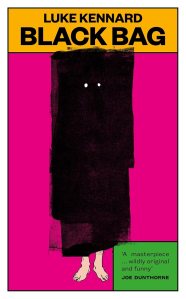 This was uproarious entertainment from the meta first line onward: “If you met anyone as whiny, as disobliging and egocentric as the average narrator of a novel in real life you’d find them unbearable.” An out-of-work actor in his late thirties who survives from one murder mystery dinner theatre gig to the next sees an ad for an unusual job. All he has to do is sit silently at the back of a university lecture hall each week, wearing a black leather bag with eyeholes. The professor is repeating a famous psychology experiment about attitudes changing through repeated exposure. For the narrator, being black bag is about freedom from his identity and inhibitions; maybe, also, finding solidarity. For his friend Claudio, who streams footage of himself gaming for a living, it’s a potential investment opportunity. For Justine, a married academic the narrator meets on campus, it’s a chance for kinky anonymous sex. I laughed out loud at the narrator’s habits of imagining his life in a 19th-century Swedish village and voicing his parents’ dog’s thoughts, and at so many random lines:
Is it not the case that for most of my life I have felt like I have just put a large crisp in my mouth during what turns out to be a quiet and pivotal scene in a play?
In the kingdom of dumb f*cks the guy with the English major is king.
Think of the moment, following the 2008 subprime crisis, when cupcakes proliferated like a cancer.
Ridiculous the plot may be, but it’s as hilarious as the novel is at the sentence level. For all that, it is still a cogent critique of modern masculinity, hypercapitalism and artificial intelligence (the scene where he and Justine go to see an AI-produced film, The Orb of Homuncules, is side-splitting). My criticism would be, as I’ve heard from various others, that the novel is overlong and slightly aimless in the second half; it could easily lose the 80 pages covering Claudio’s temporary absence. Still, when’s the last time a Booker nominee was this much pure fun? 
May We Feed the King by Rebecca Perry
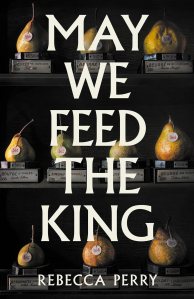 An unnamed curator arrives at a historic palace to stage its rooms with scenes of historical accuracy, tenderly rendered in the sort of detail only the most attentive visitors will register. Among other things, she’s an aficionado of high-quality, lifelike (expensive) fake food. She throws herself into the work as a way of distracting herself from the emptiness of her personal life since her partner left. We figure this out by reading between the lines, because she’s quite cagey: “At this point, certain things had happened in my life. I was ready to immerse myself.” She also finds herself unexpectedly drawn to the archivist, referred to by they/them pronouns. Her sections are in one- to two-page fragments, titled in a way that can obfuscate or signal an interpretation, such as “Peeking through a Crack in the Curtain and Seeing Another Curtain.” My favourite passage came from “All Work Is Holy”:
The rule is this: it must appear as if the person or people have just left the room. The viewer must feel as if the air is alive with their energy, that they only just missed them, that they will be back in any moment. If this isn’t the case, the scene is no more than an arrangement of objects. The scene is dead.
Indeed, the French phrase for “still life” is nature morte or dead nature. To try to bring history back to life, Perry devotes all but the first 55 and last 26 pages to a recreation of an unwilling medieval king’s court. He’s only on the throne because his two brothers died. There are rumours of infidelity concerning both him and his wife, and talk of removing him for incompetence. Soon they will all pass from life into legend.
I loved the late scene when the curator is introducing the exhibit to visitors and hears their ideas about how we know what happened in history – this is like a transcript of absolutely the best uni lecture or event Q&A ever. What gets preserved and passed down, and why? To what extent is there meaning in physical artefacts? These questions are compelling, yet I only really engaged with the contemporary storyline, while the historical pastiche felt like sub-Hilary Mantel, occasionally evocative but often edging towards pretension. 
I’d already read:
The End of Everything by M. John Harrison: A “dull, watery postapocalyptic slog [that] sheds no real light on the past, present, or future”. 
The Things We Never Say by Elizabeth Strout: About “a likeable Everyman with the same …secrets and struggles we all have.” It’s “the most engaged Strout has been with the present day, and the most specific she’s gotten about political outrages.” 
John of John by Douglas Stuart: One of my books of the year. “Cal seeks to reconcile his sexuality and artistic goals with his family’s expectations and his devout upbringing. The characters’ power plays and acts of desperation are heartrending, but mischief and love of colour and crafts lend lightness.” 
Here’s my thinking…
Masculinity is a/the theme in four of this year’s shortlisted novels (from the Kennard: “men are mostly frightened and crazy and very easily misled”) – and in last year’s winner, Flesh by David Szalay, too.
I’ve felt sure that The Disappearers or John of John would win: previous winners whose works normalize homosexuality. I would want the latter to win for its beauty and emotional power, but I think the former more likely as the judges (including Raymond Antrobus, who is British Jamaican) may have an eye on the whiteness of recent winners.
Elizabeth Strout may be doomed to be a Booker bridesmaid. I don’t think this is her best book, but I wouldn’t mind if it won.
I would actually be delighted if the Prize went to the wildcard, Black Bag. But I can’t see that happening. The same goes for the Harrison (please oh please).
Let’s say, though, that the judges want something completely different. Then perhaps May We Feed the King is it. Mary Beard (chair) and Patricia Lockwood, in particular, came across as huge fans during the shortlist announcement event.
I’m torn, so I’ll just go with the novel I loved the most: John of John by Douglas Stuart.
What’s your prediction for the winner?
Booker Prize Longlist Reads (Switzy, The End of Everything) & Shortlist Predictions
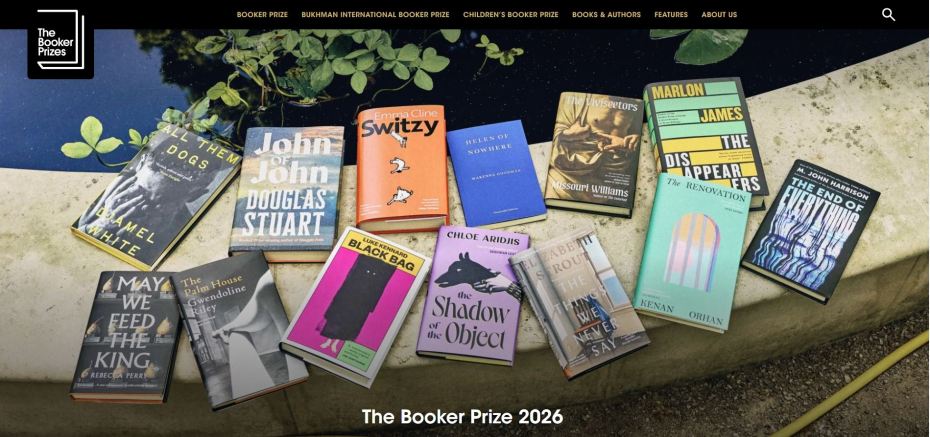
In an hour or so, the Booker Prize shortlist will be announced. I’ve now read four of the longlisted novels; I’m still awaiting a library hold of May We Feed the King by Rebecca Perry, which is the only other I’m particularly keen to read. This is the first time in four years that I’ve made much of an effort to read from the longlist, i.e., besides what I happen to have already read. I think this year’s judging panel may have something to do with it: I have read (almost) everything by Raymond Antrobus and Patricia Lockwood, and I admire Mary Beard even if I don’t know her work so well.
This pair contains unavoidably bleak stuff – dementia and preparing for an assisted death at Dignitas; weird goings-on in postapocalyptic London and Kent – but with some glints of humour. I could see the first being shortlisted but not the second.
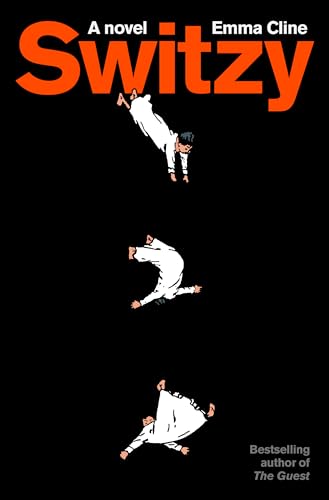
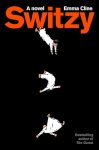
Switzy by Emma Cline
Like many, I read Cline’s debut, The Girls, but lost track of her career afterwards. I was taken aback at the subject matter of her fourth book, which sounded like fodder for a different author – an older male. I also worried that her portrait of a privileged businessman trying to make meagre amends for the wrongs from his past would be too similar to George Saunders’s subpar Vigil. But in the end she won me over with her close-third-person portrait of the last few days of an Everyman defying the inexorable course of dementia.
 David Hastings, 70, is en route to Zurich, headed to the never-named Dignitas. He’s on a private plane borrowed from a longtime associate, and has with him a personal assistant, Cody. Their first stop is London so he can see his daughter, Rebecca, and his musical prodigy grandson, Rainer, and say a sort of goodbye – although his relatives have no idea it’s the last time they’ll see him. He has one more stop to make, just over the Swiss border, to see Tom, a boarding school chum who endured hazing that David didn’t intervene to stop. Beyond the guilt, we sense that he longs to see Tom because he has always been half in love with him – a recurring homoerotic impulse never consummated. (An interesting parallel is that Rebecca is having clandestine meet-ups with a female friend. Is same-sex attraction inherited?)
Depicting the mental turmoil of a character sinking into dementia is not that ground-breaking; I’ve read a number of novels that do so with aplomb (Still Alice, Elizabeth Is Missing, Turn of Mind, The Night Guest, The Swimmers). However, Cline convincingly traces David’s bewilderment at everyday traveller experiences of hotels, restaurants and taxis. It’s no mawkish tour through disability; instead, his outsider’s view skewers the ridiculousness of modern life. I was most impressed by the way David’s internal monologue skirts lost language and gets stuck on arbitrary phrases: sayings, song lyrics, liturgy. “The quick brown fox jumps over the lazy dog”; “The hills are alive…”; “Now and at the hour of our death…”; his ex-wife’s exhortation to their little girl to “brush away the sugar bugs”; and the story of Little Nemo in Slumberland (which lends the anomalous cover image).
“Unflinching” is a reviewing cliché, but this is what people have in mind when they say it. Cline follows David right up to his last moment, taking us into the room at the clinic with him. There’s nothing special, or even very likable, about this man, but as we follow along on his final physical experiences we get a sense of the weight of any life – which can still have value even if there are no longer any words for what’s happening. I found this much more affecting than I expected to, reaching the final pages with tear-soaked cheeks. (Read via NetGalley)
Also recently reviewed by Cathy and Susan.
I’ve read and thought a lot about the topic of assisted dying, including with In Love by Amy Bloom, Intervals by Marianne Brooker, That One Patient by Ellen de Visser, The Inevitable by Katie Engelhart, and One Last Thing by Wendy Mitchell. Switzy would make a particularly good fictional counterpart to the Bloom, for those who wish to read further.
A bonus review:
A Better Death: The case for assisted dying by Jonathan Romain
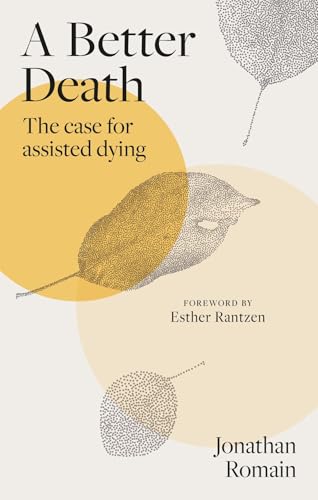 Romain is a rabbi and former chair of Dignity in Dying. In this short work, he gives a valuable history of relevant legislation in the UK and internationally, and a rundown (with rebuttals) of potential ethical objections to assisted dying. The party line of the major religions is to uphold the sanctity of life and thus oppose assisted suicide, but there are notable exceptions. Romain mentions a former archbishop of Canterbury who attends my church. George Carey changed his mind after the high-profile case of Tony Nicklinson, who was paralysed after a stroke and lost his appeal over the right to die. Pious supporters of the Campaign for Dignity in Dying emphasise the duty to be merciful to the suffering. Romain puts it this way: “From a religious perspective[,] it makes much more sense to say that we honour God most by healing someone when we can, comforting them when we cannot do so and helping them let go of life gently when desired.” Most medical bodies, too, have now reversed their official positions, with the majority voting to remain neutral on the matter. Romain characterises the campaign as a sign of humanitarian progress – like universal suffrage or the abolition of slavery – that future generations will look back on as overdue. He hopes that charismatic campaigners will arise from among the dying and their relatives. (The foreword is by TV presenter Esther Rantzen, who appealed after being diagnosed with terminal lung cancer. Just days ago, she announced she’s too fragile to travel to Dignitas.)
For me, this book offered little new because I was familiar with arguments around the issue, pro and con. However, it would be a good primer for those coming to such questions for the first time. What I did find helpful was a discussion of rituals we might develop to accompany an assisted death – a new sort of funeral that may one day be routine. Music, readings, a toast; a candle snuffed out or lit at the moment of death, and so on. Imagine a whole new category of human rite, one that should no longer be clouded in secrecy or available only to the wealthy. Alas, the latest version of the Terminally Ill Adults (End of Life) Bill was voted down by the House of Commons on 11 September, but no doubt it will be back in a new form soon.
With thanks to Reaktion Books for the free copy for review.
The End of Everything by M. John Harrison
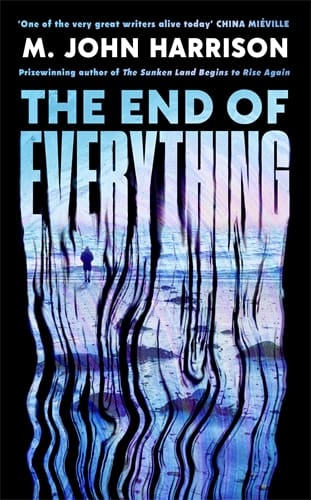 I was willing to give this a try for several reasons: it was readily available from my library (someone donated it), Harrison is lauded yet I’ve never approached his large back catalogue, and it’s novella length. Alas, those were insufficient to overcome my antipathy for vague dystopian scenarios in which characters’ actions have no clear motivations. Years post-crisis and -invasion, some people are still trying to flee Britain, but most seem content muddling along. “What were the iGhetti and where had they come from?” That’s a good question, and one to which we never get a straightforward answer, but the main hint is that they are jelly-like and arrived from elsewhere. Phillip Tennent engages in mudlarking – except some of the artefacts he discovers are amorphously humanoid and evolve human traits.
Initially it seems as if Phillip is the protagonist, but his 70-year-old painter aunt, Marnie, has more enduring importance. When she’s hounded out of her falling-down home, she shelters in an abandoned art gallery. She’s a surprising and almost admirable broad, handy with a weapon whenever she senses her way of life being threatened. There are some darkly comic outrageous happenings, and gruesome set pieces that blur the line between living and dead, human and non-. I had to wonder if there is also a Brexit allegory, given Marnie’s signs reading “HOW CAN YOU MISPLACE A CONTINENT?” Harrison’s prose is smooth and the pages turn quickly, but when I look back at the gnomic dictums I marked out, they don’t seem to mean anything:
Are we watching a film the universe is showing itself?
The world’s over. But that doesn’t matter. Because another one will be along soon enough.
Rather, significance is located in the expressions of uncertainty:
the apocalypse seemed to withhold itself, quickly becoming just another historical continuity.
There was a vigorous ambiguity to everything.
Believe all you like that at some level unavailable to you an organising principle exists. You will never have any evidence of that.
I suspect Harrison’s aim was to show how one can get used to anything, even random violence and purposeless wandering. But this watery postapocalyptic meander sheds no real light on the past, present, or future, and feels as if it should have been published more like a decade ago (at the time of The Wall by John Lanchester et al.). A couple of great scenes, such as children playing with fallen ash as if it were snow, aren’t enough to take the bitter edge off even such a short novel. I’m not tempted to try more by Harrison. (Public library) 
Also recently reviewed by Annabel.
Longlisted novels that I’d already read:
 The Things We Never Say by Elizabeth Strout: Artie Dam is a likeable Everyman with the same sorts of secrets and struggles we all have. Sometimes he thinks his marriage is going well and he’s touching his high school history students’ lives; other times he feels fatalistic about his relationships and the US’s trajectory. Along with Lucy by the Sea, this is the most engaged Strout has been with the present day, and the most specific she’s gotten about political outrages. I liked how the flash-forwards prove Artie right in his predictions (occasionally based on premonitory dreams) or confirm what he couldn’t have known about the difference he made for two particular students. In his small way, Artie is a new Stoner.
 John of John by Douglas Stuart: One of my books of the year for sure. (I reviewed it for Shelf Awareness.) Stuart’s superb third novel is set on the Isle of Harris in the 1990s. Cal seeks to reconcile his sexuality and artistic goals with his family’s expectations and his devout upbringing. An absorbing, deliciously melodramatic story is built around the contrast between modernity and the old ways. The characters’ power plays and acts of desperation are heartrending, but mischief and love of colour and crafts lend lightness. Stuart’s every observation is profound; the simplest phrase is memorable for its beauty.

Here’s my thinking about the shortlist:
Lockwood may be to thank/blame for the weirder and more niche selections (i.e. previously unknown young Americans’ second books), whereas the judges are likely to come to a consensus on more straightforward, reader-friendly material. I imagine we’ll see a shortlist dominated by women and repeat nominees.
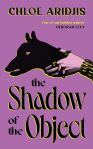
The Shadow of the Object by Chloe Aridjis – Especially with Antrobus and critic Rebecca Liu on the panel, we can expect at least two non-Anglo authors to make it through. Djamel White’s subject matter sounds neither appealing nor fresh. [Kenan Orhan is apparently Turkish American, though he looks white.] Though I’m personally not eager to read Aridjis again (after a DNF of Sea Monsters), I’m taking a gamble on this one being the second.
Switzy by Emma Cline – Edgy and powerful enough to deserve a place.
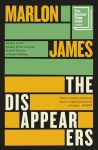
The Disappearers by Marlon James – A previous winner and a writer’s writer, though I’ve never particularly gotten on with his work.
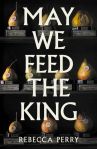
May We Feed the King by Rebecca Perry – I’ve heard almost exclusively good things.
The Things We Never Say by Elizabeth Strout – She’s getting to be a Booker bridesmaid and has been nominated for poorer books, so I hope she’ll get another shot.
John of John by Douglas Stuart – How could you not?! I’ll throw a tantrum if it doesn’t make it through.
But, of course, the judges could surprise me with a wildcard such as Black Bag by Luke Kennard; Gwendoline Riley is inexplicably popular with judging panels, too.
What have you read from the longlist? Which book(s) do you most want to read, or see on the shortlist?
 Bookish Beck = Rebecca Foster. American transplant to England. Freelance proofreader and book reviewer.

