Jacob’s Room Is Full of Books by Susan Hill
Susan Hill has published dozens of books in multiple genres, but is probably best known for her perennially popular ghost story, The Woman in Black (1983). Apart from that and two suspense novellas, the only book I’d read by her before is Howards End Is on the Landing (2009), a sort of prequel to this work. Both are bookish memoirs animated by the specific challenge to spend more time reading from her shelves and revisiting the books that have meant the most to her in the past. Though not quite a journal, this is set up chronologically and also incorporates notes on the weather, family events and travels, and natural phenomena encountered near her home in Norfolk.
The Virginia Woolf reference in the title is fitting, as Hill realizes she has four shelves’ worth of books about Woolf and her Bloomsbury set. It’s just one of many mini-collections she discovers in her library on regular “de-stocking” drives when she tries to be realistic about what, at age 75, she’s likely to reread or reference in the future. “A book that cannot be returned to again and again, and still yield fresh entertainment and insights, is only half a book,” Hill contends. Some authors who merit frequent rereading for her are Edith Wharton, Muriel Spark, W. Somerset Maugham and Olivia Manning, while other passions had a time limit: she’s gone off E.F. Benson, and no longer reads about Antarctica or medieval theology.
 Hill is unashamedly opinionated, though she at least has the humility to ask what individual taste matters. Her substantial list of no-nos includes fairy tales, science fiction, Ethan Frome, Patricia Highsmith and e-readers, and she seems strangely proud of never having read Jane Eyre. She’s ambivalent about literary festivals and especially about literary prizes: they were a boon to her as a young author, but she was also on the infamous 2011 Booker Prize judging panel, and disapproves of that prize being opened up to American entries.
As well as grumpy pronouncements, this book is full of what seems like name-dropping: encounters with Iris Murdoch, J.B. Priestley, Susan Sontag and the like. (To be fair, the stories about Murdoch and Sontag are rather lovely.) Although aspects of this book rubbed me the wrong way, I appreciated it as a meditation on how books are woven into our lives. I took note of quite a few books I want to look up, and Hill ponders intriguing questions that book clubs might like to think about: Can we ever enjoy books as purely as adults as we did as children, now that we have to “do something” with our reading (e.g. discussing or reviewing)? Is it a lesser achievement to turn one’s own life experiences into fiction than to imagine incidents out of thin air? Will an author unconsciously “catch the style” of any writer they are reading at the time of their own compositions? Is it better to come to a book blind, without having read the blurb or anything else about it?
You’ll applaud; you’ll be tempted to throw the book at the wall (this was me with the early page disparaging May Sarton). Perhaps on consecutive pages. But you certainly won’t be indifferent. And a book that provokes a reaction is a fine thing.
Some favorite lines:
“Cold room, warm bed, good book.”
“I have had fifty-five years of experience but still every book is like walking a tightrope. I might fall off.”
“People say they can never part with a book. I can. As fast as I get one out of the back door, two new ones come in through the front anyway.”
“How many people are there living in the books here? Only take the complete novels of Dickens and add up all the characters in each one and then multiply by … and I already need to lie down. Overall, there must be thousands of imaginary people sharing this house with us.”
“One of the best presents anyone can give you is the name of a writer whose books they believe will be ‘you’ – and they are. Someone you would almost certainly never have found for yourself.”
My rating:
Jacob’s Room Is Full of Books was released in the UK on October 5th. My thanks to Profile Books for the free copy for review.
Library Checkout Reboot
The Library Checkout blog meme was created by Shannon of River City Reading and previously hosted by Charleen of It’s a Portable Magic. I’m taking over as the host as of this month. There’s nothing too complicated about this challenge; it’s just a way of celebrating the libraries that you frequent, whether that’s your local public library branch or another specialist library. Maybe keeping track of your borrowing habits will encourage you to make even more use of libraries. Use ’em or lose ’em, after all.

I usually post this on the last Monday of the month, but you can post whenever is convenient for you. I’ll look into a proper link-up service, but for now just paste a link to your own post in the comments. (Feel free to use the above image, too.) The basic categories are: Library Books Read; Currently Reading; Checked Out, To Be Read; On Hold; and Returned Unread. Others I sometimes add are Skimmed Only and Returned Unfinished. I generally add in star ratings and links to reviews of any books I’ve managed to read.
A couple of weeks ago I went nuts at the university library on my husband’s campus. As a staff member he can borrow 25 books pretty much indefinitely (unless they’re requested). One or both of us has been associated with the University of Reading for over 15 years now, so the library there is a nostalgic place I love visiting. It’s technically currently undergoing a major renovation, but the books are still available, so it doesn’t make much difference to me.
LIBRARY BOOKS READ
- Interlibrary Loan Sharks and Seedy Roms: Cartoons from Libraryland by Benita L. Epstein
 (So dated, I’m afraid! A few good ones, though.)
 - Fall Down 7 Times, Get Up 8 by Naoki Higashida

- Autumn by Karl Ove Knausgaard
- A Sand County Almanac by Aldo Leopold [university library]

SKIMMED ONLY
- Option B by Sheryl Sandberg and Adam Grant
CURRENTLY READING
- Slade House by David Mitchell
- Halfway to Silence by May Sarton [poetry; university library]
CHECKED OUT, TO BE READ
A manageable selection from the public library:
Plus loads of books from lots of different genres from the university library; these will keep me going well past Christmas, I reckon!


RETURNED UNFINISHED
- The Seventh Function of Language by Laurent Binet
Have you been taking advantage of your local libraries? What appeals from my library stacks?
Making Plans (and Book Lists) for America
On Tuesday we leave for two weeks in America. It’s nearly a year and a half since our last trip – much too long – so we’ll be cramming in lots of visits with friends and family and doing a fair bit of driving around the Mid-Atlantic states. I’m giving myself the whole time off, which means I’ve been working flat out for the past two weeks to get everything done (including my U.K. and U.S. taxes). I’m nearly there: at the 11-day countdown I still had 12 books I wanted to finish and 12 reviews to write; now I’m down to five books, only one of which might be considered essential, and all the reviews are ready to submit/schedule. What with the holiday weekend underway, it should all be manageable.
I’m a compulsive list maker in general, but especially when it comes to preparing for a trip. I’ve kept adding to lists entitled “Pack for America,” “Do in America,” “Buy in America,” and “Bring back from America.” But the more fun lists to make are book-related ones: what paper books should I take to read on the plane? Which of the 315 books on my Kindle ought I to prioritize over the next two weeks? Which exclusively American books should I borrow from the public library? What secondhand books will I try to find? And which of the books in the dozens of boxes in the closet of my old bedroom will I fit in my suitcase for the trip back?
I liked the sound of Laila’s habit of taking an Anne Tyler novel on every flight. That’s just the kind of cozy reading I want, especially as I head back to Maryland – not far at all from Tyler’s home turf of Baltimore. I browsed the blurbs on a few of her paperbacks I have lying around and chose Back When We Were Grownups to be my fifth Tyler and one of my airplane reads.
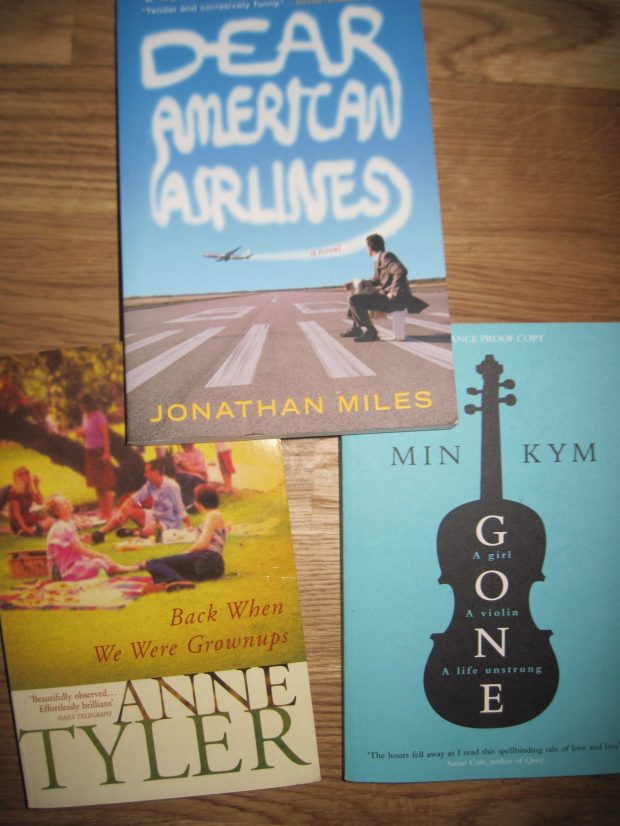
I’m also tempted by Min Kym’s Gone, a memoir by a violin virtuoso about having her Stradivarius stolen. I picked up a proof copy in a 3-for-£1 charity sale a couple of weeks ago. And then I can’t resist the aptness of Jonathan Miles’s Dear American Airlines (even though we’re actually flying on Virgin). I’ll start one or more of these before we go, just to make sure they ‘take’.
I almost certainly won’t need three print books for the trip, particularly if I take advantage of the in-flight entertainment. We only ever seem to watch films while we’re in America or en route there, so between the two legs I’ll at least try to get to La La Land and The Light between Oceans; I’m also considering Nocturnal Animals, Silence, and the live-action Beauty and the Beast – anyone seen these?
However, I’ll also keep my Kindle to hand, as I find it easier to pick up and put down on multi-part journeys like ours to the airport (train ride + coach ride). Some of the books on my Kindle priority list are: The Day that Went Missing by Richard Beard, Cork Dork by Bianca Bosker, Eleanor Oliphant Is Completely Fine by Gail Honeyman, The Fact of a Body by Alexandria Marzano-Lesnevich, Mrs. Fletcher by Tom Perrotta (out in August), The Power by Naomi Alderman, Reservoir 13 by Jon McGregor, The Rules Do Not Apply by Ariel Levy, See What I have Done by Sarah Schmidt, You Should Have Left by Daniel Kehlmann … and the list continues, but I’ll stop there.

My book shopping list is an ongoing one, as the many cross-outs and additions on this sheet show. Finding specific books at my beloved Wonder Book can be a challenge, so I usually just keep in mind the names of authors I’d like to read more by. This time that might include Arnold Bennett, Geoff Dyer, Elizabeth Hay, Bernd Heinrich, W. Somerset Maugham, Haruki Murakami and Kathleen Norris. In addition to the couple of secondhand bookstores we always hit, I hope to visit a few new-to-me ones on stays with friends in Virginia.
As for those poor books sat in boxes in the closet, I have plans to unearth novels by Anita Brookner, Mohsin Hamid, Kent Haruf, Penelope Lively, Howard Norman and Philip Roth – for reading while I’m there and/or bringing back with me. I’m also contemplating borrowing my dad’s omnibus edition of the John Updike “Rabbit” novels. From my nonfiction hoard, I fancy an Alexandra Fuller memoir, D.H. Lawrence’s travel books and more of May Sarton’s journals. If only it weren’t for luggage weight limits!
On Monday I’ll publish my intercontinental Library Checkout, on Tuesday I have a few June releases to recommend, and then I’m scheduling a handful of posts for while I’m away – a couple reviews I happen to have ready, plus some other lightweight stuff. Alas, I read no doorstoppers in May, but I have a list (of course) of potential ones for June, so will attempt to resurrect that monthly column.
Though I may be slow to respond to comments and read your blogs while I’m away, I will do my best and hope to catch up soon after I’m back.
The Folded Clock by Heidi Julavits
I keep a long list of books that I’d love to read but know are only currently available in the USA. Occasionally I manage to chip away at it through my public library borrowing during trips back to visit my family, but I’m adding more titles all the time. I was pleased, then, to learn that The Folded Clock, a book I’ve wanted to get hold of ever since it was first released in the States in 2015, was recently published in the UK.
Heidi Julavits is a founding editor of The Believer magazine as well as a novelist and an associate professor of writing at Columbia University. She lives in New York City during the academic year and spends the rest of the time in Maine, where she was born and raised. The Folded Clock is a diary of two fairly average years in her life, but its dated entries (month and day only) are not in order; they’ve been rearranged into what at times feels like an arbitrary sequence. Yet this is in keeping with the overall theme of time’s fluidity.
The title comes from her daughter’s mishearing of “folded cloth” but is apt in that it suggests time stretching and collapsing back on itself. Indeed, one reason for starting the journal was that Julavits felt time had started to pass differently from how it did in her childhood. Whereas she once thought in terms of days, she realized in her forties that she now worked in weeks and months. She was also inspired by digging out her adolescent diary – though it was not nearly as profound or revelatory about her future writing career as she might have hoped.
Every single entry begins with “Today,” reflecting a determination to live in the present. But of course, that format still offers a broad scope for memory, with certain activities and objects provoking flashbacks. For instance, she finds her ten-year-old marriage vows in the pocket of an old coat, and rereads a biography of Edie Sedgwick (from Andy Warhol’s circle, she died of a drug overdose at 28), as she periodically does to gauge how her response changes as she ages.
Julavits also situates her writing in the context of other famous diarists, such as the Goncourt brothers and Henry David Thoreau. As the latter did in Walden, she’s seeking to live deliberately, though within her regular life and without venturing into nature all that much; “I am an outdoorsman of the indoors,” she quips.
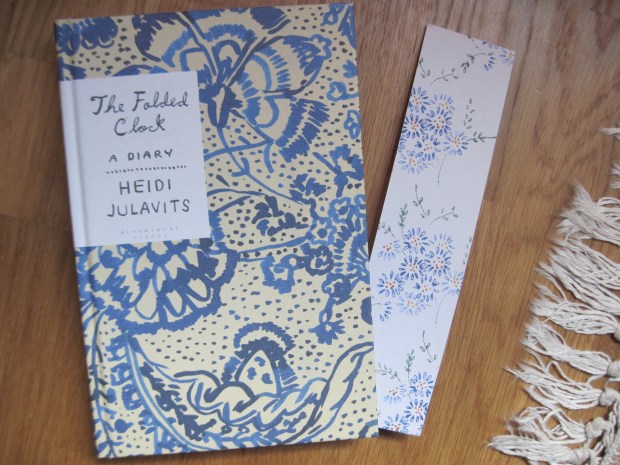
The cover design is by Leanne Shapton.
There’s a huge variety of topics here. She writes about being afraid of sharks, stealing names to use for characters in her novels, entering her small Maine town’s Fourth of July parade float competition, visiting E.B. White’s grave, mourning a tree half-lost to a hurricane, her insistence on dwelling in west-facing rooms, and regretting never telling her doctor how much she appreciated him before he died in a cycling accident. Travel features heavily, too, what with accompanying her husband to a fellowship in Germany and spending time at an art colony in Italy. Often it’s the tiny encounters and incidents that remain in her mind, though, like accidentally buying bitter apricot kernels instead of almonds at a German market and worrying that her husband might have given himself cyanide poisoning by eating 14 at once.
Some of these pieces would function well as stand-alone essays, like the one about her obsession with The Bachelor, an American reality television franchise, which leads into her belief that crushes are fostered by small spaces – she fell for her second husband (author Ben Marcus) at an arts colony even though they were both attached to other people at the time.
I was delighted to see Julavits quote the Julian Barnes passage on episodicism versus narrativism that inspired my post on that topic back in January. Unsurprisingly, Julavits sees herself as a narrativist, drawing connections between different points in her life. She’s always pondering what small incidents reveal about her character. We learn that she’s so averse to inconveniencing others that she continued a phone call while nursing a wasp sting and once planned to pee in an airsickness bag rather than wake the two sleepers between her and the aisle on a flight. She avoids yard sales because she’s so cutthroat, and she’s been known to romanticize her daily life when e-mailing a friend in London: “I probably didn’t tell the truthiest truths. I never made stuff up. But I did strive to be entertaining. Such embellishments do not constitute lies. They constitute your personality.”
In one of the pieces that stood out most for me, Julavits feels typecast as a woman of a certain age when she attends a Virginia Woolf reading. “I am of that age now where I am looking for the next age I will be. How will I dress? How will I act?” It’s a good example of how she uses these mini-essays to negotiate the stages of life and contemplate her changing roles. Elsewhere she sums up her composite identity and what she seeks from her writing:
I am a jack-of-all-trades. I edit and teach and at times desire to be a clothing designer or an artist … and I write everything but poetry and I am a mother and a social maniac and a misanthrope and a burgeoning self-help guru and a girl who wants to look pretty and a girl who wants to look sexy and a girl who wants to look girly and a woman in her middle forties who wishes not to look like anything at all, who wishes sometimes to vanish.
I sometimes think this is why I became a writer. Here was a way to regularly exercise my desire. I could desire to do this thing that no one does perfectly, and by doing it and doing it I could learn how to desire more, and better. Here was an activity that would always leave me wanting … not youth exactly, but the opposite of death. That to me is a way to always feel like I am nowhere near the end.
Inevitably, some entries are more interesting than others, and Julavits’ neuroticism may grate for some readers, but I found this book to be chock-full of quotable lines and insights into what it means to be a time-bound human being. Like one of May Sarton’s journals, I read it slowly, just a few pieces at a time over the course of weeks, and I’ll be keeping it on the shelf to flick through if I ever need an example of how to write a piercing, bite-sized fragment of autobiography. I highly recommend it.
(See also this brief Guardian interview with Julavits.)
The Folded Clock: A Diary was published by Bloomsbury Circus on March 9th. My thanks to the publisher for the free copy for review.
My rating:
Finding a Home in Nature: Singing Meadow by Peri McQuay
For 30 years Peri McQuay and her family lived in the idyllic 700-strong village of Westport in Eastern Ontario. Her husband, Barry, was the park supervisor at Foley Mountain Conservation Area, the subject of her first nature-themed memoir, The View from Foley Mountain (1995), and they lived on site amid its 800 acres. The constant push to engage in fundraising gradually made it a less pleasant place to live and work, so as Barry’s retirement neared they knew it was time to find a new home of their own. That quest is the subject of her third book, Singing Meadow: The Adventure of Creating a Country Home.
McQuay fantasized about a farmhouse surrounded by 50–100 acres of their own land, but was aware that their limited finances might not stretch to match their dreams. Long before they found their home they were buying little items for it, like an acorn door knocker that functioned as a reassuring totem object during the long, discouraging process of looking at houses. Over the course of two years, McQuay and her husband viewed more than 80 properties! Two pieces of advice they received turned out to be prescient: their loquacious real estate agent opined that “the house you end up in won’t be the one you set out to find,” and a woman in the doctor’s office waiting room counseled her, “don’t try too hard. It’ll happen when it’s time.”
 In the end, they fell in love with a plot of land with a water meadow that was home to herons and beavers. With no handyman skills, they never thought they’d embark on building a home of their own. And as it turned out, finding the land was the easy bit, as opposed to the nitty-gritty details of designing what they wanted and meeting with builders who could make it a reality. But as they planted trees and looked ahead to their move in a year’s time, they were already forming a relationship with this place before the house was ever built, learning “the hard lessons of patience and possibility.”
Woven through the book are short flashbacks to other challenging times in McQuay’s life: having chronic fatigue syndrome in her 40s, her mother’s death a few years earlier, and a terrible ice storm at the park that left them without power for 17 days and caused damage to the forest that it might take 30 years to recover from. What all of these situations, as well as looking for a home, have in common is that they forced the author to take the long view, recognizing the healing effects of time rather than the tantalizing option of quick fixes.
I’ve never owned a home, but I’ve lived in 10 properties in the last 10 years. A lot of that nomadism has been foisted upon us rather than chosen, so I could relate to McQuay’s frustration throughout the property search, as well as her feelings of being uprooted – that “the very stuff of my life was being dismantled.” I can also see the wisdom of choosing the place that feeds your soul rather than the one that seems most convenient. She remembers one of the first properties she and Barry rented as a married couple: it was an old place with an outhouse and no running hot water, but they filled it with laughter and music and felt at peace there. It was infinitely better than any soulless town apartment they might have resorted to.
The book ends with a bit of a shocker, one of two moments that brought a lump to my throat. It’s a surprisingly bittersweet turn after what’s gone before, but it’s realistic and serves as a reminder that life is an ongoing story with sad moments we can’t prepare for.
Overall, this memoir reminds me most of Michael Pollan’s A Place of My Own (which appears in McQuay’s bibliography) and May Sarton’s journals, in which the search for a long-term home in Maine is a major element. Although this will appeal to people who like reading about women’s lives and transitions, I would particularly recommend it to readers of nature writing as the book is full of lovely passages like these:
It was bliss visiting the trees and caring for them. Each one was precious. Across the meadow I could see the black, white and yellow nesting bobolink plus an unidentifiable bird with a square seed-eating beak perched on a cattail. A crow flew by, checking to see what I was doing, then a blue jay. In the distance the newly returned yellow warbler was calling “witchetty witchetty.” Over and over, I needed to keep saying that I felt deep down, richly happy in the meadow. In the glassy eye of the pond, water was burbling up in such a powerful spilling-over that it chuckled musically. Indeed, while there was such a flow only the boldest, largest minnows could swim strongly enough to approach the rushing source.
Now I was walking slowly down to the water meadow, hearing the strange, quarrelsome-sounding talk of herons beginning another season here. I was teaching myself how to be aware every moment of every step so I could keep walking longer on this rough land. With any luck, this beloved place would be my last home. And, after the unignorable message of recent fierce summers, I was here to bear witness, to stand with the great maples, beeches, and oaks through whatever might come, to accompany with whatever grace I could for as long as I could sustain it. Living here, this was who I wanted to be—an old woman vanishing into the light.
I’m keen to get hold of McQuay’s other two books as well. Her work makes for very pleasant, meditative reading.
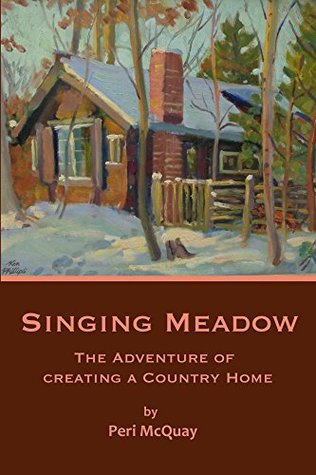
Note: The front cover is an oil painting of Peri’s childhood home by her artist father, Ken Phillips.
Singing Meadow: The Adventure of Creating a Country Home was published by Wintergreen Studios Press in 2016. My thanks to the author for sending a PDF copy for review.
My rating: 
Marginalia, Bookmarks, Etc. Found in Books
 In two of the books I currently have on the go, items found in books are a key element. First there’s Swimming Lessons in Claire Fuller, in which one strand of the narrative is told via a series of letters Ingrid hid in various thematically relevant books from her husband’s overflowing collection before she disappeared 12 years ago.
I’ve also been skimming Reading Allowed, novelist Chris Paling’s book of mildly amusing anecdotes from his time working in a public library. As little interludes he records the items he’s found being used as bookmarks in library volumes: a postcard, a shopping list, a meal plan, a CV, and so on.
In my years working in bookshops and libraries I found lots of proper bookmarks left behind in books; this photo shows the ones I’ve kept (others I’ve given away, recycled or donated to the library basket).

This doesn’t account for all the train tickets, receipts, newspaper clippings, etc. that were serving as makeshift bookmarks. The strangest thing I think I ever found in a book was an old-fashioned faux pearl-topped hatpin marking a place in a copy of Elizabeth Barrett Browning’s collected poems.
And then there are the written messages I’ve found in books: other people’s bookplates (I especially like the one that appears in the front of each volume of my 1919 Chapman & Hall set of the complete works of Dickens – such an enviable reward for good attendance!);


a heartfelt message of friendship in the copy of May Sarton’s The Fur Person I got free from Book Thing of Baltimore;

a young lady’s thoughts strewn across the selected poems of Ted Hughes;

and a dead-simple recipe for a tropical fruit drink pencilled on the back cover of Patricia Volk’s memoir, Stuffed.

For me, the random objects and messages you might find are all part of the fun of buying secondhand books.
What’s the strangest thing you’ve ever found in a secondhand book?
Novellas in November
Taking a lead from Laura over at Reading in Bed, I’ve trawled my shelves and my current library pile for some blissfully short books. For this challenge I limited myself to books with fewer than 150 pages and came up with four fiction books and two ‘nonfiction novellas’.
The Library of Unrequited Love by Sophie Divry
[92 pages]
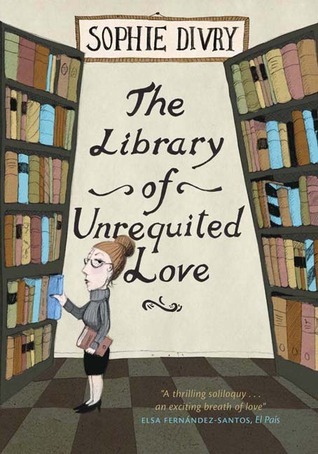 This one-sitting read is a monologue by an embittered librarian who arrives one morning to discover a patron has been locked into the basement overnight—a captive audience. Responsible for Geography, she hopes for a promotion to History, her favorite subject. Alas, no one seems to appreciate this library as a bastion of learning anymore; they only come for DVDs and a place to keep warm. That is, except for Martin, a young PhD researcher who’s caught her eye. But he doesn’t even seem to notice she exists. In one uninterrupted paragraph, this celebrates all that books do for us but suggests that they still can’t fix a broken heart.
My verdict: There are lots of great one-liners about the value of books (“You’re never alone if you live surrounded by books”), but overall it’s a somewhat aimless little experiment and not particularly well translated.
The All of It by Jeannette Haien
[145 pages]
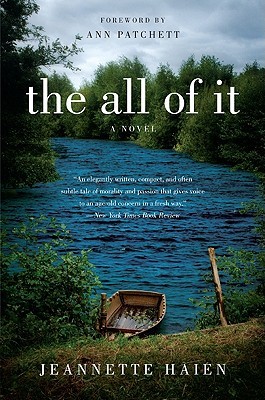 When this won the Sue Kaufman Prize for First Fiction in 1987, the author was in her sixties. It’s since been championed by Ann Patchett, who contributed a Foreword to this 2011 edition. Father Declan de Loughry, fishing for salmon, reflects on the recent death of parishioner Kevin Dennehy. Before he died, Kevin admitted that he and Enda were never properly married. Yet Enda begs the priest to approve a death notice calling Kevin her “beloved husband,” promising she’ll then explain “the all of it” – the very good reason they never married. As she tells her full story, which occupies the bulk of the novella, Father Declan tries to strike a balance between the moral high ground and human compassion.
My verdict: Enda’s initial confession on page 27 is explosive, but the rest of this quiet book doesn’t ever live up to it. I was reminded of Mary Costello’s Academy Street, a more successful short book about an Irish life.
Favorite passage: “One thing I’ve learned, Father—that in this life it’s best to keep the then and the now and the what’s-to-be as close together in your thoughts as you can. It’s when you let gaps creep in, when you separate out the intervals and dwell on them, that you can’t bear the sorrow.”
Thirteen Ways of Looking by Colum McCann
[143 pages]
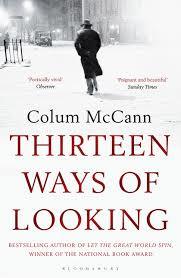 This starts off as the simple story of J. Mendelssohn, an octogenarian who wakes up on a snowy morning in his New York City apartment, contemplating his past – Lithuanian/Polish ancestry, work as a judge and marriage to Eileen, whom he met as a boy in Dublin – and planning to meet his son at a restaurant for lunch. But all of a sudden it turns into a murder mystery on page 24: “Later the homicide detectives will be surprised…” In 13 sections headed by epigraphs from the Wallace Stevens poem “Thirteen Ways of Looking at a Blackbird,” McCann flits through Mendelssohn’s thoughts and flips between the events preceding and immediately following the murder. A late interrogation scene is particularly strong – “unlike our poetry, we like our murders to be fully solved.”
My verdict: This is the first I’ve read from McCann, and it’s terrific. He stuffs so much plot and characterization into not many pages. Mendelssohn’s thought life is rich with allusions and wordplay. I was particularly intrigued to read about the autobiographical overlap in the Author’s Note. I haven’t yet read the short stories included in the volume, but for the novella on its own it’s  .
.
As We Are Now by May Sarton
[134 pages]
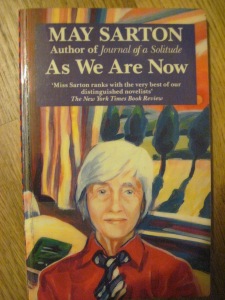 On the surface this is similar to a novel I reviewed earlier in the month, The Secret Diary of Hendrik Groen, 83¼ Years Old. But where spunky Hendrik determines to outwit his care home’s sullen staff, Sarton’s narrator, seventy-six-year-old Caroline Spencer, has given in. A retired high school math teacher, she’s landed in a New England old folks’ home because during her recovery from a heart attack she failed to get along with her brother’s younger wife. She finds kindred spirits in Standish Flint, a tough old farmer, and Reverend Thornhill, but her growing confusion and the home’s pretty appalling conditions drive her to despair.
My verdict: This is enjoyable for the unreliable narrator and the twist ending, but overall it struck me as rather melodramatic. However, I appreciated a lot of Caro’s sentiments.
Favorite passages: “Am I senile, I wonder? The trouble is that old age is not interesting until one gets there, a foreign country with an unknown language to the young, and even to the middle-aged. I wish now that I had found out more about it.” & “And what is left of you? A lapis lazuli pin, a faded rose petal, once pink, slipped into the pages of this copybook.”
And two short works of nonfiction:
Excerpts from a Family Medical Dictionary by Rebecca Brown
[113 pages]
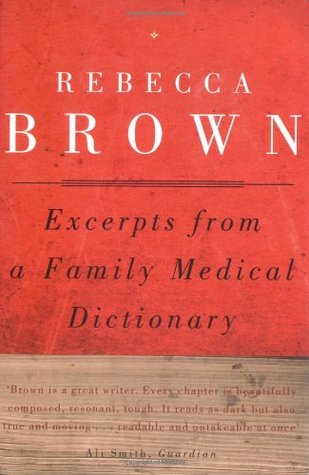 Brown is a novelist from Seattle. This is an account of her mother’s death from what sounds like stomach cancer. The disease progressed quickly and her mother died at home, under hospice care, in New Mexico in 1997. As the title suggests, the brief thematic chapters are arranged around vocabulary words like “anemia” and “metastasis.” My favorite chapters were about washing: her mother’s habit of reading while taking long baths, and the ways Brown and her sister tried to care for their mother’s disintegrating body, including a plan to prepare the corpse themselves. Clinical descriptions of vomiting alternate with magical thinking to accompany her mother’s hallucinations: “You’re packed, Mom, but all of us aren’t going, just you. But you’ve got everything you need.”
My verdict: Brown covers a lot of emotional ground in a very few pages, but I prefer my medical/bereavement memoirs to have more of a narrative and more detail than “when she died it was not peacefully or easy, it was hard.”
Ruined by Reading: A Life in Books by Lynne Sharon Schwartz
[119 pages]
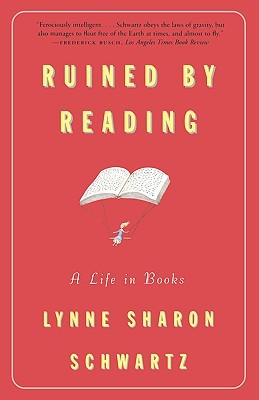 This 1996 memoir was sparked by reading a quote from a Chinese Buddhist in a New York Times article: he suggested that reading is dangerous as it imposes others’ ideas on you and doesn’t allow you to use your own mind freely. Schwartz, of course, begs to differ. As a novelist, reading has been her lifeline. She looks back at her childhood reading and her pretentious college student opinions on Franz Kafka and Henry James, and explains that she lets serendipity guide her reading choices nowadays, rather than a strict TBR list: “reading at random – letting desire lead – feels like the most faithful kind.”
My verdict: It’s a bibliomemoir; I should have loved it. Instead I thought it unstructured and thin. There are some great lines dotted through, but I wasn’t very interested in the examples she focuses on. Five pages about a children’s book by Eleanor Farjeon? Yawn! 
Favorite passages: “Like the bodies of dancers or athletes, the minds of readers are genuinely happy and self-possessed only when cavorting around, doing their stretches and leaps and jumps to the tune of words.” & “How are we to spend our lives, anyway? That is the real question. We read to seek the answer, and the search itself – the task of a lifetime – becomes the answer.”
Have you read any of these? Which one takes your fancy?
How do you feel about novellas in general?
A Nonfiction Bonanza
For much much of the summer I was sunk deep into several very good but not particularly page-turning works of nonfiction from my shelves. I spent months reading some of them, which is very unusual for me and often a sign that I’m not enjoying something, but this time that wasn’t the case. One of these nonfiction reads – the Fermor – ended up being among my favorite books of the year so far. Below I give quick write-ups of what I’ve finished lately and recall how these books came to be in my collection.
 Lincoln: A Foreigner’s Quest by Jan Morris: Like grape jelly, the obsession with Abraham Lincoln was something about American life that world traveler Jan Morris could never understand. Here she sets out to discover the melange of history and myth that composes the 16th president. She succeeds in giving not only the salient facts of Lincoln’s life but also a fair assessment of his character, in a lighthearted and accessible book that has neither the heft nor the heavygoing tone of a standard biography. Her discussion of his rhetorical style is especially good, and in a few passages she imagines the reader into scenes. Here’s one of the best pithy observations: “Academic historians cannot allow themselves such flip idiomatic judgments, but to an outsider like me that seems about the truth of it. He was a nice man. He could be scheming, irritable, disingenuous, but he was never pompous or overbearing.” [Remainder copy bought for $3.99 at Wonder Book and Video, Frederick, Maryland.]
 The Omnivore’s Dilemma by Michael Pollan: I made the mistake of reading this a decade after its publication, which means I already knew most of its facts about industrialized farming and the insidiousness of processed foods. I found Part I to be overly detailed and one-note, constantly harping on about corn. The book gets better as it goes on, though, with Pollan doing field research at Joel Salatin’s Polyface Farm in Virginia to compare large-scale organic agriculture with more sustainable grassroots operations. Pollan’s assessment of the ethics of eating meat is not quite as thorough as Jonathan Safran Foer’s (in Eating Animals), but he does a good job of showing all sides of the issue. This would make an excellent, comprehensive introduction to where food comes from for people who have never given it much thought. But then again, the people who need it most would never pick up a dense 400+-page book by a liberal journalist. [Bought in one of the Hay-on-Wye shops for £2.]
 The Naming of the Shrew by John Wright: Wright is known in the UK as TV chef Hugh Fearnley-Whittingstall’s go-to expert on foraging, especially fungi. His enthusiasm for the arcane details of Latin naming comes through clearly in this thorough history of taxonomy. At first I thought it would be a groaningly pun-filled book of arbitrarily arranged trivia, but by Chapter 2 Wright won me over. You’ll learn all about Carl Linnaeus and the taxonomists who preceded and followed him; rules for species naming and the meaning of common Latin prefixes and suffixes; the wildly divergent sources of names, from discoverers’ names to mythology; and the endless complications of a field where species are always being lumped, split, or re-evaluated. One of my favorite facts was that aloe vera and the boa constrictor are among the few species whose English names are the same as their Latin ones. [A birthday gift from my brother-in-law last year.]
 A Time of Gifts by Patrick Leigh Fermor: A true masterwork of travel writing. Over the course of three years, starting when he was just 18, Fermor walked from Holland to Constantinople. I was particularly eager to read this because he passes through a lot of places I went on my travels this past summer, including Germany, Austria and Bratislava. This first of three volumes covers up until his entry into Hungary. His descriptions of the landscape and the people he interacted with are as fresh as if they happened yesterday, and yet he was reconstructing this journey nearly 40 years after the fact. Although he was basically traveling rough, he managed to wangle invitations into castles and aristocrats’ homes. This gives him a broad base of observation such that you feel you’re getting a complete picture of European life in the early 1930s. It’s a precious glimpse of pre-war history, but Fermor doesn’t use too heavy a hand when recalling signs of rising Nazism. Lastly, this is simply damn fine writing:
Beer, caraway seed, beeswax, coffee, pine-logs and melting snow combined with the smoke of thick, short cigars in a benign aroma across which every so often the ghost of sauerkraut would float.
The Romanesque nave was packed and an anthem of great choral splendour rose from the gothic choir stalls, while the cauliflowering incense followed the plainsong across the slopes of the sunbeams.
When no buildings were in sight, I was back in the Dark Ages. But the moment a farmhouse or a village impinged, I was in the world of Peter Brueghel.
[Bought for £1 from a secondhand bookstore in Henley-on-Thames.] 
 The House by the Sea by May Sarton: This is the sixth of Sarton’s journals I’ve read. It covers 1975–6, when she was 63–4 and in her second year in Maine. Her health is not yet a worry, at least as compared to later journals, but there is a faint sense of diminished abilities and an awareness of death’s approach. Poetry has run dry for her, but in the course of writing this journal she publishes a series of biographical reflections and prepares to begin a new novel. Tamas the dog and Bramble the cat are faithful companions. Her former lover, Judy, suffers from dementia and visits with her are mostly painful reminders of what has been lost. These journals are not the place to turn if you want momentous events. Rather, read them for deep insight into a writer’s psyche, meditations on the benefits of solitude, and affirmation of the quiet joys of gardening and an ocean view. [Bought from a library book sale in America for 50 cents.]
What are some of the best nonfiction books you’ve read recently?
Five Books about Cats
I always used to be more of a dog person than a cat person, even though we had both while I was growing up, but now I’m a dedicated cat owner and have tried out some related reading. You’ll notice I don’t rate any of these five books about cats particularly highly, whereas there have been a number of dog books I’ve given 4 stars (Dog Years by Mark Doty, Ordinary Dogs by Eileen Battersby, A Dog’s Life by Peter Mayle; even books that aren’t necessarily about dogs but reference life with them, like A Three Dog Life by Abigail Thomas and Travels with Charley by John Steinbeck). What’s with that? Maybe dog lovers don’t have to worry so much about striking a balance between a pet’s standoffishness and affection. Maybe dogs play a larger role in everyday human life and leave a more gaping hole when they shuffle off the canine coil. Still, I enjoyed aspects of or specific passages from each of the following.
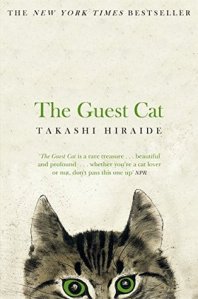 The Guest Cat by Takashi Hiraide
As a cat-loving freelance writer who aspires to read more literature in translation, I thought from the blurb that this book could not be more perfect for me. I bought it in a charity shop one afternoon and started reading right away. It’s only 140 pages, so I finished within 24 hours, but felt at a distance from the story the whole time. Part of it might be the translation – the translator’s notes at the end explain some useful context about the late 1980s setting, but also conflate the narrator and the author in such a way that the book seems like an artless memoir rather than a novella. But the more basic problem for me is that there’s simply not enough about the cat. There’s plenty of architectural detail about the guesthouse the narrator and his wife rent on the grounds of a mansion, plenty of economic detail about the housing market…but the cat just doesn’t make enough of an impression. I’m at a bit of a loss to explain why this has been such a bestseller. Quite the disappointment.
My rating: 
 The Fur Person by May Sarton
I’m a huge fan of May Sarton’s journals – in which various cats play supporting roles – so for a while I’d been hoping to come across a copy of this little novelty book from 1957, a childish fable about a tomcat who transforms from a malnourished Cat-About-Town to a spoiled Gentleman Cat. Luckily I managed to find a copy of this one plus the Lessing (see below) in the Nature section at Book Thing of Baltimore. In a preface to the 1978 edition Sarton reveals that Tom Jones was, indeed, a real cat, a stray she and her partner Judy Matlack adopted when they lived in Cambridge, Massachusetts. Wonderful coincidence: when they were on sabbatical in the early 1950s, they sublet the place to the Nabokovs, who looked after Tom while they were away!
 I found this a bit lightweight overall, and the whole idea of a ‘fur person’ is a little strange – don’t we love cats precisely because they’re not people? Still, I enjoyed the proud cat’s Ten Commandments (e.g. “II. A Gentleman Cat allows no constraint of his person … III. A Gentleman Cat does not mew except in extremity”) and spotted my own domestic situation in this description: “while she [‘Gentle Voice’ = Judy] was away the other housekeeper [= Sarton] was sometimes quite absent-minded and even forgot his lunch once or twice because she sat for hours and hours in front of a typewriter, tapping out messages with her fingers.” The black-and-white illustrations by David Canright are a highlight.
My rating: 
 Particularly Cats…And Rufus by Doris Lessing
A book about cats that I would almost hesitate to recommend to cat lovers: it contains many a scene of kitty carnage, as well as some unenlightened resistance to spaying and neutering. Lessing grew up on a farm in Zimbabwe that was at one point overrun with about 40 cats. Her mother went away, expecting her father to have ‘taken care of them’ by the time she got back. He tried chloroform to start with, but it was too slow and ineffective; in the end he rounded them all up in a room and got out his WWI revolver. And that’s not the end of it; even into her adulthood in England Lessing balked at taking female cats in for surgery so would find occasionally herself saddled with unwanted litters of kittens that they decided had to be drowned. It’s really a remarkably unsentimental record of her dealings with cats.
That’s not to say there weren’t some cats she willingly and lovingly kept as pets, particularly a pair of rival females known simply as “black cat” and “grey cat,” and later a stray named Rufus who adopted her. But even with cherished felines she comes across as tough: “Anyway, she had to be killed and I decided that to keep cats in London was a mistake” or “I smacked grey cat” for bullying the black one. The very fact of not giving the pair names certainly quashes any notion of her as some cuddly cat lady. All the same, she was a dutiful nurse when black cat and Rufus fell ill. The book ends on a repentant note: “Knowing cats, a lifetime of cats, what is left is a sediment of sorrow quite different from that due to humans: compounded of pain for their helplessness, of guilt on behalf of us all.”
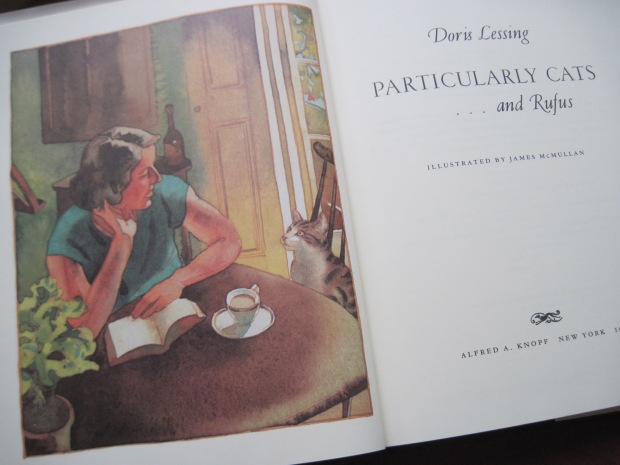
My favorite thing about the book is the watercolor illustrations by James McMullan.
My rating:
 The Unadulterated Cat: A Campaign for Real Cats by Terry Pratchett
Like Douglas Adams or Monty Python, Terry Pratchett is, alas, a representative of the kind of British humor I just don’t get. But I rather enjoyed this small novelty book (bought for my husband for Christmas) all the same. For Pratchett, a “Real” cat is a non-pampered, tough-as-nails outdoor creature that hunts and generally does its own thing but also knows how to wrap its human servants around its paws. I like his idea of “cat chess” as a neighborhood-wide feline game of strategy, moving between carefully selected vantage points to keep an eye on the whole road yet avoid confrontation with other cats. It’s certainly true on our street. And this is quite a good summary of what cats do and why we put up with them:
What other animal gets fed, not because it’s useful, or guards the house, or sings, but because when it does get fed it looks pleased? And purrs. The purr is very important. It’s the purr that makes up for the Things Under the Bed, the occasional pungency, the 4 a.m. yowl.
My rating:
 On Cats by Charles Bukowski
“In my next life I want to be a cat. To sleep 20 hours a day and wait to be fed. To sit around licking my ass.” I’d never read anything else by Bukowski, so I wasn’t sure quite what to expect from this book, which is mostly composed of previously unpublished poems and short prose pieces about the author’s multiple cats. The tone is an odd mixture of gruff and sentimental. Make no mistake: his cats were all Real cats, in line with the Pratchett model. A white Manx cat, for instance, had been shot, run over, and had his tail cut off. Another was named Butch Van Gogh Artaud Bukowski. You wouldn’t mess with a cat with a macho name like that, would you? My favorite passage is from “War Surplus,” about an exchange he and his wife had with a store clerk:
“what will the cats do if there is an explosion?”
“lady, cats are different than we are, they are of a lower order.”
“I think cats are better than we are,” I said.
the clerk looked at me. “we don’t have gas masks for cats.”
My rating:
Is there a terrific cat book out there that I haven’t read yet? I do hope so! Please add your suggestions in the comments.
Reviews Roundup, October–November
One of my goals with this blog is to have one convenient place where I can gather together all my writing that has appeared in disparate online locations. To that end, once a month I provide links to all book reviews I’ve published elsewhere, with a rating (below each description) and a taster so you can decide whether to read more. A few exceptions: I won’t point out my Kirkus Indie, BlueInk or Publishers Weekly reviews since I don’t get a byline.
This month you may recognize a few books I already previewed in my posts on books as beautiful objects and library books read in October.
The Bookbag
Charlotte Brontë’s Secret Love by Jolien Janzing: Charlotte and Emily Brontë’s time in Belgium – specifically, Charlotte’s passion for her teacher, Constantin Heger – is the basis for this historical novel. The authoritative yet inviting narration is a highlight, but some readers may be uncomfortable with the erotic portrayal; it doesn’t seem to fit the historical record, which suggests an unrequited love affair. My other issue with the book is a couple of subplots that only seem to have minor significance.

In Fidelity by Jack Wilson: In this 1970s-set novel, the central couple’s relationship is tested by illness and extramarital sexual experiences. Moving from New England to Nigeria and back, the story asks what loyalty really requires when a once-strong connection has faded over time. Strongly reminiscent of John Updike in Part One, this is the male view of adultery. Something about the self-justifying tone stuck in my craw. A more balanced book would give the wife’s perspective, too, as Carol Shields did in Happenstance, or like Lauren Groff recently did to great success in Fates and Furies.

BookBrowse
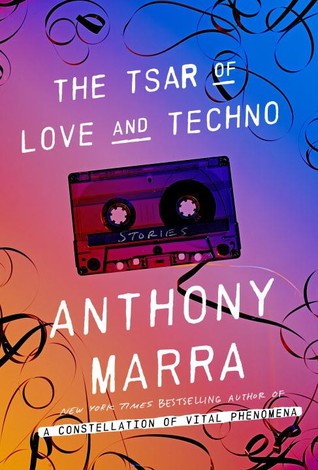 The Tsar of Love and Techno by Anthony Marra [subscription service]: This collection of tightly linked short stories, an intimate look at Russia and Chechnya in wartime and afterwards, reveals how politics, family, and art intertwine. Ranging from 1937 to 2013, the pieces show how fear and propaganda linger in the post-Stalinist era. In art as much as in politics, it can be difficult to distinguish airbrushed history from bitter reality. Just as he did in his excellent debut novel, A Constellation of Vital Phenomena, Marra renders unspeakable tragedies bearable because of his warm and witty writing. All his characters’ voices are well-realized and inviting, and he comes up with terrific one-liners.

BookTrib
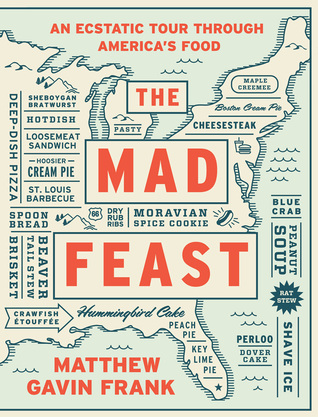 Mad Feast by Matthew Gavin Frank: This is the cookbook David Foster Wallace might have written. In an off-the-wall blend of memoir, travel, history and fiction, Frank proceeds region by region, choosing for each American state one beloved dish and interrogating its origins as well as its metaphors and associations. It’s a mixed bag of familiar foods and ones that only locals are likely to know about. Each chapter ends with a recipe for the signature plate, whether from a Lutheran church or a posh restaurant. Frank’s digressive, anecdotal approach takes some getting used to. If you appreciate the style of writers like Geoff Dyer, Maggie Nelson and Will Self, this should be your next food-themed read.
For Books’ Sake
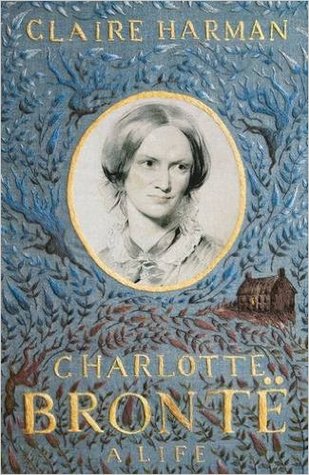 Charlotte Brontë: A Life by Claire Harman: With her bicentennial approaching in April 2016, it’s the perfect time to revisit Charlotte Brontë’s timeless stories. One of the things Harman’s biography does best is trace how the Brontës’ childhood experiences found later expression in fiction. A chapter on the publication of Jane Eyre is a highlight. Diehard fans might not encounter lots of new material, but Harman does make a revelation concerning Charlotte’s cause of death – not TB, as previously believed, but hyperemesis gravidarum (extreme morning sickness). This will help you appreciate afresh a “poet of suffering” whose novels were “all the more subversive because of [their] surface conventionality.”

Cockfosters by Helen Simpson: Simpson’s sixth story collection is full of wry, incisive reflections on aging, loss, regrets, gender roles, and a changing relationship to sex. Most of Simpson’s characters are in their late forties, a liminal time when they’re caught between older parents and still-needy children. Many pieces are dialogue-driven, like scenes in plays. In “Kentish Town,” book club members meet to discuss Dickens’s The Chimes. Simpson weaves in discussion of the plot with commentary on the state of the nation as the ladies set the world to rights and make New Year’s resolutions. It’s a perfect story to read in the run-up to Christmas. The overall stand-out is “Erewhon,” named for Samuel Butler’s 1872 satirical utopian novel. It quickly becomes clear that gender roles are reversed in its fictional world.
Foreword Reviews
 Addiction Is Addiction by Raju Hajela, Paige Abbott and Sue Newton: This comprehensive, well-organized guide discusses the features of addictive thinking and feeling, suggests holistic recovery methods, and offers useful definitions, diagrams, and case studies. The authors are affiliated with Health Upwardly Mobile Inc., Calgary, Alberta. Tracing the history of addiction back to the eighteenth century, when it was first known as “alcoholic disease syndrome,” they present an expert view of the disease’s symptoms and outlook. Strongly recommended to those who have participated in groups like Alcoholics Anonymous or Narcotics Anonymous.
Kirkus
Indie Spotlight: Books about Religion: Self-publishing allows writers to tell their full stories. An article based on interviews with four indie religion authors and mini-reviews of their books.
Nudge
Notes on Suicide by Simon Critchley: Critchley is a philosophy professor at New York’s New School for Social Research. Although he reassures readers with his first line that “This book is not a suicide note,” he also hints that its writing was inspired by personal trouble: “my life has dissolved over the past year or so, like sugar in hot tea.” Not suicidal himself, then, but sympathetic to those who are driven to self-murder. This concise essay illuminates arguments surrounding suicide, with points of reference ranging from Greek philosophers to Robin Williams. Overall, though, it feels cursory and inconclusive.
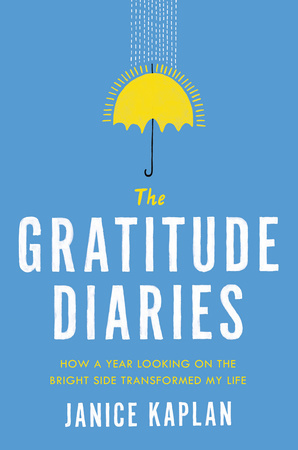 The Gratitude Diaries by Janice Kaplan: We can all do with a little encouragement to appreciate what we already have. In so many areas of life – finances, career, relationship, even the weather – we’re all too often hoping for more or better than what we are currently experiencing. Here Kaplan undertakes a year-long experiment to see if gratitude can improve every aspect of her life. She draws her information from interviews with researchers and celebrities, quotes from philosophers, and anecdotes from her own and friends’ lives. It’s easy, pleasant reading I’d recommend to fans of Gretchen Rubin.
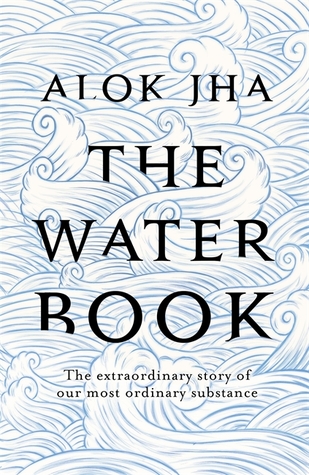 The Water Book by Alok Jha: An interdisciplinary look at water’s remarkable properties and necessity for life on earth. For the most part, Jha pitches his work at an appropriate level. However, if it’s been a while since you studied chemistry at school, you may struggle. Part IV, on the search for water in space, is too in-depth for popular science and tediously long. In December 2013 Jha was part of a month-long Antarctic expedition. He uses the trip as an effective framing device, but I would have liked more memoiristic passages. All in all, I was hoping for less hard science and more reflection on water’s importance to human culture.
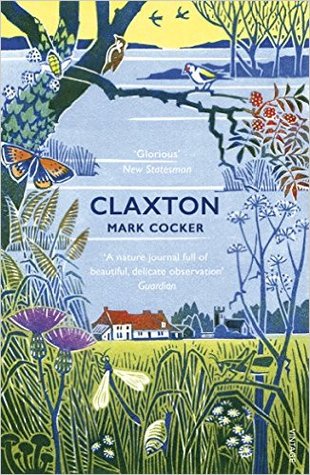 Claxton: Field Notes from a Small Planet by Mark Cocker: Mark Cocker is the Guardian’s country diarist for Norfolk. The short pieces in this book are reprints of his columns, some expanded or revised. I would advise keeping this as a bedside or coffee table book from which you read no more than one or two entries a week, so that you always stay in chronological sync. You’ll appreciate the book most if you experience nature along with Cocker, rather than reading from front cover to back in a few sittings. The problem with the latter approach is that there is inevitable repetition of topics across years. All told, after spending a vicarious year in Claxton, you’ll agree: “How miraculous that we are all here, now, in this one small place.”
 A Mile Down by David Vann: Vann, better known for fiction, tells the real-life story of his ill-fated journeys at sea. He hired a Turkish crew to build him a boat of his own, and before long shoddy workmanship, language difficulties, bureaucracy, and debts started to make it all seem like a very bad idea. Was he cursed? Would he follow his father into suicide? The day-to-day details of boat-building and sailing can be tedious, and there’s an angry tone that’s unpleasant; Vann seems to think everybody else was incompetent or a crook. However, he does an incredible job of narrating two climactic storms he sailed through.
Wasafiri
The Triumph of the Snake Goddess by Kaiser Haq: Beginning with the creation of the world and telling climactic tales of the snake goddess Manasa’s interactions with humans, Haq crafts a uniquely playful set of sacred stories that bear striking similarities to those from other religious traditions. Like Greek myths, the Manasa stories are full of shape-shifting and mistaken identity; rape and incest; jealousy and revenge; and over-the-top exploits of warring gods. She even wears snakes in her hair, like Medusa. Many parallels can also be drawn with the Hebrew and Christian scriptures. Haq’s rendering of the creation account, in particular, resembles the language of Genesis. This book will appeal to students of comparative religion, but can be read with equal enjoyment by laymen in search of engaging storytelling.
I also post reviews of most of my casual reading and skimming on Goodreads.
Mrs. Stevens Hears the Mermaids Singing by May Sarton: Although I’m a huge fan of Sarton’s memoirs, this was my first taste of her fiction. I was underwhelmed: it’s slight and strangely unfeminist. Part of the problem may be that I know so much about Sarton that I couldn’t help but see all the autobiographical detail here. Most of the novel’s action takes place in one day, as Mrs. Stevens awaits the arrival of two interviewers and reflects on past love affairs (some with women) and the meaning of the Muse. For me, Sarton’s journals are a better source of deep thoughts on the writer’s vocation, the value of solitude and the memory of love. This was seen as Sarton’s coming-out book, although it’s not at all sexually explicit.
 Running on the March Wind by Lenore Keeshig: Keeshig is a First Nations Canadian; these poems are full of images of Nanabush the Trickster, language from legal Indian acts, and sly subversion of stereotypes – cowboys and Indians, the only good Indian is a dead Indian (in “Making New”), the white man’s burden, and so on. In places I found these more repetitive and polemical than musical, though I did especially like the series of poems on trees.
The Cartographer Tries to Map a Way to Zion by Kei Miller: Kei Miller is a Jamaican writer who uses island patois and slang, and Rastafarian images and language, alongside standard English. Here he sets up (especially with the long, multi-part title poem) a playful contrast between the cartographer, emblem of civilization and unbiased science, and the rastaman, who takes an altogether more laidback approach to mapping his homeland. This was the perfect poetry collection to be reading in tandem with A Brief History of Seven Killings (see below).
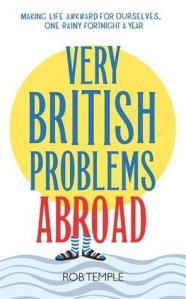 Very British Problems Abroad by Rob Temple: This is possibly ever so slightly funnier than the original (Very British Problems). A lot of it rings true. Once again the fact that the book originated as tweets means you can’t read too much of it at a time or the one-liners grow tiresome. A couple of my favorites were: “The feeling of dread as you approach the campsite and only then remembering that last year you said you’d never, ever do this again” and “Noticing an avalanche heading your way and hoping your umbrella’s up to the job.”
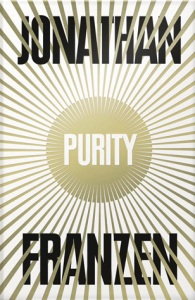 Purity by Jonathan Franzen: By starting and ending with Purity ‘Pip’ Tyler, Franzen emphasizes his debt to Dickens: shades of both Bleak House and Great Expectations are there in the discovery of true parentage and unexpected riches. This is strong on the level of character and theme. Secrecy, isolation and compassion are recurring topics. East Germany, Bolivia and Oakland, California: Franzen doesn’t quite pull all his settings and storylines together, but this is close. With a more dynamic opening section, it might have been 5 stars.
 A Brief History of Seven Killings by Marlon James: This is an edgy, worthwhile Booker pick, but not for the faint-hearted. For the most part, James alternates patois and standard speech, but nearly every section is packed with local slang and expletives. Whether in monologue or dialogue, the many voices form a captivating chorus. The novel is in five parts, each named after a popular song or album of the time. James’s scope, especially as he follows Josey Wales to the Bronx, is too wide. All the narrative switches, once so dynamic, grow tiresome. At 350 pages this would have been a 5-star read. Nevertheless, I’ll be watching the HBO miniseries. (Full review to appear in December 2015 issue of Third Way magazine.)
 Kitchens of the Great Midwest by J. Ryan Stradal: One of my favorite debuts of 2015. Stradal has revealed that his grandmother’s Lutheran church cookbook was the inspiration for this culinary-themed novel that takes place over the course of 30 years. His unique structure takes what are essentially short stories from different perspectives and time periods and links them loosely through Eva Thorvald. Eva’s pop-up supper club gains fame thanks to her innovative adaptations of traditional Midwestern foods like venison or Scandinavian lutefisk; it charges $5,000 a head. I loved almost all of Stradal’s ordinary, flawed characters. If you want a peek at how average Americans live (apart from the $5,000 meals), you’ll find it here.
 The Japanese Lover by Isabel Allende: Allende is a wonderful storyteller. This isn’t up to the level of her South American novels (e.g. The House of the Spirits), and in elaborating both Alma’s and Irina’s stories there’s a bit too much telling rather than showing, but I thoroughly enjoyed the book all the same – I devoured it in just a few days. Allende is sensitive to both the process of aging and the various strategies for dealing with traumatic events from the past.
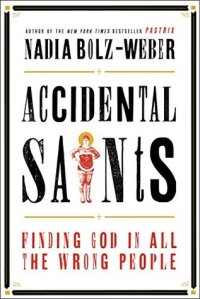 Accidental Saints: Finding God in All the Wrong People by Nadia Bolz-Weber: I knew of Nadia Bolz-Weber through Greenbelt Festival. She’s a foul-mouthed, tattooed, fairly orthodox Lutheran pastor. This brief, enjoyable memoir is about how she keeps believing despite her own past issues and the many messed-up and outwardly unlovable people who show up at her church, House for All Sinners and Saints in Denver. In my favorite section, she zeroes in on one Holy Week and shows the whole range of emotions and trauma that religion can address. The Ash Wednesday chapter is the overall highlight.
 The Road to Little Dribbling: Adventures of an American in Britain by Bill Bryson: Bryson’s funniest book for many years. It meant a lot to me since I am also an American expat in England. Two points of criticism, though: although he moves roughly from southeast to northwest in the country, the stops he makes are pretty arbitrary, and his subjects of mockery are often what you’d call easy targets. Do we really need Bryson’s lead to scorn litterbugs and reality television celebrities? Still, I released many an audible snort of laughter while reading.
 Shaler’s Fish by Helen Macdonald: I was a huge fan of Macdonald’s memoir, H is for Hawk, so was excited to read her poetry collection, originally published in 2001 but to be reissued by Atlantic Monthly Press. Unfortunately, despite the occasional bird and nature imagery (e.g. in “Monhegan”), I found these poems largely inaccessible. Perhaps it was the sprinkling of archaic vocabulary and spellings, or the general lack of punctuation apart from annoying slashes and ampersands.

Portrait of an Addict as a Young Man: A Memoir by Bill Clegg: One of the finest memoirs I’ve come across (and I read a heck of a lot of them). Through this book I followed literary agent Bill Clegg on dozens of taxi rides between generic hotel rooms and bar toilets and New York City offices and apartments; together we smoked innumerable crack pipes and guzzled dozens of bottles of vodka while letting partners and family members down and spiraling further down into paranoia and squalor. Every structural and stylistic decision works: the present tense, short paragraphs, speech set out in italics, occasional flashback chapters distanced through third-person narration. Clegg achieves a perfect balance between his feelings at the time – being out of control and utterly enslaved to his next hit – and the hindsight that allows him to see what a pathetic figure he was becoming.
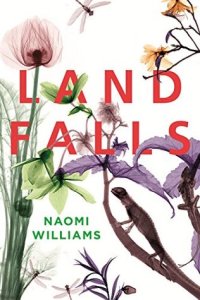 Landfalls by Naomi J. Williams: An enjoyable novel of eighteenth-century maritime adventure, based on a true story and reminiscent of Matthew Kneale’s English Passengers and Peter Carey’s Parrot and Olivier in America. Williams moves between the perspectives of various crew members and outsiders, sometimes employing first person and sometimes third. Key chapters are set in South America, California, Alaska, Macao, and the Solomon Islands. I especially enjoyed a chapter from the point-of-view of a native Alaskan girl – one of the few times the novel focuses on female experience.
 Dept. of Speculation by Jenny Offill: Not as innovative or profound as I was expecting given the rapturous reviews from so many quarters. It’s an attempt to tell an old, old story in a new way: wife finds out her husband is cheating. Offill’s style is fragmentary and aphoristic. Some of the facts and sayings are interesting, but most just sit there on the page and don’t add to the story. What I did find worthwhile was tracing the several tense and pronoun changes: from first-person, past tense into present tense, then to third-person and back to first-person for the final page.
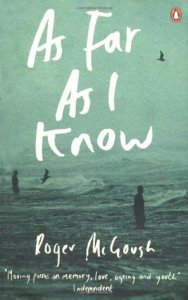 As Far As I Know by Roger McGough: A bit silly for my tastes; lots of puns and other plays on words. In style they feel like children’s poems, but with vocabulary and themes more suited to adults. I did like “Indefinite Definitions,” especially BRUPT: “A brupt is a person, curt and impolite / Brusque and impatient / Who thinks he’s always right.” The whole series is like that: words with the indefinite article cut off and an explanation playing on the original word’s connotations. From the “And So to Bed” concluding cycle, I loved Camp bed: “A la Recherche du Temps Perdu / on the bedside table / Gardenia on the pillow / Silk pyjamas neatly folded.”
 The Penguin Lessons: What I Learned from a Remarkable Bird by Tom Michell: Marley & Me with a penguin. Well, sort of. A sweet if slight story about the author keeping a Magellanic penguin as a pet while teaching in an Argentina boarding school in the 1970s. On a vacation to Uruguay the twentysomething rescued a penguin from an oil spill and named him Juan Salvado. The uproarious process of cleaning the oil-sodden bird, achieved with a bidet, string bag, and plenty of dish soap, was my favorite passage. However, I’m hesitant about anthropomorphizing, and the language can be stiff – I would have dated this to the 1950s by the speech. Also, there’s precious little evidence of Argentina’s political upheaval.
 Bookish Beck = Rebecca Foster. American transplant to England. Freelance proofreader and book reviewer.
 Bookish Beck