The Winter Soldier by Daniel Mason
Though I’m often wary of war fiction – can anything new still be written about World War I? – I was drawn to The Winter Soldier by the enthusiastic American reviews and the medical theme. The protagonist of psychiatrist Daniel Mason’s third novel, Lucius Krzelewski, comes from southern Polish nobility. In the 1910s medicine was a path for those seeking social mobility, but for Lucius neurology study is a way out of his stifling aristocratic household. Under Herr Doktor Zimmer’s tutelage in Vienna, he experiments on ways to make blood vessels visible. Dismayed to learn that Zimmer believes the “mermaid” in the medical school’s anatomical museum is real, he hurries to enlist when war begins in 1914.
 As a 22-year-old medical lieutenant he’s stationed at a church turned into a regimental hospital at Lemnowice. Here Sister Margarete has been making do without a doctor in charge for two months. She’s been performing amputations and setting fractures in a lice-ridden building where hunger and typhoid are never far away. Lucius is ashamed of his ignorance compared to this skilled nurse; though he has textbook knowledge, he has no practical experience and has to learn on the job.
The following winter a Hungarian soldier suffering from “nervous shock” but no visible wounds is brought in, a sheaf of accomplished drawings padding his coat. For Lucius and Margarete, Sergeant József Horváth poses a particular challenge, which makes his recovery seem more like a resurrection: “they were both falling a little bit in love with their silent visitor or, more, with the cure that they had wrought.” Even as Lucius and Margarete fall in love and steal moments alone, they regret they couldn’t do more for Horváth. When Lucius and Margarete are separated, he vows to find her again – and make things right with Horváth.
I loved the novel’s first half, with its gallows humor, memorable scenes of gruesome medical procedures, and bleak conditions so convincing you’ll find yourself itching right along with the lice-plagued patients. But at about the halfway point the pace changes dramatically. Years pass and Lucius has various deployments and hospital positions. Curiously, although so much is happening to him outwardly, he’s stalled internally – haunted by thoughts of Margarete and Horváth. Perhaps this is why I felt the narrative slowed to a crawl. I could barely force myself to read more than five or 10 pages in a sitting, and the novel as a whole took me much longer to read than normal. Or maybe I was just missing Margarete, the most vibrant character.
Early on I was reminded of Julie Orringer’s The Invisible Bridge and Hubert Mingarelli’s A Meal in Winter, lesser-known war novels in which the stark beauty of the writing tempers the somber subject matter. Partway through I started thinking of Ambrose Parry’s The Way of All Flesh, in which an unqualified female outshines a male in medical knowledge. By the end I was recalling epic separation-filled romances like The English Patient and Birdsong.
Though the novel’s second half never matched the strength of the first, I was at least pleased that Mason avoided a clichéd, Hollywood-ready ending in favor of a more fitting one that, while still somewhat far-fetched, makes sense of the title’s emphasis. This is a moving story of the physical and psychological effects of war, and I would certainly read more by Mason.
My rating: 
The Winter Soldier was published in the UK by Mantle on October 18th. With thanks to the publisher for the free copy for review.
My 2018 Wellcome Book Prize Wish List
Tomorrow the longlist for the 2018 Wellcome Book Prize will be announced. This year’s judging panel is chaired by Edmund de Waal, author of The Hare with Amber Eyes. I hope to once again shadow the shortlist along with a few fellow book bloggers. I don’t feel like I’ve read all that many books that are eligible (i.e., released in the UK in 2017, and on a medical theme), but here are some that I would love to see make the list. I link to all those I’ve already featured here, and give review extracts for the books I haven’t already mentioned.

 I Found My Tribe by Ruth Fitzmaurice
- In Pursuit of Memory: The Fight against Alzheimer’s by Joseph Jebelli
- Goodbye, Vitamin by Rachel Khong
- In Every Moment We Are Still Alive by Tom Malmquist
- Admissions: A Life in Brain Surgery by Henry Marsh
 I Am, I Am, I Am: Seventeen Brushes with Death by Maggie O’Farrell: O’Farrell captures fragments of her life through essays on life-threatening illnesses and other narrow escapes she’s experienced. The pieces aren’t in chronological order and aren’t intended to be comprehensive. Instead, they crystallize the fear and pain of particular moments in time, and are rendered with the detail you’d expect from her novels. She’s been mugged at machete point, nearly drowned several times, had a risky first labor, and was almost the victim of a serial killer. (My life feels awfully uneventful by comparison!) But the best section of the book is its final quarter: an essay about her childhood encephalitis and its lasting effects, followed by another about her daughter’s extreme allergies.
- The Smell of Fresh Rain: A Journey into the Sense of Smell by Barney Shaw
- Fragile Lives: A Heart Surgeon’s Stories of Life and Death on the Operating Table by Stephen Westaby
It’s also possible that we could see these make the longlist:
 History of Wolves by Emily Fridlund: Fridlund’s Minnesota-set debut novel is haunted by a dead child. From the second page readers know four-year-old Paul is dead; a trial is also mentioned early on, but not until halfway does Madeline Furston divulge how her charge died. This becomes a familiar narrative pattern: careful withholding followed by tossed-off revelations that muddy the question of complicity. The novel’s simplicity is deceptive; it’s not merely a slow-building coming-of-age story with Paul’s untimely death at its climax. For after a first part entitled “Science”, there’s still half the book to go – a second section of equal length, somewhat ironically labeled “Health”. (Reviewed for the TLS.)
- Hair Everywhere by Tea Tulić
 Modern Death: How Medicine Changed the End of Life by Haider Warraich: A learned but engaging book that intersperses science, history, medicine and personal stories. The first half is about death as a medical reality, while the second focuses on social aspects of death: religious beliefs, the burden on families and other caregivers, the debate over euthanasia and physician-assisted suicide, and the pros and cons of using social media to share one’s journey towards death. (See my full Nudge review.)
Of 2017’s medical titles that I haven’t read, I would have especially liked to have gotten to:
- Sound: A Story of Hearing Lost and Found by Bella Bathurst
 This Is Going to Hurt: Secret Diaries of a Junior Doctor by Adam Kay
- With the End in Mind: Dying, Death, and Wisdom in an Age of Denial by Kathryn Mannix [I have this one on my Kindle from NetGalley]
- Into the Grey Zone: A Neuroscientist Explores the Border between Life and Death by Adrian Owen
- Patient H69: The Story of My Second Sight by Vanessa Potter
We are also likely to see a repeat appearance from the winner of the 2017 Royal Society Science Book Prize, Testosterone Rex: Myths of Sex, Science, and Society by Cordelia Fine.
Other relevant books I read last year that have not (yet?) been released in the UK:
 The Education of a Coroner: Lessons in Investigating Death by John Bateson
- The Family Gene: A Mission to Turn My Deadly Inheritance into a Hopeful Future by Joselin Linder
- Last Things: A Graphic Memoir of Loss and Love by Marissa Moss
- Love and Laughter in the Time of Chemotherapy by Manjusha Pawagi
 No Apparent Distress: A Doctor’s Coming-of-Age on the Front Lines of American Medicine by Rachel Pearson: Pearson describes her Texas upbringing and the many different hands-on stages involved in her training: a prison hospital, gynecology, general surgery, rural family medicine, neurology, dermatology. Each comes with memorable stories, but it’s her experience at St. Vincent’s Student-Run Free Clinic on Galveston Island that stands out most. Pearson speaks out boldly about the divide between rich and poor Americans (often mirrored by the racial gap) in terms of what medical care they can get. A clear-eyed insider’s glimpse into American health care.
- The Bright Hour: A Memoir of Living and Dying by Nina Riggs
 The Tincture of Time: A Memoir of (Medical) Uncertainty by Elizabeth L. Silver: At the age of six weeks, Silver’s daughter suffered a massive brain bleed for no reason that doctors could ever determine. Thanks to the brain’s plasticity, especially in infants, the bleed was reabsorbed and Abby has developed normally, although the worry never goes away. Alongside the narrative of Abby’s baffling medical crisis, Silver tells of other health experiences in her family. An interesting exploration of the things we can’t control and how we get beyond notions of guilt and blame to accept that time may be the only healer.
Do you follow the Wellcome Book Prize? Have you read any books that might be eligible?
9 Things that Surprised Me about Madame Bovary
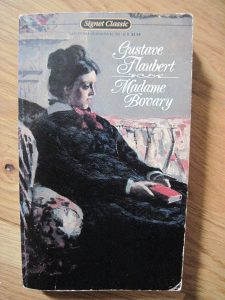
My classic for September was one of those books that are so ingrained in the canon you most likely know the basic story line even if you’ve never read a word Gustave Flaubert wrote. I’d happened to read a fair bit about Madame Bovary (1857), mostly via Julian Barnes, and had also encountered some modern novels that might be said to be updates (Hausfrau by Jill Alexander Essbaum and perhaps even George and Lizzie by Nancy Pearl), but never picked up the book itself until earlier this month. While the essential turns of the plot were indeed familiar to me, there was also plenty that surprised me in terms of the details and the mechanics. I’ve set this out in nine points below; if you’re determined to avoid anything that seems like spoilers, I’d suggest skipping over #6–8.
#1. We open with Charles Bovary.
And in the first-person plural: “We were studying when the headmaster came in, followed by a new boy”. I suppose I assumed the book would open immediately on Emma Bovary, already married to Charles. Instead, we get a quick tour through Charles’s adolescent schooling and independent medical studies.
 #2. There are two “Madame Bovarys” before the one we’re interested in.
The original Madame Bovary, and the only one to survive the book, is Charles’s mother. Charles also has a brief first marriage to Heloise, an older widow. Conveniently, she dies by the end of the second chapter, in which Charles met Emma when he went to set her farmer father’s broken leg.
#3. There’s a lovely Hardyesque flavor to the novel.
Flaubert’s original subtitle was “Provincial Morals,” and the scenes set among country folk – especially Emma and Charles’s wedding procession and reception and the later agricultural fair – reminded me of Far from the Madding Crowd.
#4. Emma has a child.
Despite all I’d absorbed about the book, I never knew Emma had a baby girl, Berthe. They lodge the infant with a wet nurse and servants do most of the hard work of raising her, so Berthe has only a tiny role. The scene in which Emma violently pushes the little girl away from her is meant, I think, to reflect her fundamental unfitness for motherhood.
#5. In the world of the novel, literature is a danger and religion is no balm.
On the advice of Charles’s mother, he cancels Emma’s lending library subscription lest novels exacerbate her discontent. Manual labor is what Emma needs, Old Madame Bovary proclaims. When Emma goes to the parish priest for advice about her angst, he tells her she must be ill if she benefits from all the physical comforts she could need yet cannot be happy. (An excellent and wrenching scene.)

Gustave Flaubert. (Public domain, via Wikimedia Commons.)
#6. There’s a strong medical theme.
Charles is a doctor, of course, but I didn’t know his profession would enter into the plot. There’s a crucial sequence in which he performs a groundbreaking operation on a stable boy with a clubfoot, but gangrene sets in and the leg has to be amputated. (Emma guiltily buys the boy a false leg.) Emma’s somewhat prolonged death by poisoning, and the appearance of her corpse, are also described in recognizable medical detail.
#7. Emma’s death isn’t the end.
There’s still two more chapters to go, and things only get worse. It’s as if Emma is still a negative influence after her death: pushing Charles on to extravagances he can’t afford, and sending him deeper into despair when he finds undeniable evidence of her two affairs.
#8. Homais, the arrogant pharmacist, is triumphant.
Monsieur Homais is one of the key secondary characters in Yonville, this small town near Rouen. He’s a middling community member who’s gotten above himself, yet he succeeds whereas Emma is crushed. The very last line of the novel goes to him: “He has just received the Legion of Honor.” In the introduction to my Signet Classic edition, Mary McCarthy suggests that Homais is “not just Emma’s foil; he is her alter ego.”
#9. Madame Bovary went on trial.
Appended to my copy is a 78-page transcript of the novel’s trial. As I skimmed it, I was reminded of the Lady Chatterley’s Lover obscenity case, which took place just over 100 years later (1959–60). Flaubert and his publisher were accused of “offenses against public morality and religion,” specifically of portraying Emma as lascivious and making adultery appealing compared to the banality of marriage. The defense countered that Charles receives all the reader’s sympathy and Emma all the reader’s revulsion. Flaubert was acquitted (as was Lady Chatterley), but the judge’s ruling was essentially “Naughty boy, don’t you know literature has a mission to exalt the spirit, not to hold up vice as an object of horror?”
Now for what doesn’t surprise me about Madame Bovary: the beautiful writing and the enduring power of what is ultimately a rather commonplace story line. The percentage of novels with an adultery subplot must be very high nowadays, but Madame Bovary and Anna Karenina were two of the first to consider the female experience.
Flaubert famously declared “Madame Bovary, c’est moi” (“Madame Bovary is me”), and I think every reader must see something of him-/herself in this character: the lure of a romantic and luxurious life, the boredom of the day to day, the longing to make something more out of existence, and an increasing desperation to cover up one’s mistakes. A book that has had meaning for generations, Madame Bovary is a true classic.
Some favorite lines:
“But her life was as cold as an attic with northern exposure, and boredom, that silent spider, was spinning its web in all the dark corners of her heart.”
“Mealtime was the worst of all in that tiny room on the ground floor, with the smoking oven, the creaking door, the damp walls, and the moist flagstones; all the bitterness of her existence seemed to be served up to her on her plate, and the steam from the boiled beef brought up waves of nausea from the depths of her soul.”
“No one can ever express the exact measure of his needs, or conceptions, or sorrows. The human language is like a cracked kettle on which we beat out a tune for a dancing bear, when we hope with our music to move the stars.”
(Isn’t that last sentence incredible?!)
My rating:
I read a Signet Classic edition of Mildred Marmur’s 1964 translation.
See also Susan’s review of Sophie Divry’s recent update, Madame Bovary of the Suburbs, at A life in books.
 Bookish Beck = Rebecca Foster. American transplant to England. Freelance proofreader and book reviewer.
 Bookish Beck