Book Serendipity, Mid-March to Early May 2021
In early April, the publisher Canongate ran a newsletter competition for one reader to win a stack of their recent releases. All you had to do was reply with your favourite word. On Twitter they gave a rundown of the most popular responses. Turning up several times each were petrichor, mellifluous, and oleaginous. Most frequent of all was serendipity: I was one of 15 to submit it! And one of those entries, but not mine, won. Anyway, fun little story there.
I call it Book Serendipity when two or more books that I read at the same time or in quick succession have something pretty bizarre in common. Because I have so many books on the go at once (usually 20‒30), I suppose I’m more prone to such incidents. I’ve realized that, of course, synchronicity is really the more apt word, but this branding has stuck.
The following are in roughly chronological order.
- A white peacock is mentioned in Indelicacy by Amina Cain and The Mermaid of Black Conch by Monique Roffey, both of which were on the 2021 Rathbones Folio Prize shortlist.
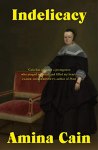

- Speaking of that Rathbones Folio Prize shortlist, four of the eight were paperbacks with French flaps.
- The main character takes ballet lessons in Indelicacy by Amina Cain and A Feather on the Breath of God by Sigrid Nunez.
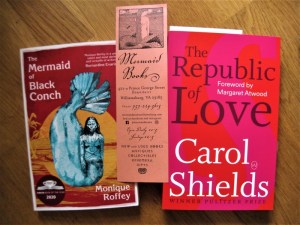
- Mermaids! A big theme in The Mermaid of Black Conch by Monique Roffey (of course) and The Republic of Love by Carol Shields, but they’re also mentioned in the opening story of The Office of Historical Corrections by Danielle Evans and are main characters in “The Pangs of Love” by Jane Gardam in the anthology Close Company.
- The Brothers Grimm story about brothers who have been transformed into swans and their sister who sews shirts out of nettles to turn them back is reworked in The Charmed Wife by Olga Grushin and used as a metaphor in Dusk, Night, Dawn by Anne Lamott.
- An electric carving knife is mentioned as a means of suicide (yipes!) in The Inevitable by Katie Engelhart and Woman on the Edge of Time by Marge Piercy.
- A discussion of the distinction between the fear of dying and the fear of being dead in This Party’s Dead by Erica Buist and The Inevitable by Katie Engelhart.
- Two novels in a row in which an older man is appalled by the squalor of his young girlfriend’s apartment, and she calls him “daddy” during sex (double yipes!), made the Dylan Thomas Prize shortlist: Luster by Raven Leilani and My Dark Vanessa by Kate Elizabeth Russell.


- Architect husbands in The Push by Ashley Audrain and The Art of Falling by Danielle McLaughlin (and, last year, in A Celibate Season by Blanche Howard and Carol Shields), as well as a female architect as a main character in The Living Sea of Waking Dreams by Richard Flanagan earlier this year.
- The next-to-last essay in the Trauma anthology quotes from The Bell Jar by Sylvia Plath, which I was also reading at the time.
- A mention of the eels in London absorbing cocaine from the Thames in the final essay in the Trauma anthology; I then moved right on to the last 40 pages of Nobody Is Talking About This by Patricia Lockwood and the same bizarre fact was mentioned. A week and a half later, there it was again, this time in Asylum Road by Olivia Sudjic.
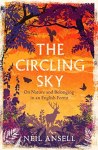
- A mention of sailors’ habit of getting tattoos of swallows in The Circling Sky by Neil Ansell (who has a swallow tattoo, even though he’s not a sailor) and Birdsong in a Time of Silence by Steven Lovatt.

- A father and teenage child wander an unfamiliar city and enter a sex shop together (yipes yet again!) in Three O’Clock in the Morning by Gianrico Carofiglio and Ten Days by Austin Duffy.
- A mention of the same University of Virginia study in which people self-administered electric shocks to alleviate the boredom of sitting alone with their thoughts in Rooted by Lyanda Lynn Haupt and You’re Not Listening by Kate Murphy.
- Basho’s poetry and George Monbiot’s Feral are both cited in The Circling Sky by Neil Ansell and Rooted by Lyanda Lynn Haupt.
- A dead sister named Mattie in Consent by Annabel Lyon and Drowning Ruth by Christina Schwarz.

- A young Black female protagonist and the same family dynamic (the mother committed suicide and the father is in the Marines/Navy) in The Mothers by Brit Bennett and Luster by Raven Leilani.
- On the same night, I read about two pets encountering snow for the first time: a cat in Close Encounters of the Furred Kind by Tom Cox and a dog in Open Water by Caleb Azumah Nelson.
- A character is described as being as wide as they are tall in Mother for Dinner by Shalom Auslander and The Absolute Book by Elizabeth Knox.


- A character is known as Seventh in Mother for Dinner by Shalom Auslander and the story “The Pangs of Love” by Jane Gardam in the Close Company anthology. Plus, there’s Septimus in Mrs Dalloway by Virginia Woolf, which I’m reading concurrently with those two.
What’s the weirdest reading coincidence you’ve had lately?
The Circling Sky & The Sleeping Beauties
I think I have another seven April releases on the go that kind publishers have sent my way, but I’m so slow at finishing books that these two are the only ones I’ve managed so far. (I see lots of review catch-up posts in my future!) For now I have a travel memoir musing on the wonders of the New Forest and the injustice of land ownership policies, and a casebook of medical mysteries that can all be classed as culturally determined psychosomatic illnesses.
The Circling Sky: On Nature and Belonging in an Ancient Forest by Neil Ansell
After The Last Wilderness and especially Deep Country, his account of five solitary years in a Welsh cabin, Ansell is among my most-admired British nature writers. I was delighted to learn that his new book would be about the New Forest as it’s a place my Hampshire-raised husband and I have visited often and feel fond of. It has personal significance for Ansell, too: he grew up a few miles from Portsmouth. On Remembrance Sunday 1966, though, his family home burned down when a spark from a central heating wire sent the insulation up in flames. He can see how his life was shaped by this incident, making him a nomad who doesn’t accumulate possessions.
Hoping to reclaim a sense of ancestral connection, he returned to the New Forest some 30 times between January 2019 and January 2020, observing the unfolding seasons and the many uncommon and endemic species its miles house. The Forest has more than 1000 trees of over 400 years old, mostly oak and beech. Much of the rest is rare heath habitat, and livestock grazing maintains open areas. There are some plants only found in the New Forest, as well as a (probably extinct) cicada. He has close encounters with butterflies, a muntjac, and less-seen birds like the Dartford warbler, firecrest, goshawk, honey buzzard, and nightjar.
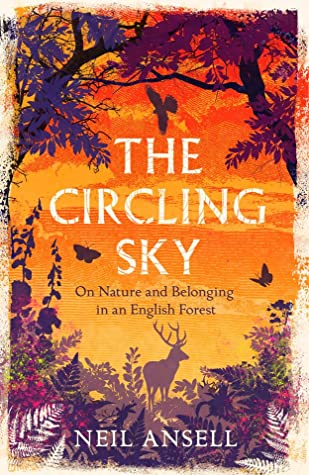 But this is no mere ‘white man goes for a walk’ travelogue, as much of modern nature writing has been belittled. Ansell weaves many different themes into the work: his personal story (mostly relevant, though his mother’s illness and a trip to Rwanda seemed less necessary), the shocking history of forced Gypsy relocation into forest compounds starting in the 1920s, biomass decline, and especially the unfairness of land ownership in Britain. More than 99% of the country is in the hands of a very few, and hardly any is left as common land. There is also enduring inequality of access to what little there is, often along race and class lines. The have-nots have been taught to envy the haves: “We are all brought up to aspire to home ownership,” Ansell notes. As a long-term renter, it’s a goal I’ve come to question, even as I crave the security and self-determination that owning a house and piece of land could offer.
Ansell speaks of “environmental dread” as a “rational response to the way the world is turning,” but he doesn’t rest in that mindset of despair. He’s in favour of rewilding, which is not, as some might assume, about leaving land alone to revert to its original state, but about the reintroduction of native species and intentional restoration of habitat types. In extending these rewilded swathes, we would combat the tendency to think of nature as something kept ‘over there’ in small reserves while subjecting the rest of the land to intensive, pesticide-based farming and the exploitation of resources. The New Forest thus strikes him as an excellent model of both wildlife-friendly land management and freedom of human access.
I appreciated how Ansell concludes that it’s not enough to simply love nature and write about the joy of spending time in it. Instead, he accepts a mantle of responsibility: “nothing is more political than the way we engage with the world around us. … Nature writing may often be read for comfort and reassurance, but perhaps we need to allow a little room for anger, too, for the ability to rage at everything that has been taken from us, and taken by us.” The bibliography couldn’t be more representative of my ecologist husband’s and my reading interests and nature library. The title is from John Clare and the book is a poetic meditation as well as a forthright argument. It also got me hankering for my next trip to the New Forest.
My rating: 
With thanks to Tinder Press for the proof copy for review.
The Sleeping Beauties: And Other Stories of Mystery Illness by Suzanne O’Sullivan
O’Sullivan is a consultant at the National Hospital for Neurology and Neurosurgery. She won the Wellcome Book Prize for It’s All in Your Head, and The Sleeping Beauties picks up on that earlier book’s theme of psychosomatic illness – with the key difference being that this one travels around the world to investigate outbreaks of mass hysteria or sickness that have arisen in particular cultural contexts. An important thing to bear in mind is that O’Sullivan and other doctors in her field are not dismissing these illnesses as “fake”; they acknowledge that they are real and meaningful, yet there is clear evidence that they are not physical in origin – brain tests come back normal – but psychological with bodily manifestations.
 The case that gives the book its title appeared in Sweden in 2017. Child asylum seekers who had experienced trauma in their home country were falling into a catatonic state. O’Sullivan visited the home of sisters Nola and Helan, part of the Yazidi ethnic minority group from Iraq and Syria. The link between them and the other children affected was that they were all now threatened with deportation: Their hopelessness had taken on physical form, giving the illness the name resignation syndrome. “Predictive coding” meant their bodies did as they expected them to. She describes it as “a very effective culturally agreed means of expressing distress.”
In Texas, the author meets Miskito people from Nicaragua who combat the convulsions and hallucinations of “grisi siknis” in their community with herbs and prayers; shamans are of more use in this circumstance than antiepileptic drugs. A sleeping sickness tore through two neighbouring towns of Kazakhstan between 2010 and 2015, affecting nearly half of the population. As with the refugee children in Sweden, it was a stress response to being forced to move away – though people argued they were being poisoned by a local uranium mine. There is often a specific external factor that is blamed in these situations, as when mass hysteria and seizures among Colombian schoolgirls were attributed to the HPV vaccine.
This book was released on the 1st of April, and at times I felt I was the victim of an elaborate April Fool’s joke: the cases are just so bizarre, and we’re used to rooting out a physical cause. But she makes clear that, in a biopsychosocial understanding (as also discussed in Pain by Abdul-Ghaaliq Lalkhen), these illnesses are serving “a vital purpose” – just psychological and cultural. The first three chapters are the strongest; the book feels repetitive and somewhat aimless thereafter, especially in Chapter 4, which hops between different historical outbreaks of psychosomatic illness, like among the Hmong (cf. Anne Fadiman’s The Spirit Catches You and You Fall Down), and other patients she treated for functional disorders. The later example of “Havana syndrome” doesn’t add enough to warrant its inclusion.
Still, O’Sullivan does well to combine her interviews and travels into compelling mini-narratives. Her writing has really come on in leaps and bounds since her first book, which I found clunky. However, much my favourite of her three works is Brainstorm, about epilepsy and other seizure disorders of various origins.
My rating: 
With thanks to Picador for the proof copy for review.
What recent releases can you recommend?
Other 2018 Superlatives and Some Early 2019 Recommendations
My Best Discoveries of the Year: Neil Ansell, James Baldwin, Janet Frame, Rohinton Mistry, Blake Morrison, Dani Shapiro, Sarah Vowell; Roald Dahl’s work for adults
The Author I Read the Most By: Anne Tyler (four novels)
 My Proudest Reading Achievement: Getting through a whole Rachel Cusk book (it was my third attempt to read her).
The 2018 Books Everybody Else Loved but I Didn’t: Melmoth by Sarah Perry and Normal People by Sally Rooney
The Year’s Biggest Disappointments: The Travelling Cat Chronicles by Hiro Arikawa and Sabrina by Nick Drnaso
 The Funniest Books I Read This Year: Fox 8 by George Saunders and Calypso by David Sedaris
Books that Made Me Cry: Leaving Before the Rains Come by Alexandra Fuller and The Long Goodbye by Meghan O’Rourke
 The Downright Strangest Books I Read This Year: The Bus on Thursday by Sheila Barrett, The Pisces by Melissa Broder and I Love Dick by Chris Kraus
The Debut Authors Whose Next Work I’m Most Looking Forward To: Julie Buntin, Lisa Ko and R.O. Kwon
The Best First Line of the Year: “Dust and ashes though I am, I sleep the sleep of angels.” (from The Western Wind by Samantha Harvey)
Some Early 2019 Recommendations
(in release date order)
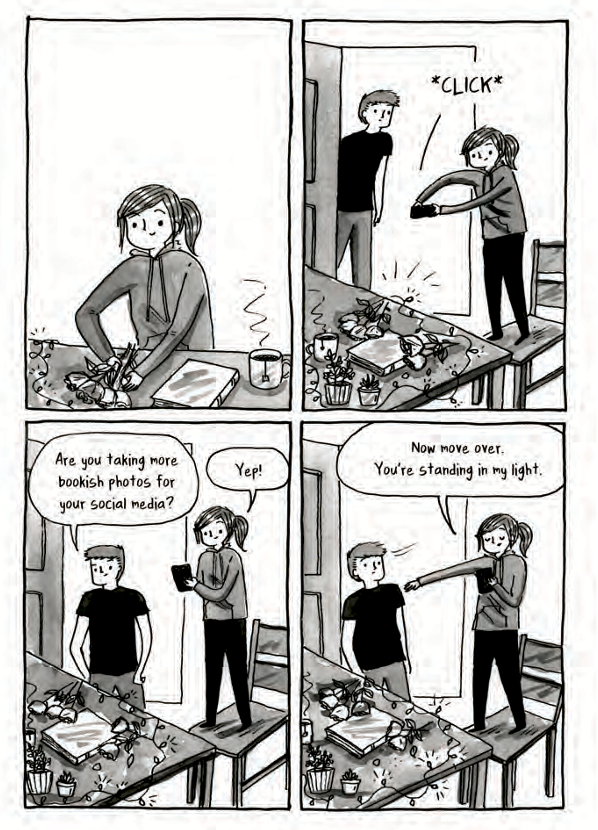
 Book Love by Debbie Tung: Bookworms will get a real kick out of these cartoons, which capture everyday moments in the life of a book-obsessed young woman (perpetually in hoodie and ponytail). She reads anything, anytime, anywhere. Even though she has piles of books staring her in the face everywhere she looks, she can never resist a trip to the bookstore or library. The very idea of culling her books or finding herself short of reading material makes her panic, and she makes a friend sign a written agreement before he can borrow one of her books. Her partner and friends think she’s batty, but she doesn’t care. I found the content a little bit repetitive and the drawing style not particularly distinguished, but Tung gets the bibliophile’s psyche just right. (Out January 1.)
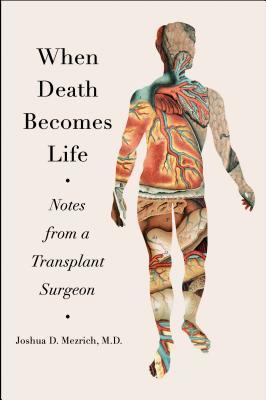 When Death Becomes Life: Notes from a Transplant Surgeon by Joshua D. Mezrich: In this debut memoir a surgeon surveys the history of organ transplantation, recalling his own medical education and the special patients he’s met along the way. In the 1940s and 1950s patient after patient was lost to rejection of the transplanted organ, post-surgery infection, or hemorrhaging. Mezrich marvels at how few decades passed between transplantation seeming like something out of a science-fiction future and becoming a commonplace procedure. His aim is to never lose his sense of wonder at the life-saving possibilities of organ donation, and he conveys that awe to readers through his descriptions of a typical procedure. One day I will likely need a donated kidney to save my life. How grateful I am to live at a time when this is a possibility. (Out January 15.)
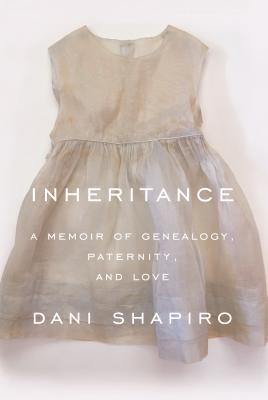 Inheritance: A Memoir of Genealogy, Paternity, and Love by Dani Shapiro: Shapiro was used to strangers’ comments about her blond hair and blue eyes. How could it be that she was an Orthodox Jew? people wondered. It never occurred to her that there was any truth to these hurtful jokes. On a whim, in her fifties, she joined her husband in sending off a DNA test kit. It came back with alarming results. Within 36 hours of starting research into her origins, Shapiro had found her biological father, a sperm donor whom she calls Dr. Ben Walden, and in the year that followed, their families carefully built up a relationship. The whole experience was memoirist’s gold, for sure. This is a moving account of her emotional state as she pondered her identity and what her sense of family would be in the future. (Out January 15.)

 Constellations: Reflections from Life by Sinéad Gleeson: Perfect for fans of I Am, I Am, I Am by Maggie O’Farrell, this is a set of trenchant autobiographical essays about being in a female body, especially one wracked by pain. As a child Gleeson had arthritis that weakened her hip bones, and eventually she had to have a total hip replacement. She ranges from the seemingly trivial to life-and-death matters as she writes about hairstyles, blood types, pregnancy, the abortion debate in Ireland and having a rare type of leukemia. In the tradition of Virginia Woolf, Frida Kahlo and Susan Sontag, Gleeson turns pain into art, particularly in a set of 20 poems based on the McGill Pain Index. The book feels timely and is inventive in how it brings together disparate topics to explore the possibilities and limitations of women’s bodies. (Out April 4.)
 The Hot Young Widows Club: Lessons on Survival from the Front Lines of Grief by Nora McInerny: In June 2016 I read It’s Okay to Laugh (Crying Is Cool Too), McInerny’s memoir about losing her father and her husband to cancer and her second child to a miscarriage – all within a few weeks – when she was 31. In this short book, an expansion of her TED talk, she argues that we are all incompetent when it comes to grief. There’s no rule book for how to do it well or how to help other people who are experiencing a bereavement, and comparing one loss to another doesn’t help anyone. I especially appreciated her rundown of the difference between pity and true empathy. “Pity keeps our hearts closed up, locked away. Empathy opens our heart up to the possibility that the pain of others could one day be our own pain.” (Out April 30.)
Coming tomorrow: Library Checkout & Final statistics for the year
Have you read any 2019 releases you can recommend?
Best Backlist Reads of 2018
Like a lot of book bloggers, I’m irresistibly drawn to the shiny new books released each year. However, I’ve noticed recently that many of my most memorable reads were published years or even decades ago. In 2018 I even came across a handful of books that are for me among the very best representatives of their genre, whether that’s nature, travel, family memoir, historical fiction or science fiction. The below selections are in alphabetical order by author name, and account for all the rest of my 4.5- and 5-star ratings of the year (another 27!).

My best backlist reads of the year (most of the ones I own in print, anyway).
Fiction
 March by Geraldine Brooks (2005): The best Civil War novel I’ve read. The best slavery novel I’ve read. One of the best historical novels I’ve ever read, period. Brooks’s second novel uses Little Women as its jumping-off point but is very much its own story. The whole is a perfect mixture of what’s familiar from history and literature and what Brooks has imagined.
 Marlena by Julie Buntin (2017): The northern Michigan setting pairs perfectly with the novel’s tone of foreboding: you have a sense of these troubled teens being isolated in their clearing in the woods, and from one frigid winter through a steamy summer and into the chill of the impending autumn, they have to figure out what in the world they are going to do with their terrifying freedom. It’s basically a flawless debut, one I can’t recommend too highly.
 Reading in the Dark by Seamus Deane (1996): Ireland’s internecine violence is the sinister backdrop to this family’s everyday sorrows, including the death of a child and the mother’s shaky mental health. The book captures all the magic, uncertainty and heartache of being a child, in crisp scenes I saw playing out in my mind.
 The Life and Loves of Lena Gaunt by Tracy Farr (2013): Lena Gaunt: early theremin player, grande dame of electronic music, and opium addict. I loved how Farr evokes the strangeness and energy of theremin music, and how sound waves find a metaphorical echo in the ocean’s waves – swimming is Lena’s other great passion.
 Late Nights on Air by Elizabeth Hay (2007): A tight-knit cast gathers around the local radio station in Yellowknife, a small city in Canada’s Northwest Territories: Harry and Gwen, refugees from Ontario starting new lives; Dido, an alluring Dutch newsreader; Ralph, the freelance book reviewer; menacing Eddie; and pious Eleanor. This is a marvellous story of quiet striving and dislocation; I saw bits of myself in each of the characters, and I loved the extreme setting, both mosquito-ridden summer and bitter winter.
 The Leavers by Lisa Ko (2017): An ambitious and satisfying novel set in New York and China, with major themes of illegal immigration, searching for a mother and a sense of belonging, and deciding what to take with you from your past. This was hand-picked by Barbara Kingsolver for the 2016 PEN/Bellwether Prize for Socially Engaged Fiction.
 The Invisible Bridge by Julie Orringer (2010): Hungarian Jew Andras Lévi travels from Budapest to Paris to study architecture, falls in love with an older woman who runs a ballet school, and – along with his parents, brothers, and friends – has to adjust to the increasingly strict constraints on Jews across Europe in 1937–45. It’s all too easy to burn out on World War II narratives these days, but this is among the very best I’ve read.
 The Sparrow by Mary Doria Russell (1996): For someone like me who struggles with sci-fi at the best of times, this is just right: the alien beings are just different enough from humans for Russell to make fascinating points about gender roles, commerce and art, but not so peculiar that you have trouble believing in their existence. All of the crew members are wonderful, distinctive characters, and the novel leaves you with so much to think about: unrequited love, destiny, faith, despair, and the meaning to be found in life.
 Salt Creek by Lucy Treloar (2015): Hester Finch is looking back from the 1870s – when she is a widowed teacher settled in England – to the eight ill-fated years her family spent at Salt Creek, a small (fictional) outpost in South Australia, in the 1850s–60s. This is one of the very best works of historical fiction I’ve read; it’s hard to believe it’s Treloar’s debut novel.
 Christmas Days: 12 Stories and 12 Feasts for 12 Days by Jeanette Winterson (2016): I treated myself to this new paperback edition with part of my birthday book token and it was a perfect read for the week leading up to Christmas. The stories are often fable-like, some spooky and some funny. Most have fantastical elements and meaningful rhetorical questions. Winterson takes the theology of Christmas seriously. A gorgeous book I’ll return to year after year.
Poetry
 Available Light by Marge Piercy (1988): The subjects are diverse: travels in Europe, menstruation, identifying as a Jew as well as a feminist, scattering her father’s ashes, the stresses of daily life, and being in love. Some of my favorites were about selectively adhering to the lessons her mother taught her, how difficult it is for a workaholic to be idle, and wrestling the deity for words.
Nonfiction
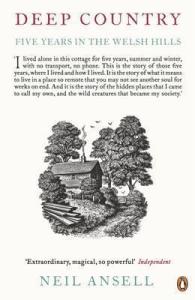
 Deep Country: Five Years in the Welsh Hills by Neil Ansell (2011): One of the most memorable nature/travel books I’ve ever read; a modern-day Walden. Ansell’s memoir is packed with beautiful lines as well as philosophical reflections on the nature of the self and the difference between isolation and loneliness.
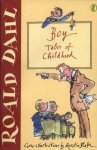 Boy by Roald Dahl (1984): Pranks and larks and holidays: these are all here; so is crushing homesickness and a bitter sense of injustice at being at the mercy of sadistic adults. Nearly 60 years later, Dahl could use memory and imagination to fully inhabit his childhood self and give a charming survey of the notable events of his life up to age 20.
 This Cold Heaven: Seven Seasons in Greenland by Gretel Ehrlich (2001): I thoroughly enjoyed my armchair trek across a frigid island nation in the company of Gretel Ehrlich, who traveled here repeatedly between 1995 and 2001 and intersperses her journeys with those of her historical model, Inuit–Danish explorer Knud Rasmussen, whose seven Arctic expeditions took in the west coast of Greenland and the far north of the North American continent. Every time she finds a fresh way to write about ice and sun glare and frigid temperatures.
 Ali: A Life by Jonathan Eig (2017): It’s a riveting account of outliving segregation and developing a personal style and world-beating confidence; it’s a sobering tale of facing consequences and having your own body fail you. I’m the furthest thing from a sports fan you could imagine, but I approached this as a book about a cultural icon and read it with a spirit of curiosity about how Eig would shape this life story and separate the facts from the legend. I loved it.
 The Book of Forgotten Authors by Christopher Fowler (2017): A charming introduction to 99 more or less obscure writers. Each profile is a perfectly formed mini-biography with a survey of the author’s major work: in just two or three pages, Fowler is able to convey all a writer’s eccentricities and why their output is still worth remembering.
 To the Is-Land: An Autobiography by Janet Frame (1982): This is some of the best writing about childhood and memory that I’ve ever read, infused with music, magic and mystery. The prose alternates between dreamy and matter-of-fact as Frame describes growing up in New Zealand one of five children in the Depression and interwar years.
 Leaving Before the Rains Come by Alexandra Fuller (2015): This poignant sequel to Don’t Let’s Go to the Dogs Tonight is a portrait of Fuller’s two-decade marriage, from its hopeful beginnings to its acrimonious end. What I most appreciated about the book was Fuller’s sense of being displaced: she no longer feels African, but nor does she feel American.
 West With the Night by Beryl Markham (1942): Markham writes so vividly about the many adventures of her life in Africa: hunting lions, training race horses, and becoming one of the continent’s first freelance pilots, delivering mail and locating elephant herds. Whether she’s reflecting on the many faces of Africa or the peculiar solitude of night flights, the prose is just stellar.
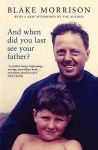 And When Did You Last See Your Father? by Blake Morrison (1993): An extraordinary memoir based around the author’s relationship with his father. Alternating chapters give glimpses into earlier family life and narrate Morrison’s father’s decline and death from cancer. This is simply marvelously written, not a bad line in the whole thing.
 The Seabird’s Cry: The Lives and Loves of Puffins, Gannets and Other Ocean Voyagers by Adam Nicolson (2017): This is an extraordinarily well-written and -researched book (a worthy Wainwright Prize winner) about the behavior, cultural importance, and current plight of the world’s seabirds. Each chapter takes up a different species and dives deep into everything from its anatomy to the legends surrounding it, simultaneously conveying the playful, intimate real lives of the birds and their complete otherness.
 The Long Goodbye: A Memoir of Grief by Meghan O’Rourke (2011): I read a whole lot of bereavement memoirs; this has been one of the very best. O’Rourke tells her story with absolute clarity – a robust, plain-speaking style that matches her emotional transparency. The heart of the book is her mother’s death from colorectal cancer on Christmas Day 2008, but we also get a full picture of the family life that preceded it and the first couple of years of aftermath.
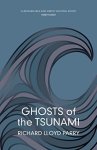 Ghosts of the Tsunami: Death and Life in Japan’s Disaster Zone by Richard Lloyd Parry (2017): Eighteen and a half thousand people died in the earthquake and tsunami that hit Japan in March 2011. It’s not really possible to get your head around a tragedy on that scale so, wisely, Parry focuses on a smaller story within the story: 74 died at Okawa primary school because the administration didn’t have a sufficient disaster plan in place. This is a stunning portrait of a resilient people, but also a universal story of the human spirit facing the worst.
 Lots of Candles, Plenty of Cake by Anna Quindlen (2012): A splendid memoir-in-essays that dwells on aging, parenting and female friendship. Some of its specific themes are marriage, solitude, the randomness of life, the process of growing into your own identity, and the special challenges her generation (roughly my mother’s) faced in seeking a work–life balance. Her words are witty and reassuring, and cut right to the heart of the matter in every case.
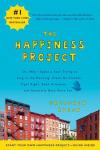 The Happiness Project: Or, Why I Spent a Year Trying to Sing in the Morning, Clean My Closets, Fight Right, Read Aristotle, and Generally Have More Fun by Gretchen Rubin (2009): Probably the best self-help book I’ve read; dense (in the best possible way) with philosophy, experience and advice. What I appreciated most is that her approach is not about undertaking extreme actions to try to achieve happiness, but about finding contentment in the life you already have by adding or tweaking small habits – especially useful for pessimists like me.
 In the Days of Rain: A daughter. A father. A cult by Rebecca Stott (2017): This was a perfect book for my interests, and just the kind of thing I would love to write someday. It’s a bereavement memoir that opens with Stott’s father succumbing to pancreatic cancer and eliciting her promise to help finish his languishing memoir; it’s a family memoir that tracks generations through England, Scotland and Australia; and it’s a story of faith and doubt, of the absolute certainty experienced inside the Exclusive Brethren (a Christian sect that numbers 45,000 worldwide) and how that cracked until there was no choice but to leave.
 Writers & Company by Eleanor Wachtel (1993): Erudite and fascinating author interviews from Wachtel’s weekly Canadian Broadcasting Corporation radio program. Whether I’d read anything by these authors (or even heard of them) or not, I found each Q&A chock-full of priceless nuggets of wisdom about creativity, mothers and daughters, drawing on autobiographical material, the writing process, and much more.
And if I really had to limit myself to just two books – my very best fiction and nonfiction reads of the year – they would be March by Geraldine Brooks and And When Did You Last See Your Father? by Blake Morrison.

What were your best backlist reads this year?
Vocabulary Words I Learned from Books This Year
These are in chronological order by my reading.
- borborygmi = stomach rumblings caused by the movement of fluid and gas in the intestines
- crapula = sickness caused by excessive eating and drinking
- olm = a cave-dwelling aquatic salamander
~The Year of the Hare, Arto Paasilinna
- befurbelowed = ornamented with frills (the use seems to be peculiar to this book, as it is the example in every online dictionary!)
~The Awakening, Kate Chopin
 roding = the sound produced during the mating display of snipe and woodcock, also known as drumming
- peat hag = eroded ground from which peat has been cut
~Deep Country, Neil Ansell
- rallentando = a gradual decrease in speed
~Sight, Jessie Greengrass
- piceous = resembling pitch
~March, Geraldine Brooks
- soffit = the underside of eaves or an arch, balcony, etc.
~The Only Story, Julian Barnes
 lemniscate = the infinity symbol, here used as a metaphor for the pattern of pipe smoke
~The Invisible Bridge, Julie Orringer
- purfling = a decorative border
- lamingtons = sponge cake squares coated in chocolate and desiccated coconut (sounds yummy!)
~The Life and Loves of Lena Gaunt, Tracy Farr
- ocellated = having eye-shaped markings
~Red Clocks, Leni Zumas
- balloonatic (WWI slang) = a ballooning enthusiast
- skinkling = sparkling
- preludial = introductory
- claustral = confining
- baccalà = salted cod
~The Incendiaries, R. O. Kwon
(There were so many words I didn’t immediately recognize in this novel that I thought Kwon must have made them up; preludial and claustral, especially, are words I didn’t know existed but that one might have extrapolated from their noun forms.)
 bronies = middle-aged male fans of My Little Pony (wow, who knew this was a thing?! I feel like I’ve gone down a rabbit hole just by Googling it.)
- callipygian = having well-shaped buttocks
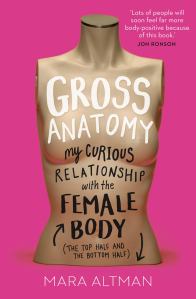
~Gross Anatomy, Mara Altman
- syce = someone who looks after horses; a groom (especially in India; though here it was Kenya)
- riem = a strip of rawhide or leather
- pastern = a horse’s ankle equivalent
~West with the Night, Beryl Markham
- blintering = flickering, glimmering (Scottish)
- sillion = shiny soil turned over by a plow
~The Light in the Dark: A Winter Journal, Horatio Clare
- whiffet = a small, young or unimportant person
~Ladder of Years, Anne Tyler
- trilliant = a triangular gemstone cut
- cabochon = a gemstone that’s polished but not faceted
- blirt = a gust of wind and rain (but here used as a verb: “Coldness blirted over her”)
- contumacious = stubbornly disobedient
~Four Bare Legs in a Bed, Helen Simpson
 xeric = very dry (usually describes a habitat, but used here for a person’s manner)
~Unsheltered, Barbara Kingsolver
- twitten = a narrow passage between two walls or hedges (Sussex dialect – Marshall is based near Brighton)
~The Power of Dog, Andrew Marshall
- swither (Scottish) = to be uncertain as to which course of action to take
- strathspey = a dance tune, a slow reel
~Stargazing, Peter Hill
- citole = a medieval fiddle
- naker = a kettledrum
- amice = a liturgical vestment that resembles a cape
~The Western Wind, Samantha Harvey
 pareidolia = seeing faces in things, an evolutionary adaptation (check out @FacesPics on Twitter!)
~The Overstory, Richard Powers
Have you learned any new vocabulary words recently?
How likely am I to use any of these words in the next year?
Review: The Last Wilderness by Neil Ansell
Many travel books are about the quest for new, exotic places and the widest possible range of experiences; many nature books focus on the surprising quality and variety of life to be found by staying close to home. In that loose framework, Neil Ansell’s The Last Wilderness belongs on the nature shelf rather than the travel section: here he’s all about developing his knowledge of a particular place, the Northwest Highlands of Scotland, where he stays five times over the course of one year to give a panoramic view of the area in different non-touristy seasons.
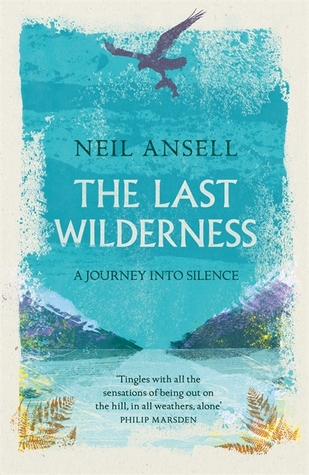 Ansell’s visits have the flavor of a pilgrimage: his wonder at the region’s sights and sounds, and particularly at the creatures he encounters, is akin to what one would experience in the presence of the holy; he also writes about wildlife as if it is a relic of a fast-vanishing world. “It is that exploratory desire to possess the wilds for ourselves that has resulted in their disappearance,” he notes. A true wilderness is unvisited, and true solitude is hard to experience “if the world is only a click away.”
Depicted against this backdrop of environmental damage are the author’s personal losses: a heart problem and progressive hearing loss mean that the world is narrowing in for him. He mourns each sign of diminishment, such as the meadow pipits whose call he can no longer hear. Depth of experience is replacing breadth for him, though flashbacks to his intrepid world travels – an African safari, hitchhiking in Australia, time in Sweden and Costa Rica – show that he has tried both approaches. There’s a good balance here between adventuring and the comfort of an increasingly familiar place.
Like “a tale told round a campfire,” Ansell’s is a meandering and slightly melancholy story that draws you in. If The Last Wilderness suffers, it’s mostly in comparison with his Deep Country (2011), one of the most memorable nature/travel books I’ve ever read, a modern-day Walden about his five years living in a cottage in the Welsh hills. Solitude and survival are more powerful themes there, though they echo here too. Once again, he writes of magical encounters with wildlife and gives philosophical reflections on the nature of the self. I can highly recommend Neil Ansell’s books to anyone who enjoys nature and travel writing.
My rating:
The Last Wilderness: A Journey into Silence will be published by Tinder Press on February 8th. My thanks to Becky Hunter for the review copy.
 Bookish Beck = Rebecca Foster. American transplant to England. Freelance proofreader and book reviewer.
 Bookish Beck