The Man I Became (Peirene)
The latest book from Peirene Press is narrated by a gorilla. That’s no secret: it’s an explicit warning given in the blurb. Yet the narrator doesn’t remain a gorilla. The clue is in the title: in The Man I Became, the eleventh novel by Belgian Flemish author Peter Verhelst (translated from the Dutch by David Colmer), various species are captured and forcibly humanized. Our narrator – whose name we never know – remembers his happy life in Africa:
We caught termites by pushing long twigs, as flexible as blades of grass, into their mounds and then licking the twigs clean. … We hung from branches one-handed to show off our muscles. We felt like princes and princesses. We were young and beautiful and our bliss was never going to end.
But soon his fellows start disappearing, and eventually the riders come for him too. He’s captured and marched across the desert to the sea to be shipped to the New World. The gorillas’ training begins soon after they arrive.
We learned to walk upright. ‘Faster! Taller!’ said the human. … Then we learned how to shave. … We learned a new language word by word. We learned to eat from a bowl and then with knife and fork. … We learned to powder our skin to make it lighter.
 At this point I started to get a bit nervous about the book’s racial connotations. Especially as the gorillas-in-transition become sexual objects, I wondered what Verhelst could be attempting to say about the notions of the noble savage and the purification of the race.
The creatures’ progress is carefully documented. They carry phones that function as identification as well as an external memory. The art of conversation is something they practice at cocktail parties, where the narrator learns that he and his kind are not the only ones; giraffes, buffalo, leopards, parrots, lions and bonobos have all been subjected to the same experiment. With all of them together in the same room, the animals have to suppress their natural fear reactions.
The narrator becomes an animal trainer for the evolution-in-action show at Dreamland, an amusement park with roller coasters and fast food. There are different classes of animals, you see; some remain animals and do menial duties, while a chosen few are transformed into humans. He halfheartedly looks for his brother and has a brief affair with Emily. When a violent incident leaves several dead and the narrator’s human is caught acquiring animals through the black market, Dreamland’s very existence is threatened. (If you know the history of the real Dreamland, a longtime Coney Island attraction, you may have an inkling.)
This novella is scarcely 120 pages. Short books can be wonderful, but that’s not the case if there’s no space to craft a believable plot. The pace is so quick here that there’s no chance to bed into scenes and settings, and the narrator is never entirely convincing – whether as a gorilla, a man or something in between. Too much of the book feels dreamlike and fragmentary.
Meanwhile, the ideology bothered me. Is this simply a social satire à la Animal Farm, to which it’s compared in the prefatory material? A sort of ‘some animals are more equal than others’ message? If so, then, well, that’s been done before. Nor is there any shortage of books mocking caste systems and eugenic experimentation. Apart from a handful of memorable lines, the prose is quite simplistic, and the overall storyline doesn’t feel original.
Verhelst has written that he was inspired by three things: a troop of cheeky baboons encountered in South Africa, the history of the early-twentieth-century Dreamland, and news of the completed human genome project. “What is a human? Is it a creature that can smile while walking on two legs? A creature with a signature and a mobile phone?” he asks. These are interesting questions, certainly, but I felt they were not explored with particular depth or panache here.
The Man I Became was my third Peirene book, after The Looking-Glass Sisters. This one was a disappointment, but I will not let that deter me from trying more, including the other two in the “Fairy Tale series: End of Innocence”: Marie Sizun’s Her Father’s Daughter and Linda Stift’s The Empress and the Cake.
With thanks to Peirene Press for the free copy.
My rating: 
Small Books Are Good, Too
Last week I wrote in praise of doorstoppers – books over 500 pages. But I also love really short books: there’s just as much writing skill involved in making a narrative concise, and it can be supremely satisfying to pick up a book and polish it off within a couple hours, especially if you’re in a situation of captured attention as on a plane. Being honest and slightly selfish for a moment, short books are also a great way to build up a flagging year list.
Below I highlight poetry collections, memoirs, short stories and novellas that should be on your agenda if you’re looking for a quick read (number of pages in brackets after each title):
Poetry
I try to always have a book of contemporary poetry on the go, usually by a British poet since I pluck these at random from my local public library shelves. Poetry collections aren’t always ‘quick’ reads, nor should they be, because you often have to read a poem more than once to understand it or truly appreciate its techniques. Still, with most poetry books numbering somewhere between 45 and 90 pages, even if you parcel them out over days or weeks they’ll take much less time than a novel. Pick up something by Mark Doty, Kathleen Jamie, David Harsent or Christopher Reid and you’ll have plenty of beautiful verse to ponder.
Recently reviewed and recommended:
- Learning to Make an Oud in Nazareth by Ruth Padel [80]
- All One Breath by John Burnside [96]
- Praise in Which I Live and Move and Have My Being by Paul Durcan [176]
Short Memoirs
Depending on how thorough they are, autobiographies can often hover around 300 or 400 pages. Looking through my shelves, though, I’ve spotted a few in the 140–160 page range: My Movie Business by John Irving [158], The Diving-Bell and the Butterfly by Jean-Dominique Bauby [139], and Winter by Rick Bass [162]. Another short one well worth reading is the unusual The Sound of a Wild Snail Eating by Elisabeth Tova Bailey [170], a story about debilitating illness and taking comfort from nature.
Abigail Thomas, one of my favorite memoirists, writes in an episodic style that makes her 200-page books fly by as if they were half that length. Also, Anne Lamott has written two very short faith memoirs that would serve as a good introduction to her style and content for those who haven’t read Traveling Mercies et al.: Help Thanks Wow [102] and Stitches [112].
Recently reviewed and recommended:
- The Two Kinds of Decay by Sarah Manguso [192]
- The Light of the World by Elizabeth Alexander [208]
- What Comes Next and How to Like It by Abigail Thomas [240] – also included on my BookTrib list of mother–daughter memoirs to read for Mother’s Day
Short Stories
I used to shy away from short stories because I didn’t think they were worth the emotional investment, but recently I’ve decided I really like the rhythm of picking up a set of characters, a storyline and a voice and then, after 20 or so pages, following an epiphany or an aporia (or utter confusion), trading them in for a whole new scenario. Short stories are also the perfect length for reading during a quick meal or car ride. Two short story collections made it onto my “Best of 2014” list: White Man’s Problems by Kevin Morris and The Heaven of Animals by David James Poissant.
Recently reviewed and recommended (no page numbers listed here because each story can stand alone):
- Wallflowers by Eliza Robertson
- Funny Once by Antonya Nelson
- Thunderstruck and Other Stories by Elizabeth McCracken
Novellas
With some credits for free Penguin books I got hold of Borges and the Eternal Orang-Utans by Luis Fernando Verissimo (translated from the Portuguese by Margaret Jull Costa) [135], a book I’d been hankering to read ever since I came across that terrific title. It’s an enjoyable academic comedy and locked room mystery, with nods to Borges and Poe (though I probably didn’t get them all).
I also recently discovered Peirene Press, which exclusively publishes novellas in translation. Their motto is “Contemporary European Literature. Thought provoking, well designed, short.” They publish the novellas in thematic trilogies, with headings such as “Male Dilemma: Quests for Intimacy” and “Small Epic: Unravelling Secrets.” The book I own from Peirene (scored from a secondhand bookshop in Henley-on-Thames for £1), from the “Turning Point: Revolutionary Moments” series, is Mr. Darwin’s Gardener by Kristina Carlson [122] (translated from the Finnish by Emily and Fleur Jeremiah).
It’s an odd little book, with a mixture of past and present tense and first-, third- and first-person plural narration. Set in the village of Downe, it’s peripherally about the title character, Charles Darwin’s gardener Thomas Davies, a new widower with two children, one of whom has Duchenne muscular dystrophy (newly identified). It’s thin on plot, it must be said. Daniel Lewis, the verger of Downe for five years, was dismissed for stealing from the church and is beaten up when he comes back to town; some characters think and talk about Darwin’s theory and Davies’s bereavement; there’s an overturned cart.
My favorite section, “At the Anchor,” is composed of conversations at the village pub, and my favorite individual lines reflect on Darwin’s influence on contemporary thought:
“Mr Darwin is a tree that spreads light, Thomas Davies thinks.”
“Great men are remembered, like Mr Darwin, a genuine monolith. We small folk are mere sand, washed by the waves as they go back and forth.”
“People in future decades and centuries will react to our ideas superciliously, as if we were children playing at thinking. We shall look most amusing in the light of new thoughts and inventions.”
If you’re looking to get through a classic in an afternoon, why not try one of these (full text available for free online through Project Gutenberg or other initiatives): Animal Farm by George Orwell [95], Ethan Frome by Edith Wharton [181] or Flush by Virginia Woolf (her spoof ‘biography’ of Elizabeth Barrett Browning’s cocker spaniel) [108]. E. M. Forster’s novels also read very quickly, and several of John Steinbeck’s novels are quite short. Whether or not you’ve seen the Audrey Hepburn movie, you’ll want to read the sparkling, bittersweet Breakfast at Tiffany’s by Truman Capote [100]; my edition also includes several of his best known short stories, including the wonderful “A Christmas Memory.”
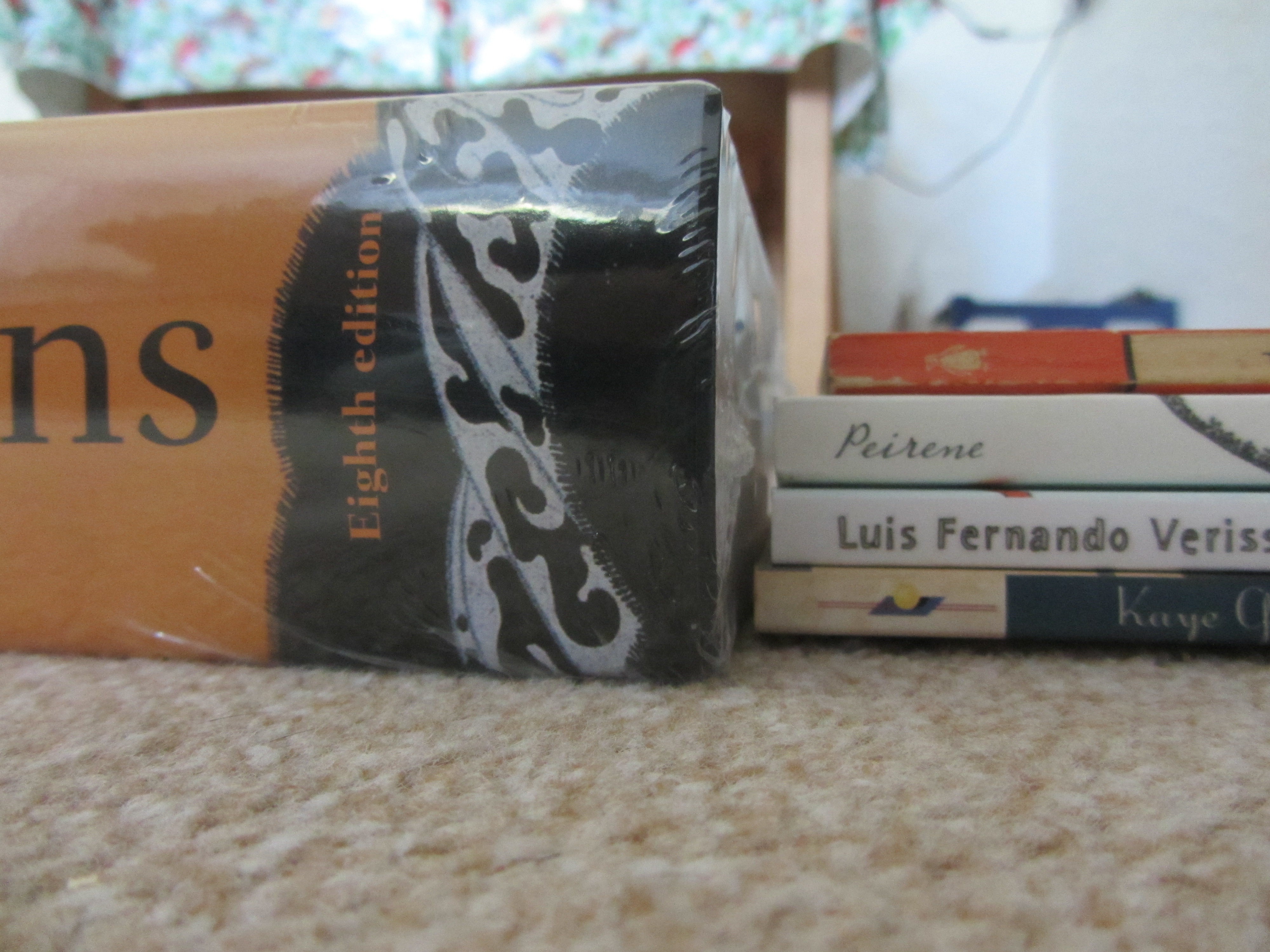
Even four novellas put together don’t stack up very far compared to the Oxford Dictionary of Quotations.
I recently finished The Bookshop by Penelope Fitzgerald [123]; all her books are similarly concise, so you may want to give her a try. The next novella on the pile for me is Ellen Foster by Kaye Gibbons [126]. I had never heard of the author, but the title and description lured me into buying it from a library book sale on a trip back to America (for 25 cents, why not?!). It’s a Southern Gothic story with an eleven-year-old narrator whom Walker Percy likened to Holden Caulfield. The alluring first line: “When I was little I would think of ways to kill my daddy.”
For more ideas, see these two Publishers Weekly’s lists:
“10 Best Books Shorter than 150 Pages” (only repeats one of my suggestions)
“10 Best Short Story Collections You’ve Never Read”
Off topic, but today is a milestone for me: it marks exactly two years that I’ve been a freelance writer!
Are you fond of short books? Do you prefer them to doorstoppers? What are some of your favorite novellas? All comments welcome!
 Bookish Beck = Rebecca Foster. American transplant to England. Freelance proofreader and book reviewer.
 Bookish Beck