Poetry Month Reviews & Interview: Amy Gerstler, Richard Scott, Etc.
April is National Poetry Month in the USA, and I was delighted to have several of my reviews plus an interview featured in a special poetry issue of Shelf Awareness on Friday. I’ve also recently read Richard Scott’s second collection.
Wrong Winds by Ahmad Almallah
Palestinian poet Ahmad Almallah’s razor-sharp third collection bears witness to the devastation of Gaza.
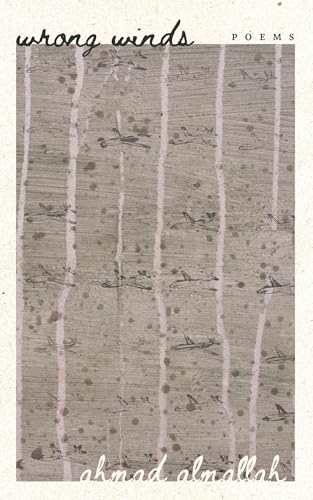 Through allusions, Almallah participates in an ancient lineage of poets, opening the collection with an homage to Al-Shanfarā and ending with “A Lament” for Zbigniew Herbert. Federico García Lorca is also a major influence. Occasional snippets of Arabic, French, and German, and accounts of travels in Berlin and Granada, reveal a cosmopolitan background. The speaker in “Loose Strings” considers exile, engaged in the potentially futile search for a homeland that is being destroyed: “What does it mean to be a poet, another ‘Homer’/ going home? Trying to find one?”
Tonally, anger and grief alternate, while alliteration and slant rhymes (sweat/sweet) create entrancing rhythms. In “Before Gaza, a Fall” and “My Tongue Is Tied Up Today,” staccato phrasing and spaced-out stanzas leave room for the unspeakable. The pièce de résistance is “A Holy Land, Wasted” (co-written with Huda Fakhreddine), which situates T.S. Eliot’s existential ruin in Palestine. Almallah contrasts Gaza then and now via childhood memories and adult experiences at checkpoints. His pastiche of “The Waste Land” starts off funny (“April is not that bad actually”) but quickly darkens, scorning those who turn away from tragedy: “It’s not good/ for your nerves to watch/ all that news, the sights/ of dead children.” The wordplay dazzles again here: “to motes the world crumbles, shattered/ like these useless mots.”
For Almallah, who now lives in Philadelphia, Gaza is elusive, enduringly potent—and mourned. Sometimes earnest, sometimes jaded, Wrong Winds is a remarkable memorial. 
Is This My Final Form? by Amy Gerstler
 Amy Gerstler’s exceptional book of poetry leaps from surrealism to elegy as it ponders life’s unpredictability.
The language of transformation is integrated throughout. Aging and the seasons are examples of everyday changes. “As Winter Sets In” delivers “every day/ a new face you can’t renounce or forsake.” “When I was a bird,” with its interspecies metamorphoses, introduces a more fantastical concept: “I once observed a scurry of squirrels,/ concealed in a hollow tree, wearing seventeenth/ century clothes. Alas, no one believes me.” Elsewhere, speakers fall in love with the bride of Frankenstein or turn to dinosaur urine for a wellness regimen.
The collection contains five thematic slices. Part I spotlights women behaving badly (such as “Marigold,” about a wild friend; and “Mae West Sonnet,” in an hourglass shape); Part II focuses on music and sound. The third section veers from the inherited grief of “Schmaltz Alert” to the miniplay “Siren Island,” a tragicomic Shakespearean pastiche. Part IV spins elegies for lives and works cut short. The final subset includes a tongue-in-cheek account of pandemic lockdown activities (“The Cure”) and wry advice for coping (“Wound Care Instructions”).
Monologues and sonnets recur—the title’s “form” refers to poetic structures as much as to personal identity. Alliteration plus internal and end rhymes create satisfying resonance. In the closing poem, “Night Herons,” nature puts life into perspective: “the whir of wings/ real or imagined/ blurs trivial things.”
This delightfully odd collection amazes with its range of voices and techniques.
I also had the chance to interview Amy Gerstler, whose work was new to me. (I’ll certainly be reading more!) We chatted about animals, poetic forms and tone, Covid, the Los Angeles fires, and women behaving ‘badly’. 
Little Mercy by Robin Walter
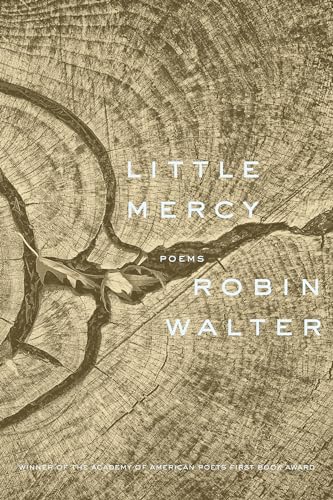 In Robin Walter’s refined debut collection, nature and language are saving graces.
Many of Walter’s poems are as economical as haiku. “Lilies” entrances with its brief lines, alliteration, and sibilance: “Come/ dark, white/ petals// pull/close// —small fists// of night—.” A poem’s title often leads directly into the text: “Here” continues “the body, yes,/ sometimes// a river—little/ mercy.” Vocabulary and imagery reverberate, as the blessings of morning sunshine and a snow-covered meadow salve an unquiet soul (“how often, really, I want/ to end my life”).
Frequent dashes suggest affinity with Emily Dickinson, whose trademark themes of loss, nature, and loneliness are ubiquitous here, too. Vistas of the American West are a backdrop for pronghorn antelope, timothy grass, and especially the wrens nesting in Walter’s porch. Animals are also seen in peril sometimes: the family dog her father kicked in anger or a roadkilled fox she encounters. Despite the occasional fragility of the natural world, the speaker is “held by” it and granted “kinship” with its creatures. (How appropriate, she writes, that her mother named her for a bird.)
The collection skillfully illustrates how language arises from nature (“while picking raspberries/ yesterday I wanted to hold in my head// the delicious names of the things I saw/ so as to fold them into a poem later”—a lovely internal rhyme) and becomes a memorial: “Here, on earth,/ we honor our dead// by holding their names/ gentle in our hollow mouths—.”
This poised, place-saturated collection illuminates life’s little mercies. 
The three reviews above are posted with permission from Shelf Awareness.
That Broke into Shining Crystals by Richard Scott
 I’ve never forgotten how powerful it was to hear Richard Scott read aloud from his forthcoming collection, Soho, at the Faber Spring Party in February 2018. Back then I called his work “amazingly intimate,” and that is true of this second collection as well.
It also mirrors his debut in that the book is in several discrete sections – like movements of a musical composition – and there are extended allusions to particular poets (there, Paul Verlaine and Walt Whitman; here, Andrew Marvell and Arthur Rimbaud). But there is one overall theme, and it’s a tough one: Scott’s boyhood grooming and molestation by a male adult, and how the trauma continues to affect him.
Part I contains 21 “Still Life” poems based on particular paintings, mostly by Dutch or French artists (see the Notes at the end for details). I preferred to read the poems blind so that I didn’t have the visual inspiration in my head. The imagery is startlingly erotic: the collection opens with “Like a foreskin being pulled back, the damask / reveals – pelvic bowl of pink-fringed shadow” (“Still Life with Rose”) and “Still Life with Bananas” starts “curved like dicks they sit – cosy in wicker – an orgy / of total yellowness – all plenty and arching – beyond / erect – a basketful of morning sex and sugar and sunlight”.
“O I should have been the / snail,” the poet laments; “Living phallus that can hide when threatened. But / I’m the oyster. … Cold jelly mess of a / boy shucked wide open.” The still life format allows him to freeze himself at particular moments of abuse or personal growth; “still” can refer to his passivity then as well as to his ongoing struggle with PTSD.
Part II, “Coy,” is what Scott calls a found poem or “vocabularyclept,” rearranging the words from Marvell’s 1681 “To His Coy Mistress” into 21 stanzas. The constraint means the phrases are not always grammatical, and the section as a whole is quite repetitive.
The title of the book (and of its final section) comes from Rimbaud and, according to the Notes, the 22 poems “all speak back to Arthur Rimbaud’s Illuminations but through the prism of various crystals and semi-precious stones – and their geological and healing properties.” My lack of familiarity with Rimbaud and his circle made me wonder if I was missing something, yet I thrilled to how visual the poems in this section were.
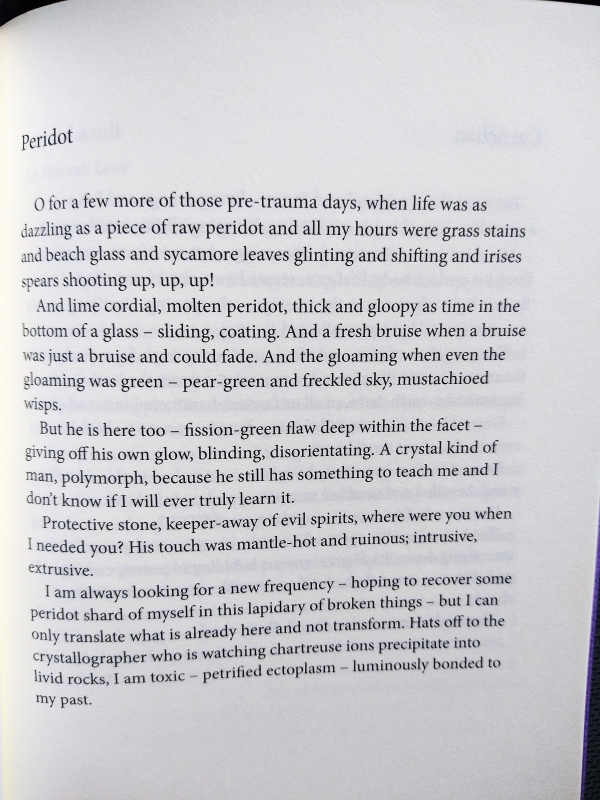
As with the Still Lifes, there’s an elevated vocabulary, forming a rich panoply of plants, creatures, stones, and colours. Alliteration features prominently throughout, as in “Citrine”: “O citrine – patron saint of the molested, sunny eliminator – crown us with your polychromatic glittering and awe-flecks. Offer abundance to those of us quarried. A boy is igneous.”
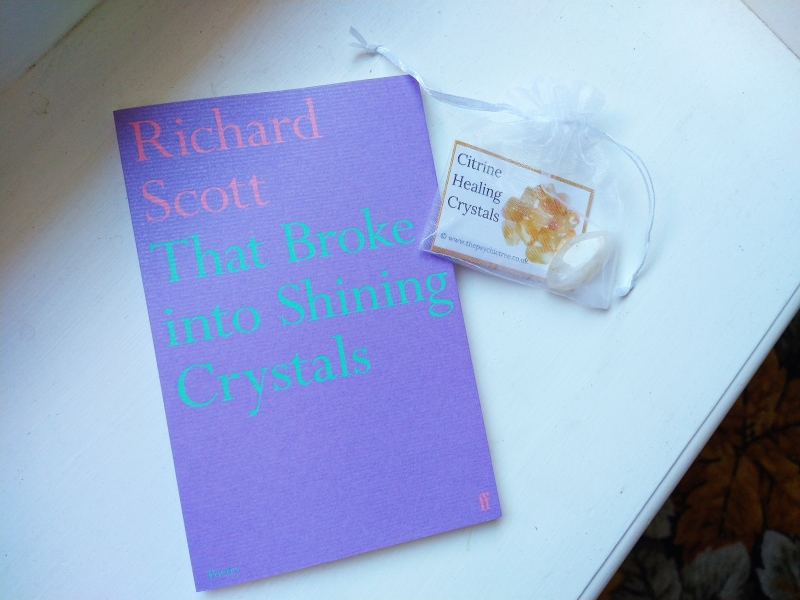
I’ve photographed “Peridot” (which was my mother’s birthstone) as an example of the before-and-after setup, the gorgeous language including alliteration, the rhetorical questioning, and the longing for lost innocence.
It was surprising to me that Scott refers to molestation and trauma so often by name, rather than being more elliptical – as poetry would allow. Though I admire this collection, my warmth towards it ebbed and flowed: I loved the first section; felt alienated by the second; and then found the third rather too much of a good thing. Perhaps encountering Part I or III as a chapbook would have been more effective. As it is, I didn’t feel the sections fully meshed, and the theme loses energy the more obsessively it’s repeated. Nonetheless, I’d recommend it to readers of Mark Doty, Andrew McMillan and Brandon Taylor.
Published today. With thanks to Faber for the free copy for review. An abridged version of this review first appeared in my Instagram post of 11 April.
Read any good poetry recently?
To Paradise by Hanya Yanagihara (Doorstopper of the Quarter)
When I expressed interest in Hanya Yanagihara’s To Paradise on Twitter, having loved A Little Life and tepidly admired The People in the Trees, I didn’t expect to be chosen to receive one of my most anticipated releases of the year. A proof arrived while I was in the States for Christmas. As soon as I got back, I started it – with a vision of doing little else but reading it for a few days and reviewing it early in January. Instead, I read about 30 pages and set it aside, the 700-page heft mocking me from my coffee table stack for the better part of two months. Finally, I forced myself to set a daily reading goal: first 30 pages, then 40, then 60; and on Friday I read the last 100 pages over a couple sessions in the summerhouse. That regimented approach was what it took for me to get through my first doorstopper of the year.
The novel is in three parts – discrete enough to feel like separate books – set largely in 1893, 1993, and 2093. New York City’s Washington Square, even one particular house, recurs as a setting in all three, with some references to the American West and South and with flashbacks to time in Hawaii linking Books II and III.
The overarching theme is the American project: is freedom, both individual and collective, a worthy and attainable goal? Or are the country’s schisms too deep to be overcome? Class, race, sexuality, and physical and mental illness are some of the differences that Yanagihara explores. Even when equality of treatment has been won in one time and scenario – same-sex marriage is de rigueur in her alternative version of the 1890s, where the USA is divided into several nations – there is always the threat of a taken-for-granted right being retracted.
In Book I, David Bingham, who is to inherit his grandfather’s Washington Square property, considers a family-approved arranged marriage with an older man, Charles, versus eloping with a lower-class male teacher, Edward, with whom he has fallen in love. Edward wants them to light out for California, where new opportunities await but homosexuality is outlawed. Can they live in freedom if they’re repressing an essential part of their identity? The austere, elegant tone is a pitch-perfect pastiche of Henry James or Edith Wharton. Although this section took me the longest to read, it was the one I most appreciated for its flawless evocation of the time period and a rigid class structure. As in The Underground Railroad, though, the alt-history angle wasn’t really the most memorable aspect.
In Book II, David Bingham, also known as Kawika, is a paralegal having a secret affair with Charles, a partner in his law firm. Various friends and former lovers in their circle have AIDS, but Charles’s best friend Peter is dying of cancer. Before Peter flies to Switzerland for an assisted death, Charles throws him one last dinner party. Meanwhile, David receives a long letter from his ill father recounting their descent from Indigenous nobility and his failed attempt to set up a self-sufficient farm on their inherited land in Hawaii. This strand is closest to Yanagihara’s previous novels, the gay friendship circle reminiscent of A Little Life and the primitive back-to-the-land story recalling The People in the Trees. I also thought of Mrs Dalloway – David wanted to get the flowers for the party himself – and of Three Junes.
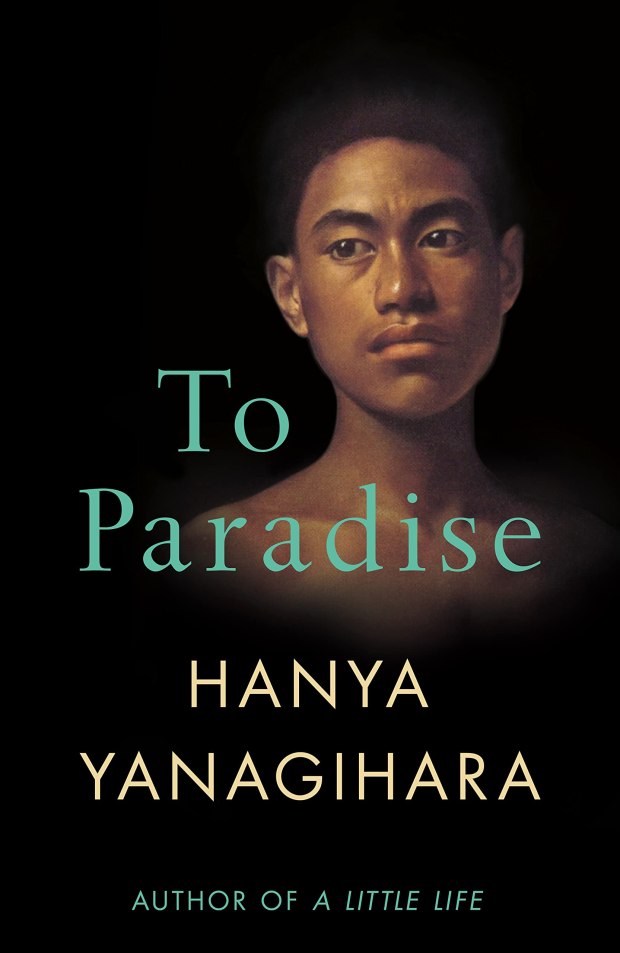 Book III is set in a dystopian future of extreme heat, rationing and near-constant pandemics. The totalitarian state institutes ever more draconian policies, with censorship, quarantine camps and public execution of insurgents. The narrator, intellectually disabled after a childhood illness, describes the restrictions with the flat affect of the title robot from Kazuo Ishiguro’s Klara and the Sun. When a stranger offers her the chance to escape, she is forced to weigh up freedom against safety. An alternating strand, based around letters sent by a Chinese Hawaiian character, traces how things got this bad, from the 2040s onwards.
While the closing speculative vision is all too plausible, two other literary/science fiction releases I’ve read this year, Sea of Tranquillity by Emily St. John Mandel and How High We Go in the Dark by Sequoia Nagamatsu, are more powerful and direct. Book III takes up half of the text and could stand alone, but the fact that it appears as a culmination of two other narratives creates false expectations that it can’t meet. The connections between the three are incidental – abandonment by a mother, a child raised by a grandparent, an arranged marriage, isolating illness – with recurring tactics like stories within stories and epistolary sections. The most overt cohesive strategy, the repeating of names across time periods, feels gimmicky and, again, sets readers up for a letdown by promising meaning that isn’t there.
Ultimately, the message seems to be: America’s problems are inherent, and so persist despite apparent progress. It takes a lot of words to build to that somewhat obvious point. I couldn’t suppress my disappointment that none of the storylines are resolved – this does, however, mean that one can choose to believe things will turn out happily for the characters. Their yearning for a more authentic life, even in a rotten state, makes it easy to empathize with their situations. I had high regard for the self-assured cross-genre prose (my interest waning only during the elder Kawika’s improbably long letter), but felt the ambition perhaps outshone the achievement.
As I learned when reviewing a recent book about American utopian projects, Heaven Is a Place on Earth, and interviewing its author, Adrian Shirk, an imagined utopia and a projected dystopia aren’t actually so different. Here was her response to one of my questions:
At one point you say, “utopia is never far from its opposite.” Dystopian novels are as popular as ever. To what extent do you think real-life utopias and fictional dystopias have the same aims?
I think real-life utopian experiments and fictional dystopias both offer warnings about the dangers of relying too much on ideology, and not enough on living, or choosing the person over the belief. So, in that way, real utopian experiments and fictional dystopian narratives are two sides of the same coin: a dystopia is a utopia that lost sight of—or never included—understanding itself as resistance to a violent empire, and thus starts to look like a violent empire itself.
Both start by diagnosing a societal sickness. The question is how we then get to paradise.
Page count: 701
Book I: 
Book II:
Book III: 
My overall rating:
With thanks to Picador for the proof copy for review.
Imitation Is the Sincerest Form of Flattery: Costello, O’Shaughnessy & Smyth
These three books – two novels and a memoir – pay loving tribute to a particular nineteenth- or twentieth-century writer. In each case, the author incorporates passages of pastiche, moving beyond thematic similarity to make their language an additional homage.
Although I enjoyed the three books very much, they differ in terms of how familiar you should be with the source material before embarkation. So while they were all reads for me, I have added a note below each review to indicate the level of prior knowledge needed.
The River Capture by Mary Costello
 Luke O’Brien has taken a long sabbatical from his teaching job in Dublin and is back living at the family farm beside the river in Waterford. Though only in his mid-thirties, he seems like a man of sorrows, often dwelling on the loss of parents, aunts and romantic relationships with both men and women. He takes quiet pleasure in food, the company of pets, and books, including his extensive collection on James Joyce, about whom he’d like to write a tome of his own. The novel’s very gentle crisis comes when Luke falls for Ruth and it emerges that her late father ruined his beloved Aunt Ellen’s reputation.
At this point a troubled Luke is driven into 100+ pages of sinuous contemplation, a bravura section of short fragments headed by questions. Rather like a catechism, it’s a playful way of organizing his thoughts and likely more than a little Joycean in approach – I’ve read Portrait of the Artist and Dubliners but not Ulysses or Finnegans Wake, so I feel less than able to comment on the literary ventriloquism, but I found this a pleasingly over-the-top stream-of-consciousness that ranges from the profound (“What fear suddenly assails him? The arrival of the noonday demon”) to the scatological (“At what point does he urinate? At approximately three-quarters of the way up the avenue”).
While this doesn’t quite match Costello’s near-perfect novella, Academy Street, it’s an impressive experiment in voice and style, and the treatment of Luke’s bisexuality struck me as sensitive – an apt metaphorical manifestation of the novel’s focus on fluidity. (See also Susan’s excellent review.)
Why Joyce? “integrity … commitment to the quotidian … refusal to take conventions for granted”
Familiarity required: Moderate
Also recommended: The Sixteenth of June by Maya Lang
With thanks to Canongate for the free copy for review.
In Love with George Eliot by Kathy O’Shaughnessy
Many characters, fictional and historical, are in love with George Eliot over the course of this debut novel by a literary editor. The whole thing is a book within a book – fiction being written by Kate, an academic at London’s Queen Elizabeth College who’s preparing for two conferences on Eliot and a new co-taught course on life writing at the same time as she completes her novel, which blends biographical information and imagined scenes.
 1857: Eliot is living with George Henry Lewes, her common-law husband, and working on Adam Bede, which becomes a runaway success, not least because of speculation about its anonymous author. 1880: The great author’s death leaves behind a mentally unstable widower 20 years her junior, John Walter Cross, once such a close family friend that she and Lewes called him “Nephew.”
Between these points are intriguing vignettes from Eliot’s life with her two great loves, and insight into her scandalous position in Victorian society. Her estrangement from her dear brother (the model for Tom in The Mill on the Floss) is a plangent refrain, while interactions with female friends who have accepted the norms of marriage and motherhood reveal just how transgressive her life is perceived to be.
In the historical sections O’Shaughnessy mimics Victorian prose ably, yet avoids the convoluted syntax that can make Eliot challenging. I might have liked a bit more of the contemporary story line, in which Kate and an alluring colleague make their way to Venice (the site of Eliot’s legendarily disastrous honeymoon trip with Cross), but by making this a minor thread O’Shaughnessy ensures that the spotlight remains on Eliot throughout.
Highlights: A cameo appearance by Henry James; a surprisingly sexy passage in which Cross and Eliot read Dante aloud to each other and share their first kiss.
Why Eliot? “As an artist, this was her task, to move the reader to see people in the round.”
Familiarity required: Low
Also recommended: 142 Strand by Rosemary Ashton, Sophie and the Sibyl by Patricia Duncker, and My Life in Middlemarch by Rebecca Mead
With thanks to Scribe UK for the free copy for review.
All the Lives We Ever Lived: Seeking Solace in Virginia Woolf by Katharine Smyth
 Smyth first read To the Lighthouse in Christmas 2001, during her junior year abroad at Oxford. Shortly thereafter her father had surgery in Boston to remove his bladder, one of many operations he’d had during a decade battling cancer. But even this new health scare wasn’t enough to keep him from returning to his habitual three bottles of wine a day. Woolf was there for Smyth during this crisis and all the time leading up to her father’s death, with Lighthouse and Woolf’s own life reflecting Smyth’s experience in unanticipated ways. The Smyths’ Rhode Island beach house, for instance, was reminiscent of the Stephens’ home in Cornwall. Woolf’s mother’s death was an end to the summer visits, and to her childhood; Lighthouse would become her elegy to those bygone days.
Often a short passage by or about Woolf is enough to launch Smyth back into her memories. As an only child, she envied the busy family life of the Ramsays in Lighthouse. She delves into the mystery of her parents’ marriage and her father’s faltering architecture career. She also undertakes Woolf tourism, including the Cornwall cottage, Knole, Charleston and Monk’s House (where Woolf wrote most of Lighthouse). Her writing is dreamy, mingling past and present as she muses on time and grief. The passages of Woolf pastiche are obvious but short enough not to overstay their welcome; as in the Costello, they tend to feature water imagery. It’s a most unusual book in the conception, but for Woolf fans especially, it works. However, I wished I had read Lighthouse more recently than 16.5 years ago – it’s one to reread.
Why Woolf? “I think it’s Woolf’s mastery of moments like these—moments that hold up a mirror to our private tumult while also revealing how much we as humans share—that most draws me to her.”
Undergraduate wisdom: “Woolf’s technique: taking a very complex (usually female) character and using her mind as an emblem of all minds” [copied from notes I took during a lecture on To the Lighthouse in a “Modern Wasteland” course during my sophomore year of college]
Familiarity required: High
Also recommended: Virginia Woolf in Manhattan by Maggie Gee, Vanessa and Her Sister by Priya Parmar, and Adeline by Norah Vincent
With thanks to Atlantic Books for the free copy for review.
 Bookish Beck = Rebecca Foster. American transplant to England. Freelance proofreader and book reviewer.
 Bookish Beck