Signs of Life: To the Ends of the Earth with a Doctor by Stephen Fabes
Stephen Fabes is an emergency room doctor at St Thomas’s Hospital, London. Not exciting enough for you? Well, he also spent six years of the past decade cycling six continents (so, all bar Antarctica). His statistics are beyond impressive: 53,568 miles, 102 international borders, 1000+ nights of free camping, 26 bicycle tires, and 23 journals filled with his experiences. A warm-up was cycling the length of Chile with his brother at age 19. After medical school in Liverpool and starting his career in London, he found himself restless and again longing for adventure. The round-the-world cycle he planned fell into four sections: London to Cape Town, the West Coast of the Americas, Melbourne to Mumbai, and Hong Kong to home.
Signs of Life is a warm-hearted and laugh-out-loud funny account of Fabes’ travels, achieving a spot-on balance between major world events, the everyday discomforts of long-distance cycling and rough camping, and his humanitarian volunteering. He is a witness to the Occupy movement in Hong Kong, the aftermath of drought and tribal conflict in Africa, and the refugee crisis via the “Jungle” migrant camp in Calais. The desperate situations he saw while putting his medical expertise to good use in short bursts – e.g., at a floating clinic on a Cambodian lake, a malaria research center in Thailand, a leper hospital in Nepal, and a mental health rehabilitation clinic in Mumbai – put into perspective more minor annoyances like fire ants in El Salvador, Indonesian traffic, extreme cold in Mongolia, and camel spiders.

Wherever he went, Fabes met with kindness from strangers, even those who started off seeming hostile – having pitched his tent by a derelict cabin in Peru, he was alarmed to awake to a man pointing a gun at him, but the illicit gold miner soon determined he was harmless and offered him some soup. (Police officers and border guards were perhaps a bit less hospitable.) He also had occasional companions along the route, including a former housemate and a one-time girlfriend. Even limited shared language was enough to form common ground with a stranger-turned-fellow cyclist for a week or so. We get surprising glimpses of how Anglo-American culture permeates the developing world: For some reason, in the ‒Stans everyone’s point of reference when he introduced himself was Steven Seagal.
At nearly 400 pages, the memoir is on the long side, though I can see that it must have felt impossible to condense six years of adventures any further. I was less interested in the potted histories of other famous cyclists’ travels and would have appreciated a clearer sense to the passing of time, perhaps in the form of a date stamp at the head of each chapter. One of my favorite aspects of the book, though, was the use of medical metaphors to link geography to his experiences. Most chapters are titled after health vocabulary; for instance, in “Membranes” he ponders whether country borders are more like scars or cell membranes.
Fabes emphasizes, in a final chapter on the state of the West upon his return in early 2016, that, in all the most important ways, people are the same the world over. Whether in the UK or Southeast Asia, he sees poverty as the major factor in illness, perpetuating the inequality of access to adequate healthcare. Curiosity and empathy are his guides as he approaches each patient’s health as a story. Reflecting on the pandemic, which hit just as he was finalizing the manuscript, he prescribes global cooperation and innovation for this time of uncertainty.
We’re all armchair travelers this year, but this book is especially for you if you enjoy Bill Bryson’s sense of humor, think Dervla Murphy was a badass in Full Tilt, and enjoyed War Doctor by David Nott and/or The Crossway by Guy Stagg. It’s one of my top few predictions for next year’s Wellcome Book Prize – fingers crossed it will go ahead after the 2020 hiatus.
My rating: 
With thanks to Dr Fabes and Profile Books for the free copy for review.
Wigtown Book Festival 2020: The Bookshop Band, Bythell, O’Connell & Stuart
During the coronavirus pandemic, we have had to take small pleasures where we can. One of the highlights of lockdown for me has been the chance to participate in literary events like book-themed concerts, prize shortlist announcements, book club discussions, live literary award ceremonies and book festivals that time, distance and cost might otherwise have precluded.
In May I attended several digital Hay Festival events, and this September to early October I’ve been delighted to journey back to Wigtown, Scotland – even if only virtually.
The Bookshop Band
The Bookshop Band have been a constant for me this year. After watching their 21 Friday evening lockdown shows on Facebook, as well as a couple of one-off performances for other festivals, I have spent so much time with them in their living room that they feel more like family than a favorite band. Add to that four of the daily breakfast chat shows from the Wigtown Book Festival and I’ve seen them play over 25 times this year already!
(The still below shows them with, clockwise from bottom left, guests Emma Hooper, Stephen Rutt and Jason Webster.)

Ben and Beth’s conversations with featured authors and local movers and shakers, punctuated by one song per guest, were pleasant to have on in the background while working. The songs they performed were, ideally, written for those authors’ books, but other times just what seemed most relevant; at times this was a stretch! I especially liked seeing Donal Ryan, about whose The Spinning Heart they’ve recently written a terrific song; Kate Mosse, who has been unable to write during lockdown so (re)read 200 books instead, including all of Agatha Christie, Ngaio Marsh et al.; and Ned Beauman, who is nearing the deadline for his next novel, a near-future story of two scientists looking for traces of the venomous lumpsucker (a made-up fish) in the Baltic Sea. Closer to science fiction than his previous work, it’s a funny take on extinctions, he said. I’ve read all of his published work, so I’m looking forward to this one.
Shaun Bythell
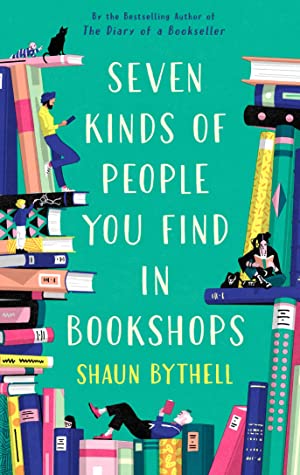 The opening event of the Festival was an in-person chat between Lee Randall and Shaun Bythell in Wigtown, rather than the split-screen virtual meet-ups that made up the rest of my viewing. Bythell, owner of The Book Shop, has become Wigtown’s literary celebrity through The Diary of a Bookseller and its sequel. In early November he has a new book coming out, Seven Kinds of People You Find in Bookshops. I’m halfway through it and it has more substance than its stocking-stuffer dimensions would imply. Within his seven categories are multiple subcategories, all given tongue-in-cheek Latin names, as if he’s naming species.
The Book Shop closed for 116 days during COVID-19: the only time in more than 40 years that it has been closed for longer than just over the Christmas holidays. He said that it has been so nice to see customers again; they’ve been a ray of sunshine for him, something the curmudgeon would never usually say! Business has been booming since his reopening, with Agatha Christie his best seller – it’s not just Mosse who’s turning to cozy mysteries. He’s also been touched by the kindness of strangers, such as one from Monaco who sent him £300, having read an article by Margaret Atwood about how hard it is for small businesses just now and hoping it would help the shop survive until they could get there in person.
(Below: Bythell on his 50th birthday, with Captain the cat.)

Randall and Bythell discussed a few of the types of customers he regularly encounters. One is the autodidact, who knows more than you and intends for you to know it. This is not the same, though, as the expert who actually helps you by sharing their knowledge (of a rare cover version on an ordinary-looking crime paperback, for instance). There’s also the occultists, the erotica browsers, the local historians and the young families – now that he has one of his own, he’s become a bit more tolerant.
Mark O’Connell
 Appearing from Dublin, Mark O’Connell was interviewed by Scottish writer and critic Stuart Kelly about his latest book, Notes from an Apocalypse (my review). He noted that, while all authors hope their books are timely, perhaps he overshot with this one! The book opens with climate change as the most immediate threat, yet now he feels that “has receded as the locus of anxiety.” O’Connell described the “flattened” experience of being alive at the moment and contrasted it with the existential awfulness of his research travels. For instance, he read a passage from the book about being at an airport Yo Sushi! chain and having a vision of horror at the rampant consumerism its conveyor belt seemed to represent.
Kelly characterized O’Connell’s personal, self-conscious approach to the end of the world as “brave,” while O’Connell said, “in terms of mental health, I should have chosen any other topic!” Having children creates both vulnerability and possibility, he contended, and “it doesn’t do you any good as a parent to indulge in those predilections [towards extreme pessimism].” They discussed preppers’ white male privilege, New Zealand and Mars as havens, and Greta Thunberg and David Attenborough as saints of the climate crisis.

O’Connell pinpointed Dr. Seuss’s The Lorax as the work he spends more time on in his book than any other; none of your classic nihilist literature here, and he deliberately avoided bringing up biblical references in his secular approach. In terms of the author he’s reached for most over the last few years, and especially during lockdown, it’s got to be Annie Dillard. Speaking of the human species, he opined, “it should not be unimaginable that we should cease to exist at some point.”
This talk didn’t add much to my experience of reading the book (vice versa would probably be true, too – I got the gist of Roman Krznaric’s recent thinking from his Hay Festival talk and so haven’t been engaging with his book as much as I’d like), but it was nice to see O’Connell ‘in person’ since he couldn’t make it to the 2018 Wellcome Book Prize ceremony.
Douglas Stuart
Glasgow-born Douglas Stuart is a fashion designer in New York City. Again the interviewer was Lee Randall, an American journalist based in Edinburgh – she joked that she and Stuart have swapped places. Stuart said he started writing his Booker-shortlisted novel, Shuggie Bain, 12 years ago, and kept it private for much of that time. Although he and Randall seemed keen to downplay how autobiographical the work is, like his title character, Stuart grew up in 1980s Glasgow with an alcoholic single mother. As a gay boy, he felt he didn’t have a voice in Thatcher’s Britain. He knew many strong women who were looked down on for being poor.
 It’s impossible to write an apolitical book about poverty (or a Glasgow book without dialect), Stuart acknowledged, yet he insisted that the novel is primarily “a portrait of two souls moving through the world,” a love story about Shuggie and his mother, Agnes. The author read a passage from the start of Chapter 2, when readers first meet Agnes, the heart of the book. Randall asked about sex as currency and postulated that all Agnes – or any of these characters; or any of us, really – wants is someone whose face lights up when they see you.
The name “Shuggie” was borrowed from a small-town criminal in his housing scheme; it struck him as ironic that a thug had such a sweet nickname. Stuart said that writing the book was healing for him. He thinks that men who drink and can’t escape poverty are often seen as loveable rogues, while women are condemned for how they fail their children. Through Agnes, he wanted to add some nuance to that double standard.
The draft of Shuggie Bain was 900 pages, single-spaced, but his editor helped him cut it while simultaneously drawing out the important backstories of Agnes and some other characters. He had almost finished his second novel by the time Shuggie was published, so he hopes it will be with readers soon.
[I have reluctantly DNFed Shuggie Bain at p. 100, but I’ll keep my proof copy on the shelf in case one day I feel like trying it again – especially if, as seems likely, it wins the Booker Prize.]
Booker Prize 2020: Longlist Progress & Shortlist Predictions
The 2020 Booker Prize shortlist will be announced tomorrow, September 15th. Following on from my initial thoughts … I’ve only managed to read one more book from the longlist, reviewed in brief below along with some thoughts on a few other nominees I’ve sampled.
Burnt Sugar by Avni Doshi
 This short, intense novel is about two women locked into resentful competition. Tara and Antara also happen to be mother and daughter. When the long-divorced Tara shows signs of dementia, artist Antara and her American-born husband Dilip take her into their home in Pune, India. Her mother’s criticism and strange behavior stir up flashbacks to the 1980s and 1990s, when Antara felt abandoned by Tara during the four years they lived in an ashram and then her time at boarding school. Emotional turmoil led to medical manifestations like excretory issues and an eating disorder, and both women fell in love in turn with a homeless photographer named Reza Pine.
When Antara learns she is pregnant, the whole cycle of guilt and maternal ambivalence looks set to start again. Memory is precarious and full of potential hurt here, and Antara’s impassive narration is perfectly suited to the story of a toxic relationship. Neither the UK title nor the one for the original Indian publication (Girl in White Cotton) seems quite right to me; I might have chosen something related to the cover and endpaper image of the aloe plant: something that is as spiky as a cactus yet holds out hope of balm. This was a good fictional follow-up to a memoir I read earlier in the year about dementia’s effect on an Indian-American mother–daughter pair, What We Carry by Maya Shanbhag Lang.
Favorite passages:
It seems to me now that this forgetting is convenient, that she doesn’t want to remember the things she has said and done. It feels unfair that she can put away the past from her mind while I’m brimming with it all the time. I fill papers, drawers, entire rooms with records, notes, thoughts, while she grows foggier with each passing day.
I will never be free of her. She’s in my marrow and I’ll never be immune.
My rating: 
My thanks to Hamish Hamilton for the free copy for review.
DNFed:
Apeirogon by Colum McCann
 Reminiscent of the work of David Grossman, this is the story of two fathers, one Israeli and one Palestinian, who lost their daughters to the ongoing conflict between their nations: Rami Elhanan’s 13-year-old daughter Smadar was killed by a Palestinian suicide bomber, while Bassam Aramin’s 10-year-old daughter Abir was shot by Israeli border police. The two men become unlikely friends through their work with a peacemaking organization, with Bassam also expanding his sense of compassion through his studies of the Holocaust.
It doesn’t take long to piece the men’s basic stories together. But the novel just keeps going. It’s in numbered vignettes ranging in length from one line to a few pages, and McCann brings in many tangentially related topics such as politics, anatomy, and religious history. Bird migration is frequently used as a metaphor. Word association means some lines feel arbitrary and throwaway. Looking ahead, I could see the numbering goes up to 500, at which point there is a long central section narrated in turn by the two main characters, and then goes back down to 1, mimicking the structure of the One Thousand and One Nights, mentioned in #101.
The narrative sags under the challenge McCann has set for himself. At 200 pages, this might have been a masterpiece. Though still powerful, it sprawls into repetition and pretension. (I read the first 150 pages.)
My rating: 
Set aside temporarily:
 The New Wilderness by Diane Cook: The blurb promised an interesting mother–daughter relationship, but so far this is dystopia by numbers. A wilderness living experiment started with 20 volunteers, but illnesses and accidents have reduced their number. Bea was an interior decorator and her partner, Glen, a professor of anthropology – their packing list and habits echo primitive human culture. I loved the rituals around a porcelain teacup, but in general the plot and characters weren’t promising. I read Part I (47 pages) and would only resume if this makes the shortlist, which seems unlikely. (See this extraordinarily detailed 1-star Goodreads review from someone who DNFed the novel near where I am now.)
 Shuggie Bain by Douglas Stuart: Dialect + depressing subject matter = a hard slog. Poverty and alcoholism make life in 1980s Glasgow a grim prospect for Agnes Bain and her three children. So far, the novel is sticking with the parents and the older children, with the title character barely getting a mention. I did love the scene where Catherine goes to Leek’s den in the pallet factory. This is a lot like the account Damian Barr gives of his childhood in Maggie & Me. I left off on page 82 but will go back to this if it makes the shortlist.
So that makes a total of 2 read, 4 DNFed, 2 set aside (and might yet DNF), 2 I still hope to read (one of which I’m awaiting from the library; the other is on my birthday wish list), and 3 I don’t intend to read. Not a great showing at all this year!
Still, I can never resist an opportunity to make predictions about a prize shortlist, so here’s what I expect to still be in the running after tomorrow. Weighty, diverse; a mixture of historical and contemporary.
- The Mirror & The Light by Hilary Mantel (will win)
- Apeirogon by Colum McCann
- The Shadow King by Maaza Mengiste
- Shuggie Bain by Douglas Stuart
- Real Life by Brandon Taylor
- How Much of These Hills Is Gold by C. Pam Zhang
What have you read from the longlist? What do you expect to be shortlisted?
Classic of the Month: Down and Out in Paris and London by George Orwell (1933)
I’d of course read Animal Farm and Nineteen Eighty-Four, but this was my first taste of George Orwell’s nonfiction. It was his first book, published when he was 30, and is an excellent first-hand account of the working and living conditions of the poor in two world cities. I started it on the Eurostar between London and Paris and have enjoyed dipping into it over the past couple of weeks. I most appreciated the first two-thirds, in which Orwell is working as a dishwasher and waiter in Paris hotel restaurants for up to 80 hours a week and has to pawn his clothes to scrape together enough money to ward off starvation. Chapter 3 is a masterful piece of writing that, with its second-person address, puts the reader right into this desperate situation with him. The matter-of-fact words about poverty and hunger are incisive:
Hunger reduces one to an utterly spineless, brainless condition, more like the after-effects of influenza than anything else. It is as though one had turned into a jellyfish, or as though all one’s blood had been pumped out and luke-warm water substituted. Complete inertia is my chief memory of hunger
Two bad days followed. We had only sixty centimes left, and we spent it on half a pound of bread, with a piece of garlic to rub it with. The point of rubbing garlic on bread is that the taste lingers and gives one the illusion of having fed recently.
It is disagreeable to eat out of a newspaper on a public seat, especially in the Tuileries, which are generally full of pretty girls, but I was too hungry to care.
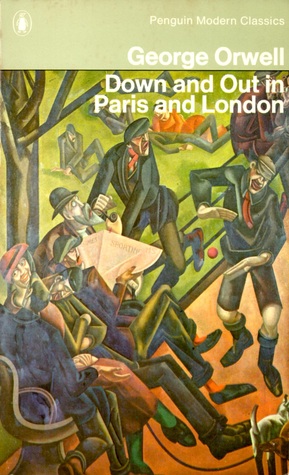 Even as he’s conveying the harsh reality of exhaustion and indignity, Orwell takes a Dickensian delight in people and their eccentricities. His pen portraits of those he associates with – Boris, a former captain in the Russian Army who is always coming up with new money-making schemes in Paris; Paddy, a tramp he falls in with in London; and Bozo, a “screever” (street painter) who “managed to keep his brain intact and alert, and so nothing could make him succumb to poverty” – are glistening passages enhanced by recreated dialogue. There are a few asides, such as a chapter about London slang and swearing, that break up the flow, and I might have liked more context about Orwell’s earlier and later life – how he slipped into poverty and how he worked his way out of it again – but he more than succeeds in his aim of exposing the truth of what it was like to be poor at that time.
Depressingly, though, this is not merely a period piece: well over 80 years later, the poor are still in danger of homelessness and enslavement to low wages and zero-hours contracts. No doubt it is still what Orwell refers to as a “dismal, demoralizing way of life,” and the poor “are ordinary human beings … if they are worse than other people it is the result and not the cause of [that] way of life.”
Our town has its fair share of the down-and-out, as was brought home to me just yesterday. My husband had an unpleasant encounter with a group of them when he tried remonstrating with a man who was cutting flowers in the community garden we’ve volunteered our time to create – the very day before the Britain in Bloom competition! When I dropped by later to help get the garden tidy for judging, they were still hanging about on the other side of the canal, smoking and drinking. Then I spotted with them an older woman who goes to our church. I’ve broken bread with her on a regular basis. She borrowed a couple of books from the theological library last week. And she must be a hair’s breadth away from homelessness, if not actually homeless. It felt like a wake-up call, a reminder that these people whose lives seem so hopelessly foreign are not as distant or as different as we might like to think.

George Orwell’s 1943 press photo. Branch of the National Union of Journalists (BNUJ). [Public domain]
My rating: 
Next month: The Go-Between by L.P. Hartley
Heartland by Sarah Smarsh
If you were a fan of Hillbilly Elegy by J.D. Vance, then debut author Sarah Smarsh’s memoir, Heartland, deserves to be on your radar too. Smarsh comes from five generations of Kansas wheat farmers and worked hard to step outside of the vicious cycle that held back the women on her mother’s side of the family: poverty, teen pregnancy, domestic violence, broken marriages, a lack of job security, and moving all the time. Like Mamaw in Vance’s book, Grandma Betty is the star of the show here: a source of pure love, she played a major role in raising Smarsh. The rundown of Betty’s life is sobering: her father was abusive and her mother had schizophrenia; she got pregnant at 16; and she racked up six divorces and countless addresses. This passage about her paycheck and diet jumped out at me:
Each month, after she paid the rent and utilities, and the landlady for watching Jeannie, Betty had $27 left. She budgeted some of it for cigarettes and gas. The rest went to groceries from the little store around the corner. The store sold frozen pot pies, five for a dollar. She’d buy twenty-five of them, beef and chicken flavor, and that would be her dinner all month. Every day, a candy bar for lunch at work and a frozen pot pie for dinner at home.
It’s a sad state of affairs when fatty processed foods are cheaper than healthy ones, and this is still the case today: the underprivileged are more likely to subsist on McDonald’s than on vegetables. Heartland is full of these kinds of contradictions. For instance, in the Reagan years the country shifted rightwards and working-class Catholics like Smarsh’s mother started voting Republican – in contravention of the traditional understanding that the Democrats were for the poor and the Republicans were for the rich. Smarsh followed her mother’s lead by casting her first-ever vote for George W. Bush in 2000, but her views changed in college when she learned how conservative fiscal policies keep people poor.
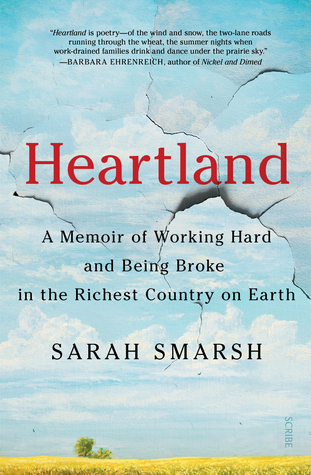 This isn’t a straightforward, chronological family story; it jumps through time and between characters. You might think of reading it as like joining Smarsh for an amble around the farm or a flip through a photograph album. Its vignettes are vivid, if sometimes hard to join into a cohesive story line in the mind. Some of the scenes that stood out to me were being pulled by truck through the snow on a canoe, helping Grandma Betty move into a house in Wichita but high-tailing it out of there when they realized it was infested by cockroaches, and the irony of winning a speech contest about drug addiction when her stepmother was hooked on opioids.
Heartland serves as a personal tour through some of the persistent trials of working-class life in the American Midwest: urbanization and the death of the family farm, an inability to afford health insurance and the threat of toxins encountered in the workplace, and the elusive dream of home ownership. Like Vance, Smarsh has escaped most of the worst possibilities through determination and education, so is able to bring an outsider’s clarity to the issues. At times she has a tendency to harp on the same points, though, adding in generalizations about the effects of poverty rather than just letting her family’s stories speak for themselves.
The oddest thing about Smarsh’s memoir – and I am certainly not the first reviewer to mention this since the book’s U.S. release in September – is who it’s directed to: her never-to-be-born daughter, “August”. Teen pregnancy was the family curse Smarsh was most desperate to avoid, and even now that she’s in her late thirties, a journalist and academic returned to Kansas after years on the East Coast, she remains childless. August is who Smarsh had in mind while working two or more jobs all through high school, earning higher degrees and buying her dream home. All along she was saving August from the hardships of a poor upbringing. While the unborn child is a potent symbol, it can be disorienting after pages of “I” to come across a “you” and have to readjust to who is being addressed.
Heartland is a striking book, not without its challenges to the reader, but one that I ultimately found rewarding to read in short bursts of 10 to 20 pages at a time. It’s worthwhile for anyone interested in what it’s really like to be poor in America.
My rating:
A favorite passage:
“My life has been a bridge between two places: the working poor and ‘higher’ economic classes. The city and the country. College-educated coworkers and disenfranchised loved ones. A somewhat conservative upbringing and a liberal adulthood. Home in the middle of the country and work on the East Coast. The physical world where I talk to people and the formless dimension where I talk to you.”
Heartland: A Memoir of Working Hard and Being Broke in the Richest Country on Earth was published by Scribe UK on November 8th. My thanks to the publisher for a free copy for review.
 Bookish Beck = Rebecca Foster. American transplant to England. Freelance proofreader and book reviewer.
 Bookish Beck