Advent Reading: In the Bleak Midwinter by Rachel Mann & More
Today marks 189 years since poet Christina Rossetti’s birth in 1830. You could hardly find better reading for Advent than poet–priest Rachel Mann’s new seasonal devotional, In the Bleak Midwinter, which journeys through Advent and the 12 days of Christmas via short essays on about 40 Rossetti poems.
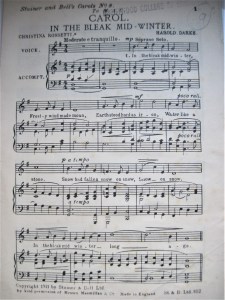
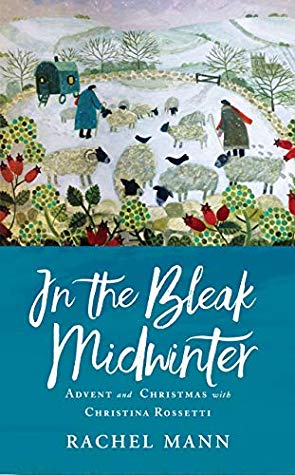 If your mental picture of Rossetti’s work is, like mine was, limited to twee repetition (“Snow had fallen, snow on snow, / Snow on snow,” as the title carol from 1872 goes), you’ll gain a new appreciation after reading this. Yes, Rossetti’s poetry may strike today’s readers as sentimental, with a bit too much rhyming and overt religion, but it is important to understand it as a product of the Victorian era.
Mann gives equal focus to Rossetti’s techniques and themes. Repetition is indeed one of her main tools, used “to build intensity and rhythm,” and some of her poems are psalm-like in their diction and emotion. I had no idea that Rossetti had written so much – and so much that’s specific to the Christmas season. She has multiple poems entitled “Advent” and “A Christmas Carol” (the technical title of “In the Bleak Midwinter”) or variations thereon.
The book’s commentary spins out the many potential metaphorical connotations of Advent: anticipation, hope, suffering, beginnings versus endings. Mann notes that Rossetti often linked Advent and apocalypse as times of change and preparation. Even as Christians await the birth of Christ, the poet seems to say, they should keep the end of all things in mind. Thus, some of the poems include surprisingly dark or premonitory language:
The days are evil looking back,
The coming days are dim;
Yet count we not His promise slack,
But watch and wait for Him. (from “Advent,” 1858)
Death is better far than birth,
You shall turn again to earth. (from “For Advent”)
 Along with that note of memento mori, Mann suggests other hidden elements of Rossetti’s poetry, like desire (as in the sensual vocabulary of “Goblin Market”) and teasing mystery (“Winter: My Secret,” which reminded me of Emily Dickinson). Not all of her work is devotional or sweet; those who feel overwhelmed or depressed at Christmastime will also find lines that resonate for them here.
Mann helped me to notice Rossetti’s sense of “divine time” that moves in cycles. She also makes a strong case for reading Rossetti to understand how we envision Christmas even now: “In some ways, ‘In the Bleak Midwinter’ offers the acme of our European cultural representations of this season.”
My rating: 
With thanks to Canterbury Press for the free copy for review.
(I also reviewed Mann’s poetry collection, A Kingdom of Love, earlier in the year.)
 For December I’m reading Do Nothing, the Advent booklet Stephen Cottrell (now the Bishop of Chelmsford; formerly Bishop of Reading) wrote in 2008 about a minimalist, low-stress approach to the holidays. I have to say, it’s inspiring me to cut way back on card-sending and gift-giving this year.
A few seasonal snippets spotted in my recent reading:
“December darkens and darkens, and the streets sprout forth their Christmas tinsel, and the Salvation Army brass band sings hymns and jingles its bells and stirs up its cauldron of money, and loneliness blows in the snowflurries”
(from The Robber Bride by Margaret Atwood)
“Fine old Christmas, with the snowy hair and ruddy face, had done his duty that year in the noblest fashion, and had set off his rich gifts of warmth and colour with all the heightening contrast of frost and snow.”
(from The Mill on the Floss by George Eliot)
A week to Christmas, cards of snow and holly,
Gimcracks in the shops,
Wishes and memories wrapped in tissue paper,
Trinkets, gadgets and lollipops
And as if through coloured glasses
We remember our childhood’s thrill
… And the feeling that Christmas Day
Was a coral island in time where we land and eat our lotus
But where we can never stay.
(from Autumn Journal by Louis MacNeice)


 I’m always on the lookout for books that seem to fit the season. Here are the piles I’ve amassed for winter (Early Riser imagines a human hibernation system for the winters), Christmas and snow. I’ll dip into these over the next couple of months. I plan to get more “winter,” “snow” and “ice” titles out from the library. Plus I have this review book (at left), newly in paperback, to start soon.
Have you read any Advent or wintry books recently?
Recent and Upcoming Poetry Releases from Carcanet Press
Many thanks to the publisher for free print or e-copies of these three books for review.
In Nearby Bushes by Kei Miller
 “Are there stories you have heard about Jamaica? / Well here are the stories underneath.” The last two lines of “The Understory” reveal Miller’s purpose in this, his fifth collection of poetry. The title is taken from Jamaican crime reports, which often speak of a victim’s corpse being dumped in, or perpetrators escaping to, “nearby bushes.” It’s a strange euphemism that calls to mind a dispersed underworld where bodies are devalued. Miller persistently contrasts a more concrete sense of place with that iniquitous nowhere. Most of the poems in the first section open with the word “Here,” which is also often included in their titles and repeated frequently throughout Part I. Jamaica is described with shades of green: a fertile, feral place that’s full of surprises, like an escaped colony of reindeer.
As usual, Miller slips in and out of dialect as he reflects on the country’s colonial legacy and the precarious place of homosexuals (“A Psalm for Gay Boys” is a highlight). Although I enjoyed this less than the other books I’ve read by Miller, I highly recommend his work in general; the collection The Cartographer Tries to Map a Way to Zion is a great place to start.
Some favorite lines:
“Here that cradles the earthquakes; / they pass through the valleys // in waves, a thing like grief, / or groaning that can’t be uttered.” (from “Hush”)
“We are insufficiently imagined people from an insufficiently imagined place.” (from “Sometimes I Consider the Names of Places”)
“Cause woman is disposable as that, / and this thing that has happened is … common as stone and leaf and breadfruit tree. You should have known.” (from “In Nearby Bushes” XIII.III)
My rating: 
In Nearby Bushes was published on 29th August.
So Many Rooms by Laura Scott
 Art, Greek mythology, the seaside, the work of Tolstoy, death, birds, fish, love and loss: there are lots of repeating themes and images in this debut collection. While there are a handful of end rhymes scattered through, what you mostly notice is alliteration and internal rhyming. The use of color is strong, and not just in the poems about paintings. A few of my favorites were “Mulberry Tree” (“My mother made pudding with its fruit, / white bread drinking / colour just as the sheets waited / for the birds to stain them purple.”), “Direction,” and “A Different Tune” (“oh my heavy heart how can I / make you light again so I don’t have to // lug you through the years and rooms?”). There weren’t loads of poems that stood out to me here, but I’ll still be sure to look out for more of Scott’s work.
My rating: 
So Many Rooms was published on 29th August.
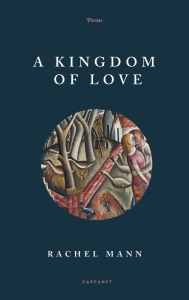
A Kingdom of Love by Rachel Mann
Rachel Mann, a transgender Anglican priest, was Poet-in-Residence at Manchester Cathedral from 2009 to 2017 and is now a Visiting Fellow in Creative Writing and English at Manchester Metropolitan University. Her poetry is full of snippets of scripture and liturgy (both English and Latin), and the cadence is often psalm-like. The final five poems are named after some of the daily offices, and “Christening” and “Extreme Unction” are two stand-outs that describe performing rituals for the beginning and end of life. The poet draws on Greek myth as well as on the language of Christian classics from St. Augustine to R.S. Thomas.
 Human fragility is an almost comforting undercurrent (“Be dust with me”), with the body envisioned as the site of both sin and redemption. A focus on words leads to a preoccupation with mouths and the physical act of creating and voicing language. There is surprisingly anatomical vocabulary in places: the larynx, the palate. Mann also muses on Englishness, and revels in the contradictions of ancient and modern life: Chaucer versus a modern housing development, “Reading Ovid on the Underground.” She undertakes a lot of train rides and writes of passing through stations, evoking the feeling of being in transit(ion).
You wouldn’t know the poet had undergone a sex change unless you’d already read about it in the press materials or found other biographical information, but knowing the context one finds extra meaning in “Dress,” about an eight-year-old coveting a red dress (“To simply have known it was mine / in those days”) and “Give It a Name,” about the early moments of healing from surgery.
This is beautiful, incantatory free verse that sparkles with alliteration and allusions that those of a religious background will be sure to recognize. It’s sensual as well as headily intellectual. Doubt, prayer and love fuel many of my favorite lines:
“Love should taste of something, / The sea, I think, brined and unsteady, / Of scale and deep and all we crawled out from.” (from “Collect for Purity”)
“I don’t know what ‘believe in’ means / In the vast majority of cases, / Which is to say I think it enough // To acknowledge glamour of words – / Relic, body, bone – I think / Mystery is laid in syllables, syntax” (from “Fides Quarens”)
“Offer the fact of prayer – a formula, / And more: the compromise of centuries / Made valid.” (from “A Kingdom of Love (2)”)
Particularly recommended for readers of Malcolm Guite and Christian Wiman.
My rating:
Official release date: September 26th – but already available from the Carcanet website.
 Bookish Beck = Rebecca Foster. American transplant to England. Freelance proofreader and book reviewer.
 Bookish Beck