June Releases by K Patrick, Brandon Taylor and More
These two sensual, campus-set queer novels were perfect additional reading for Pride Month. As a bonus, I read a recently reissued postcolonial poetry collection.
Mrs S by K Patrick
Like Tom Crewe’s The New Life, this was one of the Guardian’s 2023 debuts to look out for, and both are seriously sexy. Patrick’s unnamed narrator is an early-twenties Australian, shunned by her family, who has come to England to be a matron at a girls’ boarding school. No other characters are named, either, with The Girls discussed in aggregate and the whole institution – a tradition-bound place that issues a classical education – in thrall to the memory of “the dead author,” an Emily Brontë-like figure whose genius is both inspiration and burden.
The narrator is butch and wears a binder, and in fact, we soon learn, is not the only lesbian on staff. She and the Housemistress become drinking buddies, even venturing into the nearest large town to frequent a gay bar. But there’s also Mrs S, the headmaster’s wife, perhaps 20 years her senior, whose attention initially seems maternal – as they tend the rose garden, lead an art lesson together and fill in for a play performance – but gradually becomes more erotic when they go wild swimming and meet in the kitchen during a dinner party.
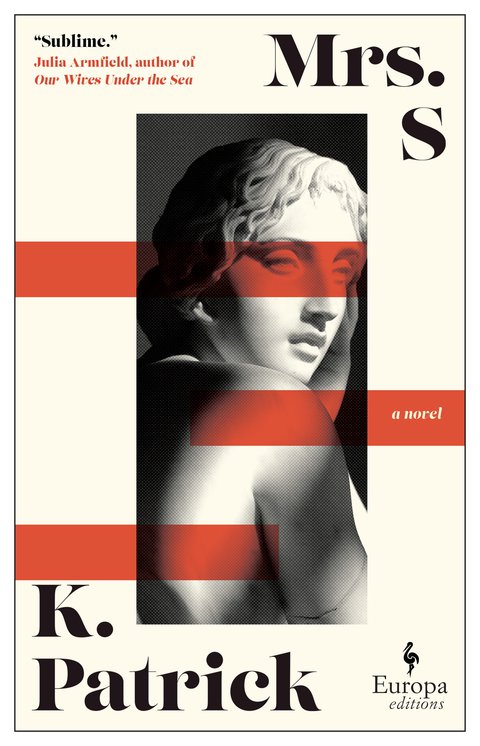
A heat wave gives the novel a sultry atmosphere as hints give way to explicit scenes. The Girls’ little dramas (one punches a boy and breaks his nose at a campus party; one group gets drunk while another gets high on mushrooms) pale in comparison to the steamy secrets. Summer romances can never last, but their intensity is legendary, and this feels like an instant standard of the type. Given the pre-Internet clues, it likely dates to the 1990s, and Mrs S and the narrator are on different pages about gender roles; had it been today, the narrator would surely have been frankly nonbinary like Patrick.
Her heterosexuality, public-facing. Its cosy violence. Who does she want to be? If I ask her that, she might fall apart. If I ask her that, I must be willing to live through the answer. … She is trying to be two people, I am not. Maybe I was. Not anymore.
The author takes the no-speech-marks thing to another level, the dialogue all in paragraph form with no new lines for each speaker. That and the under-punctuation are deliberate choices that make this somehow hyper-contemporary and a throwback to the Bloomsbury modernists all at once – what with the metaphors of propagating roses and garden fecundity, I couldn’t help but think of Virginia Woolf and Vita Sackville-West. Mrs S isn’t your average coming-of-age story, seduction narrative, or cougar stereotype. It’s a new queer classic.
With thanks to Europa Editions for the free copy for review. Released in the UK by Fourth Estate.
The Late Americans by Brandon Taylor
I was a huge fan of Taylor’s debut novel, the Booker-shortlisted Real Life, and also admired his follow-up linked story collection, Filthy Animals. This third book falls somewhere between the two in style. Although it’s been marketed as a novel, the nine close third person chapters are so discrete as to be more like short stories, all orbiting a group of students at the University of Iowa: many BIPOC, most gay; lots of them current or former ballet dancers.
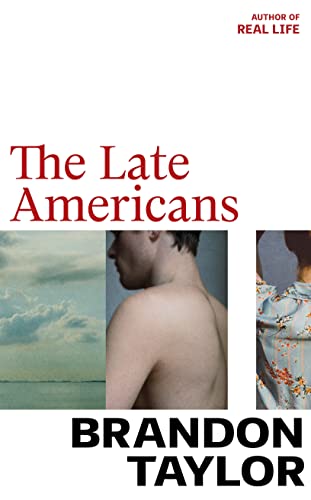 Seamus is the subject of the opening title story and “Gorgon’s Head,” so he felt to me like the core of the novel and I would happily have had him as the protagonist throughout. He’s a spiky would-be poet who ends up offending his classmates with his snobby opinions (“her poems were, in the words of a fictional Robert Lowell in an Elizabeth Bishop biopic, ‘observations broken into lines’ … she lacked a poetic intelligence”) and funds his studies by working in the kitchen at a hospice, where he meets a rough local named Bert and they have a sexual encounter that shades into cruelty.
Other characters include on-again, off-again homosexual couples Fyodor and Timo, and Ivan and Goran. Their fundamental differences account for why they so often spar: Fyodor works in a meat-packing plant, while Timo is vegetarian; Goran lives off family wealth, whereas Ivan has to get by on his own, and starts making amateur pornography for money. Noah, too, has the misfortune to get involved with Bert; most of the men, in fact, sleep with one or more of the other men. It’s hard to believe in the durability of this incestuous group. They’re all facing transitions as their studies come to an end, looking for jobs or internships, sometimes switching fields and deciding whether to leave relationships behind. Two late chapters from the perspectives of women, Noah’s neighbour Bea and dancer Fatima, who experiences sexualized shaming, were refreshing. Overall, I’m torn: Taylor’s writing can be stunning:
Iowa was a kind of cultural winter—they had all come to this speck of a city in the middle of a middle state in order to study art, to hone themselves and their ideas like perfect, terrifying weapons, and in the monastic kind of deprivation they found here, they turned to one another. Every dying species sought its own kind of comfort.
They were all posturing all the time. Everything they did was a posture, defensive or offensive, meant to demonstrate something to the outside world, perhaps that they were worthy or good or all right, perhaps to imply that they were in on the joke, that they were nothing and all they had were these crude choreographies of the self.
But it can also be laughable:
There was a resinous, burning taste in Noah’s mouth, and he wondered if it was from the semen or the cigarette or the pepper on the trout at dinner.
And even when it’s sublime, it feels a bit wasted on repetitive stories of meaningless hook-ups, assault, and resentment. This ended up being something of a disappointment from my Most Anticipated list. After three books about angsty homosexuals at midwestern universities, the author is in real danger of being perceived as a one-trick pony. I hope he’ll stretch himself and try something different with his next book.
With thanks to Jonathan Cape for the proof copy for review. Released in the USA by Riverhead.
And a bonus:
The Fat Black Woman’s Poems by Grace Nichols (1984)
 I discovered Grace Nichols a few years ago when I reviewed Passport to Here and There for Wasafiri. One of “Five Gold Reads” to mark Virago’s 50th anniversary, this was the Guyanese-British poet’s second collection (the reissue also includes a few poems from her first book, I Is a Long-Memoried Woman).
The title character is a woman of pleasures, jovial and sensual, but not without cliches (“Come up and see me sometime // My breasts are huge exciting / amnions of watermelon”). I preferred the later sections of the book about childhood memories and the expat’s dilemma: what you miss haunts you, even if what you gained in leaving was objectively better.
In London
every now and then
I get this craving
for my mother’s food
I leave art galleries
in search of plantains
These islands
not picture postcards
for unravelling tourist
you know
…
Poverty is the price we pay for the sun
The patois reminded me of work I’ve read by Bernardine Evaristo and Jackie Kay, and I might recommend the collection as a whole to readers of Fire Rush or Cane, Corn & Gully. But it didn’t spark much for me compared with Nichols’ more recent poetry.
With thanks to Virago for the free copy for review.
Book Serendipity, Mid-February to Mid-April
I call it “Book Serendipity” when two or more books that I read at the same time or in quick succession have something in common – the more bizarre, the better. This is a regular feature of mine every couple of months. Because I usually have 20–30 books on the go at once, I suppose I’m more prone to such incidents. The following are in roughly chronological order.
Last time, my biggest set of coincidences was around books set in or about Korea or by Korean authors; this time it was Ghana and Ghanaian authors:
- Reading two books set in Ghana at the same time: Fledgling by Hannah Bourne-Taylor and His Only Wife by Peace Adzo Medie. I had also read a third book set in Ghana, What Napoleon Could Not Do by DK Nnuro, early in the year and then found its title phrase (i.e., “you have done what Napoleon could not do,” an expression of praise) quoted in the Medie! It must be a popular saying there.
- Reading two books by young Ghanaian British authors at the same time: Quiet by Victoria Adukwei Bulley and Maame by Jessica George.


And the rest:
- An overweight male character with gout in Where the God of Love Hangs Out by Amy Bloom and The Secret Diaries of Charles Ignatius Sancho by Paterson Joseph.
- I’d never heard of “shoegaze music” before I saw it in Michelle Zauner’s bio at the back of Crying in H Mart, but then I also saw it mentioned in Pulling the Chariot of the Sun by Shane McCrae.
- Sheila Heti’s writing on motherhood is quoted in Without Children by Peggy O’Donnell Heffington and In Vitro by Isabel Zapata. Before long I got back into her novel Pure Colour. A quote from another of her books (How Should a Person Be?) is one of the epigraphs to Lorrie Moore’s I Am Homeless If This Is Not My Home.


- Reading two Mexican books about motherhood at the same time: Still Born by Guadalupe Nettel and In Vitro by Isabel Zapata.
- Two coming-of-age novels set on the cusp of war in 1939: The Inner Circle by T.C. Boyle and Martha Quest by Doris Lessing.
- A scene of looking at peculiar human behaviour and imagining how David Attenborough would narrate it in a documentary in Notes from a Small Island by Bill Bryson and I Have Some Questions for You by Rebecca Makkai.
- The painter Caravaggio is mentioned in a novel (The Things We Do to Our Friends by Heather Darwent) plus two poetry books (The Fourth Sister by Laura Scott and Manorism by Yomi Sode) I was reading at the same time.


- Characters are plagued by mosquitoes in The Last Animal by Ramona Ausubel and Through the Groves by Anne Hull.
- Edinburgh’s history of grave robbing is mentioned in The Things We Do to Our Friends by Heather Darwent and Womb by Leah Hazard.
- I read a chapter about mayflies in Lev Parikian’s book Taking Flight and then a poem about mayflies later the same day in Ephemeron by Fiona Benson.
- Childhood reminiscences about playing the board game Operation and wetting the bed appear in Homesick by Jennifer Croft and Through the Groves by Anne Hull.

- Fiddler on the Roof songs are mentioned in Through the Groves by Anne Hull and We All Want Impossible Things by Catherine Newman.
- There’s a minor character named Frith in Shadow Girls by Carol Birch and Rebecca by Daphne du Maurier.
- Scenes of a female couple snogging in a bar bathroom in Through the Groves by Anne Hull and The Garnett Girls by Georgina Moore.

- The main character regrets not spending more time with her father before his sudden death in Maame by Jessica George and Pure Colour by Sheila Heti.
- The main character is called Mira in Birnam Wood by Eleanor Catton and Pure Colour by Sheila Heti, and a Mira is briefly mentioned in one of the stories in Before You Suffocate Your Own Fool Self by Danielle Evans.
- Macbeth references in Shadow Girls by Carol Birch and Birnam Wood by Eleanor Catton – my second Macbeth-sourced title in recent times, after Tomorrow and Tomorrow and Tomorrow by Gabrielle Zevin last year.


- A ‘Goldilocks scenario’ is referred to in Womb by Leah Hazard (the ideal contraction strength) and Taking Flight by Lev Parikian (the ideal body weight for a bird).
- Caribbean patois and mention of an ackee tree in the short story collection If I Survive You by Jonathan Escoffery and the poetry collection Cane, Corn & Gully by Safiya Kamaria Kinshasa.
- The Japanese folktale “The Boy Who Drew Cats” appeared in Our Missing Hearts by Celeste Ng, which I read last year, and then also in Enchantment by Katherine May.


- Chinese characters are mentioned to have taken part in the Tiananmen Square massacre/June 4th incident in Dear Chrysanthemums by Fiona Sze-Lorrain and Oh My Mother! by Connie Wang.
- Endometriosis comes up in What My Bones Know by Stephanie Foo and Womb by Leah Hazard.

What’s the weirdest reading coincidence you’ve had lately?
Reading the Rathbones Folio Prize Poetry Shortlist
I borrowed the whole of this year’s Rathbones Folio Prize poetry shortlist from my local library and have enjoyed reading through it to see what the judges felt was worthy of recognition from 2022’s releases. Of course, personal taste comes into the appreciation of poetry, perhaps more so than for fiction or nonfiction, so I liked some of these more than others and suspect the judges’ final decision may differ from mine. Still, it’s always a pleasure to discover new-to-me poets and/or debut authors.
Ephemeron by Fiona Benson
 This is Benson’s third collection but my first time reading her. I was fully engaged with her exquisite poems about the ephemeral, whether that be insect lives, boarding school days, primal emotions or moments from her children’s early years. The book is in four discrete corresponding sections (“Insect Love Songs,” “Boarding-School Tales,” “Translations from the Pasiphaë” and “Daughter Mother”) but the themes and language bleed from one into another and the whole is shot through with astonishing corporeality and eroticism.
The form varies quite a lot – bitty lines, stanzas, blocky paragraph-like stories – and alliteration, slant rhymes and unexpected metaphors (a wasp’s nest as “a piñata of stings,” “this avant-garde chandelier” and an “electric hotel / of spit-balled papier mâché”) make each poem glisten. I’ll even let her off for the long section inspired by my pet hate, Greek mythology (so gruesome, so convoluted), because of how she uses these melodramatic situations to explore universal emotions. She does something interesting with the story of the Minotaur (Asterios), suggesting that instead of being born a literal bull he was born deformed or disabled and no one knew what to make of him, but even so he had a mother’s love. 
Here’s one section of “Magicicadas” as an example:
Warm rain
summons them up
through loam
like Lazarus
after seventeen years,
cases splitting
down their backs
emerging
like the wet head
of a baby,
wrestling out
of their tight old skin
arching back
like an orgasm,
like an ecstatic gymnast
on the high trapeze;
sap-green, bunker-pale,
their damp wings lemon
before they stiffen
and straighten, lattice brown.
Quiet by Victoria Adukwei Bulley
 Protest doesn’t have to be loud; sometimes it can even be silent. In her debut, Bulley, a British-born Ghanaian poet, makes that especially clear with the pair “[ ] noise” (= white noise, inescapable) and “black noise” (an erasure poem). She models how language might be decolonized (particularly in “revision”) and how Black femininity might be reimagined (“fabula”). Along with her acknowledged debts to Lucille Clifton, bell hooks, Mary Oliver et al., I spotted echoes of Kei Miller (her “there is dark that moves” sounds like his “there is an anger that moves”) and Toni Morrison (Bulley includes the line “Quiet as it’s kept,” which is the opening of The Bluest Eye).
The collection is bold but never heavy-handed, and the seriousness of its topics (also including an early miscarriage) is lightened by poems about cats and snails. My two favourites were “not quiet as in quiet but,” which juxtaposes peacefulness and the comfortable life with the perils of not speaking out about injustice; and “Epigenetic,” about generations of traumatized bodies (“if your pain is alive in me / so too must be your joy.”). 
Cane, Corn & Gully by Safiya Kamaria Kinshasa
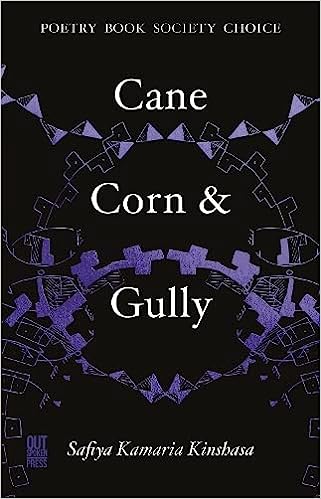 Kinshasa is also a dancer, and in her debut the British-born Barbadian intersperses poems with choreographed dances, transcribed via hand-drawn symbols explained in a key at the end. I confess I couldn’t picture them at all, though they make attractive patterns on the page – you can see one in purple on the cover. This and the Caribbean patois in which she voices narratives of historical atrocities and contemporary microaggressions against Black people (particularly women) are the collection’s claims to novelty and probably impressed the judges. Yet I found both strategies to be affected and looked forward to those poems in standard language. Some of the events are given specific dates and places in Barbados while others are more generic. Female victims of sexual oppression seek revenge, as in the gruesome “Miss Barbados Is No Longer Vegan.” This probably works best aloud, to allow one to appreciate the musicality of the voice and the alliterative lines.
Some lines I liked:
we gambled all our wishes on dandelions,
now we celebrate de little tings
every unburnt rice grain & regrown eyelash
vaulting between lemon vines and dog friendly cafés.
just because we do what needs to be done,
it doan mean we nah ready, we just aware
there are too many of us to be martyrs
(from “Sometimes Death Is a Child Who Plays With Rubber Bands”)
The work is dangerous; writing into history is like feeding unknown seeds while attempting to control the rate of their growth. Sometimes when I danced, I inhaled the language of my ancestors’ captors, and they became mine.
(from “Preface: And if by Some Miracle”)
if you want something to become extinct
doan give it attention.
(from “Choreography: She, My Nation”)
England’s Green by Zaffar Kunial
 A collection in praise of the country’s natural and cultural heritage, with poems about hedgerows and butterflies; cricket and the writings of the Brontë sisters. There are autobiographical reminiscences as well, most notably “The Crucible,” which describes the meeting between his Kashmiri father and his English mother’s father, who had refused to acknowledge the relationship for its first three years.
Kunial clearly delights in language, with wordplay and differing pronunciations fuelling “Foregrounds” et al. I particularly liked “Foxgloves” (“Sometimes I like to hide in the word / foxgloves – in the middle of foxgloves. The xgl is hard to say”) and “The Wind in the Willows,” where he wonders if the book title appeals to him just for its sound. This wasn’t as immediately cohesive and impressive as his first book, Us, but still well worth reading. 
Some favourite lines:
“Prayer is not the words / but having none and staying” (from “Empty Words”)
“Life // is wider than its page. And days are a cut field, clipped and made to run on” (from “The Groundsman”)
Manorism by Yomi Sode
Like Surge or Poor (or what little I read of Citizen), this is driven by outrage and a longing for justice for Black people. I suspect that, like those precursors, it is a book best heard in performance, given that Sode honed his skills on London’s open mic circuit.
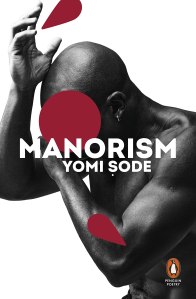 The first third of the book is under the heading “Aneephya,” a word Sode coined and defines as “the stress toxin of inherited trauma” – from slave ships to police checks. My two favourites were from this section: “L’Appel du Vide,” in which he ponders microaggressions while cooking a traditional West African mackerel and okra stew; and “A Plate of Artichokes,” about the time a waiter made him pre-pay for his meal and he went along with it even though he suspected other customers weren’t being asked to do the same.
Nigerian culture, rap music, being a father, and Black brotherhood are other themes, with recurring allusions to the work of Caravaggio. I also liked the long section on the decline and death of his great-aunt (“Big Mummy”) from cancer.
This was a book that made me feel super-white, but that’s not a problem: I can recognize its importance and appeal while also accepting that it’s not necessarily supposed to be for me. 
Which of these poetry collections interest you?
 Bookish Beck = Rebecca Foster. American transplant to England. Freelance proofreader and book reviewer.
 Bookish Beck