20 Books of Summer, 18–20: Ayanna Lloyd Banwo, Sarah Hall, Meghan O’Rourke
Whew, it’s the final day of the challenge and I’ve managed to finish and write up a last batch of two novels and one nonfiction work: a magic realist tableau of love and death in Trinidad, a fateful romance set against the backdrop of the construction of an English dam in 1936, and a personal and cultural record of chronic illness and its treatment in contemporary America.
When We Were Birds by Ayanna Lloyd Banwo (2022)
 I was sent a copy as part of the McKitterick Prize shortlist. The setting of a cemetery, Fidelis in Port Angeles, Trinidad, had vaguely attracted me even before its nomination. Emmanuel Darwin has turned his back on his Rastafarian upbringing to cut off his dreadlocks and work as a gravedigger (any contact with the dead is anathema in the religion). Meanwhile, Yejide, who lives in the hills, is losing her mother, Petronella, and gaining a legacy she’s not sure she wants: the women of her family are caretakers of the souls of the dead, keeping them alive in exchange for protection. Like the corbeaux, dark counterparts of tropical parrots, they tread the border of life and death. As All Saints’ and All Souls’ Days draw closer, Darwin and Yejide together have to decide whether they will be swallowed by the graveyard or escape it. While this was atmospheric and had alluring elements, the speculative angle was not notably well realized and the particular form of patois – eschewing all possessives and most verb conjugations – drove me nuts. I skimmed this one. (Free from the Society of Authors)
Haweswater by Sarah Hall (2002)
I bought this in Cumbria one year and started reading it in Cumbria the next. Once I got home, however, there was little impetus to keep going. Were it not for the temporary local interest, I likely would not have finished this debut novel, which lurches between dry and melodramatic. As it is, I had to skim to the end. Had it been my first taste of Sarah Hall’s work, it might have put me off trying her again.
 The frame is historical: Haweswater was indeed dammed to provide water for the city of Manchester in 1936, flooding the village of Mardale. Hall focuses on the people of Mardale, specifically the Lightburn family, who have persisted with farming despite its particular challenges in this hilly landscape. When Jack Liggett comes out from the City on behalf of the waterworks, he meets with hostility, including from the Lightburns’ daughter, Janet, who negotiates for their tenancy to continue until the dam is actually built. Then, well, you know, Romeo and Juliet and pride and prejudice and all that, and they start an affair. Hall has always written forthrightly about sex, starting here.
There’s a climactic final 60 pages in which three major characters die, two in symbolic acts of suicide, but it was a little too much tragedy, too late, for me after the dull midsection. I was intrigued, however, that a plot point turns on golden eagles being in the valley, as Wild Fell, another of my Haweswater-set reads, opens with the presence of the ghost of England’s last golden eagle, who vanished in 2015. This related snippet shows how over-the-top Hall’s use of dialect is: “Golden eagles wud be mor’less gone, gone or illegal these days, like, notta funni bizniz t’be gittin’ mixed up in, eh? What kinda daft bugger d’yer take mi for?” It’s like Thomas Hardy rustics – hard to take seriously. (Anne-Marie Sanderson’s haunting song “Haweswater” is based on the novel.) (Secondhand – Clutterbooks, Sedbergh, 2022) 
The Invisible Kingdom: Reimagining Chronic Illness by Meghan O’Rourke (2022)
Well before I was a devoted follower of the Barbellion Prize for books on disability and chronic illness, I was interested in these topics. For much of her forties and fifties, my mother struggled with fibromyalgia, one of a suite of illnesses misunderstood or even dismissed by the medical profession (as O’Rourke puts it, with a tongue-in-cheek nod to Jane Austen: “it is a truth universally acknowledged among the chronically ill that a young woman in possession of vague symptoms like fatigue and pain will be in search of a doctor who believes she is actually sick”). I hope this National Book Award nominee goes some way toward convincing skeptics that these are real conditions to be addressed by listening to patients and treating them holistically.
 In 2012 the author became seriously ill and spent much of her thirties in a fog of pain, spending the equivalent of several days per month at doctors’ appointments and agreeing to ever more bizarre treatments in her desperation. Some of her issues were autoimmune and/or genetic: Hashimoto’s (thyroid), Ehlers-Danlos, POTS, endometriosis. She also dealt with infertility at the same time as she was trying to get well enough to contemplate having children. For her, the turning point was when she was diagnosed with Lyme disease and put on antibiotics. (Later she would travel to London to get fecal microbiota transplants to restore her microbiome.) Chronic Lyme is similar to long COVID, the true extent of which we’re only just beginning to understand; reading a list of the symptoms, I was tempted to remotely/retrospectively diagnose a few people I know with one or the other. It can be ever so slightly miserable reading about navigating all of these conditions, though nowhere near as miserable as it must have been for O’Rourke to live through them, of course.
I knew the author for her exquisite memoir of losing her mother to cancer, The Long Goodbye. Here the writing is more functional and journalistic, but I was still impressed by the attention she pays and the connections she draws; she’s also a poet, so she’s open to emotions and keen to capture them in words. In the face of the unexplained, she contends, chronically ill people are searching for meaning and narrative (restitution, chaos or quest, as Arthur Frank named the three options). She probes her own psyche: “had I become trapped in my identity as a sick person, someone afraid of living? If my mission in life had been reduced to being well at all costs, then the illness had won.” There’s a good balance of research, personal experience and general reflection in this one. (Passed along by Laura – thank you!) 
Related reads: Ill Feelings by Alice Hattrick, It’s All in Your Head by Suzanne O’Sullivan, Waiting for Superman by Tracie White
And that’s a wrap! My summer reading was a little scattered and not as thematic as initially planned, but I stuck to my pledge to read only print books that I owned, and then cleared half of them from my shelves through reselling or donating to the Little Free Library. I’ll definitely call that a win.
My favourite from the 20 was a novel, Search by Michelle Huneven, then Making the Beds for the Dead by Gillian Clarke (poetry), followed by two chef’s memoirs, A Cook’s Tour by Anthony Bourdain and Dirt by Bill Buford, and Dorthe Nors’ nature/travel essays. The one DNF and couple of skims are unfortunate, but these things happen.
Next year I fancy a completely open challenge – just, again, getting through books from my shelves. (Maybe all hardbacks?)
Cumbria Sights and Reading & A Return to Sedbergh
We returned on Friday from a one-week reunion with university friends – some we see very often and some less so; we hadn’t all been together since February 2020. After a protracted winter selection process pitting locations and cottages against each other, the nine of us had managed to agree on a converted inn in Appleby-in-Westmorland, Cumbria, and it ended up being the perfect base for us: roomy, with lots of communal space plus en suite rooms for each family unit, and well located.
This was my first time in the Lake District in 17 years, and I particularly enjoyed the outings to Haweswater, Acorn Bank, Keswick and Derwentwater, and Carlisle (that one by train), as well as some low-key walking closer to the cottage.


As apposite reading, I took along:
- Some of Us Just Fall by Polly Atkin: A memoir of chronic illness by a writer based in Grasmere.
- Haweswater by Sarah Hall: Purchased in Sedbergh last year. Hall’s debut novel is set in the run-up to the lake being dammed to provide water for the city of Manchester in 1936, flooding the village of Mardale. I’m finding it rather dry and the local accent over-the-top, but I’ll push through and call it one of my 20 Books of Summer.
- The Farmer’s Wife by Helen Rebanks: A recipe-studded memoir of daily life as the spouse of famous Lake District sheep farmer James Rebanks.
- Wild Fell by Lee Schofield: As featured in my Six Degrees post, a plant-loving and conservation-oriented memoir by the manager of the RSPB Haweswater site.

I also packed, but didn’t get time to read from, books by Margaret Forster and Dorothy Wordsworth. A good showing by women from the northwest!
Though we hadn’t planned on going back so soon, having been for the first time in September, when I learned that Sedbergh was only 40 minutes from where we were staying, I suggested it for a daytrip along with a scenic walk to a waterfall and cake and soft drinks at the Cross Keys Temperance Inn, and even the less book-obsessed of us seemed to enjoy.

My final haul – including, from Carlisle, one book each from a charity shop and Bookcase (above), which I learned about from Simon but actually found kind of overwhelmingly huge and mazelike – cost £9.50 after subtracting the sellback of a partial box of books at Westwood. A good selection of poetry and novellas, plus a favourite I couldn’t resist buying two copies of and might reread as a buddy read with my husband (the Orlean).

Any vacation reading or book hauls for you this August?
Book Serendipity, June to July 2023
I call it “Book Serendipity” when two or more books that I read at the same time or in quick succession have something in common – the more bizarre, the better.
Are all of these pure coincidence? Or, as a character says in The Year of Pleasures by Elizabeth Berg, maybe it’s true that “Sometimes serendipity is just intention, unmasked.”
This is a regular feature of mine every couple of months. Because I usually have 20–30 books on the go at once, I suppose I’m more prone to such incidents. The following are in roughly chronological order.
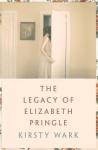
- A deadbeat boyfriend named Andrew in Yellowface by Rebecca F. Kuang and The Legacy of Elizabeth Pringle by Kirsty Wark.
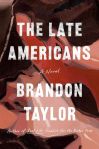
- A partner’s piano playing is by turns annoying (practice) and revelatory (performance) in The Happy Couple by Naoise Dolan and The Late Americans by Brandon Taylor.

- Frequent meals of potatoes due to poverty, and a character sneaking salt in, in Music in the Dark by Sally Magnusson and How Much of These Hills Is Gold by C Pam Zhang.
- Getting close to a seal even though the character knows it might bite in Salt & Skin by Eliza Henry-Jones and one story in High-Wire Act by JoeAnn Hart.
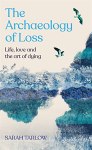
- Rev. Robert Kirk’s writings on fairies are mentioned in The Archaeology of Loss by Sarah Tarlow and The Legacy of Elizabeth Pringle by Kirsty Wark (and were also a major element in Sally Magnusson’s previous novel, The Ninth Child; I happened to be reading her most recent novel at the same time as the above two!).
- Menthols are smoked in Death of a Bookseller by Alice Slater and The Late Americans by Brandon Taylor.
- Joan Didion’s The Year of Magical Thinking is mentioned in Death of a Bookseller by Alice Slater and The Archaeology of Loss by Sarah Tarlow.
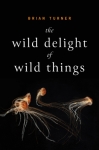 An ant farm as a metaphor in The Happy Couple by Naoise Dolan and The Wild Delight of Wild Things by Brian Turner.
- The main character, in buying a house, inherits the care of a large, elaborate garden from an older woman who kept it immaculate, in The Year of Pleasures by Elizabeth Berg and one story in High-Wire Act by JoeAnn Hart.
- A widow, despite her feminist ideals, wishes she had a man to take care of DIY and other house stuff for her in The Year of Pleasures by Elizabeth Berg and The Archaeology of Loss by Sarah Tarlow.
- A spouse’s death in 2016 and a description of cremation in The Archaeology of Loss by Sarah Tarlow and The Wild Delight of Wild Things by Brian Turner.
- A character deliberately burns a sexual partner’s cheek with a cigarette in Death of a Bookseller by Alice Slater and The Late Americans by Brandon Taylor.
- Counting down the days, then hours, until a wedding, in The Year of Pleasures by Elizabeth Berg, The Happy Couple by Naoise Dolan, and Crudo by Olivia Laing.
- Similar sentiments – about reading to find our own experiences expressed in a way we never would have thought to put them – in passages I encountered on the same day from A Life of One’s Own by Joanna Biggs (“I want to have that moment of recognition, finding something on the page I’ve felt but haven’t put into words”) and The Librarianist by Patrick deWitt (“the reader says to him or herself, Yes, that’s how it is, only I didn’t know it to describe it”).
- I encountered mentions of “Believe” by Cher in The Country of the Blind by Andrew Leland and House Gone Quiet by Kelsey Norris on the same evening.
- Calculating how old a newborn child will be on a certain date in the future – and fearing what the world will be like for them then – in Matrescence by Lucy Jones and Milk by Alice Kinsella.
- Moving with twin sons is a key part of the setup in Dirt by Bill Buford and Speak to Me by Paula Cocozza.


- I read scenes of a mother’s death from brain cancer in The Librarianist by Patrick deWitt and One Last Thing by Wendy Mitchell in the same evening.
- There’s a mint-green house, and a house with a rope banister (the same house in one case, but not in the other) in both Speak to Me by Paula Cocozza and The Librarianist by Patrick deWitt, two 6 July 2023 releases.
- Connective tissue in the body is compared to the threads of textiles in Cross-Stitch by Jazmina Barrera and Floppy by Alyssa Graybeal.

- The metaphorical framework of one day is used as the structure in One Midsummer’s Day by Mark Cocker and The Farmer’s Wife by Helen Rebanks.
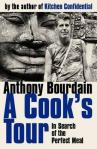
- I’ve read two chef’s memoirs this summer with a scene of pig slaughter: A Cook’s Tour by Anthony Bourdain and Dirt by Bill Buford.
- A character who lost an arm in the First World War in The Librarianist by Patrick deWitt and Haweswater by Sarah Hall.
 I read descriptions of fried egg residue on a plate, one right after the other in the same evening, in The Dead Are Gods by Eirinie Carson and The Wren The Wren by Anne Enright.
What’s the weirdest reading coincidence you’ve had lately?
Tricking Myself into Reading My Own Books
I suspect many of us have this bibliophile problem: we get tremendously excited about a particular book and just have to have it, whether as a proof from the publisher, pre-ordering it new, or (for an older book) snapping it up secondhand the minute we hear about it. Then months or even years pass and we realize that the novel or memoir we were once so desperate to read has simply joined the ranks of hundreds of other half-forgotten books we still plan to get to on that legendary ‘one day’ but always pass by in favour of newer acquisitions.
I’ve long strived to read more backlist books from my own collection, as well as to catch up on the dozens of books I’ve been foolish enough to pause partway through and group together on two “set-aside” shelves in the lounge. (Many of these I obtained as review copies from publishers, so I do feel a sense of obligation to write at least a mini review for each.) As Marcie (Buried in Print) noted in her recent reading goals post, vague intentions go by the wayside, so it’s time to get specific about how to incorporate these into my reading stacks.


- For my review backlog of 2022 releases, I get a second chance. I’ve noted the paperback release dates for around 20 books and will aim to have catch-up review posts (here or for Shiny New Books) ready for that date, or at least within that month. Having a deadline to work towards is essential for a last-minute worker like me.
- There are some authors I own 3 or more unread works by. Usually this means I enjoyed a book of theirs so much I went on a secondhand binge … then got distracted and didn’t explore their back catalogue as I meant to. Via Margaret, I just found out about What Cathy Read Next’s Backlist Burrow challenge, where she’s picked six authors who piqued her interest and two books by each to read this year. I’m unlikely to manage two each, but I fancy doing this adjacent/modified challenge: where I own 2 or more unread books by an author, I must read at least 1 this year. I have these authors to choose from, but also others in my sights, e.g. Sarah Hall, whose Haweswater I’ll take on holiday to the Lake District in July.
- Challenges like that one are the best way to get me rifling through my own shelves. I started a few low-key, long-term projects of my own back in 2020 (Journey through the Day and 4 in a Row) and am still ostensibly working on them, as well as on thematic pairs and trios (my Three on a Theme series) as they arise, along with regular tie-ins to seasons, holidays, etc. Hosted challenges are somehow better, though, perhaps due to the built-in companionship and accountability. Nordic FINDS this month, Reading Indies in February, Reading Ireland in March, the 1940 Club in April, and so on. Because they’re so useful for getting me reading from my shelves, I will participate in at least 1 reading challenge per month.
- How to tackle the dreaded set-aside shelves? One book at a time. So, in addition to the ones I’ll review to coincide with the paperback release, I’ll also reintroduce 1 set-aside book to my reading pile each week.
- How to ensure that book hauls from shopping excursions and gift-receiving occasions don’t get neglected? By undertaking regular “overhauls” such as this and this, and checking there are no more than 3 unread books remaining from any 1 haul. If there are, start reading the stragglers right away. This will be particularly important because it looks like this year I might complete the triple crown of UK book towns, with trips planned to Wigtown in June and the Sedbergh area in July/August and Hay-on-Wye a perpetual temptation.
- How to make time for all those lovely random books (such as this stack) that I keep meaning to read but somehow never do? I’m going to allow myself to start at least 1 “just because” book per fortnight.
- Connected to all of these will be requesting fewer 2023 review books from publishers. Almost all my recent requests have gone completely ignored, in fact, which is probably for the best. Unless I’m reviewing something for pay, I’ll just plan to read it from the library or, if I can’t find it that way, will add it to my wish list in advance of my birthday and Christmas.


How do you trick yourself into reading your own books?
Women’s Prize 2022: Longlist Wishes vs. Predictions
Next Tuesday the 8th, the 2022 Women’s Prize longlist will be announced.
First I have a list of 16 novels I want to be longlisted, because I’ve read and loved them (or at least thought they were interesting), or am currently reading and enjoying them, or plan to read them soon, or am desperate to get hold of them.
Wishlist
Brown Girls by Daphne Palasi Andreades
Our Wives Under the Sea by Julia Armfield (my review)
Ghosted by Jenn Ashworth (my review)
These Days by Lucy Caldwell

Damnation Spring by Ash Davidson – currently reading
Olga Dies Dreaming by Xóchitl González – currently reading
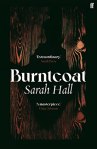
Burntcoat by Sarah Hall (my review)
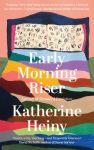
Early Morning Riser by Katherine Heiny (my review)


Pure Colour by Sheila Heti
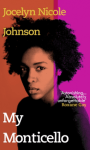
My Monticello by Jocelyn Nicole Johnson (my review)
Devotion by Hannah Kent – currently reading
Build Your House Around My Body by Violet Kupersmith – currently reading



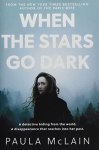
When the Stars Go Dark by Paula McLain (my review)
The Swimmers by Julie Otsuka – review coming to Shiny New Books on Thursday
Brood by Jackie Polzin (my review)
The Performance by Claire Thomas (my review)


Then I have a list of 16 novels I think will be longlisted mostly because of the buzz around them, or they’re the kind of thing the Prize always recognizes (like danged GREEK MYTHS), or they’re authors who have been nominated before – previous shortlistees get a free pass when it comes to publisher submissions, you see – or they’re books I might read but haven’t gotten to yet.
Predictions
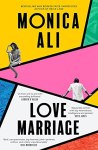
Love Marriage by Monica Ali
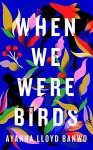
When We Were Birds by Ayanna Lloyd Banwo
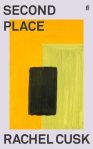
Second Place by Rachel Cusk (my review)
Matrix by Lauren Groff

Free Love by Tessa Hadley
The Other Black Girl by Zakiya Dalila Harris (my review)
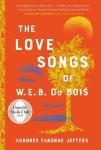
The Love Songs of W.E.B. Du Bois by Honorée Fanonne Jeffers
The Fell by Sarah Moss (my review)



My Phantoms by Gwendoline Riley
Beautiful World, Where Are You by Sally Rooney (my review)
Ariadne by Jennifer Saint
The Island of Missing Trees by Elif Shafak


Great Circle by Maggie Shipstead
Pandora by Susan Stokes-Chapman
Still Life by Sarah Winman
To Paradise by Hanya Yanagihara – currently reading



*A wildcard entry that could fit on either list: Sorrow and Bliss by Meg Mason (my review).*

Okay, no more indecision and laziness. Time to combine these two into a master list that reflects my taste but also what the judges of this prize generally seem to be looking for. It’s been a year of BIG books – seven of these are over 400 pages; three of them over 600 pages even – and a lot of historical fiction, but also some super-contemporary stuff. Seven BIPOC authors as well, which would be an improvement over last year’s five and closer to the eight from two years prior. A caveat: I haven’t given thought to publisher quotas here.
MY WOMEN’S PRIZE FORECAST
Love Marriage by Monica Ali
Our Wives Under the Sea by Julia Armfield
When We Were Birds by Ayanna Lloyd Banwo
Olga Dies Dreaming by Xóchitl González
Matrix by Lauren Groff
The Love Songs of W.E.B. Du Bois by Honorée Fanonne Jeffers
Devotion by Hannah Kent
Build Your House Around My Body by Violet Kupersmith
The Fell by Sarah Moss
My Phantoms by Gwendoline Riley
Beautiful World, Where Are You by Sally Rooney
Ariadne by Jennifer Saint
The Island of Missing Trees by Elif Shafak
Great Circle by Maggie Shipstead
Pandora by Susan Stokes-Chapman
To Paradise by Hanya Yanagihara
What do you think?
See also Laura’s, Naty’s, and Rachel’s predictions (my final list overlaps with theirs on 10, 5 and 8 titles, respectively) and Susan’s wishes.
Just to further overwhelm you, here are the other 62 eligible 2021–22 novels that were on my radar but didn’t make the cut:
In Every Mirror She’s Black by Lola Akinmade Åkerström
Violeta by Isabel Allende
The Leviathan by Rosie Andrews
Somebody Loves You by Mona Arshi
The Stars Are Not Yet Bells by Hannah Lillith Assadi
The Manningtree Witches by A.K. Blakemore
Mary Jane by Jessica Anya Blau
Defenestrate by Renee Branum
Songs in Ursa Major by Emma Brodie
Assembly by Natasha Brown
We Were Young by Niamh Campbell
The Raptures by Jan Carson
A Very Nice Girl by Imogen Crimp
Scary Monsters by Michelle de Kretser
Empire of Wild by Cherie Dimaline
Infinite Country by Patricia Engel
Love & Saffron by Kim Fay
Mrs March by Virginia Feito
Booth by Karen Joy Fowler
Tides by Sara Freeman
I Couldn’t Love You More by Esther Freud
Of Women and Salt by Gabriela Garcia
Libertie by Kaitlyn Greenidge
Listening Still by Anne Griffin
The Twyford Code by Janice Hallett
Mrs England by Stacey Halls
Three Rooms by Jo Hamya
The Giant Dark by Sarvat Hasin
The Paper Palace by Miranda Cowley Heller
Violets by Alex Hyde
Fault Lines by Emily Itami
Beasts of a Little Land by Juhea Kim
Woman, Eating by Claire Kohda
Notes on an Execution by Danya Kukafka
Paul by Daisy Lafarge
Circus of Wonders by Elizabeth Macneal
The Truth About Her by Jacqueline Maley
Wahala by Nikki May
Once There Were Wolves by Charlotte McConaghy
Cleopatra and Frankenstein by Coco Mellors
The Exhibitionist by Charlotte Mendelson
Chouette by Claire Oshetsky
The Book of Form and Emptiness by Ruth Ozeki
The Anthill by Julianne Pachico
The Vixen by Francine Prose
The Five Wounds by Kirstin Valdez Quade
Malibu Rising by Taylor Jenkins Reid
Cut Out by Michèle Roberts
This One Sky Day by Leone Ross
Secrets of Happiness by Joan Silber
Cold Sun by Anita Sivakumaran
Hear No Evil by Sarah Smith
Oh William! by Elizabeth Strout
Animal by Lisa Taddeo
Daughter of the Moon Goddess by Sue Lynn Tan
Lily by Rose Tremain
French Braid by Anne Tyler
We Run the Tides by Vendela Vida
I Love You but I’ve Chosen Darkness by Claire Vaye Watkins
Black Cake by Charmaine Wilkerson
The Dictionary of Lost Words by Pip Williams
Nightbitch by Rachel Yoder
Six Degrees of Separation: From Wolfe Island to Riverine
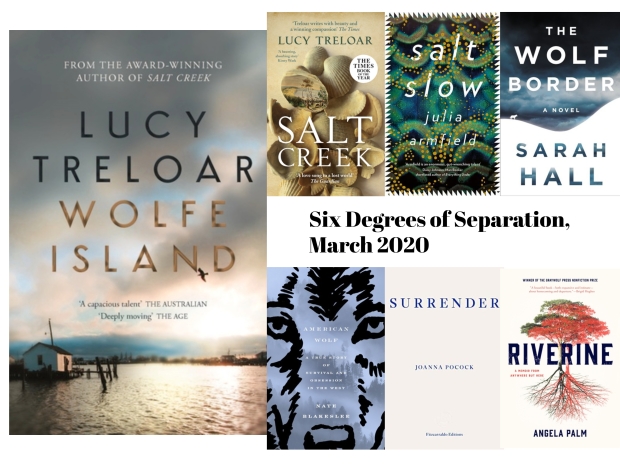
It’s my second month participating in Kate’s Six Degrees of Separation meme (see her introductory post). This time the challenge starts with Wolfe Island by Lucy Treloar. Alas, as far as I can tell this hasn’t yet been published outside of Australia. Which is such a shame, because I absolutely adored…
#1 Salt Creek, Treloar’s debut novel. I read it in 2018 and deemed it “one of the very best works of historical fiction I’ve read.” A widowed teacher settled in England looks back on the eight ill-fated years her family spent at an outpost in South Australia in the 1850s–60s. It’s a piercing story of the clash of cultures and the secret prejudices that underpin our beliefs.
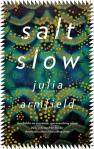
#2 I recently saw someone on Twitter remarking on the apparent trend for book titles to have the word “Salt” in them. Of the few examples he mentioned, I’ve read and enjoyed Salt Slow by Julia Armfield, which was on the Young Writer of the Year Award shortlist last year. The book’s nine short stories are steeped in myth and magic, but often have a realistic shell.
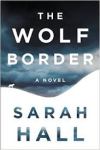
#3 One story in Salt Slow, “Formerly Feral,” is about a teenager who has a wolf for a stepsister. So, to get back to the literal wording of our starting point (a homonym, anyway; I didn’t know whether to take this in the Salt direction or the Wolf direction; now I’ve done both!), another work of fiction I read that incorporated wolves was The Wolf Border by Sarah Hall, a fantastic novel to which Scottish independence and rewilding form a backdrop.
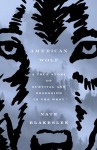
#4 The controversy over the reintroduction of wolves to Yellowstone National Park – and the decision to remove their endangered status, thus declaring open season for hunters – is at the heart of the nonfiction study American Wolf by Nate Blakeslee. “The West was caught up in a culture war, and for some people it was more than just a metaphor,” he writes.
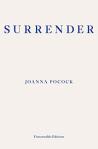
#5 Wolves and rewilding in the American West also come into the memoir-in-essays Surrender by Joanna Pocock, about the two years of loss and change she spent in Missoula, Montana and her sense of being a foreigner both there and on her return to London.
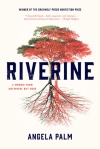
#6 A wonderful memoir-in-essays that was criminally overlooked in 2016 was Riverine by Angela Palm (my BookBrowse review). It has such a strong sense of place, revealing how traces of the past are still visible in the landscape and how our environment shapes who we are. Palm reflects on the winding course of her life in the Midwest and the people who meant most to her along the way, including a friend who was later sentenced to life in prison for murdering their elderly neighbors. In keeping with the watery imagery, there is a stream-of-consciousness element to the writing.
Join us for #6Degrees of Separation if you haven’t already!
Have you read any of my selections? Are you tempted by any you didn’t know before?
The Shortest of the Short: Four Novellas of under 50 Pages

Outside Stamford Library.
It’s a tradition now in its third and last year: I spend one day at the New Networks for Nature conference with my husband, and then (to save money, and because I’ve usually had my fill of stimulating speakers by then) wander around Stamford and haunt the public library on the other day.
 This past Saturday I browsed the charity shops and found a short story collection I’ve been interested in reading, but otherwise just spent hours in Stamford’s library looking through recent issues of the Times Literary Supplement and The Bookseller and reading from the stack of novellas I’d brought with me. I read four in one sitting because all were shorter than 50 pages long: two obscure classics and two nature books.

Fiction:
The Man Who Planted Trees by Jean Giono (1953)
[Translated from the French by Barbara Bray; 46 pages]
 Trees have been a surprise recurring theme in my 2018 reading. This spare allegory from a Provençal author is all about the difference one person can make. The narrator meets a shepherd and beekeeper named Elzéard Bouffier who plants as many acorns as he can; “it struck him that this part of the country was dying for lack of trees, and having nothing much else to do he decided to put things right.” Decades pass and two world wars do their worst, but very little changes in the countryside. Old Bouffier has led an unassuming but worthwhile life.
 There’s not very much to this story, though I appreciated the message about doing good even if you won’t get any recognition or even live to see the fruits of your labor. What’s most interesting about it is the publication history: it was commissioned by Reader’s Digest for a series on “The Most Extraordinary Character I Ever Met,” and though the magazine accepted it with rapture, there was belated outrage when they realized it was fiction. It was later included in a German anthology of biography, too! No one recognized it as a fable; this became a sort of literary in-joke, as Giono’s daughter Aline reveals in a short afterword.
Bartleby the Scrivener by Herman Melville (1853)
[40 pages from my Penguin Classics copy of Billy Budd, Sailor and Other Stories]
 You probably know the basic plot even if you’ve never read the story. Hired as the fourth scrivener in a Wall Street office of law-copyists, Bartleby seems quietly efficient until one day he mildly refuses to do the work requested of him. “I prefer not to” becomes his refrain. First he stops proofreading his copies, and then he declines to do any writing at all. (More and more these days, I find I have the same can’t-be-bothered attitude as Bartleby!) As the employer/narrator writes, “a certain unconscious air … of pallid haughtiness … positively awed me into my tame compliance with his eccentricities.” Farce ensues as he finds himself incapable of getting rid of Bartleby, even after he goes to the extreme of changing the premises of his office. Three times he even denies knowing Bartleby, but still the man is a thorn in his flesh, a nuisance turned inescapable responsibility. A glance at the introduction by Harold Beaver tells me I’m not the first to make such Christian parallels. (This was the first Melville I’ve read since an aborted attempt on Moby-Dick during college.)
Nonfiction:
The Company of Swans by Jim Crumley (1997)
[Illustrated by Harry Brockway, who also did the wood engravings for the Giono; 39 pages]

 Crumley is an underappreciated Scottish nature writer. Here he tells the tale of a pair of mute swans on a loch in Highland Perthshire. He followed their relationship with great interest over a matter of years. First he noticed that their nest had been robbed, twice within a few weeks, and realized otters must be to blame. Then, although it’s a truism that swans mate for life, he observed the cob (male) leaving the pen (female) for another! Crumley was overtaken with sympathy for the abandoned swan and got to feed her by hand and watch her fall asleep. “To suggest there was true communication between us would be outrageous, but I believe she regarded me as benevolent, which was all I ever asked of her,” he writes. Two years later he learns the end of her story. A pleasant ode to fleeting moments of communion with nature.
Favorite passages:
“Swans this wild let you into only a certain portion of their lives. They give you intimate glimpses. But you can never have any part in the business of being a swan. You can offer them no more than the flung tribute of your admiring gaze.”
“I think there is nothing in all nature that outshines that lustrous lacing of curves [of swan necks], nothing in all theatre that outperforms its pivotal tension.”
Holloway by Robert Macfarlane (2013)
[Illustrated by Stanley Donwood; 39 pages]
 In 2011 Macfarlane set out to recreate a journey through South Dorset that he’d first undertaken with the late Roger Deakin in 2005, targeting the sunken paths of former roadways. This is not your average nature or travel book, though; it’s much more fragmentary and poetic than you’d expect from a straightforward account of a journey through the natural world. I thought the stream-of-consciousness style overdone, and got more out of the song about the book by singer-songwriter Anne-Marie Sanderson. (Her Book Songs, Volume 1 EP, which has been one of my great discoveries of the year, is available to listen to and purchase on her Bandcamp page. It also includes songs inspired by Ian McEwan’s Sweet Tooth, Barbara Kingsolver’s The Poisonwood Bible, Sarah Hall’s Haweswater, and Doris Lessing’s Mara and Dann.) The black-and-white illustrations are nicely evocative, though.


Lines I liked:
“paths run through people as surely as they run through places.”
“The holloway is absence; a wood-way worn away by buried feet.”
Have you read any of these super-short novellas? Which one takes your fancy?
Novellas in November, Part 1: 3 Fiction, 3 Nonfiction
This is my third year of prioritizing novellas for my November reading. I have plenty more on the go that I’ll try to write up as the month progresses. For this first installment I review three each of my recent fiction and nonfiction reads, all of them 150 pages or fewer.

Fiction:
Lady into Fox by David Garnett (1922)
[53 pages]
 I accidentally did things the wrong way round: a few months back I read Sarah Hall’s Madame Zero, which includes the BBC National Short Story Prize 2013 winner “Mrs Fox,” clearly modeled on Garnett’s half-charming, half-horrible fable. In both, an upper-middle-class marriage is derailed when the wife turns into a fox. Here Mr. Tebrick sends away the servants and retreats from the world to look after Silvia, who grows increasingly feral. To start with the vixen will wear clothing, sleep in a bed, play cards and eat table scraps, but soon she’s hunting birds outdoors. Before long she’s effectively a wild creature, though she still shows affection to Tebrick when he comes to visit her den.
Anyone in a partnership will experience a bittersweet sense of recognition at how Tebrick and Silvia try to accommodate each other’s differences and make compromises to maintain a relationship in defiance of the world’s disapproval and danger. Beware unsentimental animal peril throughout. I downloaded it from Project Gutenberg. 
The Old Man and the Sea by Ernest Hemingway (1952)
[99 pages]
 It’s a wonder I never read this Pulitzer winner in high school. Like that other syllabus favorite, Steinbeck’s The Pearl, it’s a Great American novella praised for spare prose and weighty symbolism. My two decades’ worth of preconceptions were proven accurate insomuch as this is a gloomy story about the nobility but ultimate futility of human striving. After 84 days without a catch, Santiago returns to the waters off of Havana and finally gets a bite. Even after the harrowing process of reeling in the 18-foot marlin, his struggle isn’t over.
This is my third experience with Hemingway’s fiction; I remain unconvinced. I appreciated some of the old man’s solitary ruminations on purpose and determination – “My big fish must be somewhere,” “Now is no time to think of what you do not have. Think of what you can do with what there is” – though they sound rather like sound bites. And I kept almost falling asleep while reading this (until the sharks showed up), which almost never happens. Take that as you will.
Ghost Wall by Sarah Moss (2018)
[149 pages]
 It’s the late 1980s and teenager Silvie Hampton and her parents have joined a university-run residential archaeology course in the North of England, near bogs where human sacrifice once took place. Her father is a Rochdale-area bus driver, but British prehistory is his all-consuming hobby. They’ll skin rabbits with stone tools and forage for roots and berries. What could be better?! As it turns out, it’s a stifling summer, and the students can’t sneak off to civilization often enough. Mocked for her family’s accent, Silvie is uncomfortably aware of her class. And, always, she must tread carefully to avoid angering her father, who punishes perceived offenses with his belt or his fists.
Women’s bodies and what can be done to them is central; as the climax approaches, the tricksy matter of consent arises. Though I enjoyed Silvie’s sarcastic voice, I was underwhelmed for much of the book, yet ended up impressed by how much is conveyed in so few pages. If you haven’t read anything by Sarah Moss, do so immediately. 
Nonfiction:
Losing Susan: Brain Disease, the Priest’s Wife, and the God Who Gives and Takes Away by Victor Lee Austin (2016)
[146 pages]
 Austin, an Episcopal priest and academic, met his wife Susan at St. John’s College in Santa Fe, New Mexico. She was his companion for nearly 40 years. Unusually for a cancer story, it wasn’t the beginning of the end when Susan was diagnosed with an astrocytoma brain tumor in 1993; surgery was successful and she lived for another 19 years, but white-matter disease, a side effect of radiation, meant that her brain function was continually diminishing.
The book gives a clear sense of Susan’s personality despite the progression of her illness, and of the challenges of being a caregiver while holding down a career. I enjoyed the details of the human story of coping with suffering, but in overlaying a spiritual significance on it Austin lost me somewhat. “God, who had given us so much, now gave us this evil,” he writes. While once this kind of language would have meant something to me, now it alienates me. I valued this more as a straightforward bereavement memoir than as a theological treatise.
The Secret Life of the Owl by John Lewis-Stempel (2017)
[84 pages]
 “There is something about owls. More than any other family of birds they produce a reaction in us, and have done so across time and continents.” Some species-specific natural/cultural histories can be long-winded, giving significantly more information than your averagely interested lay reader needs (Foxes Unearthed, for instance), but Lewis-Stempel’s short book about Britain’s owls gets it just right.
He gives some general information about the family, surveys the native species and occasional visitors, gives tips for telling them apart – I’m going to photograph a page on the difference between the five major species’ pellets for future reference – and shares legends and poems that feature owls (including a jaunty little Tennyson piece that reads like a folk song; I’ll suggest that my husband turn it into one). The black-and-white illustrations by Beci Kelly are charming, too. It’s a shame I missed this when it first came out, but it would still make a great gift for a bird lover this Christmas.
Pages from a Nature-Lover’s Diary by Kathleen A. Renninger (2013)
[72 pages]
 These are lovely excerpts from nature sketchbooks Renninger kept between 1987 and 2013. My mother bought the self-published book from the author at a craft fair, and I enjoyed spotting lots of familiar place names from southern central Pennsylvania, where my mother and sister used to live. In the past I’ve unfairly considered the area devoid of natural beauty, but it’s clear from Renninger’s encounters that the wildlife is out there if you’re patient and lucky enough to find it – mostly birds and insects, but even larger mammals like foxes and bears.
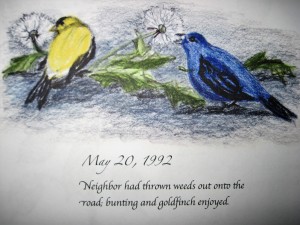 Many of her sightings are by chance: near her feeders or clothesline, or while driving past fields or down a residential street. Each month ends with a poem; these are slightly florid, but so earnest that they won me over. There are plentiful punctuation issues and the cursive font is a challenge to read, but the captured moments and the sense of the seasons’ passing make for a sweet book I’d recommend to anyone with a local interest.
Have you read any of these novellas? Which one takes your fancy?
R.I.P. Reads, Part I: Bender, Harkness, Hurley
I’ve been reading twisted fairy tales, a novel about witches and vampires with historical and contemporary timelines, and a subtle work of Gothic horror set on a remote stretch of the English coast.
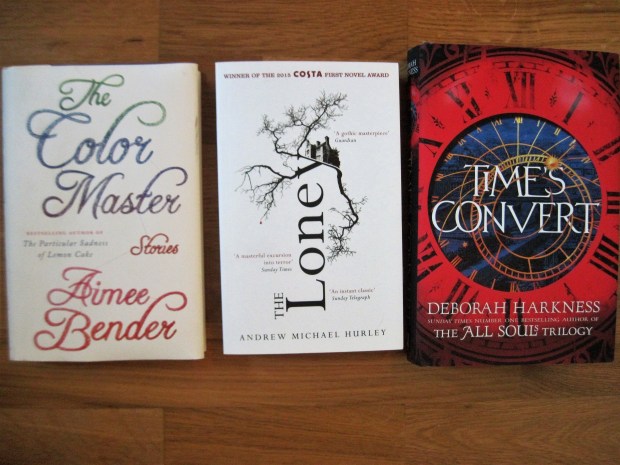
The Color Master by Aimee Bender (2013)
Aimee Bender is best known for The Particular Sadness of Lemon Cake. This is the second collection of her stories that I’ve read. Most have a touch of the bizarre to them – a tiny tweak to normal life – but some are set in completely alternate worlds. One character experiences extreme face blindness; another deludes himself that he was a famously vicious Nazi during the Second World War. Seamstresses take on odd tasks like repairing endangered animals or, in the title story, creating a dress that resembles the moon and embodies female anger. In “Appleless,” vigilantes punish a girl who won’t eat apples, while “The Devourings” is a dark riff on Shrek in which a woman comes to terms with her ogre husband’s innate violence.
 A few favorites were “A State of Variance,” in which a character can’t seem to avoid perfect facial symmetry no matter how he tries to mar his natural beauty, “The Doctor and the Rabbi,” a philosophical conversation between an ill rabbi and her atheist-leaning parishioner, and “The Red Ribbon” (which draws on the same source material as Carmen Maria Machado’s “The Husband Stitch”), about a bored housewife who starts acting out sexual fantasies to try to save her marriage.
Bender deploys a good mixture of voices and protagonists, though at least four of the 15 stories felt unnecessary to me. Her approach is similar to Kelly Link’s and Karen Russell’s, but I’ve failed to get on with their surreal stories before – Bender’s writing is that bit more accessible. I’d recommend her to fans of stories by Amy Bloom and Sarah Hall.
My rating:
Time’s Convert by Deborah Harkness (2018)
This is a companion volume to Harkness’s All Souls Trilogy, which is like the thinking gal’s Twilight, as written by a historian of science. I read the first book, A Discovery of Witches, in 2011 and surprised myself by completely loving the story of the witch Diana Bishop, who researches alchemy at the Bodleian Library and falls hard for a centuries-old vampire, Matthew de Clermont. Although Time’s Convert is likely intended to stand alone, I felt it could do with a dramatis personae at the start as I’d forgotten who many of the minor characters were.
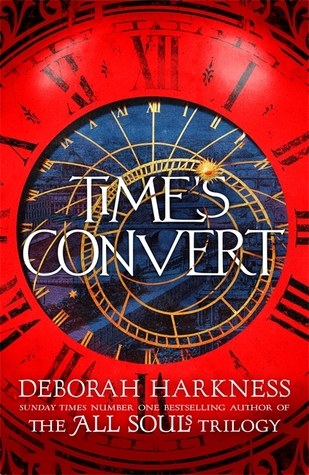 Diana and Matthew are still major characters, though not at the heart of the book. One strand has Diana and her family staying in the French countryside. She and Matthew now have toddler twins, Philip and Becca, who are just starting to show magical powers: Philip summons a griffon named Apollo as his familiar. Another is set in Paris, where Phoebe Taylor is willingly being transformed into a vampire so she can marry Matthew’s son, Marcus. A final strand recreates Marcus’s experiences during the American and French Revolutions and onward: he was born in Massachusetts in 1757 and was a surgeon during the Revolutionary War before he met Matthew and received the offer of immortality.
I almost always feel that sequels fail to live up to the original. Time’s Convert is most like Shadow of Night, the second book of the series and my least favorite because it spends so much time in 1590s England. Here the three different story lines split my focus and I resented being taken away from Diana’s first-person narration, which is much more engaging than the third-person material. I would only recommend this volume to diehard fans of the series.
My rating:
With thanks to Headline for the free copy for review.
Note: A television adaptation of A Discovery of Witches recently aired on Sky One in the UK and is coming to North America in January.
The Loney by Andrew Michael Hurley (2014)
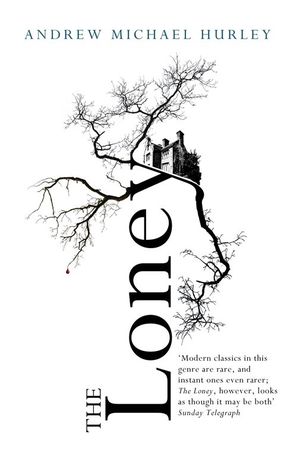 The Loney is not a monster, as I suppose I expected, but a place: an isolated coastline in the northwest of England that the narrator and his family visited on pilgrimage with their Roman Catholic congregation every Easter in the 1970s. The narrator, only identified by the nickname Tonto, explores their strange rental house – full of taxidermied animals and hidden rooms, it also has a rifle under the floorboards – and goes to the beach with his mute brother Andrew (“Hanny”). Mummer and Farther hold out hope that their son Hanny will be healed on a visit to the local shrine, and Mummer especially is frustrated that Father Bernard isn’t as strict and devout as their previous priest, Father Wilfred, who died under a cloud of suspicion not long before this trip.
Last year at around this time I read Hurley’s follow-up, Devil’s Day, which has a similarly bleak and eerie atmosphere. Both look at rural superstitions as experienced by outsiders. The Loney was more profound for me, though, in how it subverts religious rituals and posits a subtle evil influence without ever disappearing down doctrinal rabbitholes. It asks how far people will go to get what they want, what meaning there is to human life if there is no supernatural being looking out for us, and – through a framing story set 30 or more years later – how guilt and memory persist. I especially loved the Tenebrae service in a gloomy church featuring Bosch-like horrors in its artwork. This reminded me of a less abstract After Me Comes the Flood and a more contemporary The Short Day Dying; I highly recommend it.
Favorite lines:
“The Church of the Sacred Heart was an ancient place – dark and squat and glistening amphibiously in the rain.”
“The wind continued to rise and fall. Whining and shrilling. It was as insistent as the priest, louder sometimes, preaching an older sermon, about the sand and the sea.”
My rating:
Have you been reading anything fantastical or spooky this October?
Short Story Collections Read Recently
This is the third year in a row that I’ve made a concerted effort to read more short stories in the alliterative month of September; see also my 2016 and 2017 performances. (I actually finished Sarah Hall’s collection in late August, but I’m going to cheat and include it anyway.) That makes for four volumes in total read recently. Surprisingly, I had my best luck with two that were published back in the early 1990s.
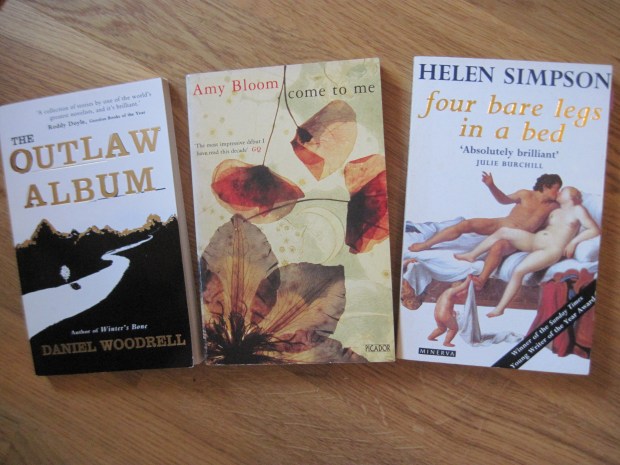
I read Sarah Hall’s book from the library; these three were bargains from my local charity warehouse, the Community Furniture Project.
Like many devoted novel readers, I struggle with short stories because they can feel fragmentary or open-ended, and it takes that much more effort to keep up with multiple settings and groups of characters. Yet I also get frustrated when the narrative voice and themes are too similar across a whole set of tales.
However, when done well short stories can be marvelous, of course. I enjoyed K.J. Orr’s article on short stories in the September 7th issue of the Times Literary Supplement. Among the virtues of the short story, she lists the following:
- “the capacity to stoke questions of definition and instability, resolution and irresolution … ; to deliver its conundrums to the reader in a state of compression”
- “The unpredictability involved means that picking up a new short story always feels to me a moment full of possibilities.”
- “The short story can combine complexity and uncertainty with ebullience and humour. It can take on subjects and situations that risk seeming clichéd and open them to wonder. It can put the familiar and the strange in conversation.”
And yet sometimes the quality of the writing, or at least the intensity of my engagement, can vary wildly within a story collection, which often makes the books difficult to rate and respond to as a whole. That’s what I found with these first two.
Madame Zero by Sarah Hall (2017)
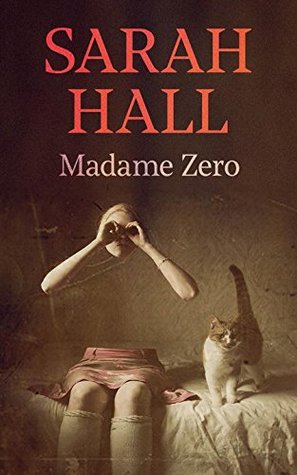 Three corkers; two pretty good; four been-there-read-that. My favorites were the first and last stories, “Mrs Fox” and “Evie” (winner of the BBC National Short Story Prize 2013 and shortlisted for the Sunday Times EFG Private Bank Short Story Award 2013, respectively). Both concern a fairly average marriage derailed when the wife undergoes a transformation. In the former Sophia literally turns into a fox and her husband scrambles for a way to make the relationship last. In “Evie,” Richard’s wife develops a voracious appetite for sweets and sex, and starts talking gibberish. This one is very explicit, but if you can get past that I found it both painful and powerful. I also especially liked “Case Study 2,” about a psychologist’s encounter with a boy who’s been brought up in a commune. It has faint echoes of T.C. Boyle’s “The Wild Child.”
“Wilderness” focuses on an intense episode of fear of heights during a trip to South Africa. In “Luxury Hour,” a new mother meets up with an old lover near the swimming pool they used to frequent and wonders where and why their lives diverged. This one reminded me of the first chapter of Rachel Cusk’s Transit.
As for the rest? “Goodnight Nobody” was completely forgettable, and the other three are in the vague speculative/post-apocalyptic vein that’s been done to death: “Theatre 6” = Red Clocks; “Later, His Ghost” = The Road et al.; “One in Four” = Station Eleven et al. I admire Hall’s writing in general, but The Wolf Border remains the best thing I’ve read by her.
My rating:
The Outlaw Album: Stories by Daniel Woodrell (2011)
 Based on the first six stories, I was planning a 5-star rating. (How can you resist this opening line? “Once Boshell finally killed his neighbor he couldn’t seem to quit killing him.”) But the second half of the book ended up being much less memorable; I wouldn’t say it wasn’t worth reading, but I got very little out of four of the stories, and the other two were okay but somewhat insubstantial. By contrast, the first two stories, “The Echo of Neighborly Bones” and “Uncle,” are gritty little masterpieces of violence and revenge.
I also particularly liked “Black Step” and “Night Stand,” about traumatized soldiers back from war (Woodrell himself was a Marine). Each has a creepy segment where the veteran gives sarcastic answers to the unspecified typical questions they always get; we have to infer that these are: How many people did you kill? What’s it like to kill someone? and What do you do with the bodies? There’s a nice balance between first- and third-person voices; lyrical and unlearned prose; and speech marks and none. I will definitely read more by Woodrell.
My rating:
I thoroughly loved these next two debut collections. In each case I’d read one or two previous books by the author and not been wild about the writing (White Houses; In-Flight Entertainment and Cockfosters), but these two have convinced me to try more of their work.
Come to Me by Amy Bloom (1993)
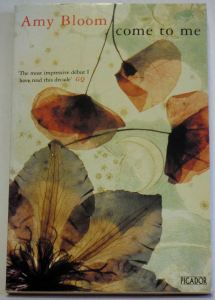 Bloom was a practicing psychotherapist, so it’s no surprise she has deep insight into her characters’ motivations. This is a wonderful set of stories about people who love who they shouldn’t love. In “Song of Solomon,” a new mother falls for the obstetrician who delivered her baby; in “Sleepwalking,” a woman gives in to the advances of her late husband’s son from a previous marriage; in “Light Breaks Where No Sun Shines,” adolescent Susan develops crushes on any man who takes an interest in her. My favorite was probably “Love Is Not a Pie,” in which a young woman rethinks her impending marriage during her mother’s funeral, all the while remembering the unusual sleeping arrangement her parents had with another couple during their joint summer vacations. The title suggests that love is not a thing to be apportioned out equally until it’s used up, but a more mysterious and fluid entity.
Linked short stories can be a useful halfway-house for readers who prefer novels and are still unsure about reading stories. Happily, then, the heart of this collection is five pieces that orbit around the same characters. In “Hyacinths” we meet David as a boy in Manitoba and get a glimpse of him as an adult. In the next story we encounter his second wife, Galen, and her lover, Henry. “Silver Water” is about a mental health crisis with David and Galen’s daughter, and the next two stories are about Henry, his wife Marie, and the other bonds they form.
Although I read the book quickly while on holiday and so haven’t marked out any particular quotes, convincing dialogue and insightful observations are on almost every page. I was reminded most of short stories I’ve read by Elizabeth McCracken and Carol Shields.
My rating:
Four Bare Legs in a Bed and Other Stories by Helen Simpson (1990)
 Simpson won the inaugural Sunday Times Young Writer of the Year Award for this in 1991. Her protagonists are women disillusioned with the norms of marriage and motherhood. They ditch their safe relationships, or carry on brazen affairs; they fear pregnancy, or seek it out on their own terms. The feminist messages are never strident because they are couched in such brisk, tongue-in-cheek narratives. For instance, in “Christmas Jezebels” three sisters in 4th-century Lycia cleverly resist their father’s attempts to press them into prostitution and are saved by the bishop’s financial intervention; in “Escape Clauses” a middle-aged woman faces the death penalty for her supposed crimes of gardening naked and picnicking on private property, while her rapist gets just three months in prison because she was “asking for it.” (Nearly three decades on, it’s still so timely it hurts.)
I loved “The Bed,” a kind of fairy tale about a luxurious bed solving all a woman’s problems; “What Are Neighbours For,” in which each woman cattily plans what she can get out of the others; “Labour,” a brief five-act play set in a hospital delivery room; and “Zoë and the Pedagogues,” about a woman learning to drive who has two very different teachers (perhaps inevitably, this recalled Mirror, Shoulder, Signal by Dorthe Nors). “An Interesting Condition,” which takes place in an antenatal class, is like Curtis Sittenfeld’s “Bad Latch,” while multiple stories reminded me of Shena Mackay, especially “Send One Up for Me,” about a woman tiptoeing around her boarding house and trying not to anger the landlady.
My rating:
 Bookish Beck = Rebecca Foster. American transplant to England. Freelance proofreader and book reviewer.
 Bookish Beck