11 Days, 11 Books: 2020’s Reads, from Best to Worst
I happen to have finished 11 books so far this year – though a number of them were started in 2019 (one as far back as September) and several of them are novelty books and/or of novella length. Just for kicks, I’ve arranged them from best to worst. Here’s how my reading year has started off…
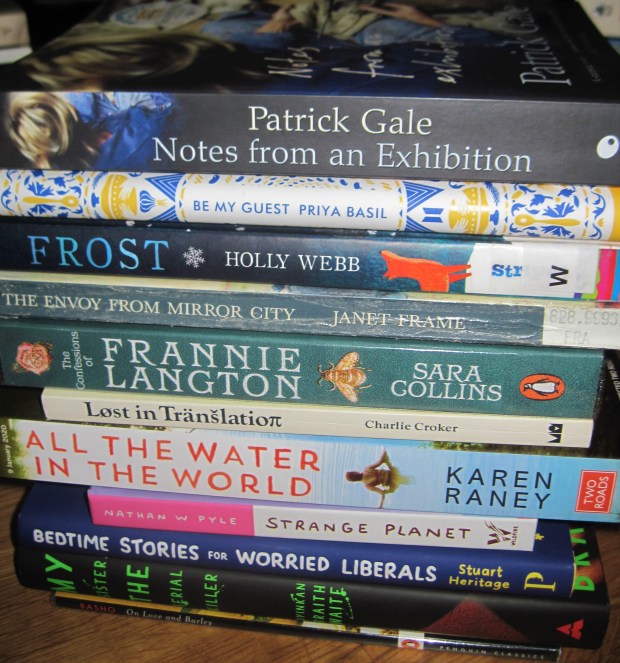
 Notes from an Exhibition by Patrick Gale – Nonlinear chapters give snapshots of the life of bipolar Cornwall artist Rachel Kelly and her interactions with her husband and four children, all of whom are desperate to earn her love. Quakerism, with its emphasis on silence and the inner light in everyone, sets up a calm and compassionate atmosphere, but also allows for family secrets to proliferate. There are two cameo appearances by an intimidating Dame Barbara Hepworth, and three wonderfully horrible scenes in which Rachel gives a child a birthday outing. The novel questions patterns of inheritance (e.g. of talent and mental illness) and whether happiness is possible in such a mixed-up family. (Our joint highest book club rating ever, with Red Dust Road. We all said we’d read more by Gale.)
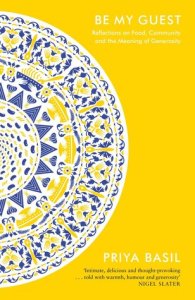 Be My Guest: Reflections on Food, Community and the Meaning of Generosity by Priya Basil – An extended essay whose overarching theme of hospitality stretches into many different topics. Part of an Indian family that has lived in Kenya and England, Basil is used to a culture of culinary abundance. Greed, especially for food, feels like her natural state, she acknowledges. However, living in Berlin has given her a greater awareness of the suffering of the Other – hundreds of thousands of refugees have entered the EU, often to be met with hostility. Yet the Sikhism she grew up in teaches unconditional kindness to strangers. She asks herself, and readers, how to cultivate the spirit of generosity. Clearly written and thought-provoking. (And typeset in Mrs Eaves, one of my favorite fonts.) See also Susan’s review, which convinced me to order a copy with my Christmas bookstore voucher.
 Frost by Holly Webb – Part of a winter animals series by a prolific children’s author, this combines historical fiction and fantasy in an utterly charming way. Cassie is a middle child who always feels left out of her big brother’s games, but befriending a fox cub who lives on scrubby ground near her London flat gives her a chance for adventures of her own. One winter night, Frost the fox leads Cassie down the road – and back in time to the Frost Fair of 1683 on the frozen Thames. I rarely read middle-grade fiction, but this was worth making an exception for. It’s probably intended for ages eight to 12, yet I enjoyed it at 36. My library copy smelled like strawberry lip gloss, which was somehow just right.
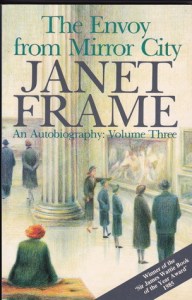 The Envoy from Mirror City by Janet Frame – This is the last and least enjoyable volume of Frame’s autobiography, but as a whole the trilogy is an impressive achievement. Never dwelling on unnecessary details, she conveys the essence of what it is to be (Book 1) a child, (2) a ‘mad’ person, and (3) a writer. After years in mental hospitals for presumed schizophrenia, Frame was awarded a travel fellowship to London and Ibiza. Her seven years away from New Zealand were a prolific period as, with the exception of breaks to go to films and galleries, and one obsessive relationship that nearly led to pregnancy out of wedlock, she did little else besides write. The title is her term for the imagination, which leads us to see Plato’s ideals of what might be.
 The Confessions of Frannie Langton by Sara Collins – Collins won the first novel category of the Costa Awards for this story of a black maid on trial in 1826 London for the murder of her employers, the Benhams. Margaret Atwood hit the nail on the head in a tweet describing the book as “Wide Sargasso Sea meets Beloved meets Alias Grace” (she’s such a legend she can get away with being self-referential). Back in Jamaica, Frances was a house slave and learned to read and write. This enabled her to assist Langton in recording his observations of Negro anatomy. Amateur medical experimentation and opium addiction were subplots that captivated me more than Frannie’s affair with Marguerite Benham and even the question of her guilt. However, time and place are conveyed convincingly, and the voice is strong.
(The next one is a book my husband received for Christmas, as are the Heritage and Pyle, further down, which were from me. Yes, I read them as well. What of it?)
 Lost in Translation by Charlie Croker – This has had us in tears of laughter. It lists examples of English being misused abroad, e.g. on signs, instructions and product marketing. China and Japan are the worst repeat offenders, but there are hilarious examples from around the world. Croker has divided the book into thematic chapters, so the weird translated phrases and downright gobbledygook are grouped around topics like food, hotels and medical advice. A lot of times you can see why mistakes came about, through the choice of almost-but-not-quite-right synonyms or literal interpretation of a saying, but sometimes the mind boggles. Two favorites: (in an Austrian hotel) “Not to perambulate the corridors in the hours of repose in the boots of ascension” and (on a menu in Macao) “Utmost of chicken fried in bother.”
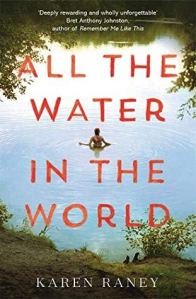 All the Water in the World by Karen Raney – Like The Fault in Our Stars (though not YA), this is about a teen with cancer. Sixteen-year-old Maddy is eager for everything life has to offer, so we see her having her first relationship – with Jack, her co-conspirator on an animation project to be used in an environmental protest – and contacting Antonio, the father she never met. Sections alternate narration between her and her mother, Eve. I loved the suburban D.C. setting and the e-mails between Maddy and Antonio. Maddy’s voice is sweet yet sharp, and, given that the main story is set in 2011, the environmentalism theme seems to anticipate last year’s flowering of youth participation. However, about halfway through there’s a ‘big reveal’ that fell flat for me because I’d guessed it from the beginning.
This was published on the 9th. My thanks to Two Roads for the proof copy for review.
 Strange Planet by Nathan W. Pyle – I love these simple cartoons about aliens and the sense they manage to make of Earth and its rituals. The humor mostly rests in their clinical synonyms for everyday objects and activities (parenting, exercise, emotions, birthdays, office life, etc.). Pyle definitely had fun with a thesaurus while putting these together. It’s also about gentle mockery of the things we think of as normal: consider them from one remove, and they can be awfully strange. My favorites are still about the cat. You can also see his work on Instagram.

 Bedtime Stories for Worried Liberals by Stuart Heritage – I bought this for my husband purely for the title, which couldn’t be more apt for him. The stories, a mix of adapted fairy tales and new setups, are mostly up-to-the-minute takes on US and UK politics, along with some digs at contemporary hipster culture and social media obsession. Heritage quite cleverly imitates the manner of speaking of both Boris Johnson and Donald Trump. By its nature, though, the book will only work for those who know the context (so I can’t see it succeeding outside the UK) and will have a short shelf life as the situations it mocks will eventually fade into collective memory. So, amusing but not built to last. I particularly liked “The Night Before Brexmas” and its all-too-recognizable picture of intergenerational strife.
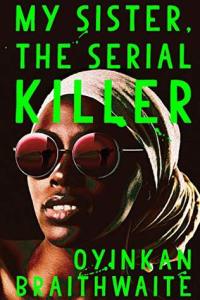 My Sister, the Serial Killer by Oyinkan Braithwaite – The Booker Prize longlist and the Women’s Prize shortlist? You must be kidding me! The plot is enjoyable enough: a Nigerian nurse named Korede finds herself complicit in covering up her gorgeous little sister Ayoola’s crimes – her boyfriends just seem to end up dead somehow; what a shame! – but things get complicated when Ayoola starts dating the doctor Korede has a crush on and the comatose patient to whom Korede had been pouring out her troubles wakes up. My issue was mostly with the jejune writing, which falls somewhere between high school literary magazine and television soap (e.g. “My hands are cold, so I rub them on my jeans” & “I have found that the best way to take your mind off something is to binge-watch TV shows”).
 On Love and Barley – Haiku of Basho [trans. from the Japanese by Lucien Stryk] – These hardly work in translation. Almost every poem requires a contextual note on Japan’s geography, flora and fauna, or traditions; as these were collected at the end but there were no footnote symbols, I didn’t know to look for them, so by the time I read them it was too late. However, here are two that resonated, with messages about Zen Buddhism and depression, respectively: “Skylark on moor – / sweet song / of non-attachment.” (#83) and “Muddy sake, black rice – sick of the cherry / sick of the world.” (#221; reminds me of Samuel Johnson’s “tired of London, tired of life” maxim). My favorite, for personal relevance, was “Now cat’s done / mewing, bedroom’s / touched by moonlight.” (#24)
Any of these you have read or would read?
Onwards with the 2020 reading!
Tenth of December by George Saunders
Even before George Saunders won the Man Booker Prize for the truly astounding Lincoln in the Bardo, I wanted to read Tenth of December (2013), the short story collection that won him the inaugural Folio Prize. The 10 stories, set in a recognizable contemporary or near-future suburban America, feature a mixture of realist and science fiction scenarios and a gently satirical tone.
 At times the narration seems to reflect a new form of human speech, almost like shorthand, with the characters only lapsing into old-fashioned garrulousness under the influence of specially designed pharmaceuticals. I found the language most amusing in “The Semplica Girl Diaries,” narrated by a lower-middle-class dad who’s trying to keep up with the Joneses and please his daughters. “Have to do better! Be kinder. Start now. Soon they will be grown and how sad, if only memory of you is testy stressed guy in bad car.”
However, notably absent from the entertaining definitions he drops in for posterity (Whac-a-Mole, in case future readers are unfamiliar: “Plastic mole emerges, you whack with hammer, he dies, falls, another emerges, you whack, kill?”) is one for the SGs. Only gradually do you realize, with some horror, that “Semplica girls,” who have left the developing world for a chance at a better life, are a trendy lawn ornament, strung along a wire through their brains. From this article, included as an introduction to the Bloomsbury paperback, I learned that this story arose from a dream Saunders had. That accounts for how matter-of-factly bizarre it is.
Although it runs a bit long, this story was one of my favorites, along with “Victory Lap,” about a geeky high schooler improbably saving a classmate from a sexual assault, and “Sticks,” which in under two pages captures a family’s entire decades-long dynamic. None of the rest were quite as memorable for me, so I’m not sure I’ll seek out more of Saunders’s stories. I just couldn’t resist the urge to read and review this book in time for the day in the title after I found it on clearance at my local Waterstones.
My rating: 
Discover Some Shiny New Books
If you haven’t already come across it, let me commend to you the UK-based web magazine Shiny New Books. It’s been around for two years now and has just released Issue #10. Each installment is stuffed full of terrific reviews and features. I suggest setting aside a bit of time each day for a week or two, say a half-hour tea break, to browse what the site has to offer. It specifically highlights what’s been recently published or reprinted in the UK, so in some cases these will be books that are already available in North America; in others these will be sneak previews of books not yet published there. You’re sure to find plenty that appeals.
I’m proud to be part of the stellar (if I do say so myself) team of SNB reviewers. Somehow I just kept volunteering for things and ended up with – whoops! – a whole five pieces in this latest issue: four reviews (two fiction, one nonfiction, and one classic reprint) and an interview. Two of the novels were fantastic, among my best reads of the year so far, while the other two books were worthwhile, even very good in places. Here are tasters of my reviews; click on a title to read the whole thing – and then spend some good time browsing the site.
Sweetbitter by Stephanie Danler
 Twenty-two-year-old Tess arrives in New York City by car in June 2006. Two days later she interviews at a restaurant in Union Square and gets a job as a backwaiter and barista. Camaraderie makes the restaurant not just bearable but a kind of substitute home. Tess is most fascinated by two colleagues who stand apart from the crowd: Simone, the resident wine know-it-all, and bartender Jake. Try as she might, Tess can’t work out the dynamic between them. To mirror her one-year taste apprenticeship, the book is broken into four seasonal parts, headed by short sections in the second person or first-person plural. Everything about this novel is utterly assured: the narration, the characterization, the prose style, the plot, the timing. It’s hard to believe that Danler is a debut author rather than a seasoned professional. It captures the intensity and idealism of youth yet injects a hint of nostalgia. I’m willing to go out on a limb and call Sweetbitter my favorite novel of 2016.
My rating: 
I also interviewed Stephanie Danler over e-mail.
My Son, My Son by Howard Spring
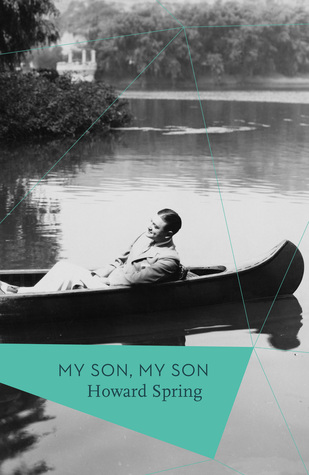 My Son, My Son opens in working-class Manchester in the 1870s and stretches through the aftermath of World War I. Like a Dickensian urchin, William Essex escapes his humble situation thanks to a kind benefactor and becomes a writer. His best friend is Dermot O’Riorden, a fervid Irish Republican. William’s and Dermot’s are roughly parallel tracks. Their sons’ lives, however, are a different matter. Oliver Essex and Rory O’Riorden are born on the same day, and it’s clear at once that both fathers intend to live vicariously through their sons. My Son, My Son struck me as an unusual window onto World War I, a subject I’ve otherwise wearied of in fiction. A straight line could be drawn between Great Expectations, Maugham’s Of Human Bondage, My Son, My Son, and The Goldfinch: all four feature a simultaneously sympathetic and enraging protagonist who overcomes family difficulties to dream of fame and fortune. No mere period or local interest piece, this is a book for the ages.
My rating: 
The Sellout by Paul Beatty
 This is such an outrageous racial satire that I kept asking myself how Beatty got away with it. Not only did he get away with it, he won a National Book Critics Circle Award. The novel opens at the U.S. Supreme Court, where the narrator has been summoned to defend himself against a grievous but entirely true accusation: he has reinstituted slavery and segregation in his hometown of Dickens, California. All the old stereotypes of African Americans are here, many of them represented by Hominy Jenkins. This reminded me most of Ishmael Reed’s satires and, oddly enough, Julian Barnes’s England, England, which similarly attempts to distill an entire culture and history into a limited space and time. The plot is downright silly in places, but the shock value keeps you reading. Even so, after the incendiary humor of the first third, the satire wears a bit thin. I yearned for more of an introspective Bildungsroman, which there are indeed hints of.
My rating: 
The Abundance by Annie Dillard
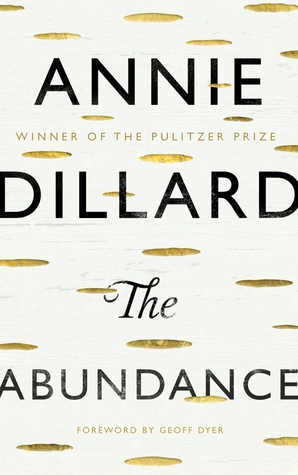 Dillard was raised a Christian in Pittsburgh, Pennsylvania, but her writing expresses an open spirituality rather than any specific faith. For readers who are reasonably familiar with her work, the selection given here might be a little disappointing. Why reread 60 pages from Pilgrim at Tinker Creek, I thought, when I have a copy of it up on the shelf? Rather than reading long, downright strange portions of For the Time Being and Teaching a Stone to Talk, why not go find whole copies to read (which might help with understanding them in context)? None of Dillard’s poetry or fiction has been included, and the most recent piece, “This Is the Life,” from Image magazine, is from 2002. I wish there could have been more fresh material as an enticement for existing fans. However, this will serve as a perfect introduction for readers who are new to Dillard’s work and want a taste of the different nonfiction genres she treats so eloquently and mysteriously.
My rating: 
 Bookish Beck = Rebecca Foster. American transplant to England. Freelance proofreader and book reviewer.
 Bookish Beck