Winter Reads: Claire Tomalin, Daniel Woodrell & Picture Books
Mid-February approaches and we’re wondering if the snowdrops and primroses emerging here in the South of England mean that it will be farewell to winter soon, or if the cold weather will return as rumoured. (Punxsutawney Phil didn’t see his shadow, but that early-spring prediction is only valid for the USA, right?) I didn’t manage to read many seasonal books this year, but I did pick up several short works with “Winter” in the title: a little-known biographical play from a respected author, a gritty Southern Gothic novella made famous through a Jennifer Lawrence film, and two picture books I picked up at the library last week.
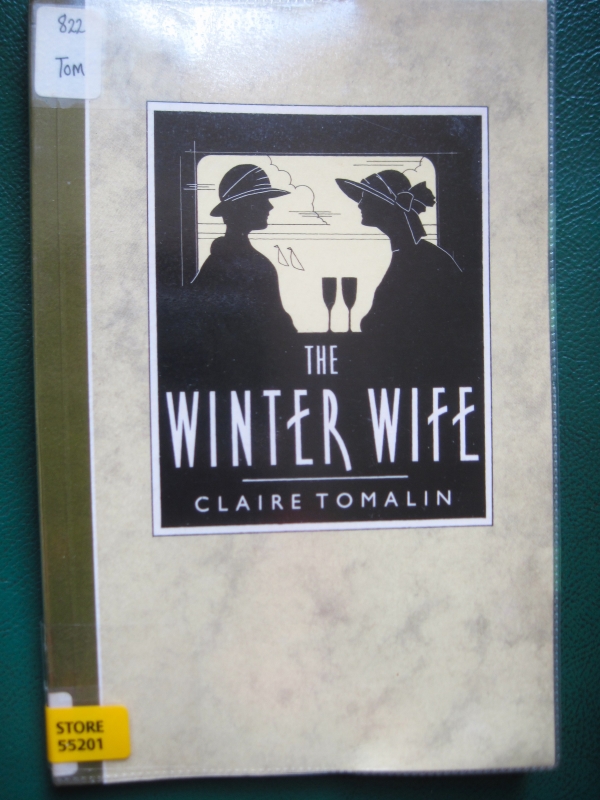
The Winter Wife by Claire Tomalin (1991)
A search of the university library catalogue turned up this Tomalin title I’d never heard of. It turns out to be a very short play (two acts of seven scenes each, but only running to 44 pages in total) about a trip abroad Katherine Mansfield took with her housekeeper?/companion, Ida Baker, in 1920. Ida clucks over Katherine like a nurse or mother hen, but there also seems to be latent, unrequited love there (Mansfield was bisexual, as I knew from fellow New Zealander Sarah Laing’s fab graphic memoir Mansfield and Me). Katherine, for her part, alternately speaks to Ida, whom she nicknames “Jones,” with exasperation and fondness. The title comes from a moment late on when Katherine tells Ida “you’re the perfect friend – more than a friend. You know what you are, you’re what every woman needs: you’re my true wife.” Maybe what we’d call a “work wife” today, but Ida blushes with pride.
Tomalin had already written a full-length biography of Mansfield, but insists she barely referred to it when composing this. The backdrops are minimal: a French sleeper train; Isola Bella, a villa on the French Riviera; and Dr. Bouchage’s office. Mansfield was ill with tuberculosis, and the continental climate was a balm: “The sun gets right into my bones and makes me feel better. All that English damp was killing me. I can’t think why I ever tried to live in England.” There are also financial worries. The Murrys keep just one servant, Marie, a middle-aged French woman who accompanies her on this trip, but Katherine fears they’ll have to let her go if she doesn’t keep earning by her pen.
Through Katherine’s conversations with the doctor, we catch up on her romantic history – a brief first marriage, a miscarriage, and other lovers. Dr. Bouchage believes her infertility is a result of untreated gonorrhea. He echoes Ida in warning Katherine that she’s working too hard – mostly reviewing books for her husband John Middleton Murry’s magazine, but also writing her own short stories – when she should be resting. Katherine retorts, “It is simply none of your business, Jones. Dr Bouchage: if I do not work, I might as well be dead, it’s as simple as that.”
She would die not three years later, a fact that audiences learn through a final flash-forward where Ida, in a monologue, contrasts her own long life (she lived to 90 and Tomalin interviewed her when she was 88) with Katherine’s short one. “I never married. For me, no one ever equalled Katie. There was something golden about her.” Whereas Katherine had mused, “I thought there was going to be so much life then … that it would all be experience I could use. I thought I could live all sorts of different lives, and be unscathed…”
The play is, by its nature, slight, but gives a lovely sense of the subject and her key relationships – I do mean to read more by and about Mansfield. I wonder if it has been performed much since. And how about this for unexpected literary serendipity?
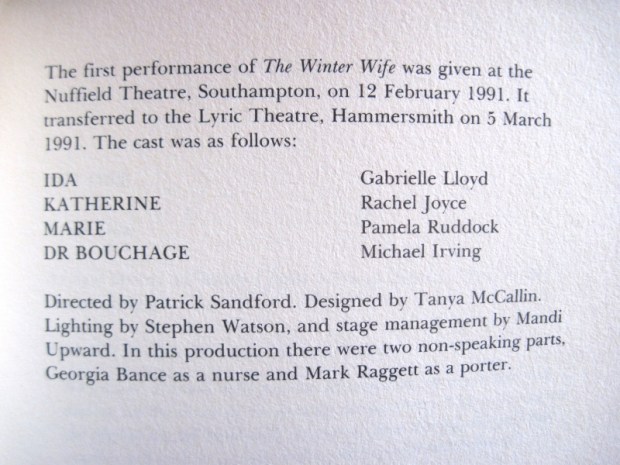
Yes, it’s that Rachel Joyce. (University library) 
Winter’s Bone by Daniel Woodrell (2006)
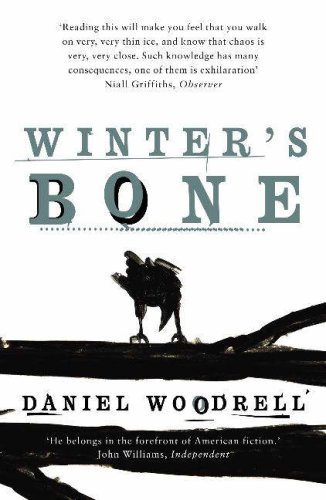 I’d seen the movie but hadn’t remembered just how bleak and violent the story is, especially considering that the main character is a teenage girl. Ree Dolly lives in Ozarks poverty with a mentally ill, almost catatonic mother and two younger brothers whom she is effectively raising on her own. Their father, Jessup, is missing; rumour has it that he lies dead somewhere for snitching on his fellow drug producers. But unless Ree can prove he’s not coming back, the bail bondsman will repossess the house, leaving the family destitute.
Forced to undertake a frozen odyssey to find traces of Jessup, she’s unwelcome everywhere she goes, even among extended family. No one is above hitting a girl, it seems, and just for asking questions Ree gets beaten half to death. Her only comfort is in her best friend, Gail, who’s recently given birth and married the baby daddy. Gail and Ree have long “practiced” on each other romantically. Without labelling anything, Woodrell sensitively portrays the different value the two girls place on their attachment. His prose is sometimes gorgeous –
Pine trees with low limbs spread over fresh snow made a stronger vault for the spirit than pews and pulpits ever could.
– but can be overblown or off-puttingly folksy:
Ree felt bogged and forlorn, doomed to a spreading swamp of hateful obligations.
Merab followed the beam and led them on a slow wamble across a rankled field
This was my second from Woodrell, after the short stories of The Outlaw Album. I don’t think I’ll need to try any more by him, but this was a solid read. (Secondhand – New Chapter Books, Wigtown)
Children’s picture books:
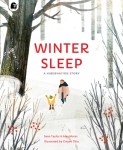 Winter Sleep: A Hibernation Story by Sean Taylor and Alex Morss [illus. Cinyee Chiu] (2019): My second book by this group; I read Busy Spring: Nature Wakes Up a couple of years ago. Granny Sylvie reassures her grandson that everything hasn’t died in winter, but is sleeping or in hiding beneath the ice or behind the scenes. As before, the only niggle is that European and North American species are both mentioned and it’s not made clear that they live in different places. (Public library)
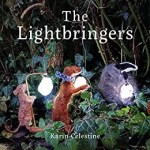 The Lightbringers: Winter by Karin Celestine (2020): An unusual artistic style here: every spread is a photograph of felted woodland creatures. The focus is on midwinter and the hope of the light coming back – depicted as poppy seed heads, lit from within and carried by mouse, hare, badger and more. “The light will always return because it is guarded by small beings and they are steadfast in their task.” The first of four seasonal stories. (Public library)
Any wintry reading (or weather) for you lately?
Winter Reads, Part II: Elisa Shua Dusapin, Howard Norman & Picture Books
As hoped for in my first instalment of winter reads, the weather is warmer now and signs of spring are appearing in the form of cherry blossom, crocuses, daffodils, primroses and snowdrops. So I’m bidding a (perhaps premature) farewell to winter with these two novels featuring very chilly settings. I also borrowed from the library a big ol’ pile of wintry children’s books full of bears, rabbits, snowmen, snowballs and days off school.
Winter in Sokcho by Elisa Shua Dusapin (2016; 2020)
[Daunt Books Originals; translated from the French by Aneesa Abbas Higgins]

Another title doing double duty for #FrenchFebruary and #ReadIndies month. This was Dusapin’s debut and won the Prix Robert Walser and the Prix Régine-Deforges.
Our beaches are still waiting for the end of a war that’s been going on for so long people have stopped believing it’s real. They build hotels, put up neon signs, but it’s all fake, we’re on a knife-edge, it could all give way any moment. We’re living in limbo. In a winter that never ends.
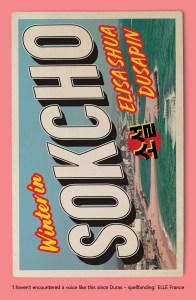 The protagonist is a young mixed-race woman working behind the reception desk at a hotel in Sokcho, a South Korean resort at the northern border. A tourist mecca in high season, during the frigid months this beach town feels down-at-heel, even sinister. The arrival of a new guest is a major event at the guesthouse. And not just any guest but Yan Kerrand, a French graphic novelist. Although she has a boyfriend and the middle-aged Kerrand is probably old enough to be her father – and thus an uncomfortable stand-in for her absent French father – the narrator is drawn to him. She accompanies him on sightseeing excursions but wants to go deeper in his life, rifling through his rubbish for scraps of work in progress.
The underemployed, self-sabotaging young woman is so familiar these days as to be a cliché (and I’d already met a very similar one, also Korean, in Ro from Sea Change by Gina Chung), but there is still something enticing about the atmosphere of this novella. I also enjoyed the narrator’s relationship with her mother, a fishmonger, which sets up for the entirely inconclusive and potentially very disturbing ending. Impossible to say more without spoilers, but I’d be interested to hear what others who have read it think will happen after the last page. (Birthday gift from my wish list)
The Northern Lights by Howard Norman (1987)
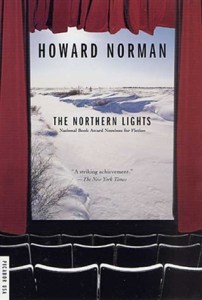 Norman is a really underrated writer and I’m a big fan of The Bird Artist and especially I Hate to Leave This Beautiful Place. This is a weird one; it’s his debut and you can see the autobiographical inspiration (per his Introduction) and the sorts of interests that would recur across his oeuvre, such as subarctic Canada and its Indigenous peoples, absent fathers and hotels (not the only reason this reminded me most of early John Irving).
The Canadian settings represent the two poles of isolation and the urban: Quill, Manitoba versus Toronto in 1959–60. The novel opens with the death of teenage Noah’s best friend, Pelly, who fell through a frozen lake while riding his unicycle. Noah’s family dynamic changes quickly, as his cousin Charlotte, orphaned by a factory disaster, comes to live with them and then his cartographer father leaves them to become a hermit in a remote cabin furnished with musical instruments. Noah stays with Pelly’s parents, Sam and Hettie (a Cree woman), to brave a harsh Quill winter –
January and February mornings you would get a crack of icy static in the nostrils when first stepping outside and have to shade your eyes against the harsh glint of snow, if the sun had worked its way through. Certain days neighbors were seen only on their way to their woodsheds. Chimney smoke was our windsocks. Enormous drifts had built up against the houses, sculpted in various shapes. Even brief walks were taken on snowshoes. Winter might be seven months long.
– while his mother, Mina, takes Charlotte to Toronto to run The Northern Lights, the movie theatre where she met her husband as a young woman. The previous alcoholic owner has run it into the ground; “the curtain smelled like a ten-thousand-year-old moose hide.”
At the time that Noah joins them, he’s never seen a movie before, but as “manager” of the theatre he soon sees The Magnificent Seven 15 times in quick succession. Norman does a peculiar thing here, which is to introduce a key character quite late on in the action. Noah hires Levon, a Cree man, to be the projectionist and he promptly moves his entire family into the building. Had Noah relocated to Toronto earlier, we might have seen more of these characters. Norman’s habit of mimicking broken speech from non-native speakers through overly frequent commas (indicating pauses, I suppose) irked me. There are lots of quirky elements here and I enjoyed the overall atmosphere, but felt the plot left something to be desired. I’d start elsewhere with Norman, but could still recommend this to readers of Robertson Davies and Elizabeth Hay. (Secondhand – 2nd & Charles)
And a DNF:
Snowflake, AZ by Marcus Sedgwick (2019): I wanted to try something else by the late Sedgwick (I’ve only read his nonfiction monograph, Snow) and this seemed ideal. I could have gotten onboard with the desert dystopia, but Ash’s narration was so unconvincing. Sedgwick was attempting a folksy American accent but all the “ain’t”s and “darned”s really don’t work from a teenage character. I only managed about 20 pages. (Public library)
Plus a whole bunch of children’s picture books:
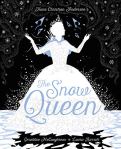 The Snow Queen by Hans Christian Andersen [adapted by Geraldine McCaughrean; illus. Laura Barrett] (2019): The whole is in the shadow painting style shown on the cover, with a black, white and ice blue palette. It’s visually stunning, but I didn’t like the language as much as in the original (or at least older) version I remember from a book I read every Christmas as a child.
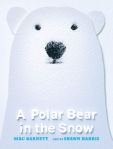 A Polar Bear in the Snow by Mac Barnett [art by Shawn Harris] (2020): From a grey-white background, a bear’s face emerges. The remaining pages are made of torn and cut paper that looks more three-dimensional than it really is. The bear passes other Arctic creatures and plays in the sea. Such simple yet intricate spreads.
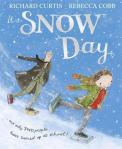 Snow Day by Richard Curtis [illus. Rebecca Cobb] (2014): When snow covers London one December, only two people fail to get the message that the school is closed: Danny Higgins and Mr Trapper, his nemesis. So lessons proceed. At first it feels like a prison sentence, but at break time Mr Trapper gives in to the holiday atmosphere. These two lonely souls play as if they were both children, making an army of snowmen and an igloo. And next year, they’ll secretly do it all again. Watch out for the recurring robin in a woolly hat.
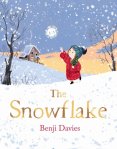 The Snowflake by Benji Davies (2020): I didn’t realize this was a Christmas story, but no matter. A snowflake starts her lonely journey down from a cloud; on Earth, Noelle hopes for snow to fall on her little Christmas tree. From motorway to town to little isolated house, Davies has an eye for colour and detail.
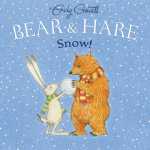 Bear and Hare: SNOW! by Emily Gravett (2014): Bear and Hare, wearing natty scarves, indulge in all the fun activities a blizzard brings: snow angels, building snow creatures, having a snowball fight and sledging. Bear seems a little wary, but Hare wins him over. The illustration style reminded me of Axel Scheffler’s work for Julia Donaldson.
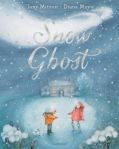 Snow Ghost by Tony Mitton [illus. Diana Mayo] (2020): Snow Ghost looks for somewhere she might rest, drifting over cities and through woods until she finds the rural home of a boy and girl who look ready to welcome her. Nice pastel art but twee couplets.
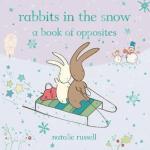 Rabbits in the Snow: A Book of Opposites by Natalie Russell (2012): A suite of different coloured rabbits explore large and small, full and empty, top and bottom, and so on. After building a snowman and sledging, they come inside for some carrot soup.
 The Snowbear by Sean Taylor [illus. Claire Alexander] (2017): Iggy and Martina build a snowman that looks more like a bear. Even though their mum has told them not to, they sledge into the woods and encounter danger, but the snow bear briefly comes alive and walks down the hill to save them. Delightful.
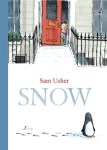
 Snow (2014) & Lost (2021) by Sam Usher: A cute pair from a set of series about a little ginger boy and his grandfather. The boy is frustrated with how slow and stick-in-the-mud his grandpa seems to be, yet he comes through with magic. In the former, it’s a snow day and the boy feels like he’s missing all the fun until zoo animals come out to frolic. There’s lots of white space to simulate the snow. In the latter, they build a sledge and help search for a lost dog. Once again, ‘wild’ animals come to the rescue. /
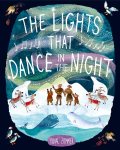 The Lights that Dance in the Night by Yuval Zommer (2021): I’ve seen Zommer speak as part of a conference panel on children’s nature writing. The Aurora Borealis unfolds across the sky above the creatures and people of the far north: “We sashayed for an Arctic fox. We swayed above an old musk ox.” I expected more anatomical accuracy (i.e., faces not flattened so that eyes appear to be next to each other on the same side of a face) but I loved how vivid and imaginative it all is.
Any snowy or icy reads (or weather) for you lately?
Spring Reading, Part II: May, Moving and Swifts
Eight days after our move, there are still piles of boxes, but the furniture is in place and there are clear walkways, so we’ll call that progress. We got a lot of help on moving day from neighbours, one of whom built a tower of book boxes in the corner of the dining room! I had fun dismantling it last week and assigning each box to a particular bookcase. Arranging the contents on shelves will be for once we’re back from Spain.
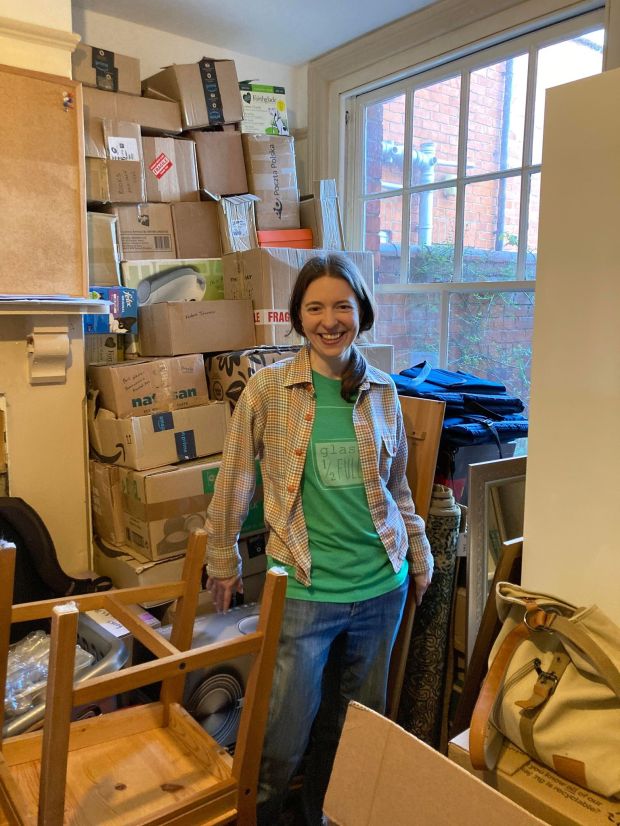
What with moving and DIY, I haven’t had a lot of time for reading lately, so didn’t finish any more of the spring books I’d intended to include – except for one children’s book from the library. I’ll give a little rundown of some of what has been on my coffee table stack.
Busy Spring: Nature Wakes Up by Sean Taylor and Alex Morss; illus. Cinyee Chiu (2021)
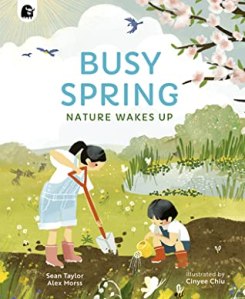 This was a cute read about two little girls helping their father in the garden and discovering the natural wonders of the season, like tadpoles in a pond, birds building nests, and insects and worms in the compost heap. A section at the end gives more information about the science of spring – unfortunately, it mislabels one bird and includes North American species without labelling them as such, whereas the rest of the book was clearly set in the UK. The strategy reminded me of that in Wild Child by Dara McAnulty. This year is the first time a children’s book Wainwright Prize will be awarded, so we’ll see this kind of book being recognized more.
May reads:
 Encore is my last unread journal of May Sarton’s. It begins in May 1991, when she’s 79 and in recovery from major illness. She’s still plagued by pain and fatigue, but her garden and visits from friends are a solace. Although she has to lie down to garden, “to put my hands in the earth to dig is life giving … it is almost as if the earth were nourishing me at the moment.” As usual, there are lovely reflections on the freedoms as well as the losses of ageing. This book, like the previous, was dictated, so there is a bit of repetition. I’ve been amused to see how pretentious she found A.S. Byatt’s Possession! An entry or two at a sitting helped calm my mind during the stress of moving week.
“In a funny way what drives me is the spring, the fleeting spring. Because of the enormous wind and rain we have had, a lot of the daffodils have blown down, though not as many as I feared. But the truth is that their peak is past. We shall have them for another week and then they will be gone. It seems quite unbearable but that is what spring is—the letting go. The waiting and waiting and waiting, and then the letting go.”
I started a reread of Snow in May by Kseniya Melnik and am partway through the second story. It’s a linked short story collection set in Magadan in northeast Russia – known for Stalin’s forced-labour camps. In “Love, Italian Style, or in Line for Bananas,” it’s 1975 and Tanya is on a shopping spree in Moscow. At a time of deprivation, she buys even things she doesn’t need or that aren’t quite right. Propositioned by an Italian football player on the plane ride over, she fantasizes about the exotic and romantic, juxtaposed against her everyday life.
“The pollen swirled around her like snow. There was a time when the distinctions between right and wrong seemed indisputable, and doing right felt good. When all the decisions had been premade and in her best interest. Back when she didn’t need so much to be happy.”
Belonging
 I saw it on shelf at the library and knew now was the perfect time to read My Life in Houses by Margaret Forster, a memoir via the places she’s lived, starting with the house where she was born in 1938, on a council estate in Carlisle. There’s something appealing to me about tracing a life story through homes – Paul Auster did the same in part of Winter Journal. I’d be tempted to undertake a similar exercise myself someday.
 The swifts come screeching down our new street and we saw one investigating a crevice in our back roof for a nest! In Fledgling by Hannah Bourne-Taylor, she is lonely in rural Ghana, where she and her husband had moved for his work, and takes in a young swift displaced from its nest. I’m only in the early pages, but can tell that her care for the bird will be a way of exploring her own feeling of displacement and the desire to belong. “Although I was unaware of it at the time, the English countryside and the birds had turned into my anchor of home.”
 Bookish Beck = Rebecca Foster. American transplant to England. Freelance proofreader and book reviewer.
 Bookish Beck