September Releases, Part II: Antrobus, Attenberg, Strout and More
As promised yesterday, I give excerpts of the six (U.S.) September releases I reviewed for Shelf Awareness. But first, my thoughts on a compassionate sequel about a beloved ensemble cast.
Tell Me Everything by Elizabeth Strout
“People always tell you who they are if you just listen”
Alternative title ideas: “Oh Bob!” or “Talk Therapy in Small-Town Maine.” I’ve had a mixed experience with the Amgash novels, of which I’ve now read four. Last year’s Lucy by the Sea was my favourite, a surprisingly successful Covid novel with much to say about isolation, political divisions and how life translates into art. Oh William!, though shortlisted for the Booker, seemed a low point. It’s presented as Lucy’s published memoir about her first husband, but irked me with its precious, scatter-brained writing. For me, Tell Me Everything was closer to the latter. It continues Strout’s newer habit of bringing her various characters together in the same narrative. That was a joy of the previous book, but here it’s overdone and, along with the knowing first-person plural narration (“As we mentioned earlier, housing prices in Crosby, Maine, had been going through the roof since the pandemic”; “Oh Jim Burgess! What are we to do with you?”), feels affected and hokey.
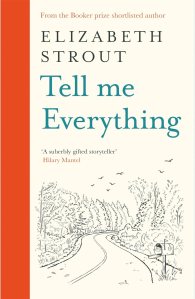
Strout makes it clear from the first line that this novel will mostly be devoted to Bob Burgess, who is not particularly interesting but perhaps a good choice of protagonist for that reason. A 65-year-old semi-retired lawyer, he’s a man of integrity who wins confidences because of his unassuming mien and willingness to listen and help where he can. One doesn’t read Strout for intrigue, but there is actually a mild murder mystery here. Bob ends up defending Matt Beach, a middle-aged man suspected of disposing of his mother’s body in a quarry. The Beaches are odd and damaged, with trauma threading through their history.
Sad stories are indeed the substance of the novel; Lucy trades in them. Literally: on her visits to Olive Kitteridge’s nursing home room, they swap bleak stories of the “unrecorded lives” they have observed or heard about. Lucy and Bob, who are clearly in love with each other, keep up a similar exchange of gloomy tales on their regular walks. Lucy asks Bob and Olive the point of these anecdotes, pondering the very meaning of life. Bob dismisses the question as immature; “as we have said, Bob was not a reflective fellow.” And because the book is filtered through Bob, we, too, feel this is just a piling up of depressing stories. Why should I care about Bob’s ex-wife’s alcoholism, his sister-in-law’s death from cancer, his nephew’s accident? Or any of the other unfortunate occurrences that make up a life. Bob and Lucy are appealingly ordinary characters, yet Strout suggests that they function as secular “sin-eaters,” accepting confessions. Forasmuch as they focus on others, they do each come to terms with childhood trauma and the reality of their marriages. Strout majors on emotional intelligence, but can be clichéd and soundbite-y. Such was my experience of this likable but diffuse novel.
With thanks to Viking (Penguin) for the proof copy for review.
Reviewed for Shelf Awareness:
Poetry:
 Signs, Music by Raymond Antrobus – The British-Jamaican poet’s intimate third collection contrasts the before and after of becoming a father—a transition that prompts him to reflect on his Deaf and biracial identity as well as the loss of his own father.
With thanks to Picador for the free copy for review.
 Want, the Lake by Jenny Factor – Factor’s long, intricate second poetry collection envisions womanhood as a tug of war between desire and constraint. “Elegy for a Younger Self” poems string together vivid reminiscences.
 Terminal Maladies by Okwudili Nebeolisa – The Iowa Writers’ Workshop graduate’s debut collection is a tender chronicle of the years leading to his mother’s death from cancer. Food and nature imagery chart the decline in Nkoli’s health and its effect on her family.
Fiction:
 A Reason to See You Again by Jami Attenberg – Her tenth book evinces her mastery of dysfunctional family stories. From the Chicago-area Cohens, the circle widens and retracts as partners and friends enter and exit. Through estrangement and reunion, as characters grapple with sexuality and addictions, the decision is between hiding and figuring out who they are.
Nonfiction:
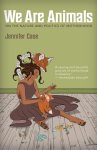 We Are Animals: On the Nature and Politics of Motherhood by Jennifer Case – Case’s second book explores the evolution, politics, and culture of contemporary parenthood in 15 intrepid essays. Science and statistics weave through in illuminating ways. This forthright, lyrical study of maternity is an excellent companion read to Lucy Jones’s Matrescence.
 Question 7 by Richard Flanagan – Ten years after his Booker Prize win for The Narrow Road to the Deep North, Richard Flanagan revisits his father’s time as a POW—the starting point but ultimately just one thread in this astonishing and uncategorizable work that combines family memoir, biography, and history to examine how love and memory endure. (Published in the USA on 17 September.)
With thanks to Emma Finnigan PR and Vintage (Penguin) for the proof copy for review.
Any other September releases you’d recommend?
The Story Girl by L. M. Montgomery (1911) #ReadingStoryGirl
Six months after the Jane of Lantern Hill readalong, Canadian bloggers Naomi (Consumed by Ink) and Sarah Emsley have chosen an earlier work by Lucy Maud Montgomery, The Story Girl, and its sequel The Golden Road, for November buddy reading.
The book opens one May as brothers Felix and Beverley King are sent from Toronto to Prince Edward Island to stay with an aunt and uncle while their father is away on business. Beverley tells us about their thrilling six months of running half-wild with their cousins Cecily, Dan, Felicity, and Sara Stanley – better known by her nickname of the Story Girl, also to differentiate her from another Sara – and the hired boy, Peter. This line gives a sense of the group’s dynamic: “Felicity to look at—the Story Girl to tell us tales of wonder—Cecily to admire us—Dan and Peter to play with—what more could reasonable fellows want?”
Felicity is pretty and domestically inclined; Sara knows it would be better to be useful like Felicity, but all she has is her storytelling ability. Some are fantasy (“The Wedding Veil of the Proud Princess”); some are local tales that have passed into folk memory (“How Betty Sherman Won a Husband”). Beverley is in raptures over the Story Girl’s orations: “if voices had colour, hers would have been like a rainbow. It made words live. … we had listened entranced. I have written down the bare words of the story, as she told it; but I can never reproduce the charm and colour and spirit she infused into it. It lived for us.”

The cousins’ adventures are gently amusing and quite tame. They all write down their dreams in notebooks. Peter debates which church denomination to join and the boys engage in a sermon competition. Pat the cat has to be rescued from bewitching, and receives a dose of medicine in lard he licks off his paws and fur. The Story Girl makes a pudding with sawdust instead of cornmeal (reminding me of Anne Shirley and the dead mouse in the plum pudding). Life consistently teaches lessons in humility, as when they are all duped by Billy Robinson and his magic seeds, which he says will change whatever each one most resents – straight hair, plumpness, height; and there is a false alarm about the end of the world.
I found the novel fairly twee and realized at a certain point that I was skimming over more than I was reading. As was my complaint about Jane of Lantern Hill, there is a predictable near-death illness towards the end. The descriptions of Felicity and the Story Girl are purple (“when the Story Girl wreathed her nut-brown tresses with crimson leaves it seemed, as Peter said, that they grow on her—as if the gold and flame of her spirit had broken out in a coronal”); I had to remind myself that this reflects on Beverley more so than on Montgomery. From Naomi’s review of The Golden Road, I think that would be more to my taste because it has a clear plot rather than just stringing together pleasant but mostly forgettable anecdotes.
Still, it’s been fun to discover some of L. M. Montgomery’s lesser-known work, and there are sweet words about cats and the seasons:
“I am very good friends with all cats. They are so sleek and comfortable and dignified. And it is so easy to make them happy.”
“The beauty of winter is that it makes you appreciate spring.”
This effectively captures the long, magical summer days of childhood. I thought about when I was a kid and loved trips up to my mother’s hometown in upstate New York, where her brothers still lived. I was in awe of the Judd cousins’ big house, acres of lawn and untold luxuries such as Nintendo and a swimming pool. I guess I was as star-struck as Beverley. (University library) 
 Bookish Beck = Rebecca Foster. American transplant to England. Freelance proofreader and book reviewer.
 Bookish Beck