Love Your Library, August 2025
Thanks to Eleanor for posting about her recent library reading, including for 20 Books of Summer (here and here). Thanks also to Skai for joining in again!
Further to last month: My library system’s reclassification seems all the stranger the more I look at it, especially in the children’s section. Yellow stickers will have: one black stripe (Beginner Reads), two black stripes (Short Chapter Books), three black stripes (Picture Books for Older Readers) or a T (Teen). Okay, that last one makes sense, but taking in the number of stripes at a quick glance when organising a trolley or shelving? Seems like a recipe for misfiling.
Also, as a member of senior staff astutely observed, surely the length of a book is the one thing you can tell just by looking at it! So why make that its own designation? Especially when those double-stripe books will be mixed in with the rest of the chapter books, which from now on will not be given a very helpful label on the spine with the first letter of the author’s surname.
It’s having the two systems on the go at the same time that is most confusing. Apparently, these changes were handed down from on high, to keep us in line with other libraries, but no one consulted with the people who actually handle the books on a day-to-day basis. As in, the staff and volunteers. Ahem. We shall see how it goes.
My library use over the last month:
(links are to books not already reviewed on the blog)
I’ve been borrowing some Booker and Wainwright Prize list reads, as well as looking ahead to our mid-September trip to Berlin and Novellas in November.
READ
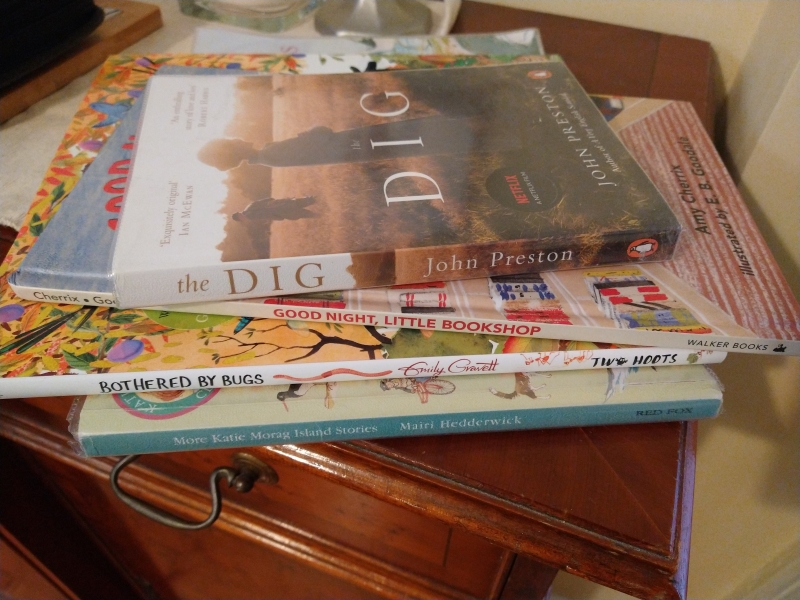
- Good Night, Little Bookshop by Amy Cherrix

- Bothered by Bugs by Emily Gravett
- More Katie Morag Island Stories by Mairi Hedderwick
- The Homemade God by Rachel Joyce

- The Dig by John Preston
Last month we joined my in-laws for a few days at the holiday cottage they’d rented in Suffolk. We crammed in loads: Orford Ness, a former military site with a very unusual shingle landscape where hares live and the wind howls; Minsmere RSPB reserve; and Sutton Hoo, the site of a famous Anglo-Saxon ship burial, discovered there during an archaeological dig of the mounds in 1939; and Woodbridge, the nearest town to the cottage, whose museum has a project underway to build a full-size replica of the ship. I didn’t put two and two together to realize that The Dig, adapted into a 2021 Netflix film starring Ralph Fiennes and Carey Mulligan (there was a big on-site exhibit about the filming), is about Sutton Hoo or I would have gotten it out of the library to take with us. Instead, I caught up afterward.


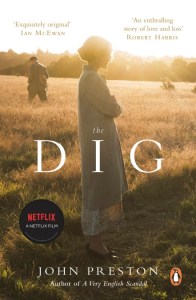 Preston focuses on the few spring and summer months of Basil Brown’s amateur excavation, which was then co-opted by museum professionals. Edith Pretty, the landowner, was a widow in her fifties, raising her plucky son Robert on her own and struggling with ill health (she had Robert at age 47, almost unheard of in those days, and would die after a stroke in 1942). The day to day of the excavation was engrossing and I enjoyed the interactions between Brown and Pretty. I didn’t need the third narrator, Peggy Piggott, wife of one of the archaeologists and excavation staff in her own right, nor the extra background about characters’ marriages and museum bureaucracy. Meanwhile, the epilogue from Robert returning to the site in the 1960s made me wish that there had been more of that retrospective viewpoint. This was enjoyable in a minor way but I wouldn’t have read it had I not been to Sutton Hoo. I wonder if the film would be, on the whole, more successful.
SKIMMED
- I Think I Like Girls by Rosie Day – I took a desultory look but the content seemed pretty lite and the writing style iffy. (Hadn’t heard of Day but I guess she’s a celebrity?)
SKIMMING
- Cuddy by Benjamin Myers (for book club; I also skimmed it when it first came out)
CURRENTLY READING
- The Most by Jessica Anthony
- The Honesty Box by Luzy Brazier
- Bellies by Nicola Dinan
- The Wedding People by Alison Espach
- The Summer I Turned Pretty by Jenny Han
- An Eye on the Hebrides by Mairi Hedderwick
- The Mermaid Chair by Sue Monk Kidd
- Of Thorn & Briar: A Year with the West Country Hedgelayer by Paul Lamb
- The Land in Winter by Andrew Miller
- The Secret Lives of Booksellers and Librarians: True Stories of the Magic of Reading by James Patterson & Matt Eversmann
CHECKED OUT, TO BE READ
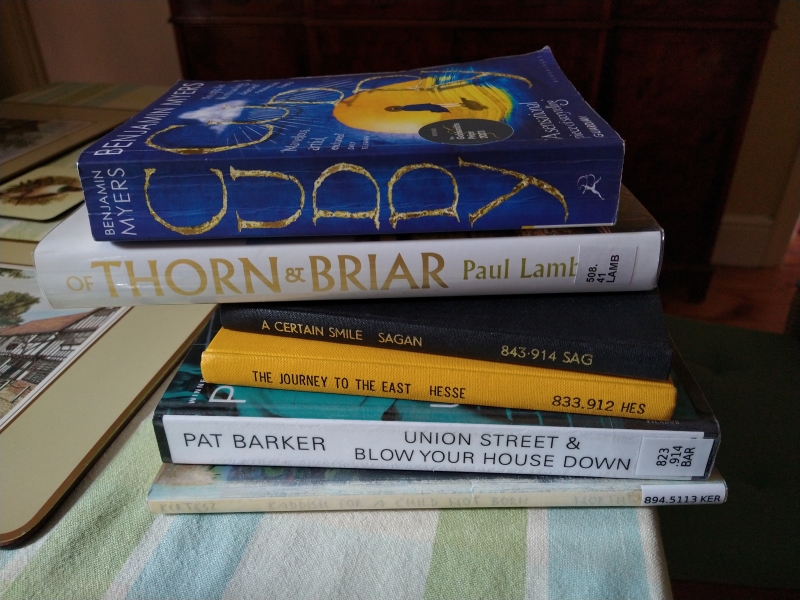
It’s nearly time for Novellas in November planning! Thus I borrowed a quartet of books from the university library (the bottom stack below), two of which were recommended by blog friends: the Barker (Blow Your House Down) by Margaret and the Hesse by Kaggsy. The Kertesz is on my radar thanks to C’s bandmate Jo. And I’ve enjoyed the two Sagan novellas I’ve read so far so thought I’d source another.
ON HOLD, TO BE COLLECTED
- Sojourn by Amit Chaudhuri
- The Names by Florence Knapp
- Love in Five Acts by Daniela Krien
- Red Pockets: An Offering by Alice Mah
- Birding by Rose Ruane
- Opt Out by Carolina Setterwall
- Slags by Emma Jane Unsworth
- Seascraper by Benjamin Wood
IN THE RESERVATION QUEUE
- The Two Roberts by Damian Barr
- All the Way to the River by Elizabeth Gilbert
- Helm by Sarah Hall
- The Haunted Wood: A History of Childhood Reading by Sam Leith
- What We Can Know by Ian McEwan
- The Eights by Joanna Miller
- Endling by Maria Reva
- Buckeye by Patrick Ryan
- Flesh by David Szalay
RETURNED UNREAD
- Fragile Minds by Bella Jackson
- Enchanted Ground: Growing Roots in a Broken World by Steven Lovatt
- Wife by Charlotte Mendelson
- The Forgotten Sense: The Nose and the Perception of Smell by Jonas Olofsson
I lost immediate interest in all of these but would be willing to try them again another time.
What have you been reading or reviewing from the library recently?

Share a link to your own post in the comments. Feel free to use the above image. The hashtag is #LoveYourLibrary.
January Releases: Greathead, Kauffman, Mills & Watts (#ReadIndies)
I feel out of practice writing reviews after the endless period of sluggish and slightly lackluster reading that was January. Here we are at the start of Kaggsy and Lizzy Siddal’s Reading Independent Publishers Month challenge and I’m happy to make this my first tie-in post as these four books all happen to be from independent publishers. The first two are American novels (that could arguably be called linked short story collections) very much in my wheelhouse for their focus on dysfunctional families and disappointing characters. I also have a group biography aiming to illuminate bisexuality, and a poetry collection about girlhood/womanhood and nature.
The Book of George by Kate Greathead
The marketing for this novel courts relatability: you probably know a George – you might have dated one (women read the most litfic). Each chapter dates to a different period in George’s life, adolescence to late thirties. From the fact that 9/11 happened when he was a college freshman, I know he’s my exact contemporary, and I could indeed see bits of myself in this Everyman schmuck: indecisive, lazy, underachieving, privileged but never living up to his own or others’ expectations. Life keeps happening around him, but you wonder if he’ll ever make something happen for himself. Two gags are revealing: In college he is known for his impression of a clinically depressed penis going through airport security, and later he has 15 minutes of fame for appearing in a hidden-camera Super Bowl commercial. He’s been writing fiction for years – first a Stoner rip-off, then a Kerouac homage – but by the time he gets a short story collection together, it’s the height of #MeToo and he’s missed his moment to publish. Meanwhile, his cohort is doing great things, winning awards for documentaries (his pal Jeremiah) or becoming pro bono lawyers (his longsuffering girlfriend Jenny).
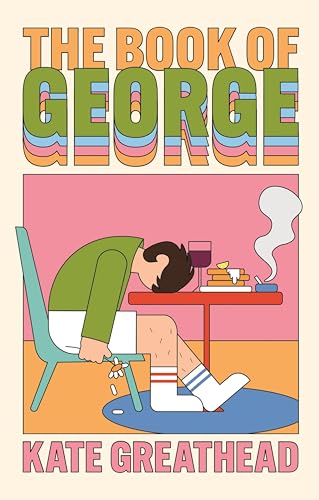 If you need to like a protagonist, expect frustration. Some of George’s behaviour is downright maddening, as when he obsessively plays his old Gameboy while his mother and Jenny pack up his childhood room. Tracing his relationships with his mother, his sister Cressida, and Jenny is rewarding. Sometimes they confront him over his shortcomings; other times they enable him. The novel is very funny, but it’s a biting, ironic humour, and there’s plenty of pathos as well. There are a few particular gut-punches, one relating to George’s father and others surrounding nice things he tries to do that backfire horribly. I thought of George as a rejoinder to all those ‘So-and-So Is Not Okay at All’ type of books featuring a face-planting woman on the cover. Greathead’s portrait is incisive but also loving. And yes, there is that hint of George, c’est moi recognition. His failings are all too common: the mildest of first-world tragedies but still enough to knock your confidence and make you question your purpose. For me this had something of the old-school charm of Jennifer Egan and Jonathan Safran Foer novels I read in the Naughties. I’ll seek out the author’s debut, Laura & Emma.
With thanks to Atlantic Books for the free copy for review. (Published in the USA by Henry Holt and Co. in 2024.)
I’ll Come to You by Rebecca Kauffman
Is 30 years long enough ago to count as historical fiction? In any case, this takes us through the whole of 1995, proceeding month by month and rotating through the close third-person perspectives of the members of one extended family as they navigate illnesses, break-ups and fraught parenting journeys. Corinne and Paul are trying to get pregnant; Paul’s mother, Ellen (again!), is still smarting from her husband leaving with no explanation; Corinne’s father, Bruce, has dementia but his wife, Janet, is doing her best to keep his cognitive deficiencies from the rest of the family. Son Rob is bitter about his ex-wife moving on so quickly, but both he and Ellen will have new romantic prospects before the end.
 The family’s lies and secrets – also involving a Christmas run-in with Bruce’s shell-shocked brother decades ago – lead to everything coming to a head in a snowstorm. (As best I can tell, the 1995 setting was important mostly so there wouldn’t be cell phones during this crisis.) As with The Book of George, the episodic nature of the narrative means that particular moments are memorable but the whole maybe less so, and the interactions between characters stand out more than the people themselves. I’ll Come to You, named after a throwaway line in the text, is poorly served by both its cover and title, which give no sense of the contents. However, it’s a sweet, offbeat portrait of genuine, if generic, Americans; I was most reminded of J. Ryan Stradal’s work. Although I DNFed Kauffman’s The Gunners some years back, I’d be interested in trying her again with Chorus, which sounds like another linked story collection.
With thanks to Counterpoint (USA) for the advanced e-copy for review.
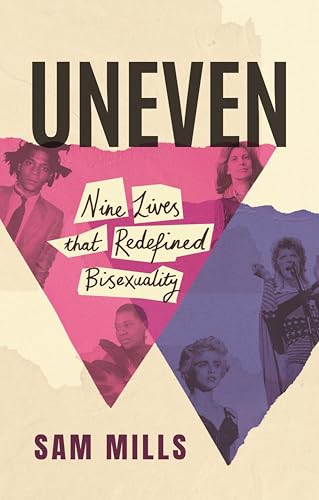
Uneven: Nine Lives that Redefined Bisexuality by Sam Mills
Back in 2022 I reviewed Julia Shaw’s Bi: The hidden culture, history and science of bisexuality, which took a social sciences approach. By contrast, this is a group biography of nine bisexuals – make that 10, as there are plenty of short memoir-ish passages from Mills, too. Oscar Wilde, Colette, Marlene Dietrich, Anaïs Nin, Susan Sontag: more or less familiar names, though not all of them are necessarily known for their sexuality. The chapters deliver standard potted biographies of the individuals’ work and relationships, probably containing little that couldn’t be found elsewhere in recent scholarship and not really living up to the revolutionary promise of the subtitle. However, it was worthwhile for Mills to recover Wilde as a bisexual rather than a closeted homosexual. A final trilogy of chapters comes more up to date with David Bowie, Jean-Michel Basquiat and Madonna. The closer to the present day, the more satisfying connections there are between figures. For instance, Madonna looked to both Dietrich and Bowie as role models and fashion icons, and she and Basquiat were lovers.
 Mills and Shaw consider the same fundamental issues: bi erasure, with bisexuality the least understood and most easily overlooked element of LGBT and many passing as straight if in heterosexual marriages; and the stereotype of bis as hypersexual or promiscuous. Mills is keen to stress that bisexuals have very different trajectories and phases. Like Wilde, they might have a heterosexual era of happy marriage and parenthood followed by a homosexual spree. Or they might have simultaneous lovers of multiple genders. Some might never even act on strong same-sex desires. (Late last year I encountered a similar unity-in-diversity approach in Daniel Tamet’s Nine Minds, a group biography about autistic people.)
The 1890s to 1980s window allows for a record of changing mores yet means that the book seems rather dated. Were it written by an author of a later generation (Mills, who I knew for The Fragments of My Father, is around 50), the point of view and terminology would likely be quite different. Also, including a section on Bessie Smith within a chapter mostly on Colette felt tokenistic. (Though later considering Basquiat separately does add a BIPOC view.) Ultimately, though, my problem with Uneven was that I don’t want to know about behaviour – which is all that a biography can usually document – so much as the internal, soul stuff. Even from Mills, whose accounts of her long-term relationships and flings (including, yes, a threesome) can be titillating but not very enlightening, I didn’t get a sense of what it feels like. So neither the Shaw nor the Mills gave me precisely what I was looking for, which means that the perfect book on bisexuality either doesn’t exist or is out there but I haven’t found it yet. Any suggestions?
With thanks to Atlantic Books for the free copy for review.
The Face in the Well by Rebecca Watts
 I’ve also read Watts’ The Met Office Advises Caution and Red Gloves; this is her third collection. The Suffolk and Cambridgeshire scenery of her early and adult lives weaves all through, sometimes as an idyll that blurs the lines between humans and nature (“Private No Access”) but other times provoking anxiety about common or gendered dangers, as in the title poem or “The Old Mill” (“What happened there, / down by the old mill, / they never tell. // Something about / a man and a girl / is the most you’ll hear.”). “Woman Seeks” is a tongue-in-cheek advert for the perfect man. Animals – a dolphin, a shark, rodents, a wandering albatross, a robin – recur, as do women poets, especially Emily Brontë, and Victorian death culture (“Victoriana” and “Baroque”). Adulthood brings routine whereas childhood stands out for minor miracles, such as a free soda from a vending machine.
The format and tone vary a lot, so the book is more of a grab bag than a cohesive statement. I noted slant rhymes and alliteration, always a favourite technique of mine. I especially liked “Entropy,” about finding a slice of cake in the freezer labeled by someone who is now dead (“Nothing ever // really dies: all the pieces of you / persist, riven and reconfigured / in infinite unknowable ways”) and “Personal Effects,” about the artefacts from her childhood that her mother guards under the bed (“twists of my hair, my teeth, / my bracelet from the hospital.”).
With thanks to Carcanet Press for the advanced e-copy for review.
Which of these appeal to you? What indie publishers have you been reading from recently?
Three on a Theme: English Gardeners (Bradbury, Laing and Mabey)
These three 2024 releases share a passion for gardening – but not the old-fashioned model of bending nature to one’s will to create aesthetically pleasing landscapes. Instead, the authors are also concerned with sustainability and want to do the right thing in a time of climate crisis (all three mention the 2022 drought, which saw the first 40 °C day being recorded in the UK). They seek to strike a balance between human interference and letting a site go wild, and they are cognizant of the wider political implications of having a plot of land of one’s own. All three were borrowed from the public library. #LoveYourLibrary
One Garden against the World: In Search of Hope in a Changing Climate by Kate Bradbury
Bradbury is Wildlife Editor of BBC Gardeners’ World Magazine and makes television appearances in the UK. She’s owned her suburban Brighton home for four years and has tried to turn its front and back gardens into havens, however small, for wildlife. The book covers April 2022 to June 2023, spotlighting the drought summer. “It’s about a little garden in south Portslade and one terrified, angry gardener.” Month by month, present-tense chapters form not quite a diary, but a record of what she’s planting, pruning, relocating, and so on. There is also a species profile at the end of each chapter, usually of an insect (as in the latest Dave Goulson book) – she’s especially concerned that she’s seeing fewer, yet she’s worried for local birds, trees and hedgehogs, too.
Often, she takes matters into her own hands. She plucks caterpillars from vegetation in the path of strimmers in the park and raises them at home; protects her garden’s robins from predators and provides enough food so they can nest and raise five fledglings; undertakes to figure out where her pond’s amphibians have come from; rescues hedgehogs; and bravely writes to neighbours who have scaffolding up (for roof repairs, etc.) beseeching them to put up swift boxes while they’re at it. Sometimes it works: a pub being refurbished by new owners happily puts up sparrow boxes when she tells them the birds have always nested in crevices in the building. Sometimes it doesn’t; people ignore her letters and she can’t seem to help but take it personally.
For individuals, it’s all too easy to be overtaken by anxiety, helplessness and despair, and Bradbury acknowledges that collective action and solidarity are vital. “I am reminded, once again, that it’s the community that will save these trees, not me. I’m reminded that community is everything.” She bands together with other environmentally minded people to resist a local development, educate the public about hedgehogs through talks, and oppose “Drone Bastard,” who flies drones at seagulls nesting on rooftops (not strictly illegal; disappointingly, their complaint doesn’t get anywhere with the police, RSPB or RSPCA).

Along the way, there are a few insights into the author’s personal life. She lives with her partner Emma and dog Tosca and accesses wild walks even right on the edge of a city in the Downs. Separate visits to her divorced parents are chances for more nature spotting – in Suffolk to see her father, she hears her first curlew and lapwings – but also involve some sadness, as her mother has aphasia and fatigue after a stroke.
Nearly every day of the chronology seems to bring more bad news for nature. “It’s hard, sometimes,” she admits, “trying to enjoy natural, wonderful events, trying to keep the clawing sense of unease at bay”. She is staunch in her fond stance: “I will love it, with all my heart, whatever has managed to remain, whatever is left.” And she models through her own amazingly biodiverse garden the ways we can extend refuge to other creatures if we throw out that pointless notion of ‘tidiness.’ “The UK’s 30 million gardens represent 30 million opportunities to create green spaces that hold on to water and carbon, create shade, grow food and provide habitats for wildlife that might otherwise not survive.” Reading this made me feel less guilty about the feral tangle of buddleia, ragwort, hemp agrimony and bindweed overtaking the parts of our back garden that aren’t given over to meadow, pond and hedge. Every time I venture back there I see tons of insects and spiders, and that’s all that matters.
My main critique is that one year would have been adequate, cutting the book to 250 pages rather than 300 and ensuring less repetition while still being a representative time period. But Bradbury is impressive for her vigilance and resolve. Some might say that she takes herself and life too seriously, but it’s really more that she’s aware of the scale of destruction already experienced and realistic about what we stand to lose.
The Garden Against Time: In Search of a Common Paradise by Olivia Laing
I consider Laing one of our most important public thinkers. I saw her introduce the book via the online Edinburgh Book Festival event “In Search of Eden,” in which she appeared on screen and was interviewed by JC Niala. Laing explained that this is not a totally new topic for her as she has been involved in environmental activism and in herbalism. But in 2020, when she and her much older husband bought a house in Suffolk – the first home she has owned after a life of renting – she started restoring its walled garden, which had been created in the 1960s by Mark Rumary. For a year, she watched and waited to see what would happen in the garden, only removing obvious weeds. This coincided with lockdown, so visits to gardens and archives were limited; she focused more on the creation of her own garden and travelling through literature. A two-year diary resulted, in seven notebooks.
Niala observed that the structure of the book, with interludes set in the Suffolk garden, means that the reader has a place to come back to between the deep dives into history. Why make a garden? she asked Laing. Beauty, pleasure, activity: these would be pat answers, Laing insisted. Instead, as with all her books, the reason is the impulse to make complicated structures. Repetitive tasks can be soothing; “the drudgery can be compelling as well.”
Laing spoke of a garden as both refuge and resistance, a mix of wild and cultivated. In this context, Derek Jarman’s Dungeness garden was a “wellspring of inspiration” for her, “a riposte to a toxic atmosphere” of nuclear power and the AIDS crisis (Rumary, like Jarman, was gay). It’s hard to tell where the beach ends and his garden begins, she noted, and she tried to make her garden similarly porous by kicking a hole in the door so frogs could get in. She hopes it will be both vulnerable and robust, a biodiversity hotspot. With Niala, she discussed the idea of a garden as a return to innocence. We have a “tarnished Eden” due to climate change, and we have to do what we can to reverse that.
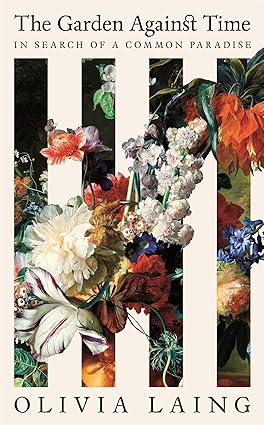
The event was brilliant – just the level of detail I wanted, with Laing flitting between subjects and issuing amazingly intelligent soundbites. The book, though, seemed like page after page about Milton (Paradise Lost) and Iris Origo or the Italian Renaissance. I liked it best when it stayed personal to her family and garden project. There are incredible lyric passages, but just stringing together floral species’ names – though they’re lovely and almost incantatory – isn’t art; it also shuts out those of us who don’t know plants, who aren’t natural gardeners. I wasn’t about to Google every plant I didn’t know (though I did for a few). Also, I have read a lot about Derek Jarman in particular. So my reaction was admiration rather than full engagement, and I only gave the book a light skim in the end. It is striking, though, how she makes this subject political by drawing in equality of access and the climate crisis. (Shortlisted for the Kirkus Prize and the Wainwright Prize.) 
Some memorable lines:
“A garden is a time capsule, as well as a portal out of time.”
“A garden is a balancing act, which can take the form of collaboration or outright war. This tension between the world as it is and the world as humans desire it to be is at the heart of the climate crisis, and as such the garden can be a place of rehearsal too, of experimenting with this relationship in new and perhaps less harmful ways.”
“the garden had become a counter to chaos on a personal as well as a political level”
“the more sinister legacy of Eden: the fantasy of perpetual abundance”
The Accidental Garden: Gardens, Wilderness and the Space in Between by Richard Mabey
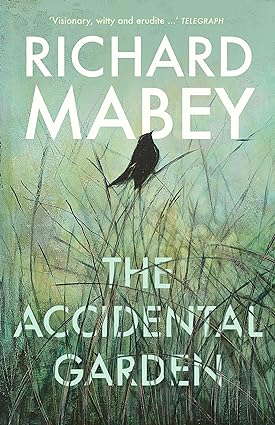 Mabey gives a day-to-day description of a recent year on his two-acre Norfolk property, but also an overview of the past 20 years of change – which of course pretty much always equates to decline. He muses on wildflowers, growing a meadow and hedgerow, bird behaviour, butterfly numbers, and the weather becoming more erratic and extreme. What he sees at home is a reflection of what is going on in the world at large. “It would be glib to suggest that the immeasurably complex problems of a whole world are mirrored in the small confrontations and challenges of the garden. But maybe the mindset needed for both is the same: the generosity to reset the power balance between ourselves and the natural world.” He seeks to create “a fusion garden” of native and immigrant species, trying to intervene as little as possible. The goal is to tend the land responsibly and leave it better off than he found it. As with the Laing, I found many good passages, but overall I felt this was thin – perhaps reflecting his age and loss of mobility – or maybe a swan song. Again, I just skimmed, even though it’s only 160 pages.
Some memorable lines:
“being Earth’s creatures ourselves, we too have a right to a niche. So in our garden we’ve had more modest ambitions, for ‘parallel development’ you might say, and a sense of neighbourliness with our fellow organisms.”
“We feel embattled at times, and that we should try to make some sort of small refuge, a natural oasis.”
“A garden, with its complex interactions between humans and nature, is often seen as a metaphor for the wider world. But if so, is our plot a microcosm of this troubled arena or a refuge from it?”
You might think I would have been more satisfied by Mabey’s contemplative bent, or Laing’s wealth of literary and historical allusions. It turns out that when it comes to gardening, Bradbury’s practical approach was what I was after. But you may gravitate to any of these, depending on whether you want something for the hands, intellect or memory.
May Poetry Releases: Blood & Cord Anthology; Connolly, Goss, Harrison
Apart from Monsters, my focus for May releases has been on poetry, with three Carcanet collections plus a poetry-heavy anthology of writing on early parenthood. Love, history, nature and parental bonds are a few underlying subjects that connect some or all of these.
The Recycling by Joey Connolly
Joey Connolly’s second collection reminded me most of Caroline Bird’s work (especially the mise en abyme ending to “For Such a Widely Used Material, Glass Sure Does Have Some Downsides”): effusive and sometimes absurdist, with unexpected imagery and wordplay.
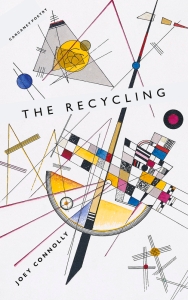 In keeping with the title, there are environmentalist considerations and musings on materials, but also the connotation of reusing language or rehashing ideas. I appreciated this strategy when he’s pondering etymology (“Strange noun full of verb, noun / bending to verb, strange / idea of repeating repetition” in the title poem) or reworking proverbs in the hilarious “Poem in Which Is Is Sufficient” (“Sufficient unto the glaze / is the primer thereunder. Sufficient / unto the applecart is the upset / thereof” and so on) but perhaps less so during 22 indulgent pages of epigraphs. The distance-designated poems of the inventive “Solvitur Ambulando” section range from history to science fiction: “Abstracted, ankle deep in the proto-gutters of Elizabethan London: / how were you ejected from your life to wash up here?”
It’s such a versatile book. I loved the philosophical self-questioning of “Why Try and Be Good When This World” (“the / mental carapace required to weather the hardness / of indifference insulates you from what it means to be alive”) and the utterly original love poetry (“I will take out the bins, and I will try not to leave the keys / in the door, and I will continue / to love you / to the fullest extent to which I find myself able. Oh love. Checkmate”). Eminently quotable stuff. Here are two of my favourite passages:
like an
amateur kintsugi enthusiast in the ruined chinashop
of my childhood idealism
What sweet sorrow
to persist within this disappeared world
With thanks to Carcanet Press for the advanced e-copy for review.
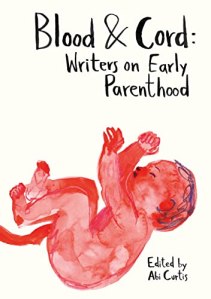
Blood & Cord: Writers on Early Parenthood, edited by Abi Curtis
“The introduction of a new baby rearranges a life, and this requires a new language and a new kind of engagement with the world,” Abi Curtis writes in her introduction. These poems and pieces of flash autofiction or memoir are often visceral, as the title and cover image by Elīna Brasliņa indicate. Elizabeth Hogarth’s “Animal Body” tracks how primal instinct takes over. Second- and third-person narratives distance the speaker from the experience, as in Ruth Charnock’s hybrid “three tarot cards for the new mother.” As I’ve come to expect from The Emma Press, there’s a wide variety of formats, styles and even page layout, with some poems printed in landscape.
 Curtis’s four poems are, together, the strongest entry. I particularly loved the final lines of “September Birth”: “We listen close but cannot fathom / Your new language. We will spend / The rest of our days learning it.” Naomi Booth, too, zeroes in on language in “What is tsunami?” A daughter’s acquisition of language provides entertainment (“She names her favourite doll, Hearty Campfire”) but also induces apprehension:
There are certain words that you dread hearing her say. The first is money. … You dread the way it will become as concrete to her as sky and cat and gate. Mu-nee. Mu-nee.
Not all of these are jubilant birth stories. There are children who are longed for but never arrive. There are also babies who never breathe, or soon die. Alex McRae Dimsdale’s “Bath” is a heartbreaking poem about bidding goodbye to a stillborn son:
It wasn’t the first time that a couple had to leave
the hospital without their newborn.
What could they give us instead?
Here, a small white wooden box –
inside, a packet of wildflower seeds,
your wristband, little
stripy hat. A curlicued certificate
inked with your footprints.
…
what maternal sin did I commit,
deciding who you were
for a whole life that was
already stopped before it started?
“Other Mothers,” a prose essay by poet Rebecca Goss (from whom more below), is about her infant daughter’s death in hospital.
There are a few male contributors, outnumbered five to one by women writers. Poets Liz Berry and Gail McConnell illuminate same-sex motherhood. The two short stories – i.e., those that are clearly fiction rather than memoir by different pronouns – were among the weakest pieces for me: the one piles cruel irony on misery (no real surprise as it’s by an author I’ve had a strong reaction against in the past; the only saving grace was a clever reference to Hemingway’s six-word story about baby shoes); the other is silly and contrived.
I think this was my seventh Emma Press book, and my fourth of their anthologies, of which I’d recommend The Emma Press Anthology of Love. This one was a bit more uneven for me, but I can see it holding appeal for new parents who are of a literary bent.
Published in association with the York Centre for Writing, York St John University. With thanks to The Emma Press for the free copy for review.
Latch by Rebecca Goss
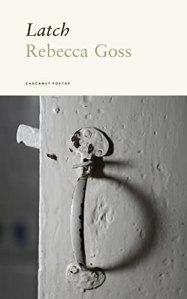 Rebecca Goss’s fourth poetry collection arises from a rural upbringing in Suffolk. Her parents’ farm was a “[s]emi-derelict, ramshackle whimsy of a place”. There’s nostalgia for the countryside left behind and for a less complicated family life before divorce, yet this is no carefree pastoral. From the omnipresent threats to girls to the challenges of motherhood, Goss is awake to the ways in which women are compelled to adapt to life in male spheres. The title/cover image has multiple connotations: the first bond between mother and child; the gates and doors that showcase craftsmanship (as in “Blacksmith, Making”) or seek to shut menacing forces out (see “The Hounds”), but cannot ensure safety.
Even the individual poem titles tell tales: “The Retired Agronomist Drives a Tractor in the Summer Because He Likes the Oily Smell of the Machine” and three with the enticing pattern “Woman Returns to Childhood Home…” Trees and animals provide much of the imagery. A few of my personal favourites were “Rooks,” “Weir,” and “In Song Flight.”

With thanks to Carcanet Press for the advanced e-copy for review.
Kitchen Music by Lesley Harrison
Lesley Harrison is a Scottish poet with a number of pamphlets and collections to her name. Orkney and other remote islands are settings for these atmospheric poems filled with whale song and weather (“the vast dark hung with / ropes of song”), birds and wordplay. Language and folktales inspire the poet, and she engages in word association and creates rebuses built around middle letters rather than first. There are also black-and-white photographs, and whale images by Marina Rees punctuating “C-E-T-A-C-E-A.” My attention threatened to drift away from the sometimes wispy lines and paragraphs, but this would be well worth taking on holiday to read on location.

With thanks to Carcanet Press for the advanced e-copy for review.
Would you be interested in reading one or more of these?
R.I.P. Part II: Wakenhyrst by Michelle Paver
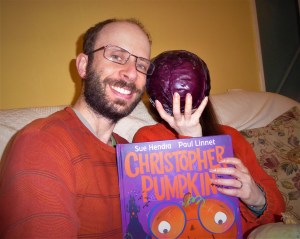
A rainy and blustery Halloween here in southern England, with a second lockdown looming later in the week. I haven’t done anything special to mark Halloween since I was in college, though this year a children’s book inspired me to have some fun with our veg box vegetables for this photo shoot. Just call us Christopher Pumpkin and Rebecca Red Cabbage.
It’s my third year participating in R.I.P. (Readers Imbibing Peril). In each of those three years I’ve reviewed a novel by Michelle Paver. First it was Thin Air, then Dark Matter – two 1930s ghost stories of men undertaking an adventure in a bleak setting (the Himalayas and the Arctic, respectively). I found a copy of her latest in the temporary Little Free Library I started to keep the neighborhood going while the public library was closed during the first lockdown.

Wakenhyrst by Michelle Paver (2019)
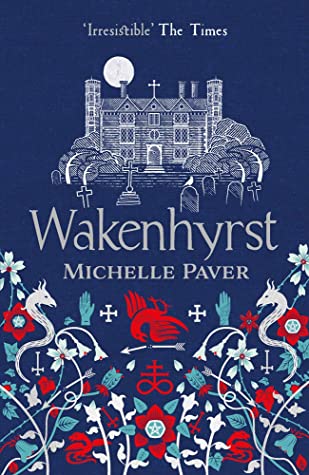 There’s a Gothic flavor to this story of a mentally unstable artist and his teenage daughter. Edmund Stearne is obsessed with the writings of Medieval mystic Alice Pyett (based on Margery Kempe) and with a Bosch-like Doom painting recently uncovered at the local church. Serving as his secretary after her mother’s death, Maud reads his journals to follow his thinking – but also uncovers unpleasant truths about his sister’s death and his relationship with the servant girl. As Maud tries to prevent her father from acting on his hallucinations of demons and witches rising from the Suffolk Fens, she falls in love with someone beneath her class. Only in the 1960s framing story, which has a journalist and scholar digging into what really happened at Wake’s End in 1913, does it become clear how much Maud gave up.
There are a lot of appealing elements in this novel, including Maud’s pet magpie, the travails of her constantly pregnant mother (based on the author’s Belgian great-grandmother), the information on early lobotomies, and the mixture of real (eels!) and imagined threats encountered at the fen. The focus on a female character is refreshing after her two male-dominated ghost stories. But as atmospheric and readable as Paver’s writing always is, here the plot sags, taking too much time over each section and filtering too much through Stearne’s journal. After three average ratings in a row, I doubt I’ll pick up another of her books in the future.
My rating: 
My top R.I.P. read this year was Sisters by Daisy Johnson, followed by 666 Charing Cross by Paul Magrs (both reviewed here).
Have you been reading anything spooky for Halloween?
A Few Bizarre Backlist Reads: McEwan, Michaels & Tremain
I’ve grouped these three prize-winning novels from the late 1980s and 1990s together because they all left me scratching my head, wondering whether they were jumbles of random elements and events or if there was indeed a satisfyingly coherent story. While there were aspects I admired, there were also moments when I thought it indulgent of the authors to pursue poetic prose or plot tangents and not consider the reader’s limited patience. I had to think for ages about how to rate these, but eventually arrived at the same rating for each, reflecting my enjoyment but also my hesitation. 
The Child in Time by Ian McEwan (1987)
[Whitbread Prize for Fiction (now Costa Novel Award)]
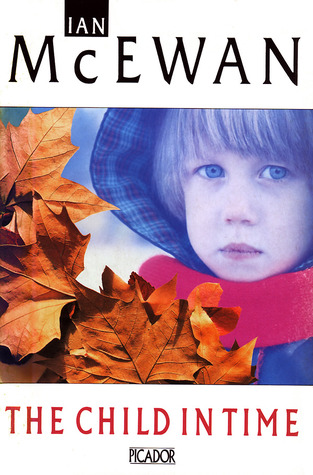 This is the second-earliest of the 13 McEwan books I’ve read. It’s something of a strange muddle (from the protagonist’s hobbies of Arabic and tennis lessons plus drinking onwards), yet everything clusters around the title’s announced themes of children and time.
Stephen Lewis’s three-year-old daughter, Kate, was abducted from a supermarket three years ago. The incident is recalled early in the book, as if the remainder will be about solving the mystery of what happened to Kate. But such is not the case. Her disappearance is an unalterable fact of Stephen’s life that drove him and his wife apart, but apart from one excruciating scene later in the book when he mistakes a little girl on a school playground for Kate and interrogates the principal about her, the missing child is just subtext.
Instead, the tokens of childhood are political and fanciful. Stephen, a writer whose novels accidentally got categorized as children’s books, is on a government committee producing a report on childcare. On a visit to Suffolk, he learns that his publisher, Charles Darke, who later became an MP, has reverted to childhood, wearing shorts and serving lemonade up in a treehouse.
Meanwhile, Charles’s wife, Thelma, is a physicist researching the nature of time. For Charles, returning to childhood is a way of recapturing timelessness. There’s also an odd shared memory that Stephen and his mother had four decades apart. Even tiny details add on to the time theme, like Stephen’s parents meeting when his father returned a defective clock to the department store where his mother worked.
This is McEwan, so you know there’s going to be a contrived but very funny scene. Here that comes in Chapter 5, when Stephen is behind a flipped lorry and goes to help the driver. He agrees to take down a series of (increasingly outrageous) dictated letters but gets exasperated at about the same time it becomes clear the young man is not approaching death. Instead, he helps him out of the cab and they celebrate by drinking two bottles of champagne. This doesn’t seem to have much bearing on the rest of the book, but is the scene I’m most likely to remember.
Other noteworthy elements: Stephen has a couple of run-ins with the Prime Minister; though this is clearly Margaret Thatcher, McEwan takes pains to neither name nor so much as reveal the gender of the PM (in fear of libel claims?). Homeless people and gypsies show up multiple times, making Stephen uncomfortable but also drawing his attention. I assumed this was a political point about Thatcher’s influence, with the homeless serving as additional stand-ins for children in a paternalistic society, representing vulnerability and (misplaced) trust.
This is a book club read for our third monthly Zoom meeting, coming up in the first week of June. While it’s odd and not entirely successful, I think it should give us a lot to talk about: the good and bad aspects of reverting to childhood, whether it matters if Kate ever comes back, the caginess about Thatcher, and so on.
Fugitive Pieces by Anne Michaels (1996)
[Orange Prize (now Women’s Prize for Fiction)]
“One can look deeply for meaning or one can invent it.”
 Poland, Greece, Canada; geology, poetry, meteorology. At times it felt like Michaels had picked her settings and topics out of a hat and flung them together. Especially in the early pages, the dreamy prose is so close to poetry that I had trouble figuring out what was actually happening, but gradually I was drawn into the story of Jakob Beer, a Jewish boy rescued like a bog body or golem from the ruins of his Polish village. Raised on a Greek island and in Toronto by his adoptive father, a geologist named Athos who’s determined to combat the Nazi falsifying of archaeological history, Jakob becomes a poet and translator. Though he marries twice, he remains a lonely genius haunted by the loss of his whole family – especially his sister, Bella, who played the piano. Survivor’s guilt never goes away. “To survive was to escape fate. But if you escape your fate, whose life do you then step into?”
The final third of the novel, set after Jakob’s death, shifts into another first-person voice. Ben is a student of literature and meteorological history. His parents are concentration camp survivors, so he relates to the themes of loss and longing in Jakob’s poetry. Taking a break from his troubled marriage, Ben offers to go back to the Greek island where Jakob last lived to retrieve his notebooks – which presumably contain all that’s come before. Ben often addresses Jakob directly in the second person, as if to reassure him that he has been remembered. Ultimately, I wasn’t sure what this section was meant to add, but Ben’s narration is more fluent than Jakob’s, so it was at least pleasant to read.
Although this is undoubtedly overwritten in places, too often resorting to weighty one-liners, I found myself entranced by the stylish writing most of the time. I particularly enjoyed the puns, palindromes and rhyming slang that Jakob shares with Athos while learning English, and with his first wife. If I could change one thing, I would boost the presence of the female characters. I was reminded of other books I’ve read about the interpretation of history and memory, Everything Is Illuminated and Moon Tiger, as well as of other works by Canadian women, A Student of Weather and Fall on Your Knees. This won’t be a book for everyone, but if you’ve enjoyed one or more of my readalikes, you might consider giving it a try.
Sacred Country by Rose Tremain (1992)
[James Tait Black Memorial Prize, Prix Fémina Etranger]
In 1952, on the day a two-minute silence is held for the dead king, six-year-old Mary Ward has a distinct thought: “I am not Mary. That is a mistake. I am not a girl. I’m a boy.” Growing up on a Suffolk farm with a violent father and a mentally ill mother, Mary asks to be called Martin and binds her breasts with bandages. Kicked out at age 15, she lives with her retired teacher and then starts to pursue a life on her own terms in London. While working for a literary magazine and dating women, she consults a doctor and psychologist to explore the hormonal and surgical options for becoming the man she believes she’s always been.
Meanwhile, a hometown acquaintance with whom she once shared a dentist’s waiting room, Walter Loomis, gives up his family’s butcher shop to pursue his passion for country music. Both he and Mary/Martin are sexually fluid and, dissatisfied with the existence they were born into, resolve to search for something more. The outsiders’ journeys take them to Tennessee, of all places. But when Martin joins Walter there, it’s an anticlimax. You’d expect their new lives to dovetail together, but instead they remain separate strivers.
At a bare summary, this seems like a simple plot, but Tremain complicates it with many minor characters and subplots. The story line stretches to 1980: nearly three decades’ worth of historical and social upheaval. The third person narration shifts perspective often to show a whole breadth of experience in this small English village, while occasional first-person passages from Mary and from her mother, Estelle, who’s in and out of a mental hospital, lend intimacy. Otherwise, the minor characters feel flat, more like symbols or mouthpieces.
To give a flavor of the book’s many random elements, here’s a decoding of the extraordinary cover on the copy I picked up from the free bookshop:
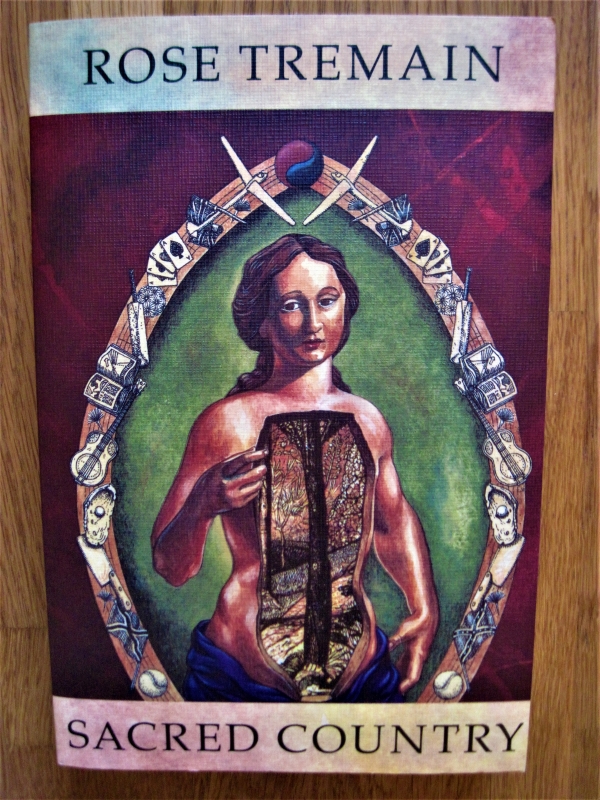
Crimson background and oval shape = female anatomy, menstruation
Central figure in a medieval painting style, with royal blue cloth = Mary
Masculine muscle structure plus yin-yang at top = blended sexuality
Airplane = Estelle’s mother died in a glider accident
Confederate flag = Tennessee
Cards = fate/chance, conjuring tricks Mary learns at school, fortune teller Walter visits
Cleaver = the Loomis butcher shop
Cricket bat = Edward Harker’s woodcraft; he employs and then marries Estelle’s friend Irene
Guitar = Walter’s country music ambitions
Oyster shell with pearl = Irene’s daughter Pearl, whom young Mary loves so much she takes her (then a baby) in to school for show-and-tell
Cutout torso = the search for the title land (both inward and outer), a place beyond duality
Tremain must have been ahead of the times in writing a trans character. She acknowledged that the premise was inspired by Conundrum by Jan Morris (who, born James, knew he was really a girl from the age of five). I recall that Sacred Country turned up often in the footnotes of Tremain’s recent memoir, Rosie, so I expect it has little autobiographical resonances and is a work she’s particularly proud of. I read this in advance of writing a profile of Tremain for Bookmarks magazine. It feels very different from her other books I’ve read; while it’s not as straightforwardly readable as The Road Home, I’d call it my second favorite from her. The writing is somewhat reminiscent of Kate Atkinson, early A.S. Byatt and Shena Mackay, and it’s a memorable exploration of hidden identity and the parts of life that remain a mystery.
 Bookish Beck = Rebecca Foster. American transplant to England. Freelance proofreader and book reviewer.
 Bookish Beck