20 Books of Summer 2020 (Food & Drink Theme): #1 Tiny Moons
It’s my third year participating in Cathy’s 20 Books of Summer challenge. Two years ago I read only books by women; last year I did an animal theme. This year, my 20 books will all tie into a food and drink theme. This includes recognizable foodie lit, memoirs and travel books that have a food element (such as Dave Gorman seeking out non-chain restaurants in America Unchained and Alice Steinbach taking French cooking lessons in Educating Alice), and fiction or nonfiction works that just happen to have a food word in the title. To avoid being grisly, I’ll try not to include any animal books left over from last year!


I have around 30 books to choose from, including these slightly cheaty selections whose authors’ names bring food to mind.

The one constant in my three summers’ selections is that all the books have to be from my own shelves – it’s my way of trying to tackle my hundreds-strong physical TBR. I also have a few classics and two rereads (Dunn and Kingsolver) in the mix here, which would contribute to other ongoing reading goals.
I’m kicking off #20BooksofSummer20 with a quick win, only 85 pages long and read in a single sitting this morning. It was a great start to the project and had my mouth watering for elevenses two hours early…
Tiny Moons: A Year of Eating in Shanghai by Nina Mingya Powles (2020)
This lovely pamphlet of food-themed essays arose from a blog Powles kept while in Shanghai on a one-year scholarship to learn Mandarin. She’d lived in the city as a teen, attending an international high school, so it was somewhat familiar – yet she struggled with homesickness. From one winter to another, she explores the city’s culinary offerings and muses on the ways in which food is bound up with her memories of people and places.
As a child in a mixed-race household in New Zealand, she only knew food words in her Malaysian Chinese mother’s native languages. “My earliest childhood impressions are ones where I am just about to eat something,” she writes. That something might have been Western or Asian food – they coexist in the book (most delightfully on a long-distance train ride she takes: you can buy noodles and dried chicken feet, but also Oreos and Pringles).

As a student in Shanghai, she has dumplings and soup for lunch almost every day. She could live off of spring onion oil noodles and pineapple buns (named for their cross-hatched top rather than their flavour). Messy foods, greasy foods, comfort foods – “It is tiring to be a woman who loves to eat in a society where hunger is something not to be satisfied but controlled.” She and her classmates know that their time here is limited, and they’re going to make the most of these flavours you can’t find every day.
Two sets of cooking lessons add dishes like sticky rice dumplings and stir-fried aubergines to her repertoire. She learns about the traditional foods associated with Chinese festivals, and about the country’s north/south divides: wheat noodles versus rice and thick-skinned dumplings versus thin ones. Street food and snacks abound, including savoury and sweet buns, filled pancakes, tofu bowls and mooncakes.
This is a book about how food can help you be at home, despite loneliness or a language barrier: “In any city anywhere, if there’s a Chinatown I’ll feel at home,” Powles concludes. I love how she uses the senses – not just taste, but also smell and sight – to recreate important places in her life. A fresh banana fritter eaten at her grandparents’ home in Borneo brings it all back, with the senses mingling synaesthetically: “I taste tropical heat. I can taste the slow hours spent in the back garden beneath the mango tree … I taste the fierce sun on my neck”.
My rating: 
Readalikes: Shark’s Fin and Sichuan Pepper: A Sweet-Sour Memoir of Eating in China by Fuchsia Dunlop & Two Trees Make a Forest: On Memory, Migration and Taiwan by Jessica J. Lee
Note: Last year Nina Mingya Powles won the inaugural Nan Shepherd Prize for underrepresented voices in nature writing, earning a publishing contract with Canongate for a nature/travel memoir that will be released in August 2021. I’m looking forward to it already.
Tiny Moons was published on February 27th. My thanks to Emma Dai’an Wright of The Emma Press, a small press based in Birmingham, UK, for the free copy for review. (Emma also illustrated the book!)
Are you joining in the summer reading challenge? What’s the first book on the docket?
Do you spy any favorites on my piles? Which ones should I be sure to read?
20 Books of Summer, #16–17: Classics by R.L. Stevenson and N. West
Doing double duty this month as my classics and two of my last few animal-themed summer reading choices are a record of a trek in France and a sleazy novella set in 1930s Hollywood.
Travels with a Donkey in the Cévennes by Robert Louis Stevenson (1879)
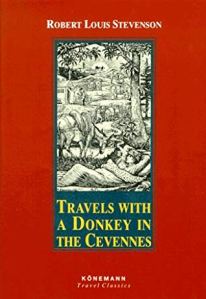 I think I decided this was a must-read because I so love Christopher Rush’s recreation of the journey in To Travel Hopefully. The problem with the original is that there doesn’t seem to have been any particular reason for walking 120 miles in 12 days with a donkey as one’s pack animal and traveling companion. “I have been after an adventure all my life, a pure dispassionate adventurer, such as befell early and heroic voyagers,” Stevenson writes, but of all the options before him this must surely have been one of the safer choices.
As autumn comes on, Stevenson keeps being mistaken for a peddler and meeting religious extremists of various stripes, from Trappist monks to a Plymouth Brother. He stays in shared inn rooms or sleeps outdoors. He learns about the history of religious wars and martyrdom in the region. It’s the sort of material that might have inspired Guy Stagg in writing The Crossway, his account of a secular pilgrimage from Canterbury to Jerusalem. But it’s, for the most part, awfully boring. Rush at least had a good reason for undertaking his journey: after his wife’s death from breast cancer he needed a quest to take his mind off his grief.
But anyway, the donkey. Stevenson buys Modestine for 65 francs and she quickly proves to be a typical stubborn-as creature. Passersby encourage him to find an effective goad and show the beast who’s in charge.
They told me when I left, and I was ready to believe it, that before a few days I should come to love Modestine like a dog. Three days had passed, we had shared some misadventures, and my heart was still as cold as a potato towards my beast of burden. She was pretty enough to look at; but then she had given proof of dead stupidity
Between the early entries and the final ones, though, she is mostly invisible. And, regretfully, Stevenson then has to sell the poor beast again – and for only 35 francs with her saddle. That represents quite a financial loss after less than two weeks!
Ultimately, I prefer reading about Stevenson to reading his actual work. (Other examples: Nancy Horan’s novel Under the Wide and Starry Sky; the chapter of Richard Holmes’s Footsteps: Adventures of a Romantic Biographer in which he recreates the Cévennes trek.) My next Stevenson-themed reading will be The Lighthouse Stevensons by Bella Bathurst.
A lovely line: “to love is the great amulet which makes the world a garden”
Wigtown gets a random mention! As he’s musing on the controversial religious history of the area: “If you met a mixed company in the King’s Arms at Wigton, it is not likely that the talk would run on Covenanters.”
(The e-book is available as a free download from Project Gutenberg, though I read a secondhand copy I’d had for ages.)
See also Kaggsy’s review: it’s more positive and includes helpful background information.
My rating: 
The Day of the Locust by Nathanael West (1939)
Boy oh boy, this is one weird and sordid little book. Like The Great Gatsby, which had been published 14 years before, it shows the seamy underbelly of a glittering American city. Here the setting is Hollywood, where Tod Hackett is a set and costume designer. He’s smitten with his neighbor, Faye Greener, a 17-year-old aspiring actress (“taut and vibrant … shiny as a new spoon”) who’s not above taking a few shifts at the brothel to make ends meet.
 Tod is not the only one obsessed with Faye, though; her other suitors include Homer Simpson (so hard to take him seriously because of that name!), a sad sack from Iowa who moved to the California desert for his respiratory health; Earle Shoop the cowboy; and Miguel, a Mexican cock-fighter. Comic relief is provided by Abe Kusich, a gambling dwarf whose slang includes “lard-ass” and “punkola.” The novella opens and ends with mob scenes, but while the first takes place on a studio lot the last is dangerously real.
There are some fairly disturbing elements here. The casual racism is probably to be expected, but the violence of Tod’s fantasies about Faye startled me: “If only he had the courage to wait for her some night and hit her with a bottle and rape her.” But like Daisy Buchanan in Gatsby, Faye is the sort of careless person who will always come out on top – “Nothing could hurt her. She was like a cork.”
West portrays Hollywood as a wasteland of broken dreams: “the dump grew continually, for there wasn’t a dream afloat somewhere which wouldn’t sooner or later turn upon it, having first been made photographic by plaster, canvas, lath, and paint.” This was his final work before he died in a car accident in 1940. I got more out of Miss Lonelyhearts, but I’m still glad I read this Wigtown purchase. I have no idea what the title refers to, though it sounds like it might be a biblical reference.
My rating: 
I’m still plugging away at my last few #20BooksofSummer and plan to write them up for the last day, September 3rd.
20 Books of Summer, #14–15: Mary Lawson and Stephen Moss
Approaching the home straight with these two: another novel that happens to have an animal in the title, and a pleasant work of modern nature writing set in an English village. My rating for both: 
Crow Lake by Mary Lawson (2002)
I’ve meant to read more by Lawson ever since I reviewed her latest book, Road Ends, for Nudge in May 2015. All three of her novels draw on the same fictional setting: Struan, Ontario. Lawson grew up in a similar Canadian farming community before moving to England in the late 1960s. After an invitation arrives for her nephew’s birthday party, narrator Kate Morrison looks 20 years into the past to remember the climactic events of the year that she was seven. When she and her siblings were suddenly orphaned, her teenage brothers, Luke and Matt, had to cobble together local employment that allowed them to look after their little sisters at home. With the help of relatives and neighbors, they kept their family of four together. All along, though, their lives were becoming increasingly entwined with those of the Pyes, a troubled local farming family.
 Matt inspired Kate’s love of pond life – she’s now an assistant professor of invertebrate ecology – but never got to go to college himself. Theirs was a family that prized schooling above all else (legend has it that Great-Grandmother installed a book rest on her spinning wheel so she could read while her hands were busy*) and eschewed emotion. “It was the Eleventh Commandment,” Kate recalls: “Thou Shalt Not Emote.”
This is a slow burner for sure, but it’s a winning picture of a family that stuck together despite the odds, as well as an appeal to recognize that emotional intelligence is just as important as book learning. The novel reminded me a lot of Surfacing by Margaret Atwood and The Girls by Lori Lansens, and I’d also recommend it to readers of Elizabeth Hay and Jane Urquhart.
*Delightfully, this detail was autobiographical for Lawson.
Wild Hares and Hummingbirds: The Natural History of an English Village by Stephen Moss (2011)
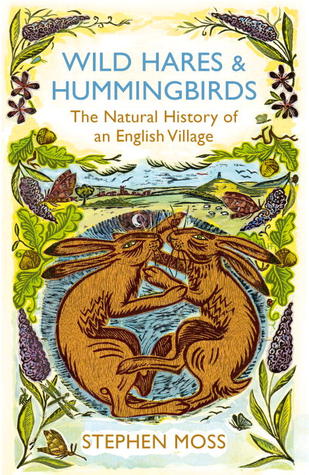 England doesn’t have any hummingbirds, but it does have hummingbird hawkmoths, which explains the title. In the tradition of Gilbert White, Moss writes a month-by-month tribute to what he regularly sees on his home turf of Mark, Somerset. As I did with Mark Cocker’s Claxton, I picked up the book partway – at the month in which I started reading it – and when I reached the end, returned to the beginning and read up to my starting point. Controversial, I know, but that July to June timeline worked fine: it gave me familiar glimpses of what’s going on with English nature now, followed by an accelerated preview of what I have to look forward to in the coming months.
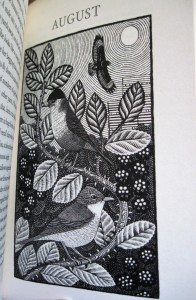 Moss is primarily a birder, so he focuses on bird life, but also notes what’s happening with weather, trees, fungi, and so on. In the central and probably best chapter, on June, he maximizes wildlife-watching opportunities: going eel fishing, running a moth trap, listening for bats, and looking out for unfamiliar plants. My minor annoyances with the book were the too-frequent references to “the parish,” which makes the book’s concerns seem parochial rather than microcosmic, and the common use of semicolons where commas and dashes would be preferable. But if you’re fond of modern nature writing, and have some familiarity with (or at least interest in) the English countryside, I highly recommend this as a peaceful, observant read. Plus, Harry Brockway’s black-and-white engravings heading each chapter are exquisite.
Favorite lines:
“Being in one place is also the best way to understand the passing of the seasons: not the great shifts between winter and spring, summer and autumn, which we all notice; but the tiny, subtle changes that occur almost imperceptibly, from week to week, and day to day, throughout the year.”
“For me, one of the greatest pleasures of living in the English countryside is the way we ourselves become part of the natural cycle of the seasons.”
This Year’s Summer-Themed Reading: Lippman, Lively, Nicholls & More
Sun, warmth and rival feelings of endlessness and evanescence: here were three reads that were perfect fits for the summer setting.
Sunburn by Laura Lippman (2018)
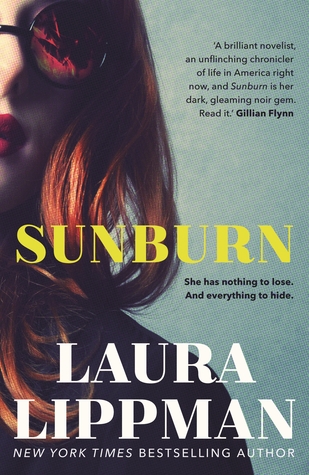 While on a beach vacation in 1995, a woman walks away from her husband and daughter and into a new life as an unattached waitress in Belleville, Delaware. Polly has been known by many names, and this isn’t the first time she’s left a family and started over. She’s the (literal) femme fatale of this film noir-inspired piece, as bound by her secrets as is Adam Bosk, the investigator sent to trail her. He takes a job as a chef at the diner where Polly works, and falls in love with her even though he may never fully trust her. Insurance scams and arson emerge as major themes.
I liked the fact that I recognized many of the Maryland/Delaware settings, and that the setup is a tip of the hat to Anne Tyler’s excellent Ladder of Years, which was published in the year this is set. It is a quick and enjoyable summer read that surprised me with its ending, but I generally don’t find mysteries a particularly worthwhile use of my reading time. Put it down to personal taste and/or literary snobbery. 
Heat Wave by Penelope Lively (1996)
 My fourth Lively book, and the most enjoyable thus far. Pauline, a freelance copyeditor (“Putting commas into a novel about unicorns”) in her fifties, has escaped from London to spend a hot summer at World’s End, the Midlands holiday cottage complex she shares with her daughter Teresa, Teresa’s husband Maurice, and their baby son Luke. Maurice is writing a history of English tourism and regularly goes back to London for meetings or receives visits from his publishers, James and Carol. Pauline, divorced from a philandering husband, recognizes the signs of Maurice’s adultery long before Teresa does, and uneasily ponders how much to hint and how much to say outright.
The last line of the first chapter coyly promises an “agreeable summer of industry and companionship,” but the increasing atmospheric threats (drought or storms; combine harvesters coming ever nearer) match the tensions in the household. I expected this to be one of those subtle relationship studies where ultimately nothing happens. That’s not the case, though; if you’ve been paying good attention to the foreshadowing you’ll see that the ending has been on the cards.
I loved the city versus country setup of the novel, especially the almost Van Gogh-like descriptions of the blue sky and the golden wheat, and recognized myself in Pauline’s freelancer routines. Her friendships with bookseller Hugh and her client, novelist Chris Rogers, might be inconsequential to the plot but give Pauline a life wider than the confines of the cottage, and the frequent flashbacks to her marriage to Harry show what she had to overcome to earn a life of her own.
This was a compulsive read that was perfect for reading during the hottest week of our English summer. I’d recommend it to fans of Tessa Hadley, Susan Hill and Polly Sansom.
Sweet Sorrow by David Nicholls (2019)
 The title is a snippet from Romeo and Juliet, which provides the setup and subject matter for this novel about first love during the golden summer of 1997, when Charlie Lewis and Fran Fisher are 16. Charlie thinks he’s way too cool for the thespians, but if he wants to keep seeing Fran he has to join the Full Fathom Five Theatre Co-operative for the five weeks of rehearsals leading up to performances. Besides, he doesn’t have anything better to do – besides watching his dad get drunk on the couch and scamming the petrol station where he works nights. Charlie starts off as the most robotic Benvolio imaginable, but Fran helps bring him up to scratch with her private tutoring (which is literal as well as a euphemism).
Glimpses of the present day are an opportunity for nostalgia and regret, as Charlie/Nicholls coyly insists that first love means nothing: “love is boring. Love is familiar and commonplace for anyone not taking part, and first love is just a gangling, glandular incarnation of the same. … first love wasn’t real love anyway, just a fraught and feverish, juvenile imitation of it.” I enjoyed the teenage boy perspective and the theatre company shenanigans well enough, but was bored with the endless back story about Charlie’s family: his father’s record shops went bankrupt; his mother left him for another golf club colleague and took his sister; he and his depressed father are slobby roommates subsisting on takeaways and booze; blah blah blah.
It’s possible that had I read or seen R&J more recently, I would have spotted some clever parallels. Honestly? I’d cut 100+ pages (it should really be closer to 300 pages than 400) and repackage this as YA fiction. If you’re looking for lite summer fare reminiscent of Rachel Joyce and, yes, One Day, this will slip down easily, but I feel like I need to get better about curating my library stack and weeding out new releases that will be readable but forgettable. I really liked Us, which explains why I was willing to take another chance on Nicholls.
Note: There is a pretty bad anachronism here: a reference to watching The Matrix, which wasn’t released until 1999 (p. 113, “Cinnamon” chapter). Also a reference to Hobby Lobby, which as far as I know doesn’t exist in the UK (here it’s Hobbycraft) (p. 205, “Masks” chapter). I guess someone jumped the gun trying to get this ready for its U.S. release.
Favorite summery passage: “This summer’s a bastard, isn’t it? Sun comes out, sky’s blue if you’re lucky and suddenly there are all these preconceived ideas of what you should be doing, lying on a beach or jumping off a rope swing into the river or having a picnic with all your amazing mates, sitting on a blanket in a meadow and eating strawberries and laughing in that mad way, like in the adverts. It’s never like that, it’s just six weeks of feeling like you’re in the wrong place … and you’re missing out. That’s why summer’s so sad – because you’re meant to be so happy. Personally, I can’t wait to get my tights back on, turn the central heating up. At least in winter you’re allowed to be miserable” (Fran)
Plus a couple of skims:
The Sun Does Shine: How I Found Life and Freedom on Death Row by Anthony Ray Hinton with Lara Love Hardin (2018)
 I’d heard about Hinton’s case: he spent nearly 30 years on death row in Alabama for crimes he didn’t commit. In 1985 he was convicted of two counts of robbery and murder, even though he’d been working in a locked warehouse 15 miles away at the time the restaurant managers were shot. His mother’s gun served as the chief piece of evidence, even though it didn’t match the bullets found at the crime scenes. “My only crime was … being born black in Alabama,” Hinton concludes. He was a convenient fall guy, and his every appeal failed until Bryan Stevenson of the Equal Justice Initiative (and author of Just Mercy, which I’d like to read) took on his case.
It took another 16 years and an appeal to the U.S. Supreme Court, but Hinton was finally released and now speaks out whenever he can about justice for those on death row, guilty or innocent. Almost the most heartbreaking thing about the book is that his mother, who kept the faith for so many years, died in 2012 and didn’t get to see her son walk free. I love the role that literature played: Hinton started a prison book club in which the men read Go Tell It on the Mountain and To Kill a Mockingbird and discussed issues of race and injustice. Although he doesn’t say very much about his life post-prison, I did note how big of an adjustment 30 years’ worth of technology was for him.
I don’t set a lot of stock by ghostwritten or co-written books, and found the story much more interesting than the writing here (though Hardin does a fine job of recreating the way a black man from the South speaks), so I just skimmed the book for the basics. I was impressed by how Hinton avoided bitterness and, from the very beginning, chose to forgive those who falsely accused him and worked to keep him in prison. “I was afraid every single day on death row. And I also found a way to find joy every single day. I learned that fear and joy are both a choice.” The book ends with a sobering list of all those currently on death row in the United States: single-spaced, in three columns, it fills nine pages. Lord, have mercy.
The Last Supper: A Summer in Italy by Rachel Cusk (2009)
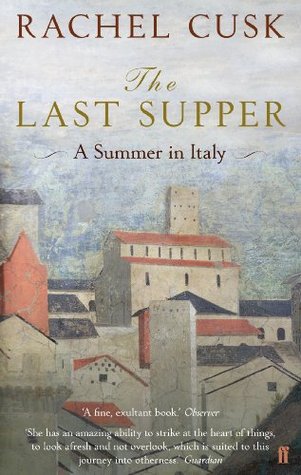 Having moved away from Bristol, Cusk and her family (a husband and two children) decided to spend a summer in Italy before deciding where to go next. They took the boat to France then drove, made a stop in Lucca, and settled into a rented house on the eastern edge of Tuscany. It proceeded to rain for 10 days. Cusk learns to speak the vernacular of football and Catholicism – but Italian eludes her: “I too feel humbled, feel childlike and impotent. It is hard to feel so primitive, so stupid.” They glory in the food, elemental and unpretentious; they try a whole spectrum of gelato flavors. And they experience as much culture as they can: “we will learn to fillet an Italian city of its artworks with the ruthless efficiency of an English aristocrat de-boning a Dover sole.” A number of these masterpieces are reproduced in the text in black and white. In the grip of a heatwave, they move on to Rome, Naples and Capri.
If I’d been able to get hold of this for my trip to Milan (it was on loan at the time), I might have enjoyed it enough to read the whole thing. As it is, I just had a quick skim through. Cusk can write evocatively when she wishes to (“We came here over the white Apuan mountains, leaving behind the rose-coloured light of the coast … up and up into regions of dazzling ferocity where we wound among deathly white peaks scarred with marble quarries, along glittering chasms where the road fell away into nothingness and we clung to our seats in terror”), but more often resorts to flat descriptions of where they went and what they did. I’m pretty sure Transit was a one-off and I’ll never warm to another Cusk book.
DNFs: Alas, One Summer: America, 1927 by Bill Bryson and The Go-Between by L. P. Hartley were total non-starters. Maybe some other day (make that year).
See also my 2017 and 2018 “summer” reads, all linked by the season appearing in the title.
Have you read any summer-appropriate books lately?
20 Books of Summer, #7–10: Auster, Darlington, Durrell, Jansma
Owls and leopards and dogs – oh my! My animal-themed reading project continues. I’m more than halfway through in that I’m in the middle of quite a few more books, but finishing and reviewing them all before the 3rd of September may still prove to be a challenge.
Timbuktu by Paul Auster (1999)
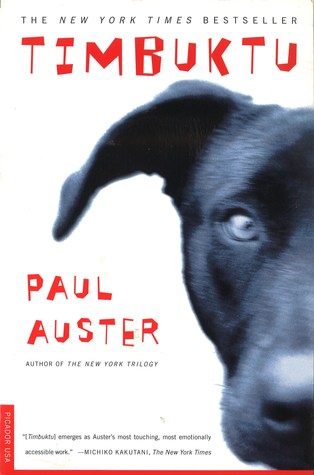 My first from Auster – and not, I take it, representative of his work in general. Never mind, though; I enjoyed it, and it was a good follow-up to Fifteen Dogs. Like the Alexis novel, this gives an intimately imagined dog’s perspective, taking seriously the creature’s whole life story. The canine protagonist is Mr. Bones, who’s accompanied his mentally unstable writer owner, Willy G. Christmas, from New York City down to Baltimore, where, one August Sunday, Willy wants to find his old high school English teacher before he dies.
What took me by surprise is that Auster doesn’t stick with Willy, but has Mr. Bones move on to two more living situations: first he’s the secret friend of 10-year-old Henry Chow, whose parents run a Chinese restaurant, then he’s a family pet in suburban Virginia. Although his English comprehension is advanced, he isn’t able to reproduce its sounds like some of the dogs in Fifteen Dogs can, so he can’t tell these new owners his real name and has to accept being called first “Cal” and then “Sparky.” In dreams he still hears Willy’s voice. He assumes Willy is now in the afterlife (“Timbuktu”), and longs to rejoin him.
The novel is tender as well as playful and funny – I loved the passage where Mr. Bones wakes up to pain but doesn’t realize he’s been castrated:
How was he to know that those missing parts had been responsible for turning him into a father many times over? Except for his ten-day affair with Greta, the malamute from Iowa City, his romances had always been brief—impetuous couplings, impromptu flings, frantic rolls in the hay—and he had never seen any of the pups he had sired. And even if he had, how would he have been able to make the connection? Dick Jones had turned him into a eunuch, but in his own eyes he was still the prince of love, the lord of the canine Romeos, and he would go on courting the ladies until his last, dying breath. For once, the tragic dimension of his own life eluded him.

Owl Sense by Miriam Darlington (2018)
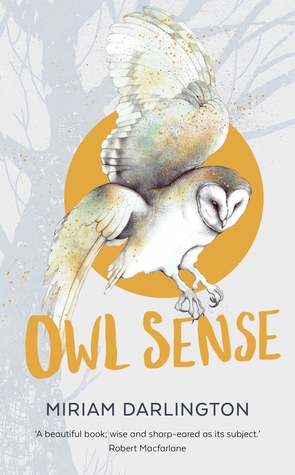 Initially the idea was to see all of Britain’s resident owls, but as often happens, the project expanded until Darlington was also taking trips to Serbia to find a Long-Eared Owl, Finland for a Eurasian Eagle Owl, and France for a Pygmy Owl; and going on a fruitless twitch to see a vagrant Snowy Owl in Cornwall. Each chapter considers a different species and includes information on its anatomy, geographical distribution, conservation status, and any associated myths and anecdotes (The Secret Life of the Owl by John Lewis-Stempel does much the same thing, but with less richness). She has closer encounters with some than with others: when volunteering with the Barn Owl Trust, she gets to ring chicks and collects pellets for dissection. But even the most fleeting sightings can be magical.
The book also subtly weaves in what was happening in Darlington’s life at the time, especially her son Benji’s struggles. On the autistic spectrum, he suddenly started having physical problems that were eventually explained by non-epileptic seizures. I would have welcomed more personal material, but that just speaks to my love of memoir. This feels slightly hurried and not quite as editorially polished as her master work, Otter Country, but it’s still well worth reading if you have any interest in birds or nature conservation. (I’ve only seen two owls in the wild: Barn and Tawny.)
Fillets of Plaice by Gerald Durrell (1971)
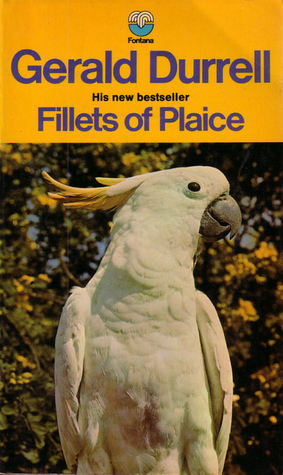 This is a pleasant miscellany of leftover essays that didn’t make it into any of Durrell’s other books. The best is “The Birthday Party,” about an incident from the Corfu years: Larry insisted on taking the fridge along on Mother’s birthday outing to an island, and their boat ran out of petrol. In “A Transport of Terrapins,” teenage Gerry works as a lowly pet shop assistant in London even though he knows twice as much as his boss; and meets other eccentric fellows, such as a bird collector and a retired colonel who has a house full of model figures for war gaming.
“A Question of Promotion” is set on one of the animal-collecting expeditions to Cameroon and turned me off a little with its colonial attitude: Durrell talks to the natives in condescending pidgin as he helps prepare a feast for the District Commissioner’s visit. In “A Question of Degrees” he visits two hospitals for a cataclysmic nosebleed, while “Ursula” is about a girlfriend who couldn’t open her mouth without uttering a malapropism. Entertaining scraps for diehard fans; if you’re new to Durrell, though, start with My Family and Other Animals and Menagerie Manor.
The Unchangeable Spots of Leopards by Kristopher Jansma (2013)
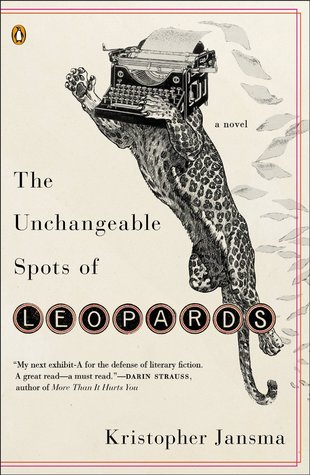 I’d meant to read Jansma’s debut ever since Why We Came to the City, his terrific novel about five university friends negotiating life in New York City during the recession, came out in 2016. I assumed the leopards of the title would be purely metaphorical – a reference to people not being able to change their inborn nature – and they are, but they’re also surprisingly literal in the one chapter set in Africa.
Jansma’s deliciously unreliable narrator, never named but taking on various aliases in these linked short stories, is a trickster, constantly reworking his life into fiction. He longs to be a successful novelist, but keeps losing his works in progress. We think we know the basics of his identity – he’s the son of a single mother who worked as a flight attendant; he grew up in North Carolina emulating the country club and debutante class; at Berkshire College he met his best friend and rival Julian McGann in creative writing class and fell for Julian’s friend Evelyn, the great unrequited love of his life – but Part II introduces doubt by calling the characters different names. Are these the ‘real’ people, or the narrator’s fictionalized versions?
The characters go on a bizarre odyssey that moves the setting from New York City to Nevada to Dubai to Sri Lanka to Ghana to Iceland to Luxembourg, finally ending up back in the very airport terminal where it started. As I remembered from Why We Came to the City, Jansma interleaves Greek mythology and allusions to other writers, especially F. Scott Fitzgerald. The coy way in which he layers fiction on fiction reminded me of work by John Boyne and Tom Rachman; other recommended readalikes are The Goldfinch and Orchid & the Wasp.
August’s Reading Plans: Too Many Projects!
My August is looking chock-full of reading projects – many of them self-imposed, to be fair.
20 Books of Summer: I’ve finished a few more books and just need to write them up; I’m in the middle of another nine, including Tisala as my doorstopper for the month.
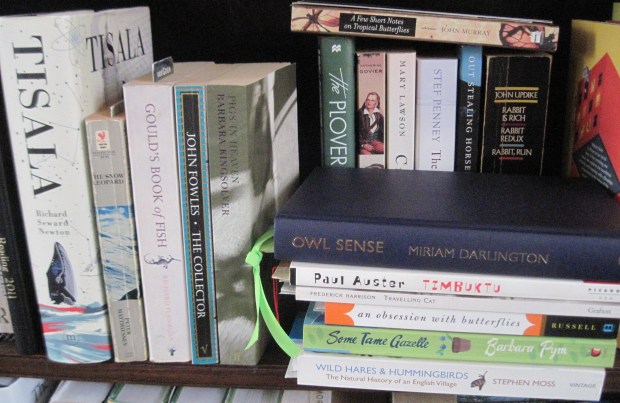
Summer theme: Books with summer/sun/shine in the title, and others set in summer, like The Go-Between by L.P. Hartley, my classic for the month.

Women in Translation month: I’ve started the Ferrante and also want to get to the Fenollera and start the Flores stories (all those Fs!), which are coming out from Oneworld in November. Also, in yesterday’s post I received a surprise copy of a forthcoming Fitzcarraldo Editions essay by Annie Ernaux about her mother’s dementia, so I will squeeze that in too.

Robertson Davies week: In the final week of August I’ll be joining in with Lory’s (The Emerald City Book Review) Robertson Davies readalong by starting Fifth Business, the first volume in The Deptford Trilogy.

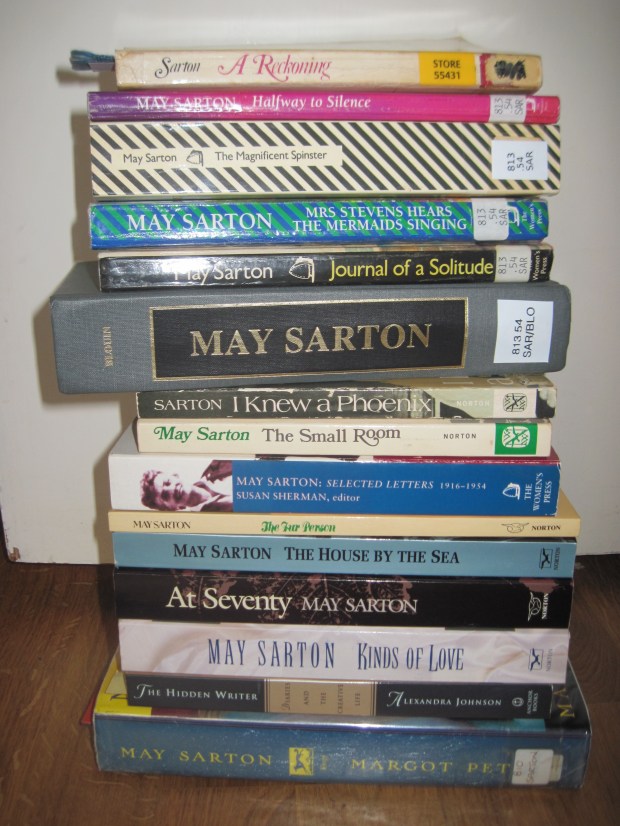
May Sarton article: I’m writing a profile for Bookmarks magazine this month, and am currently in the throes of research: finishing the Margot Peters biography I started last year and set aside for ages; reading another novel or two by Sarton; skimming back through various of the journals, novels and poems I’ve read before; and exploring other external sources. Luckily, my husband was able to forage for loads from his university library for me.
What’s keeping you busy this month?
20 Books of Summer, #1–4: Alexis, Haupt, Rutt, Tovey
I was slow to launch into my 20 Books of Summer reading, but have now finally managed to get through my first four books. These include two substitutes: a review copy I hadn’t realized fit in perfectly with my all-animals challenge, and a book I’d started earlier in the year but set aside and wanted to get back into. Three of the four were extremely rewarding; the last was somewhat insubstantial, though I always enjoy reading about cat antics. All have been illuminating about animal intelligence and behavior, and useful for thinking about our place in and duty towards the more-than-human world. Not all of my 20 Books of Summer will have such an explicit focus on nature – some just happen to have an animal in the title or pictured on the cover – but this first batch had a strong linking theme so was a great start.
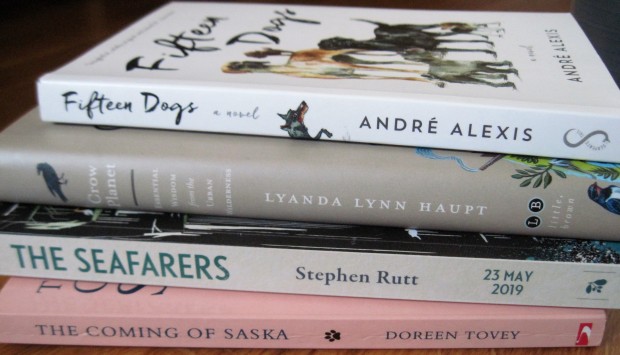
Fifteen Dogs by André Alexis (2015)
In this modern folk tale with elements of the Book of Job, the gods Apollo and Hermes, drinking in a Toronto tavern, discuss the nature of human intelligence and ponder whether it’s inevitably bound up with suffering. They decide to try an experiment, and make a wager on it. They’ll bestow human intelligence on a set of animals and find out whether the creatures die unhappy. Apollo is willing to bet two years’ personal servitude that they will be even unhappier than humans. Their experimental subjects are the 15 dogs being boarded overnight at a nearby veterinary clinic.
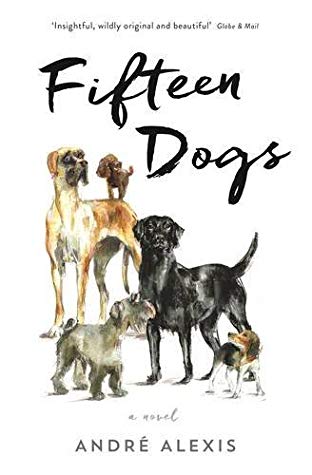 The setup means we’re in for an And Then There Were None type of picking-off of the 15, and some of the deaths are distressing. But strangely – and this is what the gods couldn’t foresee – knowledge of their approaching mortality gives the dogs added dignity. It gives their lives and deaths the weight of Shakespearean tragedy. Although they still do doggy things like establishing dominance structures and eating poop, they also know the joys of language and love. A mutt called Prince composes poetry and jokes. Benjy the beagle learns English well enough to recite the first paragraph of Vanity Fair. A poodle named Majnoun forms a connection with his owner that lasts beyond the grave. The dogs work out who they can trust; they form and dissolve bonds; they have memories and a hope that lives on.
It’s a fascinating and inventive novella, and a fond treatment of the relationship between dogs and humans. When I read in the Author’s Note that the poems all included dogs’ names, I went right back to the beginning to scout them out. I’m intrigued by the fact that this Giller Prize winner is a middle book in a series, and keen to explore the rest of the Trinidanian-Canadian author’s oeuvre.
These next two have a lot in common. For both authors, paying close attention to the natural world – birds, in particular – is a way of coping with environmental and mental health crises.
Crow Planet: Essential Wisdom from the Urban Wilderness by Lyanda Lynn Haupt (2009)
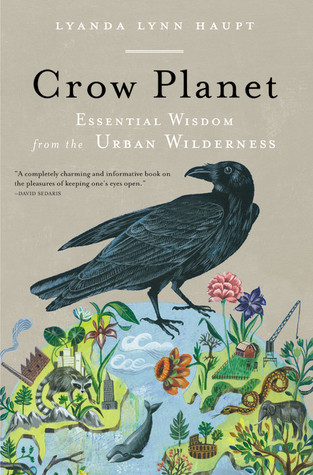 Lyanda Lynn Haupt has worked in bird research and rehabilitation for the Audubon Society and other nature organizations. (I read her first book, Rare Encounters with Ordinary Birds, quite a few years ago.) During a bout of depression, she decided to start paying more attention to the natural world right outside her suburban Seattle window. Crows were a natural place to start. From then on she took binoculars everywhere she went, even on walks to Target. She spent time watching crows’ behavior from a distance or examining them up close – devoting hours to studying a prepared crow skin. She even temporarily took in a broken-legged fledgling she named Charlotte and kept a close eye on the injured bird’s progress in the months after she released it.
Were this simply a charming and keenly observed record of bird behavior and one woman’s gradual reawakening to the joys of nature, I would still have loved it. Haupt is a forthright and gently witty writer. But what takes it well beyond your average nature memoir is the bold statement of human responsibility to the environment. I’ve sat through whole conference sessions that try to define what nature is, what the purpose of nature writing is, and so on. Haupt can do it in just a sentence, concisely and effortlessly explaining how to be a naturalist in a time of loss and how to hope even when in possession of all the facts. 
A few favorite passages:
“an intimate awareness of the continuity between our lives and the rest of life is the only thing that will truly conserve the earth … When we allow ourselves to think of nature as something out there, we become prey to complacency. If nature is somewhere else, then what we do here doesn’t really matter.”
“I believe strongly that the modern naturalist’s calling includes an element of activism. Naturalists are witnesses to the wild, and necessary bridges between ecological and political ways of knowing. … We join the ‘cloud of witnesses’ who refuse to let the more-than-human world pass unnoticed.”
“here we are, intricate human animals capable of feeling despair over the state of the earth and, simultaneously, joy in its unfolding wildness, no matter how hampered. What are we to do with such a confounding vision? The choices appear to be few. We can deny it, ignore it, go insane with its weight, structure it into a stony ethos with which we beat our friends and ourselves to death—or we can live well in its light.”
The Seafarers: A Journey among Birds by Stephen Rutt (2019)
 In 2016 Rutt left his anxiety-inducing life in London in a search for space and silence. He found plenty of both on the Orkney Islands, where he volunteered at the North Ronaldsay bird observatory for seven months. In the few years that followed, the young naturalist travelled the length and breadth of the British Isles – from Skomer to Shetland – courting encounters with seabirds. He’s surrounded by storm petrels one magical night at Mousa Broch; he runs from menacing skuas; he watches eider and terns and kittiwakes along the northeast coast; he returns to Orkney to marvel at gannets and fulmars. Whether it’s their beauty, majesty, resilience, or associations with freedom, such species are for him a particularly life-enhancing segment of nature to spend time around.
Discussion of the environmental threats that hit seabirds hardest, such as plastic pollution, makes for a timely tie-in to wider conservation issues. Rutt also sees himself as part of a long line of bird-loving travellers, including James Fisher and especially R.M. Lockley, whose stories he weaves in. This is one of the best nature/travel books I’ve read in a long time, especially enjoyable because I’ve been to a lot of the island locations and the elegantly evocative writing, making particularly effective use of varied sentence lengths, brought back to me just what it’s like to be in the far north of Scotland in the midst of an endless summer twilight, a humbled observer as a whole whirlwind of bird life carries on above you. 
A favorite passage:
“Gannets nest on the honeycombs of the cliff, in their thousands. They sit in pairs, pointing to the sky, swaying heads. They stir. The scent of the boat’s herring fills the air. They take off, tessellating in a sky that is suddenly as much bird as light. The great skuas lurk.”
My husband also reviewed this, from a birder’s perspective.
With thanks to Elliott & Thompson for the proof copy for review.
The Coming of Saska by Doreen Tovey (1977)
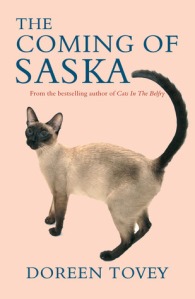 I’ve read four of Tovey’s quaint Siamese cat books now; this was the least worthwhile. It’s partially a matter of false advertising: Saska only turns up for the last 15 pages, as a replacement of sorts for Seeley, who disappeared one morning a year earlier and was never seen again. Over half of the book, in fact, is about a trip Tovey and her husband Charles took to Edmonton, Canada. The Canadian government sponsored them to come over for the Klondike Days festivities, and they also rented a camper and went looking for bears and moose. Mildly amusing mishaps, close shaves, etc. ensue. They then come back and settle into everyday life with their pair of Siamese half-siblings; Saska had the same father as Shebalu. Entertaining enough, but slight, and with far too many ellipses.
Plans for 20 Books of Summer

This is my second time taking part in Cathy’s 20 Books of Summer project. Once again I plan to focus solely on books that I own to try to get through a respectable number of them. For 2019 I’ve decided to read books that are about animals or have an animal in the title. I’ve set aside a few back-ups (the ones standing upright in the photos), and if I’m struggling I can cheat a bit by including books that happen to have an animal on the cover.


In the interest of statistics … last year I read eight nonfiction titles and 12 fiction – so that’s exactly what I’ve pulled out for this year. (For the record, I only intend to read the first of Updike’s Rabbit novels at this stage.) I have two re-reads set aside this time (Julian Barnes and Abigail Thomas) versus one last year. Last year I read one doorstopper; this year I don’t have any on the docket. In 2018 I was particularly proud of getting through two short story collections, so this year I’ve chosen one animal-themed one to read. Randomly, three of last year’s books were review copies from publishers or the author, and three were signed copies. This time I have none of either, unless I do some substituting.
Also interesting to note is that this year three of the books I’ve picked are by Canadian authors (André Alexis, Michael Crummey and Mary Lawson), and another has a Canadian setting (The Tenderness of Wolves). Canadian readers, rejoice!
Another project I might join in with this summer is the Robertson Davies reading week – I own his Deptford trilogy, and would at least read one of the books, if not attempt all three.
What are your summer reading plans?
Polishing off My 20 Books of Summer with Hay, Jones & Markham
I finished off strong with a few books I’ve been meaning to read for months or years.
Late Nights on Air by Elizabeth Hay (2007)
 (This was a Twitter buddy read with Naomi of Consumed by Ink and Penny of Literary Hoarders.) I read my first novel by Hay, A Student of Weather, last year. It was wonderfully rewarding even though it took me a month to read. By contrast, I read the Giller Prize-winning Late Nights on Air in half that time. Most of it is set in 1975–7 in Yellowknife, a small city in Canada’s Northwest Territories. Here winter lasts for eight months and you can still meet with snow and frozen lakes in early July. A tight-knit cast gathers around the local radio station: Harry and Gwen, refugees from Ontario starting new lives; Dido, an alluring Dutch newsreader; Ralph, the freelance book reviewer; menacing Eddie; and pious Eleanor.
Everyone is in love with everyone else, so you get these layers of unrequited romance and a sense of exposure: not just to the elements, but to the vulnerabilities of admitting one’s feelings and risking professional failure. The novel is also about appearances and assumptions – “You don’t look anything like how you sound,” Gwen says to Harry – and the dangers of obsession. Four of the station employees set out one summer to recreate the six-week journey of Arctic explorer John Hornby, a trip that ends up being as wondrous as it is fraught. Hay’s foreshadowing is a bit heavy-handed, and I found the final chapters after the expedition a slight letdown, but overall this is a marvellous story of quiet striving and dislocation. I saw bits of myself in each of the characters, and I loved the extreme setting, both mosquito-ridden summer and bitter winter. I need to read the rest of Hay’s oeuvre stat.
Favorite passages:
Harry’s professional advice to Gwen: “Radio was like poetry, he told her. At its best it could be, while television was like a blockbuster novel: one made you think and feel, the other dulled your mind. … ‘To be any good you have to believe it’s hard. It’s called creative tension. … And you won’t be any good until you’re dedicated to something outside yourself.’ … I learned that a mistake is just something you go on from.”
“Something blossoms in an unlikely place. An oasis of trees miles above the treeline. An arctic river warmer than any other water they’d come upon. The four of them bathed in the waters of the Thelon, wading out into it, almost swimming. On shore they towelled themselves dry and dressed, and there was no feeling to equal the splendour of warm clothes on river-cold skin.”
My rating: 
I ran out of time for Half of a Yellow Sun by Chimamanda Ngozi Adichie so substituted in…
An American Marriage by Tayari Jones (2018)
(If it’s good enough for Barack Obama and Oprah Winfrey, it’s good enough for me!)
 The title feels like an echo of An American Tragedy. It’s both monolithic and generic, as if saying: Here’s a marriage; make of it what you will. Is it representative of the average American situation, or is it exceptional? Roy and Celestial only get a year of happy marriage before he’s falsely accused of rape and sentenced to 12 years in prison in Louisiana. Through their alternating first-person narration and their letters back and forth while Roy is incarcerated, we learn more about this couple: how their family circumstances shaped them, how they met, and how they drift apart as Celestial turns to her childhood friend, Andre, for companionship. When Roy is granted early release, he returns to Georgia to find Celestial and see what might remain of their marriage. I ached for all three main characters: It’s an impossible situation. The novel ends probably the only way it could, on a realistic yet gently optimistic note. Life goes on, if not how you expect, and there will be joys still to come.
This would make a great book club pick: there’s a lot to probe about the characters’ personalities and motivations, and about how they reveal or disguise themselves through their narration. I found it remarkable how the letters, which together make up not even one-fifth of the text, enhance the raw honesty of the book. There are other marriages on display besides Roy and Celestial’s, their range providing a snapshot of African-American lower-middle- and upper-middle-class life in the South. I especially liked the use of two totem objects, Roy’s tooth and the hickory tree outside Celestial’s childhood home (what you see on the cover).
Favorite lines:
Celestial: “I believed that our marriage was a fine-spun tapestry, fragile but fixable. We tore it often and mended it, always with a silken thread, lovely but sure to give way.”
Andre: “I don’t believe that blood makes a family; kin is the circle you create, hands held tight.”
Celestial: “Our marriage was a sapling graft that didn’t have time to take.”
Roy: “mostly my life is good, only it’s a different type of good from what I figured on.”
My rating:
An American Marriage was published in the UK by Oneworld on April 5th. My thanks to the publisher for the free copy for review.
West With the Night by Beryl Markham (1942)
 (Another Twitter buddy read, with Laila of Big Reading Life.) I’ve meant to pick this up ever since I read Paula McLain’s fantastic novel about Beryl Markham, Circling the Sun. I loved Markham’s memoir even more. She writes so vividly about the many adventures of her life in Africa: hunting lions, training race horses, and becoming one of the continent’s first freelance pilots, delivering mail and locating elephant herds.
It took me a while to get used to the structure – this is a set of discrete stories rather than a chronological narrative – but whether she’s reflecting on the many faces of Africa or the peculiar solitude of night flights, the prose is just stellar. Ernest Hemingway once asserted in a letter that Markham could “write rings around all of us who consider ourselves as writers,” and I certainly enjoyed this more than anything I’ve read by Hemingway.
The text is bookended by two momentous flights: it opens with Markham scrambling to deliver oxygen to an injured miner, and ends with her completing the first east–west solo flight across the Atlantic in 1936. Her engine cut out multiple times; it’s no less than a miracle that she survived to crash land in Nova Scotia. Laila and I agree that Markham’s life is so exciting it’s crying out for a movie version. In the meantime, I’d like to read some more about her circle – Denys Finch Hatton; and Baron von Blixen and his wife Karen (aka Danish writer Isak Dinesen, famous for Out of Africa). In my Circling the Sun review for BookTrib, I wrote that “Markham was the kind of real-life action adventure heroine you expect to find in Indiana Jones movies,” and that sense was only confirmed by her own account.
Favorite passages:
“to fly in unbroken darkness without even the cold companionship of a pair of ear-phones or the knowledge that somewhere ahead are lights and life and a well-marked airport is something more than just lonely. It is at times unreal to the point where the existence of other people seems not even a reasonable possibility. The hills, the forests, the rocks, and the plains are one with the darkness, and the darkness is infinite. The earth is no more your planet than is a distant star—if a star is shining; the plane is your planet and you are its sole inhabitant.”
“I saw how a man can be master of a craft, and how a craft can be master of an element. I saw the alchemy of perspective reduce my world, and all my other life, to grains in a cup. I learned to watch, to put my trust in other hands than mine. And I learned to wander. I learned what every dreaming child needs to know—that no horizon is so far that you cannot get above it or beyond it.”
My rating:
So how did I do on my first-ever #20BooksofSummer challenge? In that I read and reviewed (more than) 20 books by women that I owned in print, it was a smashing success. However, I only read 7 of the books I’d intended to, substituting in the rest from my review pile, books I owned in America, and others that grabbed my attention more than those I’d picked out in early June. Looks like I’m not great at sticking with the specific reading plans I set!
At any rate, as bonuses, here are the additional books by women that I read in print from my own shelves over the summer, not counting ones already reviewed on the blog (in chronological order, with ratings and links to any Goodreads reviews):
- Blue Horses, Mary Oliver
- The Egg and I, Betty Macdonald
- Eye of the Shoal: A Fish-watcher’s Guide to Life, the Ocean and Everything, Helen Scales
- The Partly Cloudy Patriot, Sarah Vowell

- Talk before Sleep, Elizabeth Berg
- The Incendiaries, R.O. Kwon [blog tour review coming on Monday]

- The Artist’s Way: A Spiritual Path to Higher Creativity, Julia Cameron
- Gross Anatomy: My Curious Relationship with the Female Body (The Top Half and the Bottom Half), Mara Altman [Glamour UK review coming soon]
- Questions of Travel, Elizabeth Bishop
- Writers & Company, Eleanor Wachtel
- Help Me!: One woman’s quest to find out if self-help really can change her life, Marianne Power
- Mrs Gaskell & Me: Two Women, Two Love Stories, Two Centuries Apart, Nell Stevens
I’d call that a result!
What have been the best books of the summer? Of the final 20, The Invisible Bridge by Julie Orringer was the winner, followed closely by The Life and Loves of Lena Gaunt by Tracy Farr, Late Nights on Air by Elizabeth Hay, and West With the Night by Beryl Markham. There were no real duds. I’m still very interested in all but one of the books I chose back in June, so I’ll see how many of the rest I can fit into this autumn and winter’s reading.
How was your summer of reading? Did you meet any goals you set?
Two “Summer” Reads: Knausgaard and Trevor
Last year at about this time I reviewed Jonathan Smith’s Summer in February and Elizabeth Taylor’s In a Summer Season, two charming English novels about how love can upend ordinary life. This month I read my first William Trevor novel, Love and Summer, which is very much in that vein. My other selection, Karl Ove Knausgaard’s last of four seasonal installments written for his young daughter, is a mostly nonfiction hybrid.
Summer by Karl Ove Knausgaard (2016; English translation, 2018)

Illustrated by German artist Anselm Kiefer.
I’ve now read three volumes from the Seasons Quartet – all but Spring. The series started with Knausgaard addressing his fourth child in utero. By now she’s two years old but still the recipient of his nostalgic, slightly didactic essays on seasonal topics, as well as the “you” some of his journal entries are written to. I wasn’t so keen on Autumn, but Winter and Summer are both brilliant for how they move from tangibles – ice cream cones, camping, fruit flies, seagulls, butterflies and the circus – into abstract notions of thought, memory, identity and meaning. That fluidity is especially notable here when Knausgaard drifts in and out of the imagined experience of an elderly woman of his grandfather’s acquaintance who fell in love with an Austrian soldier and abandoned her children during World War II.
I especially enjoyed two stories: traveling with his son to Brazil for a literary festival where he ran into English surgeon Henry Marsh, and fainting at an overcrowded publisher party in London. He’s always highly aware of himself (he never gives open-mouthed smiles because of his awful teeth) and of others (this woman at the party is desperate to appear young). But more so than these stand-out events and his memories of childhood, he gives pride of place to everyday life, things like chauffeuring his three older children to their various activities and shopping at the supermarket for barbecue food. “By writing it I reveal that not only do I think about it, I attach importance to it. … I love repetition. Repetitions turn time into a place, turn the days into a house.” I highlighted dozens of passages in the Kindle book. I’ll need to catch up on Spring, and then perhaps return to the My Struggle books; I only ever read the first.
My rating:
Love and Summer by William Trevor (2009)
 Trevor (1928–2016) was considered a writer’s writer and a critic’s dream for the simple profundity of his prose. I had long meant to try his work. This short novel is set over the course of one summer in a small Irish town in the 1950s, and opens on the day of the funeral of old Mrs. Connulty. A stranger is seen taking photographs around town, and there is much murmuring about who he might be. He is Florian Kilderry, who recently inherited his Anglo-Italian artist parents’ crumbling country house. It’s impossible to pay the debts and keep the house going, so he plans to sell it and its contents as soon as possible and move abroad, perhaps to Scandinavia.
But he hasn’t passed through Rathmoye without leaving ripples. Ellie Dillahan, a young farmer’s wife who was raised by nuns and initially moved to Dillahan’s as his housekeeper, falls in love with the stranger almost before she meets him, and they embark on a short-lived liaison. Blink and you’ll miss that the relationship is actually sexual; Trevor only uses the word “embraced” twice, I think. That reticence keeps it from being a torrid affair, yet we do get a sense of how wrenching the thought of Florian leaving becomes for Ellie. Trevor often moves from descriptions of nature or farm chores straight into Ellie’s thoughts, or vice versa.
“In the crab-apple orchard she scattered grain and the hens came rushing to her. She hadn’t been aware that she didn’t love her husband. Love hadn’t come into it”
“He [Florian] would be gone, as the dead are gone, and that would be there all day, in the kitchen and in the yard, when she brought in anthracite for the Rayburn, when she scalded the churns, while she fed the hens and stacked the turf.”
This is quietly beautiful writing – perhaps too quiet for me, despite the quirky secondary characters around the town (including the busybody Connulty daughter and the madman Orpen Wren) – but I would recommend Trevor to readers of Mary Costello and Colm Tóibín. I would also like to try Trevor’s short stories, for which he was particularly known; I think in small doses his subtle relationship studies and gentle writing would truly shine.
My rating:
Summery reading options for next year: The Heat of the Day by Elizabeth Bowen, One Summer: America, 1927 by Bill Bryson, and The Go-Between by L. P. Hartley (set over a long, hot summer). I may also get Sunburn by Laura Lippman and Heat Wave by Penelope Lively out from the library.
 Bookish Beck = Rebecca Foster. American transplant to England. Freelance proofreader and book reviewer.
