Bodily Harm and Stone Mattress by Margaret Atwood (#MARM)
It’s my sixth year participating in the annual Margaret Atwood Reading Month (#MARM), hosted by indomitable Canadian blogger Marcie of Buried in Print. In previous years, I’ve read Surfacing and The Edible Woman, The Robber Bride and Moral Disorder, Wilderness Tips, and The Door; and reread The Blind Assassin. Wish a happy belated birthday to MA, who turned 84 earlier this month. As it happens, today is my husband’s 40th birthday and I am tapping away at this in the passenger’s seat of the car as we hurtle through the freezing fog toward Slimbridge for some wintry birdwatching. I spent much of yesterday making his German chocolate cake (delicious but very involved) from a Hummingbird Bakery cookbook.

Bodily Harm (1982)
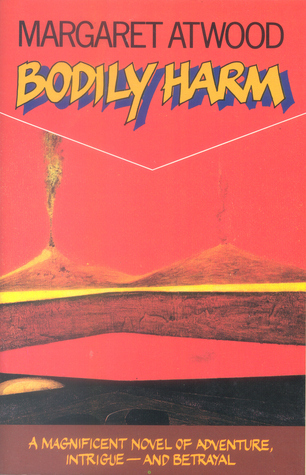 I had literally never heard of her fifth novel before I spotted it on the library catalogue and decided to have a go. The fact that nobody talks about it is evidence, I think, of an overbaked plot and more successful treatment of her trademark themes in other books. Nonetheless, it was perfectly readable and had its highlights. Renata Wilford, “Rennie,” is a journalist for hire from Ontario who has recently had her life turned upside down by breast cancer and the departure of her boyfriend, Jake. She flies to the Caribbean island nation of St. Antoine to write a travel piece, coinciding with the first elections since the British left. It’s a febrile postcolonial setting of shantytowns and shortages. Rennie tries to focus on boat trips, cocktails and beach lounging, but Dr. Minnow, who she met on the plane, is determined to show her the reality of his country – cold truths that include assassination and imprisonment.
Alongside the thriller plot are the more expected literary flashbacks to Rennie’s childhood, her life with Jake, and the cancer surgery and her crush on her surgeon. Her old friend Jocasta is an amusingly punky feminist and a counterpoint to Lora, the fellow Canadian and bad girl Rennie meets in St. Antoine. There are no speech marks in the sections set in the past, and there are some passages of direct monologue from Lora recounting her abusive upbringing. I felt Atwood was stretching to make points about cultural imperialism and violence, whereas the title is more applicable to the physical threats women face from illness and misogyny:
“The body, sinister twin, taking its revenge for whatever crimes the mind was supposed to have committed on it. Nothing had prepared her for her own outrage, the feeling that she’d been betrayed by a close friend. She’d given her body swimming twice a week, forbidden it junk food and cigarette smoke, allowed it a normal amount of sexual release. She’d trusted it. Why then had it turned against her?”
(University library) 
Stone Mattress (2014)
I was tempted to call this my first ever audiobook, but that is not technically true: 11 years ago, we had a David Attenborough book on in the car on the way to Cornwall. However, this definitely felt like a landmark. I’d long meant to catch up on Atwood’s last but one story collection, but my library had withdrawn the physical copy and only had the book on CD. How would I fit it into my life, I wondered? Others have told me they listen to audiobooks while commuting, cooking or cleaning … er, I don’t really do any of those! But I amassed a goodly list of tasks involving my hands but not much of my brain to complete while listening to the CDs through my PC speakers:
• Prepared two clothing recycling parcels (37 socks off to the London Sock Company’s Sock Amnesty programme; 3 shirts and 2 sets of pyjamas to Rapanui’s 100% cotton recycling scheme)
• Mended 13 socks, 4 shirts, 3 gloves, 2 cardigans, a shoulder bag strap, and a purse strap and lining
• Framed a photo for a Christmas gift
• Baked the aforementioned German chocolate cake
• Wrapped my husband’s birthday presents
• Wrote a couple of Christmas cards
 Nonetheless, I found it frustrating that it took so long to get through a story/disc, surely longer than I would have spent reading with my eyes (and so I have only managed 7.5 of 9 stories so far), and it was slightly harder for me to concentrate. It was also disorienting to not have visual cues, such that I had no idea how much of a story was remaining, and sometimes didn’t know how place or character names were spelt. One interesting novelty, though, was the reader voices. There are five different voice actors on this audiobook, three women (including MA herself on the title story) and two men. It is interesting to ponder how their intonation might affect my reaction to a story. For instance, Rob Delaney’s deadpan delivery really makes “The Freeze-Dried Groom,” a witty work of mild horror in which a fraudulent antiques dealer finds an entire wedding, complete with groom, abandoned in a storage unit.
As in a number of Atwood’s later works, recurring themes of ageing and the writer’s craft intertwine. I most enjoyed the opening linked trio of “Alphinland,” “Revenant” and “Dark Lady,” which orbit SFF writer Constance and her one-time lover, macho poet Gavin. The first story has Constance slipping between her fictional world and the real one, in which a winter storm is impending and her husband Ewan has been dead for four days. In “Revenant,” an elderly Gavin holds court as a scholar comes to interview him. Imagine his ire when he learns she is there to question him about Constance for her PhD research. “Dark Lady” brings the three major women from Gavin’s life into a face-off.
Funniest was “I Dream of Zenia with the Bright Red Teeth,” a The Robber Bride mini-sequel in which three ageing women fend off an interfering male with the help of a potential reincarnation of their late friend. I was reminded of the setup of Charlotte Wood’s The Weekend, not least for the presence of an annoying dog. Least engaging has been “The Dead Hand Loves You,” about Jack Dace, the author of an international horror classic who has always resented having to share his profits four ways with his early adulthood housemates because of his promise to catch up on his back rent from his creative earnings. I thought this one would never end. In general, though, this has been classic MA, mixing realism and fantasy in clever and witty ways. And I’m sure it won’t be my last audiobook. I was gifted an Audible book for my birthday by a blind friend, to start with. Now to store up some more busy work… (Public library audiobook) 
Hungerford Bookshop’s Summer Reading Celebration
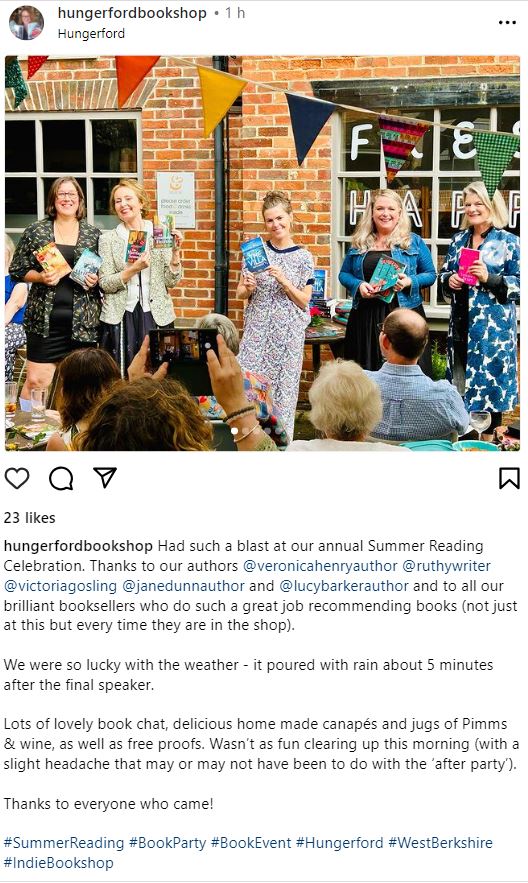
On Saturday evening my nearest indie, Hungerford Bookshop, hosted a Summer Reading celebration with five authors, some of them local, introducing their novels. It was such a delight to be invited! The rain just about held off for the duration of the outdoor event, and it was fun to learn more about new-to-me books over Pimm’s and canapes and pick up some proof copies.
Veronica Henry usually writes English countryside and coastal stories, but this time it’s Thirty Days in Paris, about Juliet, a woman of a certain age who takes a one-month rental in the city to write a novel, having amicably separated from her husband. Henry based the flat on one she stayed in in Paris, and called this novel a wish fulfilment for her.

Ruth Kelly, a ghostwriter (The Prison Doctor, etc.) based in Kintbury, has written her first novel, The Villa, a thriller about a reality TV franchise. The main character is a journalist and the other two POVs are the producer and viewers collectively. She said the book starts with the body and moves backwards.

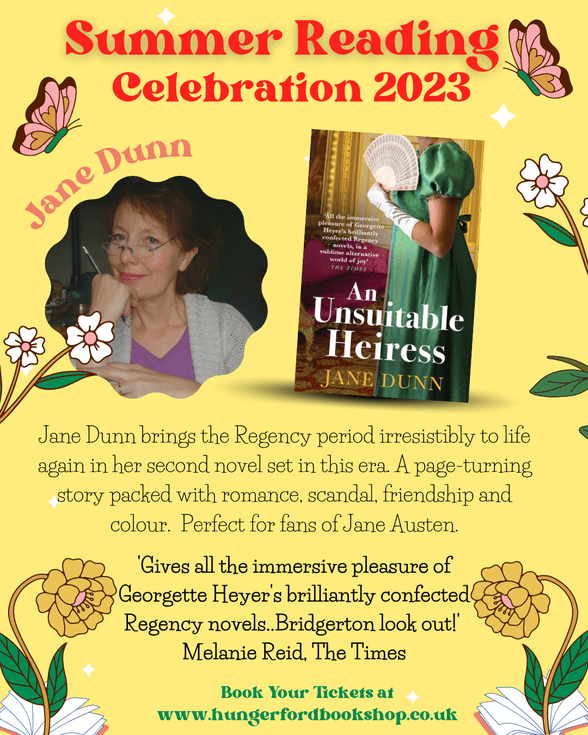
Jane Dunn is a biographer (of Daphne du Maurier, Antonia White et al.) who pivoted to writing Regency romances, having been inspired by a newfound love of Georgette Heyer. Her books, including An Unsuitable Heiress, feature women who are slightly on the periphery: a widow, illegitimate children, a male impersonator, and so on.
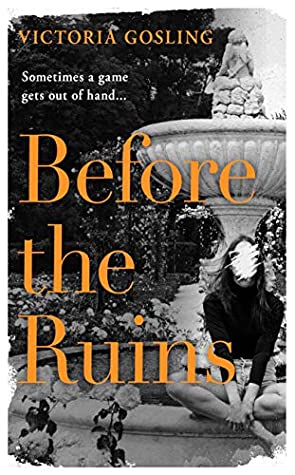
Victoria Gosling was a last-minute fill-in for an author who couldn’t make it. She moved back to Marlborough from Berlin, where she was living when she wrote her book set in Marlborough, Before the Ruins. She called it a slow-burn (Secret History-type) thriller about four people who spent the summer they were 17 squatting in a derelict manor house and have been dealing with the fallout ever since. I’ll get this one out from the library soon.
Lucy Barker’s debut novel, The Other Side of Mrs Wood, is about two warring mediums in 1873. Since I love most things set in the Victorian period, this was the one I’d already heard about and placed an order on through the library. It’s based on real-life mediums Agnes Guppy and Florence Cook and sounds like great fun! The summer reading choices are usually paperbacks, but an exception was made for this one still in hardback.

Which of these take your fancy?
There was also bookshop news and bookseller recommendations. The big announcement was the opening of a new branch in Wantage, taking over a closing-down shop.
Bookseller recommendations:
 Hilary: Briefly, A Delicious Life by Nell Stevens (I’d second that one; here’s my review)
Tessa: The Redemption of Isobel Farrar by Alan Robert Clark
Alison: Shrines of Gaiety by Kate Atkinson
Emma: Beautiful Ruins by Jess Walter (I’ve long been interested in this one)
Alex: The Sanctuary by Andrew Hunter Murray (& Lessons by Ian McEwan in paperback)
Imogen: Little Wing by Freya North (my ears pricked up to hear it’s set on the Isle of Harris)
Recent Online Events: Melanie Finn, Church Times Festival, Gavin Francis
It’s coming up on the one-year anniversary of the first UK lockdown and here we are still living our lives online. The first hint I had of how serious things were going to get was when a London event with Anne Tyler I was due to attend in March 2020 with Eric and Laura T. was cancelled, followed by … everything else. Oh well.
This February was a bountiful month for online literary conversations. I’m catching up now by writing up my notes from a few more events (after Saunders and Ishiguro) that helped to brighten my evenings and weekends.
Melanie Finn in Conversation with Claire Fuller
(Exile in Bookville American online bookstore event on Facebook, February 2nd)
I was a big fan of Melanie Finn’s 2015 novel Shame (retitled The Gloaming), which I reviewed for Third Way magazine. Her new book, The Hare, sounds appealing but isn’t yet available in the UK. Rosie and Bennett, a 20-years-older man, meet in New York City. Readers soon enough know that he is a scoundrel, but Rosie doesn’t, and they settle together in Vermont. A contemporary storyline looking back at how they met contrasts the romantic potential of their relationship with its current reality.
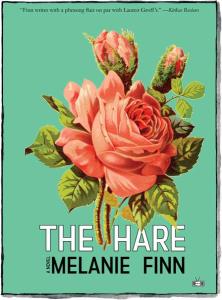 Fuller said The Hare is her favorite kind of novel: literary but also a page-turner. (Indeed, the same could be said of Fuller’s books.) She noted that Finn’s previous three novels are all partly set in Africa and have a seam of violence – perhaps justified – running through. Finn acknowledged that everyday life in a postcolonial country has been a recurring element in her fiction, arising from her own experience growing up in Kenya, but the new book marked a change of heart: there is so much coming out of Africa by Black writers that she feels she doesn’t have anything to add. The authors agreed you have to be cruel to your characters.
Finn believes descriptive writing is one of her strengths, perhaps due to her time as a journalist. She still takes inspiration from headlines. Now that she and her family (a wildlife filmmaker husband and twin daughters born in her forties) are rooted in Vermont, she sees more nature writing in her work. They recovered a clear-cut plot and grow their own food; they also forage in the woods, and a hunter shoots surplus deer and gives them the venison. Appropriately, she read a tense deer-hunting passage from The Hare. Finn also teaches skiing and offers much the same advice as about writing: repetition eventually leads to elegance.
I was especially interested to hear the two novelists compare their composition process. Finn races through a draft in two months, but rewriting takes her a year, and she always knows the ending in advance. Fuller’s work, on the other hand, is largely unplanned; she starts with a character and a place and then just writes, finding out what she’s created much later on. (If you’ve read her Women’s Prize-longlisted upcoming novel, Unsettled Ground, you, too, would have noted her mention of a derelict caravan in the woods that her son took her to see.) Both said they don’t really like writing! Finn said she likes the idea of being a writer, while Fuller that she likes having written – a direct echo of Dorothy Parker’s quip: “I hate writing. I love having written.” Their fiction makes a good pairing and the conversation flowed freely.
Church Times Festival of Faith and Literature, “Light in Darkness,” Part I
(February 20th)
I’d attended once in person, in 2016 (see my write-up of Sarah Perry and more), when this was still known as Bloxham Festival and was held at Bloxham School in Oxfordshire. Starting next year, it will take place in central Oxford instead. I attended the three morning events of Part I; there’s another virtual program taking place on Saturday the 17th of April.
Rachel Mann on The Gospel of Eve
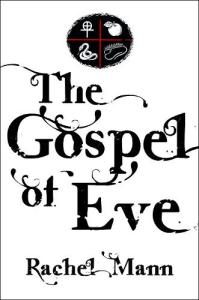 Mann opened with a long reading from Chapter 1 of her debut novel (I reviewed it here) and said it is about her “three favorite things: sex, death, and religion,” all of which involve a sort of self-emptying. Mark Oakley, dean of St John’s College, Cambridge, interviewed her. He noted that her book has been likened to “Dan Brown on steroids.” Mann laughed but recognizes that, though she’s a ‘serious poet’, her gift as a novelist is for pace. She’s a lover of thrillers and, like Brown, gets obsessed with secrets. Although she and her protagonist, Kitty, are outwardly similar (a rural, working-class background and theological training), she quoted Evelyn Waugh’s dictum that all characters should be based on at least three people. Mann argued that the Church has not dealt as well with desire as it has with friendship. She thinks the best priests, like novelists, are genuine and engage with other people’s stories.
Francis Spufford on Light Perpetual
Mann then interviewed Spufford about his second novel, which arose from his frequent walks to his teaching job at Goldsmiths College in London. A plaque on an Iceland commemorates a World War II bombing that killed 15 children in what was then a Woolworths. He decided to commit an act of “literary resurrection” – but through imaginary people in a made-up, working-class South London location. The idea was to mediate between time and eternity. “All lives are remarkable and exceptional if you look at them up close,” he said. The opening bombing scene is delivered in extreme slow motion and then the book jumps on in 15-year intervals, in a reminder of scale. He read a passage from the end of the book when Ben, a bus conductor who fell in love with a Nigerian woman who took him to her Pentecostal Church, is lying in a hospice bed. It was a beautiful litany of “Praise him” statements, a panorama of everyday life: “Praise him at food banks,” etc. It made for a very moving moment.
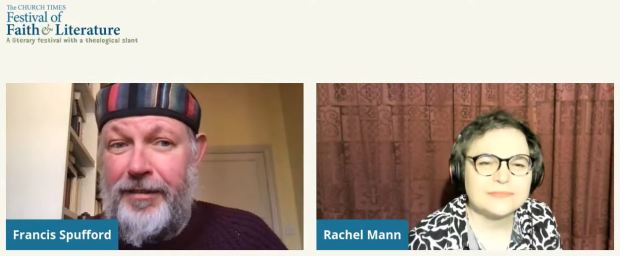
Mark Oakley on the books that got him through the pandemic
Oakley, in turn, was interviewed by Spufford – everyone did double duty as speaker and questioner! He mentioned six books that meant a lot to him during lockdown. Three of them I’d read myself and can also recommend: Vesper Flights by Helen Macdonald (my nonfiction book of 2020), Tongues of Fire by Seán Hewitt (one of my top five poetry picks from 2020), and Life’s Too Short to Pretend You’re Not Religious by David Dark. His top read of all, though, is a book I haven’t read but would like to: Featherhood by Charlie Gilmour (see Susan’s review). Rounding out his six were The Act of Living by Frank Tallis, about the psychology of finding fulfillment, and The Hunted by Gabriel Bergmoser, a bleak thriller set in the Outback. He read a prepared sermon-like piece on the books rather than just having a chat about them, which made it a bit more difficult to engage.
Spufford asked him if his reading had been about catharsis. Perhaps for some of those choices, he conceded. Oakley spoke of two lessons learned from lockdown. One is “I am an incarnational Christian” in opposition to the way we’ve all now been reduced to screens, abstract and nonmobile. And secondly, “Don’t be prosaic.” He called literalism a curse and decried the thinness of binary views of the world. “Literature is always challenging your answers, asking who you are when you get beyond what you’re good at.” I thought that was an excellent point, as was his bottom line about books: “It’s not how many you get through, but how many get through to you.”
Gavin Francis in Conversation with Louise Welsh
(Wellcome Collection event, February 25th)
 Francis, a medical doctor, wrote Intensive Care (I reviewed it here) month by month and sent chapters to his editor as he went along. Its narrative begins barely a year ago and yet it was published in January – a real feat given the usual time scale of book publishing. It was always meant to have the urgent feel of journalism, to be a “hot take,” as he put it, about COVID-19. He finds writing therapeutic; it helps him make sense of and process things as he looks back to the ‘before time’. He remembers first discussing this virus out of China with friends at a Burns Night supper in January 2020. Francis sees so many people using their “retrospecto-scopes” this year and asking what we might have done differently, if only we’d known.
He shook his head over the unnatural situations that Covid has forced us all into: “we’re gregarious mammals” and yet the virus is spread by voice and touch, so those are the very things we have to avoid. GP practices have had to fundamentally change how they operate, and he foresees telephone triage continuing even after the worst of this is over. He’s noted a rise in antidepressant use over the last year. So the vaccine, to him, is like “liquid hope”; even if not 100% protective, it does seem to prevent deaths and ventilation. Vaccination is like paying for the fire service, he said: it’s not a personal medical intervention but a community thing. This talk didn’t add a lot for me as I’d read the book, but for those who hadn’t, I’m sure it would have been an ideal introduction – and I enjoyed hearing the Scottish accents.
Bookish online events coming up soon: The Rathbones Folio Prize announcement on the 24th and Claire Fuller’s book launch for Unsettled Ground on the 25th.
Have you attended any online literary events recently?
Snow and Winter Reads, Part II
Since I wrote about my first batch of wintry reads in early February, it’s turned much more spring-like here in southern England, with blue skies and the daffodils blooming. Still, temperatures continue chilly and some nights I’ve had trouble falling asleep because of the wind tearing down the street and flapping the bin lids. With meteorological spring due to start tomorrow, I’m bidding farewell to winter with a few more snow-covered reads: a children’s classic, a modern classic from the 1990s, and an implausible but enjoyably rollicking thriller.
The Wolves of Willoughby Chase by Joan Aiken (1962)
 Aiken’s books were not part of my childhood, but I was vaguely aware of this first book in a long series when I plucked it from a neighbor’s giveaway pile. The snowy scene on the cover and described in the first two paragraphs drew me in and the story, a Victorian-set fantasy with notes of Oliver Twist and Jane Eyre, soon did, too. In this alternative version of the 1830s, Britain already had an extensive railway network and wolves regularly used the Channel Tunnel (which did not actually open until 1994) to escape the Continent’s brutal winters for somewhat milder climes.
One winter, the orphaned Sylvia travels by train from London to the north of England to live with her cousin Bonnie and her parents, Sir Willoughby and Lady Green. But dodgy things are afoot at Willoughby Chase: Miss Slighcarp, a distant cousin, has been hired as the girls’ governess but, just as soon as Bonnie’s parents leave on a long trip, she sets about taking over the house. Bonnie and Sylvia, exiled to a workhouse, rely on a secret network of friends and servants to keep them safe and get them home via an intrepid journey.
Miss Slighcarp is just one of the novel’s Dickensian villains – balanced out by some equally Dickensian urchins and helpful adults, all of them with hearts of gold. There’s something perversely cozy about the plight of an orphan in children’s books: the characters call to the lonely child in all of us, and we rejoice to see how ingenuity and luck come together to defeat wickedness. There are charming passages here in which familiar smells and favorite foods offer comfort. I especially loved their friend Simon’s cave and his little rituals. This would make a perfect stepping stone from Roald Dahl to one of the actual Victorian classics.
My only quibble with the book overall would be that the wolves seem unnecessary: they only truly appear once, for a climactic scene during the train ride, and the rest of the time are just a background menace. From fairy tales onwards, wolves have gotten a bad rap, and we don’t need to perpetuate myths about how dangerous they are to humans.
Snow Falling on Cedars by David Guterson (1994)
 My first 5-star read of the year! It certainly took a while, but I’m now on a roll with a bunch of 4.5- and 5-star ratings bunching together. I remember the buzz surrounding this novel, mostly because of the Ethan Hawke film version that came out when I was a teenager. Even though I didn’t see it, I was aware of it, as I was of other literary fiction that got turned into Oscar-worthy films at about that time, like The Shipping News and House of Sand and Fog.
The novel is set in 1954 on San Piedro, an island of 5,000 off the coast of Washington state. A decade on from the war, the community’s chickens come home to roost when a Japanese American man, Kabuo Miyamoto, is charged with murdering a fellow fisherman, Carl Heine. The men had been engaged in a dispute over some land – seven acres of strawberry fields that were seized from the Miyamoto family when, like the rest of the country’s Japanese population, they were rounded up in internment camps. Meanwhile, Ishmael Chambers, who runs the local newspaper and lost an arm in the war, stumbles on a piece of evidence that might turn the case around. Still in love with Hatsue, now Kabuo’s wife but once his teenage obsession, he is torn between winning her back and wanting to do what’s right.
Guterson alternates between trial scenes and flashbacks to war service or stolen afternoons Ishmael and Hatsue spent kissing in the shelter of massive cedar trees. The mystery element held me completely gripped – readers are just as in the dark as the jurors until very close to the end – but this is mostly a powerful picture of the lasting effects of racism. All the characters are well drawn, even minor ones like elderly defense attorney Nels Gudmundsson. Even though I only read 10 or 15 pages at a sitting over the course of a month, every time I picked up the book I was instantly immersed in the atmosphere, whether it was a warm courtroom with a snowstorm swirling outside or a troop ship entering the Pacific Theater. This has the epic feel of a doorstopper, though it’s only 400 pages. I can’t recommend it highly enough. 
The Quality of Silence by Rosamund Lupton (2015)
 Ten-year-old Ruby and her mother Yasmin have arrived in Alaska to visit Ruby’s dad, Matt, who makes nature documentaries. When they arrive, police inform them that the town where he was living has been destroyed by fire and he is presumed dead. But Yasmin won’t believe it and they set out on a 500-mile journey north to find her husband, first hitching a ride with a trucker and then going it alone in a stolen vehicle. All the time, with the weather increasingly brutal, they’re aware of someone following them – someone with malicious intent.
The narration is in short segments, alternating between Ruby’s first person and a third-person account from Yasmin’s point-of-view. There are many interesting elements here: Ruby is deaf so communicates via a combination of sign language, voice recognition software, blogs and social media, and describes things synesthetically; Yasmin is a physicist drawing metaphors to scientific concepts, but can’t explain her own mystical certainty that Matt is still alive; and there is an environmentalist message behind the fracking cover-up plot.
But starting with the first page, there are so many improbabilities in play, from a 10-year-old having a Twitter account to Yasmin managing to drive a big rig on ice roads in a foreign country. I knew from reviewing Three Hours last year that Lupton writes addictive thrillers. This one was perfectly readable, but not as good. It’s our book club read for early March, and I expect I won’t be the only one to find it hardly believable.
Plus a skim:
Arctic Dreams by Barry Lopez (1986)
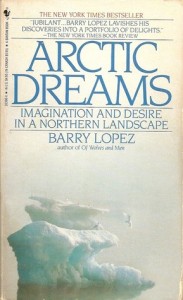 This was my first time trying the late Lopez. It was supposed to be a buddy read with my husband because we ended up with two free copies, but he raced ahead while I limped along just a few pages at a time before admitting defeat and skimming to the end (it was the 20 pages on musk oxen that really did me in). For me, the reading experience was most akin to The Snow Leopard by Peter Matthiessen in that both are about a literal journey in an extreme environment, yet what stands out are the philosophical musings. Where Matthiessen was animated by Buddhist ideas about selfhood and loss, Lopez takes the secular long view of human life and responsibility in light of potential extinction. The epilogue, in particular, is endlessly quotable. It’s depressing to encounter books like this now, though: 30+ years ago, literary nature writers were issuing clarion calls about climate disaster, and we didn’t listen.
Some favorite passages:
“Whenever I met a collared lemming on a summer day and took its stare I would think: Here is a tough animal. Here is a valuable life. … If it could tell me of its will to survive, would I think of biochemistry, or would I think of the analogous human desire? If it could speak of the time since the retreat of the ice, would I have the patience to listen?”
“The cold view to take of our future is that we are therefore headed for extinction in a universe of impersonal chemical, physical, and biological laws. A more productive, certainly more engaging view, is that we have the intelligence to grasp what is happening, the composure not to be intimidated by its complexity, and the courage to take steps that may bear no fruit in our lifetimes.”
“One of the oldest dreams of mankind is to find a dignity that might include all living things. And one of the greatest of human longings must be to bring such dignity to one’s own dreams, for each to find his or her own life exemplary in some way. The struggle to do this is a struggle because an adult sensibility must find some way to include all the dark threads of life. A way to do this is to pay attention to what occurs in a land not touched by human schemes, where an original order prevails.”
Did you read anything particularly wintry this year, or are you and your book stack moving on to spring already?
Recommended March Releases: Magnusson, May, Moor and More
March has been a huge month for new releases. With so many authors feeling let down about book tours and events being cancelled, it’s a great time for bloggers to step in and help. I attended two virtual book launches on Twitter on the 19th and have another one coming up on the 31st. I also have three more March releases on order from my local indie bookstore: Greenery by Tim Dee, tracking the arrival of spring; Footprints by David Farrier, about the fossil traces modern humans will leave behind; and The Bass Rock by Evie Wyld, a novel about violence against women set on the Scottish coast in three different time periods.
Today I have short reviews of five March releases I recommend (plus a bonus one now out in paperback): a Victorian pastiche infused with Scottish folklore, an essay collection about disparate experiences of motherhood, a thriller about victims of domestic violence, poems in graphic novel form, a novel about natural and personal disasters in Australia, and a lovely story of friendship and literature changing a young man’s life forever. All:
The Ninth Child by Sally Magnusson
(Published by Two Roads on the 19th)
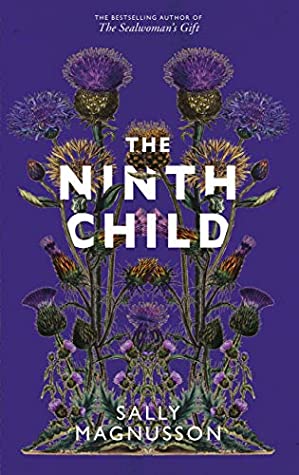 Like Hannah Kent’s The Good People and Sarah Perry’s The Essex Serpent, this is an intense, convincing work of fiction that balances historical realism with magical elements. In mid-1850s Britain, in the wake of a cholera epidemic, there is a drive to ensure clean water. Alexander Aird, hired as the on-site physician for the Glasgow waterworks, moves to the Loch Katrine environs with his wife, Isabel, who has had eight miscarriages or stillbirths. With no living babies requiring her care, Isabel spends her days wandering the hills and meets a strange scarecrow of a man, Reverend Robert Kirke … who died in 1692.
A real-life Episcopalian minister, Kirke wrote a book about fairies and other Celtic supernatural beings and, legend has it (as recounted by Sir Walter Scott and others), was taken into the faery realm after his death and continued to walk the earth looking for rest. It takes a while for Isabel to learn the truth about Kirke – though her servant, Kirsty McEchern, immediately intuits that something isn’t right about the man – and longer still to understand that he wants something from her. “Whatever else, Robert Kirke could be relied on to ruffle this mind of hers that was slowly opening to experience again, and to thinking, and to life.”
This was a rollicking read that drew me in for its medical elements (premature birth, a visit to Joseph Lister, interest in Florence Nightingale’s nursing methods) as well as the plot. It often breaks from the omniscient third-person voice to give testimonies from Kirsty and from Kirke himself. There are also amusing glimpses into the Royal household when Victoria and Albert stay at Balmoral and return to open the waterworks during the “heaviest, windiest, most umbrella-savaging, face-slashing deluge that Scotland had experienced in twenty years.” Best of all, it gives a very different picture of women’s lives in the Victorian period.
My thanks to the publisher for the proof copy for review.
The Best Most Awful Job: Twenty Writers Talk Honestly about Motherhood, edited by Katherine May
(Published by Elliott & Thompson on the 19th)
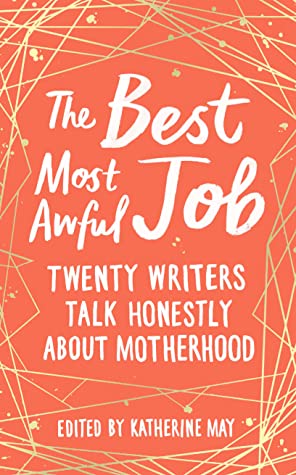 These are essays for everyone who has had a mother – not just everyone who has been a mother. I enjoyed every piece separately, but together they form a vibrant collage of women’s experiences. Care has been taken to represent a wide range of situations and attitudes. The reflections are honest about physical as well as emotional changes, with midwife Leah Hazard (author of Hard Pushed) kicking off with an eye-opening rundown of the intimate scarring some mothers will have for the rest of their lives. We hear from a mother of six who’s “addicted” to pregnancy (Jodi Bartle), but also from a woman who, after an ectopic pregnancy, realized “there are lots of ways to mother, even if your body won’t let you” (Peggy Riley, in one of my two favorite pieces in the book).
Women from BAME communities recount some special challenges related to cultural and family expectations, but others that are universal. An autistic mother (Joanne Limburg) has to work out how to parent a neurotypical child; queer parents (including author Michelle Tea) wonder how to raise a son at a time of toxic masculinity. There are also several single mothers, one of them disabled (Josie George – hers was my other favorite essay; do follow her on Twitter via @porridgebrain if you don’t already).
What I most appreciated is that these authors aren’t saying what they think they should say about motherhood; they’re willing to admit to boredom, disappointment and rage: “motherhood is an infinite, relentless slog from which there is no rest or recuperation … a ceaseless labour, often devoid of acknowledgment, recognition and appreciation” (Javaria Akbar); “I step barefoot on a rogue piece of Lego and it’s game over. I scream” (Saima Mir). These are punchy, distinctive slices of life writing perfectly timed for Mother’s Day. I plan to pass the book around my book club; mothers or not, I know everyone will appreciate it.
My thanks to the publisher for the proof copy for review.
Keeper by Jessica Moor
(Published by Viking/Penguin on the 19th)
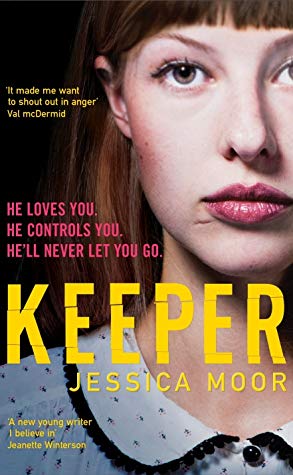 Val McDermid and Jeanette Winterson are among the fans of this, Penguin’s lead debut title of 2020. When a young woman is found drowned at a popular suicide site in the Manchester area, the police plan to dismiss the case as an open-and-shut suicide. But the others at the women’s shelter where Katie Straw worked aren’t convinced, and for nearly the whole span of this taut psychological thriller readers are left to wonder if it was suicide or murder.
The novel alternates between chapters marked “Then” and “Now”: in the latter story line, we follow the police investigation and meet the women of the refuge; in the former, we dive into Katie’s own experience of an abusive relationship back in London. While her mother was dying of cancer she found it comforting to have a boyfriend who was so attentive to her needs, but eventually Jamie’s obsessive love became confining.
I almost never pick up a mystery, but this one was well worth making an exception for. I started suspecting the twist at maybe the two-thirds point, but that didn’t detract from my enjoyment. Based on Moor’s year working in the violence against women sector, it’s a gripping and grimly fascinating story of why women stay with their abusers and what finally drives them to leave.
I picked up a proof copy at a Penguin Influencers event.
 Poems to See by: A Comic Artist Interprets Great Poetry by Julian Peters
(To be published by Plough Publishing House on the 31st)
Peters is a comics artist based in Montreal. Here he has chosen 24 reasonably well-known poems by the likes of e.e. cummings, Emily Dickinson, Robert Frost, Seamus Heaney, Langston Hughes, Edgar Allan Poe, Christina Rossetti and W.B. Yeats and illustrated each one in a markedly different fashion. From black-and-white manga to a riot of color and music, from minimalist calligraphy-like Japanese watercolor to imitations of Brueghel, there is such a diversity of style here that at first I presumed there were multiple artists involved (as in one of my favorite graphic novels of last year, ABC of Typography, where the text was written by one author but each chapter had a different illustrator). But no, this is all Peters’ work; I was impressed by his versatility.
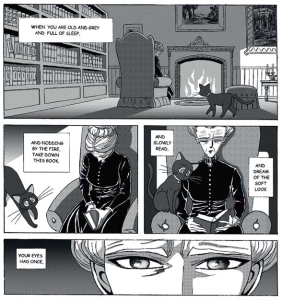
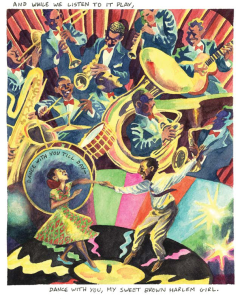
The illustrations range from realistic to abstract, with some more obviously cartoon-like. A couple of sequences reminded me of the style of Raymond Briggs. For “Caged Bird” by Maya Angelou, lines are inlaid on the squares of a painted patchwork quilt. Other sets look to have been done via wood engraving, or with old-fashioned crayons. You could quibble with the more obvious poetry selections, but I encountered a few that were new to me, including “Buffalo Dusk” by Carl Sandburg and “Conscientious Objector” by Edna St. Vincent Millay. Peters has grouped them into six thematic categories: self, others, art, nature, time and death. Teenagers, especially, will enjoy the introduction to a variety of poets and comics styles.
I read an e-copy via NetGalley.
The Inland Sea by Madeleine Watts
(Published by ONE/Pushkin on the 5th)
 “Emergency police fire, or ambulance?” The young female narrator of this debut novel lives in Sydney and works for Australia’s emergency call service. Over her phone headset she gets appalling glimpses into people’s worst moments: a woman cowers from her abusive partner; a teen watches his body-boarding friend being attacked by a shark. Although she strives for detachment, her job can’t fail to add to her anxiety – already soaring due to the country’s flooding and bush fires.
Against that backdrop of natural disasters, a series of minor personal catastrophes play out. The narrator is obsessed with a rape/murder case that’s dominating the television news, and narrowly escapes sexual assault herself. She drinks to excess, keeps hooking up with her ex-boyfriend, Lachlan, even after he gets a new girlfriend, and seems to think abortion and the morning after pill are suitable methods of birth control. Irresponsible to the point of self-sabotage, she’s planning a move to London but in the meantime is drifting through life, resigned to the fact that there is no unassailable shelter and no surefire way to avoid risk.
The title comes from the quest of John Oxley (presented here as the narrator’s ancestor), who in 1817 searched for a water body in the Australian interior. Quotations from his journals and discussions of the work of Patrick White, the subject of Lachlan’s PhD thesis, speak to the search for an Australian identity. But the inland sea is also the individual psyche, contradictory and ultimately unknowable. Like a more melancholy version of Jenny Offill’s Weather or a more cosmic autofiction than Yara Rodrigues Fowler’s Stubborn Archivist, this is a timely, quietly forceful story of how women cope with concrete and existential threats.
My thanks to the publisher for the PDF copy for review.
And a bonus…
The Offing by Benjamin Myers (2019)
(Paperback published by Bloomsbury on the 5th)
 With the Second World War only recently ended and nothing awaiting him apart from the coal mine where his father works, sixteen-year-old Robert Appleyard sets out on a journey. From his home in County Durham, he walks southeast, doing odd jobs along the way in exchange for food and lodgings. One day he wanders down a lane near Robin Hood’s Bay and gets a surprisingly warm welcome from a cottage owner, middle-aged Dulcie Piper, who invites him in for tea and elicits his story. Almost accidentally, he ends up staying for the rest of the summer, clearing scrub and renovating her garden studio.
Dulcie is tall, outspoken and unconventional – I pictured her as (Meryl Streep as) Julia Child in the movie Julie & Julia. She introduces Robert to whole new ways of thinking: that not everyone believes in God, that Germans might not be all bad, that life can be about adventure and pleasure instead of duty. “The offing” is a term for the horizon, as well as the title of a set of poems Robert finds in the dilapidated studio, and both literature and ambition change his life forever. Bright, languid and unpredictable, the novel delights in everyday sensual pleasures like long walks with a dog, dips in the ocean and an abundance of good food. I can’t think of another book I’ve read that’s quite like it – how refreshing is that?
I pre-ordered the paperback using a Waterstones voucher I got for Christmas.
 Bookish Beck = Rebecca Foster. American transplant to England. Freelance proofreader and book reviewer.
 Bookish Beck