R.I.P. Reads, Part I: Apostolides, Dahl, Harkness, Kingfisher & Kohda
Ghosts, witches, vampires, creepy underground things: It can only be Readers Imbibing Peril time of year! Here’s my first five reviews.
The Homecoming by Zoë Apostolides (2025)
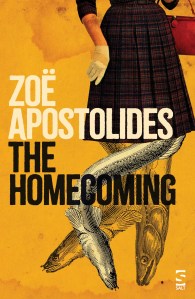 This debut novel dropped through my door as a total surprise: not only was it unsolicited, but I’d not heard about it. In this modern take on the traditional haunted house story, Ellen is a ghostwriter sent from London to Elver House, Northumberland, to work on the memoirs of its octogenarian owner, Catherine Carey. Ellen will stay in the remote manor house for a week and record 20 hours of audio interviews – enough to flesh out an autobiography. Miss Carey isn’t a forthcoming subject, but Ellen manages to learn that her father drowned in the nearby brook and that all Miss Carey did afterwards was meant to please her grieving mother and the strictures of the time. But as strange happenings in the house interfere with her task, Ellen begins to doubt she’ll come away with usable material. I was reminded of The Woman in Black, The Thirteenth Tale, and especially Wakenhyrst what with the local eel legends. The subplot about Ellen drifting apart from her best friend, a new mother, felt unnecessary, though I suppose was intended to bolster the main theme of women’s roles. There’s a twist that more seasoned readers of Gothic fiction and ghost stories might see coming. While I found this very readable and perfectly capably written, I didn’t get a sense of where the author hopes to fit in the literary market; she’s previously published a true crime narrative. Full disclosure: I once collaborated with Zoë on a Stylist assignment.
With thanks to Salt Publishing for the proof copy for review.
The Witches by Roald Dahl (1983)
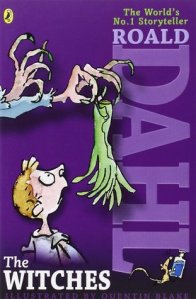 I’m sure I read all of Dahl’s major works when I was a child, though I had no specific memory of this one. After his parents’ death in a car accident, a boy lives in his family home in England with his Norwegian grandmother. She tells him stories from Norway and schools him in how to recognize and avoid witches. They wear wigs and special shoes to hide their baldness and square feet, and with their wide nostrils they sniff out children to turn them into hated creatures like slugs. When Grandmamma falls ill with pneumonia, she and the boy travel to a Bournemouth hotel for her recovery only to stumble upon a convention of witches under the guise of the Royal Society for the Prevention of Cruelty to Children. The Grand High Witch (Anjelica Huston, if you know the movie) has a new concoction that will transform children into mice at enough of a delay to occur the following morning at school. It’s up to the boy and his grandmother to save the day. I really enjoyed this caper, which I interpreted as being – like Tove Jansson’s The Summer Book – about imagination and making the most of one’s time with grandparents. But in the back of my mind was Jen Campbell’s objection to the stereotypical equating of disfigurement with villainy. The Grand High Witch also speaks with a heavy German accent. It would be understandable to dismiss this as dated and clichéd, but I still found it worthwhile. It also fit into my project to read books from my birth year. (Free from a neighbour)
The Black Bird Oracle by Deborah Harkness (2024)
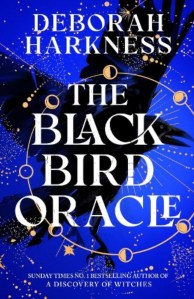 Somehow I’ve read this entire series even though none of the subsequent books lived up to A Discovery of Witches. What I loved about that first novel was how the author drew on her knowledge of the history of science to create a believable backdrop for a story of witches, vampires and other supernatural beings that took place largely in Oxford and its medieval libraries. Each sequel has elaborated further adventures for Diana Bishop, a witch; her vampire husband, Matthew de Clermont; and their family members and other hangers-on. Their twins, especially Becca, have inherited some of Diana’s power. I read the first half of this last year and finally skimmed to the end last week, so I haven’t retained much. Diana is summoned to the ancestral seat of the Bishops in Massachusetts and finds herself part of a community of gossipy, catty witches. (Dahl was right, they’re everywhere!) She has some fun, folksy interactions but things soon get more serious as she girds herself for a showdown with the darker implications of her gift. Overall, this didn’t add much to the ongoing narrative and the love scenes veered too close to romantasy for my liking. (Public library)
What Stalks the Deep by T. Kingfisher [Ursula Vernon] (2025)
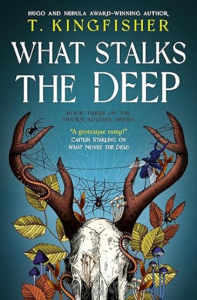 The third in the “Sworn Soldier” series, after What Moves the Dead and What Feasts at Night. Alex Easton is a witty, gender-nonconforming narrator, which is why I persist with these novellas even though I’m underwhelmed by the plots. Denton, the American doctor friend from the first book, begs Easton to come to West Virginia: his cousin Oscar has gone missing in a mine after sending a series of alarming letters about a red light he saw in the depths. Easton and their right-hand man, Angus, soon encounter claustrophobia-inducing cave systems, various kinds of bad air and siphonophore-like marine creatures that can assemble to imitate other beings. (Why aren’t these on the cover, huh?!) In other intriguing matters, Denton seems to have something going on with his friend John Ingold, an Indigenous scientist. Though, as Easton frequently reminds themself, that’s none of our business. There are some great set-pieces and funny, if anachronistic, asides (on learning how to flick a lighter just right: “I used to practice it for hours as a teenager, in hopes of impressing girls. Look, girls were more easily impressed in those days. Shut up.”) But my feeling with all three books is that they’re over before they’ve barely begun, and they never deliver the expected horror. Smart-ass, queer fantasy/horror: these will be some people’s perfect books, just not mine. If you’re intrigued, do at least try the first one, which riffs on Poe. (Read via Edelweiss)
Woman, Eating by Claire Kohda (2022)
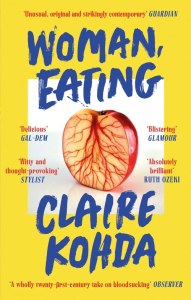 A very different sort of vampire novel. Twenty-three-year-old Lydia is half Japanese and half Malaysian; half human and half vampire. She’s trying to follow in her late father’s footsteps as an artist through an internship at a Battersea gallery, which comes with studio space where she’ll sleep to save money. But she can only drink blood like her mother, who turned her when she was a baby. Mostly she subsists on pig blood – which she can order dried if she can’t buy it fresh from a butcher – though, in one disturbing sequence, she brings home a duck carcass. When she falls for Ben, one of her studio-mates, she imagines what it would be like to be fully human: to make art together, to explore Asian cuisine, to bond over losing their mothers (his is dying of cancer; hers is in a care home with violence-tinged dementia). But Ben is already seeing someone, the internship is predictably dull, and a first attempt at consuming regular food goes badly wrong. There are a lot of promising threads in this debut. It’s fascinating how Lydia can intuit a creature’s whole life story by drinking their blood. She becomes obsessed with the Baba Yaga folk tale (and also mentions Malay vampire legends) and there’s a neat little bit of #MeToo revenge. But overall, it’s half-baked. Really, it’s just a disaster-woman book in disguise. The way Lydia’s identity determines her attitudes towards food and sex feels like a symbol of body dysmorphia. I’ll look out to see if Kohda does something more distinctive in future. (Secondhand – Awesomebooks.com)
More coming up on Halloween (thankfully, including books I liked better on average)!
R.I.P. Reads, Part I: Magrs Buddy Read; Hynes, Johnson, Oates
This is my third year participating in R.I.P. (Readers Imbibing Peril), now in its 15th year. I read my first novel by Paul Magrs as a buddy read with Liz of Adventures in reading, running and working from home, and coincidentally had Daisy Johnson’s creepy second novel out from the library. Rounding out this first post are a novella by James Hynes and a short story by Joyce Carol Oates, by whom I still haven’t managed to read a whole book. For my planned Part II, I’m working on historical suspense novels by Michelle Paver (a constant on my R.I.P. lists, it seems) and Laura Purcell, and trying my first Henning Mankell.

666 Charing Cross Road by Paul Magrs (2011)
 Apart from Dracula, my only previous experience of vampire novels was Deborah Harkness’s books. My first book from Paul Magrs ended up being a great choice because it’s pretty lighthearted and as much about the love of books as it is about supernatural fantasy – think of a cross between Jasper Fforde and Neil Gaiman. The title is a tongue-in-cheek nod to Helene Hanff’s memoir, 84 Charing Cross Road. Like Hanff, Aunt Liza sends letters and money to a London bookstore in exchange for books that suit her tastes. A publisher’s reader in New York City, Liza has to read new stuff for work but not-so-secretly prefers old books, especially about the paranormal – a love she shares with her gay bookseller friend, Jack.
One day the bookstore (actual address: 66b) sends a gruesome treasure, a grimoire soaked in vampire blood. In the wrong hands, it returns the vampiric spirit to life and sets off a chain reaction as each victim bites and infects others. I couldn’t help but think of the pandemic; indeed, Magrs uses the word “disease” at one point. Vampirism always has erotic overtones, though, making it seem more like an STD. As it happens, the vampires’ New York leader is Liza’s niece Shelley’s boyfriend, Daniel. Meanwhile, the star exhibit at the Museum of Outsider Art where Shelley works, a Scottish Bride effigy nicknamed Bessie, has come to life. Bessie leads Liza and Jack to London in the fight against Daniel and his kind.
Set between Halloween and Christmas, this is a pacy and quick-witted story that is easy to follow even as it gets more complicated and adds in ever more secondary characters. Hints about Liza’s past experience of the supernatural and an open ending leave room for a prequel or sequel. There were a few melodramatic moments and I wasn’t always convinced by Liza’s New Yawk accent. (I also wanted to stick up for Liza and another character about her age, Consuela – Magrs often refers to one or both as “the old woman,” when in the context they can’t be far past 60!) But these are minor niggles about a book that was so much fun to read. I’ll try something else by Magrs, probably Exchange and/or one of the Brenda and Effie series – who could resist that premise of the Bride of Frankenstein running a B&B in Whitby? (See also Liz’s review.)
My rating: 
The rest…
Queen of the Jungle (from Publish and Perish: Three Tales of Tenure and Terror) by James Hynes (1997)
 I read the first of this volume’s three suspense novellas and will save the others for future years of R.I.P. or Novellas in November. At 95 pages, it feels like a complete, stand-alone plot with solid character development and a believable arc. Paul and Elizabeth are academics marooned at different colleges: Paul is finishing up his postdoc and teaches menial classes at an English department in Iowa, where they live; Elizabeth commutes long-distance to spend four days a week in Chicago, where she’s on track for early tenure at the university.
The couple’s cat, Charlotte, starts acting up, peeing in random places around the apartment. The animal psychic they hire says it’s because a woman keeps coming and going, disturbing the cat’s routines. Elizabeth assumes it’s her fault, feels terrible, and redoubles her efforts to get her boss to offer Paul a job on the basis of his bizarre literary/pop culture mash-up thesis chapters. But readers soon learn the real reason for the cat’s unease: Paul is carrying on an affair with Kymberly, a graduate student from the communications department. Charlotte is preternaturally determined to terrorize Kym and broadcast Paul’s secret. It’s an amusing battle of wills that comes to have greater stakes. Mentions of computer and telephone technology made this seem slightly dated, but I liked Hynes’s writing.
My rating:
Sisters by Daisy Johnson (2020)
 Teenagers September and July were born just 10 months apart, with July always in thrall to her older sister. September can pressure her into anything, no matter how risky or painful, in games of “September Says.” But one time things went too far. That was the day they went out to the tennis courts to confront the girls at their Oxford school who had bullied July.
For much of this short novel, Johnson keeps readers guessing about what happened that day and why the girls’ mother, Sheela, took them away to Settle House, her late husband’s family home in the North York Moors. Despite the new setting, July finds it impossible to shrug off her sister’s influence. Their psychic connection is such that she feels she’s losing her own virginity as she watches September have sex with a local boy on the beach. September’s is so much the dominant personality that July admits she feels like no more than “an appendage.”
Emotionally used and physically harmed, July starts to doubt her sanity. This was most evident for me in the scene where she goes up to a soggy-looking wall of Settle House and puts a hand through it, hearing “the rustle and gurgle of motion, the shuttering of thousands of wings.” (Presuming that’s a deliberate word choice and not a typo for shuddering.) Ants start pouring out of the wall, followed by a bird. But when she goes back to look at the wall later that day, it’s intact. I was reminded of The Haunting of Hill House, with its picture of a malevolent house preying on its inhabitants’ fears.

Sisters is a book that depends entirely on its late twist, so I shall say no more. About halfway through, I had a vague idea of what the surprise might be, but convinced myself I was wrong. “What if? … Nah, couldn’t be.” I wonder how early you’ll catch on. I adore the U.S. cover, but the UK cover contains more of a hint. I think I liked Everything Under, Johnson’s Booker-shortlisted debut novel, that little bit more, but my bottom line for that one goes for this, too: “As mesmerizing as it is unsettling.” Johnson is such a talented young author, and she also has the best author photo out there at the moment, a black-and-white image of her reflected in a train window.
My rating: 
“The Woman in the Window” (from Night-Gaunts and Other Tales of Suspense) by Joyce Carol Oates (2018)
 Oates was inspired by Edward Hopper’s 1926 painting, Eleven A.M. (The striking cover image is from a photographic recreation by Richard Tuschman. Very faithful except for the fact that Hopper’s armchair was blue.) A secretary pushing 40 waits in the New York City morning light for her married lover to arrive. She’s tired of him using her and keeps a sharp pair of sewing shears under her seat cushion. We bounce between the two characters’ perspectives as their encounter nears. He’s tempted to strangle her. Will today be that day, or will she have the courage to plunge those shears into his neck before he gets a chance? In this room, it’s always 11 a.m. The tension is well maintained, but the punctuation kind of drove me crazy. I might try the rest of the book next year.
Have you been reading anything fantastical or spooky this October?
R.I.P. Reads, Part I: Bender, Harkness, Hurley
I’ve been reading twisted fairy tales, a novel about witches and vampires with historical and contemporary timelines, and a subtle work of Gothic horror set on a remote stretch of the English coast.
The Color Master by Aimee Bender (2013)
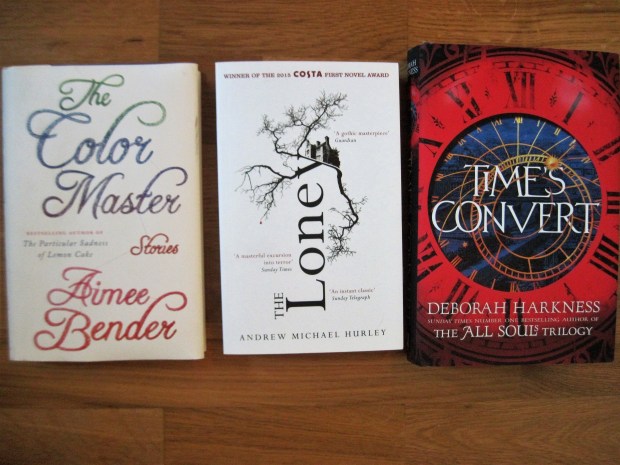
Aimee Bender is best known for The Particular Sadness of Lemon Cake. This is the second collection of her stories that I’ve read. Most have a touch of the bizarre to them – a tiny tweak to normal life – but some are set in completely alternate worlds. One character experiences extreme face blindness; another deludes himself that he was a famously vicious Nazi during the Second World War. Seamstresses take on odd tasks like repairing endangered animals or, in the title story, creating a dress that resembles the moon and embodies female anger. In “Appleless,” vigilantes punish a girl who won’t eat apples, while “The Devourings” is a dark riff on Shrek in which a woman comes to terms with her ogre husband’s innate violence.
 A few favorites were “A State of Variance,” in which a character can’t seem to avoid perfect facial symmetry no matter how he tries to mar his natural beauty, “The Doctor and the Rabbi,” a philosophical conversation between an ill rabbi and her atheist-leaning parishioner, and “The Red Ribbon” (which draws on the same source material as Carmen Maria Machado’s “The Husband Stitch”), about a bored housewife who starts acting out sexual fantasies to try to save her marriage.
Bender deploys a good mixture of voices and protagonists, though at least four of the 15 stories felt unnecessary to me. Her approach is similar to Kelly Link’s and Karen Russell’s, but I’ve failed to get on with their surreal stories before – Bender’s writing is that bit more accessible. I’d recommend her to fans of stories by Amy Bloom and Sarah Hall.
My rating:
Time’s Convert by Deborah Harkness (2018)
This is a companion volume to Harkness’s All Souls Trilogy, which is like the thinking gal’s Twilight, as written by a historian of science. I read the first book, A Discovery of Witches, in 2011 and surprised myself by completely loving the story of the witch Diana Bishop, who researches alchemy at the Bodleian Library and falls hard for a centuries-old vampire, Matthew de Clermont. Although Time’s Convert is likely intended to stand alone, I felt it could do with a dramatis personae at the start as I’d forgotten who many of the minor characters were.
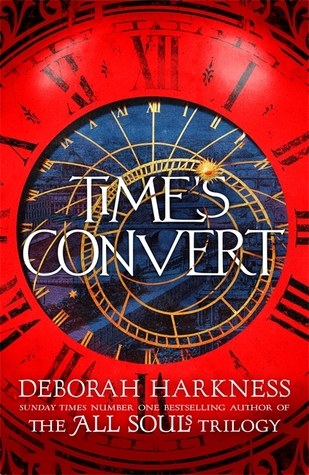 Diana and Matthew are still major characters, though not at the heart of the book. One strand has Diana and her family staying in the French countryside. She and Matthew now have toddler twins, Philip and Becca, who are just starting to show magical powers: Philip summons a griffon named Apollo as his familiar. Another is set in Paris, where Phoebe Taylor is willingly being transformed into a vampire so she can marry Matthew’s son, Marcus. A final strand recreates Marcus’s experiences during the American and French Revolutions and onward: he was born in Massachusetts in 1757 and was a surgeon during the Revolutionary War before he met Matthew and received the offer of immortality.
I almost always feel that sequels fail to live up to the original. Time’s Convert is most like Shadow of Night, the second book of the series and my least favorite because it spends so much time in 1590s England. Here the three different story lines split my focus and I resented being taken away from Diana’s first-person narration, which is much more engaging than the third-person material. I would only recommend this volume to diehard fans of the series.
My rating: 
With thanks to Headline for the free copy for review.
Note: A television adaptation of A Discovery of Witches recently aired on Sky One in the UK and is coming to North America in January.
The Loney by Andrew Michael Hurley (2014)
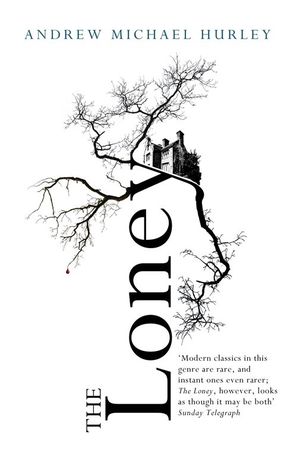 The Loney is not a monster, as I suppose I expected, but a place: an isolated coastline in the northwest of England that the narrator and his family visited on pilgrimage with their Roman Catholic congregation every Easter in the 1970s. The narrator, only identified by the nickname Tonto, explores their strange rental house – full of taxidermied animals and hidden rooms, it also has a rifle under the floorboards – and goes to the beach with his mute brother Andrew (“Hanny”). Mummer and Farther hold out hope that their son Hanny will be healed on a visit to the local shrine, and Mummer especially is frustrated that Father Bernard isn’t as strict and devout as their previous priest, Father Wilfred, who died under a cloud of suspicion not long before this trip.
Last year at around this time I read Hurley’s follow-up, Devil’s Day, which has a similarly bleak and eerie atmosphere. Both look at rural superstitions as experienced by outsiders. The Loney was more profound for me, though, in how it subverts religious rituals and posits a subtle evil influence without ever disappearing down doctrinal rabbitholes. It asks how far people will go to get what they want, what meaning there is to human life if there is no supernatural being looking out for us, and – through a framing story set 30 or more years later – how guilt and memory persist. I especially loved the Tenebrae service in a gloomy church featuring Bosch-like horrors in its artwork. This reminded me of a less abstract After Me Comes the Flood and a more contemporary The Short Day Dying; I highly recommend it.
Favorite lines:
“The Church of the Sacred Heart was an ancient place – dark and squat and glistening amphibiously in the rain.”
“The wind continued to rise and fall. Whining and shrilling. It was as insistent as the priest, louder sometimes, preaching an older sermon, about the sand and the sea.”
My rating: 
 Bookish Beck = Rebecca Foster. American transplant to England. Freelance proofreader and book reviewer.
 Bookish Beck