Miscellaneous #ReadIndies Reviews: Mostly Poetry + Brown, Sands
Catching up on a few final #ReadIndies contributions in early March! Short responses to some indie reading I did from my shelves over the course of last month.

Bloodaxe Books:
Parables & Faxes by Gwyneth Lewis (1995)
 I was surprised to discover this was actually my fourth book by Lewis, a bilingual Welsh author: two memoirs, one of depression and one about marriage; and now two poetry collections. The table of contents suggest there are only 16 poems in the book, but most of the titles are actually headings for sections of anywhere between 6 and 16 separate poems. She ranges widely at home and abroad, as in “Welsh Espionage” and the “Illinois Idylls.” “I shall taste the tang / of travel on the atlas of my tongue,” Lewis writes, an example of her alliteration and sibilance. She’s also big on slant and internal rhymes – less so on end rhymes, though there are some. Medieval history and theology loom large, with the Annunciation featuring more than once. I couldn’t tell you now what that many of the poems are about, but Lewis’s telling is always memorable.
Sample lines:
For the one
who said yes,
how many
said no?
…
But those who said no
for ever knew
they were damned
to the daily
as they’d disallowed
reality’s madness,
its astonishment.
(from “The ‘No’ Madonnas,” part of “Parables & Faxes”)
(Secondhand purchase – Westwood Books, Sedbergh) 
&
Fields Away by Sarah Wardle (2003)
 Wardle’s was a new name for me. I saw two of her collections at once and bought this one as it was signed and the themes sounded more interesting to me. It was her first book, written after inpatient treatment for schizophrenia. Many of the poems turn on the contrast between city (London Underground) and countryside (fields and hedgerows). Religion, philosophy, and Greek mythology are common points of reference. End rhymes can be overdone here, and I found a few of the poems unsubtle (“Hubris” re: colonizers and “How to Be Bad” about daily acts of selfishness vs. charity). However, there are enough lovely ones to compensate: “Flight,” “Word Tasting” (mimicking a wine tasting), “After Blake” (reworking “Jerusalem” with “And will chainsaws in modern times / roar among England’s forests green?”), “Translations” and “Word Hill.”
Favourite lines:
(oh, but the last word is cringe!)
Catkin days and hedgerow hours
fleet like shafts of chapel sun.
Childhood in a cobwebbed bower
guards a treasure chest of fun.
(from “Age of Awareness”)
(Secondhand purchase – Carlisle charity shop) 
Carcanet Press:
Tripping Over Clouds by Lucy Burnett (2019)
 The title is a setup for the often surrealist approach, but where another Carcanet poet, Caroline Bird, is warm and funny with her absurdism, Burnett is just … weird. Like, I’d get two stanzas into a poem and have no idea what was going on or what she was trying to say because of the incomplete phrases and non-standard punctuation. Still, this is a long enough collection that there are a good number of standouts about nature and relationships, and alliteration and paradoxes are used to good effect. I liked the wordplay in “The flight of the guillemet” and the off-beat love poem “Beer for two in Brockler Park, Berlin.” The noteworthy Part III is composed of 34 ekphrastic poems, each responding to a different work of (usually modern) art.
Favourite lines:
This is a place of uncalled-for space
and by the grace of the big sky,
and the serrated under-silhouette of Skye,
an invitation to the sea unfolds
to come and dine with mountain.
(from “Big Sands”)
(New (bargain) purchase – Waterstones website) 
&
The Met Office Advises Caution by Rebecca Watts (2016)
 The problem with buying a book mostly for the title is that often the contents don’t live up to it. (Some of my favourite ever titles – An Arsonist’s Guide to Writers’ Homes in New England, The Voluptuous Delights of Peanut Butter and Jam – were of books I couldn’t get through). There are a lot of nature poems here, which typically would be enough to get me on board, but few of them stood out to me. Trees, bats, a dead hare on the road; maps, Oxford scenes, Christmas approaching. All nice enough; maybe it’s just that the poems don’t seem to form a cohesive whole. Easy to say why I love or hate a poet’s style; harder to explain indifference.
Sample lines:
Branches lash out; old trees lie down and don’t get up.
A wheelie bin crosses the road without looking,
lands flat on its face on the other side, spilling its knowledge.
(from the title poem)
(New (bargain) purchase – Amazon with Christmas voucher)
Faber:
Places I’ve Taken My Body by Molly McCully Brown (2020)
 The title signals right away how these linked autobiographical essays split the ‘I’ from the body – Brown resents the fact that disability limits her experience. Oxygen deprivation at their premature birth led to her twin sister’s death and left her with cerebral palsy severe enough that she generally uses a wheelchair. In Bologna for a travel fellowship, she writes, “There are so many places that I want to be, but I can’t take my body anywhere. But I must take my body everywhere.” A medieval city is particularly unfriendly to those with mobility challenges, but chronic pain and others’ misconceptions (e.g. she overheard a guy on her college campus lamenting that she’d die a virgin) follow her everywhere.
A poet, Brown earned minor fame for her first collection, which was about historical policies of enforced sterilization for the disabled and mentally ill in her home state of Virginia. She is also a Catholic convert. I appreciated her exploration of poetry and faith as ways of knowing: “both … a matter of attending to the world: of slowing my pace, and focusing my gaze, and quieting my impatient, indignant, protesting heart long enough for the hard shell of the ordinary to break open and reveal the stranger, subtler singing underneath.” This is part of a terrific run of three pieces, the others about sex as a disabled person and the odious conservatism of the founders of Liberty University. Also notable: “Fragments, Never Sent,” letters to her twin; and “Frankenstein Abroad,” about rereading this novel of ostracism at its 200th anniversary. (Secondhand purchase – Amazon)
New River Books:
The Hedgehog Diaries: A Story of Faith, Hope and Bristle by Sarah Sands (2023)
 Reasons for reading: 1) I’d enjoyed Sands’s The Interior Silence and 2) Who can resist a book about hedgehogs? She covers a brief slice of 2021–22 when her aged father was dying in a care home. Having found an ill hedgehog in her garden and taken it to a local sanctuary, she developed an interest in the plight of hedgehogs. In surveys they’re the UK’s favourite mammal, but it’s been years since I saw one alive. Sands brings an amateur’s enthusiasm to her research into hedgehogs’ place in literature, philosophy and science. She visits rescue centres, meets activists in Oxfordshire and Shropshire who have made hedgehog welfare a local passion, and travels to Uist to see where hedgehogs were culled in 2004 to protect ground-nesting birds’ eggs. The idea is to link personal brushes with death with wider threats of extinction. Unfortunately, Sands’s lack of expertise is evident. This was well-meaning, but inconsequential and verging on twee. (Christmas gift from my wishlist)
A Bookshop of One’s Own by Jane Cholmeley (Blog Tour)
Silver Moon, one of the Charing Cross Road bookshops, was a London institution from 1984 until its closure in 2001. “Feminism and business are strange bedfellows,” Jane Cholmeley soon realised, and this book is her record of the challenges of combining the two. On the spectrum of personal to political, this is much more manifesto than memoir. She dispenses with her own story (vicar’s tomboy daughter, boarding school, observing racism on a year abroad in Virginia, secretarial and publishing jobs, meeting her partner) via a 10-page “Who Am I?” opening chapter. However, snippets of autobiography do enter into the book later on; in one of my favourite short chapters, “Coming Out,” Cholmeley recalls finally telling her mother that she was a lesbian after she and Sue had been together nearly a decade.
The mid-1980s context plays a major role: Thatcherite policies (Section 28 outlawing the “promotion of homosexuality”), negotiations with the Greater London Council, and trying to share the landscape with other feminist bookshops like Sisterwrite and Virago. Although there were some low-key rivalries and mean-spirited vandalism, a spirit of camaraderie generally prevailed. Cholmeley estimates that about 30% of the shop’s customers were men, but the focus here was always on women. The events programme featured talks by an amazing who’s-who of women authors, Cholmeley was part of the initial roundtable discussions in 1992 that launched the Orange Prize for Fiction (now the Women’s Prize), and the café was designated a members’ club so that it could legally be a women-only space.

I’ve always loved reading about what goes on behind the scenes in bookshops (The Diary of a Bookseller, Diary of a Tuscan Bookshop, The Sentence, The Education of Harriet Hatfield, The Little Bookstore of Big Stone Gap, and so on), and Cholmeley ably conveys the buzzing girl-power atmosphere of hers. There is a fun sense of humour, too: “Dyke and Doughnut” was a potential shop name, and a letter to one potential business partner read, “you already eat lentils, and ride a bicycle, so your standard of living hasn’t got much further to fall, we happen to like you an awful lot, and think we could all work together in relative harmony”.
However, the book does not have a narrative per se; the “A Day in the Life of… (1996)” chapter comes closest to what those hoping for a bookseller memoir might be expecting, in that it actually recreates scenes and dialogue. The rest is a thematic chronicle, complete with lists, sales figures, profitability charts, and excerpted documents, and I often got lost in the detail. The fact that this gives the comprehensive history of one establishment makes it a nostalgic yearbook that will appeal most to readers who have a head for business, were dedicated Silver Moon customers, and/or hold a particular personal or academic interest in the politics of the time and the development of the feminist and LGBT movements.
With thanks to Random Things Tours and Mudlark for the free copy for review.
Buy A Bookshop of One’s Own from Bookshop.org [affiliate link]
I was happy to be part of the blog tour for the release of this book. See below for details of where other reviews have appeared or will be appearing soon.

Sapphira and the Slave Girl & Portrait of the Artist as a Young Dog (#1940Club)
(I was disgusted by the ad-ridden appearance of my blog, and defeated by the task of culling my media library, so I’ve upgraded to a paid plan for a trial year. I had until now vowed not to spend any money on the site since I don’t make any money from it, but WordPress hooked me in with a 30% off deal, and I’ll appreciate the no ads and extra storage space. I hope it looks better now!)

A year club hosted by Karen and Simon is always a great excuse to read more classics. One of these was a winner, if peculiar; the other was so-so, but helped clarify for me what a particular literary prize is looking for.
Sapphira and the Slave Girl by Willa Cather
{SPOILERS IN THIS ONE}
I was surprised to find that this was my seventh book by Cather, so I’ve actually read over half of her novels now. I think all her other works I know were set on the prairies of the Midwest (or in Santa Fe in the case of Death Comes for the Archbishop), so Sapphira and the Slave Girl feels like an odd one out not just for its antebellum historical subject matter but also for its setting in Cather’s hometown of Winchester, Virginia.
In 1856, the Colberts’ is a house divided: Henry, a miller from Quaker stock, disapproves of slavery; his wife, Sapphira, grew up with slaves and treats them severely. While the other Colbert brothers’ meddling with Black women is an open secret – one of them is assumed to have fathered Henry and Sapphira’s mixed-race teenage slave, Nancy – Henry looks fondly on Nancy and thinks of her almost like a second daughter. Sapphira resents that attention. When her Colbert nephew, Martin, a known cad, comes to visit, she arranges, or at least allows, convenient opportunities for Martin to be alone with Nancy.
 Nancy appeals to the Colberts’ adult daughter, Rachel Blake, to accompany her on her walks so that Martin will not “overtake” her in the woods. Although none of the white characters take the repeated threat of attempted rape seriously enough, Henry and Rachel do eventually help Nancy escape to Canada via the Underground Railroad. When Sapphira realizes her ‘property’ has been taken from her, she informs Rachel she is now persona non grata, but changes her mind when illness brings tragedy into Rachel’s household.
Had this been written 40–80 years later, it would have been completely different: first of all, I would expect it to much more graphically recount Black suffering, rather than depicting generally happy “darkies” with folksy accents and quirky character traits; secondly, there would be either a redemptive or a punitive plot arc for Sapphira. Instead, Cather paints her as a flawed human being who accepts the status quo but is also graceful in disability (she has dropsy and is in a wheelchair) and accepting of the approach of death.
I wish I remembered from the Hermione Lee biography more about the immediate inspiration for this novel, and its reception. Simply taking an interest in Black characters must have set it apart. For instance, there is a whole chapter on Nancy’s grandmother, Aunt Jezebel, the first generation kidnapped from Africa; and the final section has Nancy, now a sophisticated Montreal housekeeper dressed in silk and fur, visiting her mother 20 years after the Civil War. That Cather’s characterization otherwise doesn’t rise above cheerful mammy stereotypes can hardly be counted against her given the time period, right? It was good to experience a lesser-known American classic that I can imagine appealing to fans of Thomas Hardy and Edith Wharton as well. (From a Little Free Library in Queen Camel, Somerset; April 2021)
Portrait of the Artist as a Young Dog by Dylan Thomas
 Published when Thomas was in his mid-twenties, this is a series of 10 sketches, some of which are more explicitly autobiographical (as in first person, with a narrator named Dylan Thomas) than others. There is a rough chronological trajectory to the stories, with the main character a mischievous boy, then a grandstanding teenager, then a young journalist in his first job. The countryside and seaside towns of South Wales recur as settings, and – as will be no surprise to readers of Under Milk Wood – banter-filled dialogue is the priority. I most enjoyed the childhood japes in the first two pieces, “The Peaches” and “A Visit to Grandpa’s.” The rest failed to hold my attention, but I marked out two long passages that to me represent the voice and scene-setting that the Dylan Thomas Prize is looking for. The latter is the ending of the book and reminds me of the close of James Joyce’s “The Dead.” (University library)
I was a lonely night-walker and a steady stander-at-corners. I liked to walk through the wet town after midnight, when the streets were deserted and the window lights out, alone and alive on the glistening tram-lines in dead and empty High Street under the moon, gigantically sad in the damp streets by ghostly Ebenezer Chapel. And I never felt more a part of the remote and overpressing world, or more full of love and arrogance and pity and humility, not for myself alone, but for the living earth I suffered on… [etc.]
For a long time he waited on the stairs, though there was no love now to wait for and no bed but his own too many miles away to lie in, and only the approaching day to remember his discovery. All around him the disturbed inhabitants of the house were falling back into sleep. Then he walked out of the house on to the waste space and under the leaning cranes and ladders. The light of the one weak lamp in a rusty circle fell across the brick-heaps and the broken wood and the dust that had been houses once, where the small and hardly known and never-to-be-forgotten people of the dirty town had lived and loved and died and, always, lost.
(I’ve previously participated in the 1920 Club, 1956 Club, 1936 Club, 1976 Club, 1954 Club and 1929 Club.)
A Look Back at 2021’s Happenings, Including Recent USA Trip
I’m old-fashioned and still use a desk calendar to keep track of appointments and deadlines. I also add in notes after the fact to remember births, deaths, elections, and other nationally and internationally important events. A look back through my 2021 “The Reading Woman” calendar reminded me that last January held a bit of snow, a third UK lockdown, an attempted coup at the U.S. capitol, and the inauguration of Joe Biden.
Activities continued online for much of the year:
- 15 music gigs (most of them by The Bookshop Band)
- 11 literary events, including book launches and prize announcements
- 9 book club meetings
- 3 literary festivals
- 2 escape rooms
- 1 progressive dinner
We were lucky enough to manage a short break in Somerset and a wonderful week in Northumberland. In August my mother and stepfather came to stay with us for a week and we showed off our area to them on daytrips.
As we entered the autumn, a few more things returned to in-person:
- 5 music gigs
- 2 book club meetings (not counting a few outdoor socials earlier in the year)
- 1 book launch
- 1 conference
I was also fortunate to get back to the States twice this year, once in May–June for my mother’s wedding and again in December for Christmas.
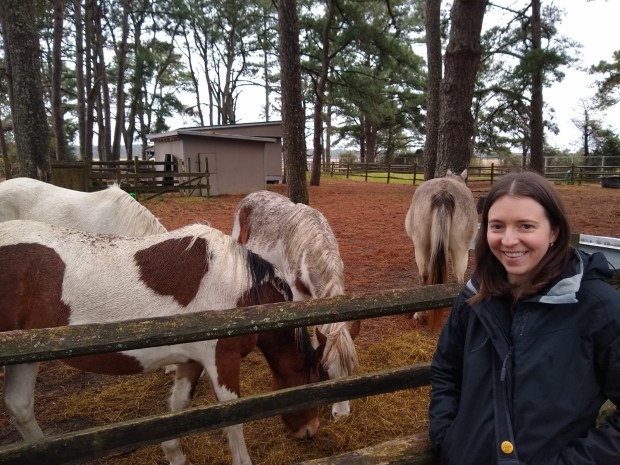
 On this most recent trip I had some fun “life meeting books” moments (the photos of me are by Chris Foster):
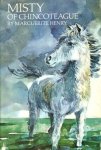
- An overnight stay on Chincoteague Island, famous for its semi-wild ponies, prompted me to reread a childhood favorite, Misty of Chincoteague by Marguerite Henry.
 Driving from my sister’s house to my mother’s new place involves some time on Route 30, aka the Lincoln Highway, through Pennsylvania. Her town even has a tourist attraction called Lincoln Highway Experience that we may check out on a future trip. (The other claims to fame there: it was home to golfer Arnold Palmer and Mister Rogers, and the birthplace of the banana split.)

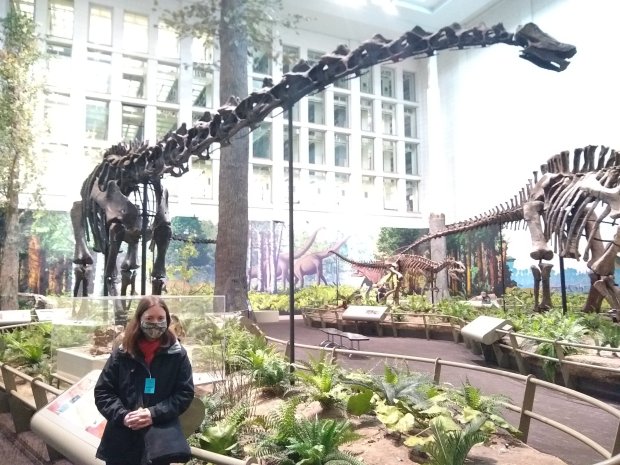
- At the Carnegie Museum of Natural History in Pittsburgh, we met the original “Dippy” the diplodocus, a book about whom I reviewed for Foreword in 2020.
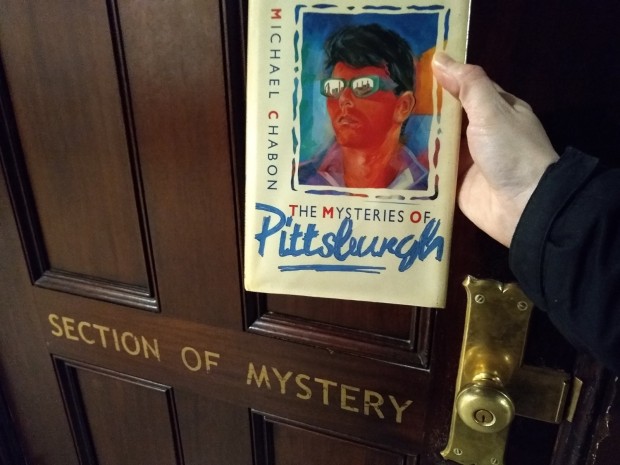
- I also took along a copy of The Mysteries of Pittsburgh by Michael Chabon and snapped a photo of it in an appropriately mysterious corner of the museum. Unfortunately, I didn’t get past the first few chapters as this debut novel felt dated and verging on racist.
No matter, though, as I donated it at a Little Free Library.
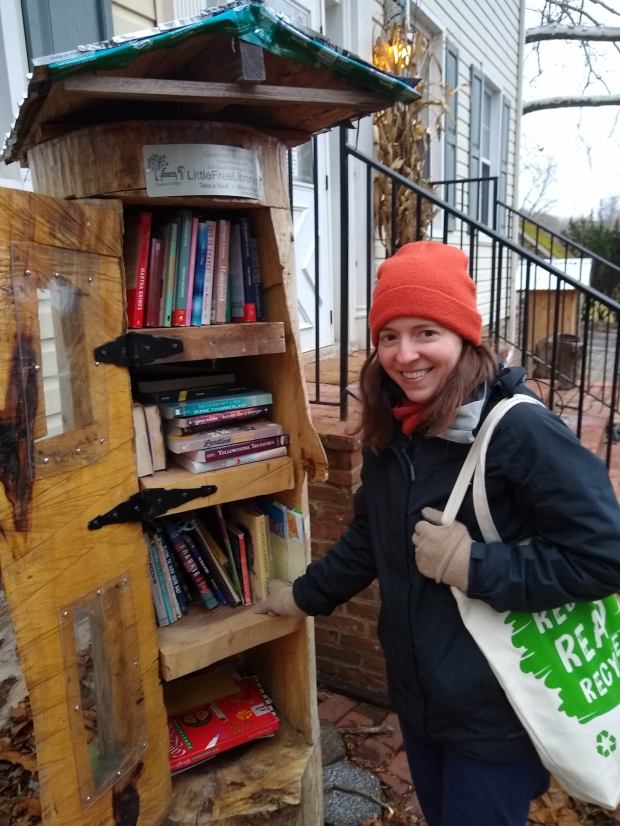
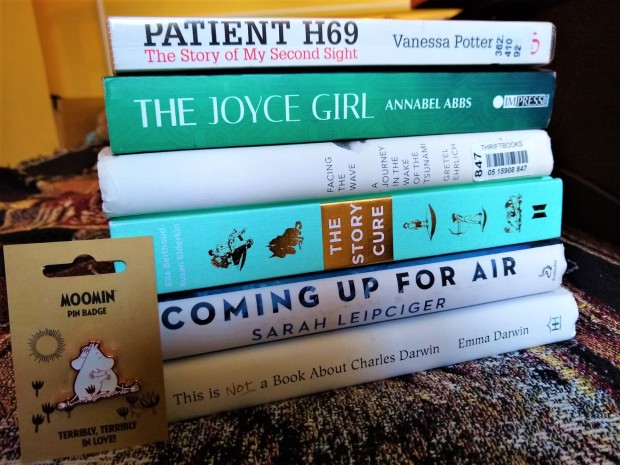
 We sought out a few LFLs on our trip, including that one in a log at Cromwell Valley Park in Maryland, where I picked up a Margot Livesey novel and a couple of travel books. My only other acquisition of the trip was a new paperback of Beneficence by Meredith Hall (author of one of the first books to turn me on to memoirs) from Curious Iguana in Frederick, Maryland, my college town. No secondhand book shopping opportunities this time, alas; just lots of driving in our rental car to visit disparate friends and relatives. However, this was my early Christmas book haul from my husband before we set off:
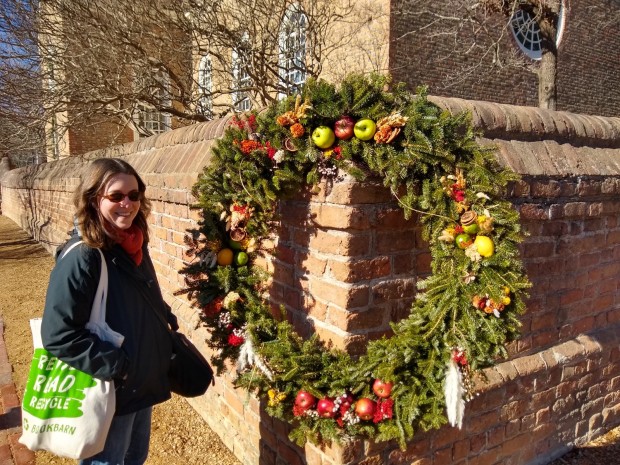
Another fun stop during our trip was at Colonial Williamsburg in Virginia, where we admired wreaths made of mostly natural ingredients like fruit.
The big news from my household this winter is that we have bought our first home, right around the corner from where we rent now, and hope to move in within the next couple of months. Our aim is to do all the bare-minimum renovations in 2022, in time to put up a tree in the living room bay window and a homemade wreath on the door for next Christmas!
Despite these glimpses of travels and merriment, Covid still feels all too real. I appreciated these reminders I saw recently, one in Bath and the other at the museum in Pittsburgh (Covid Manifesto by Cauleen Smith, which originated on Instagram).


“We all deserve better than ‘back to normal’.”
Seven Final Novellas: Crumley, Morris, Rapp Black; Hunter, Johnson, Josipovici, Otsuka (#NovNov)
We’ll be wrapping up Novellas in November and giving final statistics on Tuesday. Today, I have mini reviews of another seven novellas I’ve been working on, some of them for the whole month. I’ll start with some short nonfiction and then move on to the fiction.
Nonfiction:
Barn Owl by Jim Crumley (2014)
[63 pages]
 I reviewed Kingfisher and Otter, two other titles from Crumley’s “Encounters in the Wild” series for the publisher Saraband, earlier in the month. Barn Owl follows the same pattern, traveling the Scottish islands in search of close encounters (with badgers and ospreys, too) but also stretching back to a childhood memory from 1950s Dundee, when there was an owl-occupied derelict farmstead a quarter-mile from his home. This is a lovely little full-circle narrative in that the book closes with “the barn owl, unlike all other night-flying owls, is the one that we can see in the dark … its inarguable beauty is layered with mystery, and …all of us have a place in our hearts and minds for mysterious beauty. I have known that to be an essential truth since I was about eight years old.” (Public library)
Conundrum by Jan Morris (1974)
[148 pages]
 A reread of a book that transformed my understanding of gender back in 2006. Morris (d. 2020) was a trans pioneer. Her concise memoir opens “I was three or perhaps four years old when I realized that I had been born into the wrong body, and should really be a girl.” Sitting under the family piano, little James knew it, but it took many years – a journalist’s career, including the scoop of the first summiting of Mount Everest in 1953; marriage and five children; and nearly two decades of hormone therapy – before a sex reassignment surgery in Morocco in 1972 physically confirmed it. I was struck this time by Morris’s feeling of having been a spy in all-male circles and taking advantage of that privilege while she could. She speculates that her travel books arose from “incessant wandering as an outer expression of my inner journey.” The focus is more on her unchanging soul than on her body, so this is not a sexual tell-all. She paints hers as a spiritual quest toward true identity and there is only joy at new life rather than regret at time wasted in the ‘wrong’ one. (Public library)
Frida Kahlo and My Left Leg by Emily Rapp Black (2021)
[145 pages]
 This was my third memoir by the author; I reviewed The Still Point of the Turning World and Sanctuary earlier in the year. Like Sinéad Gleeson does in Constellations, Rapp Black turns to Frida Kahlo as a role model for “translating … pain into art.” Polio, a streetcar accident, 32 operations, failed pregnancies and an amputated leg – Kahlo endured much suffering. It was this last particular that especially drew Rapp Black (who has had a prosthetic leg since early childhood) to her. On a visit to Kahlo’s Mexico City home, she can hardly bear the intimacy of seeing Kahlo’s prostheses and corsets. They plunge her back into her own memories: of passing as normal despite a disability, having an eating disorder, losing her son Ronan to Tay-Sachs disease, and starting over with a new marriage and baby. Rapp Black weaves this all together artfully as well as effectively, but for someone like me who is already conversant with her story, there wasn’t quite enough in the way of new material.
With thanks to Notting Hill Editions for the free e-copy for review.
Fiction:
These first two ended up having a major arc in common: desperate preservation of key family relationships against the backdrop of a believably falling-apart near-future world.
The End We Start From by Megan Hunter (2017)
[127 pages]
 A woman, her partner (R), and their baby son flee a flooded London in search of a place of safety, traveling by car and boat and camping with friends and fellow refugees. “How easily we have got used to it all, as though we knew what was coming all along,” she says. Her baby, Z, tethers her to the corporeal world. What actually happens? Well, on the one hand it’s very familiar if you’ve read any dystopian fiction; on the other hand it is vague because characters only designated by initials are hard to keep straight and the text is in one- or two-sentence or -paragraph chunks punctuated by asterisks (and dull observations): “Often, I am unsure whether something is a bird or a leaf. *** Z likes to eat butter in chunks. *** We are overrun by mice.” etc. It’s touching how Z’s early milestones structure the book, but for the most part the style meant this wasn’t my cup of tea. (Secondhand purchase)
My Monticello by Jocelyn Nicole Johnson (2021)
[For novella only: 182 pages?]
 Pick this up right away if you loved Danielle Evans’s The Office of Historical Corrections. After “the unraveling,” Da’Naisha and fellow escapees from racial violence in Charlottesville – including her former and current boyfriends, the one Black and the other white; and her ailing grandmother, MaViolet – shelter at Thomas Jefferson’s famous Virginia estate. At first they stay by the visitor’s center, but as weeks pass and they fear a siege, they retreat to the mansion itself. Da’Naisha, our narrator, becomes the de facto leader of the motley crew, spearheading a trip out for supplies. She harbors two major secrets, one about her heritage and one about her future. Although this is a bit too similar to Parable of the Sower, against which I judge just about any dystopian fiction, the setting and timeliness can’t be beat. I read the U.S. ebook edition, which includes five short stories that also explore race issues and employ the first person plural and second person to good effect; “Buying a House Ahead of the Apocalypse” encapsulated my whole autumn mood. (Read via Edelweiss)
The Cemetery in Barnes by Gabriel Josipovici (2018)
[101 pages]
 After reviewing Josipovici’s 100 Days earlier in the month, I wanted to get a taste of his fiction. The protagonist is a translator who has lived in London, Paris and now rural Wales. He’s been married twice but, whatever his living situation, he’s always prized the solitude and routine he needs for his work. Passages from Monteverdi’s opera L’Orfeo and Joachim du Bellay’s poetry – in the original language, sometimes but not always translated for us – drift through the novella, which also prioritizes the sort of repeated phrases that constitute a long-cohabitating couple’s domestic vocabulary. References to cemeteries and to du Bellay’s Regrets are hints of something hasn’t isn’t being revealed to us up front. I think I worked out what it was. Clever and interesting, but I’d like a bit more grounding detail. A favorite line: “for one’s life not living up to expectation there is no excuse, except for the paltry one that this is true of everybody’s life.” (University library)
When the Emperor Was Divine by Julie Otsuka (2002)
[145 pages]
 Otsuka’s The Buddha in the Attic, about Japanese mail order brides in early 1900s San Francisco, was one of my first encounters with the first person plural, which I’ve come to love. It also serves as a prequel to this, her debut novel. In Berkeley, California in 1942, a Japanese man is arrested as a potential enemy combatant. His wife, son and daughter are given just a matter of days to pack their things and evacuate to an internment camp in the desert. Otsuka takes us along on the train journey and to the camp, where small moments rather than climactic ones reveal the children’s sadness and the injustice of what they’re missing out on. I most enjoyed the last section, when they all return to their home after over three years away and start to piece life back together. I’d already read a few novels featuring Japanese internment (e.g. The Japanese Lover and Snow Falling on Cedars) but, more than that, Otsuka’s writing is a tad too subtle for me. (Secondhand purchase)
In total, I read 29 novellas this November – a new record for me! I didn’t set out to read the equivalent of nearly one per day, but it happened to pan out like that. Some of my selections were very short indeed, at under 100 pages; multiple volumes of Garfield comics also helped. Three were 5-star reads: The Cost of Living by Deborah Levy plus two rereads, Conundrum by Jan Morris (above) and our classics buddy read, Ethan Frome by Edith Wharton.
I also had a couple of DNFs:
Gone by Michael Blencowe: (45 pages) I made a second attempt on this essay collection about extinct species this month. Maybe I’ve just read too much around the topic recently. (Review copy)
Inside the Bone Box by Anthony Ferner: (50 pages) I loved the idea of a novella about a neurosurgeon, but mostly this concerns Nick’s fatness and his family members’ various dysfunctions. (New purchase)
A Look Back at 2020’s Reading Projects, Including Rereads
Major bookish initiatives:
- Coordinated a Not the Wellcome Prize blog tour to celebrate 2019’s health-themed books – in case you missed it, the winner was Sinéad Gleeson for Constellations.
- Co-hosted Novellas in November with Cathy (746 Books).
- Hosted Library Checkout each month.


Reading challenges joined:
- 12 blog tours
- Six Degrees of Separation: I started participating in February and did nine posts this year
- Paul Auster Reading Week
- Reading Ireland month
- Japanese Literature Challenge
- 1920 Club
- 20 Books of Summer
- Women in Translation Month
- Robertson Davies Weekend
- Women’s Prize winners (#ReadingWomen)
- 1956 Club
- R.I.P.
- Nonfiction November
- Margaret Atwood Reading Month
This works out to one blog tour, one reading project, and one regular meme per month – manageable. I’ll probably cut back on blog tours next year, though; unless for a new release I’m really very excited about, they’re often not worth it.


Buddy reads:
 Crossing to Safety with Laila (Big Reading Life)
- 6 Carol Shields novels plus The Trick Is to Keep Breathing, Deerbrook, and How to Be Both with Marcie (Buried in Print)
- A Visit from the Goon Squad and The Idea of Perfection with Laura T.
- Mother’s Milk with Annabel
- 666 Charing Cross Road with Liz
Self-set reading challenges:
- Seasonal reading
- Classic of the Month (14 in total; it’s only thanks to Novellas in November that I averaged more than one a month)
- Doorstopper of the Month (just 3; I’d like to try to get closer to monthly in 2021)
- Wainwright Prize longlist reading
- Bellwether Prize winners (read 2, DNFed 1)
- Short stories in September (8 collections)
- Young Writer of the Year Award shortlist reading
- Thematic roundups – I’m now calling these “Three on a Theme” and have done 2 so far
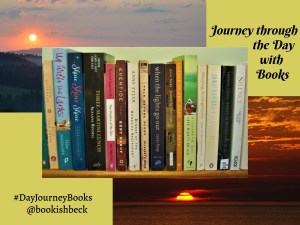
- Journey through the Day with Books (3 new reviews this year):
- Zennor in Darkness by Helen Dunmore
 Rise and Shine by Anna Quindlen
- [Up with the Larks by Tessa Hainsworth – DNF]
- [Shine Shine Shine by Lydia Netzer – DNF]
- Three-Martini Lunch by Suzanne Rindell – existing review
- The Shadow of the Sun by Ryszard Kapuściński – read part of
- Eventide by Kent Haruf
- Dinner at the Homesick Restaurant by Anne Tyler – existing review
- Talk before Sleep by Elizabeth Berg – existing review
- When the Lights Go Out by Carys Bray
- Journey by Moonlight by Antal Szerb
- Voyage in the Dark by Jean Rhys
- Late Nights on Air by Elizabeth Hay – existing review
- Sleeping Arrangements by Laura Shaine Cunningham
- The House of Sleep by Jonathan Coe
- Bodies in Motion and at Rest by Thomas Lynch – read but not reviewed
- Silence by Shūsaku Endō
- Arctic Dreams by Barry Lopez – read part of
- The Four in a Row Challenge – I failed miserably with this one. I started an M set but got bogged down in Tales of the City by Armistead Maupin (also a bibliotherapy self-prescription for Loneliness from The Novel Cure), which I had as a bedside book for much of the year, so only managed 1.5 out of 4; I also started an H quartet but set both Tinkers and Plainsong aside. Meanwhile, Debbie joined in and completed her own 4 in a Row. Well done! I like how simple this challenge is, so I’m going to use it next year as an excuse to read more from my shelves – but I’ll be more flexible and allow lots of substitutions in case I stall with one of the four books.

Rereading
At the end of 2019, I picked out a whole shelf’s worth of books I’d been meaning to reread. I kept adding options over the year, so although I managed a respectable 16 rereads in 2020, the shelf is still overflowing!

Many of my rereads have featured on the blog over the year, but here are two more I didn’t review at the time. Both were book club selections inspired by the Black Lives Matter movement. (We held a rally and silent protest in a park in the town centre in June.)
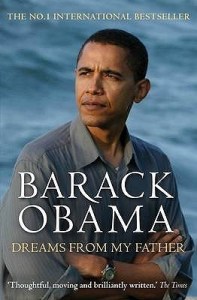 Dreams from My Father by Barack Obama: Remember when there was a U.S. president who thought deeply, searched his soul, and wrote eloquently? I first read this memoir in 2006, when Obama was an up-and-coming Democratic politician who’d given a rousing convention speech. I remembered no details, just the general sweep of Hawaii to Chicago to Kenya. On this reread I engaged most with the first third, in which he remembers a childhood in Hawaii and Indonesia, gives pen portraits of his white mother and absentee Kenyan father, and works out what it means to be black and Christian in America. By age 12, he’d stopped advertising his mother’s race, not wanting to ingratiate himself with white people. By contrast, “To be black was to be the beneficiary of a great inheritance, a special destiny, glorious burdens that only we were strong enough to bear.” The long middle section on community organizing in Chicago nearly did me in; I had to skim past it to get to his trip to Kenya to meet his paternal relatives – “Africa had become an idea more than an actual place, a new promised land”.
 The Immortal Life of Henrietta Lacks by Rebecca Skloot: This Wellcome Book Prize winner about the use of a poor African-American woman’s cells in medical research was one of the first books to turn me onto health-themed reads. I devoured it in a few days in 2010. Once again, I was impressed at the balance between popular science and social history. Skloot conveys the basics of cell biology in a way accessible to laypeople, and uses recreated scenes and dialogue very effectively. I had forgotten the sobering details of the Lacks family experience, including incest, abuse, and STDs. Henrietta had a rural Virginia upbringing and had a child by her first cousin at age 14. At 31 she would be dead of cervical cancer, but the tissue taken from her at Baltimore’s Johns Hopkins hospital became an immortal cell line. HeLa is still commonly used in medical experimentation. Consent was a major talking point at our book club Zoom meeting. Cells, once outside a body, cannot be owned, but it looks like exploitation that Henrietta’s descendants are so limited by their race and poverty. I had forgotten how Skloot’s relationship and travels with Henrietta’s unstable daughter, Deborah, takes over the book (as in the film). While I felt a little uncomfortable with how various family members are portrayed as unhinged, I still thought this was a great read. then / now
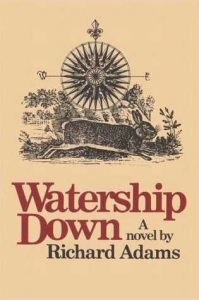 I had some surprising rereading DNFs. These were once favorites of mine, but for some reason I wasn’t able to recapture the magic: Middlesex by Jeffrey Eugenides, Everything Is Illuminated by Jonathan Safran Foer, Gilead by Marilynne Robinson, and On Beauty by Zadie Smith. I attempted a second read of John Fowles’s postmodern Victorian pastiche, The French Lieutenant’s Woman, on a mini-break in Lyme Regis, happily reading the first third on location, but I couldn’t make myself finish once we were back home. And A Visit from the Goon Squad by Jennifer Egan was very disappointing a second time; it hasn’t aged well. Lastly, I’ve been stalled in Watership Down for a long time, but do intend to finish my reread.
In general, voice- and style-heavy fiction did not work so well for me on rereading. Autobiographical essays by Anne Lamott and Abigail Thomas worked best, but I also succeeded at rereading some straightforward novels and short stories. Next year, I’d like to aim for a similar number of rereads, with a mixture of memoirs and fiction, including at least one novel by David Lodge. I’d also be interested in rereading earlier books by Ned Beauman and Curtis Sittenfeld if I can find them cheap secondhand.
What reading projects did you participate in this year?
Done much rereading lately?
Classics and Doorstoppers of the Month
April was something of a lackluster case for my two monthly challenges: two slightly disappointing books were partially read (and partially skimmed), and two more that promise to be more enjoyable were not finished in time to review in full.
Classics
Wise Blood by Flannery O’Connor (1952)
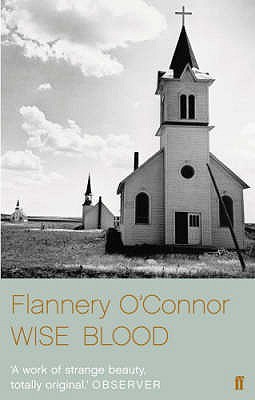 When Hazel Motes, newly released from the Army, arrives back in Tennessee, his priorities are to get a car and to get laid. In contrast to his preacher grandfather, “a waspish old man who had ridden over three counties with Jesus hidden in his head like a stinger,” he founds “The Church Without Christ.” Heaven, hell and sin are meaningless concepts for Haze; “I don’t have to run from anything because I don’t believe in anything,” he declares. But his vociferousness belies his professed indifference. He’s particularly invested in exposing Asa Hawkes, a preacher who vowed to blind himself, but things get complicated when Haze is seduced by Hawkes’s 15-year-old illegitimate daughter, Sabbath – and when his groupie, eighteen-year-old Enoch Emery, steals a shrunken head from the local museum and decides it’s just the new Jesus this anti-religion needs. O’Connor is known for her very violent and very Catholic vision of life. In a preface she refers to this, her debut, as a comic novel, but I found it bizarre and unpleasant and only skimmed the final two-thirds after reading the first 55 pages.
In progress: Cider with Rosie by Laurie Lee (1959) – I love to read ‘on location’ when I can, so this was a perfect book to start during a weekend when I visited Stroud, Gloucestershire for the first time.* Lee was born in Stroud and grew up there and in the neighboring village of Slad. I’m on page 65 and it’s been a wonderfully evocative look at a country childhood. The voice reminds me slightly of Gerald Durrell’s in his autobiographical trilogy.
*We spent one night in Stroud on our way home from a short holiday in Devon so that I could see The Bookshop Band and member Beth Porter’s other band, Marshes (formerly Beth Porter and The Availables) live at the Prince Albert pub. It was a terrific night of new songs and old favorites. I also got to pick up my copy of the new Marshes album, When the Lights Are Bright, which I supported via an Indiegogo campaign, directly from Beth.


Doorstoppers
The Resurrection of Joan Ashby by Cherise Wolas (2017)
Joan Ashby’s short story collection won a National Book Award when she was 21 and was a bestseller for a year; her second book, a linked story collection, was nominated for a Pulitzer Prize. In contravention of her childhood promise to devote herself to her art, she marries Martin Manning, an eye surgeon, and is soon a mother of two stuck in the Virginia suburbs. Two weeks before Daniel’s birth, she trashes a complete novel. Apart from a series of “Rare Babies” stories that never circulate outside the family, she doesn’t return to writing until both boys are in full-time schooling. When younger son Eric quits school at 13 to start a computer programming business, she shoves an entire novel in a box in the garage and forgets about it.
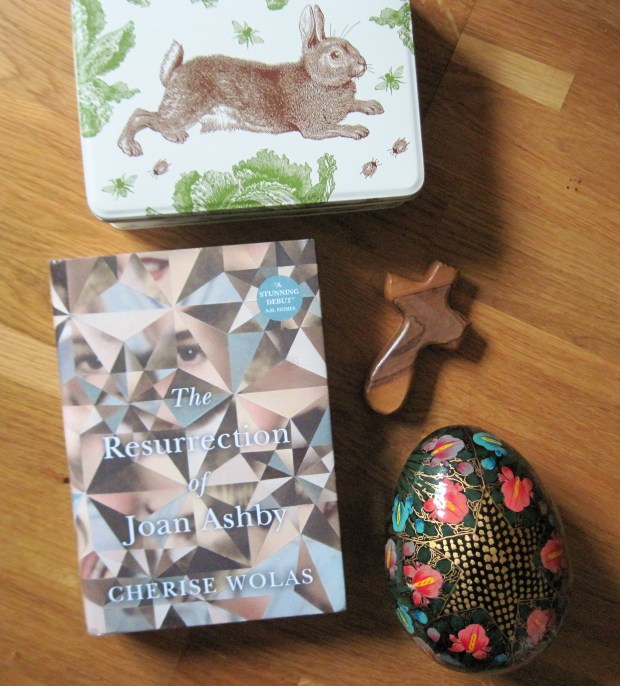
I chose this for April based on the Easter-y title (it’s a stretch, I know!).
Queasy feelings of regret over birthing parasitic children – Daniel turns out to be a fellow writer (of sorts) whose decisions sap Joan’s strength – fuel the strong Part I, which reminded me somewhat of Doris Lessing’s The Golden Notebook in that the protagonist is trying, and mostly failing, to reconcile the different parts of her identity. However, this debut novel is indulgently long, and I lost interest by Part III, in which Joan travels to Dharamshala, India to reassess her relationships and career. I skimmed most of the last 200 pages, and also skipped pretty much all of the multi-page excerpts from Joan’s fiction. At a certain point it became hard to sympathize with Joan’s decisions, and the narration grew overblown (“arc of tragedy,” “tortured irony,” etc.) [Read instead: Forty Rooms by Olga Grushin]
Page count: 523
In progress: Mary Ann Sate, Imbecile by Alice Jolly, a 613-page historical novel in verse narrated by a semi-literate servant from Stroud, then a cloth mill town. I’d already committed to read it for a Nudge/New Books magazine review, having had my interest redoubled by its shortlisting for the Rathbones Folio Prize, but it was another perfect choice for a weekend that involved a visit to that part of Gloucestershire. Once you’re in the zone, and so long as you can guarantee no distractions, this is actually a pretty quick read. I easily got through the first 75 pages in a couple of days.
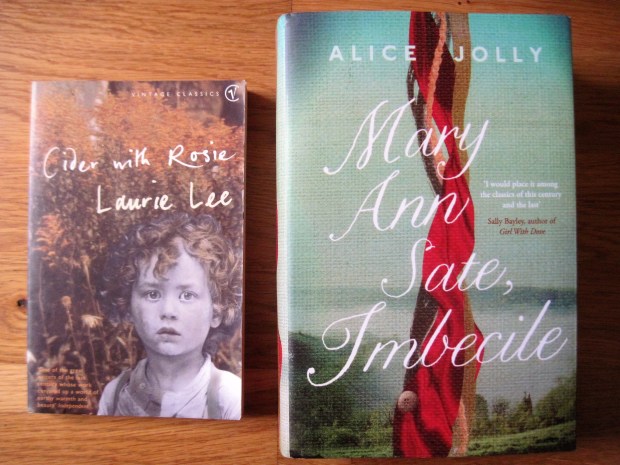
My Stroud-themed reading.
Next month’s plan: As a doorstopper Annabel and I are going to read The Amazing Adventures of Kavalier & Clay by Michael Chabon (636 pages, or roughly 20 pages a day for the whole month of May). Join us if you like! I’m undecided about a classic, but might choose between George Eliot, William Faulkner, Robert Louis Stevenson and Emile Zola.
America Reading & Book Haul, Etc.
On Wednesday we got back from two weeks in the States. We were so busy catching up with family and friends we hadn’t seen in a year and a half or more that my reading really slowed down: aside from the three books I took on the plane and finished within my first week, I only read another two books (not counting two during the trip back). Alas, I seem to be in a bit of a rut: everything I read was 3 stars. I haven’t finished anything I’d rate higher than that since late May. I do hope I can break that pattern before June ends!
What I Read:
 In Dear American Airlines by Jonathan Miles, Bennie Ford writes an extended letter during an unexpected overnight layover in Chicago, ostensibly to demand his $392.68 back, but really to tell his life story. His daughter is getting married in California tomorrow; it’s Bennie’s chance to make things right after years of estrangement. Will he make it to the wedding or not? The structure of the book means it doesn’t particularly matter, and I stopped caring a little bit as it went on. The sections of a novel Bennie is translating from the Polish felt irrelevant to me. Still, amusing, and a good one to read in the airport and on a plane.
 Gone: A Girl, a Violin, a Life Unstrung by Min Kym: I’m completely unmusical, so I enjoyed learning about what it’s like to be a violin virtuoso and a child prodigy, and what it means to fall in love with an instrument. Kym also puts things into the context of being a Korean immigrant to London. The central event of the book is having her Stradivarius, worth hundreds of thousands of pounds, stolen from a train station café in late 2010. It’s a brief and fairly immersive story, but the style is melodramatic and choppy at times.
 Back When We Were Grown-ups was my fifth Anne Tyler novel. Rebecca is in her fifties and the pillar of the large Davitch family, even though she only married into it six years before her husband’s sudden death. The Davitches are always renting out their home for their party business, and Rebecca has over the years developed a joyous persona that she’s not sure is really her true self. What would life have been like if she hadn’t become a stepmother to Joe’s three girls but instead married her college sweetheart, Will? While this is funny and warm, and a cozy read in the best possible way, it didn’t really stand out for me.
Three Singles to Adventure by Gerald Durrell, first published in 1954, tells of his animal collecting in Guiana, South America. The highlight is pipa toad reproduction and birth.
 Grief Cottage by Gail Godwin is a very atmospheric read, set on a South Carolina island with a haunted cottage where a family was swept away by a hurricane. However, I thought the rhythm of the young narrator’s languid summer days caring for his great-aunt became tedious, and I struggled to buy how self-aware he was meant to be of his fragile mental state at the age of 11. It’s reminiscent of John Irving (quirky secondary characters and so on) but without the same spark. I was sent a review copy for BookBrowse but found I couldn’t recommend it with 4 stars or higher.
To my surprise, I completely went off Kindle reading on this trip until the flight back, when I raced through Salmon Doubts by Adam Sacks, a sweet but inconsequential graphic novel about the salmon’s life cycle. I also started the poetry collection Fast by Jorie Graham but left it unfinished.
Two more DNFs from the trip were The Reluctant Fundamentalist by Mohsin Hamid and Between the World and Me by Ta-Nehisi Coates. I may try again with both in the future. Alas, library reading was a total wash: Hourglass by Dani Shapiro didn’t arrive in time, I abandoned the Coates, and I didn’t feel in the mood for advice letters so ended up not even starting Tiny Beautiful Things by Cheryl Strayed.
 My enjoyable read on the long journey back was Mennonite in a Little Black Dress by Rhoda Janzen. Janzen gave the Mennonite tradition she’d forsaken a second look after her life fell apart in her early forties: her husband left her for Bob, whom he met on a gay dating site; and she was in a serious car accident. It’s more in the form of linked autobiographical essays than a straight memoir, so she keeps cycling round to some of the same themes, and it gets less laugh-out-loud funny as it goes on. Still, I was impressed by how the author has managed to pull what’s good from experiences most would consider disastrous. (I also read the first third of Hotel du Lac by Anita Brookner.)
Now that I’m home I’ve started a huge pile of review books and library books and instead of the 1–3 books at a time I was reading while we were away I’m back up to my more usual 14.
What I Bought:
Day 2: A stop at my parents’ local Dollar Tree to stock up on greetings cards for the year’s events (2 for $1!) also brought some unexpectedly good book finds. [Not pictured: a paperback of Jonathan Franzen’s Freedom, our favorite of his novels.] Total spend: $3.18.
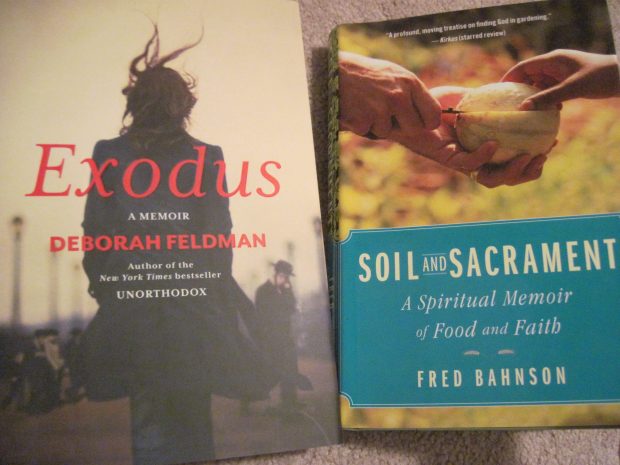
Day 4: The obligatory visit to Wonder Book & Video in Frederick, Maryland, one of my happy places.
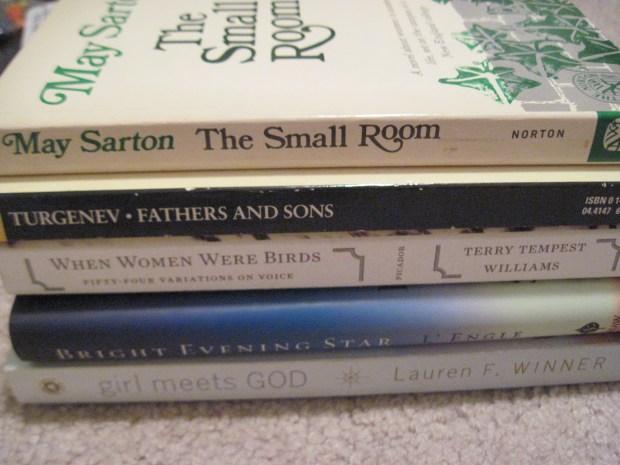
Day 5: A trip to bookstore chain 2nd & Charles in Hagerstown, MD. Total spend (minus my trade-in of various books and CDs): $5.19.
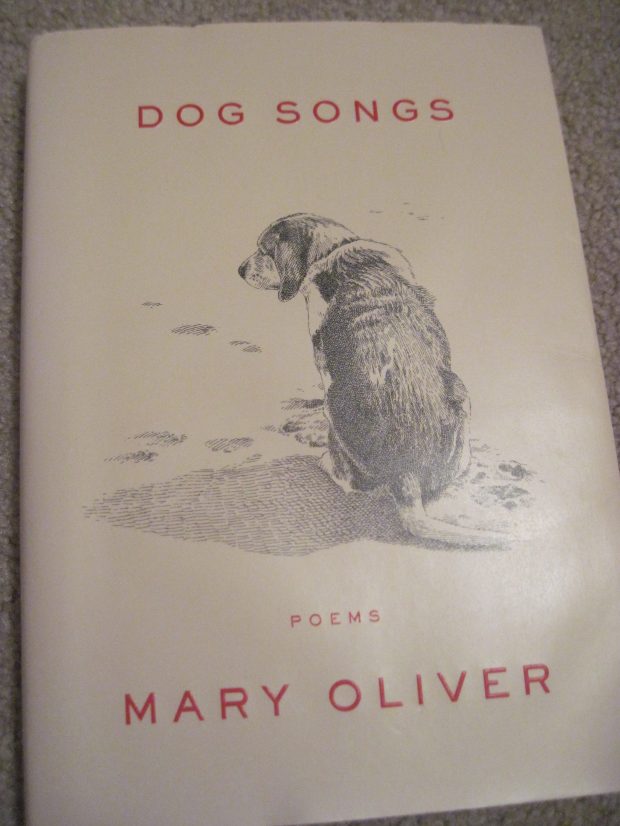
Day 6: A book of Mary Oliver poems from the Goodwill store in Westminster, MD.
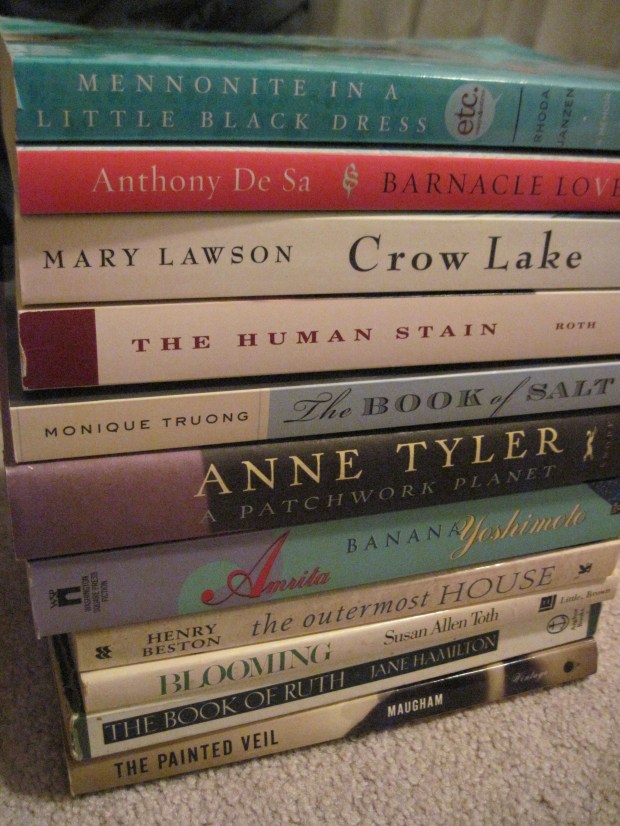
Day 14: Some bargains from a thrift store in Rehoboth Beach, Delaware, where we met up with my friend and her family while they were on holiday. Total spend: $4.50.

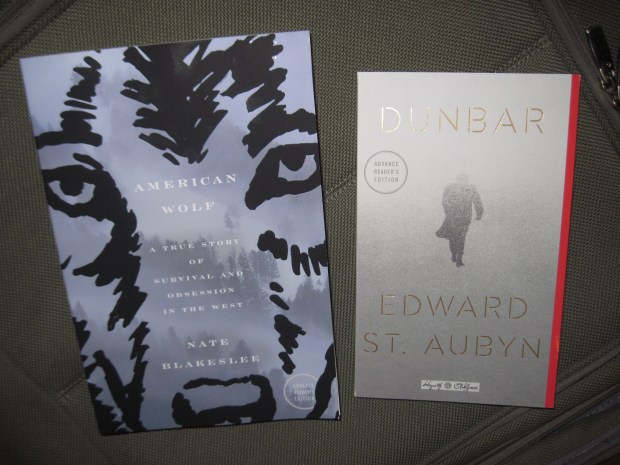
I also managed to snag a couple of Crown ARCs that are not out until October.
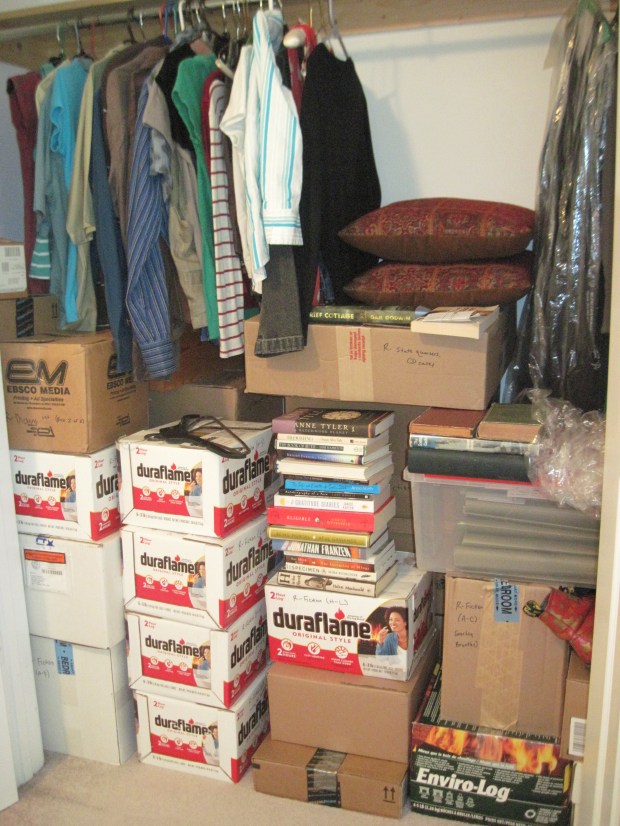
The state of my closet back in the States (most of those boxes contain books):
Other Bookish Sightings:
A Little Free Library at my parents’ local organic supermarket. I dropped off a few proof copies before I left.

The Peabody Library of Johns Hopkins University in Baltimore.

A trip to Mermaid Books in Williamsburg, Virginia (overpriced – no purchases), where I spotted an amusing cover on Anne Tyler’s first novel – she still has the same hairdo!


Ephemera in two of my purchases.


Other highlights of the trip:
- Meeting my sister’s fiancé (!) and his kids.
- Going to an alpaca farm with my sister and nephews.
- Surprising my mom with her early 70th birthday gift: a mother–daughters trip to the Kennedy Center in Washington, D.C. for dinner and a showing of Shear Madness, a long-running improvisational murder mystery with audience participation.
- Exploring Williamsburg (and Jamestown Island) for the first time since I was a kid.
- A day trip to Cape May, New Jersey – a place to go back to, methinks.
- Plus all our meet-ups, however brief, with friends.
- Not forgetting the total of seven cats and two dogs we got to spend time with.
- Two weeks of doing absolutely no work. I didn’t miss it for a second.
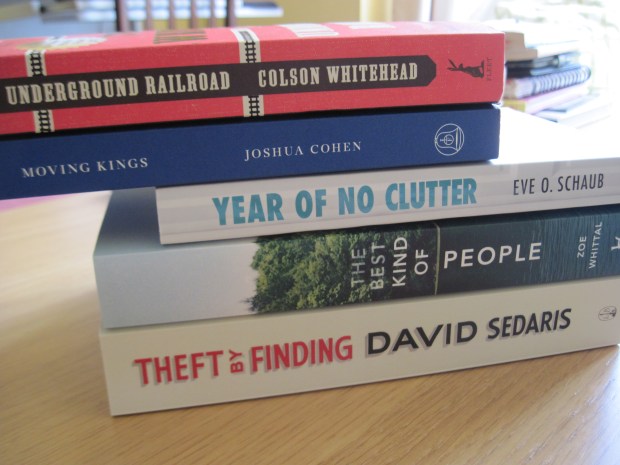
One last book haul photo: These were the review copies (top two) and giveaway books awaiting me when I got back to the UK. (I won the Schaub from Liz’s blog; I’m on a great run with Goodreads giveaways at the moment: along with these Sedaris and Whittal titles, I have new books by Cathy Rentzenbrink and Anne de Courcy on the way.)
How has your summer reading been going?
Reviews Roundup, April–May
One of my goals with this blog is to have one convenient place where I can gather together all my writing that has appeared in disparate online locations. To that end, once a month – or maybe more often – I’ll provide links to all the book reviews I’ve published elsewhere, with a rating and a short taster so you can decide whether to click to read more. (A couple of exceptions: I won’t point out my Kirkus Indie or BlueInk reviews since I don’t get a byline.)
[I seem to have done more ‘free’ than ‘required’ reading this past month, which I attribute to having been on vacation in America for about two weeks of that time.]
BookBrowse
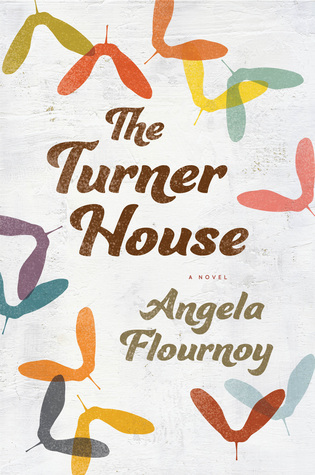 The Turner House by Angela Flournoy [subscription service, but an excerpt is available for free on the website]: In Flournoy’s debut novel, the 13 grown children of Francis and Viola Turner must put aside their own personal baggage and decide what will become of their parents’ Detroit house during the financial crisis.

The Bookbag
Mother of Eden by Chris Beckett: This sequel to 2012’s Arthur C. Clarke Award-winning science fiction novel Dark Eden sees Gela’s descendants splitting into factions and experimenting with different political systems. Starlight Brooking emerges as a Messiah figure, spreading a secret message of equality. Releases June 4th.
 Sophie and the Sibyl by Patricia Duncker: In Duncker’s sixth novel, a playful Victorian pastiche, George Eliot’s interactions with her German publisher and his feisty young wife provide fodder for Daniel Deronda. Consciously modeled on John Fowles’s The French Lieutenant’s Woman, this is a postmodern blending of history, fiction, and metafictional commentary.
We Love This Book
 The Gracekeepers by Kirsty Logan: This inventive debut novel imagines a circus traveling through a flooded future world. Humanity is divided into two races, landlockers and damplings. Fear and prejudice distance these groups but the novel imagines them drawn together through a meeting between two young women, Callanish and North.

Foreword Reviews
 The Organ Broker by Stu Strumwasser: “There is no shortage of organs; there is only a shortage of organs in America.” The antihero of this debut novel finds organs on the international market and sells them for huge profits to Americans on transplant waiting lists. With snappy dialogue and a lovable hustler protagonist, it explores ethical ambiguities.
BookTrib
I chose my top four mother–daughter memoirs (by Alice Eve Cohen, Abigail Thomas, Alison Bechdel and Jeanette Winterson) for this Mother’s Day article.
I also post reviews of most of my casual reading on Goodreads.
Mademoiselle Chanel by C.W. Gortner: A writer of Tudor-era mysteries turns to more recent history with this novel about Coco Chanel. Detailing every business venture and love affair, he makes some parts a real chronological slog. I always associate Chanel with the 1950s–60s, so it was interesting to learn that she was born in the 1880s and experienced both world wars.
 The Empathy Exams by Leslie Jamison: I liked the medical-related pieces – attending a Morgellons disease conference, working as a medical actor – but not the Latin American travel essays or the character studies. The overarching theme of empathy was not as strong as I thought it would be; really, the book is more about how experiences mark the body.
The Real Thing: Lessons on Love and Life from a Wedding Reporter’s Notebook by Ellen McCarthy: McCarthy writes about weddings and relationships for The Washington Post. This is a collection of short pieces about modern dating, breakups, wedding ceremonies, marriage, and making love last. The style is breezy and humorous, largely anecdote- and interview-based, with some heartfelt moments. If you’re a wedding junkie you’ll definitely enjoy it, but I didn’t think it broke new ground.

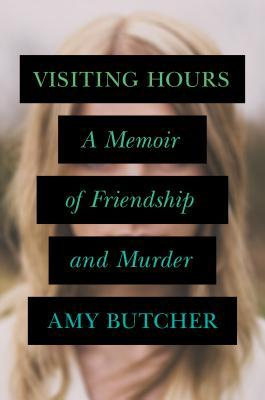 Visiting Hours: A Memoir of Friendship and Murder by Amy E. Butcher: The facts are simple: one night towards the end of their senior year at Gettysburg College, Kevin Schaeffer walked Butcher home from a drunken outing, then stabbed his ex-girlfriend to death. This book has elements of a true crime narrative, detailing the crime and speculating on possible causes for Kevin’s psychotic episode, but it’s more about how the crime affected Butcher. This is a concise and gripping narrative reminiscent of Half a Life by Darin Strauss.
A Reunion of Ghosts by Judith Claire Mitchell: Vee, Lady and Delph are the fourth generation of Alters, a Jewish family cursed with a rash of suicides. Indeed, the majority of the novel is the middle-aged sisters’ collective suicide note, narrated in the first-person plural. They reach back into the past to give the stories of their ancestors, including great-grandparents Iris and Lenz Alter, the latter of whom had the ironic distinction of being the Jewish creator of Zyklon gas (based on a real figure).

Beloved Strangers: A Memoir by Maria Chaudhuri: Islam versus Christianity is a background note, but the major theme is East versus West – specifically, Chaudhuri’s native Bangladesh set against America, where she attended university and later lived and worked. Religion, sexuality, dreams and second chances at love are all facets of the author’s search for a sense of home and family in a life of shifting loyalties. (My full review will appear in the autumn 2015 issue of Wasafiri literary magazine.)
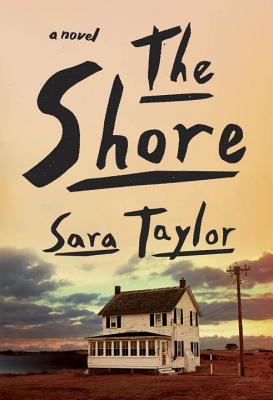 The Shore by Sara Taylor: Gritty and virtuosic, this novel-in-13-stories imagines 250 years of history on a set of islands off the coast of Virginia. As a Maryland native, I think of Chincoteague and Assateague as vacation destinations, but Taylor definitely focuses on their dark side here: industrial-scale chicken farms, unwanted pregnancies, domestic violence, bootleg liquor, gang rape, murders and meth labs.
Echoes of Heartsounds: A Memoir by Martha Weinman Lear: Longtime New York City journalist Lear’s first husband, a doctor named Hal, died after a series of heart attacks. Ironically, 30 years later she was admitted to the same hospital for a heart attack – an event that presents completely differently in women. As a sequel to her previous memoir, Heartsounds (1980), this explores life’s odd parallels and repetitions.
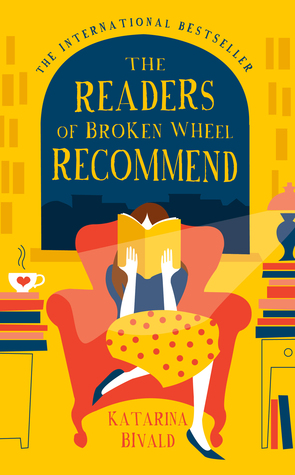 The Readers of Broken Wheel Recommend by Katarina Bivald: A Swedish tourist opens a bookstore in small-town Iowa. Given that she’d never visited the States at the time she wrote this novel (published in her native Sweden in 2013), Bivald has painted a remarkably accurate picture of a Midwestern town peopled with fundamentalists, gays, rednecks and a gun-toting diner owner. A cute read for book lovers, provided you can stomach a bit of chick lit / romance.
Life From Scratch: A Memoir of Food, Family, and Forgiveness by Sasha Martin: Martin writes well and I enjoyed this book overall, but at times you may become frustrated and ask “where’s the food?!” That’s because the makeup of this book is: Misery Memoir – 70% / Global Table Adventure blog – 30%. Martin had the idea to cook dishes from every country of the world. At the rate of one feast per weekend, the blog project took four years. She manages to give a fairly comprehensive overview of the cooking she did over that time.
Plumb Line by Steve Luttrell: Disappointingly average poems about nature and memory. The situations and sentiments are relatable but the language so plain that nothing sticks out.

The Sixth Extinction: An Unnatural History by Elizabeth Kolbert: The picture Kolbert paints of our environmental situation is depressing. I already knew the facts of climate change and animal extinction, but according to Kolbert the prognosis is even worse than I was aware. As a longtime New Yorker journalist, she writes at a good level for laymen: not talking down, nor assuming any specialist knowledge. Luckily, there are spots of humor to lighten the tone.
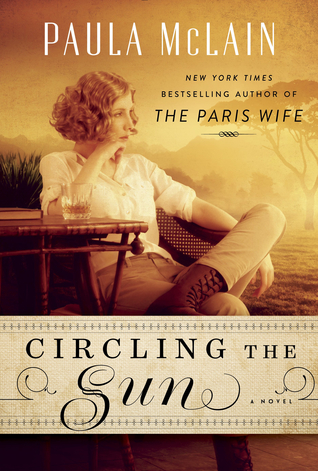 Circling the Sun by Paula McLain: This is just as good as The Paris Wife – if not better. I didn’t think I was very interested in aviatrix Beryl Markham, but McLain proved me wrong. The love triangle between her, Karen Blixen (Isak Dinesen) and Denys Finch Hatton forms the kernel of the book. McLain describes her African settings beautifully, and focuses as much on the small emotional moments that make a life as she does on the external thrills, though there are plenty of those.
The Size of Our Bed by Jacqueline Tchakalian: Well-structured and grouped into thematic sections, these poems are primarily about motherhood, the death of a much-loved husband from cancer, and adjusting to the reality of war. Alliteration and assonance stand in for traditional rhymes. Tchakalian is especially good with colors and flowers, which combine to create memorable metaphors. Releases September 15th.
 Bookish Beck = Rebecca Foster. American transplant to England. Freelance proofreader and book reviewer.
 Bookish Beck