May Releases by Siri Hustvedt, Will Maclean & More
This month’s overarching theme is creepy and/or haunted houses! My main reviews are of a collage-style bereavement memoir and a slice of English horror. I also excerpt my reviews of four more May releases read in advance for Shelf Awareness, including one that’s in the running for my Book of the Year.
Ghost Stories by Siri Hustvedt
Paul Auster died of non-small cell lung cancer on April 30, 2024. His widow, Siri Hustvedt, wears his old clothes and still occasionally smells his cigar smoke in their Brooklyn home. “I’m living in a haunted house,” she writes, one “inhabited by a ghost Paul and I made together, a ‘we’ that doesn’t exist anymore.” This isn’t a straightforward bereavement memoir recounting the relationship followed by the loved one’s decline and death. Instead, it moves back and forth between past and present and incorporates various documents. There are glimpses of her state of mind as she keeps up with routines to get through the days but still experiences life as unreal and outside of time.
One section reprints 12 e-mail updates she sent to friends and family during Paul’s illness. She weaves through fragments of his shocking family history (familiar from The Invention of Solitude), certain events that have been memorialized in his books (such as the car accident he wrote about in Winter Journal), and brief tales of his work and its reception. There’s also Paul’s incomplete series of letters to his newborn grandson, Miles, in which he tells the boy the stories he thinks he should know about his ancestors. A notable one was about 9/11, which happened to be the day their daughter Sophie started at a new high school; she passed under the World Trade Center on the subway half an hour before the first attack.
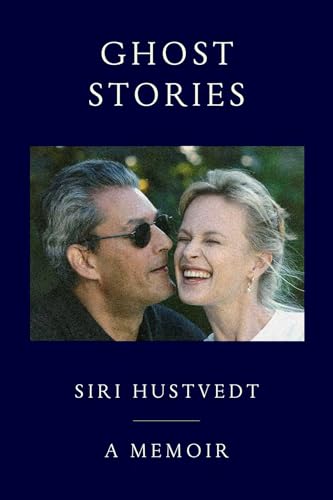 For those of us who have read both Auster and Hustvedt, it’s particularly interesting to read about how their work intersects. “We both liked the idea of our fictional worlds kissing, as it were,” she notes. She describes their connection as “intellectual-erotic” and predicts that, given another 100 years together, they would have merged into one person. Their influence on each other’s work was mutual, she insists, rather than one-sided from Paul to her as misogynistic detractors have assumed. She’s always been more the intellectual anyway, with a literature PhD and amateur interests in neurology and philosophy; and he ‘borrowed’ her character Iris Vegan (from The Blindfold) for one of his later novels, Leviathan.
The book grows increasingly political towards its close. Paul didn’t live to see “45” re-elected as 47. Hustvedt decries the rise of anti-intellectualism and, at Paul’s memorial service nearly 10 months after his death, quoted her father’s prescient words: “when fascism comes to America, they’ll call it Americanism.” It doesn’t seem like alarmism to ask what the current regime in the US and elsewhere portends for writers committed to humanism, nuance, and more or less overt voicing of outrage (as in one of Paul’s late books, a short text accompanying his son-in-law’s photographic series on gun violence in America).
This whetted my appetite to read more by Auster and fulfils her stated goal “to bring something of the man back on the page.” I can thoroughly recommend it to fans of either or both authors, as well as those interested in grief stories and the current literary scene. (Read via Edelweiss)
Solace House by Will Maclean
I hadn’t heard of Maclean’s first novel, The Apparition Phase, which was on the McKitterick Prize shortlist (before my involvement with the Prize), but I was drawn to the descriptions of his second. The cover puff from Nicholas Binge – “The Secret History meets The Haunting of Hill House” – can’t be topped, and the promotional materials’ references to Piranesi and Possession are equally accurate. In the summer of 1993, Alex Lane is 19, broke and wondering what to do with himself. He seems to be the only student left at The Ridge. Except for that pale young man he’s seen screaming at a window opposite his room…
The Student Welfare Office offers him a job on a team clearing out two Victorian properties the university has acquired or is hoping to acquire. One is Marshlands, a former mental hospital, while Solace House was the private residence of the Flaynes, the last of whom recently died at age 101. Alex finds “a lifeboat of easy camaraderie” with his seven co-workers: Clive, a loud, confident stoner; Malcolm, who’s beautiful and gay; Helen, who’s super-religious; Ruth, a Goth; Leo, a mystical researcher; Adam, a weird (traumatized rich kid; and Ella, who’s clever and alluring. But none of them is prepared for what they find at Solace House. Edwin Flayne was a hoarder and the rooms are so full that they can’t move. One is completely covered in mirrors; another has creepy effigies around a table; the hall is plastered with strange paintings; and a series of ledgers with the ravings of a madman. Alex and Ella save from the burn pile one that contains an epic poem of utopian visions and musings on the disappearance of Flayne’s mother.
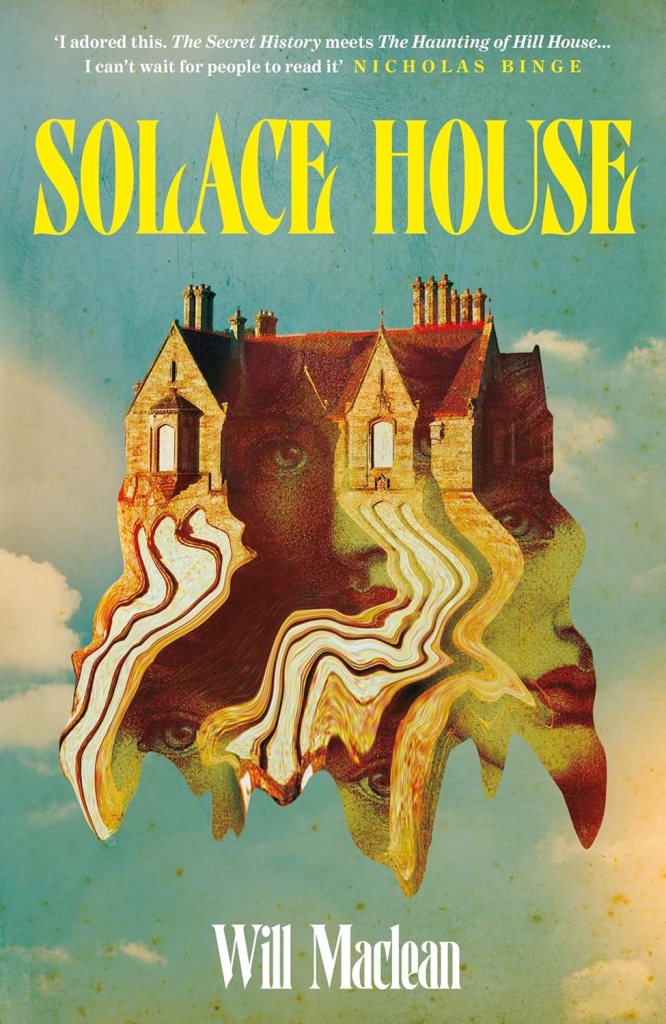
Flayne’s interest in the esoteric is only matched by Leo’s; add on some magic mushrooms and it’s a heady combination of the surreal as the team explores a cave on the property that the Flaynes considered a Thin Place. While high, Leo issues what seems to be a prophecy of the order in which they’ll all die. All along, we’re kept wondering how Alex’s parents both died on “The Last Day” at the hands of “The Annihilator.” He regurgitates fictional orphan plots to try to get Ella off his case, but she (and we) know he’s holding something back.
Although I wearied of the pastiche poetry that heads each chapter and at some point stopped reading it, it does have ultimate significance. (And bully to Maclean for adding “all written by me, rather than AI, before anyone asks” to his Acknowledgements.) Midway through, I was thinking to myself this should have been in the third person to legitimize the horror, as it can otherwise shade into silliness. Part IV jumps ahead in time and subverts what’s gone before, making Alex question not just the last four years of his life but the entire course of it. And now I knew why it had to be in the first person, so reliant is it on individual experience. Time, identity and memory all come into question.
At first I was disappointed, thinking that with this section Maclean had undermined the eerie power of what went before, but there’s another switchback still to come. The book is a little overlong at just under 500 pages, and sags a bit in the final 100, but it kept surprising me and it comes to a satisfying conclusion. I also got the sense of an author having fun with the 1990s nostalgia and student behaviour. I would certainly seek out his debut.
With thanks to Atlantic Books for the free copy for review.
Reviewed for Shelf Awareness:
 Memory House by Elaine Kraf: In this posthumous fifth novel, a novelist enters a commune for failed artists. Magic realism and metafiction coalesce in another of this unsung genius’ typically weird explorations of memory, creativity, and sexuality. It all appears to add up to a metaphorical journey, with a symbolic death and rebirth for those re-entering Society.
 Mother Tongue by Sara Nović: Nović’s fourth book is a defiant memoir of parenthood achieved in spite of the troubled histories of deaf education, religious indoctrination, and international adoption. This is a fierce defense of deafness as a culture rather than a disability to be eradicated, and a beautiful exploration of the legacies of language and love.
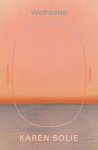 Wellwater by Karen Solie: The Canadian poet Karen Solie’s intricate sixth collection (which won the T. S. Eliot Prize), gilds the natural and human worlds with religious imagery and an environmentalist conscience. The work toggles between the material and the abstract; quotidian experiences fuel meditations on concepts such as intuition, kindness, and fate.
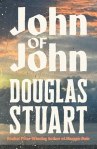 John of John by Douglas Stuart: In Douglas Stuart’s superb third novel set on the Isle of Harris (Outer Hebrides), a young man seeks to reconcile his sexuality and artistic goals with his family’s expectations and devout upbringing. Intriguing in its particularities but timeless in wisdom, it offers hope that relinquishing shame creates freedom to be true to oneself. (I also got to interview Douglas Stuart! This is one of my top three books of 2026 so far, along with Brawler and Whistler – forthcoming in June.)
 Bookish Beck = Rebecca Foster. American transplant to England. Freelance proofreader and book reviewer.
