Best Books of 2024: My Top 20
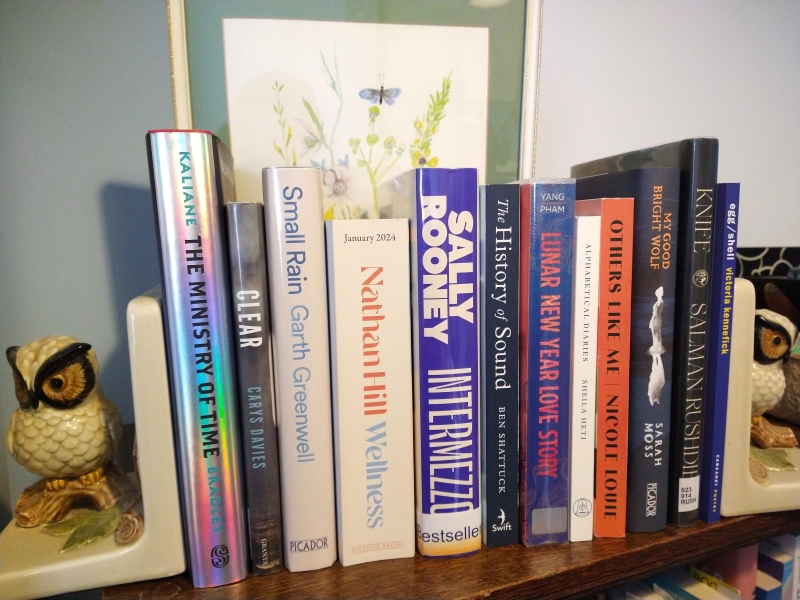
I’m keeping it simple again this year with one post covering all genres: these are the 20 current-year releases that stood out the most for me. (No rankings.) Those that aren’t repeated from my Best Books from the First Half of 2024 post didn’t quite make the cut but should be considered as runners-up well worth your time. Unsurprisingly, health is a common theme across many of my selections, especially as it touches women’s lives. Pictured below are the books I read in print; the others were all electronic copies. Links are to my full reviews where available.
Fiction
 The Worst Journey in the World, Volume 1: Making Our Easting Down: The Graphic Novel by Sarah Airriess: The thrilling opening to a cinematically vivid adaptation of Apsley Cherry-Garrard’s 1922 memoir. He was an assistant zoologist on Robert Falcon Scott’s perilous 1910-13 Terra Nova expedition to the South Pole. The book resembles a full-color storyboard for a Disney-style maritime adventure film. There is jolly camaraderie as the men sing sea shanties to boost morale. The next volume can’t arrive soon enough.
 The Ministry of Time by Kaliane Bradley: This nuanced debut alternately goes along with and flouts the tropes of spy fiction and time travel sci-fi, making clever observations about how we frame stories of empire and progress. The narrator is a “bridge” helping to resettle a Victorian polar explorer in near-future London. You just have to suspend disbelief and go with it. Bradley’s descriptive prose is memorable but never quirky for the sake of it. I haven’t had so much fun with a book since Romantic Comedy. A witty, sexy, off-kilter gem.
 Behind You Is the Sea by Susan Muaddi Darraj: Darraj’s novel-in-stories is a shimmering composite portrait of a Palestinian American community in Baltimore. Across nine stellar linked stories, she explores the complex relationships between characters divided by—or connected despite—class, language, and traditional values. Each of the stories (four in the first person, five in the third person) spotlights a particular character. The book depicts the variety of immigrant and second-generation experience, especially women’s.
 Clear by Carys Davies: Depicts the Highland Clearances in microcosm though Ivar, last resident of a remote Scottish island between Shetland and Norway. John is a minister sent by the landowner to remove Ivar. Mary, John’s wife, journeys from the mainland to rescue him. Davies writes striking scenes that bring the island scenery to life. Her deceptively simple prose captures the slow building of emotion and moments that change everything. For a trio that seemed on course for tragedy, there is the grace of a happier ending.
 Small Rain by Garth Greenwell: A poet and academic (who both is and is not Greenwell) endures a Covid-era medical crisis that takes him to the brink of mortality and the boundary of survivable pain. Over two weeks, we become intimately acquainted with his every test, intervention, setback and fear. Experience is clarified precisely into fluent language that also flies far above a hospital bed, into a vibrant past, a poetic sensibility, a hoped-for normality. I’ve never read so remarkable an account of what it is to be a mind in a fragile body.
 Wellness by Nathan Hill: A state-of-the-nation story filtered through one Chicago family experiencing midlife and marital crises: underperforming academic Jack; his wife Elizabeth, a placebo researcher at Wellness; and their YouTube-obsessed son Toby. They’ve recently invested their life savings in a new condo. The addictive and spot-on novel asks questions about authenticity, purpose, and nurture. Is love itself a placebo? Hill is clearly fascinated with psychological experimentation but also questions it to humorous effect.
 Intermezzo by Sally Rooney: Twenty- and thirtysomethings having lots of sex, yes, but now a solemn tone: Characters’ suffering and failures have deepened their thinking, sense of self, and ability to feel for others. Peter and Ivan lost their father to cancer; Sylvia is in chronic pain after an accident; Naomi is evicted and aimless; Margaret is ashamed of having an estranged alcoholic husband. Chess is a clever metaphor for their interactions; the depiction of grief rings true. A stylistic leap forward, too. Her best, most mature work by a mile.
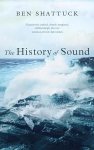 The History of Sound by Ben Shattuck: A dozen stories form a “hook-and-chain” formation of five couplets, bookended by a first and last story related to each other. Links are satisfyingly overt: A pair takes place in the same New England house in different centuries; a companion piece fills in the history of the characters from the previous. All are historically convincing, and the very human themes of lust, parenthood, sorrow and frustrated ambition resonate across centuries and state lines. Really beautiful (and better than North Woods).
 Lunar New Year Love Story by Gene Luen Yang (illus. LeUyen Pham): A super-cute teen graphic novel with gorgeous illustrations prioritizing pink and red to suit the theme. We follow Vietnamese American Valentina through high school as she plays host to an internal debate between cynicism and romanticism. Ever since her mother left, she’s longed to believe in romance but feared that love is a doomed prospect for her family. The Asian community of Oakland, California and a new hobby of lion dancing provide engrossing cultural detail.
Nonfiction
 Grief Is for People by Sloane Crosley: A bereavement memoir like no other. Heart-wrenching yet witty, it bears a unique structure and offers fascinating glimpses into the New York City publishing world. Crosley’s Manhattan apartment was burgled exactly a month before the suicide of her best friend and former boss, Russell. Throughout, the whereabouts of her family jewelry is as much of a mystery as the reason for Russell’s death, and investigating the stolen goods in parallel serves as a displacement activity for her.
 Alphabetical Diaries by Sheila Heti: Heti put 10 years of diary contents into a spreadsheet, alphabetizing each sentence, and then ruthlessly culled the results. The recurring topics are familiar from the rest of her oeuvre: obsessive cogitating about relationships, art and identity, but also the practicalities of trying to make a living as a woman in a creative profession. Heti transcends the quotidian by exploding chronology. Amazingly, the collage approach produces a genuine, crystalline vision of the self. A sui generis work of life writing.
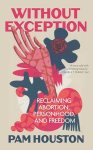 Without Exception: Reclaiming Abortion, Personhood, and Freedom by Pam Houston: If you’re going to read a polemic, make sure it’s as elegantly written and expertly argued as this one. Houston responds to the overturning of Roe v. Wade with 60 micro-essays – one for each full year of her life – about what it means to be in a female body in a country that seeks to control and systematically devalue women. The cycling of topics makes for an exquisite structure. Houston is among my recommendations for top-notch authors you might not know.
 The Body Alone: A Lyrical Articulation of Chronic Pain by Nina Lohman: Chronic Daily Headaches: Having a clinical term for extreme pain did nothing to solve it; no treatment Lohman has tried over a decade has helped much either. Medical professionals and friends alike downplay her experience because she is able to pass as well and raise two children. The fragmentary pieces read like poems. Bodily realities defy language, yet she employs words exquisitely. The tone flows from enraged to resigned to cynical and back.
 Others Like Me: The Lives of Women without Children by Nicole Louie: This impassioned auto/biographical collage combines the strengths of oral history, group biography and a fragmented memoir. “Motherhood as the epicentre of women’s lives was all I’d ever witnessed” via her mother and grandmother, Louie writes, so finding examples of women living differently was key. As readers, we watch her life, her thinking and the book all take shape. It’s warm and empathetic, with layers of stories that reflect diversity of experience.
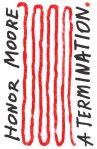 A Termination by Honor Moore: A fascinatingly discursive memoir that circles a 1969 abortion and contrasts societal mores across her lifetime. Moore was a 23-year-old drama student; the termination was “my first autonomous decision,” she insists, a way of saying, “I want this life, not that life.” Family and social factors put her life into perspective. The concise text is composed of crystalline fragments, incorporating occasional second- and third-person narration. The kaleidoscopic yet fluid approach is stunning.
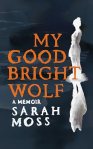 My Good Bright Wolf by Sarah Moss: Moss effectively contrasts the would-be happily ever after of generally getting better after eight years of disordered eating with her anorexia returning with a vengeance at age 46. The mood shifts so that what threatens to be slightly cloying in the childhood section turns academically curious and then, somehow, despite distancing pronouns (mostly second- but also some third-person narration), intimate. Shape-shifting, devastating, staunchly pragmatic; a unique model for converting life into art.
 Knife: Meditations after an Attempted Murder by Salman Rushdie: I’ve not had much success with Rushdie’s fiction, but this is excellent, with intriguing side tendrils and many quotable lines. It traces lead-up and aftermath; unexpected echoes, symbolism and ironies. Although Rushdie goes into some medical detail about his recovery, you get the sense of him more as an unchanging mind and a resolute will. The most noteworthy section imagines dialogues he might have with the imprisoned assailant, probing his beliefs and motivations.
Poetry
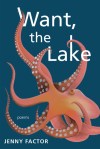 Want, the Lake by Jenny Factor: Factor’s long, intricate poetry collection showcases the tension between past and present and envisions womanhood as a tug of war between desire and constraint. “Elegy for a Younger Self” poems string together vivid reminiscences. In “Sapphics on Nursing” and elsewhere, romantic friendships edge toward homoeroticism; heterosexual marriage and motherhood represent either delightful intimacy or a snare. Allusion and experience, slant rhymes and wordplay craft a lavish tapestry.
 Inconsolable Objects by Nancy Miller Gomez: This debut collection recalls a Midwest girlhood of fairground rides and lake swimming, tornadoes and cicadas. But her Kansas isn’t all rose-tinted nostalgia; there’s an edge of sadness and danger. “Missing History” notes how women’s stories, such as her grandmother’s, are lost to time. In “Tilt-A-Whirl,” her older sister’s harmless flirtation with a ride operator becomes sinister. She also takes inspiration from headlines. The alliteration and slant rhymes are to die for.
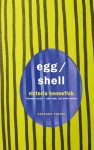 Egg/Shell by Victoria Kennefick: Motherhood and the body are overarching themes. The speaker has multiple miscarriages and names her lost children after plants. Becoming a mother is a metamorphosis all its own, while another long section is about her husband’s transition. Bird metaphors are inescapable. The structure varies throughout: columns, stanzas; a list, a recipe. Amid the sadness, there is dark humour and one-line rejoinders. If you’re wondering how life can be captured in achingly beautiful poetry, look no further.
If I had to choose just one of each? This trio trying out complementary strategies for transmuting life into literature: Small Rain, Alphabetical Diaries and Egg/Shell.


Have you read any of these? Or might you now, based on my recommendation?
The Best Books from the First Half of 2023
Yes, it’s that time of year already! It remains to be seen how many of these will make it onto my overall best-of year list, but for now, these are my 20 highlights. Plus, I sneakily preview another great novel that won’t release until September. (For now I’m highlighting 2023 releases, whereas at the end of the year I divide my best-of lists into current year and backlist. I’ve read 86 current-year releases so far and am working on another 20, so I’m essentially designating a top 20% here.) I give review excerpts and link to the full text from this site or elsewhere. Pictured below are the books I read in print; all the others were e-copies.

Fiction
 Shoot the Horses First by Leah Angstman: In 16 sumptuous historical stories, outsiders and pioneers face disability and prejudice with poise. The flash entries crystallize moments of realization, often about health. Longer pieces shine as their out-of-the-ordinary romances have space to develop. In the novella Casting Grand Titans, a botany professor in 1850s Iowa learns her salary is 6% of a male colleague’s. She strives for intellectual freedom, reporting a new-to-science species of moss, while working towards liberation for runaway slaves.
 The House Is on Fire by Rachel Beanland: Moving at a propulsive pace, Beanland’s powerful second novel rotates through the perspectives of these main characters – two men and two women; two white people and two enslaved Black people – caught up in the Richmond Theater Fire of 1811 (one of the deadliest events in early U.S. history) and its aftermath. Painstakingly researched and full of historical detail and full-blooded characters, it dramatizes the range of responses to tragedy and how people rebuild their lives.
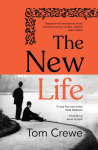 The New Life by Tom Crewe: Two 1890s English sex researchers (based on John Addington Symonds and Havelock Ellis) write a book called Sexual Inversion drawing on ancient Greek history and containing case studies of homosexual behaviour. Oscar Wilde’s trial puts everyone on edge; not long afterwards, their own book becomes the subject of an obscenity trial, and each man has to decide what he’s willing to give up in devotion to his principles. This is deeply, frankly erotic stuff, and, on the sentence level, just exquisite writing.
 Daughters of Nantucket by Julie Gerstenblatt: (Yes, another historical fire novel, and I reviewed both for Shelf Awareness!) This engrossing debut explores the options for women in the mid-19th century. Metaphorical conflagrations blaze in the background in the days leading up to the great Nantucket fire of 1846: each of three female protagonists (a whaling captain’s wife, a museum curator, and a pregnant Black entrepreneur) holds a burning secret and longs for a more expansive, authentic life. Tense and sultry; for Sue Monk Kidd fans.
 I Have Some Questions for You by Rebecca Makkai: When an invitation comes from her boarding school alma mater, Granby, to teach a two-week course on podcasting, Bodie indulges her obsession with the 1995 murder of her former roommate. Makkai has taken her cues from the true crime genre and constructed a convincing mesh of evidence and theories. She so carefully crafts her pen portraits, and so intimately involves us in Bodie’s psyche, that it’s impossible not to get invested. This is timely, daring, intelligent, enthralling storytelling.
 Sidle Creek by Jolene McIlwain: In this debut collection of 22 short stories, loosely linked by their location in the Appalachian hills in western Pennsylvania and a couple of recurring minor characters, McIlwain softens the harsh realities of addiction, poverty and violence with the tender bruises of infertility and lost love. Grief is a resonant theme in many of the stories, with pregnancy or infant loss a recurring element. At times harrowing, always clear-eyed, these stories are true to life and compassionate about human foibles and animal pain.
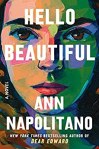 Hello Beautiful by Ann Napolitano: Oprah’s 100th book club pick. It’s a family story spanning three decades and focusing on the Padavanos, a working-class Italian American Chicago clan with four daughters. Julia meets melancholy basketball player William Waters while at Northwestern in the late 1970s. There is such warmth and intensity to the telling, and brave reckoning with bereavement, mental illness, prejudice and trauma. I love sister stories in general, and the subtle echoes of Leaves of Grass and Little Women add heft.
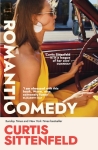 Romantic Comedy by Curtis Sittenfeld: Through her work as a writer for a sketch comedy show modelled on Saturday Night Live, Sally Milz meets Noah Brewster, a pop star with surfer-boy good looks. Plain Jane getting the hot guy – that never happens, right? In fact, Sally has a theory about this very dilemma… As always, Sittenfeld’s inhabiting of a first-person narrator is flawless, and Sally’s backstory and Covid-lockdown existence endeared her to me. Could this be called predictable? Well, what does one want from a romcom?
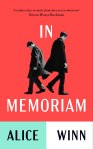 In Memoriam by Alice Winn: Heartstopper on the Western Front; swoon! Will Sidney Ellwood and Henry Gaunt both acknowledge that this is love and not just sex, as it is for so many teenage boys at their English boarding school? And will one or both survive the trenches of the First World War? Winn depicts the full horror of war, but in between there is banter, friendship and poetry. Some moments are downright jolly. This debut is obsessively researched, but Winn has a light touch with it. Engaging, thrilling, and, yes, romantic.
A bonus:
 The Vaster Wilds by Lauren Groff (Riverhead/Hutchinson Heinemann, 12 September): Groff’s fifth novel combines visceral detail and magisterial sweep as it chronicles a runaway Jamestown servant’s struggle to endure the winter of 1610. Flashbacks to traumatic events seep into her mind as she copes with the harsh reality of life in the wilderness. The style is archaic and postmodern all at once. Evocative and affecting – and as brutal as anything Cormac McCarthy wrote. A potent, timely fable as much as a historical novel. (Review forthcoming for Shelf Awareness.)
Nonfiction
 All My Wild Mothers by Victoria Bennett: A lovely memoir about grief and gardening, caring for an ill child and a dying parent. The book is composed of dozens of brief autobiographical, present-tense essays, each titled after a wildflower with traditional healing properties. The format realistically presents bereavement and caring as ongoing, cyclical challenges rather than one-time events. Sitting somewhere between creative nonfiction and nature essays, it’s a beautiful read for any fan of women’s life writing.
 Monsters by Claire Dederer: The question posed by this hybrid work of memoir and cultural criticism is “Are we still allowed to enjoy the art made by horrible people?” It begins, in the wake of #MeToo, by reassessing the work of film directors Roman Polanski and Woody Allen. The book is as compassionate as it is incisive. While there is plenty of outrage, there is also much nuance. Dederer’s prose is forthright and droll; lucid even when tackling thorny issues. Erudite, empathetic and engaging from start to finish.
 Womb by Leah Hazard: A wide-ranging and accessible study of the uterus, this casts a feminist eye over history and future alike. Blending medical knowledge and cultural commentary, it cannot fail to have both personal and political significance for readers of any gender. The thematic structure of the chapters also functions as a roughly chronological tour of how life with a uterus might proceed: menstruation, conception, pregnancy, labour, caesarean section, ongoing health issues, menopause. Inclusive and respectful of diversity.
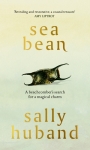 Sea Bean by Sally Huband: Stories of motherhood, the quest to find effective treatment in a patriarchal medical system, volunteer citizen science projects, and studying Shetland’s history and customs mingle in a fascinating way. Huband travels around the archipelago and further afield, finding vibrant beachcombing cultures. In many ways, this is about coming to terms with loss, and the author presents the facts about climate crisis with sombre determination. She writes with such poetic tenderness in this radiant debut memoir.
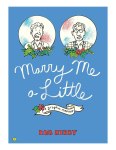 Marry Me a Little by Robert Kirby: Hopping around in time, this graphic memoir tells the story of how the author and his partner John decided to get married in 2013. The blue and red color scheme is effective at evoking a polarized America and the ebb and flow of emotions, with blue for calm, happy scenes and concentrated red for confusion or anger. This is political, for sure, but it’s also personal, and it balances those two aims well by tracing the history of gay marriage in the USA and memorializing his own relationship.
 All of Us Together in the End by Matthew Vollmer: In 2019, Vollmer’s mother died of complications of Alzheimer’s and Parkinson’s. Months later, his father reported blinking lights in the woods near the family cemetery. Although Vollmer had left the Seventh-Day Adventist Church in college, his religious upbringing influenced his investigation, which overlapped with COVID-19. Grief, mysticism, and acceptance of the unexplained are resonant themes. An unforgettable record of “a collision with the ineffable.”
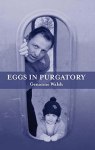 Eggs in Purgatory by Genanne Walsh: This autobiographical essay tells the story of the last few months of her father’s life. Aged 89, he lived downstairs from Walsh and her wife in San Francisco. He was quite the character: idealist, stubborn, outspoken; a former Catholic priest. Although he had no terminal conditions, he was sick of old age and its indignities and ready to exit. The task of a memoir is to fully mine the personal details of a situation but make of it something universal, and that’s just what she does here. Stunning.
Poetry
 More Sky by Joe Carrick-Varty: In this debut collection, the fact of his alcoholic father’s suicide is inescapable. The poet alternates between an intimate “you” address and third-person scenarios, auditioning coping mechanisms. His frame of reference is wide: football, rappers, Buddhist cosmology. The word “suicide” itself is repeated to the point where it becomes just a sibilant collection of syllables. The tone is often bitter, as is to be expected, but there is joy in the deft use of language.
 Lo by Melissa Crowe: This incandescent autobiographical collection delves into the reality of sexual abuse and growing up in rural poverty. Guns are insidious, used for hunting or mass shootings. Trauma lingers. “Maybe home is what gets on you and can’t / be shaken loose.” The collection is so carefully balanced in tone that it never feels bleak. In elegies and epithalamiums (poems celebrating marriage), Crowe honors family ties that bring solace. The collection has emotional range: sensuality, fear, and wonder at natural beauty.
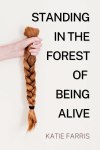 Standing in the Forest of Being Alive by Katie Farris: This debut collection addresses the symptoms and side effects of breast cancer treatment at age 36, but often in oblique or cheeky ways – it can be no mistake that “assistance” appears two lines before a mention of haemorrhoids, for instance, even though it closes an epithalamium distinguished by its gentle sibilance (Farris’s husband is Ukrainian American poet Ilya Kaminsky.) She crafts sensual love poems, and exhibits Japanese influences. (Review forthcoming at The Rumpus.)
 The House of the Interpreter by Lisa Kelly: Kelly is half-Danish and has single-sided deafness, and her second collection engages with questions of split identity. One section ends with the Deaf community’s outrage that the Prime Minister’s Covid briefings were not translated into BSL. Bizarre but delightful is the sequence of alliteration-rich poems about fungi, followed by a miscellany of autobiographical poems full of references to colour, nature and travel.
What are some of the best books you’ve read so far this year?
What 2023 releases should I catch up on right away?
 Bookish Beck = Rebecca Foster. American transplant to England. Freelance proofreader and book reviewer.
 Bookish Beck