The Moomins and the Great Flood (#Moomins80) & Poetry (#ReadIndies)
To mark the 80th anniversary of Tove Jansson’s Moomins books, Kaggsy, Liz et al. are doing a readalong of the whole series, starting with The Moomins and the Great Flood. I received a copy of Sort Of Books’ 2024 reissue edition for Christmas, so I was unknowingly all set to take part. I also give quick responses to a couple of collections I read recently from two favourite indie poetry publishers in the UK, The Emma Press and Carcanet Press. These are reads 9–11 for Kaggsy and Lizzy Siddal’s Reading Independent Publishers Month challenge.
The Moomins and the Great Flood by Tove Jansson (1945; 1991)
[Translated from the Swedish by David McDuff]
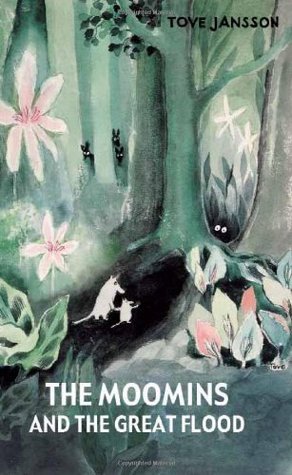 Moomintroll and Moominmamma are the only two Moomins who appear here. They’re nomads, looking for a place to call home and searching for Moominpappa, who has disappeared. With them are “the creature” (later known as Sniff) and Tulippa, a beautiful flower-girl. They encounter a Serpent and a sea-troll and make a stormy journey in a boat piloted by the Hattifatteners. My favourite scene has Moominmamma rescuing a cat and her kittens from rising floodwaters. The book ends with the central pair making their way to the idyllic valley that will be the base for all their future adventures. Sort Of and Frank Cottrell Boyce, who wrote an introduction, emphasize how (climate) refugees link Jansson’s writing in 1939 to today, but it’s a subtle theme. Still, one always worth drawing attention to.
I read my first Moomins tale in 2011 and have been reading them out of order and at random ever since; only one remains unread. Unfortunately, I did not find it rewarding to go right back to the beginning. At barely 50 pages (padded out by the Cottrell-Boyce introduction and an appendix of Jansson’s who’s-who notes), this story feels scant, offering little more than a hint of the delightful recurring characters and themes to come. Jansson had not yet given the Moomins their trademark rounded hippo-like snouts; they’re more alien and less cute here. It’s like seeing early Jim Henson drawings of Garfield before he was a fat cat. That just ain’t right. I don’t know why I’d assumed the Moomins are human-size. When you see one next to a marabou stork you realize how tiny they are; Jansson’s notes specify 20 cm tall. (Gift)
The Emma Press Anthology of Homesickness and Exile, ed. by Rachel Piercey and Emma Wright (2014)
 This early anthology chimes with the review above, as well as more generally with the Moomins series’ frequent tone of melancholy and nostalgia. A couple of excerpts from Stephen Sexton’s “Skype” reveal a typical viewpoint: “That it’s strange to miss home / and be in it” and “How strange home / does not stay as it’s left.” (Such wonderfully off-kilter enjambment in the latter!) People are always changing, just as much as places – ‘You can’t go home again’; ‘You never set foot in the same river twice’ and so on. Zeina Hashem Beck captures these ideas in the first stanza of “Ten Years Later in a Different Bar”: “The city has changed like cities do; / the bar where we sang has closed. / We have changed like cities do.”
Departures, arrivals; longing, regret: these are classic themes from Ovid (the inspiration for this volume) onward. Holly Hopkins and Rachel Long were additional familiar names for me to see in the table of contents. My two favourite poems were “The Restaurant at One Thousand Feet” (about the CN Tower in Toronto) by John McCullough, whose collections I’ve enjoyed before; and “The Town” by Alex Bell, which personifies a closed-minded Dorset community – “The town wraps me tight as swaddling … When I came to the town I brought things with me / from outside, and the town took them / for my own good.” Home is complicated – something one might spend an entire life searching for, or trying to escape. (New purchase from publisher)
Gold by Elaine Feinstein (2000)
 I’d enjoyed Feinstein’s poetry before. The long title poem, which opens the collection, is a monologue by Lorenzo da Ponte, a collaborator of Mozart. Though I was not particularly enraptured with his story, there were some great lines here:
I wanted to live with a bit of flash and brio,
rather than huddle behind ghetto gates.
The last two stanzas are especially memorable:
Poor Mozart was so much less fortunate.
My only sadness is to think of him, a pauper,
lying in his grave, while I became
Professor of Italian literature.
Nobody living can predict their fate.
I moved across the cusp of a new age,
to reach this present hour of privilege.
On this earth, luck is worth more than gold.
Politics, manners, morals all evolve
uncertainly. Best then to be bold.
Best then to be bold!
Of the discrete “Lyrics” that follow, I most liked “Options,” about a former fiancé (“who can tell how long we would have / burned together, before turning to ash?”) and “Snowdonia,” in which she’s surprised when a memory of her father resurfaces through a photograph. Talking to the Dead was more consistently engaging. (Secondhand purchase – Bridport Old Books, 2023)
Some 2022 Reading Superlatives
Longest book read this year: To Paradise by Hanya Yanagihara (720 pages)

Shortest book read this year: Everything’s Changing by Chelsea Stickle (37 pages)

Authors I read the most by this year: Nicola Colton (4), Jakob Wegelius (3), Tove Jansson and Sarah Ruhl (2)
Publishers I read the most from: (Besides the ubiquitous Penguin and its many imprints) Canongate, Carcanet and Picador – which is part of the Pan Macmillan group.
An author I ‘discovered’ and now want to read everything by: Matthew Vollmer
My overall top discovery of the year: The Murderer’s Ape by Jakob Wegelius

My proudest non-bookish achievement: Giving a eulogy at my mom’s funeral (and even getting some laughs).
The books that made me laugh the most: Revenge of the Librarians by Tom Gauld, Undoctored by Adam Kay, Forget Me Not by Sophie Pavelle, Blurb Your Enthusiasm by Louise Willder
The books that made me cry the most: Foster by Claire Keegan, The Hero of This Book by Elizabeth McCracken


Most useful fact gleaned from a book: To convert a Celsius temperature to Fahrenheit, double it and add 30. It’s a rough estimate, but it generally works! I learned this from, of all places, The Hero of This Book by Elizabeth McCracken.
Best book club selections: The Boys in the Boat by Daniel James Brown, Falling Angels by Tracy Chevalier, Small Things Like These by Claire Keegan


Best first line encountered this year: “First, I got myself born.” (Demon Copperhead, Barbara Kingsolver)
Best last lines encountered this year:
- “Darling, that’s what life’s for – to take risks.” (Up at the Villa, W. Somerset Maugham)
- “The defiant soul of the city doesn’t die. It stays alive, right below the surface, pressing up against the boot heels, crouched like the life inside an egg, the force that drives the flower, forever reaching for its next breath.” (Feral City, Jeremiah Moss)
 “Until the future, whatever it was going to be.” (This Time Tomorrow, Emma Straub)
A book that put a song in my head every time I picked it up: Heaven Is a Place on Earth by Adrian Shirk

Shortest book title encountered: O (a poetry collection by Zeina Hashem Beck), followed by XO (a memoir by Sara Rauch)
Best 2022 book title: I Want to Die But I Want to Eat Tteokbokki by Baek Se-hee (No, I haven’t read it and I’m unlikely to, not having had great luck with recent translations of work by Japanese and Korean women.)
Favourite title and cover combo of the year: Briefly, A Delicious Life by Nell Stevens

Most fun cover serendipity: Two books I read in 2022 featured Matisse cut-outs.


Biggest disappointment: The Book of Form and Emptiness by Ruth Ozeki ( for me)
Two 2022 books that everyone was in raptures about but me: Trust by Hernan Diaz and Demon Copperhead by Barbara Kingsolver (both for me)


A 2022 book that everyone was reading but I decided not to: The Marriage Portrait by Maggie O’Farrell – since I thought Hamnet her weakest work, I’m not eager to try more historical fiction by her.
A 2022 book I can’t read: (No matter how good the reviews might be, because of the title) I’m Glad My Mom Died by Jennette McCurdy
The worst books I read this year: The Reactor by Nick Blackburn, Treacle Walker by Alan Garner, Anthropology by Dan Rhodes, Bonsai by Alejandro Zambra (1-star ratings are extremely rare from me; these were this year’s four)
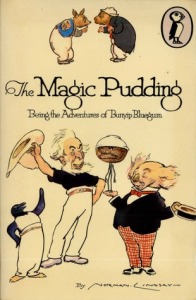
The downright strangest book I read this year: The Magic Pudding by Norman Lindsay
 Bookish Beck = Rebecca Foster. American transplant to England. Freelance proofreader and book reviewer.
 Bookish Beck