My first two dedicated reads for our informal Carol Shields Prize shadowing project exhibit one main way in which the prize is different from the Women’s Prize for Fiction: works in translation and short story collections are eligible. I have one of each to review today. Laura and I did a buddy read of an atmospheric dystopian novel translated from the French, and I caught up on a magical, erotic story collection I’d had on my Kindle for a long time. These were both very good, but my minor misgivings are such that I’d rate them the same: 
The Future by Catherine Leroux (2020; 2023)
[Translated from the French by Susan Ouriou]
For such a monolithic title, this has a limited stage: a few derelict districts of the ailing city we know as Detroit, Michigan – but in Leroux’s alternate version, it remained part of French Canada, with lingering Indigenous influence, and so is known as Fort Détroit. No doubt she was inspired by the many vacant properties that characterized Detroit in the 2010s; there’s even a ruins tour bus. In her Fort Détroit, a handful of determined adults cling on in their own homes, but the streets and parks have been abandoned to animals and to a gang of half-feral children who have developed their own nicknames (Adidas, Lego, Wolfpup), social hierarchy and vernacular. Worlds meet when Gloria determines to find her granddaughters Cassandra and Mathilda, who ran away after their addict mother Judith’s suspicious death. At the same time, her neighbour Eunice wants to find out who ran her father down in the street.
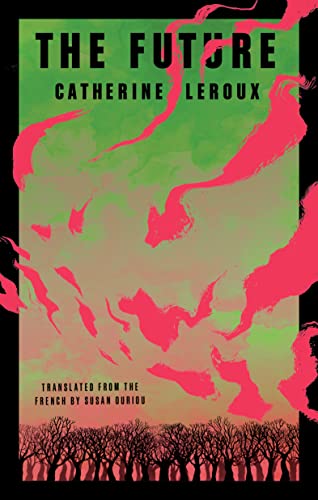 Despite their fierce independence and acts of protest, the novel’s children still rely on the adult world. Ecosystems are awry and the river is toxic, but Gloria’s friend Solomon, a former jazz pianist, still manages to grow crops. He overlooks the children’s thefts from his greenhouse and eventually offers to help them grow their own food supply, and other adults volunteer to prepare a proper winter shelter to replace their shantytown. Puberty threatens their society, too: we learn that Fiji, the leader, has been binding her breasts to hide her age.
I expected to be reminded strongly of Station Eleven, and while there were elements that were reminiscent of Emily St John Mandel’s work, Leroux’s is a more consciously literary approach. The present-tense omniscient narration occupies many perspectives, including that of a dog, and the descriptions and musings are more lyrical than literal. Where another author would site high drama – sixtysomething Gloria’s night quest, a few children rafting down the river – Leroux moves on swiftly to other character interactions. What did bring Mandel to mind was the importance of art during societal collapse: the children spin nursery rhyme mash-ups and fairytales, Stutt rescues a makeshift library and insists on Huckleberry Finn going along on the river journey, and Solomon plays the piano again after decades.
The opening mysteries of death and disappearance are resolved before the end, but don’t seem to have been the point. The Future is more subtle and slippery than many dystopian novels I’ve read in that there’s not really a warning, or a message here. Instead, there’s an intriguing situation that opens out and alters slightly, but avoids resolution. It’s all about atmosphere and language – I was especially impressed by Ouriou’s rendering of Leroux’s made-up dialect via folksy slang (“She figgers she’s growed-up”). I loved the details and one-on-one moments more than the momentous scenes. On the whole, I found the story elegant but somewhat frustrating. You might be drawn to it if you enjoyed To Paradise or the MaddAddam books. (Read via Edelweiss; published by Biblioasis)
See also Laura’s review.
Chrysalis: Stories by Anuja Varghese (2023)
This debut collection of 15 stories brims with magic and horror, and teems with women of colour and queer people. Indeed, Varghese dedicates the book to “all the girls and women who don’t see themselves in most stories.” Most of the characters are of South Asian extraction. Adoption recurs in a couple of places. Two of the rarer realist stories, “Milk” and “Stories in the Language of the Fist,” have protagonists dealing with schoolgirl bullying and workplace microaggressions. More often, there are unexplained phenomena that position the players between life and death. “In the Bone Fields” focuses on the twin daughters of an Indian immigrant family on a Canadian farm. The house and the bone field behind are active and hungry, and only one twin will survive. (I got mild North Woods vibes.)
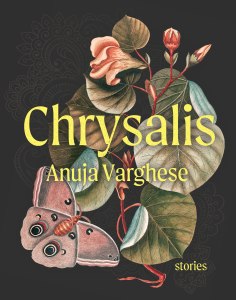 In the title story, Radhika visits her mother’s grave and wonders whether her life is here in Montreal with her lover or back in Toronto with her husband. Fangs and wings symbolize her desire for independence. Elsewhere, watery metaphors alternately evoke fear of drowning or sexual fluidity. “Midnight at the Oasis” charts the transformation of a trans woman and “Cherry Blossom Fever,” one of my two favourites, bounces between several POVs. Marjan is in love with Talia, but she’s married to Sunil, who’s also in love with Silas. “People do it — open their relationships and negotiate rules and write themselves into polyamorous fairy tales … Other people. Not brown people,” Talia sighs. They are better off, at least, than they would be back in India, where homophobia can be deadly (“The Vetala’s Song”).
My other favourite was “Bhupati,” about a man who sets up multiple Lakshmi figures in the backyard, hoping devotion will earn him and his wife a better future. The statues keep being burned up by lightning; we learn his wife may be petitioning for different things. “Chitra” is a straightforward Cinderella retelling whose title character lives with two mean stepsisters and works in food service at the mall. A Shoe Chateau BOGO closing sale gives her the chance to get a bargain – and catch the manager’s eye. Despite a striking ending signalled by the story’s subtitle, all I could conclude about this one was “cute.” The three flash horror stories (a murder hotel, ghosts in a basement, werewolves) were much the weakest for me.
There’s a pretty even split of third- and first-person stories (nine versus six) here, and the genre shifts frequently. The quality wasn’t as consistent as I’d hoped, but it was an engaging read. The overall blend of feminism and horror had me thinking of Her Body and Other Parties by Carmen Maria Machado, but I’d be most likely to recommend this to fans of Julia Armfield, Violet Kupersmith and Vauhini Vara. (Read via Edelweiss; published by House of Anansi Press)
Both of these are worthwhile books and it’s great that readers outside of Canada can discover them. I wouldn’t personally shortlist either, but the judges may well be dazzled enough to do so. I don’t yet have a sense of where they’d fit for me in the rankings.
Up next:
Cocktail by Lisa Alward (short story collection from Edelweiss)
A Council of Dolls by Mona Susan Power (buddy read with Laura)
Land of Milk and Honey by C Pam Zhang (from library)

I’m aiming for one or two more batches of reviews before the shortlist is announced on 9 April.
 Bookish Beck = Rebecca Foster. American transplant to England. Freelance proofreader and book reviewer.

[…] read this as a buddy read with Bookish Beck. Rebecca’s review is here. Thanks so much to Nicole Magas at Zgstories for sourcing a free e-ARC from the publisher for […]
LikeLike
Oh Chrysalis actually sounds RIGHT up my street.
LikeLiked by 1 person
I would recommend it to you! Some stories are stronger than others, of course, but it seems like the right vibe.
LikeLiked by 1 person
Well I hadn’t heard of Chrysalis, so you helped a reader inside of Canada discover it 🙂 Which tells you how much I pay attention to the Governor Generals Awards!
LikeLiked by 1 person
Oh cool, I didn’t even realize it had already had some prize attention!
LikeLike
I can’t decide if I want to read The Future. I have to be careful with dystopian things – sometimes they make me too anxious. It was on my radar because it was the Canada Reads winner (and some of my blog pals mention that event.)
LikeLiked by 1 person
There was nothing too distressing or close to home here, I don’t think.
LikeLiked by 1 person
One of Leroux’s motivations was to explore the idea that when times get tough people cooperate and find new ways to thrive (rather than the studies that are often cited, which take a more competitive and dismal view of society run amok). I found it gently hopeful really.
LikeLiked by 2 people
In the Canada Reads debates, one of the panelists was frustrated by the fact that Leroux did not clearly define what had happened in society in The Future: is that what you found frustrating?
We seem to have had rather different readings in one sense…I wouldn’t have thought to anticipate Mandel, either as having influenced Leroux or there being similarities…was it simply that they’re both Canadian and dystopian?
But I did have a sense of uneasiness with some of the narrative choices. Much of that I put onto the fact that all the public discussions of this book made reference to the idea of it being a retelling of Lord of the Flies which definitely impacted my expectations and skewed how I felt about how/when the children were introduced. Once I knew that, I couldn’t unknow it. But it didn’t feel like the true driving force behind the story as I read it.
I’m still reading Chrysalis, so I’ll try to remember to come back to this then, and I haven’t decided quite yet how/when to post the bits I’ve written up so far for my CSP reading. The shortlist is coming up fast, yikes, eh?
LikeLiked by 1 person
No, I wasn’t frustrated about the setup; I was happy enough to think of it as a parallel/alternate situation combining Detroit’s particular dereliction with society’s probable gradual collapse. It was more that most times there was an opportunity for drama, Leroux backed away. Just fairly underwhelming — but then again, I was wrong to anticipate a Mandel-style plot. (You are probably right in that my brain does tend to lump Australian writers with Australians and Canadians with Canadians and so on.) It was impossible not to go in with Lord of the Flies expectations given the feral-children scenario.
It’s really not long until the shortlist! I’m proceeding apace with Alward, Power and Zhang so may try to squeeze in one or two others before then too.
LikeLike
I read The Future and mostly enjoyed it. Your observations are spot on!
LikeLiked by 1 person
Thank you! That it won Canada Reads tells me that the average Canadian reader is more highbrow than a Brit or American 😉
LikeLiked by 1 person
That’s a generous interpretation!
LikeLike
[…] from the longlist that I wanted to read (as well as Dances, I now fancy Chrysalis after reading Rebecca’s review), but what would I like to see shortlisted right now? Here’s my current ranking, with links […]
LikeLike
[…] wouldn’t be averse to seeing The Future or Chrysalis on there either. (Just not Loot, […]
LikeLike
[…] Chrysalis by Anuja Varghese […]
LikeLike
I’m very late to the discussion, but it doesn’t stop being interesting!
I just wanted to pop in and say that I have loved all of Leroux’s books (that I’ve read), but that The Party Wall is still my favourite. In case you are interested in reading more of her…
LikeLiked by 1 person
I would certainly try her again. I don’t know how easy that would be to find outside North America, but I could look for it secondhand the next time I’m in the States.
LikeLiked by 1 person
[…] standouts, and I could see how they’ve influenced story writers in the decades since, including Anuja Varghese. What linked them all together for me was the theme of denying or affirming common […]
LikeLike
[…] standouts, and I could see how they’ve influenced story writers in the decades since, including Anuja Varghese. What linked them all together for me was the theme of denying or affirming common […]
LikeLike