Nearly there! I’ll have two more books to review for this challenge as part of roundups tomorrow and Saturday. Today I have a lesser-known novel by a Women’s Prize winner and a set of personal essays about body image and growing up female.
A Perfect Arrangement by Suzanne Berne (2001)
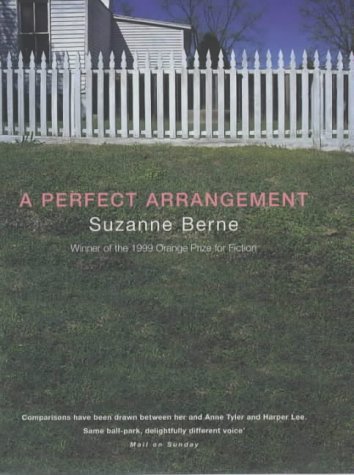 Berne won the Orange (Women’s) Prize for A Crime in the Neighbourhood in 1999. This is another slice of mild suburban suspense. The Boston-area Cook-Goldman household faces increasingly disruptive problems. Architect dad Howard is vilified for a new housing estate he’s planning, plus an affair that he had with a colleague a few years ago comes back to haunt him. Hotshot lawyer Mirella can’t get the work–life balance right, especially when she finds out she’s unexpectedly pregnant with twins at age 41. They hire a new nanny to wrangle their two under-fives, headstrong Pearl and developmentally delayed Jacob. If Randi Gill seems too good to be true, that’s because she’s a pathological liar. But hey, she’s great with kids.
It’s clear some Bad Stuff is going to happen to this family; the only questions are how bad and precisely what. Now, this is pretty much exactly what I want from my “summer reading”: super-readable plot- and character-driven fiction whose stakes are low (e.g., midlife malaise instead of war or genocide or whatever) and that veers more popular than literary and so can be devoured in large chunks. I really should have built more of that into my 20 Books plan! I read this much faster than I normally get through a book, but that meant the foreshadowing felt too prominent and I noticed some repetition, e.g., four or five references to purple loosestrife, which is a bit much even for those of us who like our wildflowers. It seemed a bit odd that the action was set back in the Clinton presidency; the references to the Lewinsky affair and Hillary’s “baking cookies” remark seemed to come out of nowhere. And seriously, why does the dog always have to suffer the consequences of humans’ stupid mistakes?!
This reminded me most of Friends and Strangers by J. Courtney Sullivan and a bit of Breathing Lessons by Anne Tyler, while one late plot turn took me right back to The Senator’s Wife by Sue Miller. While the Goodreads average rating of 2.93 seems pretty harsh, I can also see why fans of A Crime would have been disappointed. I probably won’t seek out any more of Berne’s fiction. (Secondhand – Community Furniture Project, Newbury) 
Girlhood by Melissa Febos (2021)
I was deeply impressed by Febos’s Body Work (2022), a practical guide to crafting autobiographical narratives as a way of reckoning with the effects of trauma. Ironically, I engaged rather less with her own personal essays. One issue for me was that her highly sexualized experiences are a world away from mine. I don’t have her sense of always having had to perform for the male gaze, though maybe I’m fooling myself. Another was that it’s over 300 pages and only contains seven essays, so there were several pieces that felt endless. This was especially true of “The Mirror Test” (62 pp.) which is about double standards for girls as they played out in her simultaneous lack of confidence and slutty reputation, but randomly references The House of Mirth quite a lot; and “Thank You for Taking Care of Yourself” (74 pp.), which ponders why Febos has such trouble relaxing at a cuddle party and whether she killed off her ability to give physical consent through her years as a dominatrix.
 “Wild America,” about her first lesbian experience and the way she came to love a perceived defect (freakishly large hands; they look perfectly normal to me in her author photo), and “Intrusions,” about her and other women’s experience with stalkers, worked a bit better. But my two favourites incorporated travel, a specific relationship, and a past versus present structure. “Thesmophoria” opens with her arriving in Rome for a mother–daughter vacation only to realize she told her mother the wrong month. Feeling guilty over the error, she remembers other instances when she valued her mother’s forgiveness, including when she would leave family celebrations to buy drugs. The allusions to Greek myth were neither here nor there for me, but the words about her mother’s unconditional love made me cry.
I also really liked “Les Calanques,” which again draws on her history of heroin addiction, comparing a strung-out college trip to Paris when she scored with a sweet gay boy named Ahmed with the self-disciplined routines and care for her body she’d learned by the time she returns to France for a writing retreat. This felt like a good model for how to write about one’s past self. “I spend so much time with that younger self, her savage despair and fleeting reliefs, that I start to feel as though she is here with me.” The prologue, “Scarification,” is a numbered list of how she got her scars, something Paul Auster also gives in Winter Journal. As if to insist that we can only ever experience life through our bodies.
Although I’d hoped to connect to this more, and ultimately felt it wasn’t really meant for me (and maybe I’m a deficient feminist), I did admire the range of strategies and themes so will keep it on the shelf as a model for approaching the art of the personal essay. I think I would probably prefer a memoir from Febos, but don’t need to read more about her sex work (Whip Smart), so might look into Abandon Me. If bisexuality and questions of consent are of interest, you might also like Another Word for Love by Carvell Wallace, which I reviewed for BookBrowse. (Gift (secondhand) from my Christmas wish list last year) 
 Bookish Beck = Rebecca Foster. American transplant to England. Freelance proofreader and book reviewer.
 Bookish Beck
I read Berne’s A Crime in the Neighbourhood and found that it evaporated from memory except for one incredibly painful scene in which the weirdo neighbour’s social exclusion is brutally revealed; I still can’t think about that too much. I get the sense that the Women’s Prize was still finding its feet in the early years, hence perhaps Berne’s win. The Febos sounds interesting if flawed. Whip Smart is probably the one of hers I’d be most interested in (for *research purposes*, of course). I’m also intrigued and sympathetic to the experience of reading someone else’s claims about “universal” girlhood feelings/events and thinking, “no, didn’t happen to me, or at least not like that”. I don’t think you need to consider yourself—even in jest—a bad feminist for not feeling 24/7 sexual surveillance from men! Surely that’s the kind of girlhood we *want* for the younger generation, after all. For me feminism is about acknowledging structural oppressions as they play out in individual lives, not necessarily matching each individual’s life story to the beats of oppression.
LikeLiked by 2 people
I really identify with what Rebecca says here about feeling like you don’t have some of the experiences that ‘all’ other women have, because I also feel it a lot. I totally agree with what you say about feminism as well, but there is this pull towards finding a shared kind of female experience, I guess? I suppose what I have in common with other women is not that we’ve experienced all of the same things but the overlaps in the female-coded things we have experienced.
And yeah, I found A Crime in the Neighbourhood completely forgettable so won’t be reading any more Berne. There are some weird Orange Prize picks in the early years (Fugitive Pieces…)
LikeLiked by 1 person
Yes, for sure, I think it’s very common for feminist/women writers to assume shared experience where that may not be the case. Perhaps part of the project of 4th-wave feminism (or whichever wave we’re in now!) is to broaden those categories of experience and identity so that it’s easier to say that kyriarchy works in many non-obvious, non-individual-behaviour-focused ways. (The one that’s occurring to me right now is that literally no one has ever asked me when I’m going to have kids, or made me feel pressured to, but many of the reasons I’m choosing to remain child-free are to do with the expectations and realities of child-rearing in our world. That still feels like the hand of the patriarchy at work, even though its effects are being diffused through the whole of society’s setup.)
LikeLiked by 2 people
Yes, absolutely! And I feel exactly the same about choosing not to have children – in my case, I think I would want a child if I lived in a different world, but I live in this one. It’s interesting as I know many women do have stories about being asked about plans for children or being pressured to have children, but like you, I’ve never experienced this directly.* It almost makes it harder to pin down where the pressure is coming from…
And yes, I can’t be doing with feminist waves. I tend to think that we are either still in the second wave or that there are no waves at all.
*This definitely seems to depend on age/class/race etc. As a middle-class white millennial woman, I think I’ve escaped some of the kind of direct questioning that other women experience. Coming out as a lesbian probably also helped in my case 🙂
LikeLiked by 1 person
You two are too clever for me 😉
I felt similarly in relation to Sarah Manguso’s Liars, which I reviewed today — that her experience of marriage as inherently oppressive did not ring true for me. And again I wondered, am I fooling myself? Is she right that it is only and ever patriarchal? (Or is the difference that I have not had a child?) I’m all for speaking out about abusive situations, but I did not feel she was speaking for me.
LikeLiked by 1 person
Not at all!
And yes, having just read your review of Liars, it does sound oddly unbalanced. As you say, at some point there has to be a recognition that just living with another human is always going to have its tensions, its power plays, its problems, but that doesn’t make all relationships oppressive. I do think putting children in the mix ups the stakes considerably – given how society views the roles of mothers and fathers regardless of how we ourselves might want to play them.
LikeLiked by 1 person
I really enjoyed A Crime in the Neighbourhood, but when I look back at what it was up against in the Orange Prize race that year, it’s absurd that it won — I mean, The Poisonwood Bible, for crying out loud!
I think you’d warm to Febos as a thinker, and yes, Whip Smart would certainly be adjacent to your research.
I wonder if part of it is that Febos is a micro-generation older than me. My sister (born in 1976) certainly seems to have had it worse. At times in my past, as a teenager perhaps, I might have considered it a negative that I’d never been cat-called (or kissed or had a boyfriend), etc., thinking that I just wasn’t pretty enough for that kind of attention. But you are absolutely right that we’re on a good track if these experiences are becoming less common. (I did actually have a stalker during my study abroad year, but it was so mild compared to what she describes, and he was ultimately harmless.)
LikeLike
It always amazes me that some books win prizes in the years that other, clearly immensely important and accomplished, books got nothing. (I was going to use Beloved as my example for this, but it did win a Pulitzer; maybe I’m thinking of a different Morrison.)
Micro-generational experience accounts for a lot more than we generally acknowledge, I think. To move away from questions of feminism and patriarchy: I’ve noticed with M, who’s four years younger than me, that the gap in our mental associations with particular cultural artifacts, especially music, is noticeable. (Actually, a great example of this is our memories of 9/11. I was a nine-year-old on the East Coast of the US; he was a five-year-old in London. I remember lots of details about that day and the national response in the weeks and months after; he remembers virtually nothing. And yet a four-year age gap is almost irrelevant to our lives now.)
LikeLiked by 1 person
(Morrison’s Paradise was up for the Orange Prize that year.)
OMG, you’re both babies! I was a freshman in college and getting ready for a 9:30 a.m. class when my roommate came back saying, “they’re flying planes into buildings and I’m freaking out!” I dutifully set off and passed my ‘Big Sister’ walking the other way and crying hysterically (her dad worked in the Pentagon — he was fine, thankfully). Class ended up being cancelled, of course, but they put footage up on a large screen.
LikeLike
I read Berne’s novel when it won the Orange and remember very little about it except for a feeling of disappointment. If the dog’s fate is what so often happens in fiction I couldn’t agree with you more!
LikeLiked by 1 person
I actually quite enjoyed A Crime in the Neighbourhood, but this one can safely be skipped. (Innocent victim is the term for it…)
LikeLiked by 1 person
A Perfect Arrangement does sound like perfect summer reading! I don’t know why I haven’t taken part in this challenge. I always read at least 20 books each summer, and it would be easy to just call them the 20 Books of Summer. But sometimes I think I’m trying to do too many things.
LikeLiked by 1 person
Yes, it would be easy to assign them numbers retrospectively! I probably get through 75 or 80 books in a summer 😉 The fun of the challenge for me is in choosing the books, though I usually change my mind and do loads of substitutions.
LikeLiked by 1 person
That’s a lot!
LikeLike
Now there’s a thought – and why didn’t this occur to me before now? – fill my 20 Books list with a bunch of “easy” reads for me – which would be mysteries and thrillers. Hmmm, I’m really considering this idea for next time!
LikeLiked by 1 person
I always think I should build in variety, but there’s a certain overall tone and level I could go for that would make it much easier for myself!
LikeLiked by 1 person
Well done for finishing the challenge (and being in a position to complete reviews – I’ll finish my reading but probably not the reviews).
Body Work sounds like one I need to read, given the number of memoirs related to trauma that I read!
LikeLiked by 1 person
Yes, Body Work is fab, I would recommend it to you.
LikeLike
I have the feeling that I wouldn’t like Melissa Febos’s memoirs as much as I enjoyed her craft essays in Body Work… I don’t know if it’s because I couldn’t or wouldn’t relate to her experiences. But I don’t usually need relatability to like a book, I suspect it’s still my conflicted attitude towards memoir.
LikeLiked by 1 person
That was certainly my experience, which is a shame. I may still try another of her books of autobiographical essays to see if I get on with them better. I think she’s also writing a novel?
LikeLike
What the flip is a “cuddle party”? I probably don’t want to know, do I!
The comments about micro-generations etc feels interesting to me – I was born in 1972 and definitely experienced the creepiness of that, now “O it was a different time”, era, and I am not particularly attractive but noted that I happily became invisible to the street harrassment I’d experienced since my teens as I became middle aged (apart from when I’m running, when I’m suddenly visible again, presumably fitness unless visibly white-haired giving harrassers a jolt of “she’s fertile” which ironically I never was my whole life!). I also experienced workplace sexual harrassment of the pat on the bum variety you would never get now; however also every man I slept with hadn’t seen p0rn which implies all women are pneumatically perfect yet want to be strangled half to death, so I don’t necessarily think it’s got that much better. Anyway, I digress somewhat.
LikeLiked by 1 person
A cuddle party is a platonic orgy, I suppose! Sounds just as bad to me.
Dear oh dear, you’re right that every generation has faced its issues and just when we sort out one thing another rears up. I keep hoping today’s teenagers have it a little easier, but I’m not sure they do. The teen girls I vaguely know seem very concerned with looks and attracting male attention.
LikeLiked by 1 person
I suspect that when a prize jury is comprised of very different sorts of readers that one way to compromise is to afford each member the capacity to contribute ‘x’ number of nominations rather than to require consensus at the longlist, shortlist, and winner stages. That way, they only have to survive one massive disagreement. But, for those of us on the outside, we look at some prizelists with emoji-confused open mouths. Having said that, I don’t think I’ve read Berne (I used to have some, but no longer) and Susan’s mention of the dog’s fate (with your meh-ness) makes me think I’m fine with that.
LikeLiked by 1 person
[…] particularly her ability to recreate her mindset at different times. This is another one, like her Girlhood, to keep on the shelf as a […]
LikeLike