As promised, I’m catching up on five novella-length works I finished in November. In fiction, I have an odd duck of a family story, a piece of autofiction about caring for a friend with cancer, a record of an affair, and a tale of settling two new cats into home life in the 1950s. And in nonfiction, a short book about the religious approach to midlife crisis.
Fup by Jim Dodge (1983)
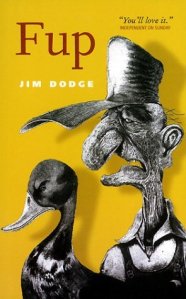 I’d never heard of this but picked it up because of my low-key project of reading books from my birth year. After his daughter died in a freak accident, Grandaddy Jake Santee adopted his grandson “Tiny.” With that touch of backstory dabbed in, we’re in the northern California hills in 1978 with grandfather and grandson – now 99 and 22, respectively. Tiny builds fences, while Grandaddy is famous for his incredibly strong, home-distilled whiskey, “Ol’ Death Whisper.” One day, Tiny rescues a filthy creature from a posthole where it’s been chased by their nemesis, Lockjaw the wild boar. It turns out to be a duckling that grows into a hen mallard named Fup Duck (it’s a spoonerism…) who eats so much she’s too heavy to fly. Grandaddy plans to continue drinking and gambling indefinitely, but the hunt for Lockjaw – who he thinks may be a reincarnation of his Native American friend, Seven Moons – breaks the household apart. This was very weird: it starts out a mixture of grit (those grotesque Harry Horse drawings!) and Homer Hickam schmaltz and then goes full Jonathan Livingston Seagull. (Secondhand – Community Furniture Project, Newbury) [89 pages]
The Spare Room by Helen Garner (2008)
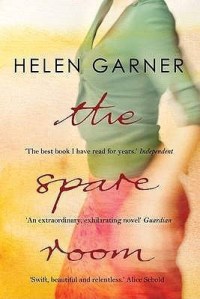 Who knew there was such a market for novels about helping a friend through cancer treatment? Or maybe it’s just that I love them so much I home right in on them. As a work of autofiction – the no-nonsense narrator, Helen, gives her old friend Nicola a place to stay in Melbourne for several weeks while she undergoes experimental procedures – this is most like What Are You Going Through by Sigrid Nunez (but I also had in mind Talk Before Sleep by Elizabeth Berg, We All Want Impossible Things by Catherine Newman, and Some Bright Nowhere by Ann Packer). Helen thinks The Theodore Institute peddles quack medicine, whereas Nicola is willing to shell out thousands of dollars for its coffee enemas and vitamin C infusions, even though they leave her terrifyingly fragile. Nicola is the only character who doesn’t acknowledge that her case is terminal. The pages turn effortlessly as Helen covers her frustration with Nicola, Nicola’s essential optimism, and the realities of living while dying. “Oh, I loved her for the way she made me laugh. She was the least self-important person I knew, the kindest, the least bitchy. I couldn’t imagine the world without her.” I’ll read more by Garner for sure. (Secondhand – Awesomebooks.com) [195 pages]
Second Journey: Spiritual Awareness and the Mid-Life Crisis by Gerald O’Collins SJ (1978; 1995)
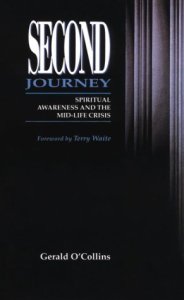 O’Collins, a Jesuit priest, sought a more constructive term than “midlife crisis” for the unease and difficult decisions that many face in their forties. He chooses instead the language of journeys, specifically one embarked upon because a previous way of life was no longer working. There are several types of triggers that O’Collins illustrates through brief case studies of famous individuals or anonymous acquaintances. The shift might be prompted by a sense of failure (John Wesley, Jimmy Carter), by literal exile (Dante), by falling in love (someone who left the priesthood to marry), by experiencing severe illness (John Henry Newman) or fighting in a war (Ignatius of Loyola), or simply by a longing for “something more” (Mother Teresa). But there are only two end points, O’Collins offers: a new place or situation; or a fresh appreciation of the old one – he quotes Eliot’s “to arrive where we started / And know the place for the first time.” This is practical and relatable, but light on actual advice. It also pales by comparison to Richard Rohr’s more recent work on spirituality in the different stages of life (especially in Falling Upward). (Free from a church member’s donations) [100 pages]
A Certain Smile by Françoise Sagan (1956)
[Translated from French by Irene Ash]
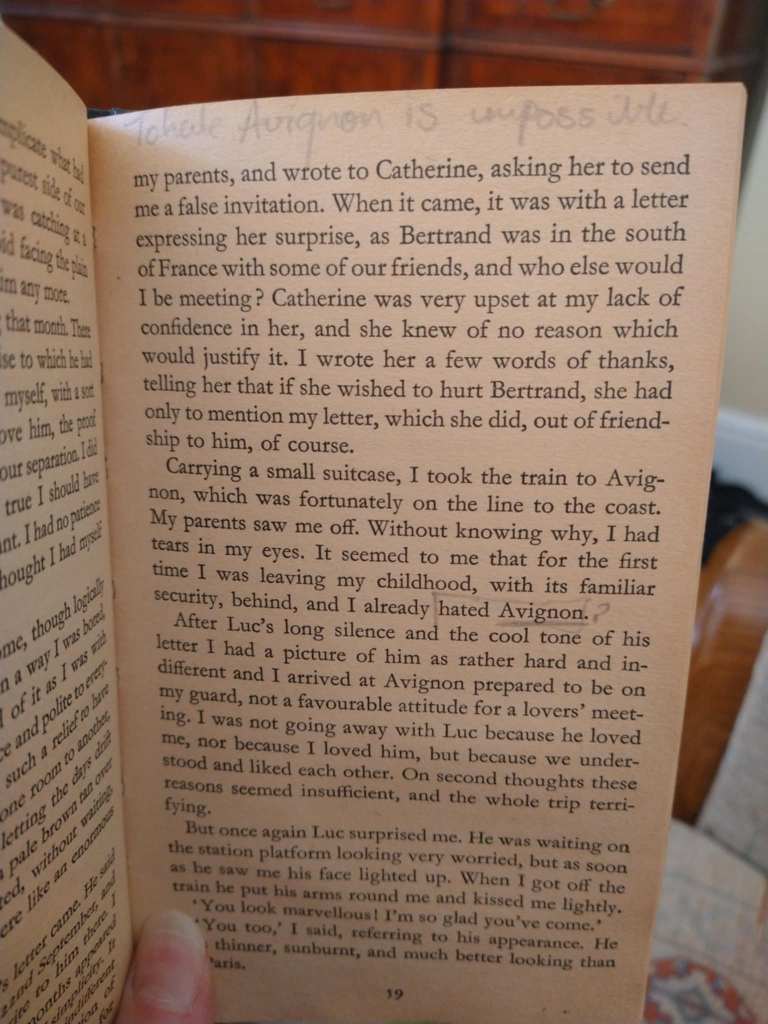
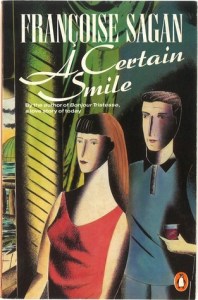 Law student Dominique is lukewarm on her boyfriend Bertrand and starts seeing his married uncle, Luc, instead. The high point is when they manage to go on a ‘honeymoon’ trip of several weeks to Avignon. Both Bertrand and Luc’s wife, Françoise, eventually find out, but everyone is very grown-up about it. The struggle is never external so much as within Dominique to accept that she doesn’t mean as much to Luc as he does to her, and that the relationship will only be a little blip in her early adulthood. I found this a disappointment compared to Bonjour Tristesse and Aimez-Vous Brahms – it really is just the story of an affair; nothing more – but Sagan is always highly readable. I read this in two days, a big section of it on a chilly beach in Devon. In its frank, cool assessment of relationship dynamics, this felt like a model for Sally Rooney. I had to laugh at the righteously angry and rather ungrammatical marginalia below (“To hate Avignon is unpossible”). (University library) [112 pages]
Minka and Curdy by Antonia White; illus. Janet and Anne Johnstone (1957)
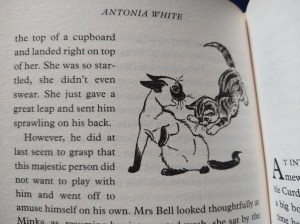
 After Mrs Bell’s formidable cat Victoria dies, she hankers to get a new kitten to keep her company – she works at home as a writer. She finds herself greeting all the neighbourhood cats and, in her enthusiasm to help a ‘stray’, accidentally overfeeds someone else’s pet with fresh fish. Her heart is set on a marmalade kitten, so she reserves one from an impending litter in Kent. But then the opportunity to take on a beautiful young female Siamese cat, for free, comes her way, and though she feels guilty about the ginger tom she’s been promised, she adopts Minka anyway. When Coeur de Lion (“Curdy”) arrives a few weeks later, her challenge is to get the kitties to coexist peacefully in her London flat. This reminded me so much of myself back in February and March, when I was so glum over losing Alfie that we rushed into adopting a giant kitten who has been a bit much for us. But we’re already contemplating getting Benny a little sister or two, so I read with interest to see how she made it happen. Well, this is fiction, so it starts out fraught but then is somewhat magically fine. No matter – White writes about cats’ antics and personalities with all the warmth and delight of Derek Tangye, Doreen Tovey and the like, and this 2023 Virago reprint is adorable. (Secondhand – Awesomebooks.com) [113 pages]
I also had a few DNFs last month:
- The Book of Colour by Julia Blackburn (1995) seemed a good bet because I’ve enjoyed some of Blackburn’s nonfiction and it was on the Orange Prize shortlist. But after 60 pages I still had no idea what was going on amid the Mauritius-set welter of family history and magic realism. (Secondhand – Bas Books charity shop, 2022)
- A Single Man by Christopher Isherwood (1964) lured me because I’d so loved Goodbye to Berlin and I remember liking the Colin Firth film. But this story of an Englishman secretly mourning his dead partner while trying to carry on as normal as a professor in Los Angeles was so dreary I couldn’t persist. (Public library)
- Night Life: Walking Britain’s Wild Landscapes after Dark by John Lewis-Stempel (2025) – JLS could write one of these mini nature volumes in his sleep. (Maybe he did with this one, actually?) I’d rather one full-length book from him every few years than bitty, redundant ones annually. (Public library)
- Aunts Aren’t Gentlemen by P.G. Wodehouse (1974) – I’ve read one Jeeves & Wooster book before and enjoyed it well enough. This felt inconsequential, so as I already had way too many novellas on the go I sent it back whence it came. (Little Free Library)
Final statistics for #NovNov25 coming up tomorrow!
 Bookish Beck = Rebecca Foster. American transplant to England. Freelance proofreader and book reviewer.
 Bookish Beck
I really liked The Spare Room and A Certain Smile (although it is nowhere near as good as Bonjour Tristesse!)
LikeLiked by 1 person
Garner’s approach to autofiction was right up my street. I love Sagan’s sophisticated style but found the story a little disappointing.
LikeLiked by 1 person
I read The Spare Room when it was first published in the UK then again when it was reissued over a decade later and found it just as impressive the second time around.
LikeLiked by 1 person
A really lovely book. Have you read others of her works that you can recommend? Do look out for the Packer on a similar topic.
LikeLiked by 1 person
I recently read and enjoyed The Children’s Bach which I think would appeal to you. I already have my eye on the Packer!
LikeLiked by 1 person
I do read that comment as ‘impossible’ rather than ‘unpossible’! But the Sagan is the only one I’ve read from your selection, and so very very long ago I have no idea that I then thought of it.
LikeLiked by 1 person
Perhaps, perhaps … this is what happens when people don’t dot their i’s properly 😉
LikeLiked by 1 person
Minka and Curdy sounds like one I’d love!
LikeLiked by 1 person
A definite cat-lover’s treat.
LikeLiked by 1 person
I realize I haven’t read anything by Sagan.
LikeLiked by 1 person
Do read Bonjour Tristesse! It’s very short and very powerful (and it’s amazing that she wrote it as a teenager).
LikeLiked by 1 person
I’ll put it on my list.
LikeLike
Fup sounds very weird. I also read the marginalia as “impossible”, accounting for what looks like a soft pencil on soft paper, but that’s still really funny. (I’ve never been to Avignon, but what a spirited defence of the place!)
LikeLiked by 1 person
It makes me want to see Avignon for myself!
LikeLiked by 1 person
I know, what an endorsement!
LikeLike
I loved Avignon when I had a holiday there!
I’ve read the Garner when it first came out in paperback and enjoyed it, but haven’t read anything else by her. The cat book does sound and look delightful.
LikeLiked by 1 person
She recently won the Baillie Gifford for her collected diaries, which my library does own, but it looks like the kind of book it would take me years to read a bit at a time so I’d be better off owning a copy.
LikeLike
I like you also love the comment in the margin about Avignon – I also liked it as a city. I really want to read more Helen Garner.
LikeLiked by 1 person
She seems like a real Australian treasure, just less well known over here.
LikeLike
A low-key goal of reading books published in your birth year sounds like something I might have to try…
LikeLiked by 1 person
I think I’ve been averaging a few a year. It’s a fun, casual project.
LikeLiked by 1 person
Ohhhh, I did not know about that Antonia White: quite different from her books for adults it would seem. Also, love coming across mention of Derek Tangye. I’ve been desperately trying to recollect a set from long-ago and some volumes are very hard to find but I recently “discovered” the first (Gull). That Helen Garner book was so sad that I’m not sure I even recorded it in my log. I second Susan’s rec for The Children’s Bach and wish I could more easily find her diaries over here (maybe eventually).
LikeLiked by 1 person
Yes, I’ve read Frost in May and the tone could hardly be more different!
Tangye’s books are relatively common secondhand finds over here.
I liked how Garner ended before the end, like Nunez and Packer did.
LikeLike