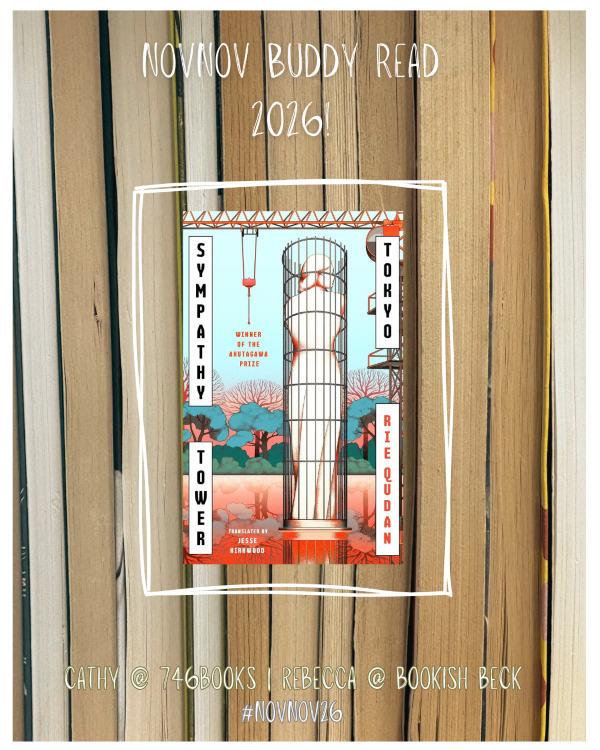
Sympathy Tower Tokyo, translated from the Japanese, is Rie Qudan’s fourth novel and won the Akutagawa Prize. An architect in her late thirties named Sara Machina is chosen to design a skyscraper to house prisoners in comfort. The striking Sympathy Tower, which will sit alongside Zaha Hadid’s Olympic stadium in this speculative future city, represents a whole new approach to the penal system: these “Homo Miserabilis” are people who, due to social and familial factors, were set up for criminality rather than goodness and thus deserve radical empathy. Inside the tower, negative language is banned in favour of that which promotes happiness.
Narration is shared between Sara and her younger boyfriend Takt, and augmented by epistolary elements such as an excerpt from Homo Miserabilis by Masaki Seto, the book wherein the concept originated; and an article by American journalist Max Klein, who visits the tower in 2030 and alternates between envy and outrage at the concept behind it. Some of these texts are preceded by an AI prompt Takt uses to achieve a particular linguistic register, and Sara also engages in conversation with the chatbot “AI-built.” These scenes are playful – she accuses it of mansplaining, for instance – but ultimately fatuous. An opening Translator’s Note gives some context about another language-related theme in the book: the use of katakana (a phonetic alphabet that approximates, e.g., English phrases) vs. complex kanji characters. Sara voices the worry that katakana may be undermining classical Japanese.
{SOME SPOILERS IN THE FOLLOWING}
Normally I enjoy a narrative comprised of different formats, but here they amounted to scattered storytelling. There are intriguing plot points, such as Seto’s murder, the fact that Sara was raped as a girl, and Takt getting a job as a prison guard because his mother is an inmate there, but these aren’t fleshed out. Readers get little sense of Sara’s inner life; there are two brief mentions of the assault and a moment where she expresses regret over designing the tower, but I was frustrated at her withholding. I expected this to be a profound book about compassion, creativity and language (the allusion to the Tower of Babel is made explicit at the beginning). But because situations, relationships and mindsets aren’t fully explored, the novella feels incomplete even though it spans four years. I hoped for more about the power of words to deceive or to create utopias. While it’s an easy read and raises interesting questions – so is indeed a good book club / buddy read – it didn’t go deep enough for my liking.
Although my overall feelings were lukewarm, I must put in a good word for translator Jesse Kirkwood (who also translated one of my other novellas this month, Suspicion by Seichō Matsumoto), for deftly rendering the book’s humour and wordplay – which must have been a challenge given the general reader’s ignorance about Japanese writing systems.
We’d love to have you read this and weigh in!
Also reviewed by Annabel, Cathy and Emma so far.
Sympathy Tower Tokyo by Rie Qudan (2024; 2025)
[Translated by Jesse Kirkwood]
(Little Free Library)

[134 pages]
 Bookish Beck = Rebecca Foster. American transplant to England. Freelance proofreader and book reviewer.


I’ve never really thought about a Buddy Read before. Is it sort of like a mini-book-group, or you discuss things as you go along? You haven’t pushed this book to the top of my list though!
LikeLike
I agree with you on all points! There was so much here that was interesting, but it just didn’t come together for me.
LikeLike