Three Theology Books for Easter
If you’ve been celebrating Passover or gearing up for Easter this past week, you might be interested in picking up one of these three recent (or forthcoming) theology titles I’ve encountered. (See also the more extensive Easter reading list I compiled two years ago.)
Misfit Faith: Confessions of a Drunk Ex-Pastor, Jason J. Stellman
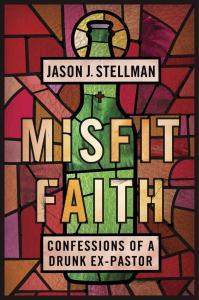 Stellman is a former pastor who runs a podcast called “Drunk Ex-Pastors” with his best friend and agnostic cohost, Christian Kingery. His book suffers a bit, I think, from an unclear aim: it started off as an apologia for his conversion to Catholicism after an unchurched upbringing and fervently Evangelical teen years. What it turned into is more of a theological ramble about how to see God and the world anew. For instance, God is Father, but also flesh, so we don’t need to condemn the secular: “embracing a Christianity that reflects the Incarnation by validating the physical world rather than vilifying it.”
With (dated, geeky) pop culture references, Stellman encourages a rejection of xenophobia and an embrace of narrative and ritual, which Roman Catholicism perhaps makes more space for than your average Protestant tradition. The last few lines of the book are a wonderful plea for openness, hearkening back to the very definition of ‘catholic’ – broad and inclusive:
Is misfit faith about love or suffering? Feasting or fasting? Divinity or humanity? Heaven or earth? The answer is yes, to all of it. And yeah, I want it all: the now and the later, the spirit and the flesh, the head, the heart, and the stations of the cross. I would rather embrace way too much than way too little, because something tells me that as wide as I can open my arms and heart, God’s are always open wider.
I’d recommend this to readers of David Dark and Rob Bell.
My rating: 
I received this e-book from Blogging for Books (via Edelweiss) for this review.
What Is the Bible? How an Ancient Library of Poems, Letters, and Stories Can Transform the Way You Think and Feel about Everything, Rob Bell
 Speaking of Rob Bell…this is one of his stronger books. Not as fresh and vibrant as Velvet Elvis, but it will have a big impact on teens and twentysomethings starting to question the narrow interpretations of the Bible they’ve grown up with in conservative churches. Bell stresses the importance of reading the Bible literately rather than literally: always looking deeper than surface facts to see what’s really going on here; striving to understand the background of Jewish practice and Roman occupation at the time of Jesus.
Bell emphasizes that the Bible is a disparate set of books written by fallible people who were defined by their own historical context, yet if you ask why they wrote down these stories of their interactions with the divine in this way – why they mattered to them then – you might get a glimpse of why they might still matter to us now. The “haphazard humanity” of the Bible, then is for him stronger evidence of its reliability than some rigid perfection would be.
He chooses a number of the more unusual incidents in the Bible to illuminate with a closer reading, such as Jesus writing in the dust, Ehud assassinating tubby King Eglon, and the Book of Revelation. Part 4 is usefully structured around FAQs (e.g. “So how would you define the word of God? The creative action of God speaking in and through the world, bringing new creation and new life into being”). This is like listening to a really good sermon series. (Releases May 16th.)
My rating: 
My Jewish Year: 18 Holidays, One Wondering Jew, Abigail Pogrebin
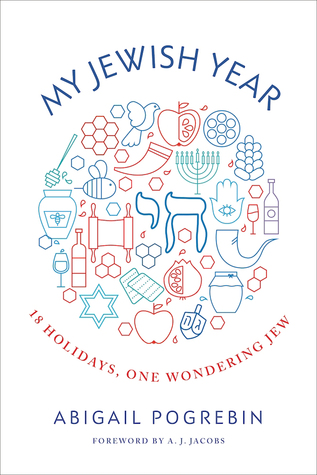 One thing Bell stresses is that Jesus was Jewish, so you can’t understand the stories about him apart from their Jewish context. This bighearted, open-minded book strikes me as a perfect model for how any person of faith should engage with their tradition: not just offering lip service and grudgingly showing up to a few services a year, but knowing what you believe and practice, and why.
Like many an American Jew, Pogrebin marked a limited set of holidays: Hanukkah, the Passover seder, Rosh Hashanah, Yom Kippur, and Shabbat. She circumcised her son, and hosted bar/bat mitzvahs for him and her daughter. Yet she had a nagging feeling that she had never genuinely locked into her own religion, and longed to go beyond the beginner stage.
So from September 2014 to September 2015, she celebrated all the holidays in the Jewish calendar, seeking to move beyond clichés and simplistic interpretations; interviewing rabbis and scholars of every stripe and reading Torah commentaries to discover meanings she’d missed before. Yom Kippur isn’t just a day of atonement; it’s for pondering the fact of your own death, taking stock of your life and asking what must change. Hanukkah, uncomfortably, is not just about persecution but about Jew-on-Jew violence.
There are opposite strands running through the Jewish ritual year: gratitude for survival (Purim) versus sorrow at tragedies (Holocaust Remembrance Day); feasting versus fasting. I was consistently impressed by how Pogrebin draws thematic connections and locates the resonance of religious ritual in her daily life.
Favorite lines:
“[I]t’s a quintessential Jewish act: seeking, grappling. If you’re reaching, it’s because you believe there’s something to grab hold of.”
“I’m beginning to think that Judaism is obsessed with brevity and instability. But rather than finding the message depressing, it’s clarifying.”
“Judaism is always asking us to apply epic stories to everyday decisions.”
“Judaism reminds us not to run from transitions, but to consecrate them.”
My rating: 
Four Books for World Kidney Day
Today, March 9th, is World Kidney Day. “The kidneys are like the Rodney Dangerfield of vital organs—they get no popular respect,” Vanessa Grubbs (whose memoir I discuss below) wryly comments. Chances are you rarely have occasion to think about your kidneys. But I’m honoring them with a reading list because several years ago I was diagnosed with polycystic kidney disease, a degenerative condition that runs in my family. My maternal grandmother had it – we’ve never definitively traced it further back than her – and four of her six children have it, too. (If you took a high school genetics class, you might remember that with an autosomal dominant condition offspring have a 50% chance of inheriting the gene for the disease.) A few cousins of my generation also have PKD, and starting with my mom we’ve had a few successful kidney transplants in the family so far.
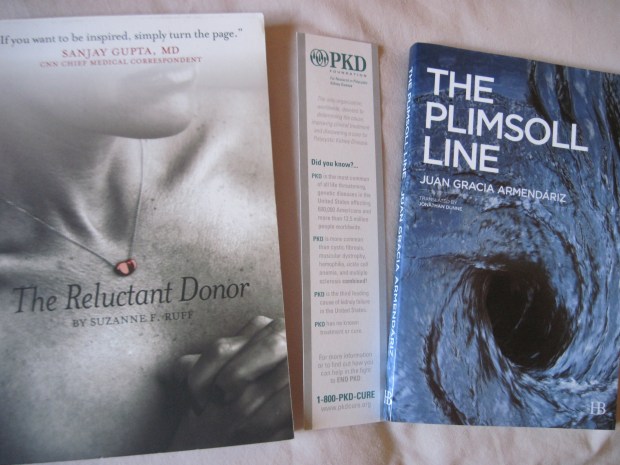
I must mention the excellent work done by the PKD Foundation in the States and the PKD Charity here in the UK. Both are a great support and source of information for me and my wider family.
The Plimsoll Line by Juan Gracia Armendáriz
As soon as I read Melissa’s review at The Book Binder’s Daughter, I knew I had to get this one. “The Plimsoll line” is a maritime term indicating how low a cargo-laden ship can sit in the water without sinking; here it’s used metaphorically to ask just how much one man can take. Gabriel Ariz is a 52-year-old art professor who lives not far from the city yet surrounded by oak woods. He’s divorced from Ana, who’s pressuring him to sell the house, and their young adult daughter Laura died a few years ago in a car accident. Now this pack-a-day smoker who gets drunk with his brother, traveling photographer Óscar, learns that he has end-stage renal disease and his life will have to change. On indefinite leave from work, he attends a dialysis clinic several times a week and joins the organ transplant list.
 At times this was a bit overwritten for my tastes – some paragraphs stretch to several pages, and I’ve had to look up words, including “lentitude” and “logomachy” – but I did love the author’s trick of jumping into different perspectives. On multiple occasions he employs an “anonymous observer,” and in various chapters the point-of-view shifts to a member of the animal kingdom: Polanski the cat, a black kite flying overhead, a mole popping up in the garden, or a beetle winging across the detritus of Gabriel’s untidy household. We also get an extended section from Laura’s journals that reveals a disturbing family secret.
This is not one for the squeamish as it gives an unflinching account of dialysis: “His forearm throbbed, lacerated by needle marks. Sara had taken a while to find the fistula, and now the pain spread under the surgical tape like a jellyfish sting.” But for every passage that makes you cringe there’s a beautiful one that captures things perfectly: “he is living in constant deferment, between parentheses” and “If the succubus of his bad dreams were to say to him, ‘Make a wish,’ he would ask to be able to mold himself to the geological quietude of stones.”
The Plimsoll Line won Spain’s Premio Tiflos de Novela in 2008 and first appeared in English translation in 2015. It is part of a “Trilogy of Illness”; I presume the other volumes are not yet available in English, though I’ve enquired of the translator, Jonathan Dunne, via a Facebook message just in case. Forget Ferrante and Knausgaard; this is the semi-autobiographical series I’ll be awaiting the next installment of with bated breath.
My rating: 
Hundreds of Interlaced Fingers by Vanessa Grubbs
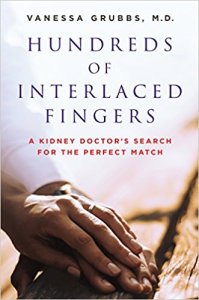 Grubbs is a nephrologist and assistant professor of medicine at San Francisco General Hospital. Well before she made the kidneys her clinical area of expertise, a personal encounter made them special to her. In 2003 she met Robert Phillips when she was an attending trying to get support for her Office of Diversity Affairs; he was a hospital trustee. She only later learned, after they started dating, that due to FSGS his kidneys had failed in his twenties and he’d been on dialysis for years. In 2005 she donated him one of her kidneys. Robert’s health was touch-and-go for a little while there, but he proposed to her soon afterwards. I read about a third of this and then skimmed the rest because I wasn’t all that interested in their separate histories. However, I did like the context Grubbs gives, such as a brief history of dialysis, nephrology case studies, and a great set of FAQs. She also notes that minorities are less likely to get organ transplants, a disparity she is working to rectify.
This memoir grew out of an essay for Health Affairs, “Good for Harvest, Bad for Planting.” Releases June 13th.
My rating:
The A to Z of You and Me by James Hannah
 (First reviewed in November 2015; here’s a shortened version.) Lying in a hospice bed, 40-year-old Ivo looks back on his life. Even after just four short decades and a modest career at a garden center, he has plenty to regret. Hard partying and drug use exacerbated his diabetes and prompted kidney failure. His lifestyle also led indirectly to his girlfriend, nursing student Mia (the “you” he often addresses directly), leaving him. He’s estranged from his sister and his friends from school days, especially Mal. How did he mess up so badly and cut himself off so completely that he’s now dying alone? And how much can he put right before he goes?
There’s plenty of affecting writing in Hannah’s debut novel. I liked how he captures the routines of institutional life. Nurse Sheila’s A to Z game, encouraging Ivo to think of a memory attached to body parts starting with each letter of the alphabet, provides a hokey but effective structure. Keeping in mind that in British English Z is pronounced ‘zed’, the title doesn’t rhyme, but this is still somewhat sappy. I’d recommend it to fans of Mark Haddon and David Nicholls. I’ll follow Hannah’s career and hope he avoids melodrama and a contrived setup – the two near-pitfalls of this one – in the future.
My rating: 
The Reluctant Donor by Suzanne F. Ruff
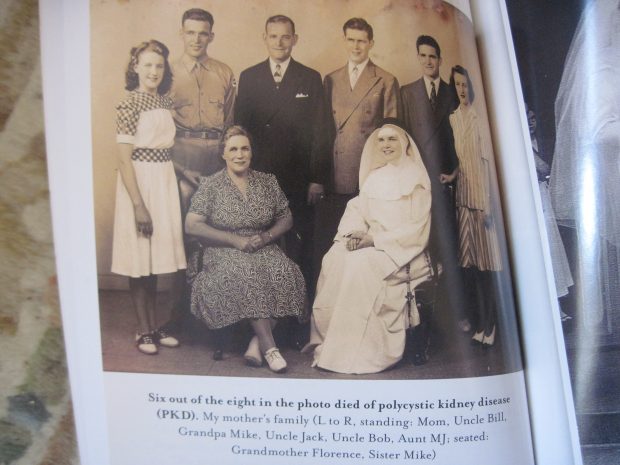
A sepia-toned photograph at the centerfold tells a solemn tale: six of these eight members of Ruff’s Irish-Catholic Chicago family died, directly or indirectly, as a result of PKD. I’ve always known there’s a long waiting list for transplant kidneys, but I was surprised to learn that dialysis machines used to be rare; demand far exceeded supply, and the procedure was not covered by Medicare until 1973. Ruff’s aunt, Sister Mike, decided the lives of people with children were more important than her own, so didn’t press for dialysis; when her kidneys failed in her forties, death followed just a few months later.
 Things had greatly improved by the time Ruff’s mother needed a transplant. Joan sounds like a feisty, lovable character, with plenty of good advice on being a patient: fight for your rights (the meek ones often end up being carried out feet first), get up and walk as soon after surgery as you possibly can, and appreciate the joy of an entirely ordinary day. Ruff’s parents had her and her sisters tested for PKD when they were teenagers. Having gone to the trouble, they then lied about the results! They said no one had PKD, but in the end two out of three did; only Ruff was spared. This is how she ended up donating a kidney to her younger sister, JoAnn. The more interesting sections of the book are about Ruff’s family history; her internal struggle to convince herself to commit to organ donation makes for pretty repetitive moaning.
 In general, the writing isn’t great. Skimming through, I found a page with 16 of my proofreading marks; on most pages it’s more like 2–3. There’s also a tendency to over-write when portraying emotion: “Genetic disease. Those two words made my spine shiver, my ears ring, my throat close, and my heart pound; I became lightheaded and faint. Terror crept into my core and gripped me in its vice [sic].” While I’m not sure I could recommend this to someone who doesn’t have a personal stake in organ donation, for those who are interested in an autobiographical account of genetic disease/transplant surgery, it’s a quick, pleasant read.
My rating:
Plus two more kidney-themed novels I’m on the look-out for:
- Useful, Debra Oswald, about a man who decides to donate a kidney to a stranger
- The Kidney Hypothetical: Or How to Ruin Your Life in Seven Days, Lisa Yee, a YA comedy in which a girl asks her boyfriend if he’d give her a kidney. Hypothetically, right?
 I’m on the fence about:
- Larry’s Kidney: Being the True Story of How I Found Myself in China with My Black Sheep Cousin and His Mail-Order Bride, Skirting the Law to Get Him a Transplant—and Save His Life, Daniel Asa Rose (I think the subtitle says it all!)
- I, Kidney, Chris Six: a self-published, semi-autobiographical novel
Yet More Books about Cats
I reviewed two sets of cat books last year, one in April and another in October. When you start looking, you realize there are endless pet books out there, with cat books seemingly second only to dog books in popularity. In the past few months I’ve encountered five more books about cats: a Christmas classic, a scientist’s introduction to cat behavior, an anthology of church-themed fiction, an installment of a charming children’s series, and a very funny memoir.
The Cat Who Came for Christmas by Cleveland Amory
 In the late 1970s Amory was a bona fide animal lover (he’d founded the NYC-based Fund for Animals, after all) but didn’t have a pet of his own until he was involved in the rescue of an unprepossessing stray one Christmas: Polar Bear, the cat who would introduce his fussy habits to a bachelor’s household and complicate his life in all kinds of ways. Cat owners will recognize so many things – the 3 a.m. bowl-emptying snack, testy relations with various other species – but I found the book strangely belabored and irrelevant as it goes into the history of the domestic cat, the business of naming cats, and Amory’s travels on behalf of the Fund. [Public library]
Favorite lines:
- “For an animal person, an animal-less home is no home at all.”
- “The fact is that most cats, most of the time, have already met everybody they care to meet.”
Cat Sense: The Feline Enigma Revealed by John Bradshaw
 Bradshaw is the founder and director of the Anthrozoology Institute at the University of Bristol. He writes as both an expert in animal behavior and a cat lover. I only skimmed this one rather than reading it in full because I expected it would repeat a lot of the information in Abigail Tucker’s The Lion in the Living Room. There is indeed a fair amount of overlap in the discussion of domestic cat evolution and the environmental effects of cats’ hunting instinct, but Bradshaw’s book is unique for the amount of time it gives to cat genetics and behavior, especially things like breeding and how cats interact with other cats and with people. This would be a good halfway house if you want a readable but quite scientific book about cats. The Lion in the Living Room is the better all-round introduction, though. [Public library]
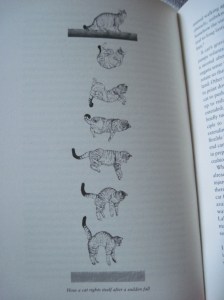
Bradshaw’s diagram of a cat landing on its feet.
Favorite lines:
- “Part of the pleasure of owning a pet comes from projecting our thoughts and feelings on to the animal, treating it as if it were almost human. We talk to our cats as if they could understand our every word, while knowing full well that they certainly can’t.”
- “Purring therefore seems to convey a general request: ‘Please settle down next to me.’ In the gentlest way, the purring cat is asking someone else, whether cat or human, to do something for it.”
The Church Cat: Clerical Cats in Stories and Verse, edited by Mark Bryant
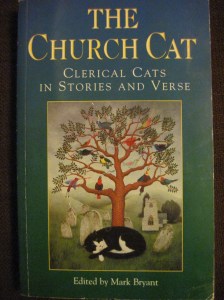 This seems like an impossibly narrow category: stories and poems that combine cats with a church setting. But Bryant has found some real gems that fulfill just that criterion. A few of the short stories, by Ellis Peters, M.R. James and Ernest Dudley, are compact murder mysteries. I most enjoyed Arnold Bennett’s “The Cat and Cupid,” about spinster sisters and “notorious cat-idolaters” who squabble over the handsome new organist; W.L. Alden’s “The Yellow Terror,” about a ship’s cat who insists that his owner hold church services onboard; and Christopher Park’s “The Case of the Cross-eyed Sphinx and the Holy Ghost” (my overall favorite) in which a newly married man meets his wife’s family, including a defrocked chaplain in a wheelchair and his barking mad wife, all of whom have “had an overdose of cat worship.” Of the 21 pieces, only five or six stood out for me (and none of the poetry, really). [Charity shop]
The Church Mice Adrift by Graham Oakley
This 1976 picture book was my introduction to the 14-strong “Church Mice” series. The town of Wortlethorpe is looking to modernize: tearing down all its heritage buildings in favor of glass-fronted monstrosities. This leaves a troop of rats without a home, but they spy an opportunity when they sneak through Sampson’s catflap in the church door. The wily creatures displace the church mice and even Sampson the ginger wonder cat can’t take back his territory. So the cat and his mice are forced to get creative, and come up with a plan that involves a doll’s house turned into a floating café for rats…
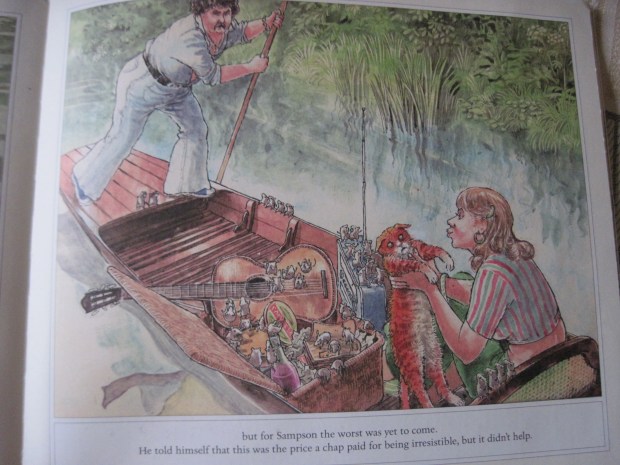
I loved the illustrations (the 1970s clothing on the few human characters cracked me up!) and the plot, a good mixture of humor and mild peril. There’s a fair number of words on each page, yet not too many. I can see this being ideal to read aloud with young children before having them take over the reading at age 5 or 6. I look forward to experiencing more of the church mice’s adventures. My thanks to Margaret of From Pyrenees to Pennines for recommending this charming series. [Public library]
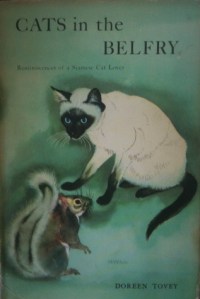
Cats in the Belfry by Doreen Tovey
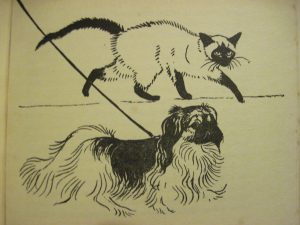
Solomon stalking a neighbor dog.
Do you think your cat is noisy and troublesome? Be thankful you don’t have Doreen Tovey’s Siamese cats! This 1957 book was the first of her many cat-themed memoirs and is perfectly delightful for any animal lover. Their first Siamese was Sugieh, who loved nothing more than to jump into a full bath and frighten the life out of the bather. They bred her and kept two of the littermates, Solomon and Sheba, a mischievous pair whose first three years of antics fill much of the book: terrorizing dogs, pulling down the curtains, following horses, and developing, er, ‘refined’ tastes – “What with spiders, string, and the occasional butterfly caught napping on a cabbage which he ate wings and all, Solomon was, of course, frequently sick. But never, ever, was he so gloriously sick as the day he ate the cream cakes.” [Charity shop]
Up next:
 I have Thomas McNamee’s The Inner Life of Cats (coming out on March 28th) and Jason Hazeley’s The Fireside Grown-Up Guide to the Cat (coming out on April 4th) on my e-readers.
- I’m sure to borrow more books from the public library by Tovey and Bradshaw, who has a book about training your cat (ha!).
- I covet I Could Pee on This, Too: And More Poems by More Cats by Francesco Marciuliano.
Whether you consider yourself a cat lover or not, do any of these books appeal?
Six “Love” Books for Valentine’s Day
Starting in mid-January I began surveying my shelves, library stack and Kindle for books with “love” in the title. Here are the six I had time to try; I didn’t get to Alain de Botton’s The Course of Love on my Kindle, nor my paperback copies of Iris Murdoch’s The Sacred and Profane Love Machine and Nancy Horan’s Loving Frank.
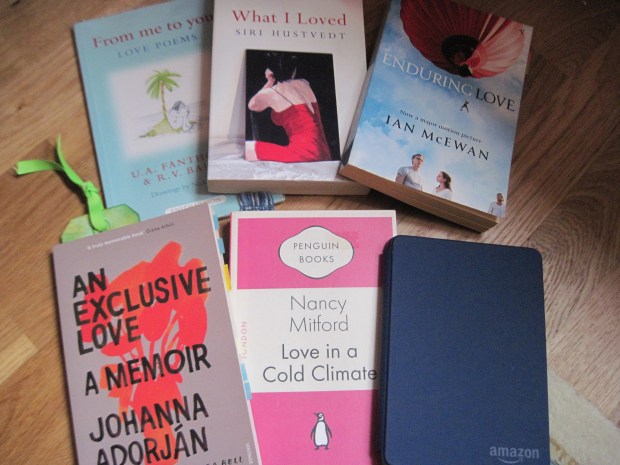
You’ll notice that a number of the books I’ve read aren’t that optimistic about love; in several cases the use of the word in the title even seems to be ironic. As Lady Montdore exclaims in Love in a Cold Climate, “Love indeed – whoever invented love ought to be shot.” So I can’t offer them as particularly romantic choices. But let’s start positively, with some pleasantly out-of-the-ordinary love poems.
From Me to You: Love Poems, U.A. Fanthorpe and R.V. Bailey
 Ursula Fanthorpe and Rosie Bailey met as English teachers at the same Cheltenham school in their late twenties and were partners for nearly 40 years. None of the poems in this short volume are attributed, though I recognized a few from Fanthorpe’s Collected Poems. They’re not particularly distinguished as poetry, but I appreciated the simple, unsentimental examples of what makes up everyday life with a partner: “There is a kind of love called maintenance, / Which stores the WD40 and knows when to use it; // Which checks the insurance, and doesn’t forget / The milkman” (“Atlas”) and “I’m working on a meal you haven’t had to imagine, / A house cleaned to the rafters” (“Dear Valentine”). [Public library]
What I Loved, Siri Hustvedt
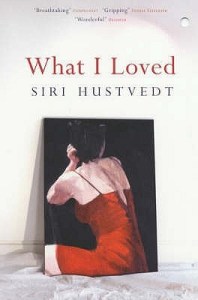 This 2003 novel could just as well have been titled “What I Lost,” which might be truer to its elegiac tone. Narrated by Professor Leo Hertzberg and set between the 1970s and 1990s, it’s about two New York City couples – academics and artists – and the losses they suffer over the years. With themes of modern art, perspective, memory, separation and varieties of mental illness, it asks to what extent we can ever know other people or use replacements to fill the gaps left by who and what is missing. Read it if you’ve enjoyed The Suicide of Claire Bishop by Carmiel Banasky, other books by Siri Hustvedt, or anything by Howard Norman. My favorite lines about love were “I often thought of our marriage as one long conversation” and “love thrives on a certain kind of distance … it requires an awed separateness to continue.” [Charity shop]
Love in a Cold Climate, Nancy Mitford
 I didn’t realize this 1949 novel is a sequel to The Pursuit of Love, so it took a while to figure out who all the characters were. Fanny Logan is a cousin orbiting around Lord and Lady Montdore and their daughter Polly Hampton, all recently returned from some years in India. Fanny marries an Oxford don, while Polly shocks everyone by eloping with her uncle by marriage, “Boy” Dougdale, a recent widower once known as the “Lecherous Lecturer” for interfering with little girls. (This hint of pedophilia is carelessly tossed off in a way no writer would get away with today.) Meanwhile, the heir to the Hampton estate, an effeminate chap named Cedric, comes over from Canada for a visit and wins Lady Montdore over. This amusing picture of aristocratic life in the 1930s marvels at who we love and why. [Bookbarn International]
Enduring Love, Ian McEwan
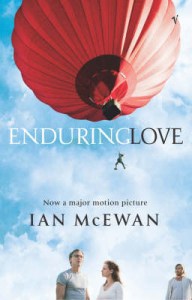 Interesting to consider this as a precursor to Saturday: both have a scientist as the protagonist and get progressively darker through a slightly contrived stalker plot. Enduring Love opens, famously, with a ballooning accident that leaves its witnesses questioning whether they couldn’t have done more to prevent it. Freelance science journalist Joe Rose – on a picnic with his partner, Keats scholar Clarissa, at the time – was one of those who rushed to help, as was Jed Parry, a young Christian zealot who fixates on Joe. He seems to think that by loving Joe, a committed atheist, he can bring him to God. In turn, Joe’s obsession with Jed’s harassment campaign drives Clarissa away. It’s a deliciously creepy read that contrasts rationality with religion and inquires into what types of love are built to last. [Charity shop]
An Exclusive Love: A Memoir, Johanna Adorján
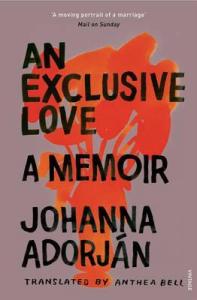 The author’s grandparents, Hungarian Holocaust survivors who moved to Denmark as refugees, committed suicide together on October 13, 1991. Her grandfather, an orthopedic surgeon who had been in an Austrian concentration camp, was terminally ill and his wife was determined not to live a day without him. This short, elegant memoir alternates Adorján’s imagined reconstruction of her grandparents’ last day with an account of their life together, drawn from family memories and interviews with those who knew them. She wonders whether, like Primo Levi and Arthur Koestler, theirs was a typically Jewish failure to fit in wherever they went, and/or a particularly Hungarian melancholy. “The answer is their great love,” the newspaper report of their death insisted. [Waterstones clearance]
Note: That striking cover is by Leanne Shapton.
And another nonfiction selection that I didn’t make it all the way through:
A Book about Love, Jonah Lehrer
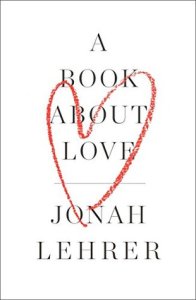 (Abandoned at 31%.) Although I can see why he starts where he does, Lehrer’s early focus on attachment and attunement – two psychological theories of how babies learn to relate affectionately to others – means the book gets bogged down in studies performed on mice and/or children and feels more like a parenting book than anything else. (If that’s what you’re after, read All Joy and No Fun.) A glance at the table of contents suggests the rest of the book will go into marriage, divorce and how love changes over time, but I couldn’t be bothered to stick around. That said, Lehrer’s popular science writing is clear and engaging, and with the heartfelt mea culpa at the start of this book I couldn’t hold a grudge about his earlier plagiarism scandal. [Kindle book from NetGalley.]
No overtly heartwarming love stories in that selection, then, but are there any you fancy reading anyway? Have you read any “love” titles recently?
See also: The Guardian’s list of Top 10 Authentic Romances.
Literary Power Couples: An Inventory
With Valentine’s Day on the way, I’ve been reading a bunch of books with “Love” in the title to round up in a mini-reviews post next week. One of them was What I Loved by Siri Hustvedt – my second taste of her brilliant fiction after The Blazing World. Yet I’ve not tried a one of her husband Paul Auster’s books. There’s no particular reason for that; I’ve even had his New York Trilogy out from the library in the past, but never got around to reading it.
How about some other literary power couples? Here’s some that came to mind, along with an inventory of what I’ve read from each half. It’s pretty even for the first two couples, but in most of the other cases there’s a clear winner.
Zadie Smith: 5
Nick Laird: 5 (= ALL)
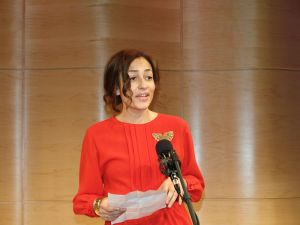
Zadie Smith in 2011. By David Shankbone (CC BY 3.0 (http://creativecommons.org/licenses/by/3.0) via Wikimedia Commons.
I’ve read all of Zadie Smith’s work apart from NW; I only got a few pages into it when it first came out, but I’m determined to try again someday. To my surprise, I’ve read everything her husband Nick Laird has ever published, which includes three poetry collections and two fairly undistinguished ‘lad lit’ novels. I’m pleased to see that his new novel Modern Gods, coming out on June 27th, is about two sisters and looks like a stab at proper literary fiction.
Jonathan Safran Foer: 4 (= ALL)
Nicole Krauss: 3 (= ALL)
Alas, they’re now an ex-couple. In any case, they’re both on the fairly short list of authors I’d read anything by. Foer has published three novels and the nonfiction polemic Eating Animals. Krauss, too, has three novels to her name, but a new one is long overdue after the slight disappointment of 2010’s Great House.
Margaret Drabble: 5
Michael Holroyd: 0
Michael Holroyd is a biographer and general nonfiction dabbler. I have a few of his books on my TBR but don’t feel much compulsion to seek them out. By contrast, I’ve read four novels and a memoir by Margaret Drabble and am likely to devour more of her fiction in the future.

Margaret Drabble in 2011. By summonedbyfells [CC BY 2.0 (http://creativecommons.org/licenses/by/2.0)%5D via Wikimedia Commons.
Claire Tomalin: 2
Michael Frayn: 1
Claire Tomalin’s masterful biographies of Charles Dickens and Thomas Hardy are pillars of my nonfiction collection, and I have her books on Nelly Ternan and Samuel Pepys on the shelf to read as well. From her husband, celebrated playwright Michael Frayn, however, I’ve only read the comic novel Skios. It is very funny indeed, though, about a case of mistaken identity at an academic conference on a Greek island.
Plus a few I only recently found out about:
Ian McEwan: 7 (+ an 8th in progress)
Annalena McAfee: 1 (I’ll be reviewing her novel Hame here on Thursday)
Katie Kitamura: 1 (I just finished A Separation yesterday)
Hari Kunzru: 0
Madeleine Thien: 1 (Do Not Say We Have Nothing)
Rawi Hage: 0
Afterwards I consulted the lists of literary power couples on Flavorwire and The Huffington Post and came up with a few more that had slipped my mind:
Michael Chabon: 1
Ayelet Waldman: 0
I loved Moonglow and am keen to try Michael Chabon’s other novels, but I also have a couple of his wife Ayelet Waldman’s books on my TBR.
Dave Eggers: 5
Vendela Vida: 0
I’ve read a decent proportion of Dave Eggers’s books, fiction and nonfiction, but don’t know anything by his wife and The Believer co-founder Vendela Vida.
David Foster Wallace: 2
Mary Karr: 1
I didn’t even know they were briefly a couple. From Wallace I’ve read the essay collection Consider the Lobster and the commencement address This Is Water. I’ve definitely got to get hold of Karr’s memoirs, having so far only read her book about memoir (The Art of Memoir).
And some classics:
Ted Hughes: 1 (Crow)
Sylvia Plath: 0
F. Scott Fitzgerald: 2 (The Great Gatsby and Tender Is the Night)
Zelda Fitzgerald: 0
![F. Scott and Zelda Fitzgerald in 1921. By Kenneth Melvin Wright (Minnesota Historical Society) [Public domain], via Wikimedia Commons.](https://bookishbeck.com/wp-content/uploads/2017/02/f_scott_fitzgerald_and_wife_zelda_september_1921.jpg?w=208&h=300)
F. Scott and Zelda Fitzgerald in 1921. By Kenneth Melvin Wright (Minnesota Historical Society) [Public domain], via Wikimedia Commons.
How have you fared with these or other literary power couples? Do you generally gravitate towards one or the other from a pair?
My (Tiny) Collection of Signed Copies
The other day I discovered a pencil-written recipe in the back of a secondhand book I got for Christmas. It got me thinking about handwriting in books: signatures, inscriptions, previous owners’ names, marginalia, and so on. If I can find enough examples of all those in my personal library, I might turn this into a low-key series. For now, though, I’ve rounded up my signed copies for a little photo gallery.
I’ve never placed particular value on owning signed copies of books. I’m just as likely to resell a signed book or give it away to a friend as I am a standard copy. The signed books I do have on my shelves are usually a result of having gone to an author event and figuring I may as well stick around for the signing. A few were totally accidental in secondhand purchases.
Though I’ve had personal correspondence with Paulette Bates Alden and love the three books of hers that I’ve read, this signature is entirely coincidental, in a used copy from Amazon. Shame on Patti for getting rid of it after Paulette’s book club visit in 2000!
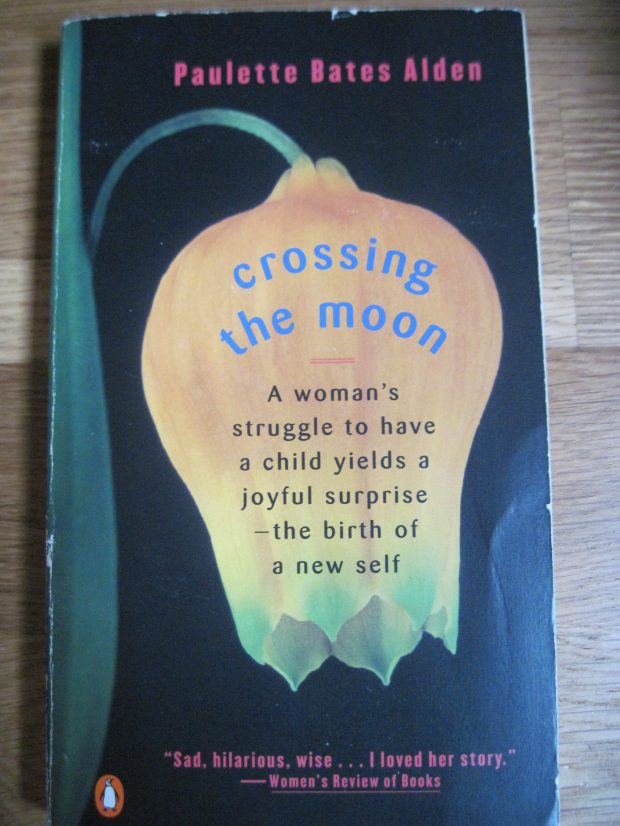

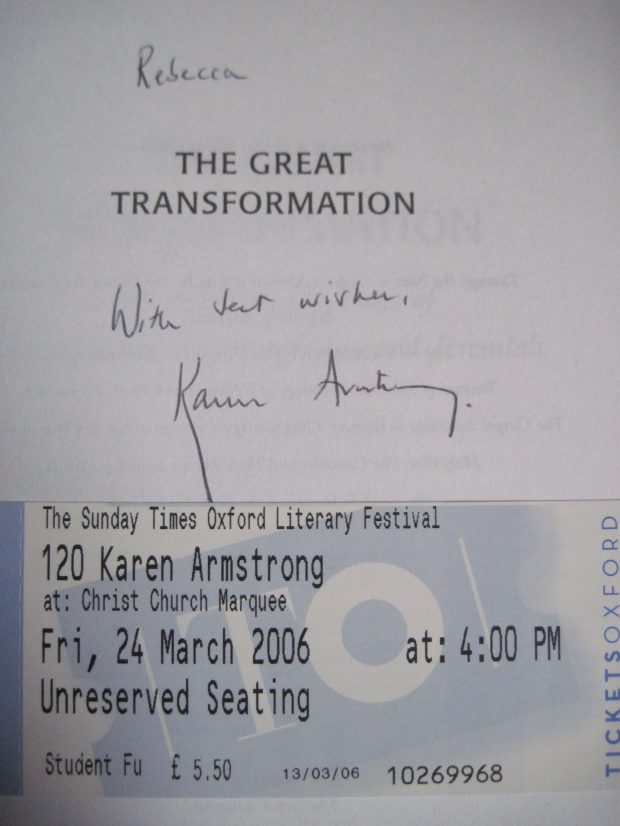
I love Karen Armstrong’s work, especially her two memoirs about deciding not to be a nun, and A History of God. I’ve seen her speak twice and am always impressed by her clear reasoning. (Tell you a secret, though: I couldn’t get through this particular book.)
While my husband worked at Royal Holloway we saw Alain de Botton speak at the Runnymede Literary Festival and I had him sign a copy of my favorite of his books.


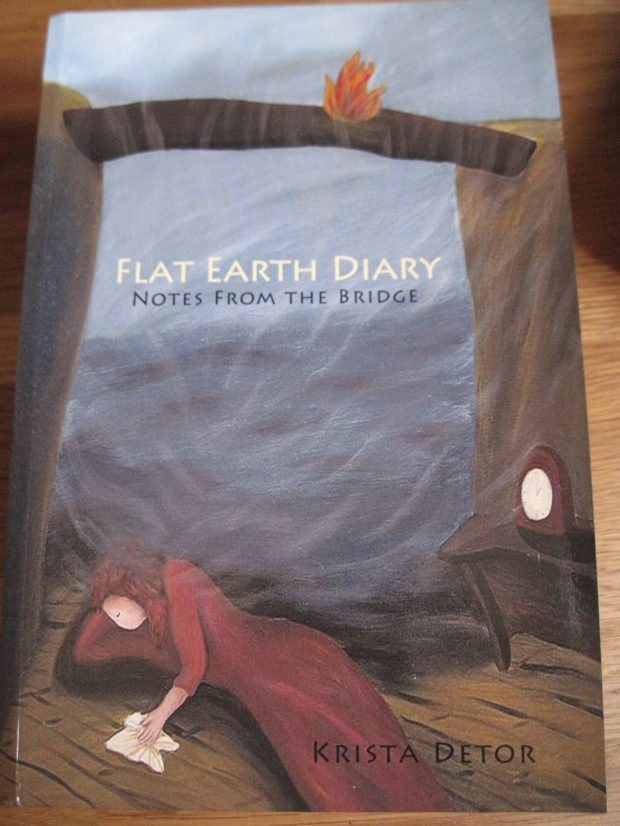
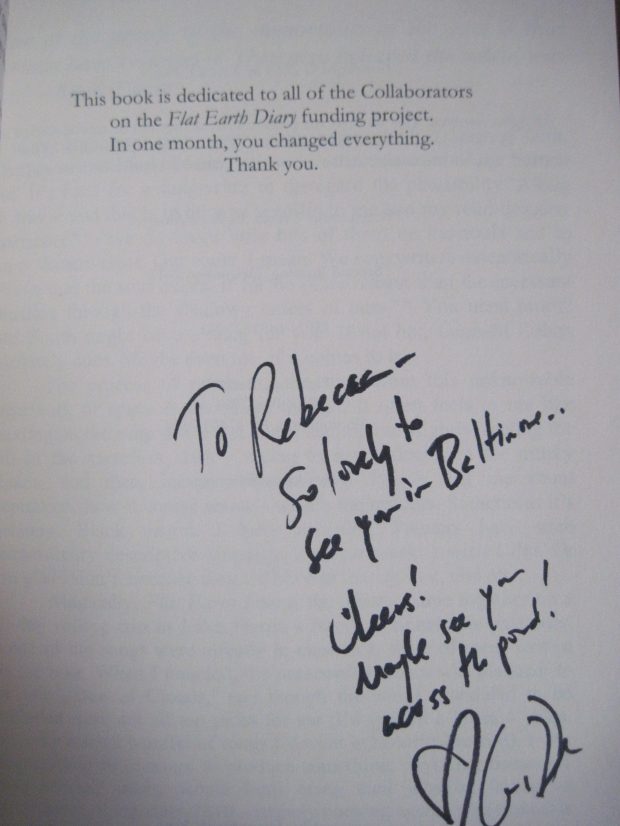
Krista Detor is one of our favorite singer-songwriters. We’ll be seeing her play for the fourth time in March. Luckily for us (but unluckily for the world, and for her coffers), this folk songstress from Indiana is unknown enough to play folk clubs and house concerts on both sides of the Atlantic. She wrote a book documenting the creative process behind her next-to-last album; when I saw her in Maryland she signed it with “Maybe see you across the pond!”
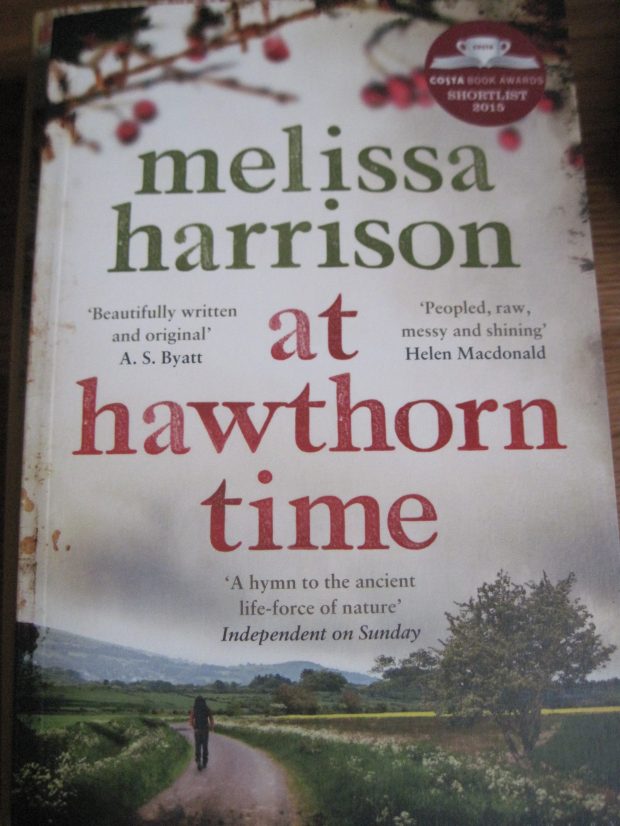
I have yet to read one of Melissa Harrison’s books, though I’m interested in her novels and her book on British weather. However, she edited the Seasons anthologies issued by the Wildlife Trusts last year – two of which my husband’s writing appeared in. When she spoke on the University of Reading campus about notions of the countryside in literature, my husband went along to meet her and bought a paperback of her second novel for her to sign.

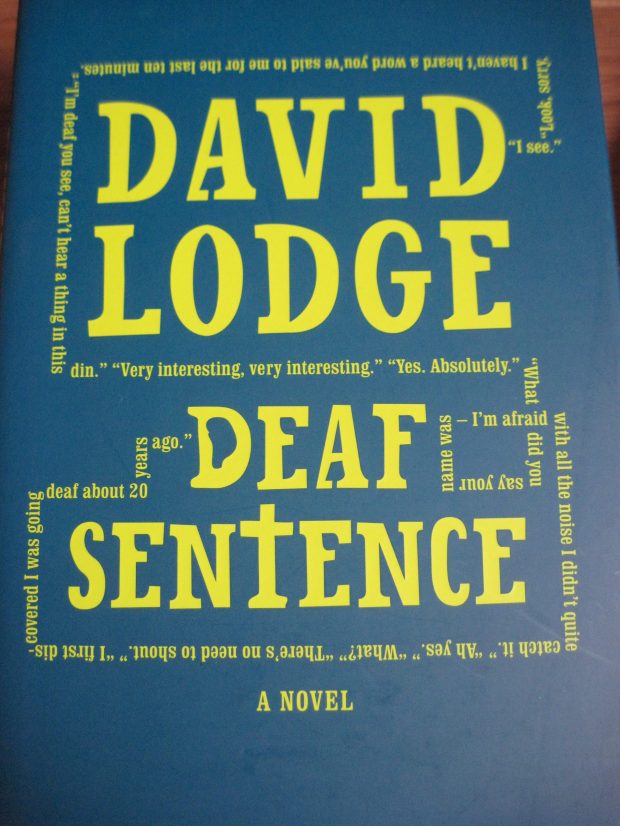
I’ve seen David Lodge speak twice, both times at the London Review Bookshop. He’s one of my favorite authors ever but, alas, isn’t all that funny or personable live; his autobiography is similarly humorless compared to his novels. Deaf Sentence was a return to his usual comic style after his first stab at historical fiction (Author, Author, about Henry James’s later life). The second time I saw him he was promoting A Man of Parts, which again imagines the inner life of a famous author – this time H.G. Wells.

An obscene bargain from Amazon that just happened to be signed. I’m looking forward to starting this one soon: books about book are (almost) always such a cozy delight.

-
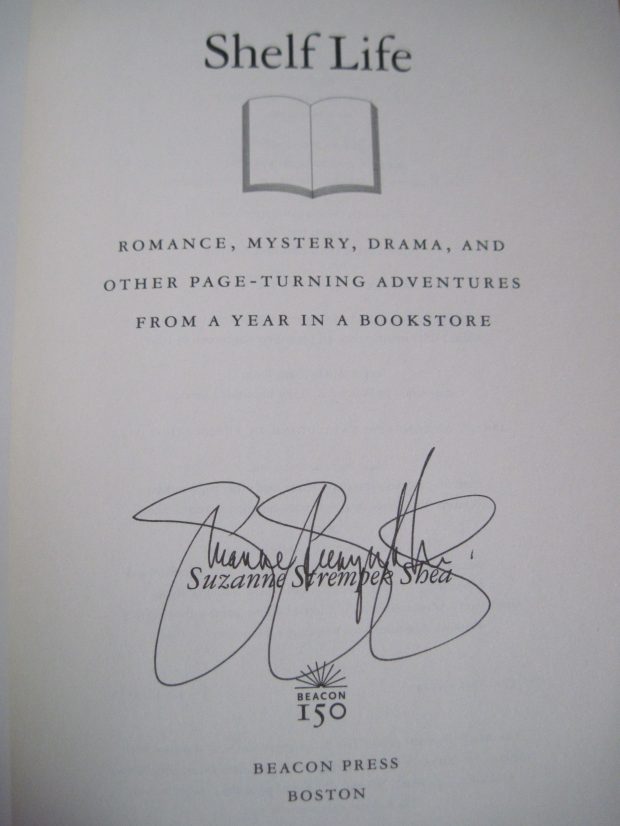
- You can tell she enjoys her S’s.
Plus three signed copies languishing in boxes in America:
- Blue Shoe by Anne Lamott: I love Lamott’s nonfiction but have never tried one of her novels. I found this one at a library book sale, going for $1; I guess nobody noticed the signature.
- The Sixteenth of June by Maya Lang: I originally read the book via NetGalley, but it quickly became a favorite. After she saw my five-star review, Maya asked me to help her out with word-of-mouth promotion and was kind enough to send me a signed copy as thanks.
- The Life of D.H. Lawrence: An Illustrated Biography by Keith M. Sagar: Sagar was one of the keynote speakers at the D.H. Lawrence Society of North America conference I attended in the summer of 2005.
Do you deliberately buy signed copies? What are some of the jewels in your collection?
Some Books I Was Surprised to Love
Like most fiction readers, I generally stick with what I’m pretty sure I’ll like. For me that means that, unless I’ve heard very good feedback that makes me think the book will stand out from its peers, I tend to avoid science fiction, fantasy, and mystery novels (or genre fiction in general). I’m also leery of magic realism and allegories, as these techniques can so often be cringe-inducing. But occasionally a book will come along that proves me wrong.
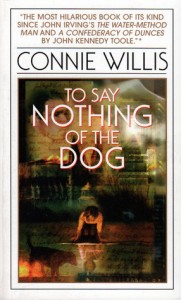 For instance, last week I finished To Say Nothing of the Dog by Connie Willis. Time travel would normally be a turnoff for me, but Willis manages it perfectly in this uproarious blend of science fiction and pitch-perfect Victorian pastiche (boating, séances and sentimentality, oh my!). Once I got into it, I read it extremely quickly – finishing the final 230 pages on one Sunday afternoon and evening – and it provoked a continuous stream of snorts. I can hardly think of anyone I wouldn’t recommend it to.
This got me thinking about some other pleasantly surprising books that took me outside of my usual reading comfort zone in recent years:
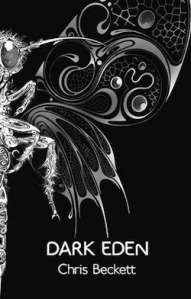 Dark Eden by Chris Beckett: Six generations ago a pair of astronauts landed on the planet Eden and became matriarch and patriarch of a new race of eerily primitive humans. A young leader, John Redlantern, rises up within the group, determined to free his people from their limited worldview by demythologizing their foundational story. Through events that mirror many of the accounts in Genesis and Exodus, Beckett provides an intriguing counterpoint to the ways Jews and Christians relate to the biblical narrative. Page-turning science fiction with deep theological implications. I liked each of the two sequels less than the book that went before, but they’re still worth reading.
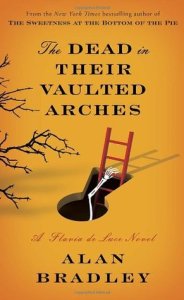 The Flavia de Luce mysteries by Alan Bradley: Normally I shy away from series and tire of child narrators – and yet I find the Flavia de Luce novels positively delightful. Why? Well, Canadian author Alan Bradley’s quaintly authentic mysteries are set at Buckshaw, a crumbling country manor house in 1950s England, where the titular eleven-year-old heroine, also the narrator, performs madcap chemistry experiments and solves small-town murders. The Dead in Their Vaulted Arches (#6) is the best yet. In this installment, Flavia finally learns of her unexpected inheritance from her mother. The most recent, Thrice the Brinded Cat Hath Mew’d (#8), is a close second.
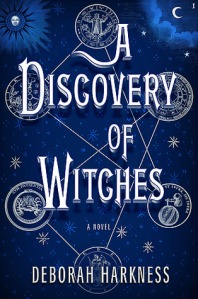 A Discovery of Witches by Deborah Harkness: The thinking gal’s Twilight. Harkness, a historian of science, draws on her knowledge of everything from medieval alchemy to recent DNA mapping. The main character, reluctant witch Diana Bishop, is studying alchemical treatises at the Bodleian Library. She calls up an enchanted manuscript from Ashmole’s original collection, presumed missing since 1859. There are three excised pages, and the book instantly draws attention from the myriad “creatures” (non-humans) plaguing Oxford. Enter Matthew Clairmont, a mega-hot vampire with a conscience. From rural France to upstate New York, he and Diana fight off rival vampires and the witches who killed Diana’s parents. As with Beckett’s books, the two sequels are a bit of a letdown, but the first book is great fun.
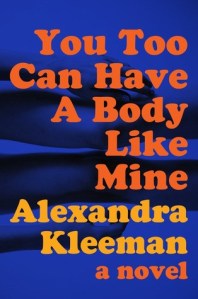 You Too Can Have a Body Like Mine by Alexandra Kleeman: A full-on postmodern satire bursting with biting commentary on body image, consumerism and conformity. The narrator, known only as A, lives in a shared suburban apartment. She and her roommate, B, are physically similar and emotionally dependent, egging each other on to paranoid anorexia. Television and shopping are the twin symbolic pillars of a book about the commodification of the body. In a culture of self-alienation where we compulsively buy things we don’t need, have no idea where our food comes from and worry about keeping up a facade of normalcy, Kleeman’s is a fresh voice advocating the true sanity of individuality.
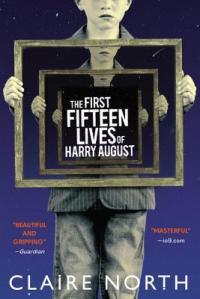 The First Fifteen Lives of Harry August by Claire North: The theme of a character reliving the same life over and over will no doubt have you thinking of Kate Atkinson’s Life After Life, but I liked this book so much better. Perhaps simply because of the first-person narration, I developed much more of a fondness for Harry August and his multiple life stories than I ever did for Ursula Todd. Harry, the illegitimate son of a servant girl, is born in the same manner each time – on New Year’s Day 1919, in the ladies’ restroom at Berwick-upon-Tweed rail station! – but becomes many people in his different lives.
What books were you surprised to love recently?
Books that (Should Have) Literally Changed My Life
(Following on from my posts Landmark Books from My Early Life and Landmark Books in My Life, Part II.)
Every once in a while you’ll hear someone claim that a certain book will change your life. I think of a scene in Garden State, still one of my favorite movies of all time, where Natalie Portman’s character tells Zach Braff’s character “this song will change your life” and puts The Shins’ “New Slang” on his headphones. (Ok, it’s a good song, but not that great.)
Are there any books that have literally changed my life? I can think of a handful that have been extremely influential on my worldview and, in a couple of cases, also changed my behavior. As it happens, they’re all nonfiction.
Religion
 After I got back to the States from my year abroad, I spent a few years doing some intensive reading about progressive Christianity (it was sometimes also called the emergent church) and other religions, trying to decide if it was worth sticking with the faith I’d grown up in. Although I still haven’t definitively answered this for myself, and have drifted in and out of lots of churches over the last 12 years, two authors were key to me never ditching Christianity entirely: Brian McLaren and Marcus Borg.
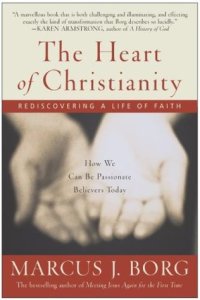 McLaren founded the church we attend whenever we’re back in Maryland and is the author of over a dozen theology titles, including the New Kind of Christian trilogy of allegorical novels. For me his best book is A New Kind of Christianity, which pulls together all his recurrent themes. Borg, who died in 2015, wrote several books that made a big impression on me, but none more so than The Heart of Christianity, which is the best single book I’ve found about what Christianity can and should be, going back to Jesus’ way of peace and social justice and siphoning off the unhelpful doctrines that have accumulated over the centuries.
 Any number of other Christian books and authors have been helpful to me over the years (Secrets in the Dark by Frederick Buechner, How (Not) to Speak of God by Peter Rollins, Falling Upward by Richard Rohr, An Altar in the World by Barbara Brown Taylor, Without Buddha I Could Not be a Christian by Paul Knitter, Unapologetic by Francis Spufford, and various by Kathleen Norris, Rowan Williams, Richard Holloway and Anne Lamott), reassuring me that it’s not all hellfire/pie in the sky mumbo-jumbo for anti-gay Republicans, but Borg and McLaren were there at the start of my journey.
Sexuality
 Reading is my primary means of examining society as well as my own life, so it’s no wonder that I have turned to books to learn from some gender pioneers. Hanne Blank’s accessible social history Straight (2012) is particularly valuable for its revelation of the surprisingly short history of heterosexuality as a concept – the term has only existed since the 1860s. But the book that most helped me adjust my definitions of gender and broaden my tolerance was Conundrum by Jan Morris (1974).
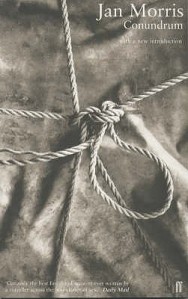 James Morris, born in 1926, was a successful reporter, travel writer, husband and father. Yet all along he knew he was meant to be female; it was something he had sensed for the first time as a young child sitting under the family piano: “I was three or perhaps four years old when I realized that I had been born into the wrong body, and should really be a girl … the conviction was unfaltering from the start.” In 1954 he began taking hormones to start his transition to womanhood, completed by a sex reassignment surgery in Morocco in 1972. This exceptional memoir of sex change evokes the swirl of determination and doubt, as well as the almost magical process of metamorphosing from one thing to another. Morris has been instrumental in helping me see sexuality as a continuum rather than a fixed entity.
Food
Apart from Michael Pollan, can you guess who’s had the greatest influence on my eating habits? You might be surprised to learn it’s American novelist Jonathan Safran Foer. In 2009 he published a provocative book called Eating Animals. I’m still surprised by how powerful and challenging I found it, considering that I knew pretty much what to expect: anti-meat rhetoric from a trendy vegetarian, with plenty of arresting statistics and horrifying behind-the-scenes accounts of factory farming and slaughter. But I set aside my jaded approach to potential propaganda and let it all saturate me, and it was devastating.
 The fact that I still haven’t completely given up meat is proof of how difficult it is to change, even once you’ve been convicted. We’ve gone from eating meat occasionally to almost never, and then mostly when we’re guests at other people’s houses. But if I really reminded myself to think about where my food was coming from, I’m sure we’d be even more hardline. Foer didn’t answer all my questions – what about offal and wild game, and why not go all the way to veganism? – but I appreciated that he never characterizes the decision to be vegetarian as an easy one. He recognizes the ways food is bound up with cultural traditions and family memories, but still thinks being true to one’s principles outweighs all. (He’s brave enough to suggest to middle America that it’s time to consider a turkey-free Thanksgiving!)
Daily Life
 There’s nothing more routine than brushing your teeth, and I never thought I would learn a new way to do it at age 32! But that’s just what Ignore Your Teeth and They’ll Go Away by Sheldon Dov Sydney gave me. He advises these steps: (1) brushing with a dry brush to remove bits of food and plaque, (2) flossing, and (3) brushing with toothpaste as a polish and to freshen breath. It takes a little bit longer than your usual quick brush and thus I can’t often be bothered to do it, but it does always leave my mouth feeling super-clean.
 I frequently succumb to negative self-talk, thinking “I can’t cope” or “There’s no way I could…” Feel the Fear and Do It Anyway by Susan Jeffers helped me see that I need to be more positive in my thought life. Originally published in 1987, the self-help classic says that at the base of every fear is a belief that “I can’t handle it.” Our fears are either of things that can happen to us (aging and natural disasters) or actions we might take (going back to school or changing jobs). You can choose to hold fear with either pain (leading to paralysis) or power (leading to action). This is still a struggle for me, but whenever I start to think “I can’t” I try to replace it with Jeffers’ mantra, “Whatever it is, I’ll handle it.”
Can you think of any books that have literally changed your life?
2016 Runners-Up and Other Superlatives
Let’s hear it for the ladies! In 2016 women writers accounted for 9 out of my 15 top fiction picks, 12 out of my 15 nonfiction selections, and 8 of the 10 runners-up below. That’s 73%. The choices below are in alphabetical order by author, with any full reviews linked in. Many of these have already appeared on the blog in some form over the course of the year.
Ten Runners-Up:
FICTION
 Hag-Seed by Margaret Atwood: Atwood looks more like a good witch every year, and here she works her magic on The Tempest to produce the most satisfying volume of the Hogarth Shakespeare series yet. There’s a really clever play-within-the-play-within-the-play thing going on, and themes of imprisonment and performance resonate in multiple ways.
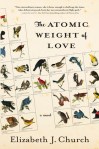 The Atomic Weight of Love by Elizabeth J. Church: In Church’s debut, an amateur ornithologist learns about love and sacrifice through marriage to a Los Alamos physicist and a relationship with a Vietnam veteran. I instantly warmed to Meri as a narrator and loved following her unpredictable life story.
 We Love You, Charlie Freeman by Kaitlyn Greenidge: The Freemans are raising Charlie, a chimpanzee, as part of their family for a Toneybee Institute experiment and teaching him to communicate via sign language. This is a rich and unsettling story of human–human interactions, even more so than human–animal interactions; it’s a great first novel and I will follow Greenidge’s career with interest.
To the Bright Edge of the World by Eowyn Ivey: Ivey’s intricate second novel weaves together diaries, letters, photographs, and various other documents and artifacts to tell the gently supernatural story of an exploratory mission along Alaska’s Wolverine River in 1885 and its effects through to the present day. I can highly recommend this rollicking adventure tale to fans of historical fiction and magic realism.
This Must Be the Place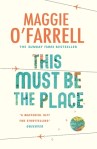 by Maggie O’Farrell: Spreading outward from Ireland and reaching into every character’s past and future, this has all O’Farrell’s trademark insight into family and romantic relationships, as well as her gorgeous prose and precise imagery. I have always felt that O’Farrell expertly straddles the (perhaps imaginary) line between literary and popular fiction; her books are addictively readable but also hold up to critical scrutiny.
Commonwealth by Ann Patchett: This deep study of blended family dynamics starts with an early 1960s christening party Los Angeles policeman Fix Keating is throwing for his younger daughter, Franny; we see the aftermath of that party in the lives of six step-siblings in the decades to come. This is a sophisticated and atmospheric novel I would not hesitate to recommend to literary fiction fans in general and Patchett fans in particular.
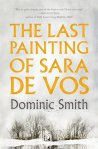 The Last Painting of Sara de Vos by Dominic Smith: Jessie Burton, Tracy Chevalier and all others who try to write historical fiction about the Netherlands in the seventeenth century, eat your hearts out. Such a beautiful epoch-spanning novel about art and regret.
Shelter by Jung Yun: A Korean-American family faces up to violence past and present in a strong debut that offers the hope of redemption. I would recommend this to fans of David Vann and Richard Ford.
NONFICTION
I Will Find You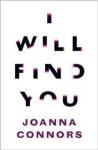 by Joanna Connors: By using present-tense narration, Connors makes the events of 1984 feel as if they happened yesterday: a blow-by-blow of the sex acts forced on her at knife-point over the nearly one-hour duration of her rape; the police reports and trials; and the effects it all had on her marriage and family. This is an excellent work of reconstruction and investigative reporting.
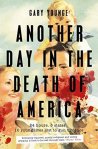 Another Day in the Death of America by Gary Younge: Younge built this book by choosing a 24-hour period (November 22 to 23, 2013) and delving into all 10 gun deaths of young Americans on record for that time: seven black, two Latino, and one white; aged nine to 18; about half at least vaguely gang-related, while in two – perhaps the most crushing cases – there was an accident while playing around with a gun. I dare anyone to read this and then try to defend gun ‘rights’ in the face of such senseless, everyday loss.
Various Superlatives:
Best Discoveries of the Year: Apollo Classics reprints (I reviewed three of them this year); Diana Abu-Jaber, Linda Grant and Kristopher Jansma.
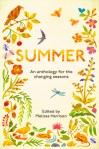
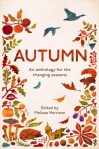
Most Pleasant Year-Long Reading Experience: The seasonal anthologies issued by the UK Wildlife Trusts and edited by Melissa Harrison (I reviewed three of them this year).

Most Improved: I heartily disliked Sarah Perry’s debut novel, After Me Comes the Flood. But her second, The Essex Serpent, is exquisite.
Debut Novelists Whose Next Work I’m Most Looking Forward to: Stephanie Danler, Kaitlyn Greenidge, Francis Spufford, Andria Williams and Sunil Yapa.
The Year’s Biggest Disappointments: Here I Am by Jonathan Safran Foer, Today Will Be Different by Maria Semple, and Swing Time by Zadie Smith. Here’s hoping 2017 doesn’t bring any letdowns from beloved authors.


The Worst Book I Read This Year: Paulina & Fran (2015) by Rachel B. Glaser. My only one-star review of the year. ’Nuff said?
The 2016 Novels I Most Wish I’d Gotten to: (At least the 10 I’m most regretful about)
- The Power by Naomi Alderman
- The Museum of You by Carys Bray
- The Course of Love by Alain de Botton
- What Belongs to You by Garth Greenwell*
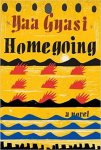 Homegoing by Yaa Gyasi
- The Waiting Room by Leah Kaminsky
- The Inseparables by Stuart Nadler
- Harmony by Carolyn Parkhurst*
- The Nest by Cynthia D’Aprix Sweeney*
- The Underground Railroad by Colson Whitehead*
*Haven’t been able to find anywhere yet; the rest are on my Kindle.
Which of these should I get reading on the double?
Coming tomorrow: Some reading goals for 2017.
Favorite Nonfiction Reads of 2016
Below I’ve chosen my 10 favorite nonfiction books published in 2016, followed by five older nonfiction reads that I only discovered this year. I find it nigh on impossible to compare different genres of nonfiction, so I’m not ranking these but simply listing them alphabetically by author (interestingly, all but one of the 2016 books are by women).
As with yesterday’s fiction choices, many of these books have already featured on the blog in some way over the course of the year. To keep it simple for myself as well as for all of you who are figuring out whether you’re interested in these books or not, I’m limiting myself to two sentences per title: the first is a potted summary; the second tells you why you should read it. I also link to any full reviews.
The Best of 2016
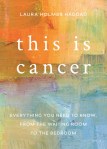 This Is Cancer by Laura Holmes Haddad: A stage IV inflammatory breast cancer survivor, the author wrote the “What to Expect” guide she wishes she could have found at the time of her diagnosis in 2012. Throughout this comprehensive, well-structured book, she uses her own experience to set out practical advice for dealing with the everyday medical and emotional realities of cancer.
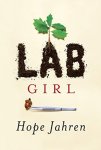 Lab Girl by Hope Jahren: With witty anecdotes and recreated dialogue, Jahren tells about her Minnesota upbringing, her long years in education, her ultimate specialization in geobiology/botany, crossing the country to take up academic posts in Atlanta, Baltimore and Hawaii, her long-time platonic relationship with eccentric lab partner Bill, and zany road trips across America for conferences and field work. What I think she does best is convey what it’s like to have true passion for your work, a rare thing.
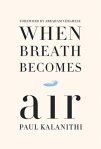 When Breath Becomes Air by Paul Kalanithi: Kalanithi was 36 and just completing his neurosurgery residency in Stanford, California when he was diagnosed with advanced lung cancer that did not respond well to treatment; he devoted his last year to writing this. I would recommend this cancer memoir to anyone for the beauty of its prose – a fine blend of literature and medicine – and the simple yet wholehearted picture of a life cut short.
 The Lonely City by Olivia Laing: A remarkable piece of work fusing social history, commentary on modern art, biographical observation and self-knowledge. It’s a testament to Laing’s skill when I say that I knew next to nothing about any of these artists to start with and have little fondness for modern art but still found her book completely absorbing.
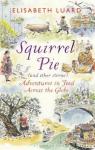 Squirrel Pie (and Other Stories): Adventures in Food across the Globe by Elisabeth Luard: Broadly speaking, this is about indigenous and peasant cooking traditions, a remit that allows Luard to include and adapt travel pieces she’s written over the past 20 years. It’s a cozy and conversational book for anyone who enjoys cooking or eating food from different cuisines (from Maui and Romania to Gujarat and Ethiopia); Luard’s own sketches and line drawings provide a lovely accompaniment.
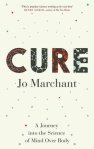 Cure: A Journey into the Science of Mind over Body by Jo Marchant: Marchant, a journalist with a PhD in genetics and medical microbiology, investigates instances where the mind seems to contribute to medical improvement: the use of placebos in transplant recipients, hypnosis for IBS patients, virtual reality to help burn victims manage pain, and the remarkable differences that social connection, a sense of purpose, meditation and empathic conversation all make. I finished the book feeling intrigued and hopeful about what this might all mean for the future of medicine.
 Poor Your Soul by Mira Ptacin: Ptacin’s wonderful memoir is based around two losses: her brother in a collision with a drunk driver, and a pregnancy in 2008; she skips back and forth in time to examine the numb aftermath of trauma as well as the fresh pain of actually going through it. I loved so much about this book, especially her memories of growing up in the cereal capital of America in Michigan and the account of her mother coming to America from Poland and setting up a fine-dining restaurant.
 The Violet Hour: Great Writers at the End by Katie Roiphe: An erudite, elegiac work of literary biography that takes in Susan Sontag, Sigmund Freud, John Updike, Dylan Thomas, Maurice Sendak and James Salter. What Roiphe observes of Sendak’s habit of drawing the dead and dying could equally be applied to The Violet Hour: it’s about seeing the beauty in what terrifies you.
 Beyond the High Blue Air: A Memoir by Lu Spinney: In March 2006 Lu Spinney’s twenty-nine-year-old son, Miles King, was on a snowboarding holiday in Austria; on the final morning of the trip he took a fall that would leave this athlete, intellectual, and entrepreneur with a traumatic brain injury. Spinney tells her sad tale remarkably well, in a consciously literary style: with no speech marks and present-tense narration, thought and action flow lucidly into dialogue and daydream; she always chooses just the right metaphors, too.
 The Lion in the Living Room: How House Cats Tamed Us and Took Over the World by Abigail Tucker: From the earliest domestication of animals to the cat meme-dominated Internet, Tucker marvels at how cats have succeeded by endearing themselves to humans and adapting as if effortlessly to any habitat in which they find themselves. This is the amazing cat book I’d been looking for, but I don’t think you even have to be a pet person to find this wide-ranging book enthralling.
If I had to list an overall favorite nonfiction book of the year, it would be The Violet Hour.
The Best of the Rest
Stir: My Broken Brain and the Meals That Brought Me Home by Jessica Fechtor (2015): At age 28 Fechtor, then a graduate student in history and Yiddish, collapsed on a treadmill with a brain bleed; a subsequent surgery to clip the aneurysm left her blind in one eye. She gives a glimpse into an ordinary existence turned upside down and the foods that helped her regain a zest for life by reconnecting her with her family and her Jewish heritage.
A Time of Gifts by Patrick Leigh Fermor (1977): Over the course of three years in the 1930s, starting when he was just 18, Fermor walked from Holland to Constantinople; this first of three volumes covers up until his entry into Hungary. His descriptions of the landscape and the people he interacted with are as fresh as if they happened yesterday; the precious glimpse of pre-war history and the damn fine writing make this a true masterwork of travel writing.
The Cloister Walk by Kathleen Norris (1996): Norris draws lessons from the time she spent as a lay Benedictine oblate but also simply reflects on her own life: the blessings and challenges of being a freelance poet and theologian; the daily discipline involved in marriage, keeping a house and gardening; and childhood memories from Virginia, Illinois and Hawaii. This is an impressively all-encompassing and eloquent set of essays on how faith intersects with everyday life.
One of Us : The Story of a Massacre and Its Aftermath by Åsne Seierstad (2015): An utterly engrossing account of Anders Behring Breivik’s July 22, 2011 attacks on an Oslo government building (8 dead) and the political youth camp on the island of Utøya (69 killed). This is a book about love and empathy – what they can achieve and what happens when they are absent; it shows how wide the ripples of one person’s actions can be, and how deep individual motivation goes.
 The Complete Maus by Art Spiegelman (1986): Spiegelman drew these allegorical tableaux to illustrate what, from a distance of decades, his Polish father Vladek told him about his almost unbelievable series of escapes, including time in Auschwitz. The only graphic novel to win the Pulitzer Prize, this brings the Holocaust home in a fresh way and paved the way for comic artists like Roz Chast and Alison Bechdel.
What were some of your top nonfiction reads of the year?
Tomorrow I’ll list some runners-up for the year, and award a few more superlatives.
 Bookish Beck = Rebecca Foster. American transplant to England. Freelance proofreader and book reviewer.
 Bookish Beck