Prize Updates: McKitterick Prize Winner and Wainwright Prize Longlists
It was my second year as a first-round manuscript judge for the McKitterick Prize; have a look at my rundown of the shortlist here.
 The winner, Louise Kennedy, and runner-up, Liz Hyder, were announced on 29 June. (Nominee Aamina Ahmad won a different SoA Award that night, the Gordon Bowker Volcano Prize for a novel focusing on the experience of travel away from home.) Other recipients included Travis Alabanza, Caroline Bird, Bonnie Garmus and Nicola Griffith. For more on all of this year’s SoA Award winners, see their website.


I’m a big fan of the Wainwright Prize for nature and conservation writing, and have been following it particularly closely since 2020, when I happened to read most of the nominees. In 2021 I also managed to read quite a lot from the longlists; 2022, the first year of an additional prize for children’s literature, saw me reading about a third of the total nominees.
This is the third year that I’ve been part of an “academy” of bloggers, booksellers, former judges and previously shortlisted authors asked to comment on a very long list of publisher submissions. I’m delighted that a few of my preferences made it through to the longlists.
My taste generally runs more to the narrative nature writing than the popular science or travel-based books. I find I’ve read just two from the Nature list (Bersweden and Huband) and one each from Conservation (Pavelle) and Children’s (Hargrave) so far.

The 2023 James Cropper Wainwright Prize for Nature Writing longlist:
- The Swimmer: The Wild Life of Roger Deakin, Patrick Barkham (Hamish Hamilton)
- The Flow: Rivers, Water and Wildness, Amy-Jane Beer (Bloomsbury)
- Where the Wildflowers Grow, Leif Bersweden (Hodder)
- Twelve Words for Moss, Elizabeth-Jane Burnett (Allen Lane)
- Cacophony of Bone, Kerri ní Dochartaigh (Canongate)
- Sea Bean, Sally Huband (Hutchinson)
- Ten Birds that Changed the World, Stephen Moss (Faber)
- A Line in the World: A Year on the North Sea Coast, Dorthe Nors, translated by Caroline Waight (Pushkin)
- The Golden Mole: And Other Living Treasure, Katherine Rundell, illustrated by Talya Baldwin (Faber)
- Belonging: Natural Histories of Place, Identity and Home, Amanda Thomson (Canongate)
- Why Women Grow: Stories of Soil, Sisterhood and Survival, Alice Vincent (Canongate)
- Landlines, Raynor Winn (Penguin)

The 2023 James Cropper Wainwright Prize for Writing on Conservation longlist:
- Sarn Helen: A Journey Through Wales, Past, Present and Future, Tom Bullough, illustrated by Jackie Morris (Granta)
- Beastly: A New History of Animals and Us, Keggie Carew (Canongate)
- Rewilding the Sea: How to Save Our Oceans, Charles Clover (Ebury)
- Birdgirl, Mya-Rose Craig (Jonathan Cape)
- The Orchid Outlaw, Ben Jacob (John Murray)
- Elixir: In the Valley at the End of Time, Kapka Kassabova (Jonathan Cape)
- Rooted: How Regenerative Farming Can Change the World, Sarah Langford (Viking)
- Black Ops and Beaver Bombing: Adventures with Britain’s Wild Mammals, Fiona Mathews and Tim Kendall (Oneworld)
- Forget Me Not, Sophie Pavelle (Bloomsbury)
- Fen, Bog, and Swamp: A Short History of Peatland Destruction and its Role in the Climate Crisis, Annie Proulx (Fourth Estate)
- The Lost Rainforests of Britain, Guy Shrubsole (HarperCollins)
- Nomad Century: How to Survive the Climate Upheaval, Gaia Vince (Allen Lane)

The 2023 James Cropper Wainwright Prize for Children’s Writing on Nature and Conservation longlist:
- The Earth Book, Hannah Alice (Nosy Crow)
- The Light in Everything, Katya Balen, illustrated by Sydney Smith (Bloomsbury)
- Billy Conker’s Nature-Spotting Adventure, Conor Busuttil (O’Brien)
- Protecting the Planet: The Season of Giraffes, Nicola Davies, illustrated by Emily Sutton (Walker)
- Blobfish, Olaf Falafel (Walker)
- A Friend to Nature, Laura Knowles, illustrated by Rebecca Gibbon (Welbeck)
- Spark, M G Leonard (Walker)
- A Wild Child’s Book of Birds, Dara McAnulty (Macmillan)
- Leila and the Blue Fox, Kiran Millwood Hargrave, illustrated by Tom de Freston (Hachette Children’s Group)
- The Zebra’s Great Escape, Katherine Rundell, illustrated by Sara Ogilvie (Bloomsbury)
- Archie’s Apple, Hannah Shuckburgh, illustrated by Octavia Mackenzie (Little Toller)
- Grandpa and the Kingfisher, Anna Wilson, illustrated by Sarah Massini (Nosy Crow)
It’s impressive that women writers are represented so well this year: 9/12 for Nature, 8/12 for Conservation, and 8/12 for Children’s. Amusingly, Katherine Rundell is on TWO of the lists. There are also, refreshingly, several BIPOC authors, and – I think for the first time ever – a work in translation (A Line in the World by Dorthe Nors, which I have as a set-aside proof copy and will get back into at once).
Here is where I have to admit that quite a number of the nominees, overall, are books I DNFed, authors whose work I’ve tried before and not enjoyed, or books I’ve been turned off of by the reviews. I’ll not mention these by name just now, and will leave any predictions for a future date when I’ve read a few more of the nominees. It seems that I’m most likely to catch up with the majority of the children’s longlist, if anything.
The shortlists will be announced on 10 August, and winners will be announced on 14 September at a 10th Anniversary live event held as part of the Kendal Mountain Festival in Cumbria (tickets available here).
See any nominees you’ve read? Who would you like to see shortlisted?
Introducing the 2023 McKitterick Prize Shortlist
For the second year in a row, I was a first-round judge for the McKitterick Prize (for a first novel by a writer over 40), helping to assess the unpublished manuscripts. Perhaps lockdowns gave people time to achieve a long-held goal of writing a novel, because submissions were up by 50%. None of the manuscripts made it through to the shortlist this year or last, but one day it could happen!

The Society of Authors kindly sent me a parcel with five of the shortlisted novels, and I picked up the remaining one from the library this week. Below are synopses from Goodreads and author bios from the SoA:
 The Return of Faraz Ali by Aamina Ahmad (Sceptre): “Sent back to his birthplace—Lahore’s notorious red-light district—to hush up the murder of a girl, a man finds himself in an unexpected reckoning with his past. … Profoundly intimate and propulsive, The Return of Faraz Ali is a spellbindingly assured first novel that poses a timeless question: Whom do we choose to protect, and at what price?”
Aamina Ahmad was born and raised in London, where she worked for BBC Drama and other independent television companies as a script editor. Her play The Dishonoured was produced by Kali Theatre Company in 2016. She has an MFA from the Iowa Writers’ Workshop and is a recipient of a Stegner Fellowship from Stanford University, a Pushcart Prize and a Rona Jaffe Writers Award. Her short fiction has appeared in journals including One Story, the Southern Review and Ecotone. She teaches creative writing at the University of Minnesota.
 When We Were Birds by Ayanna Lloyd Banwo (Hamish Hamilton): “Yejide and Darwin will meet inside the gates of Fidelis, Port Angeles’s largest and oldest cemetery, where the dead lie uneasy in their graves and a reckoning with fate beckons them both. A masterwork of lush imagination and immersive lyricism, When We Were Birds is a spellbinding novel about inheritance, loss, and love’s seismic power to heal.”
Ayanna Lloyd Banwo is a writer from Trinidad and Tobago. She is a graduate of the University of the West Indies and holds an MA in Creative Writing from the University of East Anglia, where she is now a Creative and Critical Writing PhD candidate. Her work has been published in Moko Magazine, Small Axe and PREE, among others, and shortlisted for the Small Axe Literary Competition and the Wasafiri New Writing Prize. When We Were Birds, Ayanna’s first novel, was shortlisted for the Jhalak Prize and won the OCM Bocas Prize for Fiction. She is now working on her second novel. Ayanna lives with her husband in London.
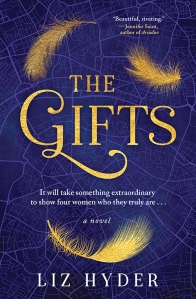 The Gifts by Liz Hyder (Manilla Press): “October 1840. A young woman staggers alone through a forest in the English countryside as a huge pair of impossible wings rip themselves from her shoulders. In London, rumours of a “fallen angel” cause a frenzy across the city, and a surgeon desperate for fame and fortune finds himself in the grips of a dangerous obsession. … [A] spellbinding tale told through five different perspectives …, it explores science, nature and religion, enlightenment, the role of women in society and the dark danger of ambition.”
Liz Hyder has been making up stories for as long she can remember. She has a BA in drama from the University of Bristol and, in early 2018, won the Bridge Award/Moniack Mhor Emerging Writer Award. Bearmouth, her debut young adult novel, won a Waterstones Children’s Book Prize, the Branford Boase Award and was chosen as the Children’s Book of the Year by The Times. Originally from London, she now lives in South Shropshire. The Gifts is her debut adult novel.
 Trespasses by Louise Kennedy (Bloomsbury Publishing): “Set in Northern Ireland during the Troubles, a shattering novel about a young woman caught between allegiance to community and a dangerous passion. … As tender as it is unflinching, Trespasses is a heart-pounding, heart-rending drama of thwarted love and irreconcilable loyalties, in a place what you come from seems to count more than what you do, or whom you cherish.”
Louise Kennedy grew up a few miles from Belfast. She is the author of the Women’s Prize-shortlisted novel Trespasses, and the acclaimed short story collection The End of the World is a Cul de Sac, and is the only woman to have been shortlisted twice for the Sunday Times Audible Short Story Award (2019 and 2020). Before starting her writing career, she spent nearly thirty years working as a chef. She lives in Sligo.
 The Whalebone Theatre by Joanna Quinn (Fig Tree): “One blustery night in 1928, a whale washes up on the shores of the English Channel. By law, it belongs to the King, but twelve-year-old orphan Cristabel Seagrave has other plans. She and the rest of the household … build a theatre from the beast’s skeletal rib cage. … As Cristabel grows into a headstrong young woman, World War II rears its head.”
Joanna Quinn was born in London and grew up in the southwest of England, where her bestselling debut novel, The Whalebone Theatre, is set. Joanna has worked in journalism and the charity sector. She is also a short story writer, published by The White Review and Comma Press, among others. She lives in a village near the sea in Dorset.
 Other Names for Love by Taymour Soomro (Harvill Secker): “A seductive coming-of-age story about queer desire, Other Names for Love is a charged, hypnotic debut novel about a boy’s life-changing summer in rural Pakistan: a story of fathers, sons, and the consequences of desire. … Decades later, Fahad is living abroad when he receives a call from his mother summoning him home. … [A] tale of masculinity, inheritance, and desire set against the backdrop of a country’s violent history, told with uncommon urgency and beauty.”
Taymour Soomro is the author of Other Names for Love and co-editor of Letters to a Writer of Colour. His writing has been published in the New Yorker, the New York Times and elsewhere. He is the recipient of fellowships from the Wisconsin Institute for Creative Writing, Bread Loaf Writers’ Conference and the Sozopol Fiction Seminars. He has degrees from Cambridge University and Stanford Law School and a PhD in creative writing from the University of East Anglia. He currently teaches on the MFA program at Bennington College.
Fellow judge Selma Dabbagh summarises the shortlist thus: “Family estates in rural Pakistan (Other Names for Love) and England (The Whalebone Theatre) fall into decline reflecting the hubris and short-sightedness of their owners[;] in The Return of Faraz Ali, it is the decaying grandeur of the courtesans of Lahore that is lovingly depicted. Whereas in both The Gifts and When We Were Birds, the otherworldly brings new possibilities to the tawdry and impoverished as mystical wings fly over the slums of Victorian London and the graveyards of Trinidad.”
I was already interested in reading a couple of these novels, and was pleased to discover a few new-to-me titles. As it’s also shortlisted for the Women’s Prize (which will be awarded on Wednesday), it seems to make sense to start with Trespasses, and I’m also particularly keen on The Gifts, which sounds like a great holiday read and right up my street, so I’m packing it for our trip to Scotland later this month. One or more of the others might end up on my 20 Books of Summer list. I’ll be sure to follow up with reviews of any I manage to read this summer.
The winner and runner-up will be announced at the SoA Awards ceremony in London on 29 June. I’ll be away at the time but will hope to watch part of the livestream. For more on all of the SoA Awards, see the press release on their website.
See any nominees you’ve read? Who would you like to see win?
From the Dylan Thomas Prize Shortlist: Seven Steeples & I’m a Fan
The Swansea University International Dylan Thomas Prize recognizes the best published work in the English language written by an author aged 39 or under. All literary genres are eligible, so the shortlist contains a poetry collection as well as novels and short stories.

I’ve read half of the shortlist (also including Warsan Shire’s poems) and would be interested in trying the rest if I can source the two short story collections; Limberlost is at my library. The winner will be announced at 8 p.m. BST on Thursday 11 May.
Seven Steeples by Sara Baume
Isabel and Simon arrive one January at a shabby rental house in coastal Ireland overlooked by a mountain, in the middle of nowhere. They’d been menial workers in Dublin and met climbing a mountain, but somehow never seem to get around to climbing their new local peak. In moving here, these “two solitary misanthropes” are essentially rejecting society and kin; Baume describes them as “post-family.” It appears that they’re post-employment as well – there is never a single reference to how they pay the rent and buy the hipster foods they favour. Could young people’s savings really fund eight years’ rural living?
It’s an appealingly anti-consumerist vision, anyway: They arrive with one van-load of stuff and their adopted dogs, Pip and Voss, and otherwise make do with a haphazard collection of secondhand belongings left by previous tenants or donated by their estranged families. The house starts to fall apart around them, but for the most part they adjust to the decay rather than do anything to reverse it. “They had become poor and shabby without noticing … accustomed to disrepair”; theirs is a “personalized squalor.”
 Bell and Sigh become increasingly hermit-like, with entrenched ways of doing things. Baume several times describes their compost bin, which struck me as a perfect image for how the stuff of daily life builds up and beds down into the foundation of personalities and a relationship. The fact that they only have each other (and the dogs) for company explains how they adopt each other’s mannerisms, develop a private language, and even conflate their separate memories. The starkest symbol of their refusal of societal norms comes when they miss a clock change and effectively live in their own time zone.
I recognized from Spill Simmer Falter Wither and handiwork several elements that reflect Baume’s interests: nature imagery, dogs, and daily routines. She gives a clear sense of time’s passage and the seasons’ turning, of repetition and attrition and ageing. I wearied of the descriptive passages and hoped that at some point there would be some action and dialogue to counterbalance them, but that is not what this novel is about. Occasional flashes from the point-of-view of a mouse in the house, or a spider in the van, tell you that Baume’s scope is wider. This is in fact an allegory about impermanence, from a mountain’s-eye view.
Although I was frustrated with the central characters’ jolly incompetence (“Just buy leashes and a tick twister, you idiots!” I felt like shouting at them after yet another mention of the dogs killing cats and rabbits; and of the difficulty of removing ticks from their coats), I recognized how easy it is to get stuck in lazy habits; how easy it is to live provisionally, as if all is temporary and not your real existence.
Baume spaces lines and paragraphs almost like hybrid poetry and indulges in overwriting in places. Because of the dearth of action, this was a slog of a months-long read for me, but I admired it in the end and enjoyed it more than the other two books of hers that I’ve read.
If you admire lyrical prose and are okay with little to no plot in a novel, you should get on fine with this one. Or it might be that it requires the right time or reading mood, when you’re after something quiet.
Having read more by Dylan Thomas now, I think this is exactly the sort of place-specific and playful, stylized prose that the prize named after him is looking for. So, I’ll predict Baume as the winner.

With thanks to Tramp Press for the free e-copy for review.
I’m a Fan by Sheena Patel
This was one of my correct predictions for the Women’s Prize longlist; I’d heard a lot about it from Best of 2022 roundups and it seemed like the kind of edgy title they might recognise. It’s also perfect for the Dylan Thomas Prize list because of how voice-driven it is. The unnamed narrator, a woman of colour in her early thirties, muses on art, entitlement, obsession, social media and sex in short titled sections ranging from one paragraph to a few pages long. The twin objects of her fanaticism are “the man I want to be with,” who is married and generally keeps her at arm’s length, and “the woman I am obsessed with,” a lifestyle influencer who, like herself, is one of this man’s girlfriends on the side. She stalks the woman via her impeccably curated Instagram images.
 The narrator has a boyfriend, in fact, a peculiarly perfect-sounding one even, but takes him for granted in her compulsive search for indiscriminate sexual experience (also including a female co-worker she calls “the Peach”). They end up parting ways and she moves back in with her parents, an ignominious retreat from attempted adulting.
She reminded me a bit of Bell and Sigh for her haplessness, but whereas the matter of having children literally never arises for them, the question of motherhood is a background niggle for her (“I thought I had the rest of my life to make this decision but I realise I am on a clock and it runs differently for me. I am female. There was never much time and I’ve wasted so much already”; “I want to gain immortality because of my brain and not because of the potential of my womb”). As the novella goes on, she even considers weaponising her fertility as a way of entrapping her crush.
I was reasonably engaged with the narrator’s deliberations about taste and autobiographical influences, but overall found this rather indulgent, slight and repetitive. Books about social media – this reminded me most of Adults by Emma Jane Unsworth – are in danger of becoming irrelevant all too quickly. The sexual frankness fell on the wrong side of unpleasant for me, and the format for referring to other characters leads to inelegant phrasing like “The man I want to be with’s work centres around conflict”. Something like Luster has that little bit more individuality and energy. (Secondhand – charity shop purchase)

Women’s Prize Longlist Reviews (Croft, Grudova, O’Farrell) & Shortlist Predictions
The Women’s Prize shortlist will be announced on Wednesday the 26th. I’ve managed to read a few more novels from the longlist and started another (Fire Rush by Jacqueline Crooks), which would take me up to 6 read out of 16. I have a couple of others on order from the library (Kennedy and Patel), but will only bother to read them if they are shortlisted.
Homesick by Jennifer Croft
I was intrigued by the publication history of this one: Croft first wrote it in Spanish, then produced an English-language version which, in the USA, was marketed as a memoir illustrated with her own photographs. Here in the UK, though, Charco Press published it as part of their new range of untranslated fiction – with no photos, alas. So, it’s clear that this is thinly veiled autobiography; literally all that may have been changed is the character names.
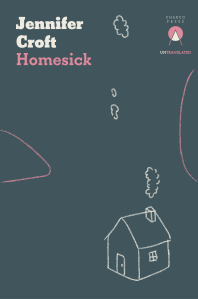 The protagonist is ‘Amy’, who lives in a tornado-ridden Oklahoma and whose sister, ‘Zoe’ – a handy A to Z of growing up there – has a mysterious series of illnesses that land her in hospital. The third person limited perspective reveals Amy to be a protective big sister who shoulders responsibility: “There is nothing in the world worse than Zoe having her blood drawn. Amy tries to show her the pictures [she’s taken of Zoe’s dog] at just the right moment, just right before the nurse puts the needle in”.
The girls are home-schooled and Amy, especially, develops a genius for languages, receiving private tutoring in Russian from Sasha, a Ukrainian former student of their father’s. Both sister are more than a little in love with Sasha. They alternate between competing for attention and indulging their joint passions – such as for the young Russian figure-skating couple who sweep the Winter Olympics. Amy starts college at 15, which earns her unwanted attention among her classmates, and struggles with her mental health before deciding to see the world. Despite periods of estrangement, her relationship with Zoe is what grounds her.
In a sense this is a simple chronological story, told in a matter-of-fact way. Yet each of its vignettes – some just a paragraph long – is perfectly chosen to reveal the family dynamic and the moment in American history. Detailed chapter headings continue the narrative and sometimes contain a shocking truth. What Croft does so brilliantly is to chart the accretion of ordinary and landmark events that form a life; Amy realizes this as she looks back at a packet of her photographs: “laid out step by step like this, more or less in order, the pictures also form a kind of path.”
Initially, I had my doubts as to whether this should have been eligible for the Women’s Prize. In the end it didn’t matter whether it was presented as memoir or autofiction, so true was it to the experience of 1990s girlhood, as well as to sisterhood and coming of age at any time in history. It reminded me strongly of Very Cold People by Sarah Manguso, but felt that little bit more universal in how it portrays family ties, ambition, and life’s winding path. (See also Annabel’s review for Shiny New Books.) 
With thanks to Charco Press for the free copy for review.
Children of Paradise by Camilla Grudova
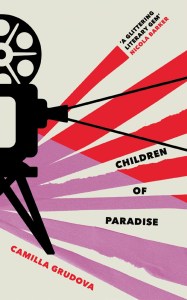 In 2017 I reviewed Grudova’s surreal story collection, The Doll’s Alphabet, describing its tales as “perverted fairytales or fragmentary nightmares.” Okay then, let’s continue in that perverted, nightmarish vein. Holly, new to the country/city, finds a room in a shared flat and a job as an usher at the Paradise Cinema, which shows a random assortment of art films and cult classics. The building is so low-rent it’s almost half derelict, and the staff take full advantage of the negligent management to get up to all sorts of sexual shenanigans, as well as drinking and drug-taking, while on duty. Holly and her co-workers are truly obsessed with the cinema, watching every showing at work but also hosting all-night movie marathons in their apartments. “The outside world, all of its news, faded away, and the movies became my main mirror of the world,” she confesses. “They were a necessary evil, customers, so that we, the true devotees, could have access to the screen, our giant godlike monument.”
The title is simultaneously ironic and an homage to Les Enfants du Paradis (1945), and the chapters are named after particular films. A change of ownership forces the Paradise to become more mainstream – hello, Marvel flicks and hipster snacks – but a series of horrific accidents and deliberate acts makes it seem like a cursed place. Aping movie genres, perhaps, Children of Paradise starts off as an offbeat stoner comedy and by the end approaches horror to an extent I didn’t expect. The content becomes increasingly sordid, visceral, with no opportunity missed to mention bodily fluids and excretions. I’m not notably opposed to gross-out humour, but the whole thing felt quite distasteful as well as miserable. (Public library e-book) 
My general feeling about these first two books, and probably a few others from the longlist (Crooks, McKenzie, Paull, et al.), is that the judges are trying to showcase the breadth of women’s writing: ‘Hey, guys, women can write autofiction and horror and humour and patois and speculative fiction and everything in between!’ But I don’t think these more niche or genre fiction representatives will make it any further in the race, especially because each may have been championed by a different judge.
Where the judges will find common ground will be on the standard stuff that always gets shortlisted: fairly run-of-the-mill character- and issue-driven contemporary or historical fiction. That makes it sound like I’m being dismissive, but in fact I do generally like much of the fiction that gets shortlisted for the WP: it’s readable book club fodder. It’s just maybe not inventive in the way that certain longlist titles can be. On which note, er, see the below!
The Marriage Portrait by Maggie O’Farrell
What a relief it was to wholeheartedly enjoy this sumptuous work of historical fiction, after the disappointment that was Hamnet (though perhaps I’ll feel more kindly towards the latter when I reread it for Literary Wives in November).
 Lucrezia di Cosimo de’ Medici is a historical figure who died at age 16, having been married off from her father’s Tuscan palazzo as a teenager to Alfonso II d’Este, Duke of Ferrara. She was reported to have died of a “putrid fever” but the suspicion has persisted that her husband actually murdered her, a story perhaps best known via Robert Browning’s poem “My Last Duchess.”
The focus is on the final year of Lucrezia’s life, but in flashbacks we meet her as a rebellious girl with a talent for drawing and a fascination with animals. At first it appears that Alfonso esteems her for her spiritedness – he gives her a painting of a stone marten as a betrothal gift, after all, and has her depicted with paintbrush in hand – but as the gradual storyline meets up with the 1561 spotlight, it becomes clear that she is only valued for her ability to produce an heir. However spacious and opulent they are, it is impossible to forget that Lucrezia, as a noblewoman, is confined to the edifices owned by her father or her husband.
O’Farrell’s usual present-tense narration is engaging throughout, and the two long chapters either side of the midpoint, one concerning her wedding day and the other the preparation for her portrait, are particularly absorbing. I was convinced I knew how this story would end, yet the author pulls off a delicious surprise. This is ripe for the miniseries treatment, not least because it is so attentive to visuals: the architecture of the main buildings, the lavish clothing, the colours, and the eye for what makes a good painting. Scenes are even described in terms of a spatial arrangement appreciated from afar: how three figures form a triangle in the centre of a room; how two people on a balcony bisect the view from a window.
Despite the length, this was thoroughly engrossing and one I’d recommend to readers of Geraldine Brooks and Tracy Chevalier. (See also Laura’s review.) (Public library) 
The other nominees I’ve read are:
Demon Copperhead by Barbara Kingsolver 
Black Butterflies by Priscilla Morris
My ideal shortlist (a wish list based on my reading and what I still want to read):
Homesick by Jennifer Croft
Fire Rush by Jacqueline Crooks
Black Butterflies by Priscilla Morris
The Marriage Portrait by Maggie O’Farrell
I’m a Fan by Sheena Patel
Memphis by Tara M. Stringfellow
vs.
My predicted shortlist:
Trespasses by Louise Kennedy
Demon Copperhead by Barbara Kingsolver
Stone Blind by Natalie Haynes
The Marriage Portrait by Maggie O’Farrell
Memphis by Tara M. Stringfellow
Wandering Souls by Cecile Pin
An overall winner? Perhaps Trespasses by Louise Kennedy, or an unprecedented repeat win from Barbara Kingsolver or Maggie O’Farrell.
(See also Laura’s predictions post.)
What have you read from the longlist so far? Which of these books are calling to you?
Rathbones Folio Prize Fiction Shortlist: Sheila Heti and Elizabeth Strout
I’ve enjoyed engaging with this year’s Rathbones Folio Prize shortlists, reading the entire poetry shortlist and two each from the nonfiction and fiction lists. These two I accessed from the library. Both Sheila Heti and Elizabeth Strout featured in the 5×15 event I attended on Tuesday evening, so in the reviews below I’ll weave in some insights from that.
Pure Colour by Sheila Heti
 Sheila Heti is a divisive author; I’m sure there are those who detest her indulgent autofiction, though I’ve loved it (How Should a Person Be? and especially Motherhood). But this is another thing entirely: Heti puts two fingers up to the whole notion of rounded characterization or coherent plot. This is the thinnest of fables, fascinating for its ideas and certainly resonant for me what with the themes of losing a parent and searching for purpose in life on an earth that seems doomed to destruction … but is it a novel?
My summary for Bookmarks magazine gives an idea of the ridiculous plot:
Heti imagines that the life we live now—for Mira, studying at the American Academy of American Critics, working in a lamp store, grieving her father, and falling in love with Annie—is just God’s first draft. In this creation myth of sorts, everyone is born a “bear” (lover), “bird” (achiever), or “fish” (follower). Mira has a mystical experience in which she and her dead father meet as souls in a leaf, where they converse about the nature of time and how art helps us face the inevitability of death. If everything that exists will soon be wiped out, what matters?
The three-creature classification is cute enough, but a copout because it means Heti doesn’t have to spend time developing Mira (a bird), Annie (a fish), or Mira’s father (a bear), except through surreal philosophical dialogues that may or may not take place whilst she is disembodied in a leaf. It’s also uncomfortable how Heti uses sexual language for Mira’s communion with her dead dad: “she knew that the universe had ejaculated his spirit into her”.
Heti explained that the book came to her in discrete chunks, from what felt like a more intuitive place than the others, which were more of an intellectual struggle, and that she drew on her own experience of grief over her father’s death, though she had been writing it for a year beforehand.
Indeed, she appears to be tapping into primordial stories, the stuff of Greek myth or Jewish kabbalah. She writes sometimes of “God” and sometimes of “the gods”: the former regretting this first draft of things and planning how to make things better for himself the second time around; the latter out to strip humans of what they care about: “our parents, our ambitions, our friendships, our beauty—different things from different people. They strip some people more and others less. They strip us of whatever they need to in order to see us more clearly.” Appropriately, then, we follow Mira all the way through to her end, when, stripped of everything but love, she rediscovers the two major human connections of her life.
Given Ali Smith’s love of the experimental, it’s no surprise that she as a judge shortlisted this. If you’re of a philosophical bent, don’t mind negligible/non-existent plot in your novels and aren’t turned off by literary pretension, you should be fine. If you are new to Heti or unsure about trying her, though, this is probably not the right place to start. See my Goodreads review for some sample quotes, good and bad.
Lucy by the Sea by Elizabeth Strout
This was by far the best of the three Amgash books I’ve read. I think it must be the first time that Strout has set a book not in the past or at some undated near-contemporary moment but in the actual world with its current events, which inevitably means it gets political. I had my doubts about how successful she’d be with such hyper-realism, but this really worked.
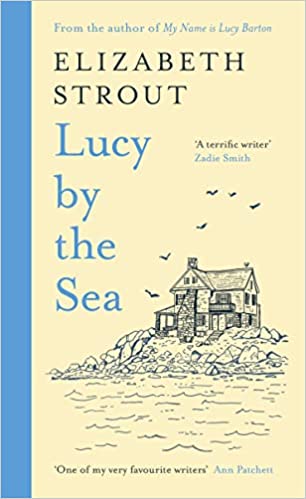 As Covid hits, William whisks Lucy away from her New York City apartment to a house at the coast in Crosby, Maine. She’s an Everywoman recounting the fear and confusion of those early pandemic days, hearing of friends and relatives falling ill and knowing there’s nothing she can do about it. Isolation, mostly imposed on her but partially chosen – she finally gets a writing studio, the first ‘room of her own’ she’s ever had – gives her time to ponder the trauma of her childhood and what went wrong in her marriage to William. She worries for her two adult daughters but, for the first time, you get the sense that the strength and wisdom she’s earned through bitter experience will help her support them in making good choices.
Here in rural Maine, Lucy sees similar deprivation to what she grew up with in Illinois and also meets real people – nice, friendly people – who voted for Trump and refuse to be vaccinated. I loved how Strout shows us Lucy observing and then, through a short story, compassionately imagining herself into the situation of conservative cops and drug addicts. “Try to go outside your comfort level, because that’s where interesting things will happen on the page,” is her philosophy. This felt like real insight into a writer’s inspirations.
Another neat thing Strout does here, as she has done before, is to stitch her oeuvre together by including references to most of her other books. So she becomes friends with Bob Burgess, volunteers alongside Olive Kitteridge’s nursing home caregiver (and I expect their rental house is supposed to be the one Olive vacated), and meets the pastor’s daughter from Abide with Me. My only misgiving is that she recounts Bob Burgess’s whole story, replete with spoilers, such that I don’t feel I need to read The Burgess Boys.
Lucy has emotional intelligence (“You’re not stupid about the human heart,” Bob Burgess tells her) and real, hard-won insight into herself (“My childhood had been a lockdown”). Readers as well as writers have really taken this character to heart, admiring her seemingly effortless voice. Strout said she does not think of this as a ‘pandemic novel’ because she’s always most interested in character. She believes the most important thing is the sound of the sentences and that a writer has to determine the shape of the material from the inside. She was very keen to separate herself from Lucy, and in fact came across as rather terse. I had somehow expected her to have a higher voice, to be warmer and softer. (“Ah, you’re not Lucy, you’re Olive!” I thought to myself.) 
Predictions
This year’s judges are Guy Gunaratne, Jackie Kay and Ali Smith. Last year’s winner was a white man, so I’m going to say in 2023 the prize should go to a woman of colour, and in fact I wouldn’t be surprised if all three category winners were women of colour. My own taste in the shortlists is, perhaps unsurprisingly, very white-lady-ish and non-experimental. But I think Amy Bloom and Elizabeth Strout’s books are too straightforward and Fiona Benson’s not edgy enough. So I’m expecting:
Fiction: Scary Monsters by Michelle de Kretser
Nonfiction: Constructing a Nervous System by Margo Jefferson
Poetry: Quiet by Victoria Adukwei Bulley (or Cane, Corn & Gully by Safiya Kamaria Kinshasa)
Overall winner: Constructing a Nervous System by Margo Jefferson (or Quiet by Victoria Adukwei Bulley)
This is my 1,200th blog post!
Reading the Rathbones Folio Prize Poetry Shortlist
I borrowed the whole of this year’s Rathbones Folio Prize poetry shortlist from my local library and have enjoyed reading through it to see what the judges felt was worthy of recognition from 2022’s releases. Of course, personal taste comes into the appreciation of poetry, perhaps more so than for fiction or nonfiction, so I liked some of these more than others and suspect the judges’ final decision may differ from mine. Still, it’s always a pleasure to discover new-to-me poets and/or debut authors.
Ephemeron by Fiona Benson
 This is Benson’s third collection but my first time reading her. I was fully engaged with her exquisite poems about the ephemeral, whether that be insect lives, boarding school days, primal emotions or moments from her children’s early years. The book is in four discrete corresponding sections (“Insect Love Songs,” “Boarding-School Tales,” “Translations from the Pasiphaë” and “Daughter Mother”) but the themes and language bleed from one into another and the whole is shot through with astonishing corporeality and eroticism.
The form varies quite a lot – bitty lines, stanzas, blocky paragraph-like stories – and alliteration, slant rhymes and unexpected metaphors (a wasp’s nest as “a piñata of stings,” “this avant-garde chandelier” and an “electric hotel / of spit-balled papier mâché”) make each poem glisten. I’ll even let her off for the long section inspired by my pet hate, Greek mythology (so gruesome, so convoluted), because of how she uses these melodramatic situations to explore universal emotions. She does something interesting with the story of the Minotaur (Asterios), suggesting that instead of being born a literal bull he was born deformed or disabled and no one knew what to make of him, but even so he had a mother’s love. 
Here’s one section of “Magicicadas” as an example:
Warm rain
summons them up
through loam
like Lazarus
after seventeen years,
cases splitting
down their backs
emerging
like the wet head
of a baby,
wrestling out
of their tight old skin
arching back
like an orgasm,
like an ecstatic gymnast
on the high trapeze;
sap-green, bunker-pale,
their damp wings lemon
before they stiffen
and straighten, lattice brown.
Quiet by Victoria Adukwei Bulley
 Protest doesn’t have to be loud; sometimes it can even be silent. In her debut, Bulley, a British-born Ghanaian poet, makes that especially clear with the pair “[ ] noise” (= white noise, inescapable) and “black noise” (an erasure poem). She models how language might be decolonized (particularly in “revision”) and how Black femininity might be reimagined (“fabula”). Along with her acknowledged debts to Lucille Clifton, bell hooks, Mary Oliver et al., I spotted echoes of Kei Miller (her “there is dark that moves” sounds like his “there is an anger that moves”) and Toni Morrison (Bulley includes the line “Quiet as it’s kept,” which is the opening of The Bluest Eye).
The collection is bold but never heavy-handed, and the seriousness of its topics (also including an early miscarriage) is lightened by poems about cats and snails. My two favourites were “not quiet as in quiet but,” which juxtaposes peacefulness and the comfortable life with the perils of not speaking out about injustice; and “Epigenetic,” about generations of traumatized bodies (“if your pain is alive in me / so too must be your joy.”).
Cane, Corn & Gully by Safiya Kamaria Kinshasa
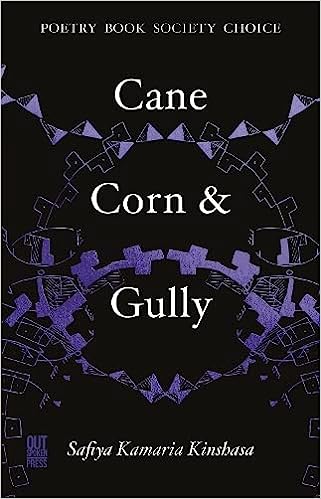 Kinshasa is also a dancer, and in her debut the British-born Barbadian intersperses poems with choreographed dances, transcribed via hand-drawn symbols explained in a key at the end. I confess I couldn’t picture them at all, though they make attractive patterns on the page – you can see one in purple on the cover. This and the Caribbean patois in which she voices narratives of historical atrocities and contemporary microaggressions against Black people (particularly women) are the collection’s claims to novelty and probably impressed the judges. Yet I found both strategies to be affected and looked forward to those poems in standard language. Some of the events are given specific dates and places in Barbados while others are more generic. Female victims of sexual oppression seek revenge, as in the gruesome “Miss Barbados Is No Longer Vegan.” This probably works best aloud, to allow one to appreciate the musicality of the voice and the alliterative lines.
Some lines I liked:
we gambled all our wishes on dandelions,
now we celebrate de little tings
every unburnt rice grain & regrown eyelash
vaulting between lemon vines and dog friendly cafés.
just because we do what needs to be done,
it doan mean we nah ready, we just aware
there are too many of us to be martyrs
(from “Sometimes Death Is a Child Who Plays With Rubber Bands”)
The work is dangerous; writing into history is like feeding unknown seeds while attempting to control the rate of their growth. Sometimes when I danced, I inhaled the language of my ancestors’ captors, and they became mine.
(from “Preface: And if by Some Miracle”)
if you want something to become extinct
doan give it attention.
(from “Choreography: She, My Nation”)
England’s Green by Zaffar Kunial
 A collection in praise of the country’s natural and cultural heritage, with poems about hedgerows and butterflies; cricket and the writings of the Brontë sisters. There are autobiographical reminiscences as well, most notably “The Crucible,” which describes the meeting between his Kashmiri father and his English mother’s father, who had refused to acknowledge the relationship for its first three years.
Kunial clearly delights in language, with wordplay and differing pronunciations fuelling “Foregrounds” et al. I particularly liked “Foxgloves” (“Sometimes I like to hide in the word / foxgloves – in the middle of foxgloves. The xgl is hard to say”) and “The Wind in the Willows,” where he wonders if the book title appeals to him just for its sound. This wasn’t as immediately cohesive and impressive as his first book, Us, but still well worth reading. 
Some favourite lines:
“Prayer is not the words / but having none and staying” (from “Empty Words”)
“Life // is wider than its page. And days are a cut field, clipped and made to run on” (from “The Groundsman”)
Manorism by Yomi Sode
Like Surge or Poor (or what little I read of Citizen), this is driven by outrage and a longing for justice for Black people. I suspect that, like those precursors, it is a book best heard in performance, given that Sode honed his skills on London’s open mic circuit.
 The first third of the book is under the heading “Aneephya,” a word Sode coined and defines as “the stress toxin of inherited trauma” – from slave ships to police checks. My two favourites were from this section: “L’Appel du Vide,” in which he ponders microaggressions while cooking a traditional West African mackerel and okra stew; and “A Plate of Artichokes,” about the time a waiter made him pre-pay for his meal and he went along with it even though he suspected other customers weren’t being asked to do the same.
Nigerian culture, rap music, being a father, and Black brotherhood are other themes, with recurring allusions to the work of Caravaggio. I also liked the long section on the decline and death of his great-aunt (“Big Mummy”) from cancer.
This was a book that made me feel super-white, but that’s not a problem: I can recognize its importance and appeal while also accepting that it’s not necessarily supposed to be for me.
Which of these poetry collections interest you?
Constructing a Nervous System by Margo Jefferson
I’ve had mixed feelings about the online nature of life recently. On Sunday I avoided the Internet altogether so as not to be bombarded with (UK) Mother’s Day memes and notifications. Yesterday our home broadband dropped out completely, such that I couldn’t do any freelance work or post about the Folio Prize poetry shortlist as I’d meant to do on World Poetry Day. Too much connectivity or not enough. Today – just as a line engineer is due to arrive; that usual irony – all is normal and I’m back in the swing of working and blogging.
Using my husband’s phone as a hotspot, I was at least still able to watch yesterday evening’s free 5×15 event with the Rathbones Folio Prize, featuring Amy Bloom, NoViolet Bulawayo, Sheila Heti, Margo Jefferson and Elizabeth Strout and hosted by interviewer Alex Clark. Over the next couple of days I’ll review Heti and Strout’s novels and the entire poetry shortlist, but for now I’ll weave some of the insight I gained last night into a review of Constructing a Nervous System by Margo Jefferson (2022), the new-to-me book from the nonfiction shortlist that I was most interested in reading.
Although the subtitle is “A Memoir,” this experimental text does such novel things with the genre that it bears little resemblance to most memoirs I’ve read. For that reason alone, I can see why the judges shortlisted it. During the 5×15 event, Jefferson described her book as “an assemblage of ideas, memories, sensations, feelings, and other people’s words—not just my own.” It’s also a reckoning with culture – particularly jazz music and dance by African Americans, but also particular examples from the white literary canon.
Jefferson was a long-time theatre and book critic for Newsweek and The New York Times and won a Pulitzer Prize for her criticism in 1995; she now teaches writing at Columbia University. She has previously published another memoir, Negroland, and a biography of Michael Jackson. Here she blends her chosen genres of life writing and cultural criticism. Her aim, she said, was to craft “criticism with the intensities and intimacies of memoir” and “memoir with the range of criticism.”

Jefferson mentioned that the deaths of her mother and older sister (who was like her muse) left her an orphan and, strangely, “cleared the stage for me to step out and speak my lines.” Indeed, the book is loosely structured as a play, opening with the metaphor of an empty stage and ending with the direction “BLACKOUT.” In between there are many imagined dialogues with herself or between historical figures, such as the bizarre pairing of George Eliot and W.E.B. Du Bois. Some quotations and definitions appear in italics or bold face. Ella Fitzgerald and Josephine Baker play major roles, but there’s also a surprisingly long section devoted to Willa Cather’s The Song of the Lark, which Jefferson loves and has often taught, yet finds problematic for how it enshrines whiteness (“Confederate Southern mythmaking”).
I don’t feel that I got much of a sense of the sweep of Jefferson’s life from the book, just a vague impression of an upper-middle-class Black upbringing. (Perhaps Negroland is a more straightforward memoir?) To be sure, she was keen to avoid “slogging through chronology,” as she explained, instead welcoming onto the page “a repertory company of myself as I encounter all the materials of my life—the factual and historical as well as the creative.” And so I do feel I have met her as an industrious mind, drawing connections between disparate aspects of experience and cultural consumption. This is a model of how a critic (like myself) might incorporate a body of work into a record of life. Yet when so many of her touchstones do not overlap with mine, I could only observe and admire from afar, not be truly drawn in.
Some lines I loved:
“Remember: Memoir is your present negotiating with versions of your past for a future you’re willing to show up in.”
“Older women’s tales— ‘Une femme d’un certain âge’ tales—are hard to pull off. They risk being arch.”
(of Ella Fitzgerald) “You turned the maw of black female labor into the wonderland of black female art.”
“Women’s anger needs to be honored—celebrated and protected—the way virginity used to be! … I’ve spent my adult years working on an assemblage of black feminist anger modes.”
With thanks to FMcM Associates and Granta Books for the free copy for review.
I was very impressed with both Amy Bloom and Margo Jefferson ‘in person’ (on Zoom): elegant, intellectual, well-spoken; authors at the top of their game. I reviewed Amy Bloom’s affecting memoir In Love, about her husband Brian’s early-onset Alzheimer’s and the decision to end his life at Dignitas in Zurich, last year. She told Alex Clark that the book started as a caregiver’s notes, but Brian made it clear that he wanted her to write about the experience, to inform people about end-of-life options. She believes that ultimately the memoir is about what it means to be a person and the decisions that make up a life. Her children joke that her only four subjects – in fiction or otherwise – are love, sex, family and death. Well, what else is there, really?
I know only the barest facts about the other three books on the Folio nonfiction shortlist but none of them screams ‘must read’ to me:
- The Passengers by Will Ashon – oral narratives from contemporary Britain
- The Escape Artist by Jonathan Freedland – biography of an Auschwitz whistle-blower
- The Social Distance Between Us by Darren McGarvey – a rapper’s book about inequality and antisocial behaviour
Have you read, or would you read, anything from the Folio nonfiction shortlist?
Tomorrow: Five poetry shortlist reviews
Friday: Two fiction shortlist reviews; my predictions for the category winners and overall prize winner
Phantom Gang by Ciarán O’Rourke: Dylan Thomas Prize Blog Tour
As part of the 2023 Dylan Thomas Prize blog celebration, I’m featuring the second collection by Irish poet Ciarán O’Rourke, Phantom Gang (2022).

There is an elegiac cast to much of this, with scenes that evoke historical warfare from the American West through the Second World War Resistance to Afghanistan. The title line references the discovery of the victims of an ancient raid. Even the love poems and descriptions of the natural world are more redolent of desperation and decline than they are celebratory. “Book of Salt,” in the tradition of Catullus, is the longest poem in the book and voices unrequited longing. Its short lines and end rhymes are in service of a passion mixed with hatred. There are lovely descriptions of curlew and starlings, but also mourning for the loss of the corncrake.

A favourite passage of mine was from “Portrait in Red and Black”:
Only the goldfinch
feels alive –
a skeet of colour,
stout as a cloud,
his knuckle and plunge
of plumage stark
against the slipping boughs.
I watch him thrum
and pluck terrifically,
marshalling the morning
with my heart in his mouth.
That excerpt is representative in that most of the poems are composed of two- or three-line stanzas, with assonance, alliteration and internal rhymes more common techniques than end rhymes. Although there are some mentions of recent figures – James Dyson, Elon Musk, Donald Trump – the collection as a whole feels inclined towards the past, with Bertolt Brecht and John Clare as stars. It’s austere, refined work, rooted yet ranging in both time and place.
More favourite lines:
“History”
Our one sick world spins on –
returningly, and slow
and with birds
the rising days begin,
the rage and ache
we call the spring,
a word for what
the carnage reckoned –
and still the birds returning.
~from “The Tree”
(My thanks to The Irish Pages Press and Midas PR for the free copy for review.)
I’ve reviewed Dylan Thomas Prize-longlisted poetry in several previous years as well:
- Eye Level by Jenny Xie
- If All the World and Love Were Young by Stephen Sexton
- Auguries of a Minor God by Nidhi Zak/Aria Eipe
For a reminder of the full longlist, see my post from last month. I’ve read 3.5 books from it now and would be delighted to see Nell Stevens’ debut novel (my review) make the shortlist. This will be announced on 23 March, with the winner on 11 May.
Happy St Patrick’s Day – this is also my token contribution to Reading Ireland Month!

Young Writer of the Year Award Shortlist: Larger than an Orange by Lucy Burns
Looking back, being on the 2017 shadow panel for the Sunday Times Young Writer of the Year Award was still one of the best things I’ve achieved in my time as a book blogger. Each year I eagerly look out for this award’s shortlist to see how many titles I’ve read and who I think the judges will choose as the winner. For a couple years the prize has had a higher cash fund thanks to sponsorship from the Charlotte Aitken Trust, and is now, like the McKitterick Prize that I’ve judged the past two years, administered by the Society of Authors.

This year’s four nominees include two novels and two nonfiction works: Oxblood by Tom Benn is said to be a “poignantly rendered exploration of domesticity and violence” and Maddie Mortimer’s Maps of our Spectacular Bodies, which won the Desmond Elliott Prize and was longlisted for the Booker Prize, is a “lyrical and captivating look at mortality, desire and forgiveness”; Lucy Burns’s debut memoir is an examination of abortion through the prism of her personal experience; and Katherine Rundell’s Super-Infinite (winner of the Baillie Gifford Prize for Non-Fiction) is a biography of John Donne.
I was intrigued by the premise (narration by a young woman – and her cancer) of the Mortimer when it was longlisted for the Booker so bought a sale copy with a Christmas voucher, but the style and over-400-page length has been defeating me. I might try again, but for a debut author’s experimental work I think 200 pages would have been sufficient. I’m not keen to try the Benn, but would gladly read the Rundell from the library another time. The final book is one I requested as a review copy.
Larger Than an Orange by Lucy Burns (2021)
I’ve only read one other memoir of an abortion (as opposed to a memoir in which an abortion is simply one event of many), Happening by Annie Ernaux, so it was perhaps inevitable for me to get similar vibes from the two works. Both are fragmentary, spare; matter of fact in tone to avoid melodramatic extremes of emotion. The difference, of course, is that in the 1960s abortion was illegal in France and so ending a pregnancy required clandestine action. However, even in 2017, when the then 26-year-old Burns had a medical abortion in England, where it had been legal for 50 years, she found that the process was invasive and officious. She presents the experience as infantilizing – not trusting the patient, and lacking in compassion. And although it was the only practical choice for her at the time and she remains firmly committed to women’s right to an abortion, it sparked feelings of guilt, shame and depression that lingered and affected her work and personal life. At counselling appointments she expressed disgust at herself, and she became obsessed with looking up American pro-life propaganda and testimonials from former abortion clinic workers online.
 The book is, collage-like, assembled from pieces – sometimes as little as one paragraph or one line to a page – of dated autobiographical material, going back and forth between the summer of the abortion and the few-year aftermath as she suffers with irregular bleeding, chooses a new contraceptive method and has a short-term relationship; transcripts of radio debates; alphabetical lists of predicted search terms and so on. She even requests her medical records, including sections from it plus ultrasound images, and marks her baby’s would-be birthday.
I could imagine this working very well as a play for voices, especially because Burns is in the habit of counting each person she tells about the abortion and referring to them by their number until, at fifty-something, she gives up. Friends, receptionists, the people at work who adjudicate her petition to be granted two weeks’ leave: there are those she tells willingly and those she feels duty-bound to inform to explain her health or behaviour. Some remain a part of her life and others, awkward or judgemental, fade out of it.
This is a powerful read I can’t say I necessarily enjoyed, but did admire for its uncompromising clarity and honesty, and its willingness to probe both sides of ethical issues in a way that ‘good feminists’ might think they cannot.
With thanks to FMcM Associates and Chatto & Windus for the free copy for review.
Tomorrow we’ll hear the Young Writer of the Year results. My feeling is that Katherine Rundell, though already a prize winner for this book and an established author due to her children’s oeuvre, will win for Super-Infinite.
Have you read anything from this year’s shortlist?
Eighth Blog Anniversary! & Thoughts on the Women’s Prize Longlist
Last year, in the manic busyness that preceded moving into our house, I completely forgot to mark my blog anniversary. This time (8 years!) I wanted to be sure to remember it. Why have I not noted before that it coincides with International Women’s Day?! I’m pleased with that.

By Հայկ Ափրիկյան, CC BY-SA 3.0, via Wikimedia Commons.
Yesterday evening the Women’s Prize longlist was announced.** Of my predictions, 4 were correct, which is pretty good going for me. I got none of my personal wishes, however. Of course, I would have preferred for us to have one of my lists. Still, overall, it’s a fairly interesting mix of new and established authors, with a full half of the list being debut work. Seven of the authors are BIPOC. I’ve read 2 of the nominees and would be amenable to reading up to 7 more. My library always buys the entire longlist, so I’ll eventually get the chance to read them, but not soon enough to add to the conversation.

Read:
Demon Copperhead by Barbara Kingsolver (CORRECT PREDICTION): Follows the contours of Charles Dickens’s David Copperfield, transplanting the plot to 1990s southwest Virginia to uncover the perils of opiate addiction. Ten-year-old Damon Fields lives in a trailer home with his addict mother, who works at Walmart, and his new stepfather, a mean trucker. Tragedy strikes and Damon moves between several foster homes before running away. His irrepressible, sassy voice is reminiscent of Holden Caulfield’s in this Appalachian cousin to Shuggie Bain.
Black Butterflies by Priscilla Morris: Drawing on her own family history, Morris has crafted an absorbing story set in Sarajevo in 1992, the first year of the Bosnian War. Zora, a middle-aged painter, has sent her husband, Franjo, and elderly mother off to England to stay with her daughter, Dubravka, confident that she’ll see out the fighting in the safety of their flat and welcome them home in no time. But things rapidly get much worse than she is prepared for. It was especially poignant to be reading this during the war in Ukraine.
Requested from the library:
Fire Rush by Jacqueline Crooks – Sounds good, if too much like this year’s Opal & Nev.
The Marriage Portrait by Maggie O’Farrell (CORRECT PREDICTION) – I was going to skip this because I wasn’t keen on Hamnet, but I do love O’Farrell in general, so I guess I’ll give it a try.
Interested in reading (but can’t find):
Homesick by Jennifer Croft – N.B. This was subtitled “A Memoir” at its U.S. release.
Children of Paradise by Camilla Grudova
Memphis by Tara M. Stringfellow
I’m a Fan by Sheena Patel (CORRECT PREDICTION)
Wandering Souls by Cecile Pin
Not interested in reading:
Glory by NoViolet Bulawayo – Like I said when it was nominated for the Booker, I have to wonder why we needed an extended Animal Farm remake…
Stone Blind by Natalie Haynes – I really should have predicted this one. It’s a hard pass on the Greek myth retellings for me.
Trespasses by Louise Kennedy (CORRECT PREDICTION) – I avoid anything set during The Troubles. (Sorry!)
Cursed Bread by Sophie Mackintosh – The Water Cure was awful.
The Dog of the North by Elizabeth McKenzie – The Portable Veblen was trying too hard.
Pod by Laline Paull – Her novels always sound so formulaic.
The Bandit Queens by Parini Shroff – Nah.
See also the reactions posts from Cathy, Clare, Eric and Laura.
**The announcement has traditionally been on International Women’s Day, but I’m guessing that this year they brought it forward to pre-empt news of the inaugural Carol Shields Prize for Fiction longlist. This prize is open to novels, short stories and graphic novels by women, published in calendar year 2022, with parameters otherwise quite similar to those of the WP except that it’s only for U.S. and Canadian residents. {EDITED} To be honest, I was not convinced that the literary world needed an additional prize for women’s fiction, especially as North Americans tend to do well in the WP race. However, at first glance, its longlist is a lot less obvious and more interesting, with 11/15 BIPOC and some short story collections as well as a graphic novel in the running. It remains to be seen if I’ll follow both prizes or switch allegiance. Some of the CSP books may prove difficult to access in the UK. So far I have read Brown Girls and can get The Furrows from the library. Of note: the Carol Shields Prize is worth a lot more ($150,000 U.S. vs. £30,000).
What have you read, or might you read, from the longlist?
 Bookish Beck = Rebecca Foster. American transplant to England. Freelance proofreader and book reviewer.
 Bookish Beck