Library Checkout: August 2016
I still have dozens of priority books to read from my own shelves , and I’ve been building up a stock of Booker-longlisted titles on my Kindle through NetGalley to try to get through before the shortlist announcement … BUT now that I live in a district where library reservations are free, I haven’t been able to resist placing holds on a bunch of books I’ve been wanting to read.
LIBRARY BOOKS READ
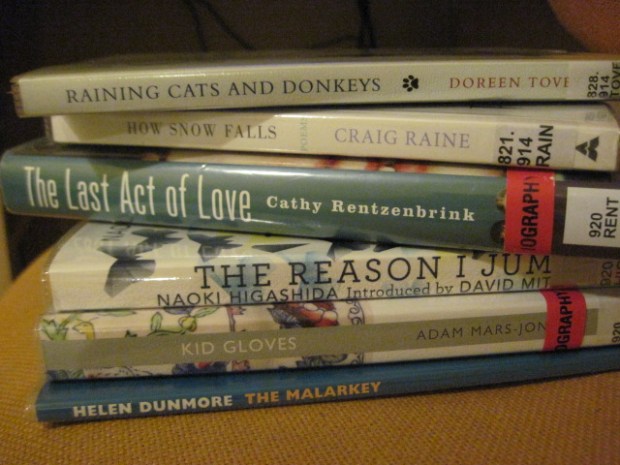
- Raining Cats and Donkeys by Doreen Tovey: Thanks to Liz at Adventures in reading for the recommendation of Tovey’s cat books. I’ll save up a mini-review of this one for a future follow-up post on books about cats.
LIBRARY BOOKS CURRENTLY READING
- How Snow Falls: Poems by Craig Raine
- The Last Act of Love: The Story of My Brother and His Sister by Cathy Rentzenbrink [in advance of a September 20th event at Foyles, London I’ll be attending on grief in literature, featuring her and Michel Faber]
CHECKED OUT, TO BE READ
- The Malarkey (poems) by Helen Dunmore
- The Reason I Jump: One Boy’s Voice from the Silence of Autism by Naoki Higashida
- Kid Gloves: A Voyage round My Father by Adam Mars-Jones
ON HOLD, TO BE PICKED UP
- Late Fragments: Everything I Want to Tell You (about This Magnificent Life) by Kate Gross
IN THE RESERVATION QUEUE
- The Crime Writer by Jill Dawson
- Let Me Tell You about a Man I Knew by Susan Fletcher
- Hot Milk by Deborah Levy [Booker longlist]
- Thirteen Ways of Looking by Colum McCann
- Winter by Christopher Nicholson
- The House at the Edge of the World by Julia Rochester
- Maus: A Survivor’s Tale by Art Spiegelman [graphic novel]
- Golden Hill by Francis Spufford
- Do Not Say We Have Nothing by Madeleine Thien [Booker longlist]
- The Painted Bridge by Wendy Wallace
RETURNED UNFINISHED
Words in Air: The Complete Correspondence between Elizabeth Bishop and Robert Lowell, edited by Thomas Travisano: I paused at page 140. I was enjoying this very much but am setting it aside because it’s an enormous book that I’ve had out from the university library for months and months, and I was making very little visible progress. Like Airmail, the collection of Robert Bly and Tomas Tranströmer’s letters that I read last year, it’s a delightful mixture of the two poets’ reading, writing, travels, and relationships, including their own burgeoning friendship. I need to get hold of a secondhand copy so I can read it at my leisure, a few letters at a time.
(Thanks, as always, go to Shannon of River City Reading for the great blog idea and template!)
Literary Blind Spots: Hemingway and Fitzgerald
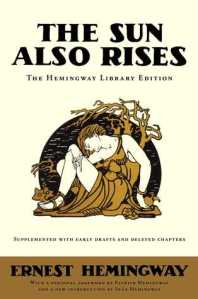 Despite being educated through university level in the United States, I’m better acquainted with British literature than American, in part due to my own predilections. Ernest Hemingway and F. Scott Fitzgerald are two of the American authors I’ve most struggled with. For one thing, their novels’ titles are interchangeable, abstract quotations that I can never keep straight. Which is which? The Sun Also Rises is the bullfighting one, right? And is A Farewell to Arms the other one I’ve read? Fitzgerald is an even worse offender as titles go, with The Great Gatsby the only one that actually refers to its contents.
 For the record, I recognize The Great Gatsby as a masterpiece, and I absolutely loved A Moveable Feast, Hemingway’s memoir of life in Paris. I also enjoy reading about the Hemingways (Paula McLain’s The Paris Wife and Naomi Wood’s Mrs. Hemingway) and the Fitzgeralds (Therese Anne Fowler’s Z: A Novel of Zelda Fitzgerald and R. Clifton Spargo’s Beautiful Fools). But when I’ve tried to go deeper into the authors’ work, it hasn’t been an unmitigated success. The above two Hemingway novels are just okay for me. The Sun Also Rises struck me as having a thin plot, two-dimensional characters and repetitious dialogue.
When I eagerly approached Tender Is the Night last year – having recently read a novel about the real-life couple who inspired Fitzgerald’s portrait of Dick and Nicole Diver, Gerald and Sara Murphy (Villa America by Liza Klaussmann) – I pulled out a lot of great individual lines but had trouble following the basic plot and only really enjoyed the early chapters of Book Two. Here are some of those pearls of prose:
The delight in Nicole’s face—to be a feather again instead of a plummet, to float and not to drag. She was a carnival to watch—at times primly coy, posing, grimacing and gesturing—sometimes the shadow fell and the dignity of old suffering flowed down into her finger tips.
somehow Dick and Nicole had become one and equal, not apposite and complementary; she was Dick too, the drought in the marrow of his bones. He could not watch her disintegrations without participating in them.
Well, you never knew exactly how much space you occupied in people’s lives.
women marry all their husbands’ talents and naturally, afterwards, are not so impressed with them as they may keep up the pretense of being.
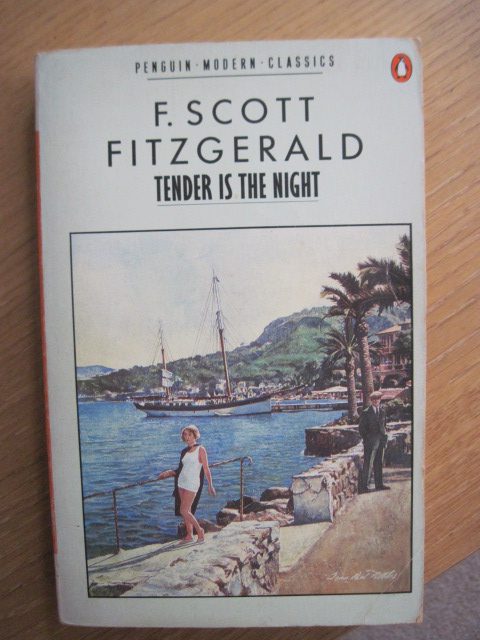
Imagine my surprise when I learned from a note at the end of my Penguin paperback that Fitzgerald made a major revision that rearranged the action into chronological order, thus opening with Book Two. That text, edited by Malcolm Cowley, appeared in 1951 and was printed by Penguin from 1955. However, the version I have – as reprinted from 1982 onwards – goes back to Fitzgerald’s first edition. Would I have had a more favorable reaction to the novel if I’d encountered it in its revised version? Somehow I think so.
Is there a Hemingway or Fitzgerald novel that will change my opinion about these literary lions? Share your favorites.
A Booker Prize & Libraries Action Plan, Etc.
On Wednesday the Man Booker Prize’s longlist of 13 novels was announced. I never bother making predictions in advance of prize list announcements because inevitably I forget what was released during the eligibility period and I’m no good at squaring personal favorites with what a judging panel is likely to admire. See the Guardian’s photo essay and Karen’s thorough discussion at Booker Talk for more information about the nominees.
It turns out I’ve read and reviewed four of the longlisted books:
The Sellout by Paul Beatty for Shiny New Books: This is such an outrageous racial satire that I kept asking myself how Beatty got away with it. The Sellout struck a chord in America, but I’m slightly surprised that it’s also been received well in the UK.
The North Water by Ian McGuire for BookBrowse: A gritty, graphic novel about 19th-century whaling that traverses the open seas and the forbidding polar regions. It’s a powerful inquiry into human nature and the making of ethical choices in extreme circumstances.
Work Like Any Other by Virginia Reeves on Goodreads: I was meant to review this for BookBrowse but couldn’t rate it highly enough despite the competent writing. Between the blurb and the first paragraph, you already know everything that’s going to happen.
My Name Is Lucy Barton by Elizabeth Strout on Goodreads: I won a free copy through a Goodreads giveaway. I read this in one sitting on a plane ride and found it to be a powerful portrayal of the small connections that stand out in a life.
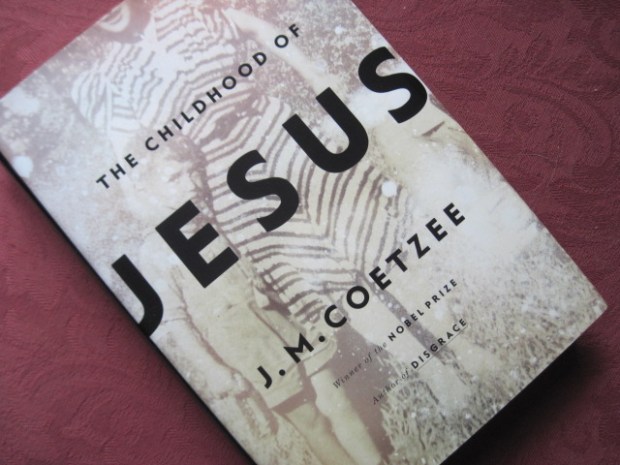
As for what’s next from the longlist, I finally have an excuse to read the copy of The Childhood of Jesus by J.M. Coetzee I won from Goodreads many moons ago – a sequel to which (The Schooldays of Jesus) is among the nominees. It’ll be my first Coetzee; if I like it I’ll be sure to read the follow-up book when it comes out in September.
I already knew I was interested in Eileen by Ottessa Moshfegh, a creepy debut novel about a misfit; All That Man Is by David Szalay, a linked short story collection about stages of men’s lives; and Do Not Say We Have Nothing by Madeleine Thien, set in Canada in the wake of the Tiananmen Square protests. I’ve only read one novel each by A.L. Kennedy and Deborah Levy and wasn’t hugely keen on either author’s style, but the subject matter of both Serious Sweet and Hot Milk is more tempting. I might seek them out from the library.
 And then there’s the books I’d simply never heard of. Of these I’m most interested in His Bloody Project by Graeme Macrae Burnet, based on a true-life murder in Scotland in the 1860s, and The Many by Wyl Menmuir, a debut novella about a village newcomer.
The surprise omission for me is Sarah Perry’s The Essex Serpent. I might also have expected to see Julian Barnes, Adam Haslett, and maybe even Ann Patchett on the longlist.
We’ve found a new rental house and hope to move in on August 15, but we’re waiting for our reference check to be complete and the tenancy contract to be drawn up before we can start doing official things like hire movers, change our address with a zillion service providers, and start packing in earnest.
This past week I’ve busied myself with comparing removals quotes and doing pre-packing tasks I’ve tried to convince myself are useful, like sorting through drawers of mementoes, assessing what’s in storage under the beds, and shifting some unwanted possessions through Freegle, a local web forum for giving away free stuff. So far I’ve gotten rid of a spice rack, 11 empty bottles, 55 empty CD cases, a cat tower plus some food and toys our fussy cat won’t use, and a wildly popular picnic hamper (11 offers came through!). It’s really gratifying to see things go to a good home.
Alas, we did also have to take some items to the local recycling center this weekend, which always seems like something of a failure, but no one’s going to want a broken vacuum cleaner and printer. My hope is that the small appliances dumped there will at least be mined for parts, so it’s better than sending them to landfill.
The weekend has also included berry picking at the local pick-your-own farm and making a summer pudding, a labor-intensive but delicious annual tradition. Plus this afternoon we’re off to Northampton to meet our newest nephew, born on the 20th.

Last year’s summer pudding.
I did finally start boxing up books last night. Much as I love my print library, it’s dispiriting just how much space it takes up. It took five boxes just to empty the small spare room bookcase! Before packing anything I did another full inventory of unread books in the flat and came up with a total of 205, higher than last time but not too bad considering the review books I’ve acquired recently as well as the secondhand shopping I’ve done. I’ve made good progress in my attempt to read mostly books I own for the summer, but it’s a resolution that will have to carry over into the autumn and winter.
The one thing that might scupper me in that plan is that, although we’re only moving 45 minutes away, we’ll be in a new council area where library reservations are free! For years I’ve been a part of library systems where it costs 40 or 50 pence to reserve each book, so I’ve kept holds to an absolute minimum. But from now on you can be sure I’ll be putting myself on the waiting list for every new and forthcoming book that appeals to me! Expect the monthly Library Checkout posts to resume by September.
Any thoughts on this year’s Booker Prize longlist? How are you doing on reading from public libraries or from your own personal collection?
Book-Lovers’ Quotes (& Dubious Habits)
“They say books about books are profitless, but they certainly make very pleasant reading.”
(W. Somerset Maugham’s “The Book Bag,” 1951)
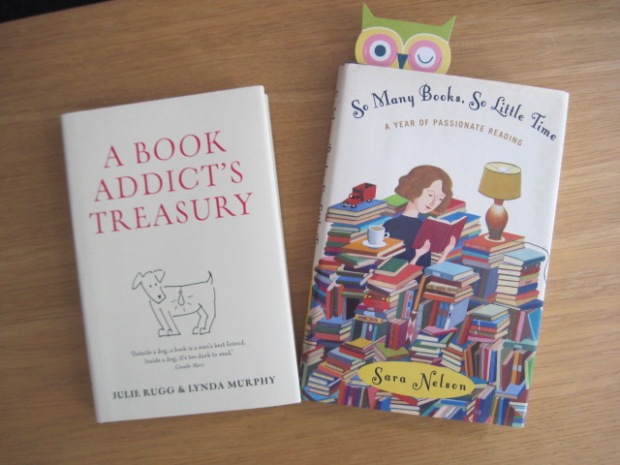
A Book Addict’s Treasury by Julie Rugg and Lynda Murphy was my bedside book for the first half of the year. I like having a literary-themed book to read a bit of daily, rather like a secular devotional. Last year John Sutherland and Stephen Fender’s Love, Sex, Death and Words filled that purpose. The authors have chosen a huge variety of quotations from fiction and nonfiction, ranging from the Middle Ages to the present day. The chapters are loosely thematic, with topics like lending and borrowing, organizing one’s library, bad book habits, and so on.
Here’s a sampling of the quotes that meant the most to me:
- “I can remember when I read any book, as the act of reading adheres to the room, the chair, the season.” (Guy Davenport)
- “To read good books is like holding a conversation with the most eminent minds of past centuries.” (René Descartes)
- “How useful it would be to have an authoritative list of books that, despite the world’s generally high opinion of them, one really need not read.” (Joseph Epstein)
- “I am all for the giving and receiving of books at Christmas, though not keen either on giving or receiving ‘gift books’, the kind of tarted-up books which appear at this time of year and no other. I agree that the only thing you could do with such books is to give them away.” (Daniel George)
- “As often as I survey my bookshelves I am reminded of Lamb’s ‘ragged veterans’.” (George Gissing)
- “Libraries are reservoirs of strength, grace and wit, reminders of order, calm and continuity, lakes of mental energy.” (Germaine Greer)
I also came across two controversial reader habits I’m not sure how I feel about:
1. “The outward and visible mark of the citizenship of the book-lover is his book-plate.” (Edmund Gosse)
I do have two packs of book-plates featuring a rather nice black-and-white engraving of a puffin on a rock, but I’ve never used them. For one thing, my collection seems too changeable: what if I decide, after reading a book, to resell it or pass it on to someone else? I also wouldn’t know how to choose which lucky 20 books get a bookplate. (Probably only those monolithic hardbacks I’m sure to keep as reference books for decades to come.)
2. Harold Nicolson’s habit of labeling passages from books with “F and C” (= “very feeble and cheap”) and “G.B.” or “B.B.” (= “Good Bits” or “Bad Bits”)!
I’ve never annotated my books, apart from a few textbooks in college. It just seems like defacement; are my thoughts really so important that they need to be preserved forever? Instead I use Post-It flags to mark passages I want to revisit, and usually copy those out into my annual book list (a huge Word file).
My current bedside book fit for a bibliophile is So Many Books, So Little Time: A Year of Passionate Reading by Sara Nelson. Favorite quote so far:
“Part of the appeal of books, of course, is that they’re the cheapest and easiest way to transport you from the world you know into one you don’t. … dollar for dollar, hour per hour, it’s the most expedient way to get from our proscribed little ‘here’ to an imagined, intriguing ‘there.’”
What are your favorite book-related quotes? Do you use bookplates and annotations?
Six Books I Abandoned Recently
Sigh. It keeps happening. A book that looks unmissable ends up disappointing me and I abandon it partway through. Here’s six I dropped recently: two from the library, two e-copies I was meant to review but found I couldn’t recommend, and two that couldn’t hold my interest on our European holiday. Below I give brief write-ups of the abandonees. As always, I’d be interested to hear if you’ve read any of them and thought they were worth persisting with.
 You Are Having a Good Time: Stories by Amie Barrodale
I only managed the first two stories. Barrodale writes in a flat, affectless style full of unconnected sentences; her themes are of Hollywood and the emptiness of modern life. This reminded me most of Miranda July, so if you’re a big fan of hers I’d say go for it. Otherwise, don’t bother. [Read the first 21%.]
My rating: 
 Sweet Home by Carys Bray
These gently magical short stories equate parenthood with peril: a child is always somehow lost or on the verge of being lost. “Just in Case” is wonderfully macabre, and I was glad to discover how A Song for Issy Bradley got its start (with “Scaling never”). The fragility of memory is another theme, with one story narrated by a woman with dementia. The title story has a Hansel and Gretel fairytale feel to it. I enjoyed the first half well enough, but didn’t feel compelled to continue; I definitely prefer Bray’s full-length work, and this needed to go back to the library anyway. [Read the first 96 pages out of 178.]
My rating: 
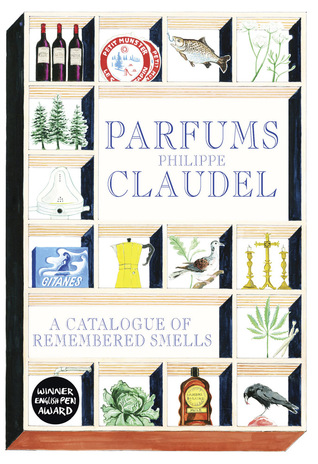 Parfums: A Catalogue of Remembered Smells by Philippe Claudel
[translated from the French by Euan Cameron]
I loved the idea behind this: a memoir in the form of short essays built around scent memories. Cinnamon brings the Christmas season to mind, aftershave reminds him of his father, and garlic and cannabis dredge up different aspects of his growing-up years. There’s some beautifully poetic language here. A favorite line was “The child that I am is allowed to breathe in these smells of dead pollen, widowed woolens and orphaned linen so that one day he can piece them together into a narrative and resurrect lives lost through wars, illnesses and accidents.” But ultimately I got a bit tired of more of the same. Perhaps if I’d kept it as a bedside book and just read a few pieces at a time instead of attempting to read it straight through, it would have worked better for me. [Read the first 86 pages out of 173.]
My rating:
 Absalom’s Daughters by Suzanne Feldman
Three generations of black women – Cassie, Lil Ma and Grandmother – live on Negro Street above the laundry where they work in Heron-Neck, Mississippi. Cassie learns that her father is a white man, William Forrest, whose daughter Judith is near her age. They know they’re sisters and when they hear their worthless pater has received an inheritance they concoct a scheme to go get their nest egg. Alas, the Southern dialect feels false to me, and I wasn’t taken with any of the characters. (Great piece of trivia: Feldman used to write science fiction under the pen name “Severna Park,” which is a town in Maryland.) [Read the first 18%.]
My rating: 
 The Hemingway Thief by Shaun Harris
I thought this would be a fun, light-hearted literary mystery to read on European trains. Henry Cooper, a writer of vampire romances, takes a sabbatical to Mexico to figure out what he really wants to do. Here he unexpectedly wanders into intrigue when a Hemingway manuscript turns up in a small-time criminal’s hotel room. I never warmed to the uninspired hardboiled-lite style and it took far too long for the story to get going. [Read the first 17%.]
My rating:
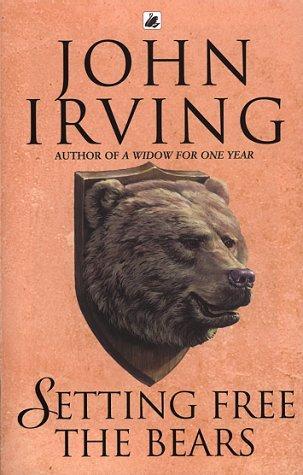 Setting Free the Bears by John Irving
This was Irving’s debut, and although you can see seeds of the Dickensian characterization at which he excels in his best work, it was just not good overall. Neither Siggy nor Graff held my interest, and the dialogue feels stiff and unrealistic. There’s also some downright strange wording: “I could peek how the helmet nearly covered her eyes”; “the rain still puddled the courtyard”; “When his spongy ribs whomped the cobbles, the horse said, ‘Gnif!’” I couldn’t decide if this was Irving trying to show that the story is set abroad or if it was just evidence of bad writing. My husband is enough of an Irving fan to have gobbled the book up by the time we reached Austria, but I decided it wasn’t going to get much better. That’s a shame, as I would have liked to get to them, you know, actually setting free the bears at the Vienna Zoo. [Read the first 75 pages out of 384.]
My rating:
European Holiday Reading – A (Temporary) Farewell
Tomorrow we’re off to continental Europe for two weeks of train travel, making stops in Brussels, Freiburg (Germany), two towns in Switzerland, and Salzburg and Vienna in Austria. This will be some of the most extensive travel I’ve done in Europe in the 11 or so years that I’ve lived here – and the first time I’ve been to Switzerland or Austria – so I’m excited. I’ve been working like a fiend recently to catch up and/or get ahead on reviews and blogs, so it will be particularly good to spend two weeks away from a computer. It’s also nice that our adventure doesn’t have to start with going to an airport.
Here’s what I’ve packed:
- Setting Free the Bears by John Irving (his first novel; set in Vienna)
- Diary of a Pilgrimage by Jerome K. Jerome (about a train journey from England to Germany)
- Me and Kaminski by Daniel Kehlmann (the author is Austrian)
- A Whole Life by Robert Seethaler (a novella set in the Austrian Alps)
+ Enchanting Alpine Flowers & the Rough Guide to Vienna
Also on the e-readers, downloaded from Project Gutenberg:
- Three Men on the Bummel by Jerome K. Jerome (further humorous antics in Germany)
- Burning Secret by Stefan Zweig (a novella; the author is Austrian)
+ another 250+ Kindle books from a wide variety of genres and topics – I’ll certainly have no shortage of reading material!
(Looking back now, it occurs to me that this all skews rather towards Austria! Oh well. Vienna is one of our longer stops.)

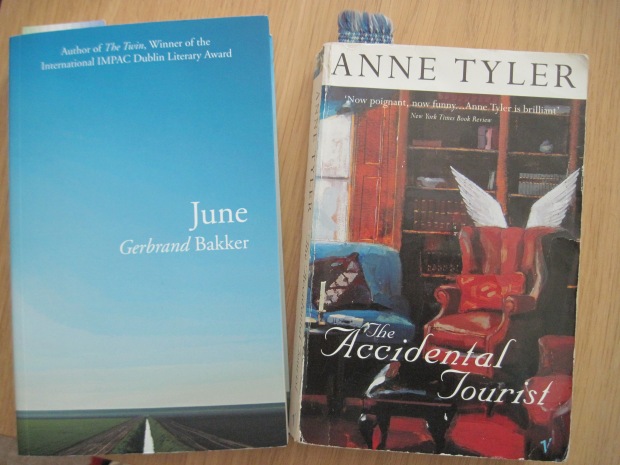
I’m supposed to be making my way through the books we already own, but on Saturday I was overcome with temptation at our local charity shop when I saw that all paperbacks were on sale – 5 for £1. I’m in the middle of one of the novels I bought that day, June by Gerbrand Bakker, along with The Accidental Tourist by Anne Tyler, and need to decide whether to put them on hold while I’m away or take one or both with me. Either way I’ll try to finish June this month; it’s just too appropriate not to!
I was also overcome with temptation at the thought of a new Eowyn Ivey novel coming out in August, so requested a copy for review.

It’s an odd time here in the UK. Readers from North America or elsewhere might be unaware that we’re gearing up for a referendum to decide whether to remain in the European Union. By the time we pass back through Brussels (‘capital’ of the European Union) on the 24th, there’s every chance the UK might no longer be an official member of Europe. I haven’t taken British citizenship so am ineligible to cast a vote; I won’t court debate by elaborating on a comparison of “Brexit” with the specter of Trump in the States. My husband has sent in his postal vote, so collectively we’ve done all we can do and now just have to wait and see.
We’re not back until late on the 24th, but I’ve scheduled a few posts for while we’re away. I will only have sporadic Internet access during these weeks, so won’t be replying to blog comments or reading fellow bloggers’ posts, but I promise to catch up when we get back.
Happy June reading!
Library Checkout: May 2016
The next week and a half will be my last chance to read library books before we head off on our European vacation. Apart from the Rough Guide to Vienna and one novella I plan on taking with us, everything else needs to go back to the library before we leave on June 9th. Luckily several of the books I have out at the moment are quite thin.
I’ve vowed not to borrow any library books for the rest of the summer so I can concentrate on books I actually own and cull some before our move in mid-August. Depending on where we move, I may be using a different library system come autumn.
So, much as I enjoy putting these together, I will be taking a break from Library Checkout posts until September.
LIBRARY BOOKS READ
- The Revised Fundamentals of Caregiving by Jonathan Evison
- The Signature of All Things by Elizabeth Gilbert
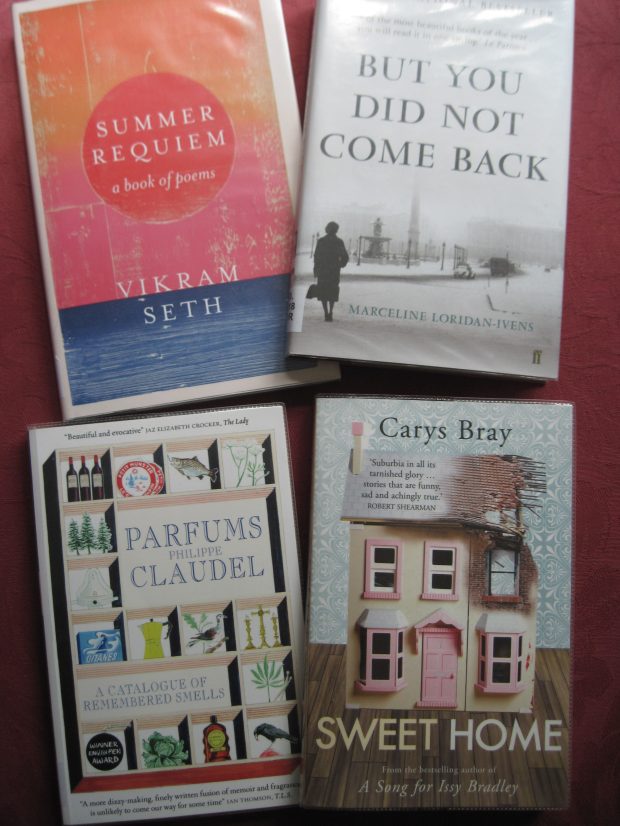
- But You Did Not Come Back by Marceline Loridan-Ivens
LIBRARY BOOKS CURRENTLY READING
- Sweet Home (short stories) by Carys Bray
- Parfums: A Catalogue of Remembered Smells by Philippe Claudel
- Summer Requiem (poems) by Vikram Seth
- Words in Air: The Complete Correspondence between Elizabeth Bishop and Robert Lowell, edited by Thomas Travisano
CHECKED OUT, TO BE READ
- The Running Hare: The Secret Life of Farmland by John Lewis-Stempel
- A Whole Life by Robert Seethaler (for reading on our European holiday)
RETURNED UNREAD
- In the Unlikely Event by Judy Blume
- The Great Soul of Siberia by Sooyong Park
(Thanks, as always, to Shannon of River City Reading for the great blog idea and template!)
Four Books Abandoned Recently (+ One I SHOULD Have)
I’d like to think I’ve gotten better at choosing books that are sure to suit me, but sometimes it’s still a matter of ditching the duds when it becomes clear they’re not working. Here’s the small (digital) pile of abandoned novels I’ve amassed over the last couple of months. I’d be interested to hear if you’ve read any of them and thought they were worth persisting with.
Mrs. Houdini by Victoria Kelly
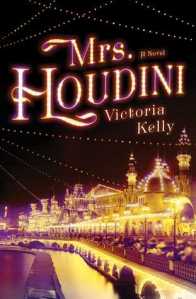 Perfectly serviceable historical fiction, but with no spark. I felt like I was just being given a lot of information about the two major time periods (1894 and 1929). Alas, scenes set at a séance, a circus, and an insane asylum are not nearly as exciting as they promise to be. And, as is often the case with these famous wives books – a genre I generally love but can also find oddly disappointing from time to time – the protagonist tries but fails to explain why she finds her husband so fascinating. “His eyes danced. There was a madness to his passion, but he was not insane. There was something real and familiar about him. … Harry was promising her a life of possibility, of magic, and it was unlike anything she had ever imagined for herself.” [Read the first 40%.]
My rating: 
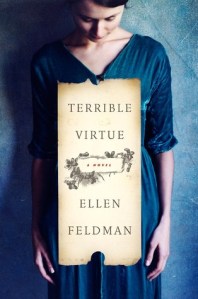 Terrible Virtue by Ellen Feldman
Another case of expectations too high and payoff too little. Fictionalized biographies can be among my favorite historical fiction, but the key is that they have to do something that a biography doesn’t do. They have to shape a story that goes beyond the chronology of what happened to whom and when. This novel about contraception activist Margaret Sanger failed to tell me anything I didn’t already know from The Birth of the Pill, a more engaging book all round. If anything this left me more confused about why Sanger consented to marriage and motherhood. These cringe-worthy lines try to explain it: “His [Bill’s] sex upended the world. His love filled the hole my childhood had carved out of me. Maybe that was the reason I married him.” [Read the first 26%.]
My rating: 
Vexation Lullaby by Justin Tussing
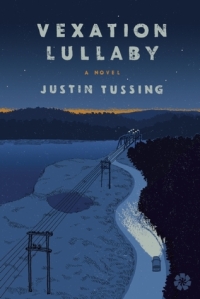 This started off very promising, with Pete Silver, a doctor in Rochester, New York, being summoned by ageing rock star Jimmy Cross for a consult. Jimmy knows Pete’s mother from way back and wants to know if he’ll accompany him on the airplane during this comeback tour as his personal physician. However, after that there was a lot of downtime filling in Pete’s backstory and introducing a first-person voice that didn’t feel relevant. This is Arthur Pennyman, a fan who’s seen every Jimmy Cross show and writes them up on his website. I didn’t care for Arthur’s sections and thought they pulled attention away from Pete’s story. That’s a shame, as the plot reminded me of Jennifer Egan’s A Visit from the Goon Squad. [Read the first nearly 100 pages.]
My rating:
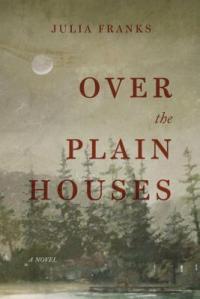 Over the Plain Houses by Julia Franks
Entirely decent historical fiction with a flavor of Ron Rash or Virginia Reeves (Work Like Any Other), but it felt so slow and aimless. Irenie Lambey is married to a harsh fundamentalist preacher named Brodis. She longs for their son to get a good education and hopes that the appearance of a USDA agent may be the chance, but Brodis cares about the boy’s soul rather than his mind. On night-time walks, Irenie stores up artifacts and memories in a cave – desperately trying to have a life larger than what her husband controls. It could well just be my lack of patience, but the believable dialect and solid characters weren’t quite enough to keep me reading. [Read the first 16%.]
My rating:
And now for the one I should have stopped reading at about the 25% point. I have an expanded version of this review on Goodreads; click on the title to read more.
The Mandibles: A Family, 2029–2047 by Lionel Shriver
 Shriver does a good line in biting social commentary. Here she aims at Atwood-style near-future speculative fiction and takes as her topic the world economy. I had big problems with this one. Worst is the sheer information overload: tons of economic detail crammed into frequent, wearisome conversations. Instead of making America’s total financial collapse a vague backdrop for her novel, she takes readers through it event by agonizing event. This means the first third or more of the novel feels like prologue, setting the scene. When she finally gets around to the crux of the matter – the entire extended Mandible family descending on Florence’s small New York City house – it feels like too little plot, too late. Everything Shriver imagines for the near future, except perhaps the annoying slang (e.g. “boomerpoop”), is more or less believable. But boy is it tedious in the telling.
My rating: 
Summer Reading Plans
In June my husband and I will be off to Europe for two weeks of train travel, making stops in Brussels, Freiburg (Germany), two towns in Switzerland and another two in Austria. I like picking appropriate reading material for my vacations whenever possible (even though I’ll never forget Jan Morris’s account of reading the works of Jane Austen on a houseboat in Sri Lanka – a case of the context being so wrong it’s right), so I’ve been thinking about what to take with me and what to read ahead of time.
Back in October I picked up a lovely little secondhand hardback of Jerome K. Jerome’s Diary of a Pilgrimage for £1. Given that it’s a novel about a journey by train and boat from England to Germany to see the Oberammergau Passion Play and that Jerome is a safe bet for a funny read, this one is definitely going in my luggage. I also plan to take along a library paperback of A Whole Life by Robert Seethaler, a novella set in the Austrian Alps at the time of the Second World War.
Last year I discovered Austrian writer Daniel Kehlmann through the brilliant F: A Novel, and now have two more of his waiting: Me and Kaminski and Measuring the World, which sound completely different from each other but equally appealing (see Naomi’s review of the latter). What I might do is read one just before the trip and the other soon after we get back.
There are a few thin classics I have on my shelves and might be tempted to slip into a backpack, but for the most part I’ll plan to save space by taking a well-loaded Kindle. (It currently houses 300 books, so there’s no risk of running out of reading material!) I think I’ll treat myself to a few July/August books from my priority advanced reads list, like (fiction) The Hemingway Thief by Shaun Harris and The Book that Matters Most by Ann Hood, and (nonfiction) Playing Dead by Elizabeth Greenwood and On Trails by Robert Moor.
Once we get back to England, my self-imposed restriction for the rest of the summer will be reading only my own books. That means no library books, NetGalley/Edelweiss ARCs, or unpaid review books. This should work out well because it looks like we’ll be moving on August 18th, so I’ll be able to cull some books after reading them to reduce the packing load.
In any case, it will be a good chance to reassess my collection and get through some doorstoppers like A Suitable Boy, City on Fire, and This Thing of Darkness. During moving week itself I may have to stick to Kindle books while the print ones are inaccessible, but then as I rediscover them through unpacking I can try to push myself through a few more.
What are your summer and/or vacation reading strategies?
Library Checkout: April 2016
You’ll notice a lot of familiar titles: some I’ve reviewed here recently; others have been hanging around since last month. It’s high time I actually read some of these – especially the Elizabeth Gilbert, for which I have high hopes. It’s a long Bank Holiday weekend coming up here in the UK, so maybe I’ll use that as the excuse to sink into a nice long library book…
LIBRARY BOOKS READ
- The Human Age: The World Shaped by Us by Diane Ackerman
- The Zimzum of Love: A New Way of Understanding Marriage by Rob and Kristen Bell
- To the River by Olivia Laing
- The Observances by Kate Miller (poetry)
- Dream Work by Mary Oliver (poetry)
- One of Us: The Story of a Massacre and Its Aftermath by Åsne Seierstad
- Golden Age by Jane Smiley
Skimmed only:
- My Brilliant Friend by Elena Ferrante
- The Towers of Trebizond by Rose Macaulay
LIBRARY BOOKS CURRENTLY READING
- Words in Air: The Complete Correspondence between Elizabeth Bishop and Robert Lowell, edited by Thomas Travisano [It’s over 800 pages, so I’ll probably be reading it all year!]
 CHECKED OUT, TO BE READ
- In the Unlikely Event by Judy Blume
- The Revised Fundamentals of Caregiving by Jonathan Evison
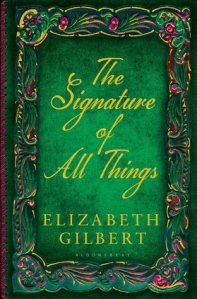
- The Signature of All Things by Elizabeth Gilbert
- The Great Soul of Siberia by Sooyong Park (about tigers)
RETURNED UNREAD
- The Land Ballot by Fleur Adcock
- Song of the Sea Maid by Rebecca Mascull
(Thanks, as always, to Shannon of River City Reading for the great blog idea and template!)
 Bookish Beck = Rebecca Foster. American transplant to England. Freelance proofreader and book reviewer.
 Bookish Beck