Season’s Readings: What I’ll Be Reading This Christmas
With part of my birthday book token I treated myself to the new paperback edition of Jeanette Winterson’s Christmas Days, which I’ll read off and on over the holidays this year and next, probably. I recently finished Rachel Joyce’s wintry short story collection and started Madeleine L’Engle’s third Crosswicks Journal, An Irrational Season. The first two chapters are set at Advent and Christmas and the rest later in the liturgical year; I’ve set the book aside to come back to in January. L’Engle is a great author to read if you’d like some liberal, non-threatening theology at this time of year. I particularly recommend her Christmas-themed book that I read last year. (Mini-reviews of the Joyce and L’Engle are below.)
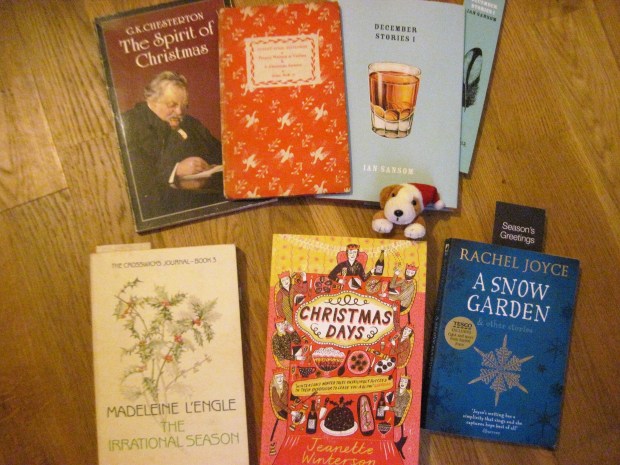
I also have a signed copy of Ian Sansom’s December Stories I that I won in a giveaway on Cathy’s blog, so I’ll be dipping into plenty of seasonally appropriate short stories this year. Earlier this year I picked up copies of the G.K. Chesterton collection (signed by the anthology editor) and the Robert Louis Stevenson volume (which contains prayers plus a sermon written during his time in Samoa) free at church from the theological library of a woman who’d died and donated her books to the church family.


A Snow Garden and Other Stories by Rachel Joyce
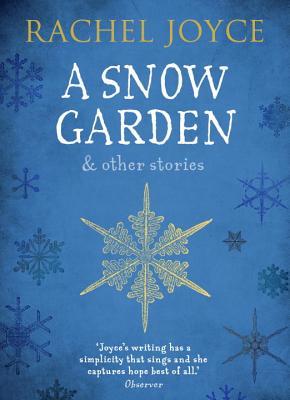 Two stand-outs were “The Boxing Day Ball,” a prequel to The Unlikely Pilgrimage of Harold Fry, describing how Harold and Maureen met, and “A Faraway Smell of Lemon,” in which a woman mourning the end of her relationship wanders into a cleaning supplies store and learns the simple lesson that everybody hurts. (“Life is hard sometimes” – fair enough, but can we say it without a cliché?) “I’ll Be Home for Christmas” is about the boy formerly known as Tim, now the mega pop star X. All he wants is a quiet few days back home, but he can’t seem to escape his reputation. Characters and little elements from previous stories reappear in later ones. My favorite was probably the title story, about a father trying to make the holidays perfect for his sons after his breakdown and divorce.
Joyce chooses to write about ordinary and forgotten people, but sometimes her vision of chavvy types doesn’t quite ring true, and when she isn’t being melancholy she’s twee. “Christmas Day at the Airport” was so contrived it made me groan. While I don’t think any of her books are truly great, they’re pleasant, relatable and easy to read.
My rating: 
Favorite lines:
“There is much to do, much to prepare, much to mend, but it cannot be done in a day and sometimes it is better to do one small thing.” (from “A Faraway Smell of Lemon”)
“The truth was, there were no instructions when you got married. There was no manual in the birthing suite that explained how to bring up a happy child. No one said, you do this, and then you do this, and after that this will happen. You made it up as you went along.” (from “The Marriage Manual”)
Bright Evening Star: Mystery of the Incarnation by Madeleine L’Engle
 “The story of Jesus’ birth has been oversentimentalized until it no longer has the ring of truth, and once we’d sentimentalized it we could commercialize it and so forget what Christmas is really about.” L’Engle believes in the power of storytelling, and in this short volume of memoir she retells the life story of Jesus and recalls her own experiences with suffering and joy: losing her father young (his lungs damaged by poison gas in WWI) and the death of her husband of 40 years versus the sustaining nature of family love and late-life friendships. Chapters 4 and 5 are particular highlights.
L’Engle was not at all your average American Christian: raised in the Episcopal tradition, she didn’t even encounter Evangelicalism until her mid-forties, and she doesn’t understand the focus on creationism and sexual morality. She also writes about free will and the adoration of Mary and how A Wrinkle in Time (rejected by many a publisher) was her fable of light in the midst of darkness. The title comes from The New Zealand Prayer Book, which also gives helpful alternate names for the persons of the Trinity: Earth Maker, Pain Bearer, Life Giver. This isn’t a particularly Christmas-y book, but it still lends itself to being read a chapter at a time during Advent.
My rating: 
Some other favorite lines:
“Christ, in being born as Jesus, broke into time for us, so that time will never be the same again.”
“Family can be a movable feast. It can be a group of friends sitting around the dining table for an evening. It can be one or two people coming to stay with me for a few nights or a few weeks. It should be the church, and I am grateful that my church is a small church.”
Are you reading any particularly wintry or Christmasy books this year?
“Cat Poems” & Other Cats I’ve Encountered in Books Recently
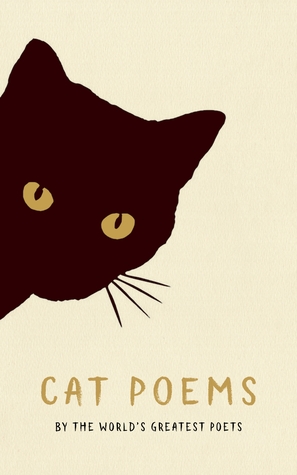 Cat Poems: An enjoyable selection of verse about our feline friends, nicely varied in terms of the time period, original language of composition, and outlook on cats’ contradictory qualities. I was unaware that Angela Carter and Muriel Spark had ever written poetry. There are perhaps too many poems by Stevie Smith – six in total! – though I did enjoy their jokey rhymes.
Some favorite lines:
“Cat sentimentality is a human thing. Cats / are indifferent, their minds can’t comprehend / the concept ‘I shall die’, they just go on living.” (from “Sonnet: Cat Logic” by Gavin Ewart)
“For every house is incomplete without him and a blessing is lacking in the spirit.” (from “Jubilate Agno” by Christopher Smart)
“These adorable things. When my life gives out, they’d eat me up in a second.” (from “I’ll Call Those Things My Cats” by Kim Hyesoon)
My rating:
Cat Poems was published in the UK on October 4th. My thanks to Serpent’s Tail for the free copy for review.
Even when it’s not a book specifically about cats, cats often turn up in my reading. Maybe it’s simply that I look out for them more since I became a cat owner several years ago. Here are some of the quotes, scenes or whole books featuring cats that I’ve come across this year.
Cats real and imaginary
 Stranger on a Train by Jenni Diski: “I find myself astonished that a creature of another species, utterly different to me, honours me with its presence and trust by sitting on me and allowing me to stroke it. This mundane domestic moment is as enormous, I feel at such moments, as making contact across a universe with another intelligence. This creature with its own and other consciousness and I with mine can sit in silence and enjoy each other’s presence. … This is a perfectly everyday scene but sometimes it takes my breath away that another living thing has allowed me into its life.”
 Certain American States by Catherine Lacey: “This cat wants to destroy beauty—I can tell. He is more than animal, he is evil, a plain enemy of the world. I wish him ill. I do. Almost daily I find a mess of feathers in the dirt. Some mornings there are whole bird carcasses left on my porch—eyes shocked open, brilliant blue wings, ripped and bloody. I have thought often of what it would take to kill a cat, quietly and quickly, with my bare hands. I have thought of this often. In fact I am thinking of it right now.” (from the story “Because You Have To”)
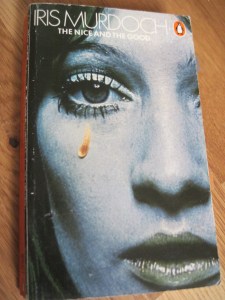 The Nice and the Good by Iris Murdoch: “Montrose was a large cocoa-coloured tabby animal with golden eyes, a square body, rectangular legs and an obstinate self-absorbed disposition, concerning whose intelligence fierce arguments raged among the children. Tests of Montrose’s sagacity were constantly being devised, but there was some uncertainty about the interpretation of the resultant data since the twins were always ready to return to first principles and discuss whether cooperation with the human race was a sign of intelligence at all. Montrose had one undoubted talent, which was that he could at will make his sleek hair stand up on end, and transform himself from a smooth stripey cube into a fluffy sphere. This was called ‘Montrose’s bird look’.”
 Four Bare Legs in a Bed and Other Stories by Helen Simpson: “They found it significant that I called my cat Felony. I argued that I had chosen her name for its euphonious qualities. She used to sink her incisors into the hell of my hand and pause a fraction of a millimeter from breaking the skin, staring at me until her eyes were reduced to sadistic yellow semibreves. She murdered without a qualm. She toyed with her victims, smiling broadly at their squeaks and death throes.
‘Why isn’t she a criminal?’ I asked. …
‘The difference is,’ said Mr Pringle, that we must assume your cat commits her crimes without mischievous discretion.’” (from the story “Escape Clauses”)
 In Delia Owens’s Where the Crawdads Sing, Sunday Justice is the name of the courthouse cat. He sits grooming on the courtroom windowsill during the trial and comes in and curls up to sleep in the cell of a particular prisoner we’ve come to care about.
A recommended picture book
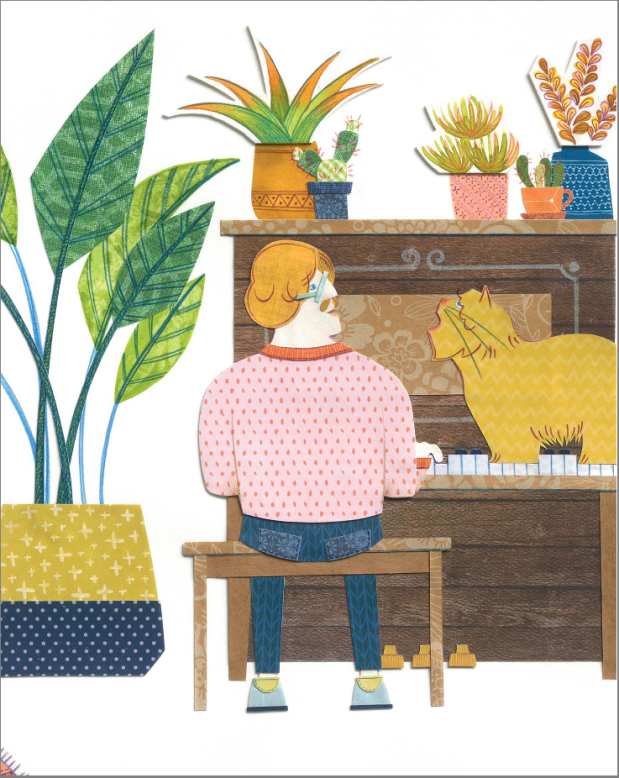
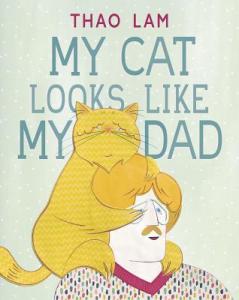 My Cat Looks Like My Dad by Thao Lam: I absolutely loved the papercut collage style of this kids’ book. The narrator explains all the ways in which the nerdy-cool 1970s-styled dad resembles the family cat, who is more like a sibling than a pet. “Family is what you make it.” There’s something of a twist ending, too. (Out on April 15, 2019.)
My rating: 
Later today I’m off to America for two weeks, but I’ll be scheduling plenty of posts, including the usual multi-part year-end run-down of my best reads, to go up while I’m away. Forgive me if I’m less responsive than usual to comments and to your own blogs!
This Really Isn’t About You by Jean Hannah Edelstein
This was the book I wanted Places I Stopped on the Way Home to be: a wry, bittersweet look at the unpredictability of life as an idealistic young woman in the world’s major cities. Edelstein’s memoir also fits into several of my favorite subgenres: it’s a family memoir, a medical memoir and a bereavement memoir all at once. The story opens in Brooklyn in February 2014 as Edelstein, age 32, is trying to build an adult life back in America after 14 years in London and Berlin. Two years earlier her father had told her via Skype from Baltimore that he had lung cancer, and she returned to the States to be closer to help. But when the moment came, she was still unprepared: “if someone had said to me: What would you like to be doing when your father dies? I would not have said, I would like to be looking for love on OKCupid. But I did not have the luxury to make that decision. Who does?”
 Her father never smoked yet died of lung cancer; his mother had colon cancer and died at 42. Both had Lynch syndrome, a genetic disease that predisposes people to various cancers. Six months after her father’s death, Edelstein took a genetic test, as he had wanted her to, and learned that she was positive for the Lynch syndrome mutation. The book’s structure (“Between” – “Before” – “After”) plunges readers right into the middle of the family mess, then pulls back to survey her earlier life, everything from childhood holidays in her mother’s native Scotland to being a secretary to a London literary agent who hated her, before returning to the turning point of that diagnosis. How is she going to live with this knowledge hanging over her? Doctors want her to have a prophylactic hysterectomy, but how can she rule out children when she doesn’t yet have a partner in her life?
So many aspects of this book resonated for me, especially moving between countries and having a genetic disease in the family. Beyond those major themes, there were tiny moments that felt uncannily familiar to me, like when she’s helping her mother prepare for an online auction of the contents of the family home in Maryland, or comparing the average cleanliness and comfort of rental properties in England and the States. There are so many little memorable scenes in this memoir: having an allergic reaction to shellfish two days after her arrival in the States, getting locked out of her sublet and having to call an Uzbek/Israeli locksmith at 3 a.m., and subsisting on oatmeal three times a day in London versus going on all-expenses-paid trips to Estonia and Mauritius for a conference travel magazine.
This is a clear-eyed look at life in all its irony (such as the fact that she’s claustrophobic and dreads getting MRI tests when it was her own father, a nuclear physicist, who built the world’s first full-body MRI scanner at Aberdeen) and disappointment. I’m prizing this as a prime example of life writing that’s not comprehensive or strictly chronological yet gives a clear sense of the self in the context of a family and in the face of an uncertain future.
My rating:
Readalikes:
The Family Gene by Joselin Linder
My Salinger Year by Joanna Rakoff
Mrs Gaskell & Me by Nell Stevens
Favorite lines:
“when I was in London, … I wondered if the problem of having my whole life ahead of me, free and clear and open for anything, was that having an unlimited number of options made the chance of choosing the wrong thing so high.”
“I was not yet old enough to realize that I’d never really know, that there would never be a time when I could think: I am here. This is me, without becoming uncertain again a moment later.”
“When I lived in England I drank a lot of tea, many cups a day, even though I didn’t like it. I learned quite fast after I arrived in London that drinking tea was an important way to connect with people: when I went over to their homes, or if we worked together in an office. Being offered a cup of tea meant that you were being offered an entry to something, and accepting it was important.”
This Really Isn’t About You was published by Picador on August 23rd. My thanks to the publisher for the free copy for review.
Frieda by Annabel Abbs: A Sideways Look at D.H. Lawrence
Possibly never before nor since has a great writer been so intensely and so permanently influenced by one woman as Lawrence was by Frieda von Richtofen.
~biographer Robert Lucas
I have a weakness for “famous wives” books, which have become increasingly popular over the past decade. (I have a whole shelf for them on Goodreads.) Frieda particularly appealed to me because of the reading I’ve done around the life of D.H. Lawrence. In my sophomore year of college I took a course on Yeats & Lawrence and found Lawrence fascinating almost in spite of myself. I remember bursting out in one early seminar on Sons and Lovers, “but he sexualizes everything!” The more I read, though, the more I admired his grasping for the fullness of life, which at least starts with the body.
After my study abroad year I did independent travel in Dorset and around Nottingham to explore the sense of place in Thomas Hardy and Lawrence’s works, and when I applied for graduate school scholarships I was undecided whether to focus on the Victorians or Lawrence and the Moderns (I eventually settled on the former). I also adapted a paper I’d written about D.H. Lawrence’s new moral framework for sexuality in Lady Chatterley’s Lover and presented it at the D.H. Lawrence Society of North America’s 2005 conference in Santa Fe, New Mexico. The conference included a wonderful trip out to Lawrence’s ranch at Taos.

All this explains why I was so keen to see how Annabel Abbs would depict Frieda, who came from disgraced German aristocracy and left her first husband, Ernest Weekley, a linguistics professor at Nottingham, and their three children to be with Lawrence. If you rely only on the words of Lawrence himself, you’d think Frieda was lucky to shed her dull family life and embark on an exciting set of bohemian travels with him as he built his name as a writer.
 Abbs adds nuance to that picture by revealing just how much Frieda was giving up, and the sorrow she left behind her. Much of the book is in third person limited from Frieda’s point of view, but there are also occasional chapters from the perspectives of Ernest and the children, mostly their son Monty, as they work through their confusion over Frieda’s actions and try to picture the future without her. I loved the way that these chapters employ dramatic irony, especially to create a believable child mindset. “I have realised there is something inside me struggling to come out,” Frieda says to Monty. “I call it the what-I-could-be.” Poor Monty, just seven years old when the book opens in 1907, thinks his mother must be talking literally about a baby on the way. When her inchoate longings finally center on Lawrence, Ernest’s working-class former student, in 1912, Monty describes the young man as a “hungry fox.”
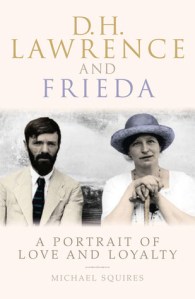 Frieda’s relationship with Lawrence, whom she called “Lorenzo,” lasted nearly two decades but was undeniably volatile. Abbs refuses to romanticize it: the early days of frolicking naked in meadows and weaving flowers through each other’s pubic hair soon cede to incidents of jealousy and disturbing cruelty. Lawrence pressed her into remarrying though she was happier living outside of convention. We can sympathize with the passion and deep communion she found with Lawrence –
“She was conscious, in that moment, that their minds had met and crossed and understood. That this miner’s son – so strange and unknown, so young – was more like her than anyone she’d ever met.”
“She felt as if she had been split open, as if Mr Lawrence had peered deep inside her, seen things she had hidden from the rest of the world. It was a marvellous feeling, she decided, to be explored and understood.”
– but also with the later suspicion that she’s given up so much – social acceptability and years of life with her children – and perhaps in some ways it hasn’t been worth it. “He could be so infuriating! So exhausting! But his vitality, the sharp light in which he saw everything, his wild poetic fury, they made her feel as if she could breathe again.”
Frieda is particularly reminiscent of Loving Frank, Nancy Horan’s novel about Mamah Borthwick Cheney’s affair with architect Frank Lloyd Wright: she left her children in pursuit of love and independence and spent time traveling, including in Germany, where she absorbed notions of free love and women’s rights – just as Frieda did. I was also reminded of Free Woman, Lara Feigel’s book on Doris Lessing, who gave up her children to pursue her writing. In Lessing’s case there was not the same wrenching regret. Still, all three books offer a valuable look at the choices women make when love, duty and vocation don’t align.

The Australian cover.
My knowledge of Lawrence’s writings and biography enhanced my enjoyment of this novel. I’ve appreciated for the first time just how much Frieda inspired the female protagonists in Lawrence’s major works. In a comprehensive Historical note and Author’s note, Abbs lists her sources and explains the small tweaks she made to the historical record to fit the story line. However, you don’t need any prior knowledge to fall in love with Frieda’s vivacity. Her determination to live according to her own rules makes her a captivating character.
My rating:
Frieda was published by Two Roads on November 15th. With thanks to the publisher for the proof copy for review.
Recent Writing for BookBrowse, Shiny New Books and the TLS
Here are excerpts from (and links to, where available) some of my recent reviews for other places. A few of these books will undoubtedly be showing up on my end-of-year best lists in a couple weeks’ time.
BookBrowse
I was pleased to have three of the books I reviewed show up on BookBrowse’s list of the top 20 books of the year, as voted for by the site’s readers. What’s more, Educated was voted their top nonfiction book of the year and Where the Crawdads Sing (below) their #1 debut novel. (The third on the list was Unsheltered.)
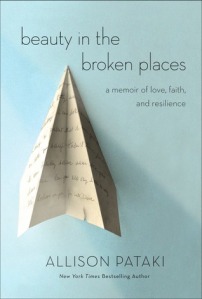 Beauty in the Broken Places by Allison Pataki: Ernest Hemingway wrote that we are strong at the broken places, and Allison Pataki found that to be true when her husband, David Levy, a third-year orthopedic surgery resident in Chicago, had a near-fatal stroke at age 30. On June 9, 2015, Dave and five-months-pregnant Allison were on a flight from Chicago to Hawaii for their babymoon, planning to stop in Seattle to visit Dave’s brothers. But they never made it there. On the plane Dave told her he couldn’t see out of his right eye.The plane made an emergency landing in Fargo, North Dakota and Dave was rushed to a hospital for testing. Doctors found he had suffered a bithalamic midbrain ischemic stroke, even though he’d had no risk factors and this stroke type was virtually unknown in patients of his age. Pataki goes back and forth between the details of this health crisis and her past with Dave. Hers is a relatable story of surviving the worst life can throw at you and finding the beauty in it.
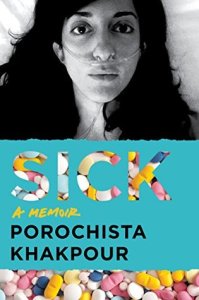 Sick by Porochista Khakpour: Khakpour can’t remember a time when she didn’t feel unwell and like she wanted to escape. “I had no idea what normal was. I never felt good,” she writes in her bracing memoir. Related to this sense of not being at home in her body was the feeling of not having a place where she fit in. Throughout Sick, she gives excellent descriptions of physical and mental symptoms. Her story is a powerful one of being mired in sickness and not getting the necessary help from medical professionals. Lyme disease has cost her $140,000 so far, and a lack of money and health insurance likely delayed her diagnosis by years. There is, unfortunately, some inherent repetition in a book of this nature. At times it feels like an endless cycle of doctors, appointments, and treatment strategies. However, the overall arc of struggling with one’s body and coming to terms with limitations will resonate widely.
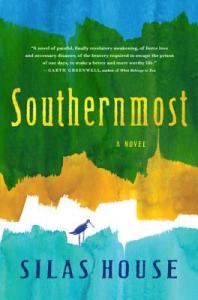 Southernmost by Silas House: In Silas House’s sixth novel, a Tennessee preacher’s family life falls apart when he accepts a gay couple into his church. We go on a long journey in Southernmost: not just a literal road trip from Tennessee to Florida, but also a spiritual passage from judgment to grace. Reconciliation is a major theme, but so is facing up to the consequences of poor decisions. I found the plotting decisions rewarding but also realistic. The pattern of a narrow religious worldview ebbing away to no faith at all and eventually surging back as a broader and more universal spirituality truly resonates. I loved House’s characters and setups, as well as his gentle evocation of the South. His striking metaphors draw on the natural world, like “She had the coloring of a whip-poor-will” and “The sky is the pink of grapefruit meat.” It’s a beautiful, quietly moving novel of redemption and openness to what life might teach us.
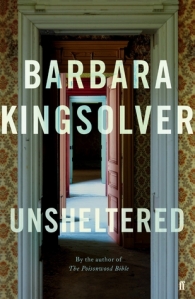 Unsheltered by Barbara Kingsolver: Kingsolver’s bold eighth novel has a dual timeline that compares the America of the 1870s and the recent past, revealing how they are linked by distrust and displacement. The book’s themes and structure emphasize similarities between two time periods that might initially appear very different. Chapters alternate between the story lines, and the last words of one chapter form the title of the next. It’s a clever and elegant connecting strategy, as is the habit of using variations on the title word as frequently as possible – something Jonathan Franzen also does in his novels. (I counted 22 instances of “shelter” and its variants in the text; how many can you spot?) Kingsolver can be heavy-handed with her messages about science, American politics and healthcare, etc. All the same, Unsheltered is a rich, rewarding novel and an important one for our time, with many issues worth pondering and discussing.
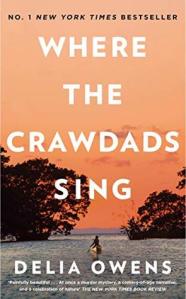 Where the Crawdads Sing by Delia Owens: It’s easy to see why so many have taken this debut novel into their hearts: it’s a gripping mystery but also a tender coming-of-age story about one woman’s desperately lonely upbringing and her rocky route to finding love and a vocation. Not only that, but its North Carolina marsh setting is described in lyrical language that evinces Delia Owens’s background in nature writing, tempered with folksy Southern dialect. The title refers to places where wild creatures do what comes naturally, and throughout the book we are invited to ponder how instinct and altruism interact and what impact human actions can have in the grand scheme of things. In Kya, Owens has created a truly outstanding character. The extremity of her situation makes her a sympathetic figure in spite of her oddities. Crawdads is a real treat.
Shiny New Books
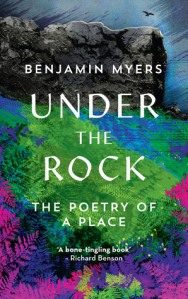 Under the Rock by Benjamin Myers: When Myers moved to the Calder Valley of West Yorkshire from London over a decade ago, he approached his new patch with admirable curiosity, and supplemented the observations he made from his study window with frequent long walks with his dog (“Walking is writing with your feet”) and research into the history of the area. The result is a divagating, lyrical book that ranges from literature and geology to true crime but has an underlying autobiographical vein. This isn’t old-style nature writing in search of unspoiled places. Instead, it’s part of a growing interest in the ‘edgelands’ where human impact is undeniable but nature is creeping back in. Interludes transcribe his field notes, which are stunning impromptu poems. I came away from this feeling that Myers could write anything – a thank-you note, a shopping list – and make it profound literature. Every sentence is well-crafted and memorable. “Writing is a form of alchemy,” he declares. “It’s a spell, and the writer is the magician.” I certainly fell under his spell here.
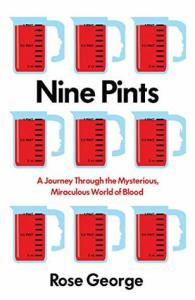 Nine Pints by Rose George: Nine Pints dives deep into the science and cultural history of blood. George’s journalistic tenacity keeps her pushing through the statistics to find the human stories that animate the book. In the first chapter we track the journey of a pint of blood that she donates in her hometown of Leeds. I was particularly interested, if morbidly so, in the chapter on leeches and bloodletting. Other sections journey further afield, chiefly to South Africa and India, to explore AIDS and menstruation taboos. The style can be choppy and repetitive, given to short sentences and identical paragraph openers, and there are a couple of places where the nine-chapter structure shows its weaknesses. While Nine Pints is quite uneven, it does convey a lot of important information about the past, present and future of our relationship to blood.
Times Literary Supplement
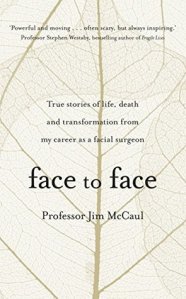 Face to Face: True stories of life, death and transformation from my career as a facial surgeon by Jim McCaul: Eighty percent of a facial surgeon’s work is the removal of face, mouth and neck tumors in surgeries lasting eight hours or more. McCaul also restores patients’ appearance as much as possible after disfiguring accidents. Here he pulls back the curtain on the everyday details of his work life: everything from his footwear (white Crocs that soon become stained with blood and other fluids) to his musical choices (pop for the early phases; classical for the more challenging microsurgery stage). Like neurosurgeon Henry Marsh, he describes the awe of the first incision – “an almost overwhelming sense of entering into a sanctuary.” There’s a vicarious thrill to being let into this insider zone, and the book’s prose is perfectly clear and conversational, with unexpectedly apt metaphors such as “Sometimes the blood vessels can be of such poor quality that it is like trying to sew together two damp cornflakes.” This is a book that inspires wonder at all that modern medicine can achieve.
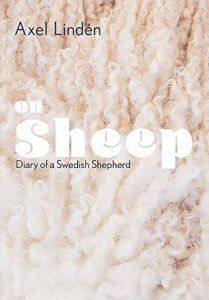 On Sheep: Diary of a Swedish Shepherd by Axel Lindén: Lindén left city life behind to take on his parents’ rural collective in southeast Sweden. This documents two years in his life as a shepherd aspiring to self-sufficiency and a small-scale model of food production. Published diaries can devolve into tedium, but the brevity and selectiveness of this one prevent its accounts of everyday tasks from becoming tiresome. Instead, the rural routines are comforting, even humbling, as the shepherd practices being present with these “quiet and unpretentious and stoical” creatures. The attention paid to slaughtering and sustainability issues – especially as the business starts scaling up and streamlining activities – lends the book a wider significance. It is thus more realistic and less twee than its stocking-stuffer dimensions and jolly title font seem to suggest.
Three Books that Originated on the Radio
As the end of the year approaches and I try to get through a final handful of review books, I’m looking for ways to combine posts. It may seem like a fairly arbitrary connection, but all three of these books originated as essays or short stories that were aired on British radio. I never listen to the radio so I miss out on these projects the first time around, but I’ve been interested to note how short forms and conversational styles lend themselves to oral performance.
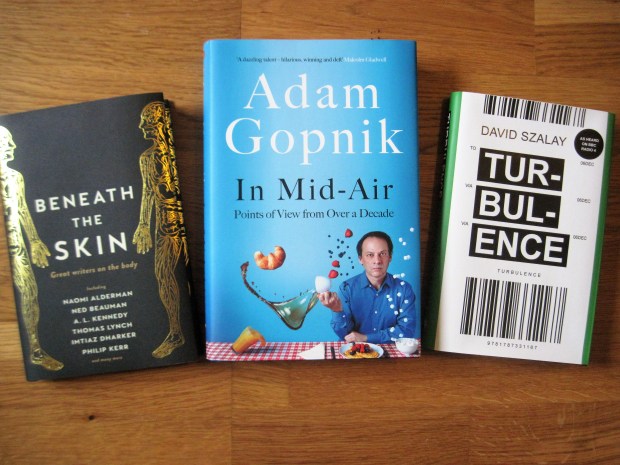
Beneath the Skin: Great Writers on the Body
These 15 pieces were commissioned for the BBC Radio 3 series “A Body of Essays.” Thomas Lynch, a small-town American undertaker and wonderful, unjustly obscure writer, opens and closes the volume. In his introduction he remarks – appropriately as Christmas draws near – that “We are an incarnate species”: we experience the world only through our bodies, which are made of disparate parts that work together as a whole. This project considers single organs by turn “in hopes that by knowing the part we might better know the whole of our predicament and condition.”
 Naomi Alderman, musing on the intestines, draws metaphorical connections between food, sex and death, and gives thanks that digestion and excretion are involuntary processes we don’t have to give any thought. Ned Beauman reports on misconceptions about the appendix as he frets about the odds of his bursting while he’s in America without health insurance. The late Philip Kerr describes the checkered history of the lobotomy, which used to reduce patients to a vegetative state but can now quite effectively treat epilepsy.
The pieces incorporate anatomical knowledge, medical history, current research, cultural connections, and sometimes observation of a hospital procedure. These threads are elegantly woven together, as in Patrick McGuinness’s essay on the ear, which skips between Hamlet’s father’s death, the secretive delight of mining for earwax, Beethoven’s ear trumpet, and what we know about in utero sounds.
 Most authors chose a particular organ because of its importance to their own health. Christina Patterson’s acne was so bad she went to the UK’s top skin specialist for PUVA light treatments, Mark Ravenhill had his gallbladder removed in an emergency surgery, and Daljit Nagra’s asthma led his parents to engage Sikh faith healers for his lungs. Two of my favorite chapters were by William Fiennes, whose extreme Crohn’s disease caused him to have a colostomy bag for two years in his early twenties, and poet Kayo Chingonyi, who has always been ashamed to admit that his parents both died of complications of HIV in Zambia. Such personal connections add poignancy to what could have been information dumps.
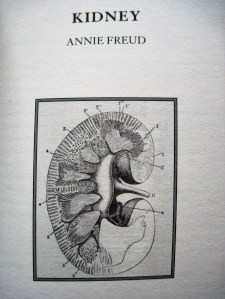
As is usual for essay collections, my interest varied somewhat. I had my hopes too high so was disappointed with a scattered piece on the kidneys. But the overall quality is terrific. If you enjoy medical reads to any extent, I recommend this as a bedside book to read occasionally.
Some favorite lines:
“It’s a strange and shifting thing – this sense I have that I am my body, of which some bits are essential and some expendable.” (Mark Ravenhill)
“There are things we only think about when they go wrong: the fan belt, the combi boiler, the bowel.” (William Fiennes)
“Like most of us, I take my body for granted. I live in the most complex, intricate machine and as long as it wakes up in the morning, and goes to bed at night, I am uninterested in its inner workings.” (Chibundu Onuzo, “Thyroid”)
My rating:
Beneath the Skin was published by the Wellcome Collection imprint of Profile Books on October 25th. My thanks to the publisher for a free copy for review.
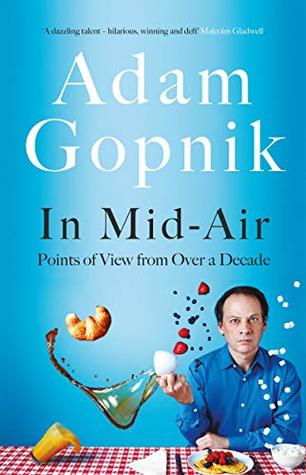
In Mid-Air by Adam Gopnik
New Yorker writer Gopnik contributed to BBC Radio 4’s A Point of View for over a decade. These essays date from 2012 to 2017 and are grouped into three loosely thematic sections on family, culture and politics. Gopnik self-deprecatingly sees himself as “offering measured ambivalences on everything.” As an American who was raised in Canada and has lived in Paris and spent significant time in London, he has a refreshingly cosmopolitan outlook and can appreciate the nuances in different countries’ identities. At the same time, he brings out what’s universal: being annoying to one’s teenage children, gauging the passing of time by family members’ changes, the desire to die with dignity (remembering his father-in-law’s death at age 95), and lessons in a happy marriage from Charles and Emma Darwin – he boils it down to lust, laughter and loyalty.
 During the weeks that I spent with these essays I was frequently reminded of Jan Morris’s In My Mind’s Eye, which casts a similarly twinkling eye over the absurdities of modern life and the aging body. Gopnik endures shingles and shrugs over his funny last name (“drunken lout” in Russian) and short stature. He mostly ignores Twitter and decries our dependence on smartphones. As he’s never learned to drive, he’s amused by the idea of self-driving cars.
My favorite pieces were on significantly more trivial matters, though: the irony of famous Christmas songs being written by Jews, and a satire on society’s addiction to DVD box sets. Other arts references vary from the Beatles and Bob Dylan’s Nobel Prize to Cubism and literary festivals. It’s a quirky blend of high and low culture here. Bizarrely, Gopnik has recently written an oratorio on Alan Turing and a musical about a New York City restaurant.
The author is an unabashed liberal who prizes pluralism above all else but warns how fragile it is. In the final section he prophesies catastrophe under Trump and, afterwards, can only say that at least his election puts lesser issues into perspective. I valued the diagnosis of American insularity and British inwardness – this particular essay was written in 2013 but seems all the more relevant post-Brexit. This was my fifth book from Gopnik. While I didn’t engage with every essay and would have liked them to be chronological so there was a mix of topics all the way through, it was a pleasant and often thought-provoking read.
Some favorite lines:
“Watching the people we love die bit by bit is the hardest thing life demands until we recall that watching the people we love die bit by bit is in a certain sense what life simply is. It just usually takes more time for the bits to go by.”
“We should never believe that people who differ from us about how we ought to spend public money want to commit genocide or end democracy, and we should stop ourselves from saying so, even in the pixellated heat of internet argument. But when we see the three serpents of militarism, nationalism and hatred of difference we should never be afraid to call them out, loudly, by name”
My rating:
In Mid-Air was published by riverrun, a new Quercus imprint, on October 18th. My thanks to the publisher for a free copy for review.
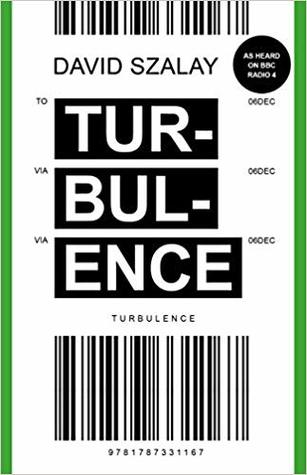
Turbulence by David Szalay
These 12 linked short stories, commissioned for BBC Radio 4, focus on travel and interconnectedness. Each is headed by a shorthand route from one airport to another, and at the destination we set out with a new main character who has crossed paths with the previous one. For instance, in “YYZ – SEA” the writer Marion Mackenzie has to cancel a scheduled interview when her daughter Annie goes into labor. There’s bad news about the baby, and when Marion steps away from the hospital to get Annie a few necessaries from a supermarket and is approached by a pair of kind fans, one of whom teaches Marion’s work back in Hong Kong, she’s overcome at the moment of grace-filled connection. In the next story we journey back to Hong Kong with the teacher, Jackie, and enter into her dilemma over whether to stay with her husband or leave him for the doctor she’s been having an affair with.
 As he ushers readers around the world, Szalay invites us to marvel at how quickly life changes and how – improbable as it may seem – we can have a real impact on people we may only meet once. There’s a strong contrast between impersonal and intimate spaces: airplane cabins and hotel rooms versus the private places where relationships start or end. The title applies to the characters’ tumultuous lives as much as to the flight conditions. They experience illness, infidelity, domestic violence, homophobia and more, but they don’t stay mired in their situations; there’s always a sense of motion and possibility, that things will change one way or another.
My favorite story was “DOH – BUD,” in which Ursula goes to visit her daughter Miri and gains a new appreciation for Miri’s fiancé, Moussa, a Syrian refugee. I also liked how the book goes full circle, with the family from the final story overlapping with that of the first. Though a few of the individual stories are forgettable, I enjoyed this more than Szalay’s Booker-shortlisted All that Man Is, another globe-trotting set of linked stories.
Like Beneath the Skin, this acknowledges the many parts making up the whole of humanity; like In Mid-Air, it encourages a diversity of opinion and experience rather than narrow-mindedness. Maybe the three books had more in common than I first thought?
A favorite line:
“In fact it was hard to understand quite what an insignificant speck this aeroplane was, in terms of the size of the ocean it was flying over, in terms of the quantity of emptiness which surrounded it on all sides.”
My rating:
Turbulence is published by Jonathan Cape today, December 6th. My thanks to the publisher for a free copy for review.
The Winter Soldier by Daniel Mason
Though I’m often wary of war fiction – can anything new still be written about World War I? – I was drawn to The Winter Soldier by the enthusiastic American reviews and the medical theme. The protagonist of psychiatrist Daniel Mason’s third novel, Lucius Krzelewski, comes from southern Polish nobility. In the 1910s medicine was a path for those seeking social mobility, but for Lucius neurology study is a way out of his stifling aristocratic household. Under Herr Doktor Zimmer’s tutelage in Vienna, he experiments on ways to make blood vessels visible. Dismayed to learn that Zimmer believes the “mermaid” in the medical school’s anatomical museum is real, he hurries to enlist when war begins in 1914.
 As a 22-year-old medical lieutenant he’s stationed at a church turned into a regimental hospital at Lemnowice. Here Sister Margarete has been making do without a doctor in charge for two months. She’s been performing amputations and setting fractures in a lice-ridden building where hunger and typhoid are never far away. Lucius is ashamed of his ignorance compared to this skilled nurse; though he has textbook knowledge, he has no practical experience and has to learn on the job.
The following winter a Hungarian soldier suffering from “nervous shock” but no visible wounds is brought in, a sheaf of accomplished drawings padding his coat. For Lucius and Margarete, Sergeant József Horváth poses a particular challenge, which makes his recovery seem more like a resurrection: “they were both falling a little bit in love with their silent visitor or, more, with the cure that they had wrought.” Even as Lucius and Margarete fall in love and steal moments alone, they regret they couldn’t do more for Horváth. When Lucius and Margarete are separated, he vows to find her again – and make things right with Horváth.
I loved the novel’s first half, with its gallows humor, memorable scenes of gruesome medical procedures, and bleak conditions so convincing you’ll find yourself itching right along with the lice-plagued patients. But at about the halfway point the pace changes dramatically. Years pass and Lucius has various deployments and hospital positions. Curiously, although so much is happening to him outwardly, he’s stalled internally – haunted by thoughts of Margarete and Horváth. Perhaps this is why I felt the narrative slowed to a crawl. I could barely force myself to read more than five or 10 pages in a sitting, and the novel as a whole took me much longer to read than normal. Or maybe I was just missing Margarete, the most vibrant character.
Early on I was reminded of Julie Orringer’s The Invisible Bridge and Hubert Mingarelli’s A Meal in Winter, lesser-known war novels in which the stark beauty of the writing tempers the somber subject matter. Partway through I started thinking of Ambrose Parry’s The Way of All Flesh, in which an unqualified female outshines a male in medical knowledge. By the end I was recalling epic separation-filled romances like The English Patient and Birdsong.
Though the novel’s second half never matched the strength of the first, I was at least pleased that Mason avoided a clichéd, Hollywood-ready ending in favor of a more fitting one that, while still somewhat far-fetched, makes sense of the title’s emphasis. This is a moving story of the physical and psychological effects of war, and I would certainly read more by Mason.
My rating:
The Winter Soldier was published in the UK by Mantle on October 18th. With thanks to the publisher for the free copy for review.
Novellas in November Wrap-Up, with Mini-Reviews
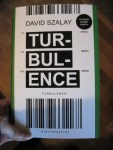 Novellas in November was a great success, helping me to finish more books in one month than I possibly ever have before. David Szalay’s Turbulence – a linked short story collection of tantalizing novella length – just arrived yesterday; I’ve started it but will be finishing it in December. The slim volume Fox 8 by George Saunders is also waiting for me at the library and I should be able to read it soon.
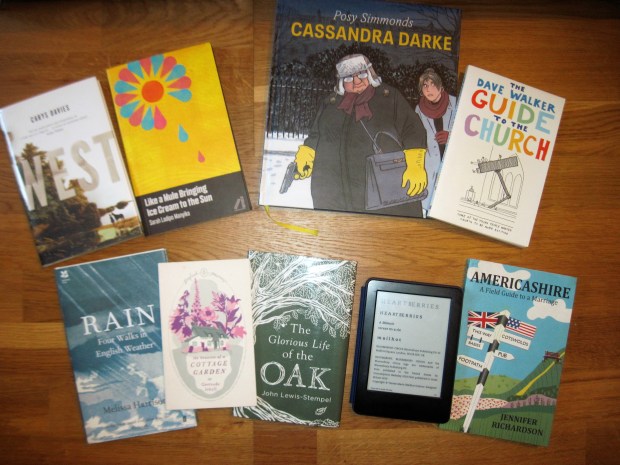
For this final installment I have 10 small books to feed back on: a mixture of fiction, graphic novels, nature books and memoirs.
Fiction:
West by Carys Davies (2018)
[149 pages]
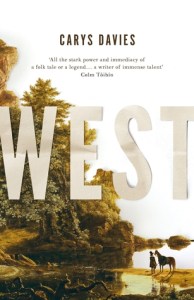 A gritty piece of historical fiction about a widowed mule breeder, Cyrus Bellman, who sets out from Pennsylvania to find traces of the giant creatures whose bones he hears have been discovered in Kentucky. He leaves his 10-year-old daughter, Bess, in the care of his sister, knowing he’ll be gone at least two years and may never return. Chapters cut between Cy’s harrowing journey in the company of a Native American guide, Old Woman From A Distance, and Bess’s home life, threatened by the unwanted attentions of their ranch hand neighbor and the town librarian. I don’t usually mind dark stories, but this was so bleak that I found it pretty unpleasant. The deus ex machina ending saved it somewhat.
Like a Mule Bringing Ice Cream to the Sun by Sarah Ladipo Manyika (2016)
[118 pages]
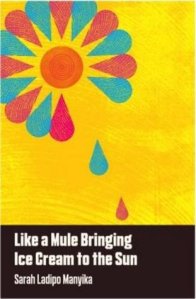 Morayo Da Silva is an unlikely heroine: soon to turn 75, she’s a former English professor from Nigeria who hopped between countries with her ambassador husband but now lives alone in San Francisco. The first-person narration switches around to give the perspectives of peripheral figures like a shopkeeper, a homeless woman, and Sunshine, the young friend who helps Morayo get her affairs in order after she has a fall and goes into a care home temporarily. These shifts in point of view can be abrupt, even mid-chapter, and are a little confusing. However, Morayo is a wonderful character, inspiring in her determination to live flamboyantly. I also sympathized with her love of books. I would happily have read twice as many pages about her adventures.
Graphic Novels:
Cassandra Darke by Posy Simmonds (2018)
[94 pages]
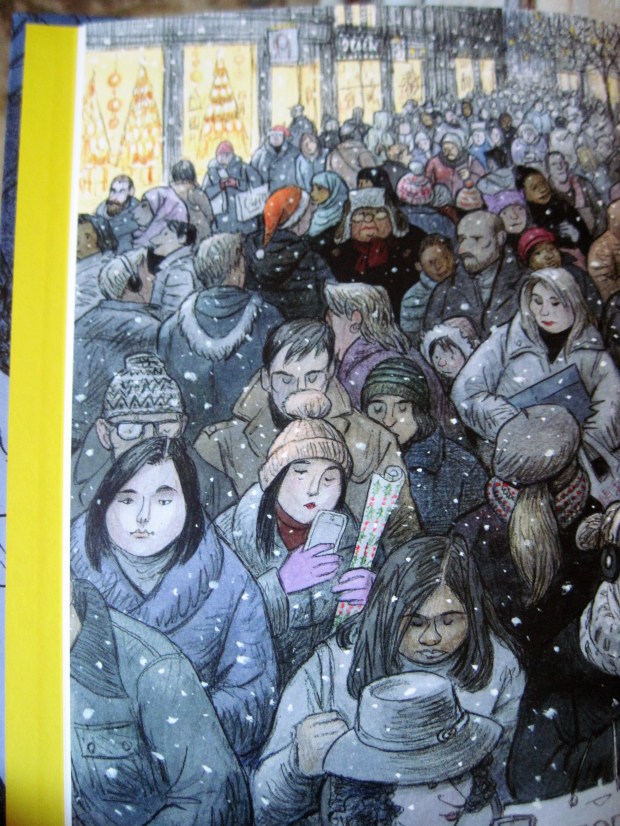
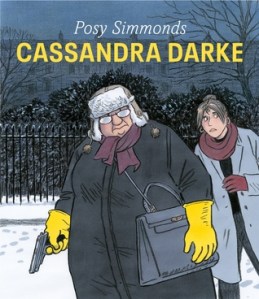 Simmonds would be great for graphic novel newbies: she writes proper, full-length stories, often loosely based on a classic plot, with lots of narration and dialogue alongside the pictures. Cassandra Darke is a 71-year-old art dealer who’s laid low by fraud allegations and then blindsided by a case of mistaken identity that brings her into contact with a couple of criminal rings. To start with she’s a Scrooge-like curmudgeon who doesn’t understand the big fuss about Christmas, but she gradually grows compassionate, especially after her own brief brush with poverty. Luckily, Simmonds doesn’t overdo the Christmas Carol comparisons. Much of the book is in appropriately somber colors, with occasional brightness, including the yellow endpapers and built-in bookmark.
The Dave Walker Guide to the Church by Dave Walker (2006)
[88 pages]
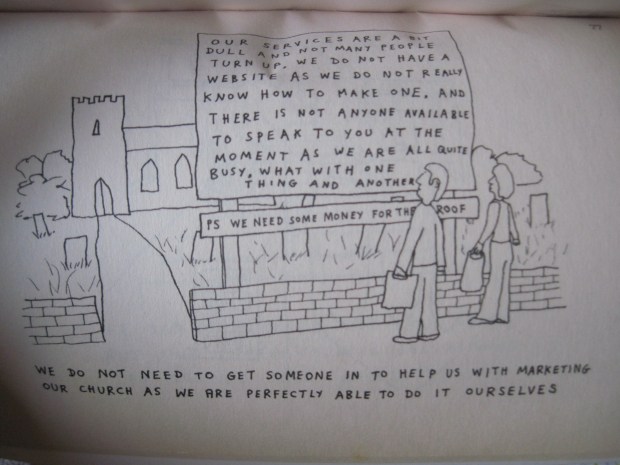
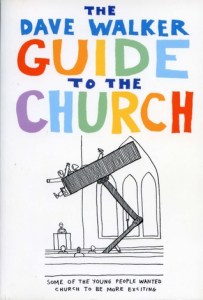 Most of these comics originally appeared in the Church Times, the official newspaper of the Church of England. No doubt you’ll get the most out of it if you’re familiar with Anglican churches or the like (Episcopalian or even Roman Catholic). My mother-in-law is a C of E vicar and we’ve attended a High Anglican church for the last two years, so I got many a good snort out of the book. Walker pokes fun at bureaucracy, silly traditions, closed-mindedness, and the oddities of church buildings and parishioners’ habits. My favorite spreads compare choirs and music groups on criteria like “ability to process in” and liken different church members to chess pieces to explain church politics.
Nature Books:
Rain: Four Walks in English Weather by Melissa Harrison (2016)
[100 pages]
 In the course of a year Harrison took four rainy walks, in different seasons and different parts of England. She intersperses her observations with facts and legends about the rain, quotes from historical weather guides and poems. It has the occasional nice line, but is overall an understated nature/travel book. A noteworthy moment is when she remembers scattering her mother’s ashes on a Dartmoor tor. I most liked the argument that it’s important to not just go out in good weather, but to adapt to nature in all its moods: “I can choose now to overcome the impulse for comfort and convenience that insulates us not only from the bad in life but from much of the good. I think we need the weather, in all its forms, to feel fully human.”
The Beauties of a Cottage Garden by Gertrude Jekyll (2009)
[88 pages]
 This mini-volume from Penguin’s English Journeys series feels like a bit of a cheat because it’s extracted from Wood and Garden (1899). Oh well. In short chapters Jekyll praises the variety of colors, smells and designs you’ll find in the average country garden, no matter how modest its size. She speaks of gardening as a lifelong learning process, humbly acknowledging that she’s no expert. “I hold that the best purpose of a garden is to give delight and to give refreshment of mind, to soothe, to refine, and to lift up the heart in a spirit of praise and thankfulness. … a garden is a grand teacher. It teaches patience and careful watchfulness; it teaches industry and thrift; above all, it teaches entire trust.”
The Glorious Life of the Oak by John Lewis-Stempel (2018)
[87 pages]
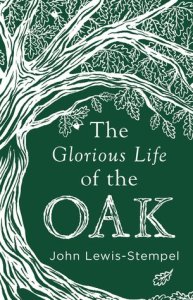
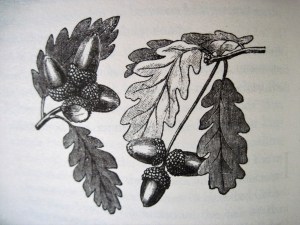 I didn’t enjoy this as much as the other Lewis-Stempel book I read this month, The Secret Life of the Owl. There’s a lot here about the role the oak has played in British history, such as in warships and cathedral roofs. Other topics are the oak’s appearance and function in different seasons, the use of acorns and oak leaves in cooking, and the myths and legends associated with the trees. I felt there was too much minimally relevant material added in to make up the page count, such as a list of Britain’s famous named oaks and long poems from the likes of John Clare and William Cowper. While Lewis-Stempel always has a piercing eye, I wonder if he shouldn’t be saving up his energies to write more substantial books.
General Nonfiction / Memoirs:
My Year by Roald Dahl (1993)
[64 pages]
 I spotted a copy in our Stamford Airbnb bedroom and read it over our two nights there. These short month-by-month essays were composed in the last year of Dahl’s life. Writing with children in mind, he remarks on what schoolkids will experience, whether a vacation or a holiday like Guy Fawkes night. But mostly he’s led by the seasons: the birds, trees and other natural phenomena he observed year after year from his home in Buckinghamshire. Dahl points out that he never lived in a city, so he chose to mark the passing of time chiefly by changes in the countryside. This is only really for diehard fans, but it’s a nice little book to have at the bedside. (Illustrated, as always, with whimsical Quentin Blake sketches.)
Heart Berries by Terese Marie Mailhot (2018)
[178 pages]
 Mailhot was raised on a First Nation reservation on an island off of British Columbia. She is wary of equating her family with Native stereotypes, but there’s no denying that her father was a drunk and ended up murdered. After a childhood of abuse and foster homes, Mailhot committed herself to a mental hospital for PTSD, bipolar II and an eating disorder. It was there that she started writing her story. Much of the book is addressed in the second person to her partner, who helped her move past a broken marriage and the loss of her older son to his father’s custody. Though I highlighted lots of aphoristic pronouncements, I had trouble connecting with the book as a whole: the way imprecise scenes blend into each other makes it hard to find a story line in the murk of miserable circumstances. A more accurate title would have been “Indian Condition” or “Indian Sick” (both used as chapter titles).
Americashire: A Field Guide to a Marriage by Jennifer Richardson (2013)
[151 pages]
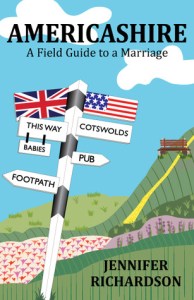 A memoir by an American woman married to a Brit and adjusting to English village life was always going to appeal to me. If you approach this as a set of comic essays on the annual rituals of rich toffs (summer fairs, auctions, horse racing, a hunt ball, a cattle market, etc.), it’s enjoyable enough. It’s when Richardson tries to be more serious, discussing her husband’s depression, their uncertainty over having children, and her possible MS, that the book falters. You can tell her editors kept badgering her to give the book a hook, and decided the maybe-baby theme was strongest. But I never sensed any real wrestling with the question. Not a bad book, but it lacks a clear enough idea of what it wants to be.
Total number of novellas read this month: 26
[not reviewed: In the Space between Moments: Finding Joy and Meaning in Medicine by Pranay Sinha – ]
A few that didn’t take: The Optician of Lampedusa by Emma Jane Kirby, The Mussel Feast by Birgit Vanderbeke, Sea of Ink by Richard Weihe
 My overall favorite: The Gifts of the Body by Rebecca Brown
Runners-up: Surfacing by Margaret Atwood, How to See Nature by Paul Evans, Bodies of Water by V. H. Leslie, and Ghost Wall by Sarah Moss
The ones that got away from me:
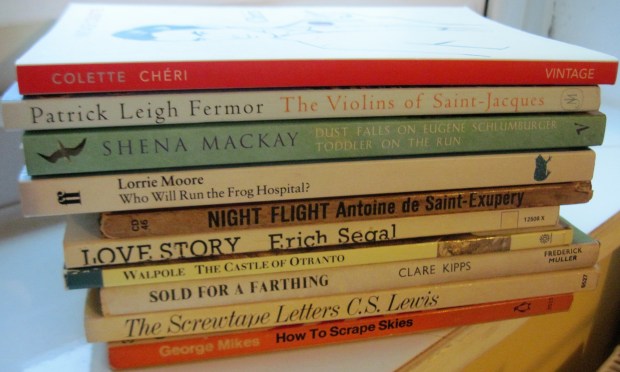
There’s always next year!
What’s the best novella you’ve read recently? Do you like the sound of any of the ones I read?
Margaret Atwood Reading Month: Surfacing and The Edible Woman
For the Margaret Atwood Reading Month hosted by Marcie and Naomi, I read her first two novels – though I didn’t realize they were so at the time, and read them in reverse order. These were my 18th and 19th Atwood books overall, and my 11th and 12th of her novels. It was particularly interesting to see the germ of her frequent themes in these early works.
Surfacing (1972)
(At 186 pages, this just about fit into Novellas for November too!) A young Canadian woman has returned to her French-speaking hometown, ostensibly to search for her missing father but really to search for herself. She’s an illustrator at work on a collection of Quebec folk tales, and in her past are a husband and child that she left behind. With her at her father’s lakeside cabin are her boyfriend Joe, whom she’s not sure she loves, and their friends David and Anna, a married couple whose dynamic is rather disturbing – David is always making demeaning sexualized jokes about Anna, who is afraid for him to see her without makeup on.
 This is a drifting, dreamy sort of book whose gorgeous nature writing (“Above the trees streaky mackerel clouds are spreading in over the sky, paint on a wet page; no wind at lake level, soft feel of the air before rain”) inures you to various threats. You’re never sure just how serious they’ll turn out to be. Will the men’s attitude to women spill over into outright assault? Will there be some big blowup with the resented Americans who are monopolizing the lake? (“We used to think they were harmless and funny and inept and faintly lovable, like President Eisenhower.”)
Meanwhile, the question of her father’s whereabouts becomes less and less important as the book goes on. The narrator seems to have closed herself off to emotion, but all that’s repressed returns dramatically in the final 20 pages (“From any rational point of view I am absurd; but there are no longer any rational points of view.”).
I suspect there may be a fair bit I missed; the book would probably benefit from future re-readings and even some exploration of secondary sources to think about all that’s going on. It’s maybe not as accessible and plot-heavy as much of Atwood’s later work, but I found it to be an intriguing and rewarding read, and it still feels timely more than four decades later.
The Edible Woman (1969)
Marian McAlpin works for Seymour Surveys, administering questionnaires about rice pudding and a new brand of beer. She shares an apartment with Ainsley, who tests electric toothbrushes, in the home of a harridan of a landlady who monitors their every move. Marian is happy enough with her boyfriend Peter and gradually drifts into an engagement – but she can’t stop thinking about Duncan, an apathetic graduate student whom she met during her survey rounds and ran into again at the laundromat. Duncan represents a sort of strings-free relationship that contrasts with the traditional marriage she’d have with Peter. Her challenge is to overcome the inertia of convention and decide what she really wants from her life.
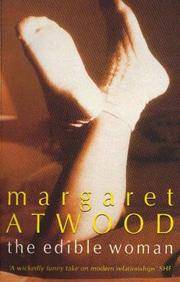 Part Two’s shift from first person to third person is a signal that Marian is dissociating from her situation. She recoils from food and pregnancy – two facts of bodily life that the book’s characters embrace greedily or turn from in horror. Gradually Marian eliminates more and more foods from her diet, starting with meat. And while Ainsley concocts a devious plan to get pregnant by Marian’s friend Len, Marian keeps in mind the cautionary tale of her college friend Clara, whose three monstrous children are always peeing on people or going off to poop in corners. Marian perceives Clara as having given up her mind in favor of her womb.
It’s unclear whether we’re meant to see Marian’s experience as a temporary eating disorder or a physical manifestation of endangered femininity. Now that veganism is mainstream, it sounds dated to hear her lamenting, “I’m turning into a vegetarian, one of those cranks; I’ll have to start eating lunch at Health Bars.” In any case, you can spot themes that will recur in Atwood’s later work, like the threat of the male gaze (Surfacing), the perception of the female body (Lady Oracle), manipulation of pregnancy (The Handmaid’s Tale) and so on. I can’t say I particularly enjoyed this novel, but I liked the food metaphors and laughed at the over-the-top language about babies.
Have you read any of Margaret Atwood’s books recently?
The Shortest of the Short: Four Novellas of under 50 Pages

Outside Stamford Library.
It’s a tradition now in its third and last year: I spend one day at the New Networks for Nature conference with my husband, and then (to save money, and because I’ve usually had my fill of stimulating speakers by then) wander around Stamford and haunt the public library on the other day.
 This past Saturday I browsed the charity shops and found a short story collection I’ve been interested in reading, but otherwise just spent hours in Stamford’s library looking through recent issues of the Times Literary Supplement and The Bookseller and reading from the stack of novellas I’d brought with me. I read four in one sitting because all were shorter than 50 pages long: two obscure classics and two nature books.

Fiction:
The Man Who Planted Trees by Jean Giono (1953)
[Translated from the French by Barbara Bray; 46 pages]
 Trees have been a surprise recurring theme in my 2018 reading. This spare allegory from a Provençal author is all about the difference one person can make. The narrator meets a shepherd and beekeeper named Elzéard Bouffier who plants as many acorns as he can; “it struck him that this part of the country was dying for lack of trees, and having nothing much else to do he decided to put things right.” Decades pass and two world wars do their worst, but very little changes in the countryside. Old Bouffier has led an unassuming but worthwhile life.
 There’s not very much to this story, though I appreciated the message about doing good even if you won’t get any recognition or even live to see the fruits of your labor. What’s most interesting about it is the publication history: it was commissioned by Reader’s Digest for a series on “The Most Extraordinary Character I Ever Met,” and though the magazine accepted it with rapture, there was belated outrage when they realized it was fiction. It was later included in a German anthology of biography, too! No one recognized it as a fable; this became a sort of literary in-joke, as Giono’s daughter Aline reveals in a short afterword.
Bartleby the Scrivener by Herman Melville (1853)
[40 pages from my Penguin Classics copy of Billy Budd, Sailor and Other Stories]
 You probably know the basic plot even if you’ve never read the story. Hired as the fourth scrivener in a Wall Street office of law-copyists, Bartleby seems quietly efficient until one day he mildly refuses to do the work requested of him. “I prefer not to” becomes his refrain. First he stops proofreading his copies, and then he declines to do any writing at all. (More and more these days, I find I have the same can’t-be-bothered attitude as Bartleby!) As the employer/narrator writes, “a certain unconscious air … of pallid haughtiness … positively awed me into my tame compliance with his eccentricities.” Farce ensues as he finds himself incapable of getting rid of Bartleby, even after he goes to the extreme of changing the premises of his office. Three times he even denies knowing Bartleby, but still the man is a thorn in his flesh, a nuisance turned inescapable responsibility. A glance at the introduction by Harold Beaver tells me I’m not the first to make such Christian parallels. (This was the first Melville I’ve read since an aborted attempt on Moby-Dick during college.)
Nonfiction:
The Company of Swans by Jim Crumley (1997)
[Illustrated by Harry Brockway, who also did the wood engravings for the Giono; 39 pages]

 Crumley is an underappreciated Scottish nature writer. Here he tells the tale of a pair of mute swans on a loch in Highland Perthshire. He followed their relationship with great interest over a matter of years. First he noticed that their nest had been robbed, twice within a few weeks, and realized otters must be to blame. Then, although it’s a truism that swans mate for life, he observed the cob (male) leaving the pen (female) for another! Crumley was overtaken with sympathy for the abandoned swan and got to feed her by hand and watch her fall asleep. “To suggest there was true communication between us would be outrageous, but I believe she regarded me as benevolent, which was all I ever asked of her,” he writes. Two years later he learns the end of her story. A pleasant ode to fleeting moments of communion with nature.
Favorite passages:
“Swans this wild let you into only a certain portion of their lives. They give you intimate glimpses. But you can never have any part in the business of being a swan. You can offer them no more than the flung tribute of your admiring gaze.”
“I think there is nothing in all nature that outshines that lustrous lacing of curves [of swan necks], nothing in all theatre that outperforms its pivotal tension.”
Holloway by Robert Macfarlane (2013)
[Illustrated by Stanley Donwood; 39 pages]
 In 2011 Macfarlane set out to recreate a journey through South Dorset that he’d first undertaken with the late Roger Deakin in 2005, targeting the sunken paths of former roadways. This is not your average nature or travel book, though; it’s much more fragmentary and poetic than you’d expect from a straightforward account of a journey through the natural world. I thought the stream-of-consciousness style overdone, and got more out of the song about the book by singer-songwriter Anne-Marie Sanderson. (Her Book Songs, Volume 1 EP, which has been one of my great discoveries of the year, is available to listen to and purchase on her Bandcamp page. It also includes songs inspired by Ian McEwan’s Sweet Tooth, Barbara Kingsolver’s The Poisonwood Bible, Sarah Hall’s Haweswater, and Doris Lessing’s Mara and Dann.) The black-and-white illustrations are nicely evocative, though.


Lines I liked:
“paths run through people as surely as they run through places.”
“The holloway is absence; a wood-way worn away by buried feet.”
 Bookish Beck = Rebecca Foster. American transplant to England. Freelance proofreader and book reviewer.
 Bookish Beck