First Encounter: Haruki Murakami (The Wind-Up Bird Chronicle)
I don’t know why I resisted reading Haruki Murakami for so long. I have some friends who are big fans of his work, but I always thought his fiction would be a bit too odd for me. The Wind-Up Bird Chronicle (1994), which I just finished last night, is certainly bizarre, but in the best possible way: it questions our comfort in the everyday by contorting familiar elements in the way that dreams do. This is the story of a young man who’s become lost in his own life and is looking for the way back. It’s a hero’s quest through a baffling, mystical underworld.
It all starts with a missing cat and a dirty phone call. It’s 1984. Thirty-year-old Toru Okada recently left his job as a law clerk and has been aimlessly spending days at home while his wife, Kumiko, goes out to her magazine editor job. A week ago the cat – named Noboru Wataya, after Toru’s hateful brother-in-law – disappeared, so he’s cooking himself some spaghetti and pondering his cat hunting strategy when he gets a call from what seems to be a phone sex hotline, except that the female speaker claims to know him well. And unexpected phone calls just keep coming, including from Malta Kano, a clairvoyant who foretells that he will experience “Bad things that seem good at first, and good things that seem bad at first.”

The cover on my library paperback. Yuck!
There’s a narrow alleyway behind their suburban Tokyo house that cuts between two rows of back gardens. On these hot June days, it’s an almost preternaturally still place, with the quiet broken only by the mechanical-sounding call of a creature Toru thinks of as the wind-up bird. He heads down the alley to look for the cat, but all he finds is the deserted (haunted?) Miyawaki house with a bird sculpture and an old, dry well in its yard. He also meets May Kasahara, a blunt sixteen-year-old who’s taking a year off school after a motorcycle accident.
So far, so realist (mostly). But things keep getting weirder, mainly through a series of further appearances and disappearances. The first to go is Kumiko, who says she’s been having an affair. Toru doesn’t believe, her, though. Or, rather, he doesn’t think a pattern of cheating is enough of an explanation for her leaving everything behind one morning. He knows there’s a deeper force driving this, and he’s determined to rescue his wife from it. Meanwhile, he has more encounters with and stories of pain from peculiar characters – everyone from a World War II lieutenant and a former fashion designer to Malta Kano’s ex-prostitute sister, Creta.
Rather like a Kafka antihero, Toru simply can’t grasp what’s happening to him.
I shook my head. Too many things were being left unexplained. The one thing I understood for sure was that I didn’t understand a thing. … “I’m sick of riddles. I need something concrete that I can get my hands on. Hard facts. Something I can use as a lever to pry the door open. That’s what I want.”
Yet his first-person narration anchors the book, making him an Everyman who we journey along with in his state of confusion. So even as the plot gets increasingly outlandish and somewhat taken over by other voices – via long monologues, letters, or tales stored in computer files – we always have this sympathetic protagonist to come home to. Like in Dickens’s novels, I noticed that minor characters like the Kano sisters keep turning up just when you’re in danger of forgetting them due to the weight of the intervening pages.

I prefer this, or pretty much any other, cover.
Yesterday I gave a gleeful squeal when a review copy of just 190 pages arrived. “So you love short books?” my husband asked. I do … but I also adore long ones that have a darn good reason to be that long – creating a whole world you can get lost in. That’s what I’m trying to celebrate with this year’s monthly Doorstopper series: books whose 500+ pages fly by, best consumed in big gulps. Such won’t always be the case: City on Fire and Hame both felt like a slog in places, though were ultimately worth engaging with. But my first encounter with Murakami showcased expansive storytelling at its best. I want to read more books like this.
I’m not entirely sure I comprehended all that happens at the end of The Wind-Up Bird Chronicle, but that doesn’t really matter. The novel left me mesmerized, shaking my head as if waking up from the strangest dream but hoping to someday go back to its world. And for 99.8% of it I forgot that I was reading a work in translation.
If I were to make a word cloud of important phrases from the book, it would look off the wall: lemon drops, a necktie, wells, bald men, baseball bats, birthmarks, being skinned alive, zoo animals, a hotel room, a wig factory, and so on. That list might intrigue you; equally, it might put you off in the same way that I was always daunted by the idea of Japanese magic realism. Let me assure you, this stunning novel is so much more than the sum of its parts.
My rating: 
How do you feel about Murakami? Which of his books should I read next?
Classic of the Month: The Tenant of Wildfell Hall
Thank you to those who recommended Anne Brontë’s The Tenant of Wildfell Hall (1848) as my classic for March. I’m glad I read it, not least because, like Narcissism for Beginners, it’s an epistolary within an epistolary – bonus! I imagine most of my readers will already be familiar with the basic plot, but if you’re determined to avoid spoilers you’ll want to look away from my second through fourth paragraphs.
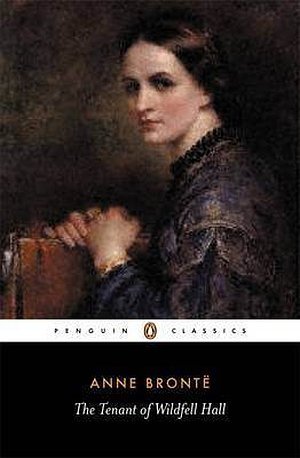 The chronology and structure of the novel struck me as very sophisticated: in 1847, gentleman farmer Gilbert Markham is writing a detailed letter to a friend, describing how he fell in love with the widow Helen Graham – the new tenant at Wildfell Hall, a painter who’s living there in secret – starting in the autumn of 1827. (I even wondered if this could have been one of the earliest instances of a female author writing from a male point-of-view.) Their interrupted and seemingly ill-fated courtship reminded me of Lizzy and Darcy’s in Pride and Prejudice: Gilbert initially thinks Helen stubborn and argumentative, especially in how she refuses to accept neighbors’ advice on how to raise her young son, Arthur. Gradually, though, he comes to be captivated by this intelligent and outspoken young woman on whose “lofty brow … thought and suffering seem equally to have stamped their impress.”
And indeed, at the heart of Gilbert’s narrative is a lengthy journal by Helen herself, starting in 1821, explaining the misfortune that drove her to take refuge in the isolation of Wildfell Hall. For, as in Anne’s sister Charlotte’s Jane Eyre, there’s an impediment to the marriage of true minds in the form of a living spouse. Helen is still tied to Arthur Huntingdon, a dissolute alcoholic she married against her family’s advice and has ever since longed to see reformed. In a phrase I was highly bemused to see in use in the middle of the nineteenth century, she defends him thusly: “if I hate the sins I love the sinner, and would do much for his salvation.” The novel’s religious language may feel outdated in places, but the imagined psyche of a woman who stays with an abusive or at least neglectful partner is spot on.
For the most part I enjoyed the story line, but I must confess that I wearied of Helen’s 260-page account, filled as it is with repetitive instances of her incorrigibly loutish husband’s carousing. I had a bit too much of her melodrama and goody-goody moralizing, such that it felt like a relief to finally get back to Gilbert’s voice. The last 100 pages, though, and particularly the last few chapters, are wonderful and race by. I loved this late metaphor for Helen’s chastened beauty:
This rose is not so fragrant as a summer flower, but it has stood through hardships none of them could bear. The cold rain of winter has sufficed to nourish it, and its faint sun to warm it; the bleak winds have not blanched it or broken its stem, and the keen frost has not blighted it. Look, … it is still fresh and blooming as a flower can be, with the cold snow even now on its petals.

Anne Brontë c. 1834, painted by Patrick Branwell Brontë [Public domain or Public domain], via Wikimedia Commons (restored version).
As always, I’m dumbfounded by the Brontës’ profound understanding of human motivation and romantic love given their sheltered upbringing. Theirs were wild hearts. I’ll always be a Charlotte fan first and foremost, but I was delighted with my first experience of Anne’s work and look forward to trying Agnes Grey in the near future.
Lest you think Victorian literature is all po-faced, righteous ruminating, I’ll end with my favorite funny quote from the book. This is from Gilbert’s snide, sporty brother Fergus (I wish he’d had a larger role!), seeming to mock Jane Austen with this joke about needing to know everything about Helen Graham as soon as she arrives in town:
“mind you bring me word how much sugar she puts in her tea, and what sort of caps and aprons she wears, and all about it, for I don’t know how I can live till I know,” said Fergus very gravely. But if he intended the speech to be hailed as a masterstroke of wit, he signally failed, for nobody laughed. However, he was not much disconcerted at that; for when he had taken a mouthful of bread and butter, and was about to swallow a gulp of tea, the humour of the thing burst upon him with such irresistible force that he was obliged to jump up from the table, and rush snorting and choking from the room.
My rating: 
Next month: Eleanor of Elle Thinks recommends Our Mutual Friend as the book that will finally get me back into Dickens, so I plan to make it do double duty as my Classic and Doorstopper for April.
Wellcome Prize Shortlist, Part 1: de Kerangal and Kalanithi
I’m delighted to announce the final members of our Wellcome Book Prize 2017 shadow panel:
Ruby blogs at My Booking Great Blog.
GrrlScientist is an ornithologist and science journalist who was on the judging panel for the 2016 Royal Society Insight Investment Science Book Prize.
Along with Paul and Amy, this brings us up to five people – the same number as the official judging panel.
Luckily, I’ve already read two of the shortlisted titles, one quite recently and one nearly a year and a half ago. Here are the reviews I published on Goodreads at the time. I’ll be getting both books back out of the library soon to have another look before we choose our winner.
Mend the Living by Maylis de Kerangal
(translated from the French by Jessica Moore; published in the USA as The Heart)
[This is the French author’s second novel to be translated into English. It has been made into a film and won the Prix Orange du Livre and the Grand prix RTL du livre. It was also recently shortlisted for the Albertine Prize, an American readers’ choice award for contemporary French fiction. If you’re based in the States, feel free to vote by April 30th!]
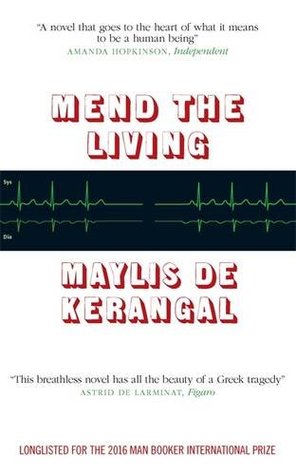 Nineteen-year-old Simon Limbeau is declared brain dead in a French hospital after a car accident, but his heart lives on: metaphorically through the love of his parents, sister, friends, and girlfriend; but also literally, in the recipient of his organ donation. Again and again de Kerangal makes a distinction between the physical reality of organs and what they represent: “Simon’s eyes are not just his nervous retina, his taffeta iris, his pupil of pure black in front of the crystalline – they are also his gaze; his skin isn’t just the threaded mesh of his epidermis, his porous cavities – it’s his light and his touch, the living sensors of his body.”
The novel spends time with Simon’s family, especially his mother, but also with the transplant coordinator, the surgeons, the nurse, and so on. I was reminded of ER as well as the French TV show The Returned – this would work really well on screen, and would be a way of avoiding the more off-putting aspects of the author’s style. She writes long, run-on sentences: sometimes half a page, sometimes even stretching to two pages, and stuffs her prose with abstruse vocabulary (or at least that’s how the translator has rendered it), a lot of it medical but some of it simply inaccessible: “emollient conjugality” plus at least a dozen English words I’d never encountered (e.g. abulic, tumid, atony, claudicant, auscultation, precellence, torticollis, naevi, scialytic).
The worst example of the unnecessary opacity is “the digitigrade gait of the sardana dancer when he’s nearing a quintal, the corpulence of an ex-obese man calibrating him in thickness, in fullness, but without visible excrescence” – in plain English, the guy is stocky.
Read in November 2016.
My rating: 
My gut feeling: The novel gives a vivid sense of the fragility of life and imbues parts of the body with metaphorical meaning. However, I think the style makes it too inaccessible and I can’t see its appeal ever being more than niche.
More reviews:
Annabel’s at Shiny New Books
Carolyn’s at Rosemary and Reading Glasses
When Breath Becomes Air by Paul Kalanithi
[The first posthumous nominee for the Wellcome Book Prize. I’ll be interested to see what I make of this one when I revisit it.]
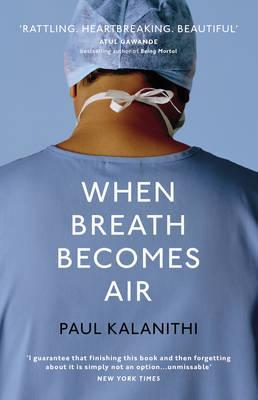 Paul Kalanithi was 36 and just completing his neurosurgery residency in Stanford, California when he was diagnosed with advanced lung cancer that did not respond well to treatment. It came as a complete surprise to this non-smoker, and set his life on a new course. He and his coterie of doctors managed his symptoms so he could operate for as long as possible, but when the time came he knew he wanted to devote his last year to writing this memoir. In addition, he would get a brief, sweet taste of fatherhood: he and his wife Lucy, also in the medical field, decided to have a child, a daughter named Cady.
Kalanithi grew up the son of Indian immigrants in Arizona. “I was driven less by achievement than by trying to understand, in earnest: What makes human life meaningful?” he recalls. Degrees in English literature and human biology were disparate attempts to find an answer. Like Henry Marsh (Do No Harm), he has a surgeon’s knowledge of the anatomy of reasoning, but realizes that does not provide the full picture. He recognizes the responsibility of holding others’ lives in the balance, and regrets occasional failures of empathy.
Those burdens are what make medicine holy and wholly impossible: in taking up another’s cross, one must sometimes get crushed by the weight.
It’s intriguing to see religious language in that statement – indeed, Kalanithi saw his work as a calling, and one with moral connotations. Christian imagery shows up repeatedly:
Instead of being the pastoral figure aiding a life transition, I found myself the sheep, lost and confused.
Openness to human relationality does not mean revealing grand truths from the apse; it means meeting patients where they are, in the narthex or nave, and bringing them as far as you can.
When’s the last time you encountered the word “narthex”?! The vocabulary is striking throughout, as in another favorite passage: “A tureen of tragedy was best allotted by the spoonful. Only a few patients demanded the whole at once; most needed time to digest.”
Kalanithi died in March 2015. In addition to the foreword by Abraham Verghese, there’s a lovely epilogue from his widow, who’s more than competent to carry on his legacy.
I appreciate stories lived on the knife edge of life and death, but I would recommend this to those who don’t normally choose to read illness narratives, simply for the beauty of its prose – a fine blend of literature and medicine – and the wholehearted picture of a life cut short.
Read in October 2015 (Random House were looking for early readers via NetGalley).
My rating: 
My gut feeling: I suspect this is by far the most popular and best-selling title on this year’s shortlist. So many people have taken it to their hearts. It will take a truly special book to knock it from the top spot.
More reviews:
Shadow panelist Paul’s at Nudge
Shadow panelist Ruby’s at My Booking Great Blog
Susan’s at A life in books
Shortlist strategy:
Currently reading: The Tidal Zone by Sarah Moss – about halfway through.
Up next: Whichever of the remaining nonfiction titles turns up to the library for me first!
I’ve also sent off an emergency e-mail to Bodley Head asking for a copy of Ed Yong’s I Contain Multitudes; it’s on loan through my library system until April 19th, which gives me no time to read it even if it comes back on time.
Blog Tour: Foxes Unearthed by Lucy Jones
Cold, delicately as the dark snow
A fox’s nose touches twig, leaf;
[…]
Across clearings, an eye,
A widening deepening greenness,
Brilliantly, concentratedly,
Coming about its own business
~Ted Hughes, “The Thought-Fox” (1957)
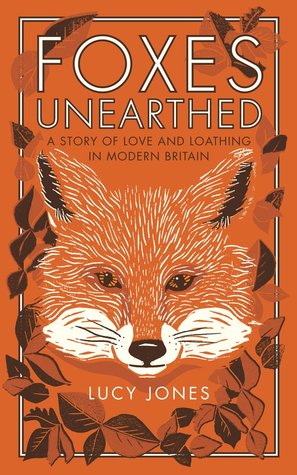
Foxes Unearthed, freelance journalist Lucy Jones’s first book, won a Society of Authors’ Roger Deakin Award for nature writing. If you’re familiar with Patrick Barkham’s Badgerlands, you’ll recognize this as a book with a comparable breadth and a similar aim: clearing the reputation of an often unfairly reviled British mammal. Jones ranges from history to science and from mythology to children’s literature in her search for the truth about foxes. Given the media’s obsession with fox attacks, this is a noble and worthwhile undertaking.
 The book proper opens with a visit to Roald Dahl’s house, now a Buckinghamshire museum, where he wrote Fantastic Mr. Fox. Still one of the best-known representations of foxes in British literature, Dahl’s Mr. Fox is a Robin Hood-like hero, outsmarting a trio of mean-spirited farmers to provide a feast for his family. Foxes’ seemingly innate wiliness prompts ambivalent reactions, though; we admire it, but we also view it as a threat or an annoyance. As Jones puts it, the fox of fables and traditional stories is “a villain we cheer for.”
Not everyone cheers, of course. Under Henry VIII, the Vermin Acts of 1532 (not repealed until the 1750s) promised a reward to anyone who killed foxes, then considered a nuisance animal. Fox hunting and the cruel sport of “tossing” have a long history that eventually came up against the movement towards animal welfare, starting with Jeremy Bentham in the 1740s and codified by the 1911 Protection of Animals Act. Meanwhile, Jones notes, children’s books advocating compassion for animals, such as Anna Sewell’s Black Beauty (1877), ensured that the message made it out of the legislative chamber and into everyday life.
The second chapter is a useful survey of fox behavior. Foxes are omnivores, and in recent decades have started to move into Britain’s cities, where they find plenty of food to scavenge. In rural settings, foxes are still the subject of farmers’ loathing even though they rarely take lambs and actually help keep rabbit numbers in check. Still, the stereotype of foxes killing for fun instead of for hunger persists, whereas they in fact cache their surplus food. Chapter 3 asks whether fox numbers have reached pest status and considers various control strategies, from straightforward culling to the non-lethal methods supported by conservationists.
I enjoyed Jones’s meetings with figures from both sides of the debate. She goes along on a fox hunt, but also meets or quotes animal rights activists, academics, and high-profile nature promoters like Chris Packham. All told, though, I felt the book could have been closer to 200 pages than 300. Most chapters are very long, and some could easily be combined and/or shortened. For instance, Chapter 1 relays the amount of information about fox hunting that most readers will be prepared to absorb, yet it’s then the subject of two more chapters.

At the British Wildlife Centre in Surrey. Photo by Chris Foster.
This is an important book for correcting misconceptions, but your enjoyment of it may be in proportion to your personal interest in the subject. In terms of fonts and cover design, though, you’re unlikely to come across a more gorgeous book this year.
Foxes Unearthed was published in paperback by Elliott & Thompson on March 16th. Thanks to Alison Menzies for arranging my free copy for review.
To encounter foxes in fiction, try the following:
- Glow by Ned Beauman
- The Many Selves of Katherine North by Emma Geen
- Midwinter by Fiona Melrose
- The Soho Leopard by Ruth Padel (a poetry book with a sequence on urban foxes)
& the forthcoming How to Be Human by Paula Cocozza (April 6th).
Blog Tour: Two Voices, One Story
“[B]eing an adoptive parent is like parenting in Technicolor: everything is just a little more intense. This means the highs can be really high, but it also means that the lows are going to be really low. You have to prepare yourself.”
~Sharon Roszia, quoted in A Book about Love, by Jonah Lehrer
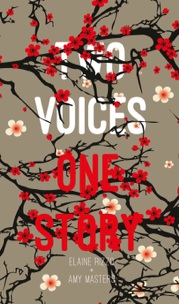
Two Voices, One Story is a mother–daughter memoir that splits narration duties between Elaine Rizzo and Amy Masters, the now-teenage daughter she adopted from China in 1999. Elaine’s sections provide the main thread of their story, while Amy’s passages, generally shorter and printed in italics, chime in to give her perspective on various events and relationships that have been important in her life.
 Elaine is forthright about her infertility and the miscarriage that led to her decision to adopt. In the late 1990s, China’s one-child policy was still in place, but it was the severe flooding of the Yangtze River that led directly to Amy’s adoption. Thousands died and millions more were displaced. Given the context, it’s not so surprising that baby Amy was left outside a welfare center. She was given the Chinese name Tong Fang – “Copper Child.”
For me the highlight of the book was Elaine and Lee’s trip to China to pick up Amy. Although they were nervous and disoriented, they experienced the kindness of strangers and responded with compassion of their own, taking along extra toiletries and clothes of different sizes and leaving the surplus with the care center. Amy had bronchitis, one more worry on top of all the paperwork and red tape they had to go through to finalize the adoption.
Back in England, Amy had some behavioral problems that were likely vestiges of her time at the orphanage. She hated noise, especially thunderstorms; she hit herself and others; and she often woke up screaming. Private schooling ensured she wouldn’t get left behind, and there were many happy times with extended family and holidays to Australia and the west coast of Wales, where Elaine and Amy would later settle with Elaine’s second husband.
But life wasn’t always rosy: Amy was strong-willed and uncooperative – perhaps nothing out of the ordinary for a teenager, but still a challenge for her parents. Elaine recalls a social worker telling them “that very often adoptive parents don’t feel like they have the right to tell their child off, or that they think they shouldn’t say or do anything which might upset the child, because they are trying to compensate for what has happened prior to the adoption.”
Lengthy commuting to her job back in England and years-long house renovations demanded much of Elaine’s attention, yet she remained alert to what was going on with Amy. Unfortunately, in her teen years Amy experienced racism from a few schoolmates, including abusive Facebook messages that drove the family to contact the police. Amy herself, though, always comes across as easygoing about being different: “Every Christmas we used to do a Nativity show and I remember being an angel first and then one of the kings, which I suppose was the right role for me because I really do come from the East.”
Even though this is a very quick read, my interest waxed and waned. The telling can be clichéd and sentimental, and I felt too much space was given to banal details that added little to an understanding of the central mother–daughter relationship. This self-published book has a very appealing cover but needs another look from an experienced editor who could fix the fairly frequent typos and punctuation issues and cut out the bullet points (nine pages’ worth) and speech tics like “I will also say…” and “I have to comment…”
I would certainly recommend this book to those who have a personal experience of or interest in adoption, particularly from overseas (for a fictional take on adoption from China, you might also try The Fortunes by Peter Ho Davies, The Red Thread by Ann Hood, and This Must Be the Place by Maggie O’Farrell), as well as to anyone wondering how to parent or educate a child who is in some way different.
I’ll end with some lovely words from Amy:
when my Chinese mum left me outside the gates of the welfare center almost eighteen years ago now, because there was nothing left for me in Tongling, she must have had the desperate hope that I would find a happy life with people who loved me. I can only say that her wish did come true.
My rating: 
Two Voices, One Story will be published by Clink Street Publishing on March 21st. Thanks to Rachel Gilbey of Authoright Marketing & Publicity for arranging my free copy for review.
I was pleased to participate in the blog tour for Two Voices, One Story.
First Encounter: Karl Ove Knausgaard
 For years I felt behind the curve because I had not yet read the two prime examples of European autofiction: Elena Ferrante and Karl Ove Knausgaard. It seemed like everyone was raving about them, calling their work revelatory and even compulsive (Zadie Smith has famously likened Knausgaard’s autobiographical novels to literary “crack”). Well, my first experience of Ferrante (see my review of My Brilliant Friend), about this time last year, was underwhelming, so that tempered my enthusiasm for trying Knausgaard. However, I had a copy of A Death in the Family on the shelf that I’d bought with a voucher, so I was determined to give him a go.
I read this first part of the six-volume “My Struggle” series over the course of about two months. That’s much longer than I generally spend with a book, and unfortunately reflects the fact that it was the opposite of compelling for me; at times I had to force myself to pick it up from a stack of far more inviting books and read just five or 10 pages so I’d see some progress. Now, a couple of weeks after finally reading the last page, I can say that I’m glad I tried Knausgaard to see what the fuss is all about, but I think it unlikely that I’ll read any of his other books.
Written in 2008, when he was 39, this is Knausgaard’s record of his childhood and adolescence – specifically his relationship with his father, a distant and sometimes harsh man who drank himself to an early death. And yet at least half the book is about other things, with the father – whether alive or dead – as just a shadow in the background. I found it so curious what Knausgaard chooses to focus on in painstaking detail versus what he skates over.
For instance, he spends ages on the preparations for a New Year’s Eve party he attended in high school: acquiring the booze, the lengths he had to go to in hiding it and lugging it through a snowy night, and so on. He gives a broader idea of his school years through some classroom scenes and word pictures of friends he was in an amateur rock band with and girls he had crushes on, but these are very brief compared to the 50 pages allotted to the party.
Part Two feels like a significant improvement. It opens at the time of composition, with Karl Ove the writer and family man in his office in Sweden – a scene we briefly saw around 30 pages into Part One. I like these interludes perhaps best of all because they make a space for his philosophical musings about writing and parenthood:
Even if the feeling of happiness [fatherhood] gives me is not exactly a whirlwind but closer to satisfaction or serenity, it is happiness all the same. Perhaps, even, at certain moments, joy. And isn’t that enough? Isn’t it enough? Yes, if joy had been the goal it would have been enough. But joy is not my goal, never has been, what good is joy to me? The family is not my goal, either. … The question of happiness is banal, but the question that follows is not, the question of meaning.
Writing is drawing the essence of what we know out of the shadows. That is what writing is about. Not what happens there, not what actions are played out there, but the there itself.
At about the book’s halfway point we finally delve into the title event. About a decade previously Karl Ove got a call from his older brother, Yngve, telling him that their father was dead. Almost instantly he found himself trying to construct a narrative around this fact, assessing his thoughts to see if they had the appropriate gravity:
this is a big, big event, it should fill me to the hilt, but it isn’t doing that, for here I am, staring at the kettle, annoyed that it hasn’t boiled yet. Here I am, looking out and thinking how lucky we were to get this flat … and not that dad’s dead, even though that is the only thing that actually has any meaning.

Karl Ove Knausgaard at Turku Book Fair, 2011. By Soppakanuuna (Own work) [CC BY-SA 3.0 (http://creativecommons.org/licenses/by-sa/3.0) or GFDL (http://www.gnu.org/copyleft/fdl.html)%5D, via Wikimedia Commons.
What puzzles me, once again, is Knausgaard’s fixation on detail. He describes every meal he and Yngve shared with their grandmother, their every conversation, what he ate, how he slept, what he wore, what he cleaned and how and when. How could he possibly remember all of this, unless the journal that he mentions keeping at the time was truly exhaustive? And why does it all matter anyway? Does this slavish recreation fulfill the same role that obsessive action did back then: displacing his feelings about his father?
This is all the more unusual to me given the numerous asides where the author/narrator denigrates his memory:
I remembered hardly anything from my childhood. That is, I remembered hardly any of the events in it. But I did remember the rooms where they took place.
nostalgia is not only shameless, it is also treacherous. What does anyone in their twenties really get out of a longing for their childhood years? For their own youth? It was like an illness.
Now I had burned all the diaries and notes I had written, there was barely a trace of the person I was until I turned twenty-five, and rightly so; no good ever came out of that place.
Why did I remember this so well? I usually forgot almost everything people, however close they were, said to me.
The best explanation I can come up with is that this is not a work of memory. It’s more novel than it is autobiography. It’s very much a constructed object. Early in Part Two he reveals that when he first tried writing about his father’s death he realized he was too close to it; he had to step back and “force [it] into another form, which of course is a prerequisite for literature.” Style and theme, he believes, should take a backseat to form.
Ultimately, then, I think of this book as an experiment in giving a literary form to his father’s life and death, which affected him more than he’d ever, at least consciously, acknowledged. Even if I found the narrative focus strange at times, I recognize that it makes for precise vision: I could clearly picture each scene in my head, most taking place in an airy house with wood paneling and shag pile carpeting matching its 1970s décor. Maybe what I’m saying is: this would make a brilliant film, but I don’t think I have the patience for the rest of the books.
My rating:
Whether or not you’ve read Knausgaard, do you grasp his appeal? Should I persist with his books?
Medical Mysteries: Joselin Linder’s The Family Gene
Yes, another memoir on a medical theme! I really do read a lot of them. My eye was drawn to The Family Gene: A Mission to Turn My Deadly Inheritance into a Hopeful Future by Joselin Linder because of the medical mystery aspect: 14 members of Linder’s Ashkenazi Jewish family are the only known exemplars of their particular genetic disease, so rare it doesn’t have a name or surefire treatment protocol, but now at least has a location on a chromosome.
 Linder’s awareness of her family’s peculiar medical problems began when her father, William, himself a doctor near their home in Columbus, Ohio, started having a persistent build-up of lymph (also known as chyle) in his abdomen – usually a sign of heart or liver failure. At one point doctors tapped four liters of the stuff from his lungs. Her father’s illness threw Linder, then a junior in college, for a loop; drugs and music started to replace academics. After he died, aged 49, in September 1996, she became a nomad, moving from Prague to San Francisco to Brooklyn and dabbling in different careers.
Only gradually did they all realize that the same thing had happened to William’s uncle, Nathan, in the 1960s and his grandmother, Mae, before that. While Mae lived to age 54, Nathan died at 34, even after treatment at NIH. Along with the lymphedema, a heart murmur was a common factor. William’s brother, Norman; Linder and her older sister, Hilary; and various cousins of their generation were diagnosed in this way. The author’s own symptoms were initially easily to ignore – swollen ankles and a low platelet count – but escalated in her thirties: a blocked vein in her liver meant she was in danger of bleeding out if she vomited.
It’s rare to be able to trace a genetic disease from its founder through to the present. In Linder’s case, her great-great-grandmother, Ester Bloom, is the first known sufferer. Researchers eventually isolated their family’s gene on the X chromosome, near the location for asthma. This explained why, historically, female family members had a better prognosis than males – they have one normal X chromosome and one diseased one; men only get the defective X chromosome – and why asthma medication helped to an extent.
There are a couple of chapters here on the basics of genetics that felt a little condescending to me; for anyone with a high school or A level biology qualification, the simplistic metaphors explaining the workings of DNA may seem superfluous. I also had trouble relating to Linder’s immediate reaction to her father’s death. Although he’d been severely ill for years by then, her attitude still seems a little heartless. Of the decision to take him off dialysis, she writes, “I was on board. It was time to call it a day.” When the family went around expressing opinions, she said, “I think it’s time, Dad. You’ve been through so much,” to which he replied “F— you”! An ex-boyfriend’s suicide a couple years later affected her much more than her own father’s death. Grief affects people in strange and unpredictable ways, I guess.
What I most appreciated was how the book sensitively reveals the ways a genetic condition complicates life, especially in America: Linder had to do without health insurance for 10 years, having been denied it in Ohio on the grounds of a pre-existing condition. In addition, she and her sister faced a quandary common to those who carry genetic diseases: should they have children? While Hilary underwent pre-implantation genetic diagnosis, a form of IVF, to bear healthy twins, Linder ultimately decided against having children.
I enjoyed the earlier part of this genetic quest narrative a bit more than the later material about Linder’s symptoms. Still, I can recommend this to viewers of House and readers of Susannah Cahalan’s Brain on Fire and the like.
The Family Gene is released by Ecco today. With thanks to Beth Parker and James Faccinto for the electronic review copy via Edelweiss.
My rating: 
Narcissism for Beginners by Martine McDonagh
Don’t talk like we were stuck in a lift.
Why would I be missing you so violently?
We’re all the hero when directing the scene,
But therapy for liars is a giant ice cream.
(from “Montparnasse” by Elbow)
I broke one of my cardinal reviewing rules—write about the book while it’s still fresh in your mind—and waited two weeks after finishing Martine McDonagh’s Narcissism for Beginners before writing it up. Luckily the Elbow stanza above (Guy Garvey’s lyrics are like poetry, after all) brought back to me some of the themes I want to explore: how you can miss someone you barely know, the way that ties ebb and shift such that your blood kin are strangers and the unrelated become like family, and how a narcissistic personality can use coercion and deception to get his or her way. Plus there’s the ice cream metaphor of the last line, a link to the terrific cover on finished copies of the novel—not on my proof, alas.
 The novel is presented as Sonny Anderson’s extended letter to the mother he doesn’t remember. He’s lived with his guardian, a Brit named Thomas Hardiker, in Redondo Beach, California for 11 years; before that they were in Brazil with Sonny’s father. A month ago, on his twenty-first birthday, Sonny received the astounding news that he’s a millionaire thanks to a trust fund from his late father, Robin Agelaste-Bim, better known as Guru Bim. His mother is Sarah Anderson: once a Scottish housewife, now untraceable. Despite his youth, Sonny has been a meth addict and kicked the habit through NA. This kid’s done a lot of living already, but sets out on a new adventure to learn about his parents from those who knew them. And while he’s in Britain, he’ll squeeze in some tourism related to his favorite movie, Shaun of the Dead.
Starting with Sonny’s plane ride to Heathrow, the book is in the present tense, which makes you feel you’re taking the journey right along with him. Although this isn’t being marketed as young adult fiction, it has the same vibe as some YA quest narratives I’ve read: John Green’s The Fault in Our Stars, both of David Arnold’s books, and Nicola Yoon’s The Sun is Also a Star. Sonny is more bitter and world-weary than those teen protagonists, but you still get the slang and the pop culture references along with the heartfelt emotions.
Sonny’s first visit is to Torquay octogenarian Doris Henry, who was the Agelaste-Bims’ servant and Robin’s wet nurse circa 1970. Next up: London and Ruth Williams, whom Sonny’s mother, then going by Suki, recruited into a LifeForce meditation group. Ruth remembers taking against Guru Bim immediately: “He was faking it to get in with Suki. I understood the attraction, though; those narcissistic types are always charming.” Bim and Suki formed a splinter group, Trembling Leaves and soon announced Suki’s pregnancy, but things went awry and Suki fled to Scotland with her ex-boyfriend, Andrew.
This slightly madcap biographical trip around Britain also takes in Brighton, Scotland and Keswick in the Lake District. At each stop Sonny’s able to fill in more about his past, but it’s the letters Thomas sent along for him that contain the real shockers. It’s an epistolary within an epistolary, really, with Thomas’s series of long, explanatory letters daubing in the details and anchoring Sonny’s sometimes-earnest, sometimes-angry missive to his mother.
I loved tagging along on this kooky hero’s quest. My one small criticism about an otherwise zippy novel is that there is a lot of backstory to absorb, from Sonny’s former drug use onwards. For an American expat, though, it was especially fun to watch Sonny trying to get used to some peculiarities of Britain: “apparently it’s compulsory to eat potato chips and on Brit trains” and “We argue about which floor she lives on. I say second and Ruth says first, until we realise we mean the same thing.”
In a year that opened with a narcissist being installed in the White House and will soon see the publication of a new book about cult leader Jim Jones (The Road to Jonestown by Jeff Guinn, April 11th), McDonagh’s picture of Guru Bim is sure to strike a chord. As Ruth tells Sonny, in Ancient Greek an agelast was someone with no sense of humor; and she accused Bim of being “a manipulative charlatan.”
For Sonny, whose very name places him in relationship to others, coming to grips with who he came from means deciding to live differently and be content with his own piecemeal family, including Thomas, the Great Dudini (their dog), and maybe even a cool old lady like Ruth. You’ll love spending time with them all, and I imagine you’ll get a particular kick out of this if you like Shaun of the Dead. (Whisper it: I’ve never seen it.)
Narcissism for Beginners was published in the UK on March 9th. With thanks to Unbound for the review copy.
My rating: 
Martine McDonagh was an artist manager in the music industry for 30 years and now leads the Creative Writing & Publishing MA at West Dean College, Sussex. This is her third novel, following I Have Waited, and You Have Come and After Phoenix.
Four Books for World Kidney Day
Today, March 9th, is World Kidney Day. “The kidneys are like the Rodney Dangerfield of vital organs—they get no popular respect,” Vanessa Grubbs (whose memoir I discuss below) wryly comments. Chances are you rarely have occasion to think about your kidneys. But I’m honoring them with a reading list because several years ago I was diagnosed with polycystic kidney disease, a degenerative condition that runs in my family. My maternal grandmother had it – we’ve never definitively traced it further back than her – and four of her six children have it, too. (If you took a high school genetics class, you might remember that with an autosomal dominant condition offspring have a 50% chance of inheriting the gene for the disease.) A few cousins of my generation also have PKD, and starting with my mom we’ve had a few successful kidney transplants in the family so far.
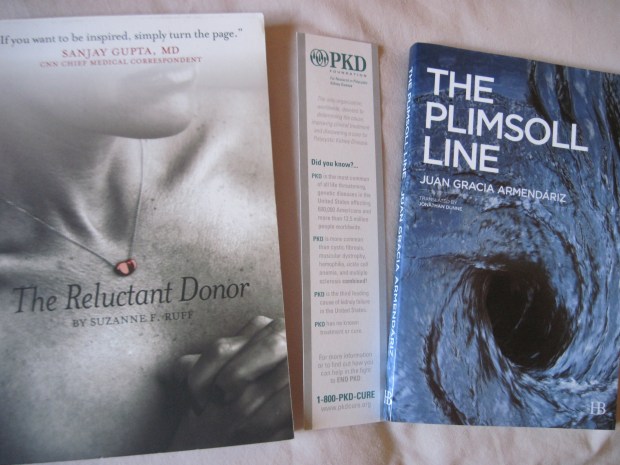
I must mention the excellent work done by the PKD Foundation in the States and the PKD Charity here in the UK. Both are a great support and source of information for me and my wider family.
The Plimsoll Line by Juan Gracia Armendáriz
As soon as I read Melissa’s review at The Book Binder’s Daughter, I knew I had to get this one. “The Plimsoll line” is a maritime term indicating how low a cargo-laden ship can sit in the water without sinking; here it’s used metaphorically to ask just how much one man can take. Gabriel Ariz is a 52-year-old art professor who lives not far from the city yet surrounded by oak woods. He’s divorced from Ana, who’s pressuring him to sell the house, and their young adult daughter Laura died a few years ago in a car accident. Now this pack-a-day smoker who gets drunk with his brother, traveling photographer Óscar, learns that he has end-stage renal disease and his life will have to change. On indefinite leave from work, he attends a dialysis clinic several times a week and joins the organ transplant list.
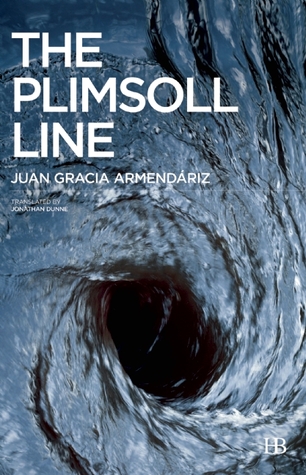 At times this was a bit overwritten for my tastes – some paragraphs stretch to several pages, and I’ve had to look up words, including “lentitude” and “logomachy” – but I did love the author’s trick of jumping into different perspectives. On multiple occasions he employs an “anonymous observer,” and in various chapters the point-of-view shifts to a member of the animal kingdom: Polanski the cat, a black kite flying overhead, a mole popping up in the garden, or a beetle winging across the detritus of Gabriel’s untidy household. We also get an extended section from Laura’s journals that reveals a disturbing family secret.
This is not one for the squeamish as it gives an unflinching account of dialysis: “His forearm throbbed, lacerated by needle marks. Sara had taken a while to find the fistula, and now the pain spread under the surgical tape like a jellyfish sting.” But for every passage that makes you cringe there’s a beautiful one that captures things perfectly: “he is living in constant deferment, between parentheses” and “If the succubus of his bad dreams were to say to him, ‘Make a wish,’ he would ask to be able to mold himself to the geological quietude of stones.”
The Plimsoll Line won Spain’s Premio Tiflos de Novela in 2008 and first appeared in English translation in 2015. It is part of a “Trilogy of Illness”; I presume the other volumes are not yet available in English, though I’ve enquired of the translator, Jonathan Dunne, via a Facebook message just in case. Forget Ferrante and Knausgaard; this is the semi-autobiographical series I’ll be awaiting the next installment of with bated breath.
My rating:
Hundreds of Interlaced Fingers by Vanessa Grubbs
 Grubbs is a nephrologist and assistant professor of medicine at San Francisco General Hospital. Well before she made the kidneys her clinical area of expertise, a personal encounter made them special to her. In 2003 she met Robert Phillips when she was an attending trying to get support for her Office of Diversity Affairs; he was a hospital trustee. She only later learned, after they started dating, that due to FSGS his kidneys had failed in his twenties and he’d been on dialysis for years. In 2005 she donated him one of her kidneys. Robert’s health was touch-and-go for a little while there, but he proposed to her soon afterwards. I read about a third of this and then skimmed the rest because I wasn’t all that interested in their separate histories. However, I did like the context Grubbs gives, such as a brief history of dialysis, nephrology case studies, and a great set of FAQs. She also notes that minorities are less likely to get organ transplants, a disparity she is working to rectify.
This memoir grew out of an essay for Health Affairs, “Good for Harvest, Bad for Planting.” Releases June 13th.
My rating:
The A to Z of You and Me by James Hannah
 (First reviewed in November 2015; here’s a shortened version.) Lying in a hospice bed, 40-year-old Ivo looks back on his life. Even after just four short decades and a modest career at a garden center, he has plenty to regret. Hard partying and drug use exacerbated his diabetes and prompted kidney failure. His lifestyle also led indirectly to his girlfriend, nursing student Mia (the “you” he often addresses directly), leaving him. He’s estranged from his sister and his friends from school days, especially Mal. How did he mess up so badly and cut himself off so completely that he’s now dying alone? And how much can he put right before he goes?
There’s plenty of affecting writing in Hannah’s debut novel. I liked how he captures the routines of institutional life. Nurse Sheila’s A to Z game, encouraging Ivo to think of a memory attached to body parts starting with each letter of the alphabet, provides a hokey but effective structure. Keeping in mind that in British English Z is pronounced ‘zed’, the title doesn’t rhyme, but this is still somewhat sappy. I’d recommend it to fans of Mark Haddon and David Nicholls. I’ll follow Hannah’s career and hope he avoids melodrama and a contrived setup – the two near-pitfalls of this one – in the future.
My rating: 
The Reluctant Donor by Suzanne F. Ruff
A sepia-toned photograph at the centerfold tells a solemn tale: six of these eight members of Ruff’s Irish-Catholic Chicago family died, directly or indirectly, as a result of PKD. I’ve always known there’s a long waiting list for transplant kidneys, but I was surprised to learn that dialysis machines used to be rare; demand far exceeded supply, and the procedure was not covered by Medicare until 1973. Ruff’s aunt, Sister Mike, decided the lives of people with children were more important than her own, so didn’t press for dialysis; when her kidneys failed in her forties, death followed just a few months later.
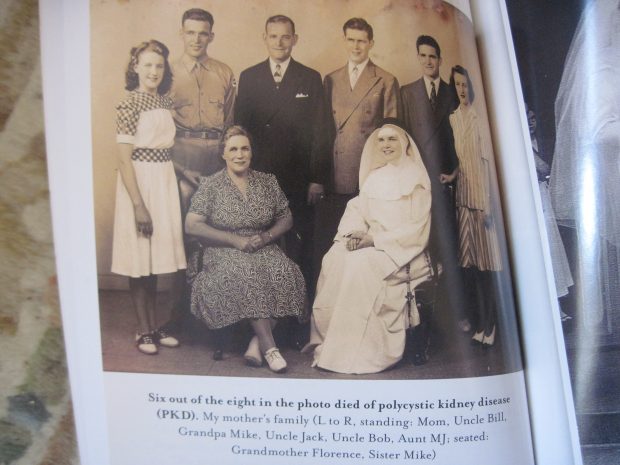 Things had greatly improved by the time Ruff’s mother needed a transplant. Joan sounds like a feisty, lovable character, with plenty of good advice on being a patient: fight for your rights (the meek ones often end up being carried out feet first), get up and walk as soon after surgery as you possibly can, and appreciate the joy of an entirely ordinary day. Ruff’s parents had her and her sisters tested for PKD when they were teenagers. Having gone to the trouble, they then lied about the results! They said no one had PKD, but in the end two out of three did; only Ruff was spared. This is how she ended up donating a kidney to her younger sister, JoAnn. The more interesting sections of the book are about Ruff’s family history; her internal struggle to convince herself to commit to organ donation makes for pretty repetitive moaning.
 In general, the writing isn’t great. Skimming through, I found a page with 16 of my proofreading marks; on most pages it’s more like 2–3. There’s also a tendency to over-write when portraying emotion: “Genetic disease. Those two words made my spine shiver, my ears ring, my throat close, and my heart pound; I became lightheaded and faint. Terror crept into my core and gripped me in its vice [sic].” While I’m not sure I could recommend this to someone who doesn’t have a personal stake in organ donation, for those who are interested in an autobiographical account of genetic disease/transplant surgery, it’s a quick, pleasant read.
My rating:
Plus two more kidney-themed novels I’m on the look-out for:
- Useful, Debra Oswald, about a man who decides to donate a kidney to a stranger
- The Kidney Hypothetical: Or How to Ruin Your Life in Seven Days, Lisa Yee, a YA comedy in which a girl asks her boyfriend if he’d give her a kidney. Hypothetically, right?
 I’m on the fence about:
- Larry’s Kidney: Being the True Story of How I Found Myself in China with My Black Sheep Cousin and His Mail-Order Bride, Skirting the Law to Get Him a Transplant—and Save His Life, Daniel Asa Rose (I think the subtitle says it all!)
- I, Kidney, Chris Six: a self-published, semi-autobiographical novel
Midwinter Cedes to Spring
I’ve marked the turn of the seasons by following a ‘Midwinter’ book with a ‘Spring’ one.
Moominland Midwinter by Tove Jansson
 My third and favorite Moomins book (so far).
Moomins are supposed to sleep through the winter, but this year young Moomintroll awakens and finds himself in a “strange and dangerous” world transformed by snowdrifts. He can’t get his parents to wake up so is effectively a temporary orphan, surrounded by peculiar creatures from Jansson’s menagerie, this time including a dim-witted squirrel, invisible shrews, a glum little dog who wishes he could run with wolves, and the Dweller Under the Sink (with its exceptionally bushy eyebrows).
While Moomintroll searches for totems of familiarity—
He looked at the cupboard in the corner and thought of how nice it was to know that his own old bath-gown was hanging inside it. That something certain and cosy still remained in the middle of all the new and worrying things.
—Too-ticky has the opposite mindset: “All things are so very uncertain, and that’s exactly what makes me feel reassured.” She goes fishing under the ice, builds a life-size horse out of snow, and assembles tree trunks and old furniture for the midwinter ritual of a huge bonfire.
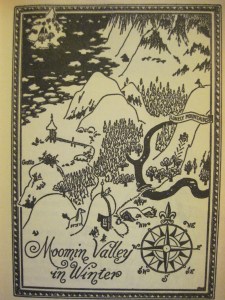 When they receive a visit from the Hemulen, who’s keen on skiing and declares the indoors too stuffy in winter, the creatures quickly tire of his energetic optimism. The truth is that they like sitting around being miserable. “I’m cold! I’m lonely! I want the sun back again!” Moomintroll pouts, but even he is too affable to make the Hemulen leave.
Of course the spring finally arrives, as it does every year, but it’s depressingly long in coming and for Moomintroll becomes a matter of faith. I love the strangeness of Jansson’s imagination, the balance of melancholy and comedy, and the little philosophical nuggets buried along the way – children and adult readers alike will get a lot out of this. It doesn’t talk down to children with a rosy message about everything being alright.
My rating:
Spring: An anthology for the changing seasons, edited by Melissa Harrison
Although this was the first of the Wildlife Trusts anthologies published in 2016, I got a late start last year so am reading this as the final of four. In common with the other volumes, it’s a terrific mix of contemporary and historical writing, big names and newcomers, observation and reflection. Compared with the other books, it seems to have more about WT sites in particular, with a few pieces from current volunteers or former employees. I also noticed that there’s a bit more of a focus on birds – with essays on the chiffchaff, the birds encountered on the Cley Marshes, cuckoo festivals, young dippers, and a tawny owl chick.
 That said, there’s still plenty of variety here, with everything from spring flora* to adders fueling the generally two- to three-page essays. I especially liked Kate Long’s piece on filming hedgehogs at night and Vijay Medtia’s on how people of color living in cities have little access to nature; he recalls spotting a magpie with a twig in its beak at a train station and having to ask someone what it was called. Of the previously published authors, I enjoyed hearing more from Rob Cowen and Miriam Darlington and laughed at Will Cohu’s ice cream and underwear metaphors applied to varieties of cherry trees.
You can’t beat George Orwell on toad sex, and it’s fun to encounter excerpts from classic novels in the context of a nature book: The Wind in the Willows, Lorna Doone, and Jane Eyre (which, shamefully, I didn’t recognize until Lowood was mentioned in the last paragraph). I think my favorite piece of all, though, was Jo Sinclair’s about watching spring’s arrival after a major operation and noting nature’s inscrutable jumble of beauty and brutality.
And my favorite passage:
Year after year all this loveliness for eye and ear recurs: in early days, in youth, it was anticipated with confidence; in later years, as the season approaches, experience and age qualify the confidence with apprehension lest clouds of war or civil strife, or some emergency of work, or declining health, or some other form of human ill may destroy the pleasure or even the sight of it: and when once again it has been enjoyed we have a sense of gratitude greater than in the days of confident and thoughtless youth. Perhaps the memory of those days, having become part of our being, helps us in later life to enjoy each passing season.
(from Sir Edward Grey’s The Charm of Birds, 1927)
This passage from Reverend Francis Kilvert’s diary (April 14, 1871) makes me look forward to our trip to nearby Hay-on-Wye next month: “The village is in a blaze of fruit blossom. Clyro is at its loveliest. What more can be said?” Simply that these anthologies are an essential companion to the seasons.
*Like my husband’s piece, positioned right before the R.D. Blackmore extract.
(See also my reviews of Summer, Autumn and Winter.)
My rating:
 Bookish Beck = Rebecca Foster. American transplant to England. Freelance proofreader and book reviewer.
 Bookish Beck