The Lonely City by Olivia Laing
For several years in her mid-thirties, British author Olivia Laing lived in New York City. A relationship had recently fallen through and she was subletting an apartment from a friend. Whole days went by when she hardly left the flat, whiling away her time on social media and watching music videos on YouTube. Whenever she did go out, she felt cut off because of her accent and her unfamiliarity with American vernacular; she wished she could wear a Halloween mask all the time to achieve anonymity. How ironic, she thought, that in a city of millions she could be so utterly lonely.
Loneliness feels like such a shameful experience, so counter to the lives we are supposed to lead, that it becomes increasingly inadmissible, a taboo state whose confession seems destined to cause others to turn and flee. … [L]oneliness inhibits empathy because it induces in its wake a kind of self-protective amnesia, so that when a person is no longer lonely they struggle to remember what the condition is like.
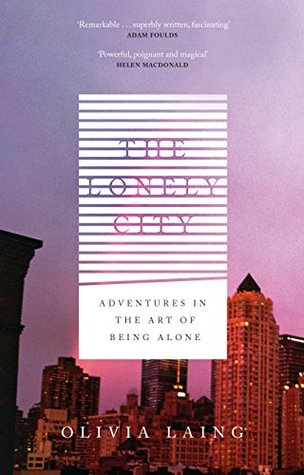 Whereas alcoholic writers were the points of reference for her previous book, the superb The Trip to Echo Spring (2013), here outsider artists take center stage: Edward Hopper, Andy Warhol, David Wojnarowicz, Henry Darger, and the many lost to AIDS in the 1980s to 1990s. It’s a testament to Laing’s skill at interweaving biography, art criticism and memoir when I say that I knew next to nothing about any of these artists to start with and have little fondness for modern art but still found her book completely absorbing.
Several of the artists shared underlying reasons for loneliness: an abusive childhood, mental illness and/or sexuality perceived as aberrant. Edward Hopper might seem the most ‘normal’ of the artists profiled, but even he was bullied when he shot up to 6 feet at age 12; his wife Jo, doing some amateur psychoanalyzing, named it the root of his notorious taciturnity. His Nighthawks, with its “noxious pallid green” shades, perfectly illustrates the inescapability of “urban alienation,” Laing writes: when she saw it in person at the Whitney, she realized the diner has no door. (It’s a shame the book couldn’t accommodate a centerfold of color plates, but each chapter opens with a black-and-white photograph of its main subject.)
Andy Warhol was born Andrej Warhola to Slovakian immigrants in Pittsburgh in 1928. He was often tongue-tied and anxious, and used fashion and technology as ways of displacing attention. In 1968 he was shot in the torso by Valerie Solanas, the paranoid, sometimes-homeless author of SCUM Manifesto, and ever after had to wear surgical corsets. For Warhol and Wojnarowicz, art and sex were possible routes out of loneliness. As homosexuals, though, they could be restricted to sordid cruising grounds such as cinemas and piers. Like Klaus Nomi, a gay German electro-pop singer whose music Laing listened to obsessively, Wojnarowicz died of AIDS. Nomi was one of the first celebrities to succumb, in 1983. The epidemic only increased the general stigma against gay people. Even Warhol, as a lifelong hypochondriac, was leery about contact with AIDS patients. Through protest marches and artworks, Wojnarowicz exposed the scale of the tragedy and the lack of government concern.
In some ways Henry Darger is the oddest of the outsiders Laing features. He is also the only one not based in New York: he worked as a Chicago hospital janitor for nearly six decades; it was only when he was moved into a nursing home and the landlord cleared out his room that an astonishing cache of art and writing was discovered. Darger’s oeuvre included a 15,000-page work of fiction set in “the Realms of the Unreal” and paintings that veer towards sadism and pedophilia. Laing spent a week reading his unpublished memoir. With his distinctive, not-quite-coherent style and his affection for the asylum where he lived as an orphaned child, he reminded me of Royal Robertson, the schizophrenic artist whose work inspired Sufjan Stevens’s The Age of Adz album, and the artist character in the movie Junebug (2005).
A few of the chapters are less focused because they split the time between several subjects. I also felt that a section on Josh Harris, Internet entrepreneur and early reality show streaming pioneer, pulled the spotlight away from outsider art. Although I can see, in theory, how his work is performance art reflecting on our lack of true connection in an age of social media and voyeurism, I still found this the least relevant part.

The American cover
The book is best when Laing is able to pull all her threads together: her own seclusion – flitting between housing situations, finding dates through Craigslist and feeling trapped behind her laptop screen; her subjects’ troubled isolation; and the science behind loneliness. Like Korey Floyd does in The Loneliness Cure, Laing summarizes the physical symptoms and psychological effects associated with solitude. She dips into pediatrician D.W. Winnicott’s work on attachment and separation in children, and mentions Harry Harlow’s abhorrent rhesus monkey experiments in which babies were raised without physical contact.
The tone throughout is academic but not inaccessible. Ultimately I didn’t like this quite as much as The Trip to Echo Spring, but it’s still a remarkable piece of work, fusing social history, commentary on modern art, biographical observation and self-knowledge. The first chapter and the last five paragraphs, especially, are simply excellent. Your interest may wax and wane through the rest of the book, but I expect that, like me, you’ll willingly follow Laing as a tour guide into the peculiar, lonely crowdedness you find in a world city.
(See also Laing’s list of 10 Books about Loneliness, chosen for Publishers Weekly.)
With thanks to Canongate for sending a free copy.
My rating: 
The Man I Became (Peirene)
The latest book from Peirene Press is narrated by a gorilla. That’s no secret: it’s an explicit warning given in the blurb. Yet the narrator doesn’t remain a gorilla. The clue is in the title: in The Man I Became, the eleventh novel by Belgian Flemish author Peter Verhelst (translated from the Dutch by David Colmer), various species are captured and forcibly humanized. Our narrator – whose name we never know – remembers his happy life in Africa:
We caught termites by pushing long twigs, as flexible as blades of grass, into their mounds and then licking the twigs clean. … We hung from branches one-handed to show off our muscles. We felt like princes and princesses. We were young and beautiful and our bliss was never going to end.
But soon his fellows start disappearing, and eventually the riders come for him too. He’s captured and marched across the desert to the sea to be shipped to the New World. The gorillas’ training begins soon after they arrive.
We learned to walk upright. ‘Faster! Taller!’ said the human. … Then we learned how to shave. … We learned a new language word by word. We learned to eat from a bowl and then with knife and fork. … We learned to powder our skin to make it lighter.
 At this point I started to get a bit nervous about the book’s racial connotations. Especially as the gorillas-in-transition become sexual objects, I wondered what Verhelst could be attempting to say about the notions of the noble savage and the purification of the race.
The creatures’ progress is carefully documented. They carry phones that function as identification as well as an external memory. The art of conversation is something they practice at cocktail parties, where the narrator learns that he and his kind are not the only ones; giraffes, buffalo, leopards, parrots, lions and bonobos have all been subjected to the same experiment. With all of them together in the same room, the animals have to suppress their natural fear reactions.
The narrator becomes an animal trainer for the evolution-in-action show at Dreamland, an amusement park with roller coasters and fast food. There are different classes of animals, you see; some remain animals and do menial duties, while a chosen few are transformed into humans. He halfheartedly looks for his brother and has a brief affair with Emily. When a violent incident leaves several dead and the narrator’s human is caught acquiring animals through the black market, Dreamland’s very existence is threatened. (If you know the history of the real Dreamland, a longtime Coney Island attraction, you may have an inkling.)
This novella is scarcely 120 pages. Short books can be wonderful, but that’s not the case if there’s no space to craft a believable plot. The pace is so quick here that there’s no chance to bed into scenes and settings, and the narrator is never entirely convincing – whether as a gorilla, a man or something in between. Too much of the book feels dreamlike and fragmentary.
Meanwhile, the ideology bothered me. Is this simply a social satire à la Animal Farm, to which it’s compared in the prefatory material? A sort of ‘some animals are more equal than others’ message? If so, then, well, that’s been done before. Nor is there any shortage of books mocking caste systems and eugenic experimentation. Apart from a handful of memorable lines, the prose is quite simplistic, and the overall storyline doesn’t feel original.
Verhelst has written that he was inspired by three things: a troop of cheeky baboons encountered in South Africa, the history of the early-twentieth-century Dreamland, and news of the completed human genome project. “What is a human? Is it a creature that can smile while walking on two legs? A creature with a signature and a mobile phone?” he asks. These are interesting questions, certainly, but I felt they were not explored with particular depth or panache here.
The Man I Became was my third Peirene book, after The Looking-Glass Sisters. This one was a disappointment, but I will not let that deter me from trying more, including the other two in the “Fairy Tale series: End of Innocence”: Marie Sizun’s Her Father’s Daughter and Linda Stift’s The Empress and the Cake.
With thanks to Peirene Press for the free copy.
My rating: 
Reviews Roundup, January–February
One of my goals with this blog is to have one convenient place where I can gather together all my writing that has appeared in disparate online locations. To that end, once a month I provide links to all book reviews I’ve published elsewhere, with a rating (below each description) and a taster so you can decide whether to read more. A few exceptions: I won’t point out my Kirkus Indie, BlueInk or Publishers Weekly reviews since I don’t get a byline. Meanwhile, I’ve done my first review for the Pittsburgh Post-Gazette – exciting!
The Bookbag
The Noise of Time by Julian Barnes: “Art is the whisper of history, heard above the noise of time.” Through a fictionalized biography of the Russian composer Shostakovich, Barnes questions how art can withstand political oppression. Knowing Barnes’s penchant for stylistic experimentation, this was never going to be a straightforward, chronological life story. Instead, as he so often does, he sets up a tripartite structure, focusing on three moments when Shostakovich has a reckoning with Power. The book is full of terrific one-liners (“Integrity is like virginity: once lost, never recoverable”), but there are not many memorable scenes to latch on to.

Motions and Moments : More Essays on Tokyo (& interview) by Michael Pronko: Pronko’s third collection of essays about his adopted city is an eloquent tribute to a place full of contradictions and wonders. Compared to his earlier collection, Beauty and Chaos, I sense Pronko is now more comfortable in his surroundings, perhaps happier to include himself in ‘we’ rather than looking on passively at ‘them’. For instance – inspired by Japanese women’s perfect outfits – he consciously tries to dress better, and he’s taken to eating ramen and sleeping on a futon, just like a native. The highlight is a set of pieces written in the aftermath of the 2011 earthquake / tsunami.
BookBrowse
 The Portable Veblen by Elizabeth McKenzie: Veblen, named after the late-nineteenth-century Norwegian-American economist, is one of the oddest heroines you’ll ever meet. She thinks squirrels are talking to her and kisses flowers. But McKenzie doesn’t just play Veblen for laughs; she makes her a believable character well aware of her own psychological backstory. I suspect the squirrel material could be a potential turn-off for readers who can’t handle too much whimsy. Over-the-top silly in places, this is nonetheless a serious account of the difficulty of Veblen and Paul, her neurology researcher fiancé, blending their dysfunctional families and different ideologies – which is what marriage is all about.
 Weathering by Lucy Wood: This atmospheric debut novel is set in a crumbling house by an English river and stars three generations of women – one of them a ghost. Ada has returned to her childhood home after 13 years to scatter her mother Pearl’s ashes, sort through her belongings, and get the property ready to sell. In a sense, then, this is a haunted house story. Yet Wood introduces the traces of magical realism so subtly that they never feel jolting. Like the river, the novel is fluid, moving between the past and present with ease. The vivid picture of the English countryside and clear-eyed look at family dynamics remind me most of Tessa Hadley (The Past) and Polly Samson (The Kindness).
Foreword Reviews
When We Were Invincible by Jonathan Harnisch: In this short novel, a young man wrestles with depression and Tourette’s syndrome, which together drive him to the point of suicide. A series of dreams and chance meetings, along with the possibility of romance and faith in God, pull him back from the edge. The book successfully introduces philosophical themes and gives a sympathetic picture of mental illness. However, it is weaker at filling in background and providing transitions, and there are many awkward, unlikely lines of dialogue. Recommended to fans of The Curious Incident of the Dog in the Night-Time.

Nudge
 The Life and Death of Sophie Stark by Anna North: The twisty, clever story of a doomed filmmaker – perfect for fans of Hausfrau. Who is Sophie Stark? A New York City-based indie director whose four documentary-style movies are “almost more like life than life itself.” Bisexual and with certain traits of high-functioning autism, Sophie is easily misunderstood. She’s a rebel who doesn’t conform to social niceties. The book is told through five first-person reminiscences from the people closest to her. In this respect the novel’s format recalls Kitchens of the Great Midwest. My favorite sections, though, are the reviews of her films, all by the same critic.
 Casualties by Betsy Marro: A powerful, melancholy debut novel about how war affects whole families, not just individual soldiers. As in Bill Clegg’s Did You Ever Have a Family, which Casualties resembles in tone if not in style, a bereaved mother sets off on a journey. Ruth’s unlikely companion on the road trip east is a Gulf War amputee who appears little more than a conman but genuinely wants to clean up his act so he can reconcile with his teenage daughter. At times the road trip scenario felt a little far-fetched to me, and Casey too obvious a replacement son figure. Yet as both he and Ruth ponder how much they have lost and the small things they can try to put right, they together form a touching picture of the various ways war’s effects can linger.
Pittsburgh Post-Gazette
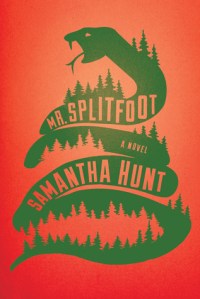 Mr. Splitfoot by Samantha Hunt: “All stories are ghost stories,” Samantha Hunt proclaims in her quirky third novel about the crossover between motherhood and mysticism. In a dual storyline that takes in fundamentalist cults, unlikely mediums and a pregnant woman’s pilgrimage, Hunt asks whether one can ever believe in the unseen. Mr. Splitfoot has the offbeat charm of Scarlett Thomas’s work. While the plot ultimately feels like a bit of a jumble, its vision of unexpected love and loyalty remains compelling. “The End’s always coming,” but it is how one lives in the face of brutality and impending extinction that matters.
I also post reviews of most of my casual reading and skimming on Goodreads:
 Rush Oh! by Shirley Barrett: A debut novel in which an Australian whaler’s daughter looks back at 1908, a catastrophic whaling season but also her first chance at romance. I felt that additional narrators, such as a whaleman or an omniscient voice, would have allowed for more climactic scenes. Still, I found this gently funny, especially the fact that the family’s cow and horse are inseparable and must be together on any outing. There are some great descriptions of whales, too.
 Felicity by Mary Oliver: I was disappointed with my first taste of Mary Oliver’s poetry. So many readers praise her work to the skies, and I’ve loved excerpts I’ve read elsewhere. However, I found these to be rather simplistic and clichéd, especially poems’ final lines, e.g. “Soon now, I’ll turn and start for home. / And who knows, maybe I’ll be singing.” or “Late, late, but now lovely and lovelier. / And the two of us, together—a part of it.” I’ll definitely try more of her work, but I’ll look out for an older, classic collection.
 Paulina & Fran by Rachel B. Glaser: Full of blunt, faux-profound sentences and smutty, two-dimensional characters. Others may rave about it, but this wasn’t for me. I get that it is a satire on female friendship and youth entitlement. But I hated how the main characters get involved in a love triangle, and once they leave college any interest I had in them largely disappeared. Least favorite lines: “Paulina. She’s like Cleopatra, but more squat.” / “She’s more like Humphrey Bogart” and “She craved the zen-ness of being rammed.”

 Noah’s Wife by Lindsay Starck: I kept wanting to love this book, but never quite did. It’s more interesting as a set of ideas – a town where it won’t stop raining, a minister losing faith, homeless zoo animals sheltering with ordinary folk – than as an executed plot. My main problem was that the minor characters take over so that you never get to know the title character, who remains nameless. There’s also a ton of platitudes towards the end. It reminded me most of The Readers of Broken Wheel Recommend and Not Forgetting the Whale (another cozy environmental dystopia based around biblical allusions).
 Spill Simmer Falter Wither by Sara Baume: This sounded like a charmingly offbeat story about a loner and his adopted dog setting off on a journey. As it turns out, this debut is much darker than expected, but what saves it from being unremittingly depressing is the same careful attention to voice you encounter in fellow Irish writers like Donal Ryan and Anne Enright. It’s organized into four sections, with the title’s four verbs as headings. In a novel low on action, the road trip is much the most repetitive section, extending to the language as well. Even so, Baume succeeds in giving a compassionate picture of a character whose mental state comes into question. (Full review in March 2016 issue of Third Way magazine.)
 Medium Hero by Korby Lenker: Lenker is an indie musician, and the 27 autobiographical stories in his debut collection are about the everyday challenges of being on the road versus trying to pay the bills. Many feature “Korby” or “Simon” as fictional stand-ins, and recurring locations include his hometown of Twin Falls, Idaho and his adopted home of Nashville. As the title suggests, Lenker has no illusions about being famous or out of the ordinary. Most of the time he just tries to be a decent guy, the kind who prays for family members in distress even though he’s not sure he believes in God. Lest that sound too serious, though, there are also stories about peeing his pants and the perils of being a metrosexual.
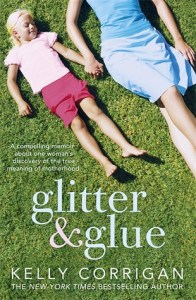 Glitter and Glue by Kelly Corrigan: Slides down like ice cream. And I say that even though the whole basis for this memoir feels rather thin. Corrigan frames it around five months in the early 1990s when she worked as a nanny for two Australian kids whose mother died of cancer. For a young woman fresh out of college, it was like a trial run for being a mother, and also gave her a new appreciation for everything her own mother had done for her during her Philadelphia Catholic upbringing. If Corrigan’s father was the ‘glitter’ of the family, her mother was the ‘glue’ – holding everything together in the background. This is impressively reconstructed, dialogue and all, from letters, journals and photos.
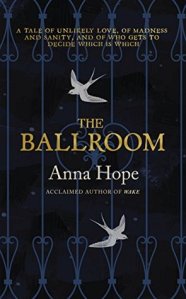 The Ballroom by Anna Hope: This novel was inspired by the story of the author’s great-great-grandfather, an Irishman who was a patient at Menston Asylum in West Yorkshire from 1909 to 1918. The novel zeroes in on the long, hot summer of 1911, focusing through alternating close third-person chapters on John Mulligan, a new patient named Ella Fay, and Dr. Charles Fuller, who wants to put his mental hospital at the frontline of eugenics research. Ultimately I didn’t like this quite as much as Wake, but I think it cements Anna Hope’s reputation as a solid historical fiction writer. I hope with her next book she’ll move beyond the years around World War I to consider a less-chronicled era.
 Life without a Recipe by Diana Abu-Jaber: The Jordanian–American writer reflects on how various food cultures have sustained her through a life that hasn’t always turned out as expected. Three marriages, a move from Portland to Florida, a winding path to motherhood in her forties, and her father’s death from leukemia are some of the main events. Like Sasha Martin’s Life from Scratch, this is more about family and personal history than it is about food (and there are no recipes). Still, food is the stuff of memories, and it is what binds her to two strong characters: her Jordanian father Bud with his stuffed grape leaves, and her maternal grandmother Grace with her frequent baking and the pastries they consumed together in Paris.
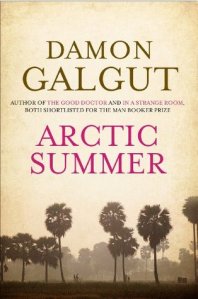 Arctic Summer by Damon Galgut: This fictionalized account of the life of E.M. Forster focuses on the drawn-out composition of A Passage to India, which he began in 1913 but wouldn’t complete and publish until 1924. In between he broke off to write his explicitly homosexual novel Maurice (only published posthumously), spent three years working in Egypt during the war, and served as a secretary to an Indian maharajah. As fictionalized biographies of authors go, I’d rate this somewhere between David Lodge’s A Man of Parts (H.G. Wells) and Colm Tóibín’s superior The Master (Henry James); all three share a heavy focus on the author’s sexuality. “Buggery in the colonies. It wasn’t noble” is one of my favorite random snippets from this novel, and sums up, for me, its slightly prurient aftertaste.
Better Late than Never: The Goldfinch
And the painting, above his head, was the still point where it all hinged: dreams and signs, past and future, luck and fate. There wasn’t a single meaning. There were many meanings. It was a riddle expanding out and out and out.
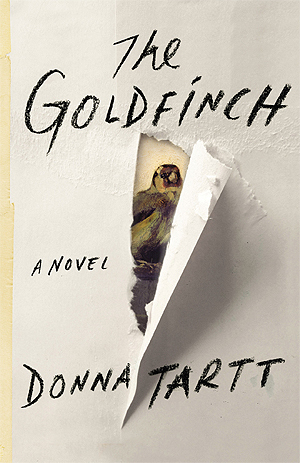 My pristine paperback copy of Donna Tartt’s The Goldfinch cost all of £1 at a used bookshop in Henley. Talk about entertainment value for money! Although it took me nearly a month to read, starting with Christmas week, it was more gripping than that timeframe seems to suggest. I read it under a pair of cats in the bitter-cold first week of a Pennsylvania January, then tucked it under my arm for airport queues (no way would it fit in my overstuffed carry-on bag) and finally finished it during my first week of bouncing back from transatlantic jetlag. Somehow Theo Decker’s fictional travels – from New York to Las Vegas and back; to Amsterdam and home again – blended with my sense of having been on a literal journey with the book to make this one of my most memorable reading experiences in years.
That’s not to say that the book was flawless. In fact, I found the first 200 pages or so pretty slow. You almost certainly know the basics of the plot already, but if not, glance away from the rest of this paragraph. Theo, 13, is separated from his mother during a terrorist attack on a New York City museum. Among the dying he encounters an older man – guardian of the pretty red-haired girl Theo had been checking out just moments before – who gives him a ring and tells him to go to Hobart and Blackwell antiques. But this is not the only souvenir Theo takes from his ordeal; he also steals the little Dutch masterpiece by Fabritius that appears on the book’s cover. Stumbling around the streets of New York, the shell-shocked Theo undoubtedly resembles a 9/11 victim. As the years pass, he is moved from guardian to guardian, but a few things remain constant: his memory of his mother, his obsession with the painting, and his love for Pippa, that red-haired girl who, like him, was among the survivors.
The aftermath of the attack was the most tedious section for me. It felt like it took forever for Theo’s future to be set in motion, and I thought if I heard him complain of how his head was killing him one more time I might just scream. It’s when Theo gets to Vegas, and specifically when he meets Boris, that the book really takes off. Boris is simply a terrific character. He’s lived all over and has a mixed-up accent that’s part Australian with heavy Slavic overtones. Like Theo, he has an unreliable father who is often too drunk to care what his kid is doing. This leaves the two young teens free to do whatever they want, usually something classified as illegal. Indeed, there’s a lot of drug use in this book, described in the kind of detail that makes you wonder what Tartt was up to during her years at Bennington.
As a young man Theo, back in New York, joins Hobie (of Hobart and Blackwell) in selling antiques both genuine and ersatz, and reconnects with an old friend’s family in a surprising manner. The story of what becomes of the painting was in danger of turning into a clichéd crime caper, yet Tartt manages to transform it into a richly philosophical interrogation of the nature of fate. Theo’s intimate first-person narration makes him the heir first of Dickensian orphans and later of the kind of tortured antiheroes you’d find in a nineteenth-century Russian novel: “I had the queasy sense of my own life … as a patternless and transient burst of energy, a fizz of biological static just as random as the street lamps flashing past.”
Similar to my experience with Of Human Bondage, I found that the latter part of the novel was the best. The last 200 pages are not only the most addictive plot-wise but also the most introspective; all my Post-It flags congregate here. It’s also full of the best examples of Tartt’s distinctive prose. The best way I can describe it is to say it’s like brush strokes: especially in the scenes set in Amsterdam, she’s creating a still life with words. Often this is through sentences listing images, in phrases separated by commas. Here’s a few examples:
Floodlit window. Mortuary glow from the cold case. Beyond the fog-condensed glass, trickling with water, winged sprays of orchids quivered in the fan’s draft: ghost-white, lunar, angelic.
Out on the street: holiday splendor and delirium. Reflections danced and shimmered on black water: laced arcades above the street, garlands of light on the canal boats.
Medieval city: crooked streets, lights draped on bridges and shining off rain-peppered canals, melting in the drizzle. Infinity of anonymous shops, twinkling window displays, lingerie and garter belts, kitchen utensils arrayed like surgical instruments, foreign words everywhere…
Such sentence construction shouldn’t work, yet it does. I’ve never been one to fawn over Donna Tartt, but this is writing I can really appreciate.
[I did take issue with some of the punctuation in the novel, though whether that’s down to Tartt, her editor or the UK publication team I couldn’t say. Take, for instance, this description of a station clerk: “a broad, fair, middle aged woman, pillowy at the bosom and impersonally genial like a procuress in a second rate genre painting.” Another solid allusion to Dutch art, but missing two hyphens if you ask me.]
The Goldfinch contains multitudes. It’s the Dickensian coming-of-age tale of a hero much like David Copperfield who’s “possessed of a heart that can’t be trusted.” It’s a realist record of criminal escapades. It’s a story of unrequited love. It’s a convincing first-hand picture of anxiety, addiction and regret. It has a great road trip, an endearing small dog, and a last line that rivals The Great Gatsby’s (I’ll leave you to experience it for yourself). It’s a meditation on time, fate and the purpose of art. It’s not perfect, and yet I – even as someone who pretty much never rereads books – can imagine reading this again in the future and gleaning more with hindsight. That makes it worthy of one of my rare 5-star recommendations.
Caring too much for objects can destroy you. Only—if you care for a thing enough, it takes on a life of its own, doesn’t it? And isn’t the whole point of things—beautiful things—that they connect you to some larger beauty? Those first images that crack your heart wide open and you spend the rest of your life chasing, or trying to recapture, in one way or another?
My rating: 
Books in Brief: Five I Loved Recently
Why We Write about Ourselves: Twenty Memoirists on Why They Expose Themselves (and Others) in the Name of Literature
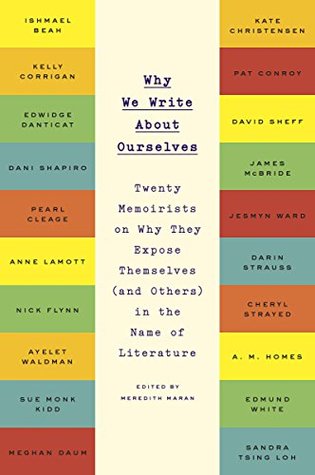 (Edited by Meredith Maran)
A great collection of first-person pieces from memoir authors, charting their individual journeys into autobiographical writing and giving their top tips. Opinions vary as to whether you have to get the approval of the people who appear in your work – some think that’s essential; others simply change the names and get on with it. Sometimes this has led to fallout within families. One thing everyone agrees on, though, is that a memoir has to be as carefully crafted as any novel, with a clear narrative arc and distinctive dialogue and scenes. My favorite pieces were from Kate Christensen, Edwidge Danticat and Darin Strauss.
Can’t We Talk about Something More Pleasant?
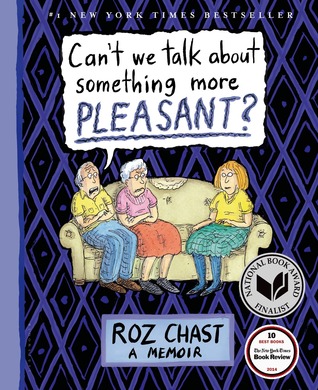 (By Roz Chast)
Memoir + graphic novel = graphic memoir. This one’s about her parents’ aging, senility and death yet still manages to be laugh-out-loud funny. It also includes photos of her parents’ apartment filled with ancient stuff they’d hoarded and a touching series of sketches she made of her mother while she was dying. This and Fun Home are the two best graphic memoirs I’ve read. A favorite line, uttered when her mother bounced back temporarily from hospice care: “Where, in the five Stages of Death, is EAT TUNA SANDWICH?!?!?”
Best Food Writing 2015
(Edited by Holly Hughes)
 “Food is intimate. We take it into our bodies. When we gather at the table with friends and family, we’re gathering to affirm something.” The title doesn’t lie – these essays are terrific. There wasn’t a single one I didn’t find interesting, whether the topic was lab meat; seeking out the perfect burger, Bolognese sauce or gumbo; particular chefs or restaurants; food fads; starting a simple meatball supper club; or feeding picky kids. A couple favorites were “Finding Home at Taco Bell” by John DeVore and “The One Ingredient that Has Sustained Me during Bouts of Leukemia” by Jim Shahin. This series has been running since 2000, but this is the first time I’ve picked up one of the books. I’ll be looking out for it again next year.
 The Longest Night
(By Andria Williams)
Utterly absorbing historical fiction. What with the remote setting and the threat of Cold War or nuclear fallout, this is reminiscent of The Last Pilot and The Wives of Los Alamos, but more engaging than either of those. You may also see hints of Richard Yates or even Tom Perrotta’s Little Children in the story of a marriage strained to the breaking point. Each character is fully explored and the early 1960s atmosphere is completely convincing. A great debut and an author I’d like to hear more from.
Your Heart Is a Muscle the Size of a Fist
(By Sunil Yapa)
 A hard-hitting novel with an unforgettably resonant title, this is set at the 1999 Seattle WTO protest. Yapa explores the motivations and backstories of activists, police officers, and delegates as the day deteriorates into violence. The novel flows pretty much effortlessly. Yapa’s writing style is closest to Smith Henderson’s (Fourth of July Creek): short, verbless sentences alternate with long, lyrical ones; there’s plenty of repetition and rhetorical questions, but it remains accessible rather than overblown. This fine debut novel is about cultivating the natural compassion in your heart even while under the threat of the fist.
My rating for all: 
Of Human Bondage: Finally Caught Up from 2015
When it came to it, it isn’t me
was all he seemed to learn
from all his diligent forays outward.
(from “It Isn’t Me” by James Lasdun)
I chose to read this doorstopper from 1915 because it appeared in The Novel Cure on a list entitled “The Ten Best Novels for Thirty-Somethings.” By happy accident, I was also reading it throughout its centenary year. My knowledge of W. Somerset Maugham’s work was limited – I had seen the 2006 film version of The Painted Veil but never read anything by him – so I had no clear idea of what to expect. I was pleased to encounter a narrative rich with psychological insight and traces of the Victorian novel.
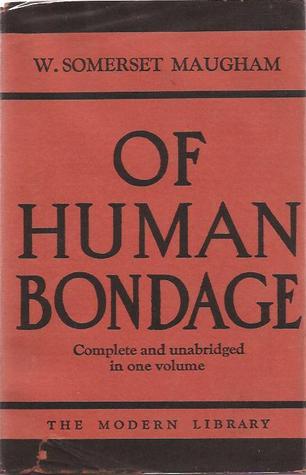 Philip Carey is not unlike a Dickensian hero: born with a club foot and orphaned as a child, he’s raised by his stern vicar uncle in Kent and reluctantly attends boarding school. Much of the book is filled with his post-schooling wanderings and professional shilly-shallying, along with multiple romantic missteps. He studies in Germany, tries to make it as a painter in Paris, and returns to London to train as an accountant and then as a doctor. Each attempted career seems to fail, as does every relationship. Philip reminded me most of David Copperfield, especially after he meets the jolly, Micawber-esque Thorpe Athelny during his hospital internship and becomes friendly with his wife and children.
As is common in Victorian novels, Philip is troubled by his conflicting desires. When it comes to women, he cannot get love to match up with lust. As a youth he loses his virginity to Emily Wilkinson, a woman in her mid-30s, then wants nothing to do with her. A few other dalliances have mixed success, but the novel focuses on Philip’s connection to Mildred Rogers. A café waitress, she’s vain and ill-tempered and acts indifferent to Philip – but is happy for him to spend money on her. He’s disgusted and infatuated all at once: “He did not care if she was heartless, vicious and vulgar, stupid and grasping, he loved her. He would rather have misery with [her] than happiness with [another].” Though Mildred tries to eschew the traditional roles of wife and mother, the Victorian notion of the fallen woman haunts her.
This on-again, off-again romance forms the heart of the book. Both Philip and Mildred are maddening in their own way. Not since Pip (another Philip, interestingly) in Great Expectations have I been so furious at a main character for consistently making the wrong choices, being dazzled by beauty and status and ignoring the more important things in life. Yet the close third-person narration sees so deeply into Philip’s psyche that I could not help but feel sympathy for him, too, cringing over his every failure – especially when stock market losses leave him destitute and he undertakes humiliating (to him) work at a department store. The novel is liberally studded with intimate paragraphs conveying Philip’s thoughts:
He painted with the brain, and he could not help knowing that the only painting worth anything was done with the heart. … [H]e had a terrible fear that he would never be more than second-rate. Was it worth while for that to give up one’s youth, and the gaiety of life, and the manifold chances of being?
Pain and disease and unhappiness weighed down the scale so heavily. What did it all mean? He thought of his own life, the high hopes with which he had entered upon it, the limitations which his body forced upon him, his friendlessness, and the lack of affection which had surrounded his youth. He did not know that he had ever done anything but what seemed best to do, and what a cropper he had come! Other men, with no more advantages than he, succeeded, and others again, with many more, failed. It seemed pure chance. The rain fell alike upon the just and upon the unjust, and for nothing was there a why and a wherefore.
Another humanizing element that especially appealed to me was Philip’s loss of Christian faith. During my study abroad year and especially my master’s year at Leeds, when I wrote a dissertation on women’s loss-of-faith narratives in Victorian fiction, I read a lot of novels about belief and doubt. In Philip’s case, I was interested to see how Maugham portrays what is usually seen as a loss as more of a liberation:
Suddenly he realised that he had lost also that burden of responsibility which made every action of his life a matter of urgent consequence. He could breathe more freely in a lighter air. He was responsible only to himself for the things he did. Freedom! He was his own master at last. From old habit, unconsciously he thanked God that he no longer believed in Him.
Although Philip frequently indulges in self-pity, he also has moments where he wakes up to the wonder of life. These epiphanies of the beauty of London, of the whole world, were among my favorite scenes.
Unusually in a long book, I thought the last 150 pages were the strongest. I struggled to pay attention throughout Philip’s schooling and wearied of the endless negotiations with Mildred, but when Philip is at his lowest point – like the protagonist of Knut Hamsun’s Hunger, not even sure if he’ll find enough to eat – there’s a real intensity to the plot that made this last chunk fly by.
I read a 1930s Modern Library copy from the University of Reading, but consulted Robert Calder’s introduction to the 1992 Penguin Classics edition for background information. It seems the novel was recognizably autobiographical for Maugham, though where a club foot was Philip’s source of shame, for the author it was his stammer (and his sexuality – he married but is known to have been a homosexual).
Like Joyce’s roughly contemporary A Portrait of the Artist as a Young Man, Calder notes, Of Human Bondage fits into the “apprentice novel” genre. Despite being published in 1915, it is set in a recent past so makes no reference to the First World War, though the Boer War plays a background role. I didn’t find the book to be particularly dated; I even discovered that a couple of sayings I might have pegged as later inventions were around in the 1910s: “like it or lump it” and “put that in your pipe and smoke it.”
Of Human Bondage met with a lukewarm critical response in its own time but does seem to be among the more beloved – if obscure – classics nowadays. Calder insists that it “remains Maugham’s most complete statement of the importance of physical and spiritual liberty.”
There have been three film versions – and another is in production this year, apparently. The best known, from 1934, launched the career of Bette Davis, who gave it her all as Mildred Rogers (she was a write-in favorite for the Oscars that year). Overacting, for sure, but her blonde wave and simpering looks were perfect for the role. By contrast, Leslie Howard’s is a fairly subtle Philip. The movie – condensed, amazingly, to just over an hour and a half – focuses on his club foot and his relationship with Mildred; I was disappointed that no attempt was made to reproduce Philip’s introspective monologues through voiceovers.
To my surprise, Calder asserts that Of Human Bondage “has become one of the most widely read of modern novels, particularly by young people, who still find relevance in Philip’s struggle for a free and meaningful life.” It was good enough for Holden Caulfield, after all. It struck me during my reading that two recent novels may have taken inspiration from Maugham: the main character in Esther Freud’s Mr. Mac and Me, set in 1914, has a club foot; and in Hanya Yanagihara’s A Little Life Jude’s shame over his deteriorating physical condition, especially his legs, is reminiscent of Philip’s.
I’m not sure I’ll try anything else by Maugham – how could I when there’s still so much of Dickens and Hardy left to read? – but I’m certainly glad I read this. It’s clear why Berthoud and Elderkin thought Of Human Bondage would be a perfect read for someone in their 30s: it’s infused with the protagonist’s nostalgia for his youth and regret at opportunities not taken and time lost. The novel imagines a world where, even without a god pulling a string, some misfortune seems to be fated. Even so, free will is there, allowing you to recover from failure and try something new that will be truer to yourself in this one and only life.
My rating: 
Love, Sex, Death & Words: Catch-up Book #3
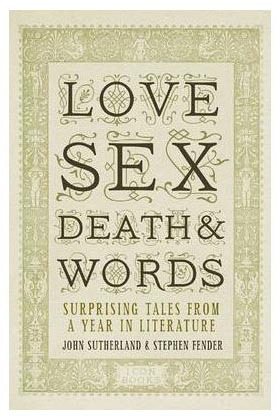 Love, Sex, Death & Words: Surprising Tales from a Year in Literature was my bedside book for 2015. It’s composed of 366 daily entries compiled by John Sutherland, one of my favorite commentators on books, and Stephen Fender. Each entry zeroes in on an event from literary history corresponding to that calendar date. The events range enormously in terms of time period, setting and theme. Births, deaths, anniversaries, Nobel prizes awarded to authors you’ve never heard of, publication dates – this has it all.
A few of my favorite random pieces were: “12 July – The end of blasphemy” (the last successful blasphemy charge was made against a work of literature in 1977: a poem in Gay News that implied Jesus was homosexual and imagines a Roman soldier sodomizing his corpse); “20 August – England’s finest naturalist–novelist is buried” (introducing me to Richard Jefferies, about whom I knew next to nothing); “19 November – After a sound night’s sleep at the Willard Hotel, Washington, D.C., Julia Ward Howe wakes early in the dawn with the words of ‘The Battle Hymn of the Republic’ in her head”; and “9 December – Peanuts gets its first of many outings on television.”
Bits of what I read here kept tying in with my reading and writing assignments over the course of the year. Several mini-essays about the Nobel Prize inspired me to write a BookBrowse backstory article about literary prizes named after people (such as Alfred Nobel). A piece about Alexander Pope’s relationship with his doctor, John Arbuthnot, struck me for its similarity to Jude’s friendship with Andy in Hanya Yanagihara’s A Little Life – “Pope was of necessity closer to his physician than any other human being.”
There are also humorous little comments about the writing life dotted through, like “None but a blockhead, [Samuel] Johnson said, writes for anything but money.” I can feel better about my work ethic after reading about Edgar Wallace, creator of King Kong, who “hated the labor of actually writing” so much that between dictation sessions he brewed a pot of tea every half hour and smoked 80 cigarettes a day. I chuckled at this analogy: “Harold Bloom … is to literary criticism what Einstein was to physics” (for learned yet readable literary criticism, I’d take John Sutherland any day). And I even learned a new word: “pathographesis” is writing inspired by illness – one of my favorite autobiographical subgenres.
Like The Novel Cure, this would make an ideal gift for any bibliophile. Entries are only a page or a page and a half, so even the busiest literature lover will have time to fit them in. Over the course of a year, you’ll take away your own personalized cache of literary nuggets, and still get to keep the book on the shelf for future reference when birthdays and holidays get you thinking “now, what else happened on this day?”
My rating:
Have you read any “daily devotional” type books for literature lovers? Let me know if there’s any you’d recommend.
Airmail: Books that Lasted All of 2015 #2
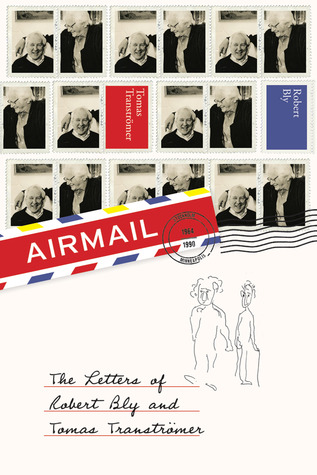 Airmail: The Letters of Robert Bly and Tomas Tranströmer was my first-ever Goodreads giveaway win. Way back in the summer of 2013, the good people of Graywolf Press spent a small fortune to send this tremendous book all the way from Minnesota to my tiny then-house on the outskirts of Reading, England. It took me an unconscionably long time first to pick it up, then to read it, and finally to review it. But here we are.
This is the first time I’d read a literary correspondence, and I absolutely loved it. I knew very little about either poet before picking this up, though I recognized Bly as the translator of the copy of Knut Hamsun’s Hunger I had read a few years back. The two first corresponded in 1964 when Tranströmer requested a copy of the poetry journal The Sixties from Bly’s small press. At this point Tranströmer was already an established poet in his native Sweden, but in decades to come Bly was responsible for making his reputation in English translation.
“Friendships have their rhythms and seasons, fat times and lean times,” editor Thomas R. Smith writes in his introduction. One of the pleasures of this book is watching a friendship develop, as salutations go from “Dear Mr. Tranströmer” and “Best wishes” to “Your friend” and “With deep fondness always.”
Their relationship was both professional and personal: they translated each other’s poems into their respective languages so discussed intricacies of meaning as well as publication details and reading tours, but they also visited each other and became ever deeper confidants through deaths in the family and Bly’s painful divorce. They also commiserate over the debacle of the Vietnam War (as a protestor Bly was once arrested alongside Dr. Spock and Allen Ginsberg) and the Nixon–Reagan affronts to liberalism.
These letters sparkle with humor, especially from Tranströmer, who paints a Micawber-ish picture of his impecunious family, initially supported through his day job as a psychologist at a boys’ prison. My impression of him was of an impish joker.
Our shortage of money is comical—toward the end of the month we go around and shake all our old clothes in the hope that a stray coin might fall out.
We drank some champagne, which makes you think very clearly—my head turned into an aquarium with goldfish who were mumbling sentences of Marcus Aurelius.
Bly’s a witty sort, too:
I’ll send you the most insulting review I’ve ever gotten—it’s wonderful, he objects to everything about me except the size of my shoes!
I carefully set aside these free days which are known as Introvert Days, and are to be spent in solitary anxious, obstinate, confused ectomorph brooding.
Forgive my new typewriter—its mother was frightened by a Latin manuscript, and it doesn’t believe in pauses…
You don’t have to have any interest in poetry to read this with enjoyment. In fact, I didn’t care for most of the poem extracts. In the 1960s and 70s, at least – the heyday for the letters – they both wrote free verse poems that alternate matter-of-fact observations with abstractions. Lacking in sound techniques, they struck me as flat and artless. They weren’t to my taste apart from this one stanza of Tranströmer’s that instantly jumped out to me:
Two truths approach each other. One comes from inside, the other from outside, and where they meet we have a chance to catch sight of ourselves. (from “Preludes”)
However, Bly, at least, became “positively form-mad” in his later years; “[I] now have to eat all my words praising free verse as the only food conceivable for true Christian folk,” he wrote in 1981. He even created his own form, the “ramage” of 85 syllables. Perhaps I’ll like their later work better – I’m game for trying a full collection from each of them.
For anyone interested in the nitty-gritty of translation, there are many fascinating passages here where the poets wrestle with vocabulary and nuances. “Poems are best when there are incredible mysteries in them,” Bly declares, and all the more difficult to retain that mystery as they passed back and forth between Swedish and English. “I think it was something unexplainable, something water-like or flowing in our approach to poetry that made our translations of each other full of feeling even with occasional mistakes,” Bly wrote to their Swedish editor.
These selected letters continue through 1990, when Tranströmer had a stroke and their correspondence inevitably declined. Tomas Tranströmer would go on to win the Nobel Prize in 2011 and died in March 2015. Robert Bly is still going at age 89 and has recently been the subject of a biopic. Stealing Sugar from the Castle, a volume of his new and selected poems, was published in 2013.
After this I’d be keen to try out more authors’ correspondence volumes. I love letters whether they appear in epistolary fiction or in nonfiction, and here they form a touching picture of a friendship that sustained their writers for decades. In 1978 Bly wrote: “Thank you for receiving my grief and my uncertainties and my shadowy complications without running out the door.” That’s the mark of a true friend.
With thanks to Graywolf Press for the free copy, won in a Goodreads giveaway.
My rating:
Four Books that Lasted All of 2015: #1
With this four-part post (one per day for the rest of this week) I think I will finally have caught up on the 2015 reads I needed to review. These four books have daunted me for ages because I spent much of last year with them – one because I wrestled with it (vacillating between admiration and frustration), another because it was a daily bedside book, and the other two because they were long and rewarding yet tough to read more than a bit of at a time. Knowing full well that I won’t do any of them justice, I’ll offer a few thoughts.
Fourth of July Creek by Smith Henderson
“I go into homes all the time and I save children. It’s what I do for a living, you see? And I didn’t save my own daughter.”
 If I take nearly a year over a novel, stopping and starting, that’s usually a bad sign. But I forced myself to finish this one, just like I did with The Orphan-Master’s Son by Adam Johnson. In the end my feelings were roughly similar, too: I appreciated the skill behind Henderson’s writing but never fully warmed to it. This is the story of Pete Snow, a Montana social worker in the early 1980s. His cases are uniformly distressing, but the one that most captivates his attention is Benjamin Pearl, raised in the wilderness by his father Jeremiah, a fundamentalist anarchist who drills holes in coins to show his antipathy to the government.
Since his wife and their teenage daughter Rachel left for Texas, Pete has been adrift in a fog of alcohol and sex, driving obsessively between remote locations in an attempt to save his doomed clients and criminal brother. When Rachel runs away, though, life’s dangers come home to Pete for the first time: “He’d seen so much suffering, but he’d only ever suffered it secondarily. To have it fresh and his own. The scope of it. He’d had no idea. He’d known nothing.” His search for his daughter is what saved the book for me. However, what actually happens to Rachel I found melodramatic, and how it’s narrated – through a third-person rendering of an interview, rather than a you/I back-and-forth – seemed odd.
Indeed, there are unusual narration choices throughout, such as the occasional second-person phrase in reference to Pete. The prose style is by turns fragmentary (as the above lines attest) and expansive, as in this long, alliterative sentence:
Shattered chants and ceaseless invective morph into a nearly simian cacophony of hoots and throaty shrieks as a white cloud of gas composes and insinuates itself into the small crowd that yet churns forward from the rear and backward from the front as the agitators break into two scattering bodies, fanning and choking and wild-eyed, coursing up and down the road.
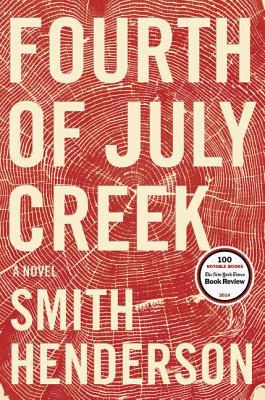
Once again I prefer the American cover. What’s up with that?
Ultimately I found this novel to be very hard work. The one scene I’ll remember most clearly is Pete and the Pearls stumbling on a pile of animals, from a raccoon right up to a black bear, that were all killed by a downed telephone wire. I’d recommend this if you’re a dedicated reader of dirty realism and you accept the violence and the detached writing style that genre tends to involve. If not, you should probably start somewhere else, like with Ron Rash or David Vann.
Ever since Sufjan Stevens’s Carrie and Lowell came out, I can’t help but hear his song “Fourth of July” in my head when I think about this book: “What did you learn from the Tillamook Burn and the Fourth of July? We’re all gonna die.” It’s that oppressive, depressing, even apocalyptic atmosphere I’ll return to when I think about this book. Fourth of July Creek – a real place in Montana – is nowhere I’ll want to revisit.
With thanks to Windmill Books for the free copy, won in a Goodreads giveaway.
My rating: 
The Novel Cure—Bibliotherapy in Action
A good book, read at the right moment, should leave you uplifted, inspired, energized and eager for more. With so many books to choose from, what’s the point of reading even one more that leaves you cold?
I’ve mentioned my interest in bibliotherapy before. Well, for anyone new to the concept or interested in finding out more, The Novel Cure by Ella Berthoud and Susan Elderkin, two of the bibliotherapists at London’s School of Life, is an accessible introduction. Subtitled “An A–Z of Literary Remedies,” this is a learned and at times tongue-in-cheek book of advice about what fiction to read if you’re suffering from any sort of malady – physical, psychological, or imagined.
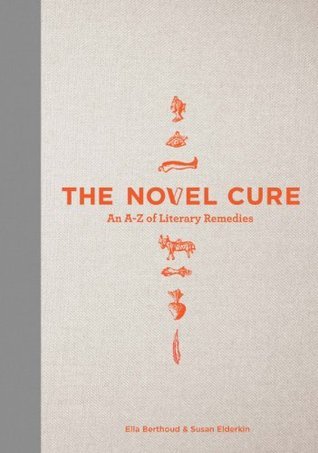 The alphabetical format and “see also” asides make it more like a cross-referenced encyclopedia than a book to read straight through, though I tried it both ways. Initially I flipped through at random, letting one entry take me to another related one and so on, but after a while I went back to the start and caught up on unread entries to finish within a year.
“It helps enormously at times of stress to read about other people who are going through similar things; watching how other people cope or fail to cope will make you feel less alone and give you strength,” the authors write to introduce the “cancer, caring for someone with” entry. I found this to be true when my sister lost her husband to cancer last year. She had never been a reader – apart from celebrity magazines – but in the past year she’s read nearly 90 books, many of them memoirs about illness and bereavement. Books are how I’ve always made sense of the world, so it’s been incredibly gratifying to see her turn to them as well. There are plenty of recommendations I’ll pass on to her from this book, especially “death of a loved one” (After You’d Gone by Maggie O’Farrell and Extremely Loud and Incredibly Close by Jonathan Safran Foer) and “widowed, being” (The Same Sea by Amos Oz and Major Pettigrew’s Last Stand by Helen Simonson).
You’ll be amazed at the range of conditions and circumstances for which the book offers prescriptions. Newly retired? “Bucolic and tranquil, The Enigma of Arrival [by V.S. Naipaul] will encourage you to take stock of your life and enjoy the unfolding of new possibilities.” Workaholic? “Immerse your desiccated soul in something very simple, very rustic, very small. We suggest [Thomas] Hardy’s gentlest, most innocent novel, Under the Greenwood Tree.” Two sections that felt particularly relevant to me as a vertically challenged freelancer were “short, being” and “tax return, fear of doing.” Meanwhile I’ll be pointing my husband to “baldness,” “flying, fear of,” “stress” and “tinnitus” (poor chap). But some of these entries surely resulted from the authors thinking “hey, here’s a great book we have to mention,” and then coming up with a category to fit it into, like “determinedly chasing after a woman even when she’s a nun” for In the Skin of a Lion by Michael Ondaatje.

I think I prefer this U.S. cover.
Indeed, there’s a certain levity to this book that I think some reviewers have missed. These aren’t all entirely serious suggestions, though they are all worthwhile books. I especially liked the sections where the authors incorporate pastiche of the book in question. A piece recommending Pamela by Samuel Richardson is in the form of an old-fashioned letter, for example, while “single, being” apes Bridget Jones’s diary entries. They even imitate certain authors’ prose style, as in “Who poses questions without question marks and observes the subtle changes in the light with exquisite brevity.” Answer: J.P. Donleavy, apparently.
The book is also a great source of top ten lists (I’m working through their novels for thirty-somethings) and advice for how to deal with reading crises (e.g. “busy to read, being too” and “giving up halfway through, tendency to”). My only criticism of the book – and this is one I level against many examples from the ‘books about books’ genre – is that there’s a fair bit of plot summary, sometimes so much so that it puts me off reading a book rather than whets my appetite for it.
It’s a bit belated (or early) for suggesting this as a Christmas gift for a book lover, but perhaps you can hand it over as a birthday gift or an anytime present – even to yourself. I got my copy on Amazon for £4, quite a bargain for a book I’ll be returning to again and again over the years.
My rating:
Do you agree that novels have the power to cure, or at least help with, problems?
 Bookish Beck = Rebecca Foster. American transplant to England. Freelance proofreader and book reviewer.
 Bookish Beck