Vincent van Gogh’s Life as a Graphic Novel
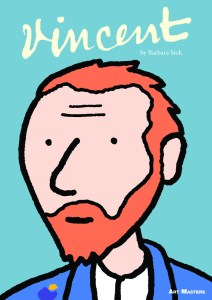 Dutch artist and writer Barbara Stok’s Vincent is the second graphic novel I’ve read from SelfMadeHero’s “Art Masters” series, after reviewing Munch last month. It’s another biographical study of an artist, in this case of Vincent van Gogh. Oddly, though, the drawing style and the subject’s vibrant shock of red hair reminded me most of Agatha.
The book focuses primarily on the time van Gogh spent in the South of France. He settled in Arles, staying first in a hotel and then in a large rental house he hoped to turn into an artists’ colony – he temporarily attracted Paul Gauguin before driving him away with his strict, workaholic ways and his temper.
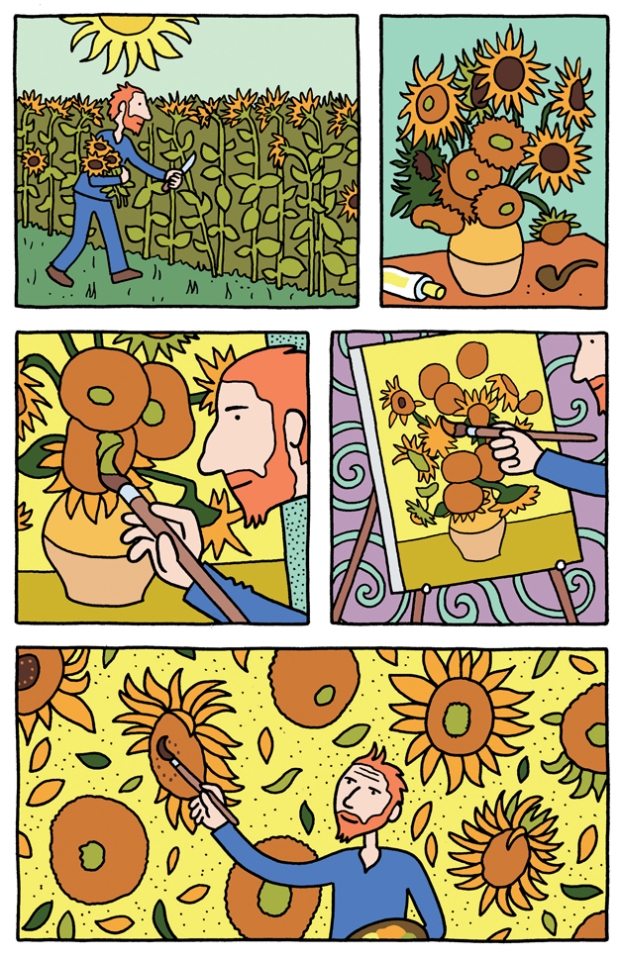
In presumably authentic letters to his younger brother Theo (an art dealer who supported him financially) back in Paris, van Gogh details his progress and tells of his fondness for the Provence scenery. I particularly love the panels where you can spot the direct inspiration for some of van Gogh’s most famous paintings: wheat fields, cypress trees, sunflowers, irises, a starry night sky, and even his cluttered bedroom.
We also get insights into the philosophy behind van Gogh’s work: “An artist has to put character and emotion into his work, not just paint whatever sells,” he insists to an art dealer who expects him to pander to public taste. “I use lots of different techniques, all mixed together. I like to exaggerate the colors in order to capture the soul of the subject,” he explains to a couple of fellow painters who take an interest in him. He used thick, confident brush strokes and painted quickly, making him annoyingly prolific in others’ eyes.
Stok does a wonderful job of depicting van Gogh as a misunderstood genius who drove people away with his lack of social skills, and sensitively introduces the breakdown during which he famously cut off his ear. He admitted himself to a mental hospital, where he could be treated for his epileptic attacks and continued to paint natural scenes under supervision.

Striking colors in the breakdown scene.
The book closes on what seems to be a fairly positive note: van Gogh voluntarily leaves the hospital and moves to Auvers-sur-Oise, near Paris, where he can be closer to Theo and his young family. “I foresee a future full of problems, but I’m not pessimistic,” he declares to his brother. And yet the final page shows a pair of gravestones: Vincent died in 1890 at age 37 and Theo just a year later, at 33.
Turn back one page and you see what might actually be a rather ominous scene: van Gogh has been painting in a wheat field; in one last two-page spread, he has disappeared from view and a flock of crows has taken off and filled the sky. Were they startled by the gunshot of his attempted suicide? While still true to the facts of van Gogh’s life, it’s a refreshingly subtle ending.
Stok perfectly captures van Gogh’s personality amid the warm colors of the French countryside, and whetted my appetite to read his letters for myself. I’d recommend this to anyone with an interest in the lives of artists, whether you think you’re a fan of graphic novels or not.
With thanks to the publisher, SelfMadeHero, for the free copy for review. Translated from the Dutch by Laura Watkinson.
My rating: 
Undying: Poems by Michel Faber
Today, July 7th, happens to be my ninth wedding anniversary. For Michel Faber, however, it marks a more somber occasion: two years since his wife, Eva, died of cancer. They met in 1988 and got to spend over 25 years together. It was a second marriage for Eva, a visual artist – a bohemian life full of travel and each working on their art, until a six-year battle with multiple myeloma (a cancer of the bone marrow) cut Eva down in her fifties.
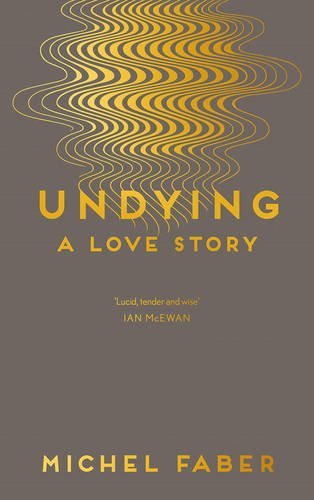 Faber’s new book, Undying: A Love Story, is a striking outpouring of 67 poems, most of them written in 2014–15, after Eva died. In two halves, it takes up first Eva’s illness and death, and then the aftermath and memories. Faber gives a vivid sense of how completely cancer changed both their lives: “There were three of us in our marriage. / You, me, and your cancer.” Eva’s illness put everything into perspective: “In our former lives, B.C., / all sorts of issues seemed to matter – / like minor wastes of money, and a scarcity / of storage space.”
The poems vary widely in stanza length and style. With only a few exceptions, they are in the first person – “I” and “we” – and addressed directly to Eva as “you,” even after she was gone. In one of my favorites, “You Loved to Dance,” Faber remembers the rare occasions in their relationship when they danced together and shakes his head over lost opportunities: “A thousand chances that we didn’t take. … Half a dozen dances in a quarter-century. / I doubt you thought that that was all there’d be.”
Although this is mostly free verse, the occasional rhyming couplet ends a poem:
Yes, let us not leave off praying.
Not for God our soul to keep
but just to die, of old age, in our sleep.
Wake-up call. You’re dead another day.
The hotel hopes I have enjoyed my stay.
As you can see from those last lines, the tone is gently sardonic. Faber’s strategy is often to hold up physical artifacts of Eva’s life – the hundreds of menstrual pads she’d accumulated, only to go through early menopause (“Change Of Life”); the odd foodstuffs he found in their cupboards after her death and tried to use up (“Tamarind”) – and turn them to gently mocking commentary on all the futile plans we make. Most ironic of all is “Or, If Only,” in which he catalogues all the ways life can kill you when you don’t want it to, whereas by the end Eva longed for an easy way out: “We’d jump at any offer. / Any speedy death would do us.”
In subject matter and tone I would liken these poems to Christian Wiman’s and Christopher Reid’s. Wiman is a poet and theologian who has himself been through the trenches – long, painful years of treatment for blood cancer. Christopher Reid’s A Scattering is a poetic reflection on his wife Lucinda’s death from a brain tumor. Though you can sense the rich emotion in the poems of Undying, Faber doesn’t quite match either of these authors for craft. His talent is better suited to the expansive world of a novel like The Crimson Petal and the White.
I was thus dismayed to read in this book’s publicity materials that Faber does not intend to write any more fiction – “[Eva’s] death is a major factor in his decision not to write any further novels. A talented artist, she set aside her career to help further his, despite his protestations – and he is dedicating much of the rest of his life to making her work better known.” Faber’s The Book of Strange New Things was one of my most memorable reads from 2014. The story of an interplanetary missionary separated from his wife, it takes on new ache when you realize Faber was writing it in the shadow of his own wife’s death. If, indeed, it was to be his last novel, it’s appropriate that it gives such a poignant portrait of a marriage.
I’ll keep hoping that Faber writes more fiction. In the meantime, any fan of his writing should get hold of these tender, elegiac poems.
All I can do, in what remains of my brief time,
is mention, to whoever cares to listen,
that a woman once existed, who was kind
and beautiful and brave, and I will not forget
how the world was altered, beyond recognition,
when we met.
With thanks to Canongate for the free copy for review.
My rating:
Practical Theology: Something More by John Pritchard
This is only the second theology book I’ve reviewed here, after Joan Chittister’s Between the Dark and the Daylight in May 2015. I requested John Pritchard’s Something More from SPCK after reading a leaflet about it at Bloxham Festival, thinking it sounded like a relevant, non-preachy approach to the spiritual side of life. And that is indeed what I found. It’s a book stuffed full of relatable themes under one overarching topic: the moments that cause us to question whether there is more to life than what we see and do in the everyday.
 Each chapter has many of the familiar elements of a short sermon: opening prompts, personal or borrowed anecdotes, exposition of a theme, quotations from the Bible and other writers or poets, and life application questions. At times I felt Pritchard was too reliant on quotes from other authors, meaning I didn’t get a particular sense of his own style. However, like an Anglican sermon, each chapter is something you can work through in 10 or 15 minutes – understandable, solidly put together, and with plenty of take-home messages.
Some examples of the chapter-by-chapter themes are suffering, social justice, the arts, and the search for stillness and wonder. There are a few slightly overlapping pieces that might have been combined, but that would have altered the digestible format. A recurring image is of the church building as a tranquil place of holiness and power – no matter if you view it religiously or not. Whether Pritchard is discussing pain or poetry, his tactic is always to expose hints of the supernatural. “To describe the Bruch violin concerto as the product of horse hair scraping over catgut doesn’t feel adequate. There’s more to be said,” he writes.
That word “more” is the book’s clarion call, encouraging readers to look deeper into every situation for sparks of light that point to God. SPCK is a venerable Christian publishing company and Pritchard is a retired Bishop of Oxford, so it’s clear where the book is coming from. Its assumptions may not reflect your own, as Pritchard is well aware. He remembers being in a hospital in London and telling his nurse about the book he was planning. “The entire Christian world-view is probably a foreign country to my nurse,” he realized, which encouraged him to avoid religious jargon and keep it simple and applicable here.
I think everyone can relate to the circumstances Pritchard sets out at the beginning of the book: “Life is OK in an OK kind of way but it fails the test of ecstasy or lament. It rolls on in a safe, middling register, but it feels as if there should be more. … In the meantime we get on with secondary things, with our habits of low hope.” If you dare to think there must be more to life than going to work and paying the bills and want to explore what might be out there, I’d recommend picking this up alongside books by some of the other terrific writers Pritchard quotes, such as Brian McLaren, Marcus Borg, and Barbara Brown Taylor.
With thanks to Sarah Head at SPCK for sending a free copy for review.
My rating: 
European Traveling and Reading
We’ve been back from our European trip for over a week already, but I haven’t been up to writing until now. Partially this is because I’ve had a mild stomach bug that has left me feeling yucky and like I don’t want to spend any more time at a computer than is absolutely necessary for my work; partially it’s because I’ve just been a bit blue. Granted, it’s nice to be back where all the signs and announcements are in English and I don’t have to worry about making myself understood. Still, gloom over Brexit has combined with the usual letdown of coming back from an amazing vacation and resuming normal life to make this a ho-hum sort of week. Nonetheless, I want to get back into the rhythm of blogging and give a quick rundown of the books I read while I was away.
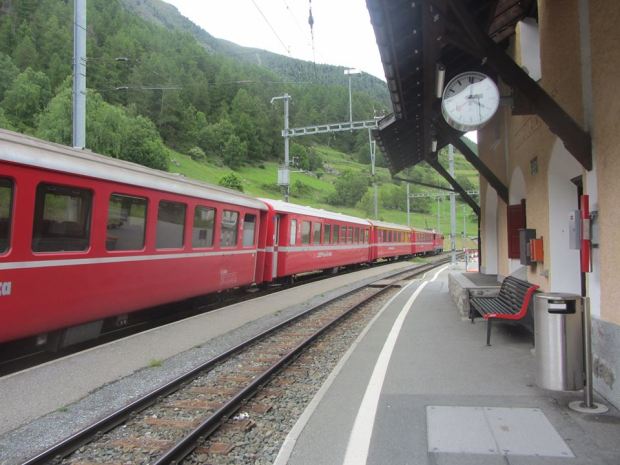
Tiny Lavin station, our base in southeastern Switzerland.
But first, some of the highlights of the trip:
- the grand architecture of the center of Brussels; live jazz emanating from a side street café
- cycling to the zoo in Freiburg with our friends and their kids
- ascending into the mountains by cable car and then on foot to circle Switzerland’s Lake Oeschinensee
- traipsing through meadows of Alpine flowers
- exploring the Engadine Valley of southeast Switzerland, an off-the-beaten track, Romansh-speaking area where the stone buildings are covered in engravings, paintings and sayings
- our one big splurge of the trip (Switzerland is ridiculously expensive; we had to live off of supermarket food): a Swiss dessert buffet followed by a horse carriage ride
- spotting ibex and chamois at Oeschinensee and marmots in the Swiss National Park
- miming “The Hills Are Alive” in fields near our accommodation in Austria (very close to where scenes from The Sound of Music were filmed)
- the sun coming out for our afternoon in Salzburg
- daily coffee and cake in Austrian coffeehouses
- riding the underground and trams of Vienna’s public transport network
- finding famous musicians’ graves in Vienna’s Zentralfriedhof cemetery
- discovering tasty vegan food at a hole-in-the-wall Chinese restaurant in Vienna that makes its own noodles
- going to Slovakia for the afternoon on a whim (its capital, Bratislava, is only 1 hour from Vienna by train – why not?!)
We went to such a variety of places and had so many different experiences. Weather and language were hugely variable, too: it rained nine days in a row; some mornings in Switzerland I wore my winter coat and hat; in Bratislava it was 95 °F. Even in the ostensibly German-speaking countries of the trip, we found that greetings and farewells changed everywhere we went (doubly true in the Romansh-speaking Engadine). Most of the time we had no idea what shopkeepers were saying to us. Just smile and nod. It was more difficult at the farm where we stayed in Austria. Thanks to Google Translate, we had no idea that the owner spoke no English; her e-mails were all in unusual but serviceable English. We speak virtually no German, so fellow farm guests, including a Dutch couple, had to translate between us. (The rest of Europe puts us to shame with their knowledge of languages!)
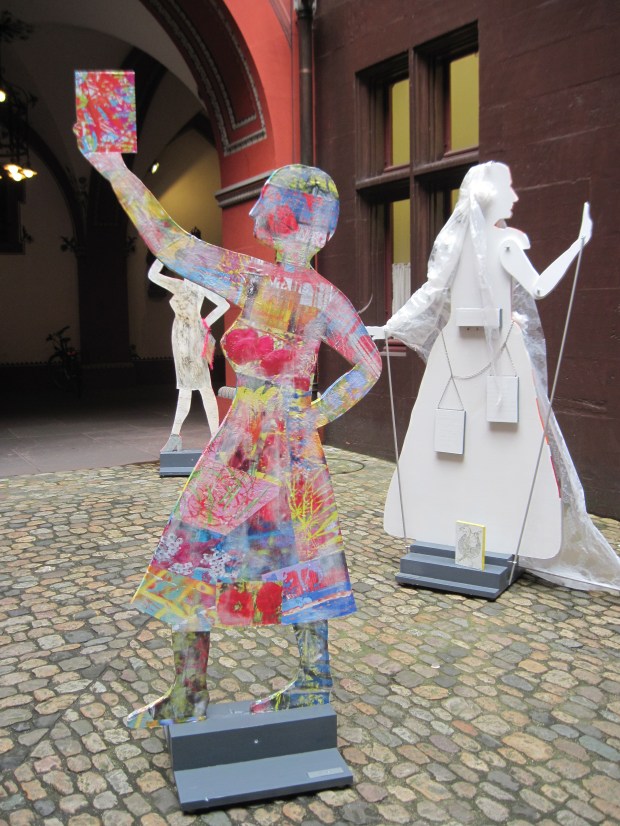
A reading-themed art installation at the Rathaus in Basel, Switzerland.
Train travel was, for the most part, easy and stress-free. Especially enjoyable were the small lines through the Engadine, which include the highest regular-service station in Europe (Ospizia Bernina, where we found fresh snowfall). The little town where we stayed in an Airbnb cabin, Lavin, was a request stop on the line, meaning you always had to press a button to get the train to stop and then walk across the tracks (!) to board. Contrary to expectations, we found that nearly all of our European trains were running late. However, they were noticeably more comfortable than British trains, especially the German ones. Thanks to train rides of an hour or more on most days, I ended up getting a ton of reading done.
 On the journey out I finished The Accidental Tourist by Anne Tyler. This is the first “classic” Tyler I’ve read, after her three most recent novels, and although I kept being plagued by odd feelings of ‘reverse déjà vu’, I really enjoyed it. This story of staid, reluctant traveler Macon Leary and how his life is turned upside down by a flighty dog trainer is all about the patterns of behavior we get stuck in. Tyler suggests that occasionally journeying into someone else’s unpredictable life might change ours for the good.
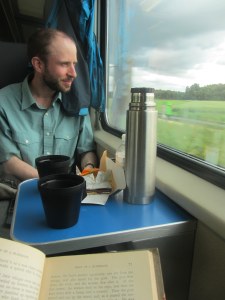 Diary of a Pilgrimage by Jerome K. Jerome was just what I expected: a very silly book about the travails of international travel. It’s much more about the luckless journey and the endurance of national stereotypes than it is about the Passion Play the travelers see once they get to Germany. It was amusing to see the ways in which some things have hardly changed in 125 years.
 A Whole Life by Robert Seethaler, a novella set in the Austrian Alps, is the story of Andreas Egger – at various times a farmer, a prisoner of war, and a tourist guide. Various things happen to him, most of them bad. I have trouble pinpointing why Stoner is a masterpiece whereas this is just kind of boring. There’s a great avalanche scene, though.
 The Book that Matters Most by Ann Hood releases on August 9th. A new book club helps Ava cope with her divorce, her daughter Maggie’s rebelliousness, and tragic events from her past. Each month one club member picks the book that has mattered most to them in life. I thought the choices were all pretty clichéd and Ava was unrealistically passive. Although what happens to her in Paris is rather melodramatic, I most enjoyed Maggie’s sections.
 Me and Kaminski was my second novel from Daniel Kehlmann. Know-nothing art critic Sebastian Zöllner interviews reclusive artist Manuel Kaminski and then accompanies the older man on a road trip to find his lost sweetheart. Zöllner is an amusingly odious narrator, but I found the plot a bit thin. This is a rare case where I would argue the book needs to be 100 pages longer.
 About midway through the trip I finished another I’d started earlier in the month, This Is Where You Belong by Melody Warnick. The average American moves 11.7 times in their life. I’m long past that already. The book collects an interesting set of ideas about how to feel at home wherever you are: things like learning the place on foot, shopping and eating locally, and getting to know your neighbors. I am bad about integrating into a new community every time we move, so I picked up some good tips. Warnick uses examples from all over (though mostly U.S. locations), but also makes it specific to her home of Blacksburg, Virginia.
 “A cabinet of fantasies, a source of knowledge, a collection of lore from past and present, a place to dream… A bookshop can be so many things.” In A Very Special Year by Thomas Montasser, Valerie takes over Ringelnatz & Co. bookshop when the owner, her Aunt Charlotte, disappears. She has the entrepreneurial skills to run a business and gradually develops a love of books, too. The title book is a magical tome with blank pages that reveal the reader’s destination when the time is right. Twee but enjoyable; a quick read.
 Eleven Hours by Pamela Erens is a taut thriller set during one woman’s experience of childbirth in New York City in 2004. Flashbacks to how the patient and her Caribbean nurse got where they are now add emotional depth. Another very quick read.
 Burning Secret by Stefan Zweig is a psychologically astute novella in which a 12-year-old tries to interpret what’s happening between his mother and a fellow hotel guest, a baron he looks up to. For this naïve boy, many things come as a shock, including the threat of sex and the possibility of deception. This reminded me most of Thomas Mann’s Death in Venice. (On a hill above Salzburg we discovered a strange disembodied bust of Stefan Zweig, along with a plaque and a road sign.)


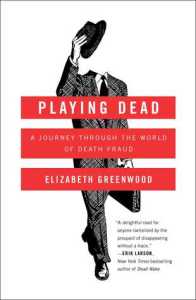 Playing Dead by Elizabeth Greenwood (releases August 9th) was great fun. Thinking of the six-figure education debt weighing on her shoulders, she surveys various cases of people who faked their own death or simply tried to disappear. Death fraud/“pseudocide” is not as easy to get away with as you might think. Fake drownings are especially suspect. I found most ironic the case of a man who lived successfully for 20 years under an assumed name but was caught when police stopped him for having a license plate light out. I particularly liked the chapter in which Greenwood travels to the Philippines, a great place to fake your death, and comes back with a copy of her own death certificate.
 Miss Jane by Brad Watson (releases July 12th) is a historical novel loosely based on the story of the author’s great-aunt. Born in Mississippi in 1915, she had malformed genitals, which led to lifelong incontinence. Jane is a wonderfully plucky protagonist, and her friendship with her doctor, Ed Thompson, is particularly touching. “You would not think someone so afflicted would or could be cheerful, not prone to melancholy or the miseries.” This reminded me most of What Is Visible by Kimberly Elkins, an excellent novel about living a full life and finding romance in spite of disability.
I also left two novels unfinished (that’ll be for another post) and made progress in two other nonfiction titles. All in all, a great set of reading!


I’m supposed to be making my way through just the books we already own for the rest of the summer, but when I got back of course I couldn’t resist volunteering for a few new books available through Nudge and The Bookbag. Apart from a few blog reviews I’m bound to, my summer plan will be to give the occasional quick roundup of what I’ve read of late.
What have you been reading recently?
Munch, Steffen Kverneland (graphic novel)
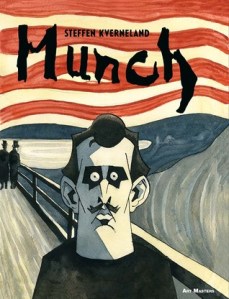 Munch is my second biography in graphic novel form from SelfMadeHero, following on from a life of Agatha Christie that I reviewed last month. Norwegian painter Edvard Munch (1863–1944) is, of course, best known for The Scream, but I learned a lot more about his work through this striking visual tour curated by illustrator Steffen Kverneland. Much of the text accompanying Kverneland’s images is from authentic primary sources: Munch’s diaries and letters, his contemporaries’ responses to his art, and so on.
Munch’s mother died early in his life, and sickroom and deathbed scenes were to permeate his work. “Disease and insanity and death were the black angels that stood by my cradle,” he wrote. “A mother who died early – gave me the seed of consumption – a distraught father – piously religious, verging on madness – gave me the seeds of insanity.” His first solo show opened in Kristiania (now Oslo) in 1889. Three and a half years later scandal erupted when his exhibition in Berlin was closed down. The establishment disapproved of the Impressionist influence in his work and thought he showed a lack of artistic technique. As it turned out, having his show shut down was the best publicity he ever could have asked for.
Kverneland shows different incarnations of Munch’s most famous pieces, such as Madonna, The Girls on the Bridge and The Scream. He also traces the painter’s important relationships, such as his friendship with playwright August Strindberg and his pursuit of the various women who inspired his nudes. In 1895, the writer Sigbjørn Obstfelder gave a lecture on Munch’s art. His appreciation included the following:
As no other Norwegian painter, Munch has focused on essential questions – has caused the deepest subjects to quiver. Before, one painted landscapes and everyday life – Munch paints human beings in all their shapes – even the beastly human. He finds his subjects where the emotions are strongest. Munch is one of the genuine artists who can shift boundaries.
This is a visually remarkable book, with various styles coexisting sometimes on the same page. Sometimes Munch is portrayed like a superhero in a comic (often with a hugely exaggerated chin); other times the images are more like photographs or nineteenth-century portraits. Pen sketches alternate with color spreads in which red, orange, sepia and flesh tones and black dominate. Some of my most admired individual panels have angular faces drawn in almost kaleidoscopic fragments. Strindberg’s is the most frighteningly fractured face, with triangles and trapezoids emphasizing his angry expression.
There’s also a meta aspect to this work: Kverneland depicts his travels with his friend Lars Fiske to sites associated with Munch, again using everything from black-and-white sketches to color photographs. These were, I’m afraid, my least favorite parts of the book: the friends’ raunchy, booze-filled banter has not translated well, and the style of some of their scenes is among the most cartoon-ish.
“Munch had become a monk whose life was devoted to art” is one of the last lines of the graphic novel. It’s a nice summation of what has gone before – with that wordplay especially remarkable given that this is a work in translation. I haven’t come away with a particularly clear sense of the trajectory of Munch’s life, but that’s probably not the point of a deliberately splintered biography like this one.
Kverneland worked on the book for seven years. First published in 2013, it won Norway’s Brage Prize for Literature. This is the fourth installment in SelfMadeHero’s “Art Masters” series, after Pablo, Vincent and Rembrandt. I can highly recommend it to you if you are already a fan of Munch’s work. However, if, like me, you look to graphic novels to also tell you a good story, you might come away slightly disappointed.
With thanks to the publisher, SelfMadeHero, for the free copy. Translated from the Norwegian by Francesca M. Nichols.
My rating:
Note: I’m traveling until the 24th so won’t be responding to comments right away, but will be sure to catch up soon after I’m back. I always welcome your thoughts!
Her Father’s Daughter (Peirene)
Originally issued in 2005, Her Father’s Daughter was French author Marie Sizun’s first of seven novels, published when she was 65. It’s an autobiographical reflection on a painful experience from her childhood: in 1945, when she was four and a half, the father she had never met returned from the war and reentered the family, only to leave again two years later. That is the essential storyline of this spare novella, told from the perspective of a four-year-old girl whose name is France but who is usually just referred to as “the child.”
 “Of the outside world, the child still knows pretty much nothing.” Her universe is limited to her Paris neighborhood and apartment; her mother, Liliane (Li), is the star around which she orbits. Li gives her daughter free rein, even leaving her alone in the apartment while she goes shopping. When the child learns that her father, a prisoner of war, is soon to return from Germany, she is anxious and resentful. The “secret, intimate world” she has with her mother looks fragile, and she is jealous of anyone who tries to encroach. Meanwhile her father and grandmother both think France has been spoiled and seek to instill a new sense of discipline.
There’s a secret at the heart of the book, something big that the mother and grandmother are covering up. It involves a trip to Normandy, yet whenever the girl tries to speak of the event later on, they deny it and tell her she’s only dreaming. My favorite passages of the book recount her helpless anger as she tries to expose their lies: “Fury from the child, who ploughs on, incredulous. Protests. Persists. In vain.” All she can do in retaliation for this deception and the increasing tension between her parents is pour her mother’s perfumes down the sink.
Sizun’s style is characterized by short, simple phrases. The child is not the narrator, yet the prose imitates the straightforward language that a child might use: “A very strange thing for the child, having a father. A father who’s there. At home. All the time. Morning, noon and night.” The compact chapters chronicle the family’s descent into silence, ignoring each other and walking away – which eventually the father does for good.
Peirene issues books in trios. This one is part of the “Fairy Tale: End of Innocence” series, along with The Man I Became by Peter Verhelst. It’s interesting to think about the book in that context, with the Eden of the mother and daughter being shattered by the entry of the father. “Fathers are found in fairy tales, and they’re always slightly unreal and not very kind,” the child thinks. Unfortunately, I found this novella to be slightly monotonous, with a particularly flat ending. I’ll leave you with a few words from the author about what she was trying to do with the book:
I needed to tell this story. To speak about that wound. … As my writing progressed and the book took shape, I felt this therapy wasn’t only for my personal use but spoke to everyone who, like me, may have been immersed in misunderstandings, in emotional distortions with loved ones, for example being forced to choose between a father and a mother.
It’s not exactly a cheery Father’s Day read, but an intriguing little book all the same.
Translated from the French by Adriana Hunter. With thanks to Peirene Press for the free copy.
My rating:
Note: I’m traveling until the 24th so won’t be responding to comments right away, but will be sure to catch up soon after I’m back. I always welcome your thoughts!
Books in Brief: Five I Enjoyed Recently
Lab Girl
By Hope Jahren
This memoir puts so many things together that it shouldn’t work, yet somehow – delightfully – does. With witty anecdotes and recreated dialogue, Jahren tells about her Minnesota upbringing, crossing the country to take up geobiology/botany academic posts in Atlanta, Baltimore and Hawaii, her long-time platonic relationship with eccentric lab partner Bill, and zany road trips for conferences and field work. On the serious side, she writes about how bipolar disorder complicated work life, marriage and motherhood. Add to that the interspersed chapters illuminating aspects of plant biology and you get a truly varied and intricate narrative. What Jahren does best is simply convey what it is like to have true passion for your work, a rare thing. You don’t have to be a science type to enjoy this book. All that’s required is curiosity about how others live. Jahren might even inspire you to go plant a tree.
My rating: 
 It’s Okay to Laugh (Crying Is Cool, Too)
By Nora McInerny Purmort
Purmort was hit by a triple whammy of loss: within weeks of miscarrying her second child, both her father and her husband were dead of cancer. After a seizure revealed his brain tumor, she and Aaron got engaged on his hospital bed and went through fertility treatment to have their son. All in all they got three years together, after which the Minneapolis-based author founded what she calls the “Hot Widows Club.” She’s only about my age but, as she puts it, has “been through some shit.” The book is in the form of short essays, a lot like blog entries, that tread the fine line between heartbreak and humor. I might have preferred a bit more of a narrative; I wearied of open letters and lists. The book is best where she eases up on self-deprecating jokes and pop culture references and just tells her story, so much of which resonates with my sister’s experience. As soon as I finished the book, I ordered her a copy.
My rating: 
My Heart Can’t Even Believe It: A Story of Science, Love, and Down Syndrome
 By Amy Silverman
When her younger daughter Sophie was born with Down’s syndrome in 2003, Silverman had no idea what to expect. The long-time Arizona journalist put her investigative skills to work, finding out everything she could about the discovery of Down’s and the history of how patients have been treated down the decades. In addition, she delves into the foundation of the Special Olympics (which had a connection with the Kennedy family) and its alternatives, and – not being a “support group kinda girl,” the other sources of encouragement she finds, especially through fellow bloggers. A significant portion of the book is about finding the best schools for Sophie – information that may well be not just U.S.-specific but particular to Arizona, where charter schools are popular. Still, what comes through is Silverman’s fierce love for her daughter and her insistence that every person with Down’s is an individual.
My rating:
 How to Ruin Everything: Essays
By George Watsky
Watsky is a slam poet and rap/hip hop artist from San Francisco. These essays about his misadventures reminded me most of Lauren Weedman (Miss Fortune) and John Jeremiah Sullivan (Pulphead). My favorite pieces were “Tusk,” on smuggling a narwhal tusk from Canada to the States to be his roommate’s great-aunt June’s hundredth birthday present, and “The White Whale,” about his unreliable tour bus. Others see him moving from a crumbling Boston college house to the heart of Hollywood deadbeat territory, traveling through India, fishing in Alaska, trying to attract older women, and reflecting on a childhood love of baseball. In the other stand-out essay, a more serious one, he reveals his experience of epilepsy and weaves in the history of its diagnosis and treatment. Also remarkable was a mention of Pauly Shore, a personage I haven’t thought about in, oh, I don’t know, a decade?
My rating:
Only in Naples: Lessons in Food and Famiglia from My Italian Mother-in-Law
 By Katherine Wilson
This is just the kind of book I would want to write about my experience studying abroad in England and eventually settling here. Of course, Wilson had it harder: she had to conduct her romance with Salvatore Avallone, relate to her future in-laws, and start a career all in a different language. But there were consolation prizes, chief among them the food. A lot of the best anecdotes revolve around Italian cuisine, like Salva’s mother Raffaella sending food down to her daughter in the apartment below via the elevator, or his uncle catching octopi with his one arm. I loved the colorful Italian and Neapolitan dialect expressions Wilson dots around, and as a fellow expat it was interesting to see what her non-negotiable American imports are (we all have our own list, I’m sure): wall-to-wall carpeting, air conditioning, a garbage disposal, and peanut butter – I’m with her on that last one, anyway.
My rating:
(For each one, read my full Goodreads review by clicking on the title link.)
Have you read any of these? Which one takes your fancy?
Note: I’m traveling until the 24th so won’t be responding to comments right away, but will be sure to catch up soon after I’m back. I always welcome your thoughts!
An Anthology of Summer Reading
In partnership with the UK’s Wildlife Trusts, London-based publisher Elliott & Thompson is celebrating the seasons with a series of anthologies edited by novelist and nature writer Melissa Harrison. My husband had a short piece published in the first volume (Spring), so I was eager to get my hands on a copy of Summer.
 The format in all the books is roughly the same: they’re composed of short pieces that range from one to a few pages and run the gamut from recurring phenological records (Gilbert White and Thomas Furly Forster) and extracts from classic literature (Adam Bede and Far from the Madding Crowd) to recent nature books (Mark Cocker’s Claxton and Paul Evans’s Field Notes from the Edge). In addition, there are new contributions from established writers or talented amateurs, one as young as twelve – heartening proof that young people are still enthused about nature.
With the exception of the poems, none of these entries have titles, and the attribution and date of composition are not given until the very end. The idea behind this pseudo-anonymity, I think, is that if – as I sometimes was – you are patient enough to not skip ahead to discover who wrote it when, you will judge all of the pieces by the same standards. You approach each without expectations, and in many cases may be stumped as to whether the writing is historical or modern. I found W.H. Hudson’s and Mary Webb’s extracts particularly readable, for instance; you wouldn’t guess they’re from the early decades of the twentieth century.
There are 70-some pieces here on a wide variety of subjects, but a few of the ones that struck me were on badger-watching (Caroline Greville, who is writing a memoir on the topic), looking for orchids (environmental journalist Michael McCarthy), moth trapping, and night-time wildlife like glow-worms and bats. I especially appreciated Alexandra Pearce’s essay on the brief life of mayflies and Nicola Chester’s on searching for owls. Of the previously published pieces, Paul Evans’s on ant swarms is a stand-out. My two favorites, though, are from celebrated nature columnist Simon Barnes, who writes about paddling a canoe in Norfolk with his son in search of adventure, and Esther Woolfson, who, as she does in her book Field Notes from a Hidden City, illuminates the unnoticed wildlife of Aberdeen.

Courtesy of Chris Foster
Again and again this message comes through: take the time to look closely and you will find great wonders. “Perhaps as adults our lives are so filled with bills, chores, jobs and other things that we often forget to stop and look at the world around us,” Jan Freedman, curator of natural history at Plymouth City Museum and Art Gallery, astutely notes. Whether it’s lichens or weevils, all you generally have to pay to experience nature’s delights is attention. I loved Alexi Francis’s description of a hare: “Haunches down, nose cross-stitched, it closes its eyes to the sun in a moment of blissful slumber.” Having that moment of communion with nature and then choosing just the right words to capture it is what this book is all about.
Taken together, these pieces truly give the feeling of an English summer. The older writing is remarkably undated, which contributes to a sense of continuity across the centuries. However, the book also evokes more universal notions of summer: those drowsy, leisurely days we gild with nostalgia. As Harrison puts it in her introduction, the longing for summer is really a wish to return to childhood: “Those elysian summers, polished to dazzling brightness by the flow of years, can never be recaptured; but we have this summer, however imperfect we as adults might deem it, and we can go out and seek it at every opportunity we find.”

Courtesy of Chris Foster
As the relatively frequent typos – three in the Barnes piece alone, for example – suggest, the series has been somewhat hastily put together. Nonetheless, these are really rather lovely books. Summer is a perfect bedside companion to dip into as the days warm up. Impossible not to covet the whole four-season set.
With thanks to Marianne Thorndahl at Elliott & Thompson for the free copy for review.
My rating:
Discover Some Shiny New Books
If you haven’t already come across it, let me commend to you the UK-based web magazine Shiny New Books. It’s been around for two years now and has just released Issue #10. Each installment is stuffed full of terrific reviews and features. I suggest setting aside a bit of time each day for a week or two, say a half-hour tea break, to browse what the site has to offer. It specifically highlights what’s been recently published or reprinted in the UK, so in some cases these will be books that are already available in North America; in others these will be sneak previews of books not yet published there. You’re sure to find plenty that appeals.
I’m proud to be part of the stellar (if I do say so myself) team of SNB reviewers. Somehow I just kept volunteering for things and ended up with – whoops! – a whole five pieces in this latest issue: four reviews (two fiction, one nonfiction, and one classic reprint) and an interview. Two of the novels were fantastic, among my best reads of the year so far, while the other two books were worthwhile, even very good in places. Here are tasters of my reviews; click on a title to read the whole thing – and then spend some good time browsing the site.
Sweetbitter by Stephanie Danler
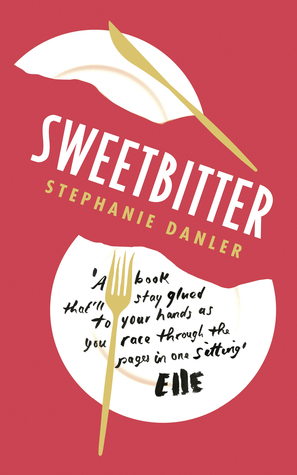 Twenty-two-year-old Tess arrives in New York City by car in June 2006. Two days later she interviews at a restaurant in Union Square and gets a job as a backwaiter and barista. Camaraderie makes the restaurant not just bearable but a kind of substitute home. Tess is most fascinated by two colleagues who stand apart from the crowd: Simone, the resident wine know-it-all, and bartender Jake. Try as she might, Tess can’t work out the dynamic between them. To mirror her one-year taste apprenticeship, the book is broken into four seasonal parts, headed by short sections in the second person or first-person plural. Everything about this novel is utterly assured: the narration, the characterization, the prose style, the plot, the timing. It’s hard to believe that Danler is a debut author rather than a seasoned professional. It captures the intensity and idealism of youth yet injects a hint of nostalgia. I’m willing to go out on a limb and call Sweetbitter my favorite novel of 2016.
My rating: 
I also interviewed Stephanie Danler over e-mail.
My Son, My Son by Howard Spring
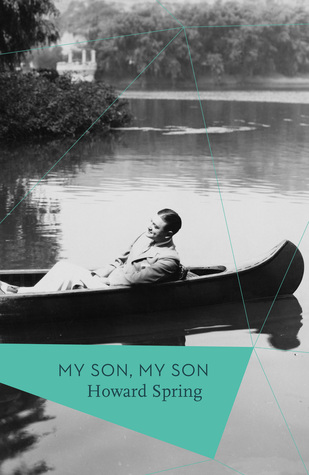 My Son, My Son opens in working-class Manchester in the 1870s and stretches through the aftermath of World War I. Like a Dickensian urchin, William Essex escapes his humble situation thanks to a kind benefactor and becomes a writer. His best friend is Dermot O’Riorden, a fervid Irish Republican. William’s and Dermot’s are roughly parallel tracks. Their sons’ lives, however, are a different matter. Oliver Essex and Rory O’Riorden are born on the same day, and it’s clear at once that both fathers intend to live vicariously through their sons. My Son, My Son struck me as an unusual window onto World War I, a subject I’ve otherwise wearied of in fiction. A straight line could be drawn between Great Expectations, Maugham’s Of Human Bondage, My Son, My Son, and The Goldfinch: all four feature a simultaneously sympathetic and enraging protagonist who overcomes family difficulties to dream of fame and fortune. No mere period or local interest piece, this is a book for the ages.
My rating: 
The Sellout by Paul Beatty
 This is such an outrageous racial satire that I kept asking myself how Beatty got away with it. Not only did he get away with it, he won a National Book Critics Circle Award. The novel opens at the U.S. Supreme Court, where the narrator has been summoned to defend himself against a grievous but entirely true accusation: he has reinstituted slavery and segregation in his hometown of Dickens, California. All the old stereotypes of African Americans are here, many of them represented by Hominy Jenkins. This reminded me most of Ishmael Reed’s satires and, oddly enough, Julian Barnes’s England, England, which similarly attempts to distill an entire culture and history into a limited space and time. The plot is downright silly in places, but the shock value keeps you reading. Even so, after the incendiary humor of the first third, the satire wears a bit thin. I yearned for more of an introspective Bildungsroman, which there are indeed hints of.
My rating:
The Abundance by Annie Dillard
 Dillard was raised a Christian in Pittsburgh, Pennsylvania, but her writing expresses an open spirituality rather than any specific faith. For readers who are reasonably familiar with her work, the selection given here might be a little disappointing. Why reread 60 pages from Pilgrim at Tinker Creek, I thought, when I have a copy of it up on the shelf? Rather than reading long, downright strange portions of For the Time Being and Teaching a Stone to Talk, why not go find whole copies to read (which might help with understanding them in context)? None of Dillard’s poetry or fiction has been included, and the most recent piece, “This Is the Life,” from Image magazine, is from 2002. I wish there could have been more fresh material as an enticement for existing fans. However, this will serve as a perfect introduction for readers who are new to Dillard’s work and want a taste of the different nonfiction genres she treats so eloquently and mysteriously.
My rating:
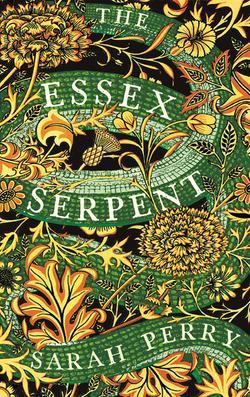
The Essex Serpent by Sarah Perry
This exquisite work of historical fiction explores the gaps – narrower than one might think – between science and superstition and between friendship and romantic love. The Essex Serpent was a real-life legend from the latter half of the seventeenth century, but Perry’s second novel has fear of the sea creature re-infecting Aldwinter, her invented Essex village, in the 1890s. Mysterious deaths and disappearances are automatically attributed to the Serpent who dwells in the depths of the Blackwater. This atmosphere of paranoia triggers some schoolgirls to erupt in frenzied delusions as in The Crucible. It is unclear whether the Church should tolerate a source of mystery or dismiss it all as nonsense – after all, there’s a winged serpent carved onto one of the pews at the parish church.
 In a domestic counterpart to all these supernatural goings-on, we gain entry into two middle-class households. Cora Seaborne’s abusive husband, Michael, has recently died of throat cancer, leaving her to raise their odd (autistic, I wondered?) eleven-year-old son Francis on her own. She has an amateur interest in fossils to rival Mary Anning’s, so when she hears of a cache near Colchester she leaves London for Essex, bringing along Frankie and her companion, Martha. Mutual friends put her in touch with Will Ransome, the vicar of Aldwinter, sure that he and his family – consumptive wife Stella and children Joanna, James and John – will be able to show her around the coast.
Despite an inauspicious first meeting, which sees Cora and Will, still unknown to each other, hauling a drowning sheep out of a lake, theirs soon becomes a close, easy friendship. Cora feels she can speak her mind about the faith she lost and the new marvels she finds in nature:
I had faith, the sort I think you might be born with, but I’ve seen what it does and I traded it in. It’s a sort of blindness, or a choice to be mad – to turn your back on everything new and wonderful – not to see that there’s no fewer miracles in the microscope than in the gospels!
She holds her own in cerebral debates with Will as he deplores his parishioners’ fantasies about the Serpent. Is there really such a big difference between his faith – “all strangeness and mystery – all blood, and brimstone,” Cora teases – and the Serpent legend? In seeming contradiction to his career path, Will is more suspicious than many of the other characters of things he doesn’t understand and can’t explain away, like hypnosis and a Fata Morgana.
The novel’s nuanced treatment of faith and doubt is enhanced by references to Victorian science, including fossil hunting and early medical procedures. Dr. Luke Garrett, Michael’s surgeon, is one of Cora’s best friends back in London; she calls him “The Imp.” In one of the most striking passages of the entire book, he performs rudimentary heart surgery on the young victim of a stab wound. Perry fills in the novel’s background with a plethora of apt Victorian themes, including housing reform and London crime. For a book of 440 pages, it has a large cast and a fairly epic scope. Although there are places where subplots and minor characters might have been expanded upon, Perry wisely refrains from stuffing the novel with evidence of her research. Indeed, it’s a restrained book overall, yet breaks out into effusiveness in just the right places, as in Stella’s mystical adoration of the color blue.
Descriptive passages and the letters passing between the characters give a clear sense of the months passing, yet there is also something timelessly English about the narrative – Dickensian in places (Our Mutual Friend) and Hardyesque in others (Far from the Madding Crowd). I especially loved this picture of the June countryside:
Essex has her bride’s gown on: there’s cow parsley frothing by the road and daisies on the common, and the hawthorn’s dressed in white; wheat and barley fatten in the fields, and bindweed decks the hedges.
Cross this cozy pastoral vision with the Gothic nature of the Serpent craze and you get quite a unique atmosphere. The vague, unexplained sense of menace didn’t work for me at all in Perry’s previous novel, After Me Comes the Flood, but here it’s just right.
It was no doubt true in the late Victorian period that “men and women can’t be friends because the sex part always gets in the way” (as famously declared in When Harry Met Sally). No one is sure what to make of a sexually available, self-assured female like Cora. The different kinds of Greek love, from philia to eros, keep shading into each other here. Like the water that forms the book’s metaphorical substrate, the relationships ebb and flow. Yet there’s no denigrating any connection as just friendship; in fact, friendship is enough to rescue one character from suicide. Like Hanya Yanagihara’s A Little Life, the novel asks whether love is ever enough to save us – and gives a considerably more optimistic answer.

My proof copy didn’t have quite such a gorgeous cover but did come intriguingly wrapped in snakeskin ribbon…
The fact that I have an MA in Victorian literature means I’m drawn to Victorian-set novels but also highly critical about their authenticity. While reading this, though, I thoroughly believed that I was in 1890. Moreover, Perry adroitly illuminates the situation of the independent “New Woman” and the quandary of science versus religion (which were the joint subjects of my dissertation: women’s faith and doubt narratives in Victorian fiction).
I’m delighted, especially having seen Perry speak at Bloxham Festival in February (see my write-up for more on her background and the inspirations behind this novel), to have liked The Essex Serpent three times as much as her debut. It has an elegant, evocative writing style reminiscent of A.S. Byatt and Penelope Fitzgerald. Something holds me back from the full 5 stars – too diffuse? Too much staying on the surface of things? Not quite intimate enough, especially about Cora’s inner life? – but I still declare myself mightily impressed. The Essex Serpent counts as one of my favorite novels of 2016 so far. You can see why Serpent’s Tail (how perfect is her publisher’s name?!) rushed this one into publication a few weeks early. Expect to see it on the Booker Prize shortlist and any other award list you care to mention.
With thanks to Anna-Marie Fitzgerald at Serpent’s Tail for the free review copy.
My rating:
 Bookish Beck = Rebecca Foster. American transplant to England. Freelance proofreader and book reviewer.
