Pride and Prejudice: The Panto
On Wednesday I attended my second-ever pantomime. If you grew up with them, pantomimes might be totally commonplace for you, but imagine how peculiar they’d seem to anyone unfamiliar with the tradition. I was introduced to this campy theatrical genre in early 2006, when I saw my first panto, Jack and the Beanstalk, with my in-laws in Winchester.
Luckily I’d been given a brief primer, so I knew vaguely what to expect: a fairytale or other traditional story (e.g. Cinderella, Aladdin or Peter Pan), often featuring a young hero played by a female, a central female role played by a man in outrageous drag (this is the “pantomime dame”), stock lines including “It/He/She’s behind you!” and “Oh yes, it is”/ “Oh no, it isn’t,” an obvious villain whom the audience is invited to boo, and a mixture of puns, inane and/or raunchy jokes frequently referencing popular culture, and silly musical numbers. (The Wikipedia entry on pantomimes is actually quite a helpful history lesson.)
My mother- and father-in-law take part in an annual pantomime put on by the Steventon Players near their home in Hampshire, and this year the theme was Pride and Prejudice – appropriate given that 2017 marks 200 years since Jane Austen’s death and that she lived for her first 25 years in Steventon, where her father was the rector. In fact, she completed a first draft of Pride and Prejudice, then titled First Impressions, at home in Steventon in 1796.

The whole cast in the final musical number. My mother-in-law, as Mary Bennet, is at the front, second from left (white dress). My father-in-law, as Mr. Collins, is at the back in the center (large black hat).
We had the chance to see the panto on the opening night of four. My mother-in-law, the priest at Steventon and other local churches, played Mary Bennet (a rather thankless role that involved sitting with her nose in a book and issuing the occasional sharp reproach to her mother or Lydia), and my father-in-law was a suitably fawning, cringing Reverend Collins.

Mr. Collins’s marriage proposal to Lizzy is swiftly rejected.
The play was narrated by “Jane Austen’s ghost,” an actress in period costume who sat to one side of the stage and gave bits of information in a wry, knowing voice to move the plot along between scenes (she also helpfully called out prompts for forgotten lines!). I’d conveniently forgotten about the pantomime dame custom, so was taken aback at the first appearance of Mrs. Bennet. Not one but two actors appeared in drag, the other being a fabulously beturbaned Lady Catherine de Bourgh, who was presented as the clear villain of the piece.
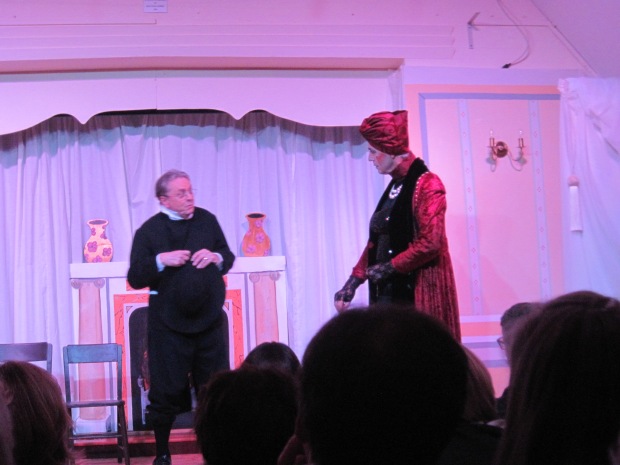
Mr. Collins quails before his patroness, Lady Catherine de Bourgh.
Impressively, the panto remained almost entirely faithful to the plot of the novel, just cutting and combining scenes to keep it under two hours and make it fit into a two-act structure. For instance, Mr. Collins and Wickham make their first appearance at the same time, and Mr. Collins proposes to Lizzy pretty much immediately. Instead of hearing of Lydia and Wickham’s elopement secondhand, we see it for ourselves in a scene set on their midnight ride to Gretna Green, with Mr. Gardiner and Mr. Darcy accosting them like highwaymen.
Highlights included a joke about Mr. Darcy’s manhood, Mrs. Bennet getting sozzled at the ball hosted by Mr. Bingley, Mr. Darcy traipsing up the aisle in flippers and goggles in homage to the BBC’s lake-and-wet-shirt scene, and Lizzy’s repartee with Lady Catherine. Audience participation was welcome on musical numbers such as “Money, Money, Money” and “I’m a Believer.”

Mrs. B. and her five daughters (my MIL is at far left).
Other running gags were Mrs. Bennet’s dramatic entries (to her “Hello, everybody!” the audience was meant to reply “Mrs. B., is it time for tea?”), the Bennets’ servant’s general uselessness, and Mr. Bingley’s two hapless footmen (I’m told that Tweedledee and Tweedledum-style characters are also common in pantomimes).
We were impressed with the authentic costuming and set design in this amateur village hall production. Anachronistic pop music aside, you might well have believed you were in the Regency period during the dance scene at the ball. I’d certainly never seen Pride and Prejudice like this before, but it was great fun.
Where do you stand on pantomimes? What’s your favorite P&P adaptation?
The Last Summer by Ricarda Huch (Peirene)
Originally published in 1910, The Last Summer is a suspenseful epistolary novella by Ricarda Huch (1864–1947), one of the first German women to earn a PhD. She wrote widely across many fields – history, poetry, fiction, and religion – and had an asteroid named after her, earning Thomas Mann’s accolade of “the First Lady of Germany.” I’m grateful to Peirene for resurrecting this German classic as I have a special love for epistolary novels – traditionally told through nothing but letters. You have to be on the lookout for little clues dotted through the correspondence that will tell you who these characters are, how they’re connected to one another, what you need to know about their pasts, and what’s happening now.
 Set across one May to August in the early 1900s, the book joins the von Rasimkara family at their summer home. In response to student protests, patriarch Yegor, the governor of St. Petersburg, has shut down the university and left for the country. With him are his wife, Lusinya; their three twenty-something children, Velya, Jessika and Katya; and Yegor’s new secretary-cum-bodyguard, Lyu. What the family don’t know, but readers do from the first letter onward, is that Lyu is in league with the student revolutionaries and is in on a plot to assassinate the governor at his summer home.
This central dramatic irony is what fuels much of the book’s tension. All of the von Rasimkaras persist in believing the best about Lyu, even when the evidence seems to point to his deception. Both daughters fall in love with him, Velya calls him their “guardian angel,” and Lusinya is sure of his loyalty even after odd incidents she can’t explain, like finding him standing in their bedroom doorway in the middle of the night and a mysterious letter appearing under her pillow. “In case of doubt, one ought to hold back with one’s judgement,” Lusinya opines.
I wouldn’t go so far as to call this a “psychological thriller,” as the back cover blurb does, but I do think it’s a compelling picture of how different groups and ideologies can be fundamentally incompatible. In my favorite passage, Lyu describes the von Rasimkara family to his friend Konstantin:
My stay here is fascinating from a psychological viewpoint. The family has all the virtues and defects of its class. Perhaps one cannot even talk of defects; they merely have the one: belonging to an era that must pass and standing in the way of one that is emerging. When a beautiful old tree has to be felled to make way for a railway line, it’s painful to watch; you stand beside it like an old friend, gazing admiringly and in grief until it comes down. It is undeniably a shame about the governor, who is a splendid example of his kind, but I believe that he has already passed his peak.
As I sometimes feel about novellas, the plot is fairly thin and easily could have been spun out to fill a book of twice the length or more. But that is not what Peirene Press books are about. They’re meant to be quick reads that introduce European novellas in translation. This one has a terrific ending – which I certainly won’t spoil, though the title and cover could be read as clues – and is a perfectly enjoyable way to spend a winter evening.
[Peirene issues books in trios. This is the first of the three books in the “East and West: Looking Both Ways” series. The other two, The Orange Grove by Larry Tremblay and Dance by the Canal by Kerstin Hensel, will be released later in 2017.]
The Last Summer was published in the UK on February 1st. Translated from the German by Jamie Bulloch.
With thanks to James Tookey of Peirene Press for the free copy for review.
My rating: 
Other Peirene titles I’ve reviewed:
- Mr. Darwin’s Gardener by Kristina Carlson
- The Looking-Glass Sisters by Gøhril Gabrielsen
- Her Father’s Daughter by Marie Sizun
- The Man I Became by Peter Verhelst
Classic of the Month: George Orwell’s 1984
Big Brother, the Thought Police, Newspeak, doublethink, 2 + 2 = 5, Room 101. I’d never read George Orwell’s Nineteen Eighty-Four until this month, but so many of its concepts and catchphrases were familiar to me; they’ve entered into popular culture to a remarkable extent. I found that the basics of the plot, and even the specifics of the horrifying climax, were already somewhere in the back of my mind. That’s how much of a household story this is. And, given the recent rise of authoritarian regimes, 1984 is back in style – if it ever went out.

Published in 1949, just four years after Animal Farm, the novel imagines a post-Revolution future in which Oceania (England) is alternately at war with Eurasia and Eastasia. It’s a dystopian vision of bombing raids, public hangings and triumphant film reels of refugees drowning. Absolute loyalty to Big Brother and his Party and total hatred of dissidents are required. Winston Smith works for the Ministry of Truth – an ironic name if ever there was one. His job is to doctor newspaper articles to ‘rectify’ the past. Scrutinized constantly by a telescreen, he ‘corrects’ the written record and burns the evidence in memory holes.
But Winston can’t forget that he once saw a photograph proving that several scapegoats who were executed were actually innocent, and ever since he has been unfaithful to the Party in his heart. “There was truth and there was untruth, and if you clung to the truth even against the whole world, you were not mad.” He makes two bids for freedom: his thought life, as revealed in his diary, and (in Part II) an affair with Julia, a fellow rebel he meets in a rented room above a pawnbroker’s. They join the Brotherhood, Emmanuel Goldstein’s anti-Party movement, and read from his manifesto. Impossible to forget, though, that there’s a Part III to come, and their happy nonconformity is unlikely to survive the Thought Police’s vigilance.
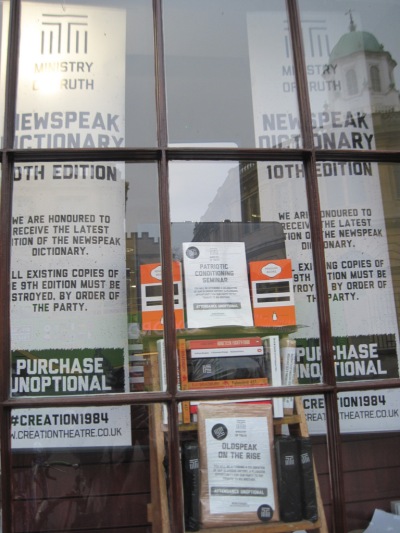
A 1984-themed window at Blackwells in Oxford.
I can’t say I enjoyed this novel exactly. It was more a case of recognizing its cultural importance and prescience about perennial political trends. What I most liked was the irony of the Party’s rebranding: the Ministry of Love is the torture headquarters, for instance, and the propaganda is rife with oxymorons (“WAR IS PEACE. FREEDOM IS SLAVERY. IGNORANCE IS STRENGTH.”). I also appreciated Orwell’s efforts to humanize Winston via his memories of his mother and sister, his estranged wife, and his simple love of beauty – as when he buys a glass and coral paperweight on a whim. Reassuringly, the relationship with Julia isn’t just about sex but is an example of true love against the odds: when Winston tells her “I’m thirty-nine years old. I’ve got a wife that I can’t get rid of. I’ve got varicose veins. I’ve got five false teeth,” she replies “I couldn’t care less.”
And yet there are parts of the book that are truly tedious, like the extracts from Goldstein’s manifesto and the appendix on Newspeak. Like many dystopians, this somewhat sacrifices story in the service of ideas. It certainly could have been cut by up to one-third. However, it’s still full of potent reminders like these about resisting misinformation:
I don’t imagine that we can alter anything in our own lifetime. But one can imagine little knots of resistance springing up here and there—small groups of people banding themselves together, and gradually growing, and even leaving a few records behind, so that the next generation can carry on where we leave off.
At present nothing is possible except to extend the area of sanity little by little. … We can only spread our knowledge outwards from individual to individual, generation after generation. In the face of the Thought Police, there is no other way.
If he [the average citizen of Oceania] were allowed contact with foreigners he would discover that they are creatures similar to himself and that most of what he has been told about them is lies. The sealed world in which he lives would be broken, and the fear, hatred and self-righteousness on which his morale depends might evaporate.
I found it rewarding to follow this with Margaret Atwood’s 2003 essay on Orwell. Nineteen Eighty-Four was the direct model for the feminist dystopia she started writing in the real 1984, The Handmaid’s Tale. She helped me realize something I hadn’t due to my eyes glazing over during the appendix: it’s in the past tense, looking back on a repressive government. In other words, she writes, “the regime has fallen … language and individuality have survived. For whoever has written the essay on Newspeak, the world of Nineteen Eighty-Four is over. … Orwell had much more faith in the resilience of the human spirit than he’s usually been given credit for.” In homage, she ended The Handmaid’s Tale with a section set hundreds of years in the future, when Offred’s world is studied by academics.
That’s important to remember: one day our current situation, horrible as it might feel to live through, will be nothing but a brief chapter in the history books. It’s up to us, though, to help ensure that whatever succeeds it is much better.
My rating:
Next month: I plan to choose a short classic from “The Ten Best Novels for Thirtysomethings” list in The Novel Cure; my options are The Tenant of Wildfell Hall (Anne Brontë), The Rector’s Daughter (F.M. Mayor), and The Jungle (Upton Sinclair), all of which I own. Let me know which would be your pick.
Yet More Books about Cats
I reviewed two sets of cat books last year, one in April and another in October. When you start looking, you realize there are endless pet books out there, with cat books seemingly second only to dog books in popularity. In the past few months I’ve encountered five more books about cats: a Christmas classic, a scientist’s introduction to cat behavior, an anthology of church-themed fiction, an installment of a charming children’s series, and a very funny memoir.
The Cat Who Came for Christmas by Cleveland Amory
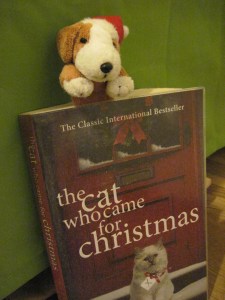 In the late 1970s Amory was a bona fide animal lover (he’d founded the NYC-based Fund for Animals, after all) but didn’t have a pet of his own until he was involved in the rescue of an unprepossessing stray one Christmas: Polar Bear, the cat who would introduce his fussy habits to a bachelor’s household and complicate his life in all kinds of ways. Cat owners will recognize so many things – the 3 a.m. bowl-emptying snack, testy relations with various other species – but I found the book strangely belabored and irrelevant as it goes into the history of the domestic cat, the business of naming cats, and Amory’s travels on behalf of the Fund. [Public library]
Favorite lines:
- “For an animal person, an animal-less home is no home at all.”
- “The fact is that most cats, most of the time, have already met everybody they care to meet.”
Cat Sense: The Feline Enigma Revealed by John Bradshaw
 Bradshaw is the founder and director of the Anthrozoology Institute at the University of Bristol. He writes as both an expert in animal behavior and a cat lover. I only skimmed this one rather than reading it in full because I expected it would repeat a lot of the information in Abigail Tucker’s The Lion in the Living Room. There is indeed a fair amount of overlap in the discussion of domestic cat evolution and the environmental effects of cats’ hunting instinct, but Bradshaw’s book is unique for the amount of time it gives to cat genetics and behavior, especially things like breeding and how cats interact with other cats and with people. This would be a good halfway house if you want a readable but quite scientific book about cats. The Lion in the Living Room is the better all-round introduction, though. [Public library]
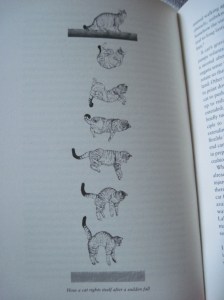
Bradshaw’s diagram of a cat landing on its feet.
Favorite lines:
- “Part of the pleasure of owning a pet comes from projecting our thoughts and feelings on to the animal, treating it as if it were almost human. We talk to our cats as if they could understand our every word, while knowing full well that they certainly can’t.”
- “Purring therefore seems to convey a general request: ‘Please settle down next to me.’ In the gentlest way, the purring cat is asking someone else, whether cat or human, to do something for it.”
The Church Cat: Clerical Cats in Stories and Verse, edited by Mark Bryant
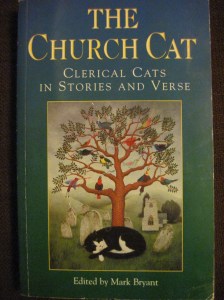 This seems like an impossibly narrow category: stories and poems that combine cats with a church setting. But Bryant has found some real gems that fulfill just that criterion. A few of the short stories, by Ellis Peters, M.R. James and Ernest Dudley, are compact murder mysteries. I most enjoyed Arnold Bennett’s “The Cat and Cupid,” about spinster sisters and “notorious cat-idolaters” who squabble over the handsome new organist; W.L. Alden’s “The Yellow Terror,” about a ship’s cat who insists that his owner hold church services onboard; and Christopher Park’s “The Case of the Cross-eyed Sphinx and the Holy Ghost” (my overall favorite) in which a newly married man meets his wife’s family, including a defrocked chaplain in a wheelchair and his barking mad wife, all of whom have “had an overdose of cat worship.” Of the 21 pieces, only five or six stood out for me (and none of the poetry, really). [Charity shop]
The Church Mice Adrift by Graham Oakley
This 1976 picture book was my introduction to the 14-strong “Church Mice” series. The town of Wortlethorpe is looking to modernize: tearing down all its heritage buildings in favor of glass-fronted monstrosities. This leaves a troop of rats without a home, but they spy an opportunity when they sneak through Sampson’s catflap in the church door. The wily creatures displace the church mice and even Sampson the ginger wonder cat can’t take back his territory. So the cat and his mice are forced to get creative, and come up with a plan that involves a doll’s house turned into a floating café for rats…
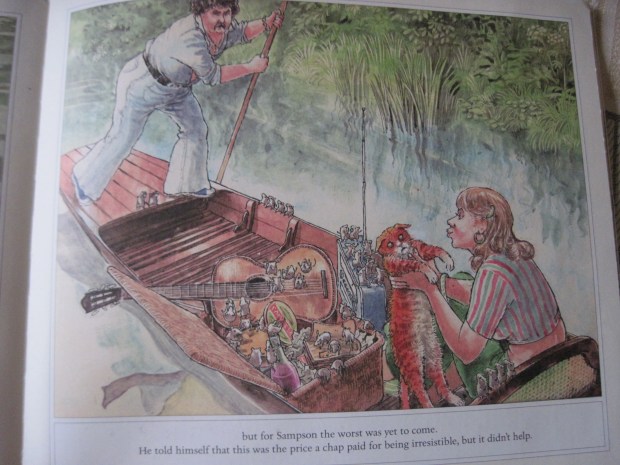
I loved the illustrations (the 1970s clothing on the few human characters cracked me up!) and the plot, a good mixture of humor and mild peril. There’s a fair number of words on each page, yet not too many. I can see this being ideal to read aloud with young children before having them take over the reading at age 5 or 6. I look forward to experiencing more of the church mice’s adventures. My thanks to Margaret of From Pyrenees to Pennines for recommending this charming series. [Public library] 
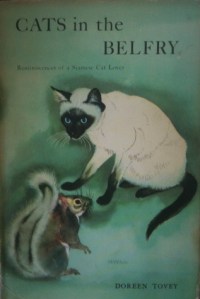
Cats in the Belfry by Doreen Tovey
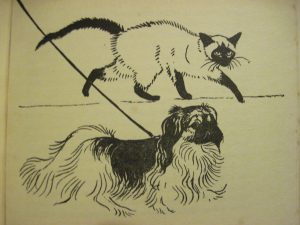
Solomon stalking a neighbor dog.
Do you think your cat is noisy and troublesome? Be thankful you don’t have Doreen Tovey’s Siamese cats! This 1957 book was the first of her many cat-themed memoirs and is perfectly delightful for any animal lover. Their first Siamese was Sugieh, who loved nothing more than to jump into a full bath and frighten the life out of the bather. They bred her and kept two of the littermates, Solomon and Sheba, a mischievous pair whose first three years of antics fill much of the book: terrorizing dogs, pulling down the curtains, following horses, and developing, er, ‘refined’ tastes – “What with spiders, string, and the occasional butterfly caught napping on a cabbage which he ate wings and all, Solomon was, of course, frequently sick. But never, ever, was he so gloriously sick as the day he ate the cream cakes.” [Charity shop]
Up next:
 I have Thomas McNamee’s The Inner Life of Cats (coming out on March 28th) and Jason Hazeley’s The Fireside Grown-Up Guide to the Cat (coming out on April 4th) on my e-readers.
- I’m sure to borrow more books from the public library by Tovey and Bradshaw, who has a book about training your cat (ha!).
- I covet I Could Pee on This, Too: And More Poems by More Cats by Francesco Marciuliano.
Whether you consider yourself a cat lover or not, do any of these books appeal?
In the Past Week…
It truly felt like spring was on the way. Temperatures were in the mid-fifties (I’ve never really gotten to grips with Centigrade) and the daffodils in our back garden were trying their best to join the snowdrops decorating the churchyard in town. I started reading this pair of books to look to the seasons ahead instead of dreading that winter might return in earnest:
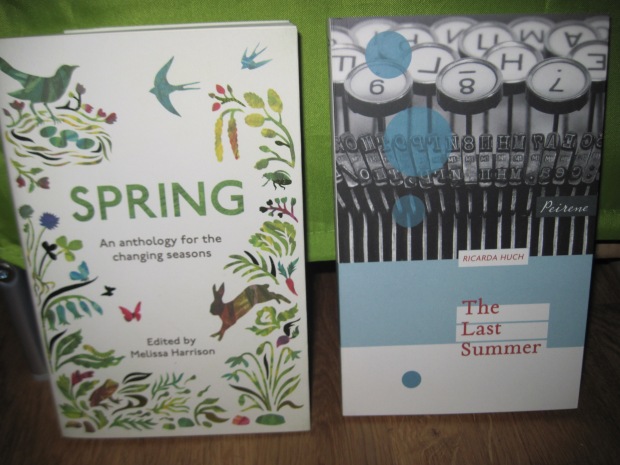
Some lovely things have happened in the past week.
- I’ve delighted from afar as my sister, a widow for just over two years, precipitously falls in love with a pastor she met through a dating website.
- I had my second yoga class and, after the one other participant had to leave early, got what was essentially a private lesson. Many of the poses feel right at the edge of what my flexibility and balance will allow, which is surely a sign that the exercise is doing me good.
- (This one’s not so much lovely as annoying yet amusing.) The cat, already a connoisseur of cereal milk, discovered the illicit pleasure of melted butter in a dish we unthinkingly left on the counter, and now will not rest in his search for it. This is bad news as he’s already quite the butterball. He’s also ramped up his efforts to access all of the house’s secret spaces, including the airing cupboard, the under-stairs cupboard, and the crawlspace under the bath. [Stay tuned for tomorrow’s mini-reviews of yet more cat books, including one about some very mischievous Siamese cats.]
- On Friday I got an e-mail out of the blue asking me to review a book for the Times Literary Supplement. It was October 2015 when I first wrote for them, but that ended poorly: they ran out space in the magazine for my review and paid me a “kill fee” instead, but it made me doubt myself – was that code for them not thinking my writing was good enough to publish? So hearing back from them five months after I’d last gotten in touch asking for work was a great surprise. And I get to read History of Wolves, which I’ve heard marvelous things about.
- We went to a brilliant gig by folk artists Phillip Henry and Hannah Martin in a hole-in-the-wall venue 10 minutes from our house. It was doubtless the first time I’d seen beatboxing and a classical Indian sitar/guitar used in folk music, and Henry’s harmonica skills were literally unbelievable. You had to have been there. I was impressed anew at how folk, arising as it does from liberal working-class traditions, is unafraid to tackle social issues. They had songs about his cotton mill-working grandfather, the war in Syria, immigration, and a detention center in the Midlands. My favorite, though, was “Landlocked,” about a real woman from the eighteenth century who went to sea with her naval husband but ended up right back where she started: selling fish at Exmouth harbor. I loved Martin’s deep, rich voice and the complex interplay of guitar, banjo, pedal steel and fiddle in many of their songs.
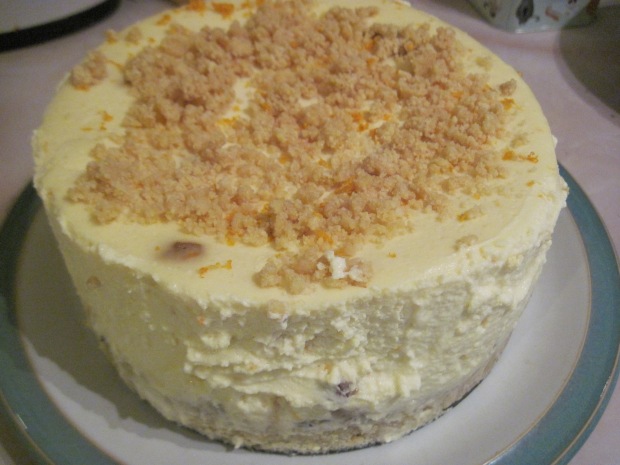
- With one of our leftover jars of homemade mincemeat we made a decadent mincemeat cheesecake from this Nigel Slater recipe. What with the shortbread crust and crumbs and the orange zest in the topping, it was very much like having mince pies – but also cheesecake. Yum.
- This morning we attended a service led by a former archbishop. We knew that George Carey was a parishioner at the Berkshire church we’ve been frequenting since December, but hadn’t seen him at the pulpit yet. He’s one of various retired and lay clergy who have been filling in while the church seeks to appoint a new vicar. Carey gave a damn fine sermon (I guess he’s had plenty of practice) on the enormous topic of why bad things happen to good people, refuting the prosperity gospel and telling the tragically fascinating story behind the hymn “It Is Well with My Soul.”
And, of course, I’ve been reading some brilliant books. This week’s ongoing reading has included three terrific novels: Homegoing by Yaa Gyasi, Spaceman of Bohemia by Jaroslav Kalfař, and Narcissism for Beginners by Martine McDonagh.
How was your week – in terms of reading and otherwise?
The Doll’s Alphabet: Stories by Camilla Grudova
Camilla Grudova lives in Toronto and has a degree in Art History and Germany from McGill University of Montreal. The Doll’s Alphabet, her debut collection, sets surreal tales of women’s inner lives against ruined cityscapes. These 13 stories are like perverted fairytales or fragmentary nightmares, full of strange recurring imagery and hazily dystopian setups. Flash fiction-length stories alternate with longer ones that move at a dizzying pace, and the book is roughly half third-person and half first-person – a balance I always appreciate.
 “Unstitching,” the two-page opener, introduces the metaphors and gender politics that form the backdrop for Grudova’s odd imagination. One day Greta realizes she can unstitch herself, removing an outer covering to reveal her true identity; “It brought great relief … like undoing one’s brassiere before bedtime or relieving one’s bladder after a long trip.” Her neighbor Maria does the same, but men – including Greta’s husband – find this intimidating, and are jealous because they don’t seem to have a deeper self to uncover. I was tickled by the idea of women having a secret life unshared by men, but had trouble grasping the actual mechanics of the unstitching: “She did not so much resemble a sewing machine as she was the ideal form on which a sewing machine was based. The closest thing she resembled in nature was an ant.” Huh? This is a case where keeping things vague might have been a better strategy.
Sewing machines keep popping up, along with mermaids, dolls, babies, zoos, factories, and old-fashioned or derelict shops. For example, the narrator of “The Mouse Queen” is a clerk in a doll’s house shop, while her husband Peter works in a graveyard. One night he brings home the corpse of an old dwarf woman, which the narrator decides to stow in the abandoned grocery store under their apartment. Um, naturally.
In “Waxy” (full text available on the Granta website) the narrator works at a sewing machine factory and unlawfully acquires a baby by her sub-par Man, Paul. The sexual violence in this one and in “Moth Emporium” is deeply unsettling: even in these off-kilter fictional worlds women’s bodies are considered a threat and pregnancy is never innocuous.
My two favorites were “Agata’s Machine” (full text available at The White Review) and “Notes from a Spider.” The former is perhaps indebted to D.H. Lawrence’s “The Rocking-Horse Winner” in its picture of obsessive and ultimately self-destructive activity. It features two Eastern European eleven-year-olds: the narrator is bullied, while her friend Agata is an aloof genius. In her attic room Agata keeps what looks like a sewing machine, but pushing its treadle creates flickering images of Pierrot (a clown) or an angel. This one has a chilling ending. The last story, “Notes from a Spider,” is told by a half-man, half-spider with eight legs. He keeps a zoo for vermin and opens – what else? – a sewing machine museum.
I’ve discovered that I have limited tolerance for outlandish tales like these. I’d be intrigued to find one of Grudova’s stories in an anthology, and I might be happy to read the best four or five of these. But because the same images and concepts keep repeating, the book feels twice as long as it needs to be. Ultimately this book was not for me, but I would not hesitate to recommend it to you if you have enjoyed the more fantastical of the feminist short stories by Karen Russell, Alexandra Kleeman and Helen Simpson.
The Doll’s Alphabet was published on February 14th by Fitzcarraldo Editions. With thanks to publicist Nicolette Praça for the review copy.
My rating:
London-based publisher Fitzcarraldo Editions produces elegantly simple volumes of long-form essays and niche contemporary fiction, with much of the latter appearing in English translation for the first time. I’ve enjoyed a number of Fitzcarraldo books – particularly On Immunity by Eula Biss, The Hatred of Poetry by Ben Lerner, and Second-Hand Time by Svetlana Alexievich – and even when the topics don’t hold any particular interest for me (as was the case with Football by Jean-Philippe Toussaint and Pretentiousness by Dan Fox), they are still thought-provoking, out-of-the-ordinary discourses on the topic at hand.

Coming up next from Fitzcarraldo (March 22nd) is French author Mathias Enard’s novel Compass, which won the 2015 Prix Goncourt. On one sleepless night in Vienna Franz Ritter, an ailing musicologist, entertains memories of travels in the Middle East and his unrequited love for Sarah. Here’s part of the first run-on paragraph as a preview of the hypnotic style:
We are two opium smokers each in his own cloud, seeing nothing outside, alone, never understanding each other we smoke, faces agonizing in a mirror, we are a frozen image to which time gives the illusion of movement, a snow crystal gliding over a ball of frost, the complexity of whose intertwinings no one can see, I am that drop of water condensed on the window of my living room, a rolling liquid pearl that knows nothing of the vapour that engendered it, nor of the atoms that still compose it but that, soon, will serve other molecules, other bodies, the clouds weighing heavy over Vienna tonight: over whose nape will this water stream, against what skin, on what pavement, towards what river, and this indistinct face on the glass is mine only for an instant, one of the millions of possible configurations of illusion …
Review: Darke by Rick Gekoski
Dr. James Darke, the narrator of rare-book dealer Rick Gekoski’s debut novel, is of the same lineage as titular antiheroes like Hendrik Groen and Fredrik Backman’s Ove, or J. Mendelssohn, protagonist of the title novella in Colum McCann’s Thirteen Ways of Looking: an aging widower and curmudgeon with an unforgettable voice.
As Darke begins, this retired English teacher is literally sealing himself off from the world. He hires a handyman to take out the door’s built-in letterbox, change the locks and install a high-tech peephole; he has all his mail redirected to an old colleague, George; he changes his e-mail address; and he compiles a thorough list of service providers who will come to him – everything from grocery deliveries to a doctor. Now, with any luck, he won’t need to set foot outside his London home while he writes this “coming-of-old-age book.”
 For eight months Darke stays in self-imposed exile, his solitude broken only by visits from Bronya, a Bulgarian cleaner who engages him in discussions of his beloved Dickens. Although he’s only sixty-something, Darke sounds like a much older man, complaining of constipation and vision problems and launching a vendetta against the annoying neighbor dog. Ignoring the pile of adamant letters George guiltily delivers on behalf of Darke’s daughter, Lucy, he keeps up his very particular habits and rituals (I loved the steps of making coffee with an espresso-maker) and gives himself over to memories of life with Suzy.
The novel is tripartite: In Part I we meet Darke and get accustomed to his angry, hypercritical voice. In Part II we descend into a no-holds-barred account of his wife Suzy’s death from lung cancer. She’s another wonderful character: pessimistic, ungraceful and utterly foul-mouthed. Here Darke unleashes the full extent of his bitterness. He mocks the approach, advocated by Joan Didion (“that poor Joan D’Idiot,” he calls her!), of turning to sages of the past for comfort, instead insisting that literature – including W.B. Yeats, T.S. Eliot and all the rest – was of no use to him in the face of his wife’s impending death:
We don’t have God, so we have literature, with its associated proverbs and allegories, its received wisdom. We quote and genuflect and defer and pay homage, as if in a holy sanctuary. But just as God failed us, so too will reading. We will turn against it as certainly, and rightly, as we did against Him. Nobody, and nothing, can explain life for us.
Luckily, Part III is something of a reprieve, as Darke starts to come out of his temporary retreat and resume life. He has a rental car delivered and sets out for Oxford, where he revisits his and Suzy’s old university haunts and hesitantly reopens a connection with Lucy and her young son, Rudy.
Sebastian Barry astutely notes the novel’s debt to Dante, but the component parts of the Divine Comedy are reordered, with the purgatory of the house-bound months broken by the hellish narrative of Suzy’s dying, which is then lifted by Darke’s return to life.
Each section has a different tone and is enjoyable in its own way, but for me there was no getting around the fact that Part I is the most entertaining. I was surprised to read in the Acknowledgments that Gekoski toned down this first dose of Darke considerably, on the advice of his wife and his literary agent; I think he could have hammed him up a fair bit more. Also, Lucy didn’t ring true for me as a character, which detracted from what’s meant to be an alternately volatile and poignant relationship; I preferred Darke’s scenes with Bronya.
In any case, the novel makes great metaphorical use of light and darkness. Not so subtle, maybe, but it works:
witnessing a protracted and horrible death infects the soul, the images implant themselves, root and flourish, you can never look at yourself or others in the innocent light – you are tarnished, uncleanably darkened.
And of course, look to literature and you find nothing but “shitslingers – Kahlil Gibran, Mr Tolstoy, the dreaded Eliot – all of them. Just wandering in the dark with flashlights.”
With lots of memorable scenes and turns of phrase, Darke is a rewarding glance at loss, literature and the sometimes futile search for salvation. It’s inspiring to see Gekoski, an American-born academic and literary critic (he’s been dubbed the Bill Bryson of the book world), turn his hand to fiction at age 71. I knew of him through his nonfiction, including Outside of a Dog: A Bibliomemoir, which I read in 2010, and have also enjoyed a couple of his articles that nicely presage this novel, on the subjects of reading through grief and turning against print books. I hope you’ll give his work a try.
Darke was published in the UK on February 2nd. With thanks to Becca Nice and Jamie Norman of Canongate for the free copy for review.
My rating:
Six “Love” Books for Valentine’s Day
Starting in mid-January I began surveying my shelves, library stack and Kindle for books with “love” in the title. Here are the six I had time to try; I didn’t get to Alain de Botton’s The Course of Love on my Kindle, nor my paperback copies of Iris Murdoch’s The Sacred and Profane Love Machine and Nancy Horan’s Loving Frank.
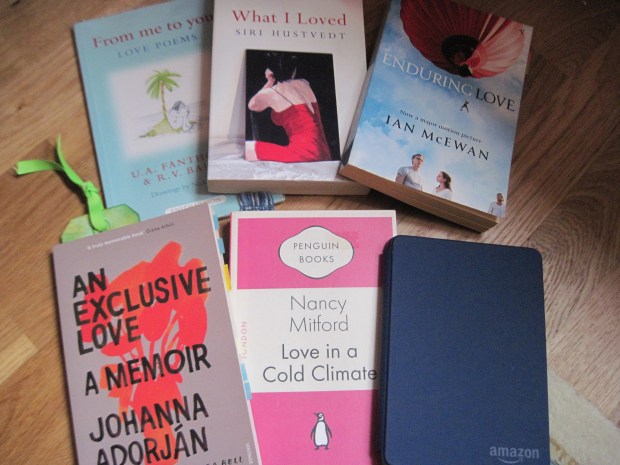
You’ll notice that a number of the books I’ve read aren’t that optimistic about love; in several cases the use of the word in the title even seems to be ironic. As Lady Montdore exclaims in Love in a Cold Climate, “Love indeed – whoever invented love ought to be shot.” So I can’t offer them as particularly romantic choices. But let’s start positively, with some pleasantly out-of-the-ordinary love poems.
From Me to You: Love Poems, U.A. Fanthorpe and R.V. Bailey
 Ursula Fanthorpe and Rosie Bailey met as English teachers at the same Cheltenham school in their late twenties and were partners for nearly 40 years. None of the poems in this short volume are attributed, though I recognized a few from Fanthorpe’s Collected Poems. They’re not particularly distinguished as poetry, but I appreciated the simple, unsentimental examples of what makes up everyday life with a partner: “There is a kind of love called maintenance, / Which stores the WD40 and knows when to use it; // Which checks the insurance, and doesn’t forget / The milkman” (“Atlas”) and “I’m working on a meal you haven’t had to imagine, / A house cleaned to the rafters” (“Dear Valentine”). [Public library]
What I Loved, Siri Hustvedt
 This 2003 novel could just as well have been titled “What I Lost,” which might be truer to its elegiac tone. Narrated by Professor Leo Hertzberg and set between the 1970s and 1990s, it’s about two New York City couples – academics and artists – and the losses they suffer over the years. With themes of modern art, perspective, memory, separation and varieties of mental illness, it asks to what extent we can ever know other people or use replacements to fill the gaps left by who and what is missing. Read it if you’ve enjoyed The Suicide of Claire Bishop by Carmiel Banasky, other books by Siri Hustvedt, or anything by Howard Norman. My favorite lines about love were “I often thought of our marriage as one long conversation” and “love thrives on a certain kind of distance … it requires an awed separateness to continue.” [Charity shop]
Love in a Cold Climate, Nancy Mitford
 I didn’t realize this 1949 novel is a sequel to The Pursuit of Love, so it took a while to figure out who all the characters were. Fanny Logan is a cousin orbiting around Lord and Lady Montdore and their daughter Polly Hampton, all recently returned from some years in India. Fanny marries an Oxford don, while Polly shocks everyone by eloping with her uncle by marriage, “Boy” Dougdale, a recent widower once known as the “Lecherous Lecturer” for interfering with little girls. (This hint of pedophilia is carelessly tossed off in a way no writer would get away with today.) Meanwhile, the heir to the Hampton estate, an effeminate chap named Cedric, comes over from Canada for a visit and wins Lady Montdore over. This amusing picture of aristocratic life in the 1930s marvels at who we love and why. [Bookbarn International]
Enduring Love, Ian McEwan
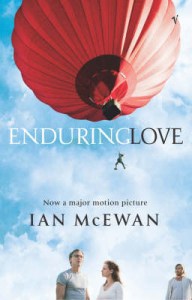 Interesting to consider this as a precursor to Saturday: both have a scientist as the protagonist and get progressively darker through a slightly contrived stalker plot. Enduring Love opens, famously, with a ballooning accident that leaves its witnesses questioning whether they couldn’t have done more to prevent it. Freelance science journalist Joe Rose – on a picnic with his partner, Keats scholar Clarissa, at the time – was one of those who rushed to help, as was Jed Parry, a young Christian zealot who fixates on Joe. He seems to think that by loving Joe, a committed atheist, he can bring him to God. In turn, Joe’s obsession with Jed’s harassment campaign drives Clarissa away. It’s a deliciously creepy read that contrasts rationality with religion and inquires into what types of love are built to last. [Charity shop]
An Exclusive Love: A Memoir, Johanna Adorján
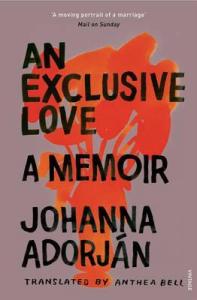 The author’s grandparents, Hungarian Holocaust survivors who moved to Denmark as refugees, committed suicide together on October 13, 1991. Her grandfather, an orthopedic surgeon who had been in an Austrian concentration camp, was terminally ill and his wife was determined not to live a day without him. This short, elegant memoir alternates Adorján’s imagined reconstruction of her grandparents’ last day with an account of their life together, drawn from family memories and interviews with those who knew them. She wonders whether, like Primo Levi and Arthur Koestler, theirs was a typically Jewish failure to fit in wherever they went, and/or a particularly Hungarian melancholy. “The answer is their great love,” the newspaper report of their death insisted. [Waterstones clearance]
Note: That striking cover is by Leanne Shapton.
And another nonfiction selection that I didn’t make it all the way through:
A Book about Love, Jonah Lehrer
 (Abandoned at 31%.) Although I can see why he starts where he does, Lehrer’s early focus on attachment and attunement – two psychological theories of how babies learn to relate affectionately to others – means the book gets bogged down in studies performed on mice and/or children and feels more like a parenting book than anything else. (If that’s what you’re after, read All Joy and No Fun.) A glance at the table of contents suggests the rest of the book will go into marriage, divorce and how love changes over time, but I couldn’t be bothered to stick around. That said, Lehrer’s popular science writing is clear and engaging, and with the heartfelt mea culpa at the start of this book I couldn’t hold a grudge about his earlier plagiarism scandal. [Kindle book from NetGalley.]
No overtly heartwarming love stories in that selection, then, but are there any you fancy reading anyway? Have you read any “love” titles recently?
See also: The Guardian’s list of Top 10 Authentic Romances.
Review & Giveaway: Hame by Annalena McAfee
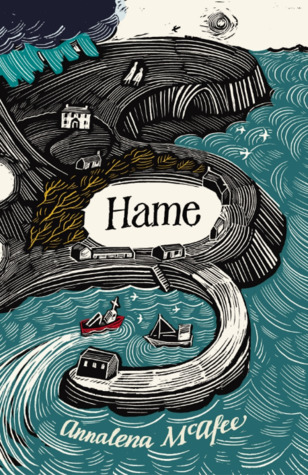 As I mentioned on Tuesday, I previously knew of Annalena McAfee only as Mrs. Ian McEwan, though she has a distinguished literary background: she founded the Guardian Review and edited it for six years, was Arts and Literary Editor of the Financial Times, and is the author of multiple children’s books and one previous novel for adults, The Spoiler (2011).
Well, anyone who reads Hame will be saying “Ian who?” as this is on such a grand scale compared to anything McEwan has ever attempted. The subtitle, “The Fascaray Archives,” gives an idea of how thorough McAfee means to be: the life of fictional poet Grigor McWatt is her way into everything that forms the Scottish identity. Her invented island of Fascaray is a carefully constructed microcosm of Scotland from ancient times to today. I loved the little glimpses of recent history, like the referendum on independence and a Donald Trump figure, billionaire “Archie Tupper,” bulldozing an environmentally sensitive area to build his new golf course (this really happened, in Aberdeenshire in 2012).
Narrator Mhairi McPhail arrives on Fascaray in August 2014, her nine-year-old daughter Agnes in tow. She’s here to oversee the opening of a new museum, edit a seven-volume edition of McWatt’s magnum opus, The Fascaray Compendium (a 70-year journal detailing the island’s history, language, flora, fauna and customs), and complete a critical biography of the poet. Over the next four months she often questions the feasibility of her multi-strand project. She also frets about her split from Marco, whom she left back in New York City after their separate infidelities. And her rootlessness – she’s Canadian via Scotland but has spent a lot of time in the States, giving her a mixed-up heritage and accent – is a constant niggle.
Mhairi’s narrative sections share space with excerpts from her biography of McWatt and extracts from McWatt’s own writing: The Fascaray Compendium, newspaper columns, letters to on-again, off-again lover Lilias Hogg, and Scots translations of famous poets from Blake to Yeats. We learn of key events from the island’s history through Mhairi’s biography and McWatt’s prose, including ongoing tension between lairds and crofters, Finnverinnity House being used as a Special Ops training school during World War II, a lifeboat lost in a gale in the 1970s, and the way the fishing industry is now ceding to hydroelectric power.
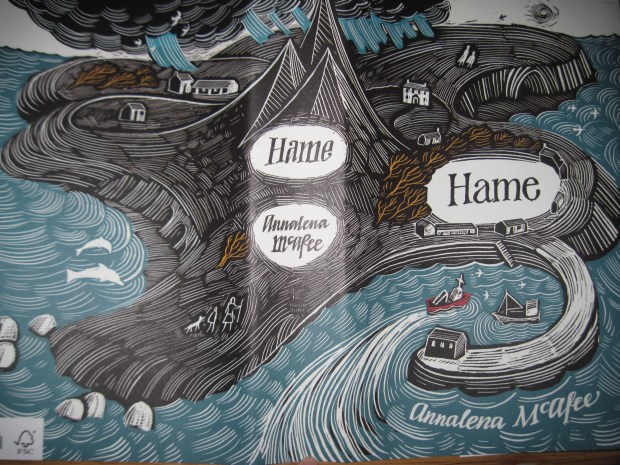
The balance between the alternating elements isn’t quite right – sections from Mhairi’s contemporary diary seem to get shorter as the novel goes along, such that it feels like there’s not enough narrative to anchor the book. Faced with yet more Scots poetry and vocabulary lists, or passages from Mhairi’s dry biography, it’s mighty tempting to skim.
That’s a shame, as the novel contains some truly lovely writing, particularly in McWatt’s nature observations:
In July and August, on rare days of startling and sustained heat, dragonflies as blue as the cloudless skies shimmer over cushions of moss by the burn while the midges, who abhor direct sunlight, are nowhere to be seen. Out to sea, somnolent groups of whales pass like cortèges of cruise ships and around them dolphins and porpoises joyously arc and dip as if stitching the ocean’s silken canopy of turquoise, gentian and cobalt.
For centuries male Fascaradians have sailed in the autumn, at the time of the ripe barley and the fruiting buckthorn, to hunt the plump young solan geese or gannets – the guga – near their nesting sites on the uninhabited rock pinnacles of Plodda and Grodda. No true Fascaradian can suffer vertigo since the scaling of these granite towers is done without the aid of mountaineers’ crampons or picks.
“Hame” means home in Scots – like in McWatt’s claim to fame, the folk-pop song “Hame tae Fascaray” – and themes of home and identity are strong here. The novel asks to what extent identity is bound up with a particular country and language, and whether we can craft our own selves. Must the place you come from always be the same as the home you choose? I could relate to Mhairi’s feeling that there’s nowhere she belongs, whether she’s in the bustle of New York or “marooned on a patch of damp peat floating in the North Sea.”
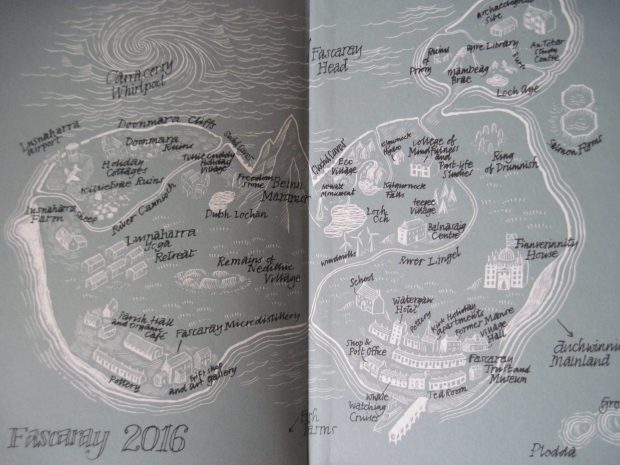
A map of the island from the inside of the back cover.
Although the blend of elements initially made me think that this would resemble A.S. Byatt’s Possession, it’s actually more like Rachel Cantor’s Good on Paper, which similarly stars a scholar who’s a single parent to a precocious daughter. In places I was also reminded of the work of Scarlett Thomas, Sara Maitland and Sarah Moss, and there’s even an echo of Robert Macfarlane’s Landmarks in the inventories of dialect words.
If you’ve done much traveling in Scotland, an added pleasure of the novel is trying to spot places you’ve been. (I thought I could see traces of Stromness, Orkney; indeed, McWatt reminded me most of Orcadian poet George Mackay Brown.) The comprehensive, archival approach didn’t completely win me over, but I was impressed by the book’s scope and its affectionate portrait of a beloved country. McAfee is of Scots-Irish parentage herself, and you can tell this is a true labor of love, and a cogent tribute.
Hame was published by Harvill Secker on February 9th. With thanks to Anna Redman for sending a free copy for review.
My rating:
Giveaway Announcement!
I was accidentally sent two copies of Hame, so I am giving one away to a reader. Alas, this giveaway will have to be UK-only – the book is a hardback of nearly 600 pages, so would be prohibitively expensive to send abroad.
If you’re interested in winning a copy, simply leave a comment to that effect below. The competition will be open through the end of Friday the 17th and I will choose a winner at random on Saturday the 18th, to be announced via the comments and a personal e-mail.
Good luck!
Literary Power Couples: An Inventory
With Valentine’s Day on the way, I’ve been reading a bunch of books with “Love” in the title to round up in a mini-reviews post next week. One of them was What I Loved by Siri Hustvedt – my second taste of her brilliant fiction after The Blazing World. Yet I’ve not tried a one of her husband Paul Auster’s books. There’s no particular reason for that; I’ve even had his New York Trilogy out from the library in the past, but never got around to reading it.
How about some other literary power couples? Here’s some that came to mind, along with an inventory of what I’ve read from each half. It’s pretty even for the first two couples, but in most of the other cases there’s a clear winner.
Zadie Smith: 5
Nick Laird: 5 (= ALL)
Zadie Smith in 2011. By David Shankbone (CC BY 3.0 (http://creativecommons.org/licenses/by/3.0) via Wikimedia Commons.
I’ve read all of Zadie Smith’s work apart from NW; I only got a few pages into it when it first came out, but I’m determined to try again someday. To my surprise, I’ve read everything her husband Nick Laird has ever published, which includes three poetry collections and two fairly undistinguished ‘lad lit’ novels. I’m pleased to see that his new novel Modern Gods, coming out on June 27th, is about two sisters and looks like a stab at proper literary fiction.
Jonathan Safran Foer: 4 (= ALL)
Nicole Krauss: 3 (= ALL)
Alas, they’re now an ex-couple. In any case, they’re both on the fairly short list of authors I’d read anything by. Foer has published three novels and the nonfiction polemic Eating Animals. Krauss, too, has three novels to her name, but a new one is long overdue after the slight disappointment of 2010’s Great House.
Margaret Drabble: 5
Michael Holroyd: 0
Michael Holroyd is a biographer and general nonfiction dabbler. I have a few of his books on my TBR but don’t feel much compulsion to seek them out. By contrast, I’ve read four novels and a memoir by Margaret Drabble and am likely to devour more of her fiction in the future.

Margaret Drabble in 2011. By summonedbyfells [CC BY 2.0 (http://creativecommons.org/licenses/by/2.0)%5D via Wikimedia Commons.
Claire Tomalin: 2
Michael Frayn: 1
Claire Tomalin’s masterful biographies of Charles Dickens and Thomas Hardy are pillars of my nonfiction collection, and I have her books on Nelly Ternan and Samuel Pepys on the shelf to read as well. From her husband, celebrated playwright Michael Frayn, however, I’ve only read the comic novel Skios. It is very funny indeed, though, about a case of mistaken identity at an academic conference on a Greek island.
Plus a few I only recently found out about:
Ian McEwan: 7 (+ an 8th in progress)
Annalena McAfee: 1 (I’ll be reviewing her novel Hame here on Thursday)
Katie Kitamura: 1 (I just finished A Separation yesterday)
Hari Kunzru: 0
Madeleine Thien: 1 (Do Not Say We Have Nothing)
Rawi Hage: 0
Afterwards I consulted the lists of literary power couples on Flavorwire and The Huffington Post and came up with a few more that had slipped my mind:
Michael Chabon: 1
Ayelet Waldman: 0
I loved Moonglow and am keen to try Michael Chabon’s other novels, but I also have a couple of his wife Ayelet Waldman’s books on my TBR.
Dave Eggers: 5
Vendela Vida: 0
I’ve read a decent proportion of Dave Eggers’s books, fiction and nonfiction, but don’t know anything by his wife and The Believer co-founder Vendela Vida.
David Foster Wallace: 2
Mary Karr: 1
I didn’t even know they were briefly a couple. From Wallace I’ve read the essay collection Consider the Lobster and the commencement address This Is Water. I’ve definitely got to get hold of Karr’s memoirs, having so far only read her book about memoir (The Art of Memoir).
And some classics:
Ted Hughes: 1 (Crow)
Sylvia Plath: 0
F. Scott Fitzgerald: 2 (The Great Gatsby and Tender Is the Night)
Zelda Fitzgerald: 0
![F. Scott and Zelda Fitzgerald in 1921. By Kenneth Melvin Wright (Minnesota Historical Society) [Public domain], via Wikimedia Commons.](https://bookishbeck.com/wp-content/uploads/2017/02/f_scott_fitzgerald_and_wife_zelda_september_1921.jpg?w=208&h=300)
F. Scott and Zelda Fitzgerald in 1921. By Kenneth Melvin Wright (Minnesota Historical Society) [Public domain], via Wikimedia Commons.
How have you fared with these or other literary power couples? Do you generally gravitate towards one or the other from a pair?
 Bookish Beck = Rebecca Foster. American transplant to England. Freelance proofreader and book reviewer.
