Library Checkout, May 2021
Another big library reading month for me as I scrambled to get through the books that were reserved after me and then wrangle the remaining pile under some semblance of control before heading back to the USA for my mother’s wedding. I’ve also suspended any holds that look like they might arrive imminently – the first time I’ve taken advantage of this option. Once I’m back I’m sure I’ll quickly build up another goodly stack to last me through the summer.

I give links to reviews of books I haven’t already featured here, as well as ratings for most reads and skims. I would be delighted to have other bloggers – not just book bloggers – join in with this meme. Feel free to use the image above and leave a link to your blog in the comments if you’ve taken part in Library Checkout (on the last Monday of each month), or tag me on Twitter and Instagram: @bookishbeck / #TheLibraryCheckout & #LoveYourLibraries.
READ
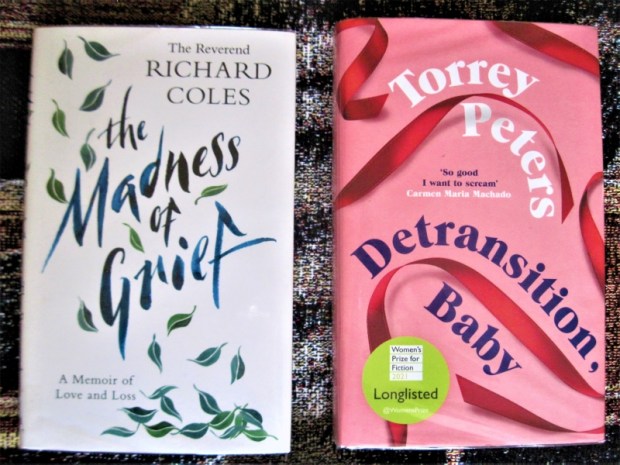
- The Madness of Grief: A Memoir of Love and Loss by Reverend Richard Coles

- Ten Days by Austin Duffy

- Featherhood: On Birds and Fathers by Charlie Gilmour

- Deep Water by Patricia Highsmith
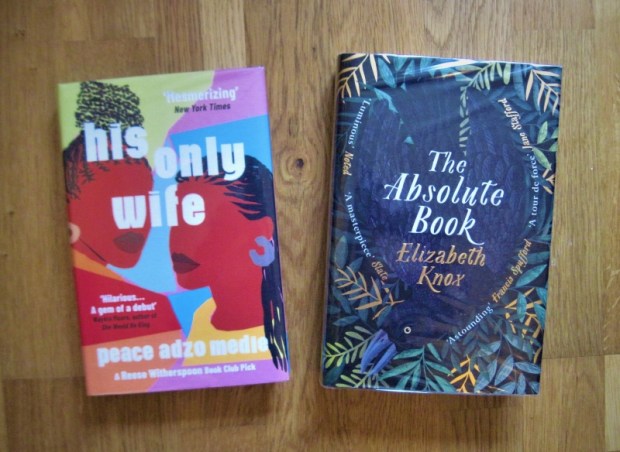
- The Absolute Book by Elizabeth Knox

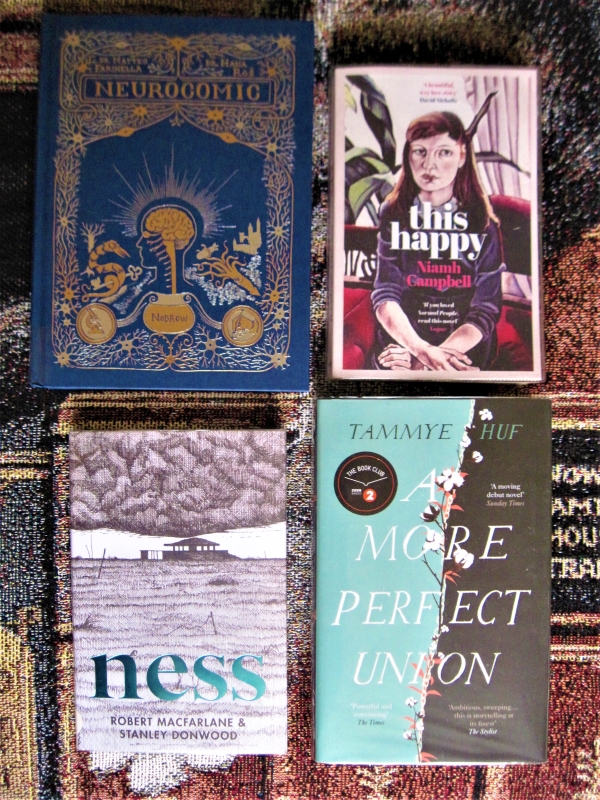
- Ness by Robert Macfarlane and Stanley Donwood

- The Lonely Passion of Judith Hearne by Brian Moore
- The Pleasure Steamers by Andrew Motion

- You’re Not Listening: What You’re Missing and Why It Matters by Kate Murphy
- Open Water by Caleb Azumah Nelson
- Woods etc. by Alice Oswald
- Detransition, Baby by Torrey Peters
- Neurocomic by Dr. Matteo Farinella (illustrations) and Dr. Hana Roš
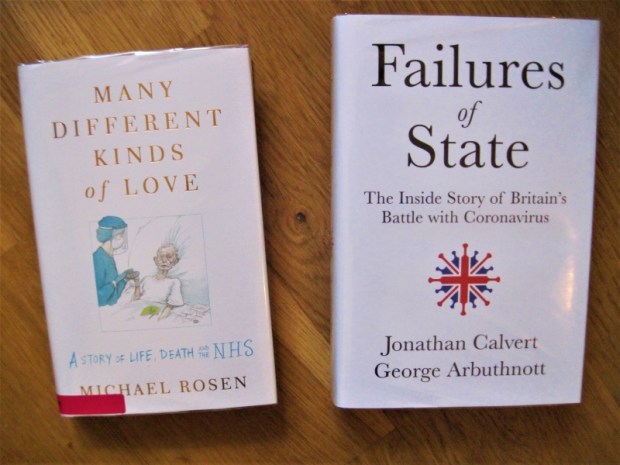
- Many Different Kinds of Love: A Story of Life, Death and the NHS by Michael Rosen
- When We Went Wild by Isabella Tree and Allira Tee (a children’s picture book; doesn’t count towards my year total)
SKIMMED
- After: A Doctor Explores What Near-Death Experiences Reveal about Life and Beyond by Bruce Greyson
- The Ministry of Bodies: Life and Death in a Modern Hospital by Seamus O’Mahony
CURRENTLY READING
- Blue Dog by Louis de Bernières
- Becoming a Man: Half a Life Story by Paul Monette [set aside temporarily]
CHECKED OUT, TO BE READ
- Under the Blue by Oana Aristide
- Summer Story and Autumn Story by Jill Barklem
- This Happy by Niamh Campbell
- The Pure Gold Baby by Margaret Drabble
- Lakewood by Megan Giddings
- The Master Bedroom by Tessa Hadley
- A More Perfect Union by Tammye Huf
- The Rome Plague Diaries: Lockdown Life in the Eternal City by Matthew Kneale
- His Only Wife by Peace Adzo Medie
- Dreamland by Rosa Rankin-Gee
- How to Be Sad: Everything I’ve Learned about Getting Happier, by Being Sad, Better by Helen Russell
- Earthed: A Memoir by Rebecca Schiller
- The Color Purple by Alice Walker (to reread)
IN THE RESERVATION QUEUE
- Who Is Maud Dixon? by Alexandra Andrews
- Misplaced Persons by Susan Beale
- Civilisations by Laurent Binet
- Medusa’s Ankles: Selected Stories by A.S. Byatt
- Small Pleasures by Clare Chambers
- Heavy Light: A Journey through Madness, Mania and Healing by Horatio Clare
- Second Place by Rachel Cusk
- Darwin’s Dragons by Lindsay Galvin
- Early Morning Riser by Katherine Heiny
- The Premonition: A Pandemic Story by Michael Lewis
- Nothing but Blue Sky by Kathleen MacMahon
- Circus of Wonders by Elizabeth Macneal
- Demystifying the Female Brain by Sarah McKay
- When the Stars Go Dark by Paula McLain
- Elegy for a River: Whiskers, Claws and Conservation’s Last, Wild Hope by Tom Moorhouse
- Acts of Desperation by Megan Nolan
- Heartstoppers, Volume 1 by Alice Oseman
- Joe Biden: American Dreamer by Evan Osnos
- The Dig by John Preston
- My Phantoms by Gwendoline Riley
- I Belong Here: A Journey along the Backbone of Britain by Anita Sethi
- Great Circle by Maggie Shipstead
- Broke Vegan: Over 100 Plant-Based Recipes that Don’t Cost the Earth by Saskia Sidey
- Still Life by Sarah Winman
- The Hidden Life of Trees by Peter Wohlleben
RETURNED UNFINISHED
- You Exist Too Much by Zaina Arafat
- The Last Migration by Charlotte McConaghy – I read the first 22 pages. The plot felt very similar to Ankomst and I didn’t get drawn in by the prose, but this has been a huge word-of-mouth hit among my Goodreads friends. I’ll try it again another time.
- Hot Stew by Fiona Mozley
RETURNED UNREAD
- Failures of State: The Inside Story of Britain’s Battle with Coronavirus by Jonathan Calvert and George Arbuthnott – I think I’m finally tiring of Covid stories.
- Life Support: Diary of an ICU Doctor on the Frontline of the COVID Crisis by Jim Down – Ditto, though having now seen him at a Hay Festival event I might give this a try another time.
- Life Sentences by Billy O’Callaghan – I can’t even remember how I heard about this or why I put a request on it!
What appeals from my stacks?
20 Books of Summer 2021 (Colour Theme) & Other Reading Plans
It’s my fourth year participating in Cathy’s 20 Books of Summer challenge. Three years ago, I read only books by women; two years ago, I did an animal theme; last year, all my choices were related to food and drink. This year it’s all about colour: the word colour, or one mentioned in a title or in an author’s name, or – if I get really stuck – a particularly vibrant one on a book cover. My options range from short stories to biography, with a couple of novels in translation and a couple of children’s classics to reread on the piles.
As usual, I will prioritize books from my own shelves, but this time I will also allow myself to include library and/or Kindle reads. For instance, I have a hold placed on Nothing but Blue Sky by Kathleen MacMahon, which was on the Women’s Prize longlist.
Here are the initial stacks I’m choosing from:

 One that’s not pictured but that I definitely plan to read and review over the summer is God Is Not a White Man by Chine McDonald, which came out earlier this month.
Tomorrow I’m flying out to the USA as my mother is getting remarried in mid-June. I’m not completely at ease about travelling, especially as on this occasion it has involved expensive private Covid testing and quarantine periods at either end, but I am looking forward to the fun aspects of travel, like downtime in an airport with nothing to do but read. For this purpose, the first two books for my challenge that I’ve packed are the novel Purple Hibiscus by Chimamanda Ngozi Adichie and the short story collection Emerald City by Jennifer Egan.


This week and next, the Hay Festival is taking place. I went nuts and booked myself onto eight different literary talks, three of which have already aired, with two more coming up this evening. Then there will be a few to keep me occupied during my first few days of quarantine next week. It’s a fantastic program and all the online events are free (though you can donate), so do take a look if you haven’t already. I’ll try to write up at least some of these events.

Liz’s Anne Tyler readalong is continuing throughout this year, and I happen to own one novel that’s scheduled for each of the next three months: Saint Maybe for June, A Patchwork Planet for July, and An Amateur Marriage for August. The last two I’ll be rescuing from boxes in my sister’s basement.
I always like reading with the seasons, so this is my summery stack:

I’ll start with Three Junes. Others I will contemplate getting out from the library include Heatstroke by Hazel Barkworth, The Summer before the Dark by Doris Lessing, and August by Callan Wink.
 In mid-June I’m on the blog tour for Mary Jane by Jessica Anya Blau, a novel that’s perfect for the season’s reading – nostalgic for a teen girl’s music-drenched 1970s summer, and reminiscent of Curtis Sittenfeld’s work.
I have also managed to amass a bunch of books about fathers and fatherhood, so I’ll do at least one “Three on a Theme” post to tie in with Father’s Day.
Are you joining in the summer reading challenge? What’s the first book on the docket?
Do you spy any favourites on my piles? Which ones should I be sure to read?
Recommended May Releases: Adichie, Pavey and Unsworth
Three very different works of women’s life writing: heartfelt remarks on bereavement, a seasonal diary of stewarding four wooded acres in Somerset, and a look back at postnatal depression.
Notes on Grief by Chimamanda Ngozi Adichie
This slim hardback is an expanded version of an essay Adichie published in the New Yorker in the wake of her father’s death in June 2020. With her large family split across three continents and coronavirus lockdown precluding in-person get-togethers, they had a habit of frequent video calls. She had seen her father the day before on Zoom and knew he was feeling unwell and in need of rest, but the news of his death still came as a complete shock.
 Adichie anticipates all the unhelpful platitudes people could and did send her way: he lived to a ripe old age (he was 88), he had a full life and was well respected (he was Nigeria’s first statistics professor), he had a mercifully swift end (kidney failure). Her logical mind knows all of these facts, and her writer’s imagination has depicted grief many times. Still, this loss blindsided her.
She’d always been a daddy’s girl, but the anecdotes she tells confirm how special he was: wise and unassuming; a liberal Catholic suspicious of materialism and with a dry humour. I marvelled at one such story: in 2015 he was kidnapped and held in the boot of a car for three days, his captors demanding a ransom from his famous daughter. What did he do? Correct their pronunciation of her name, and contradict them when they said that clearly his children didn’t love him. “Grief has, as one of its many egregious components, the onset of doubt. No, I am not imagining it. Yes, my father truly was lovely.” With her love of fashion, one way she dealt with her grief was by designing T-shirts with her father’s initials and the Igbo words for “her father’s daughter” on them.
I’ve read many a full-length bereavement memoir, and one might think there’s nothing new to say, but Adichie writes with a novelist’s eye for telling details and individual personalities. She has rapidly become one of my favourite authors: I binged on most of her oeuvre last year and now have just one more to read, Purple Hibiscus, which will be one of my 20 Books of Summer. I love her richly evocative prose and compassionate outlook, no matter the subject. At £10, this 85-pager is pricey, but I was lucky to get it free with Waterstones loyalty points.
Favourite lines:
“In the face of this inferno that is sorrow, I am callow and unformed.”
“How is it that the world keeps going, breathing in and out unchanged, while in my soul there is a permanent scattering?”
Deeper Into the Wood by Ruth Pavey
 In 1999 Ruth Pavey bought four acres of scrubland at auction, happy to be returning to her family’s roots in the Somerset Levels and hoping to work alongside nature to restore some of her land to orchard and maintain the rest in good health. Her account of the first two decades of this ongoing project, A Wood of One’s Own, was published in 2017.
In this sequel, she gives peaceful snapshots of the wood throughout 2019, from first snowdrops to final apple pressing, but also faces up to the environmental degradation that is visible even in this pocket of the countryside. “I am sure there has been a falling off in numbers of insects, smaller birds and rabbits on my patch,” she insists. Without baseline data, it is hard to support this intuition, but she has botanical and bird surveys done, and invites an expert in to do a moth-trapping evening. The resulting species lists are included as appendices. In addition, Pavey weaves a backstory for her land. She meets a daffodil breeder, investigates the source of her groundwater, and visits the head gardener at the Bishop’s Palace in Wells, where her American black walnut sapling came from. She also researches the Sugg family, associated with the land (“Sugg’s Orchard” on the deed) from the 1720s.
 Pavey aims to treat this landscape holistically: using sheep to retain open areas instead of mowing the grass, and weighing up the benefits of the non-native species she has planted. She knows her efforts can only achieve so much; the pesticides standard to industrial-scale farming may still be reaching her trees on the wind, though she doesn’t apply them herself. “One sad aspect of worrying about the state of the natural world is that everything starts to look wrong,” she admits. Starting in that year’s abnormally warm January, it was easy for her to assume that the seasons can no longer be relied on.
Compared with her first memoir, this one is marked by its intellectual engagement with the principles and practicalities of rewilding. Clearly, her inner struggle is motivated less by the sense of ownership than by the call of stewardship. While this book is likely be of most interest to those with a local connection or a similar project underway, it offers a universal model of how to mitigate our environmental impact. Pavey’s black-and-white sketches of the flora and fauna on her patch, reminiscent of Quentin Blake, are a highlight.
With thanks to Duckworth for the proof copy for review. The book will be published tomorrow, the 27th of May.
After the Storm: Postnatal Depression and the Utter Weirdness of New Motherhood by Emma Jane Unsworth
The author’s son was born on the day Donald Trump won the U.S. presidential election. Six months later, she realized that she was deep into postnatal depression and finally agreed to get help. The breaking point came when, with her husband* away at a conference, she got frustrated with her son’s constant fussing and pushed him over on the bed. He was absolutely fine, but the guilty what-ifs proliferated, making this a wake-up call for her.
 In this succinct, wry and hard-hitting memoir, Unsworth exposes the conspiracies of silence that lead new mothers to lie and pretend that everything is fine. Since her son’s traumatic birth (which I first read about in Dodo Ink’s Trauma anthology), she hadn’t been able to write and was losing her sense of self. To add insult to injury, her baby had teeth at 16 weeks and bit her as he breastfed. She couldn’t even admit her struggles to her fellow mum friends. But “if a woman is in pain for long enough, and denied sleep for long enough, and at the same time feels as though she has to keep going and put a ‘brave’ face on, she’s going to crack.”
The book’s titled mini-essays give snapshots into the before and after, but particularly the agonizing middle of things. I especially liked the chapter “The Weirdest Thing I’ve Ever Done in a Hotel Room,” in which she writes about borrowing her American editor’s room to pump breastmilk. Therapy, antidepressants and hiring a baby nurse helped her to ease back into her old life and regain some part of the party girl persona she once exuded – enough so that she was willing to give it all another go (her daughter was born late last year).
While Unsworth mostly writes from experience, she also incorporates recent research and makes bold statements of how cultural norms need to change. “You are not monsters,” she writes to depressed mums. “You need more support. … Motherhood is seismic. It cracks open your life, your relationship, your identity, your body. It features the loss, grief and hardship of any big life change.” I can imagine this being hugely helpful to anyone going through PND (see also my Three on a Theme post on the topic), but I’m not a mother and still found plenty to appreciate (especially “We have to smash the dichotomy of mums/non-mums … being maternal has nothing to do with actually physically being a mother”).
I’m attending a Wellcome Collection online event with Unsworth and midwife Leah Hazard (author of Hard Pushed) this evening and look forward to hearing more from both authors.
*It took me no time at all to identify him from the bare facts: Brighton + doctor + graphic novelist = Ian Williams (author of The Lady Doctor)! I had no idea. What a fun connection.
With thanks to Profile Books/Wellcome Collection for the free copy for review.
What recent releases can you recommend?
Three May Graphic Novel Releases: Orwell, In, and Coma
These three terrific graphic novels all have one-word titles and were published on the 13th of May. Outwardly, they are very different: a biography of a famous English writer, the story of an artist looking for authentic connections, and a memoir of a medical crisis that had permanent consequences. The drawing styles are varied as well. But if the books share one thing, it’s an engagement with loneliness: It’s tempting to see the self as being pitted against the world, with illness an additional isolating force, but family, friends and compatriots are there to help us feel less alone and like we are a part of something constructive.
Orwell by Pierre Christin; illustrated by Sébastien Verdier
[Translated from the French by Edward Gauvin]
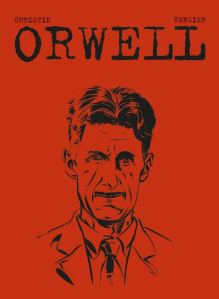 George Orwell was born Eric Blair in Bengal, where his father worked for the colonial government. As a boy, he loved science fiction and knew that he would become a writer. He had an unhappy time at prep school, where he was on reduced fees, and proceeded to Eton and then police training in Burma. Already he felt that “imperialism was an evil thing.” Among this book’s black-and-white panes, the splashes of colour – blood, a British flag – stand out, and guest artists contribute a two-page colour spread each, illustrating scenes from Orwell’s major works. His pen name commemorates a local river and England’s patron saint, marking his preoccupation with the essence of Englishness: something deeper than his hated militarism and capitalism. Even when he tried to ‘go native’ for embedded journalism (Down and Out in Paris and London and The Road to Wigan Pier), his accent marked him out as posh. He was opinionated and set out “rules” for clear writing and the proper making of tea.
The book’s settings range from Spain, where Orwell went to fight in the Civil War, via a bomb shelter in London’s Underground, to the island of Jura, where he retired after the war. I particularly loved the Scottish scenery. I also appreciated the notes on where his life story entered into his fiction (especially in A Clergyman’s Daughter and Keep the Aspidistra Flying). During World War II he joined the Home Guard and contributed to BBC broadcasting alongside T.S. Eliot. He had married Eileen, adopted a baby boy, and set up a smallholding. Even when hospitalized for tuberculosis, he wouldn’t stop typing (or smoking).
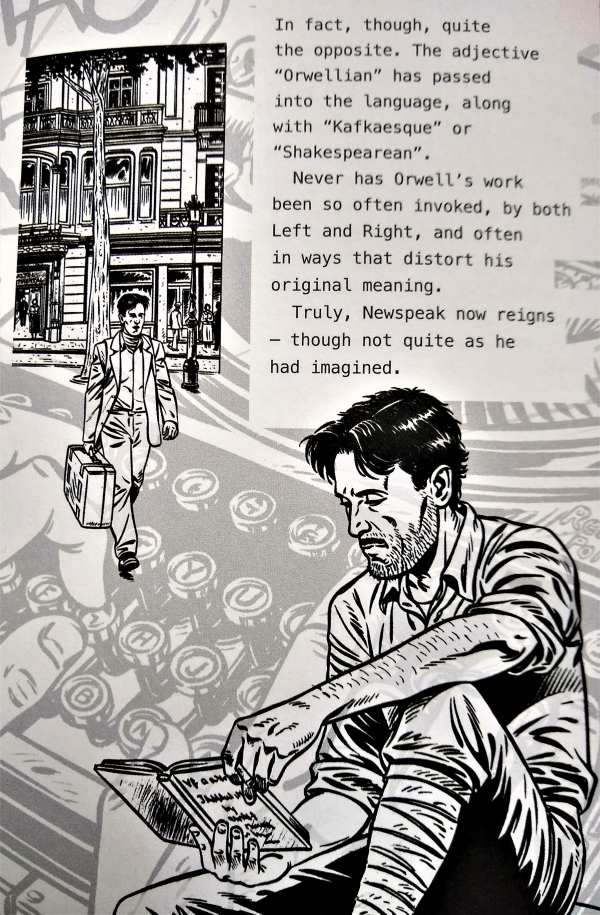 Christin creates just enough scenes to give a sense of the sweep of Orwell’s life, and incorporates plenty of the author’s own words in a typewriter font. He recognizes all the many aspects, sometimes contradictory, of his subject’s life. And in an afterword, he makes a strong case for Orwell’s ideas being more important now than ever before. My knowledge of Orwell’s oeuvre, apart from the ones everyone has read – Animal Farm and 1984 – is limited; luckily this is suited not just to Orwell fans but to devotees of life stories of any kind.
With thanks to SelfMadeHero for the free copy for review.
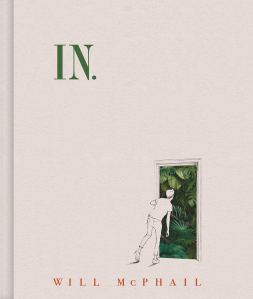
In by Will McPhail
Nick never knows the right thing to say. The bachelor artist’s well-intentioned thoughts remain unvoiced, such that all he can manage is small talk. Whether he’s on a subway train, interacting with his mom and sister, or sitting in a bar with a tongue-in-cheek name (like “Your Friends Have Kids” or “Gentrificchiato”), he’s conscious of being the clichéd guy who’s too clueless or pathetic to make a real connection with another human being. That starts to change when he meets Wren, a Black doctor who instantly sees past all his pretence.
 Like Orwell, In makes strategic use of colour spreads. “Say something that matters,” Nick scolds himself, and on the rare occasions when he does figure out what to say or ask – the magic words that elicit an honest response – it’s as if a new world opens up. These full-colour breakthrough scenes are like dream sequences, filled with symbols such as a waterfall, icy cliff, or half-submerged building with classical façade. Each is heralded by a close-up image on the other person’s eyes: being literally close enough to see their eye colour means being metaphorically close enough to be let in. Nick achieves these moments with everyone from the plumber to his four-year-old nephew.
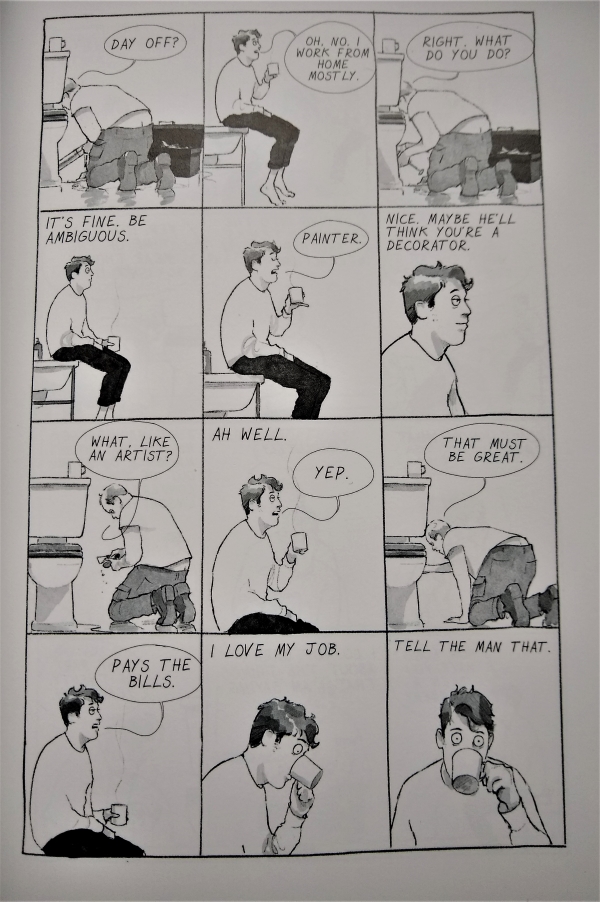
Alternately laugh-out-loud funny and tender, McPhail’s debut novel is as hip as it is genuine. It’s a spot-on picture of modern life in a generic city. I especially loved the few pages when Nick is on a Zoom call with carefully ironed shirt but no trousers and the potential employers on the other end get so lost in their own jargon that they forget he’s there. His banter with Wren or with his sister reveals a lot about these characters, but there’s also an amazing 12-page wordless sequence late on that conveys so much. While I’d recommend this to readers of Alison Bechdel, Craig Thompson, and Chris Ware (and expect it to have a lot in common with Kristen Radtke’s forthcoming Seek You: A Journey through American Loneliness), it’s perfect for those brand new to graphic novels, too – a good old-fashioned story, with all the emotional range of Writers & Lovers. I hope it’ll be a wildcard entry on the Sunday Times Young Writer of the Year Award shortlist.
With thanks to Sceptre for the free copy for review.
Coma by Zara Slattery
In May 2013, Zara Slattery’s life changed forever. What started as a nagging sore throat developed into a potentially deadly infection called necrotising fascitis. She spent 15 days in a medically induced coma and woke up to find that one of her legs had been amputated. As in Orwell and In, colour is used to differentiate different realms. Monochrome sketches in thick crayon illustrate her husband Dan’s diary of the everyday life that kept going while she was in hospital, yet it’s the coma/fantasy pages in vibrant blues, reds and gold that feel more real.
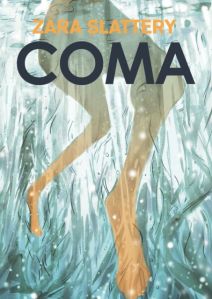 Slattery remembers, or perhaps imagines, being surrounded by nightmarish skulls and menacing animals. She feels accused and guilty, like she has to justify her continued existence. In one moment she’s a puppet; in another she’s in ancient China, her fate being decided for her. Some of the watery landscapes and specific images here happen to echo those in McPhail’s novel: a splash park, a sunken theatre; a statue on a plinth. There’s also a giant that reminded me a lot of one of the monsters in Spirited Away.
Meanwhile, Dan was holding down the fort, completing domestic tasks and reassuring their three children. Relatives came to stay; neighbours brought food, ran errands, and gave him lifts to the hospital. He addresses the diary directly to Zara as a record of the time she spent away from home and acknowledges that he doesn’t know if she’ll come back to them. A final letter from Zara’s nurse reveals how bad off she was, maybe more so than Dan was aware.


This must have been such a distressing time to revisit. In this interview, Slattery talks about the courage it took to read Dan’s diary even years after the fact. I admired how the book’s contrasting drawing styles recreate her locked-in mental state and her family’s weeks of waiting – both parties in limbo, wondering what will come next.
Brighton, where Slattery is based, is a hotspot of the Graphic Medicine movement spearheaded by Ian Williams (author of The Lady Doctor). Regular readers know how much I love health narratives, and with my keenness for graphic novels this series couldn’t be better suited to my interests.
With thanks to Myriad Editions for the free copy for review.
Read any graphic novels recently?
Doorstopper of the Month: The Absolute Book by Elizabeth Knox (2019)
Epic fantasy is far from my usual fare, but this was a book worth getting lost in. The reading experience reminded me of what I had with A Discovery of Witches by Deborah Harkness, The Wind-Up Bird Chronicle by Haruki Murakami, or perhaps Jonathan Strange & Mr. Norrell by Susanna Clarke – though it’s possible this last association was only in my mind because of Dan Kois. You see, we have Kois, an editor at Slate, to thank for this novel being published outside of Knox’s native New Zealand. He wrote an enthusiastic Slate review of an amazing novel he’d found that was only available through a small university press, and Clarke’s novel was his main point of reference. How’s that for the power of a book review?
Taryn Cornick, 33, has adapted her PhD thesis into a popular history of libraries – the search for absolute knowledge; the perennial threats that libraries face, from budget cuts to burnings – that she’s been discussing at literary festivals around the world. One particular burning looms large in her family’s history: the library at her grandfather’s country estate near the border of England and Wales, Princes Gate. As girls, Taryn and her older sister, Beatrice, helped to raise the alarm and saved the bulk of their grandfather’s collection. But one key artifact has been missing ever since: the Firestarter, an ancient scroll box that is said to have been through five fires and will survive another arson attempt before the book is through.

Nearly 15 years ago now, Beatrice was the victim of a random act of violence. Soon after her killer was released from prison, he turned up dead in unusual circumstances. Ever since, Detective Inspector Jacob Berger has suspected that Taryn arranged a revenge killing, but he has no proof. His cold case heats back up when Taryn lands in the hospital and complains of a series of prank calls.
What ensues is complicated, but in essence, the ongoing fallout of Beatrice’s murder and a cosmic battle over the Firestarter are twin forces that plunge Taryn and Jacob into the faerie realm (Sidh). Their guide to the Sidh is Shift, a shapeshifter who can create impromptu gates between the two worlds (while others, like Princes Gate, are permanent passageways).
Fairies (sidhe), demons, talking ravens … there’s some convoluted world-building here, and when I reached the end I realized I still had many ‘how’ and ‘why’ questions, though often this was because I hadn’t paid close enough attention and if I glanced back I’d see that Knox did indeed tell us how characters got from A to B, and who was after the Firestarter and why.
The book travels everywhere from Provence to Purgatory, but I particularly liked the descriptions of the primitive lifestyle in the faerie realm. Knox gives enough detail about things like food and clothing that you can really imagine yourself into each setting, and there’s the occasional funny turn of phrase that inserts the magical into everyday life in a tongue-in-cheek way, like “The Nespresso [machine] made hatching-dragon sounds.”
My two favorite scenes were an intense escape from a marsh and one that delightfully blends the human world and faerie: Taryn’s father, Basil Cornick, is a Kiwi actor best known for his role in a Game of Thrones-style television show. He’s roped into what he thinks is a screen test, playing Odin opposite a very convincing animatronic monster and pair of talking birds. We and Taryn know what he doesn’t: that he was used to negotiate with a real demon. The terrific epilogue also offers an appealing vision of how the sidhe might save the world.
If, like me, all you know of Knox’s previous work is the bizarre and kind of awful The Vintner’s Luck (which I read for a book club a decade or so ago), you’ll be intrigued to learn that angels play a role here, too. But beneath all the magical stuff, which is sometimes hard to follow or believe in, the novel is a hymn to language and libraries. A number of books are mentioned, starting with the one that was in Beatrice’s backpack at the time of her death: “the blockbuster of that year, 2003, a novel about tantalising, epoch-spanning conspiracies. Beatrice enjoyed those books, perhaps because they were often set in libraries.” (That’s The Da Vinci Code, of course.) Also mentioned: Labyrinth by Kate Mosse, the Moomin books, and the film Spirited Away – no doubt these were beloved influences for Knox.
I appreciated the words about libraries’ enduring value, even on a poisoned planet. “I want there to be libraries in the future. I want today to give up being so smugly sure about what tomorrow won’t need,” Taryn says. She knows that, for this to happen, people must “care about the transmission of knowledge from generation to generation, and about keeping what isn’t immediately necessary because it might be vital one day. Or simply intriguing, or beautiful.” That’s an analogy for species, too, I think, and a reminder of our responsibility: to preserve human accomplishments, yes, but also the more-than-human world (even if that ‘more’ might not include fairies).
Page count: 626 (my only 500+-page doorstopper so far this year!)
My rating:
Recent BookBrowse & Shiny New Books Reviews, and Book Club Ado
Excerpts from and links to some of my recent online writing for other places:
BookBrowse
Three O’Clock in the Morning by Gianrico Carofiglio
 The quotation that gives Carofiglio’s tender novel its title is from F. Scott Fitzgerald’s The Crack-Up: “In a real dark night of the soul it is always three o’clock in the morning.” It lends an appropriate sense of time suspended, of earnest seeking and extreme circumstances: The main action of the book takes place over just a few days in June of 1983, when Italian teenager Antonio and his father are stranded in Marseilles while there for Antonio to be seen by an epilepsy specialist. The gift of this time outside of time allows them to get to know each other better, such that the memory of the trip will be precious to Antonio even decades later. I appreciated how the limited setting heightened this short novel’s emotions. Carofiglio invites readers to peer between the leisurely progression of events to see the bond that is being formed. (See my full review at BookBrowse. See also my related article on HarperVia, a new publishing imprint for international literature.)
The Dictionary of Lost Words by Pip Williams
 Inspired by the composition of the Oxford English Dictionary, this Australian debut novel explores the lives of the women on its fringes through the words that were omitted. The suffrage movement and World War I loom large as the storyline enters the 1910s. I most appreciated the relationships Esme has with the various women in her life. The main action spans the 40 years of the original composition of the OED. That scope means there is a lot of skipping forward in time. Especially in the first half, I longed for the narrative to slow down so I could spend more time with this character. Despite the first-person narration, I never felt I knew Esme very well. Women’s bonds and women’s words are strong themes in this forthrightly feminist novel that, despite its flaws, would make a great book club selection. (See my full review at BookBrowse. See also my reading list of books about dictionaries and lost words.)
Shiny New Books
Notes from Deep Time: The Hidden Stories of the Earth Beneath Our Feet by Helen Gordon
 To assess the place of humanity, we can look back to prehistory, but also forward to envision the “deep future.” (It was only in a late chapter on nuclear waste disposal sites and warning messages to the future that I found too much direct overlap with Footprints by David Farrier.) This engagingly blends both tactics, surveying the fields of geology and palaeontology and pondering the future traces of the Anthropocene. I most enjoyed the middle chapters, in which science meets wildlife and cultural studies. For instance, a chapter on ammonites leads into a profile of Mary Anning and the history of both fossil hunting and women in STEM careers. The prose is well pitched to the layman’s level. Interviews, travels, and snapshots from her own life generally keep the material from becoming too dry. An invigorating interdisciplinary tour. (See my full review at Shiny New Books.)
My book club has been meeting via Zoom since April 2020. This is a common state of affairs for book clubs around the world. Especially since we have 12 members (if everyone attends, which is rare), we haven’t been able to contemplate meeting in person as of yet. However, a subset of us meet midway between the monthly reads to discuss women’s classics like Marge Piercy’s Woman on the Edge of Time. For next week’s meeting on Mrs. Dalloway, we are going to attempt a six-person get-together in one member’s house.
 Anyway, a neat thing we did last month was a Zoom chat with the author: a BBC correspondent who happens to be the brother of one of our members. If you’re a news junkie in the UK, you may know the name Jon Sopel, though since I don’t have a telly or ever listen to radio, I hadn’t encountered him until this “in-person” meet-up. He has been the BBC’s North America Editor since 2014.
UnPresidented is the third book he wrote over the course of the Trump presidency. It started off as a diary of the 2020 election campaign, beginning in July 2019, but of course soon morphed into something slightly different: a chronicle of life in D.C. and London during Covid-19 and a record of the Trump mishandling of the pandemic. But as well as a farcical election process and a public health crisis, 2020’s perfect storm also included economic collapse and social upheaval – thanks to the murder of George Floyd and the subsequent Black Lives Matter protests worldwide plus isolated rioting.
UnPresidented served as a good reminder for me of the timeline of events and the full catalogue of outrages committed by Trump and his cronies. You just have to shake your head over the litany of ridiculous things he said and did, and got away with – any one of which might have sunk another president or candidate. The style is breezy and off-the-cuff, so the book reads quickly. There’s a good balance between world events and personal ones, with his family split across the UK and Australia. I appreciated the insight into differences from the British system. I thought it would be depressing reading back through the events of 2020, but for the most part the knowledge that everything turned out “right” allowed me to see the humour in it. Still, I found it excruciating reading about the four days following the election.

Sopel kindly gave us an hour of his time one Wednesday evening before he had to go on air and answered our questions about Biden, Harris, journalistic ethics, and more. He was charming and eloquent, as befits his profession.
Would any of these books interest you?
Rooted by Lyanda Lynn Haupt
Lyanda Lynn Haupt’s Crow Planet was the highlight of my 2019 animal-themed summer reading. I admired her determination to incorporate wildlife-watching into everyday life, and appreciated her words on the human connection to and responsibility towards the rest of nature. Rooted, one of my most anticipated books of this year, continues in that vein, yet surprised me with its mystical approach. No doubt some will be put off by the spiritual standpoint and dismiss the author as a barefoot, tree-hugging hippie. Well, sign me up to Haupt’s team, because nature needs all the help it can get, and we know that people won’t save what they don’t love. Start to think about trees and animals as brothers and sisters – or even as part of the self – and actions that passively doom them, not to mention wanton destruction of habitat, will hit closer to home.
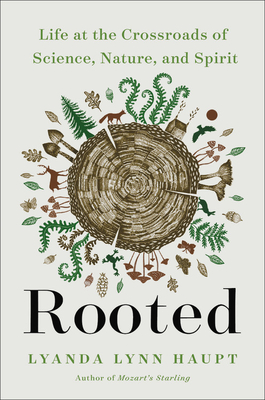 I hadn’t realized that Haupt grew up Catholic, so the language of mysticism comes easily to her, but even as a child nature was where she truly sensed transcendence. Down by the creek, where she listened to birdsong and watched the frog lifecycle, was where she learned that everything is connected. She even confessed her other church, “Frog Church” (this book’s original title), to her priest one day. (He humored her by assigning an extra Our Father.) How to reclaim that childhood feeling of connectedness as a busy, tech-addicted adult?
The Seattle-based Haupt engages in, and encourages, solo camping, barefoot walking, purposeful wandering, spending time sitting under trees, mindfulness, and going out in the dark. This might look countercultural, or even eccentric. Some will also feel called to teach, to protest, and to support environmental causes financially. Others will contribute their talent for music, writing, or the visual arts. But there are subtler changes to be made too, in our attitudes and the way we speak. A simple one is to watch how we refer to other species. “It” has no place in a creature-directed vocabulary.
Haupt’s perspective chimes with the ethos of the New Networks for Nature conference I attend each year, as well as with the work of many UK nature writers like Robert Macfarlane (in particular, she mentions The Lost Words) and Jini Reddy (Wanderland). I also found a fair amount of overlap with Lucy Jones’s Losing Eden. There were points where Haupt got a little abstract and even woo-woo for me – and I say that as someone with a religious background. But her passion won me over, and her book helped me to understand why two things that happened earlier this year – a fox dying in our backyard and neighbors having a big willow tree taken down – wounded me so deeply. That I felt each death throe and chainsaw cut as if in my own body wasn’t just me being sentimental and oversensitive. It was a reminder that I’m a part of all of life, and I must do more to protect it.
Favorite lines:
“In this time of planetary crisis, overwhelm is common. What to do? There is so much. Too much. No single human can work to save the orcas and the Amazon and organize protests to stop fracking and write poetry that inspires others to act and pray in a hermit’s dwelling for transformation and get dinner on the table. How easy it is to feel paralyzed by obligations. How easy it is to feel lost and insignificant and unable to know what is best, to feel adrift while yearning for purpose. Rootedness is a way of being in concert with the wilderness—and wildness—that sustains humans and all of life.”
“No one can do all things. Yet we can hold all things as we trim and change our lives and choose our particular forms of rooted, creative action—those that call uniquely to us.”
With thanks to Little, Brown Spark for sending a proof copy all the way from Boston, USA.
Daphne du Maurier Reading Week: My Cousin Rachel (1951)
It’s probably a decade or more since I read anything by Daphne du Maurier. The three novels of hers that I know are Rebecca (of course), Jamaica Inn, and The House on the Strand. HeavenAli’s annual reading week was the excuse I needed to pick up the copy of My Cousin Rachel that I grabbed from the closed-down free bookshop in the mall about a year ago as we were clearing it out. I’m glad I finally got to this one: it has a gripping storyline and the title character is a complex woman it’s impossible to make up your mind about.
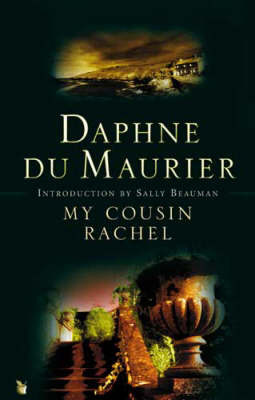 To start with, we have an opening line that’s sure to make my year-end superlatives post: “They used to hang men at Four Turnings in the old days.” The whole first chapter is heavy with foreboding, most of which I didn’t pick up on. It’s clear at once that the narrator, a young man named Philip Ashley, feels guilty for the situation he finds himself in, but can’t decide whether Rachel shares his culpability. Philip is the ward and heir of his older cousin, Ambrose, who winters in Florence for his health but on his latest trip marries Rachel, a widow and distant half-Italian cousin who also has roots in Cornwall, and stays in Italy.
From what little he learns of her through Ambrose’s increasingly incoherent letters, Philip is predisposed to dislike Rachel. When Ambrose dies of a suspected brain tumour, Philip is alarmed to hear that Rachel has already emptied their Florence villa and is reluctant to meet her when she arrives in Plymouth some weeks later. But she is not what he expected: just 35 and beautiful; with a passion for garden design and herbal medicine; witty and gently flirtatious. Before long Philip is smitten. “Why, in heaven’s name, did she have to be so different and play such havoc with my plans?”
The plot revolves around Ambrose’s unsigned will and what it means for the ownership of the Ashleys’ Cornwall estate. Philip is now 24, but on his 25th birthday, which happens to fall on April Fool’s Day, he will come into his inheritance and can make his own decisions. Will Rachel, notorious for her extravagant spending, bewitch him into altering the will to her advantage? A pearl necklace, hidden letters, a beggar woman, churchyard conversations, tisanes, lavish curtains, and a foppish Italian visitor form the backdrop to this Gothic tale.
 I never succeeded in dating the action: the only major clue is that it takes three weeks to travel between southwest England and Florence, which seems to point to the nineteenth century. But a lack of definite markers makes the story feel timeless and almost like a fairy tale. Although she shrewdly looks out for her own interests and can manipulate Philip’s emotions, Rachel is no stereotypical witch. Sally Beauman’s introduction to my Virago paperback usefully points out that we only ever see Rachel through the male gaze (Philip’s perhaps unreliable narration and Ambrose’s letters) and that from the title onward she is defined in relation to men. In making a bid for her own independent life, she is the true heroine of what Beauman calls du Maurier’s “most overtly feminist” novel.
I always love the murky atmosphere of du Maurier’s work, but can find her plots contrived. However, this ended up being my favourite of the four I’ve read so far. Initially, it reminded me of E.M. Forster’s Where Angels Fear to Tread, while by the end I was wondering if Janet Fitch took it as inspiration for White Oleander. There’s an unusual pair for you! Make of it what you will…
What else should I read by du Maurier?
Painting Time by Maylis de Kerangal
Today I’m taking part in the “blog blast” for Painting Time by Maylis de Kerangal (translated from the French by Jessica Moore), which is published today by MacLehose Press.

This is the third novel I’ve read by de Kerangal, after her 2017 Wellcome Book Prize winner, Mend the Living, and 2019’s The Cook. Painting Time resembles the former in the way it revels in niche vocabulary and the latter in that it slowly builds up a portrait of the central character. But all three books could be characterized as deep dives into a particular subject – the human body, gastronomy, and painting, respectively.
The protagonist of Painting Time is Paula Karst, one of 20-some art students who arrive at the Institut de Peinture in Brussels in the autumn of 2007 to learn trompe l’oeil technique. They’re taught to painstakingly imitate every variety of wood and stone so their murals will look as convincing as the real thing. It’s a gruelling course, with many hours spent on their feet every day.
Years later, the only classmates Paula has kept up with are Jonas, her old flatmate, with whom she had a sort-of-almost-not-quite relationship, and their Scottish friend Kate. The novel opens with the three of them having a reunion in Paris. Given this setup, I expected de Kerangal to follow all three characters from 2007 to the near past, but the book sticks closely to Paula, such that the only secondary characters who come through clearly are her parents.
 It’s intriguing to see the work that comes Paula’s way after a degree in decorative painting, including painting backdrops for a Moscow-set film of Anna Karenina and the job of a lifetime: working on a full-scale replica of the prehistoric animal paintings of the Lascaux Caves (Lascaux IV). The final quarter of the novel delves into the history of Lascaux, which was discovered in 1940 and open to the public on and off until the late 1960s. Deep time abuts the troubled present as Paula contemplates what will last versus what is ephemeral.
As de Kerangal did with medical terminology in Mend the Living, so here she relishes art words: colours, tools, techniques; names for types of marble and timber (Paula’s own surname is a word for limestone caves). The long sentences accrete to form paragraphs that stretch across multiple pages. I confess to getting a bit lost in these, and wanting more juicy interactions than austere character study. However, the themes of art and history are resonant. If you’ve enjoyed de Kerangal’s prose before, you will certainly want to read this, too.
My thanks to MacLehose Press for access to an e-copy via NetGalley.
The 2021 Dylan Thomas Prize Shortlist
The Swansea University International Dylan Thomas Prize recognizes the best published work in the English language written by an author aged 39 or under. All literary genres are eligible, so the longlist contained poetry collections as well as novels and short stories. Remaining on the shortlist are these six books (five novels and one short story collection; four of the works are debuts):
- Alligator and Other Stories by Dima Alzayat – Stories of the Syrian American experience.
- Kingdomtide by Rye Curtis – A novel about an elderly plane crash victim and the alcoholic park ranger who tries to find her. (See Annabel’s review.)
- The Death of Vivek Oji by Akwaeke Emezi – A coming-of-age story set in Nigeria.
- Pew by Catherine Lacey – A mysterious fable about a stranger showing up in a Southern town in the week before an annual ritual.
- Luster by Raven Leilani – A young Black woman and would-be painter negotiates a confusing romantic landscape and looks for meaning beyond dead-end jobs.
- My Dark Vanessa by Kate Elizabeth Russell – A nuanced look at the #MeToo phenomenon through the prism of one young woman’s relationship with her teacher.
It’s an American-dominated set this year, but, refreshingly, five of the six nominees are women or non-binary. I happen to have already read the last three of the novels on the list. I’m most keen to try Alligator and Other Stories and Kingdomtide and hope to still have a chance to read them. No review copies reached me in time, so today I’m giving an overview of the list.
This is never an easy prize to predict, but if I had to choose between the few that I’ve read, I would want Kate Elizabeth Russell to win for My Dark Vanessa.

(The remaining information in this post comes from the official Midas PR press release.)
The shortlist “was selected by a judging panel chaired by award-winning writer, publisher and co-director of the Jaipur Literature Festival Namita Gokhale, alongside founder and director of the Bradford Literature Festival Syima Aslam, poet Stephen Sexton, writer Joshua Ferris, and novelist and academic Francesca Rhydderch.
“This year’s winner will be revealed at a virtual ceremony on 13 May, the eve of International Dylan Thomas Day.”
Namita Gokhale, Chair of Judges, says: “We are thrilled to present this year’s extraordinary shortlist – it is truly a world-class writing showcase of the highest order from six exceptional young writers. I want to press each and every one of these bold, inventive and distinctive books into the hands of readers, and celebrate how they challenge preconceptions, ask new questions about how we define identity and our relationships, and how we live together in this world. Congratulations to these tremendously talented writers – they are master storytellers in every sense of the word.”
Francesca Rhydderch on Alligator and Other Stories by Dima Alzayat: “Dima Alzayat’s visceral, innovative Alligator & Other Stories marks the arrival of a major new talent. While the range of styles and stories is impressively broad, there is a unity of voice and tone here which must have been so very difficult to achieve, and a clear sense that all these disparate elements are part of an overriding, powerful examination of identity.”
Joshua Ferris on Kingdomtide by Rye Curtis: “Kingdomtide is a propulsively readable and frequently very funny book about the resources, personal and natural, necessary to survive a patently absurd world. The winning voice of Texas-native Cloris Waldrip artfully takes us through her eighty-eight-day ordeal in the wilds of Montana as the inimitable drunk and park ranger Debra Lewis searches for her. This fine novel combines the perfect modern yarn with something transcendent, lyrical and wise.”
Namita Gokhale on The Death of Vivek Oji by Akwaeke Emezi: “The Death of Vivek Oji by Akwaeke Emezi is a powerful novel that carries the authenticity of cultural and emotional context. The story unfolds brilliantly, with the prescient foreboding about Vivek Oji’s death already announced in the brief line that constitutes the opening chapter. Yet the suspense is paced and carefully maintained until the truth is finally communicated in the final chapter. A triumph of narrative craft.”


Francesca Rhydderch on Pew by Catherine Lacey: “In this brilliant novel Catherine Lacey shows herself to be completely unafraid as a writer, willing to tackle the uglier aspects of a fictional small town in America, where a stranger’s refusal to speak breeds paranoia and unease. Beautifully written, sharply observed, and sophisticated in its simplicity, Pew is a book I’m already thinking of as a modern classic.”
Syima Aslam on Luster by Raven Leilani: “Sharp and incisive, Luster speaks a fearless truth that takes no hostages. Leilani is unflinchingly observant about the realities of being a young, black woman in America today and revelatory when it comes to exploring unconventional family life and 21st-century adultery, in this darkly comic and strangely touching debut.”
Stephen Sexton on My Dark Vanessa by Kate Elizabeth Russell: “My Dark Vanessa is an articulate, uncompromising and compelling novel about abuse, its long trail of damage and its devastating iterations. In Vanessa, Russell introduces us to a character of immense complexity, whose rejection of victimhood—in favour of something more like love—is tragic and unforgettable. Timely, harrowing, of supreme emotional intelligence, My Dark Vanessa is the story of one girl; of many girls, and of the darknesses of Western literature.”
 Bookish Beck = Rebecca Foster. American transplant to England. Freelance proofreader and book reviewer.
 Bookish Beck