Three on a Theme: Works of (Auto)biography by Susie Boyt, Sarah Laing and Jenn Shapland
“If biography is peering through the windows of someone’s house and describing what you see … [then] memoir is peeking into the windows of your own life. A voyeurism of the self. An interior looting.”
~Jenn Shapland
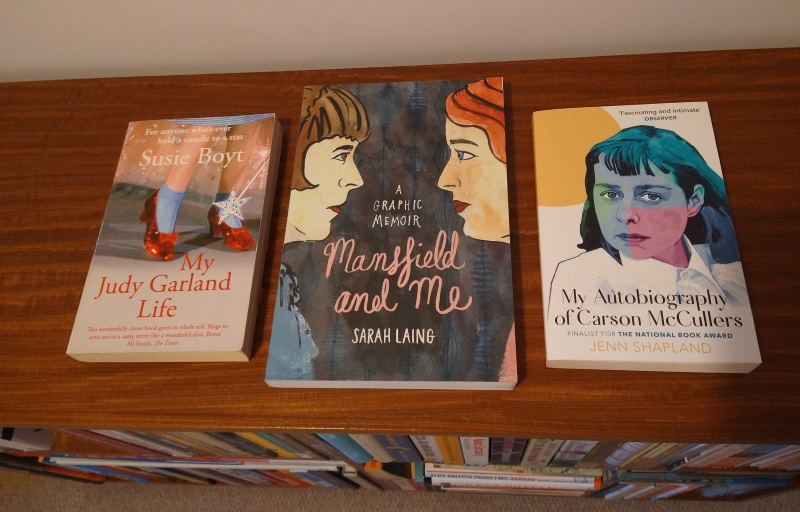
This thematic trio has been in the works for an awfully long time: I read the Laing in 2022 and also started the Shapland that year but took an inexplicable pause and didn’t finish it until a couple of days ago. All three are about understanding the self by way of an obsession with a particular woman from history. Sometimes it’s also a matter of coming to terms with one’s sexuality. In each case, the premise is biographical but the pursuit and reflections end up being equally autobiographical. These are beautifully introspective works with such an appealing approach that they made me ponder who I would pinpoint as my (auto)biographical muse. All: 
My Judy Garland Life by Susie Boyt (2008)
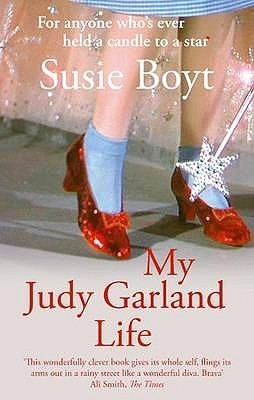 After discovering Boyt through her brilliant latest novel, Loved and Missed, I was keen to try more from her. This Ackerley Prize-shortlisted memoir was just as fascinating as it sounded. Seeing The Wizard of Oz turned Boyt into a Garland mega-fan.
A daughter of Lucian Freud raised by a single mother, Boyt was a sensitive, earnest and lonely child who harboured hopeless dreams of being on the stage herself. She admires Garland’s talent, pluck, hard work and grit. After all, Garland remained the ‘world’s greatest entertainer’ despite struggling with mental illness and prescription drug dependency for three decades.
When I begin to listen to Judy Garland there is no joy or wound from the story of my life that isn’t with me. … Her central credo, and it always always comes to me as her voice begins to swell, is that to be the person with the strongest feelings in life is to be the best. This is an instinct I am quite sure I was born with.
Boyt meets fellow Garland mega-fans in person and online, and visits her hero’s Birthplace Home and Museum (in Grand Rapids, Minnesota) and mausoleum (then in Hartsdale, New York). She draws distinctions between “bad fans” with a morbid eye to Garland’s struggles (they memorise her suicide notes, for instance), “good fans” like herself who acknowledge she was no saint but choose to focus on her successes, and the “crazy-good fans” who won’t hear a word said against her. It’s reassuring that Boyt recognises ambiguity.
“I don’t claim to know Judy Garland, of this I am sure. I feel very close to her, I love her, but I don’t understand. Perhaps I never will. I accept there are layers and layers of things.”
I don’t retain a lot of the detail of this book after over a year (and no notes, silly me!), but I do remember that I felt it blends biography and memoir skilfully and incorporates illuminating discussions of addiction, mental health, celebrity, fandom and the search for love – Garland married five times. (Secondhand – Awesomebooks.com)
Mansfield and Me: A Graphic Memoir by Sarah Laing (2016)
 (I’ve added a few lines to my original review from 2022.) Growing up in Aotearoa New Zealand an aspiring writer, Laing looked to Katherine Mansfield as one of her idols. Here she alternates between vignettes from her own past in vivid colour and scenes from Mansfield’s short life in black and white. The Mansfield material is drawn from her letters and notebooks as well as various biographies. Mansfield was friendly with the Bloomsbury Group and lost a brother in the First World War. Laing uses a few Mansfield story titles as chapter headings, has Mansfield’s ghost turn up to comment on her authorial choices, and compares and contrasts their careers and love lives. Laing published her first short story collection at 34 – the age at which Mansfield died of tuberculosis. They share a bisexual identity. Mansfield married twice and miscarried her only pregnancy by a lover; by the end of this book Laing is married and a mother of three. This made me want to read more of Mansfield’s stories; I’ve only read a few thus far. “Katherine’s stories were full of … little lamps – moments of illumination, flashes of truth. I don’t need to be famous, but I would like someone to really see me,” Laing concludes. I’ve also reviewed her Let Me Be Frank. (New purchase – Waterstones sale)


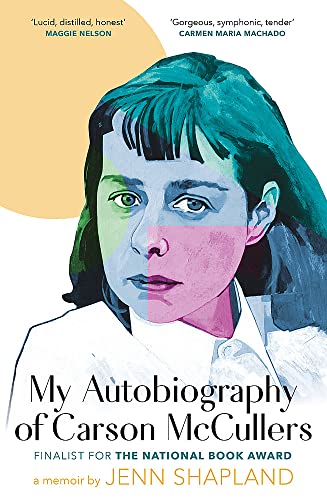
My Autobiography of Carson McCullers by Jenn Shapland (2020)
When Shapland was an intern at the Harry Ransom Center of the University of Texas, Austin (a famous literary archive), someone requested the letters sent by Annemarie Clarac-Schwarzenbach to the writer Carson McCullers. To Shapland’s surprise, these were basically love letters. “I had received letters like these,” she writes. “I had written letters like these to the women I’d loved. It was very little to go on, and yet I felt an utter certainty: Carson McCullers had loved women.” The discovery sparked a quest to know all there was to know about McCullers (she archived the writer’s clothing as part of the internship, too). It also, somehow, liberated Shapland to fully accept her lesbian identity. She was, by this point, in her mid-twenties and had been dating a fellow female student for six years, yet had been semi-closeted the whole time. The letters were, she acknowledges, “a turning point.”
Shapland later spent a month in McCullers’s childhood home in Columbus, Georgia* and worked through her archive at the state university there. Annemarie was by no means the only same-sex entanglement; Shapland lists another 21 possible girlfriends, with McCullers’s correspondence with her therapist, Dr. Mary Mercer, being particularly suggestive. But Shapland had hardly found some lesbian role model: McCullers married the same man, Reeves McCullers, twice, and called her special women “imaginary friends.” (Not to mention that she was an alcoholic, and struggled with chronic illness until her death at age 50.)
Dogged in her own search for evidence, Shapland nonetheless decries unjust expectations: “Historians demand proof from queer love stories that they never require of straight relationships.” How to prove happiness? she wonders. “Love … lives in the mundane, the moment-to-moment exchanges, and can so easily become invisible after the people who shared it are no longer alive. But, of course, it leaves traces.” I thought Shapland was perhaps too insistent on the word “lesbian” – only once entertaining the possibility that McCullers was bisexual, and never seriously considering fluidity or a change of sexuality. “I prefer the idea that we are all part lesbian, that we are lesbian to one degree or another,” she insists. “Is this semantics?” True to her dual vocation as author and archivist, Shapland continually interrogates how language and objects don’t just reflect reality, but create it. I was impressed by her willingness to call herself out on how she might be “shellacking, setting [McCullers] on my terms despite my desire to give her space in her own words.”
This debut work, a Lambda Literary Award winner and finalist for the National Book Award, is in titled sections that range in length from one paragraph to several pages. Shapland drifts back and forth in time and between her own life and McCullers’s, following thought and memory in loose loops but still conveying the sense of a chronological investigation. She doesn’t devote a lot of space to McCullers’s oeuvre– this is definitely not a work of literary appreciation or criticism – but I’m intrigued enough by the writer’s life and even a bare outline of the recurring themes and elements in her fiction to try her soon. Meanwhile, I have Shapland’s second book, the essay collection Thin Skin, on my e-reader. Her final plea for queer visibility here may be more for her own sake than for the historical McCullers, but either way it persuaded me. “Call it love.”
*I’ve not read McCullers but have always meant to, not least because my father is from Columbus, Georgia. His wasn’t a bookish family and I was never aware of the McCullers connection, though when I mentioned this book to my dad a few years ago he did know her name.
With thanks to Virago for the free copy for review.
20 Books of Summer, 13–16: Tony Chan, Jen Hadfield, Kenward Anthology, Catherine Taylor
Three from my initial list (all nonfiction) and one substitute picked up at random (poetry). These are strongly place-based selections, ranging from Sheffield to Shetland and drawing on travels while also commenting on how gender and dis/ability affect daily life as well as the experience of nature.
Four Points Fourteen Lines by Tony Chan (2016)
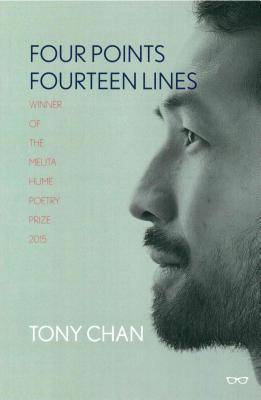 Chan is a schoolteacher who, in 2015, left his day job to undertake a 78-day solo walk between “the four extreme cardinal points of the British mainland”: Dunnet Head (North) to Ardnamurchan Point (West) in Scotland, down to Lowestoft Ness (East) in Suffolk and across to Lizard Point, Cornwall (South). It was a solo trek of 1,400 miles. He wrote one sonnet per day, not always adhering to the same rhyme scheme but fitting his sentiments into 14 lines of standard length. He doesn’t document much practical information, but does admit he stayed in decent hotels, ate hot meals, etc. Each poem is named for the starting point and destination, but the topic might be what he sees, an experience on the road, a memory, or whatever. “Evanton to Inverness” decries a gloomy city; “Inverness to Foyers” gives thanks for his shoes and lycra undershorts. He compares Highlanders to heroic Trojans: “Something sincere in their browned, moss-green tweeds, / In their greeting voice of gentle tenor. / From ancient Hector or from ancient clans, / Here live men most earnest in words and deeds.” None of the poems are laudable in their own right, but it’s a pleasant enough project. Too often, though, Chan resorts to outmoded vocabulary to fit the form or try to prove a poetic pedigree (“Suddenly comes an Old Testament of deluge and / Tempest, deluding the sense wholly”; “I know these streets, whence they come and whither / They run”; “I learnt well some verses of Tennyson / Years ago when noble dreams were begat”) when he might have been better off varying the form and/or using free verse. (Signed copy from Little Free Library)
Storm Pegs: A Life Made in Shetland by Jen Hadfield (2024)
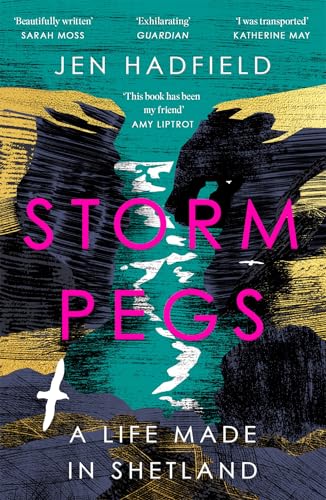 This is not so much a straightforward memoir as a set of atmospheric vignettes, each headed by a relevant word or phrase in the Shaetlan dialect. Hadfield, who is British Canadian, moved to the islands in her late twenties in 2006 and soon found her niche. “My new life quickly debunked those Edge-of-the-World myths – Shetland was too busy to feel remote, and had too strong a sense of its own identity to feel frontier-like.” It’s gently ironic, she notes, that she’s a terrible sailor and gets vertigo at height yet lives somewhere with perilous cliff edges that is often reachable only by sea. Living in a trailer waiting for her home to be built on West Burra, she feels the line between indoors and out is especially thin. It’s a life of wild swimming, beachcombing, fresh fish, folk music, seabirds, kind neighbours, and good cheer that warms long winter nights. After the isolation of the pandemic period comes the unexpected joy of a partner and a pregnancy in her mid-forties. Hadfield is a Windham-Campbell Prize-winning poet, and her lyrical prose is full of lovely observations that made me hanker to return to Shetland – it’s been 19 years since my only visit, after all. This was a slow read I savoured for its language and sense of place.
With thanks to Picador for the free paperback copy for review.
From Shetland authors, I have also reviewed:
Orchid Summer by Jon Dunn (Hadfield mentions him)
Sea Bean by Sally Huband (Hadfield meets her)
The Valley at the Centre of the World by Malachy Tallack
Moving Mountains: Writing Nature through Illness and Disability, ed. Louise Kenward (2023)
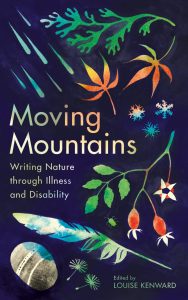 I often read memoirs about chronic illness and disability – the sort of narratives recognized by the Barbellion and ACDI Literary Prizes – and the idea of nature essays that reckon with health limitations was an irresistible draw. The quality in this anthology varies widely, from excellent to barely readable (for poor prose or pretentiousness). I’ll be kind and not name names in the latter category; I’ll only say the book has been poorly served by the editing process. The best material is generally from authors with published books: Polly Atkin (Some of Us Just Fall; see also her recent response to the Raynor Winn fiasco), Victoria Bennett (All My Wild Mothers), Sally Huband (as above!), and Abi Palmer (Sanatorium). For the first three, the essay feels like an extension of their memoir, while Palmer’s inventive piece is about recreating seasons for her indoor cats. My three favourite entries, however, were Louisa Adjoa Parker’s poem “This Is Not Just Tired,” Nic Wilson’s “A Quince in the Hand” (she’s an acquaintance through New Networks for Nature and has a memoir out this summer, Land Beneath the Waves), and Eli Clare’s “Moving Close to the Ground,” about being willing to scoot and crawl to get into nature. A number of the other pieces are repetitive, overlong or poorly shaped and don’t integrate information about illness in a natural way. Kudos to Kenward for including BIPOC and trans/queer voices, though. (Christmas gift from my wish list)
The Stirrings: Coming of Age in Northern Time by Catherine Taylor (2023)
“A typical family and an ordinary story, although neither the family nor the story seems commonplace when it is your family and your story.”
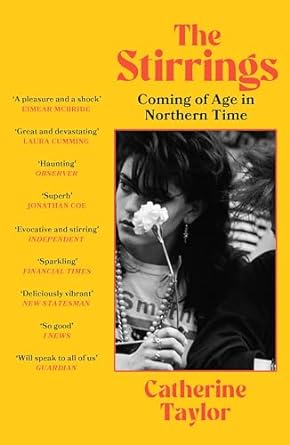 Taylor, who was born in New Zealand and grew up in Sheffield, won the Ackerley Prize for this memoir. (After Dunmore and King, this is the third in my intended four-in-a-row on the 20 Books of Summer Bingo card, fulfilling the “Book published in summer” category – August 2023.) It is bookended by two pivotal summers: 1976, the last normal season in her household before her father left; and 1989, the “Second Summer of Love,” when she had an abortion (the subject of “Milk Teeth,” the best individual chapter and a strong stand-alone essay). In between, fear and outrage overshadow her life: the Yorkshire Ripper is at large, nuclear war looms, mines are closing and protesters meet with harsh reprisals, and her own health falters until she gets a diagnosis of Graves’ disease. Then, in her final year at Cardiff, one of their housemates is found dead. Taylor draws reasonably subtle links to the present day, when fascism, global threats, and femicide are, unfortunately, as timely as ever. She’s the sort of personality I see at every London literary event I attend: Wellcome Book Prize ceremonies, Weatherglass’s Future of the Novella event, and so on. I got the feeling this book is more about bearing witness to history than revealing herself, and so I never warmed to it or to her on the page. But if you’d like to get a feel for the mood of the times, or you have experience of the settings and period, you may well enjoy it more than I did. (New purchase from Bookshop.org with a Christmas book token)
 Bookish Beck = Rebecca Foster. American transplant to England. Freelance proofreader and book reviewer.
