Books that (Should Have) Literally Changed My Life
(Following on from my posts Landmark Books from My Early Life and Landmark Books in My Life, Part II.)
Every once in a while you’ll hear someone claim that a certain book will change your life. I think of a scene in Garden State, still one of my favorite movies of all time, where Natalie Portman’s character tells Zach Braff’s character “this song will change your life” and puts The Shins’ “New Slang” on his headphones. (Ok, it’s a good song, but not that great.)
Are there any books that have literally changed my life? I can think of a handful that have been extremely influential on my worldview and, in a couple of cases, also changed my behavior. As it happens, they’re all nonfiction.
Religion
 After I got back to the States from my year abroad, I spent a few years doing some intensive reading about progressive Christianity (it was sometimes also called the emergent church) and other religions, trying to decide if it was worth sticking with the faith I’d grown up in. Although I still haven’t definitively answered this for myself, and have drifted in and out of lots of churches over the last 12 years, two authors were key to me never ditching Christianity entirely: Brian McLaren and Marcus Borg.
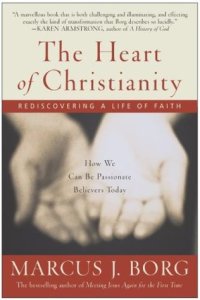 McLaren founded the church we attend whenever we’re back in Maryland and is the author of over a dozen theology titles, including the New Kind of Christian trilogy of allegorical novels. For me his best book is A New Kind of Christianity, which pulls together all his recurrent themes. Borg, who died in 2015, wrote several books that made a big impression on me, but none more so than The Heart of Christianity, which is the best single book I’ve found about what Christianity can and should be, going back to Jesus’ way of peace and social justice and siphoning off the unhelpful doctrines that have accumulated over the centuries.
 Any number of other Christian books and authors have been helpful to me over the years (Secrets in the Dark by Frederick Buechner, How (Not) to Speak of God by Peter Rollins, Falling Upward by Richard Rohr, An Altar in the World by Barbara Brown Taylor, Without Buddha I Could Not be a Christian by Paul Knitter, Unapologetic by Francis Spufford, and various by Kathleen Norris, Rowan Williams, Richard Holloway and Anne Lamott), reassuring me that it’s not all hellfire/pie in the sky mumbo-jumbo for anti-gay Republicans, but Borg and McLaren were there at the start of my journey.
Sexuality
 Reading is my primary means of examining society as well as my own life, so it’s no wonder that I have turned to books to learn from some gender pioneers. Hanne Blank’s accessible social history Straight (2012) is particularly valuable for its revelation of the surprisingly short history of heterosexuality as a concept – the term has only existed since the 1860s. But the book that most helped me adjust my definitions of gender and broaden my tolerance was Conundrum by Jan Morris (1974).
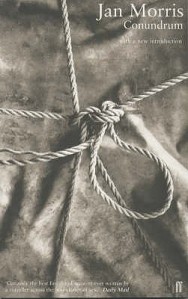 James Morris, born in 1926, was a successful reporter, travel writer, husband and father. Yet all along he knew he was meant to be female; it was something he had sensed for the first time as a young child sitting under the family piano: “I was three or perhaps four years old when I realized that I had been born into the wrong body, and should really be a girl … the conviction was unfaltering from the start.” In 1954 he began taking hormones to start his transition to womanhood, completed by a sex reassignment surgery in Morocco in 1972. This exceptional memoir of sex change evokes the swirl of determination and doubt, as well as the almost magical process of metamorphosing from one thing to another. Morris has been instrumental in helping me see sexuality as a continuum rather than a fixed entity.
Food
Apart from Michael Pollan, can you guess who’s had the greatest influence on my eating habits? You might be surprised to learn it’s American novelist Jonathan Safran Foer. In 2009 he published a provocative book called Eating Animals. I’m still surprised by how powerful and challenging I found it, considering that I knew pretty much what to expect: anti-meat rhetoric from a trendy vegetarian, with plenty of arresting statistics and horrifying behind-the-scenes accounts of factory farming and slaughter. But I set aside my jaded approach to potential propaganda and let it all saturate me, and it was devastating.
 The fact that I still haven’t completely given up meat is proof of how difficult it is to change, even once you’ve been convicted. We’ve gone from eating meat occasionally to almost never, and then mostly when we’re guests at other people’s houses. But if I really reminded myself to think about where my food was coming from, I’m sure we’d be even more hardline. Foer didn’t answer all my questions – what about offal and wild game, and why not go all the way to veganism? – but I appreciated that he never characterizes the decision to be vegetarian as an easy one. He recognizes the ways food is bound up with cultural traditions and family memories, but still thinks being true to one’s principles outweighs all. (He’s brave enough to suggest to middle America that it’s time to consider a turkey-free Thanksgiving!)
Daily Life
 There’s nothing more routine than brushing your teeth, and I never thought I would learn a new way to do it at age 32! But that’s just what Ignore Your Teeth and They’ll Go Away by Sheldon Dov Sydney gave me. He advises these steps: (1) brushing with a dry brush to remove bits of food and plaque, (2) flossing, and (3) brushing with toothpaste as a polish and to freshen breath. It takes a little bit longer than your usual quick brush and thus I can’t often be bothered to do it, but it does always leave my mouth feeling super-clean.
 I frequently succumb to negative self-talk, thinking “I can’t cope” or “There’s no way I could…” Feel the Fear and Do It Anyway by Susan Jeffers helped me see that I need to be more positive in my thought life. Originally published in 1987, the self-help classic says that at the base of every fear is a belief that “I can’t handle it.” Our fears are either of things that can happen to us (aging and natural disasters) or actions we might take (going back to school or changing jobs). You can choose to hold fear with either pain (leading to paralysis) or power (leading to action). This is still a struggle for me, but whenever I start to think “I can’t” I try to replace it with Jeffers’ mantra, “Whatever it is, I’ll handle it.”
Can you think of any books that have literally changed your life?
Starting the Year as I Mean to Go On?
The houseguests have gone home, the Christmas tree is coming down tomorrow, and it’s darned cold. I’m feeling stuck in a rut in my career, the blog, and so many other areas of life. It’s hard not to think of 2017 as a huge stretch of emptiness with very few bright spots. All I want to do is sit around in my new fuzzy bathrobe and read under the cat. Luckily, I’ve had some great books to accompany me through the Christmas period and have finished five so far this year.
I thought I’d continue the habit of writing two-sentence reviews (or maybe no more than three), except when I’m writing proper full-length reviews on assignment or for blog tours or other websites. Granted, they’re usually long and multi-part sentences, and this isn’t actually a time-saving trick – as Blaise Pascal once said, “I’m sorry I wrote you such a long letter; I didn’t have time to write a short one” – but it feels like good discipline.
So here’s some mini-reviews of what I’ve been reading in late December and early January:
The Dark Flood Rises, Margaret Drabble
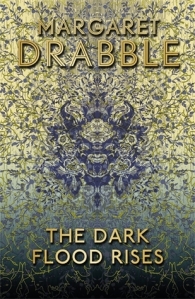 The “dark flood” is D.H. Lawrence’s metaphor for death, and here it corresponds to busy seventy-something Fran’s obsession with last words, obituaries and the search for the good death as many of her friends and acquaintances succumb – but also to literal flooding in the west of England and (dubious, this) to mass immigration of Asians and Africans into Europe. This is my favorite of the five Drabble books that I’ve read – it’s closest in style and tone to her sister A.S. Byatt as well as to Tessa Hadley, and the themes of old age and life’s randomness are strong – even though there seem to be too many characters and the Canary Islands subplot mostly feels like an unnecessary distraction. (Public library)
Hogfather, Terry Pratchett
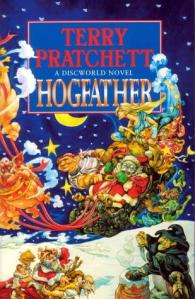 In Discworld belief causes imagined beings to exist, so when a devious plot to control children’s minds results in a dearth of belief in the Hogfather, the Fat Man temporarily disappears and Death has to fill in for him on this Hogswatch night. I laughed aloud a few times while reading this clever Christmas parody, but I had a bit of trouble following the plot and grasping who all the characters were given that this was my first Discworld book; in general I’d say that Pratchett is another example of British humor that I don’t entirely appreciate (along with Monty Python and Douglas Adams) – he’s my husband’s favorite, but I doubt I’ll try another of his books. (Own copy)
Love of Country: A Hebridean Journey, Madeleine Bunting
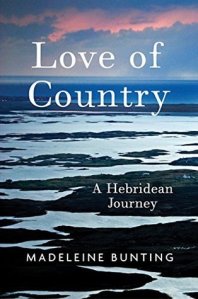 In a reprise of childhood holidays that inevitably headed northwest, Bunting takes a series of journeys around the Hebrides and weaves together her contemporary travels with the religion, folklore and history of this Scottish island chain, an often sad litany of the Gaels’ poverty and displacement that culminated with the brutal Clearances. Rather than giving an exhaustive survey, she chooses seven islands to focus on and tells stories of unexpected connections – Orwell’s stay on Jura, Lord Leverhulme’s (he of Port Sunlight and Unilever) purchase of Lewis, and Bonnie Prince Charlie’s landing on Eriskay – as she asks how geography influences history and what it truly means to belong to a place. (Public library)
Cobwebs and Cream Teas: A Year in the Life of a National Trust House, Mary Mackie
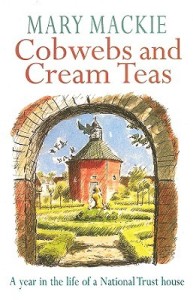 Mackie’s husband was Houseman and then Administrator at Felbrigg Hall in Norfolk in the 1980s – live-in roles that demanded a wide range of skills and much more commitment than the usual 9 to 5 (when he borrowed a pedometer he learned that he walked 15 miles in the average day, without leaving the house!). Her memoir of their first year at Felbrigg proceeds chronologically, from the intense cleaning and renovations of the winter closed season through to the following Christmas’ festivities, and takes in along the way plenty of mishaps and visitor oddities. It will delight anyone who’d like a behind-the-scenes look at the life of a historic home. (Own copy)
The Bridge Ladies: A Memoir, Betsy Lerner
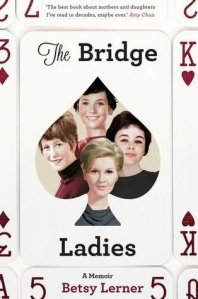 When life unexpectedly took the middle-aged Lerner back to her hometown of New Haven, Connecticut, she spent several years sitting in on her mother’s weekly bridge games to learn more about these five Jewish octogenarians who have been friends for 50 years and despite their old-fashioned reserve have seen each other through the loss of careers, health, husbands and children. Although Lerner also took bridge lessons herself, this is less about the game and more about her ever-testy relationship with her mother (starting with her rebellious teenage years), the ageing process, and the ways that women of different generations relate to their family and friends. It wouldn’t be exaggerating to say that every mother and daughter should read this; I plan to shove it in my mother’s and sister’s hands the next time I’m in the States. (Own copy)
Waiting on the Word, Malcolm Guite
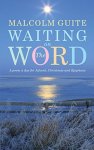 Guite chooses well-known poems (by Christina Rossetti, John Donne, Alfred Lord Tennyson, Samuel Taylor Coleridge et al.) as well as more obscure contemporary ones as daily devotional reading between the start of Advent and Epiphany; I especially liked his sonnet sequence in response to the seven “O Antiphons.” His commentary is learned and insightful, and even if at times I thought he goes into too much in-depth analysis rather than letting the poems speak for themselves, this remains a very good companion to the Christmas season for any poetry lover. (E-book from NetGalley)
 I started too many books over Christmas and have sort of put six of them on hold – including Titus Groan, which I’m thinking of quitting (it takes over 50 pages for one servant to tell another that the master has had a son?!), and City on Fire, which is wonderful but dispiritingly long: even after two good sessions with it in the days after Christmas, I’ve barely made a dent.
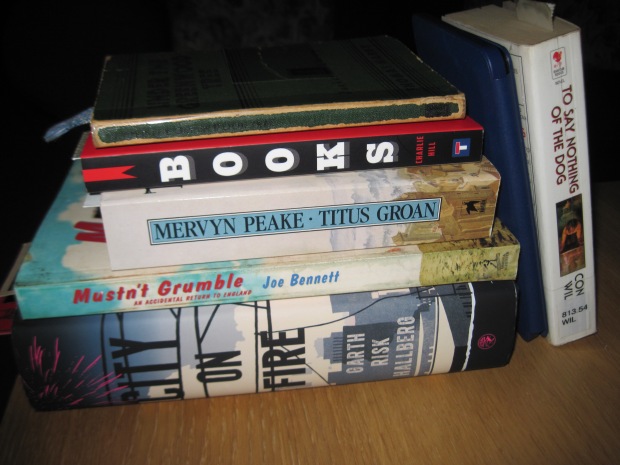
Stack on left = on hold (the book on top is Under the Greenwood Tree); standing up at right = books I’m actually reading.
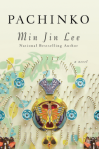
However, the three books that I am actively reading I’m loving: To Say Nothing of the Dog by Connie Willis is an uproarious blend of time travel science fiction and Victorian pastiche (university library), Pachinko by Min Jin Lee is a compulsive historical saga set in Korea (ARC from NetGalley), and the memoir Birds Art Life by Kyo Maclear has been compared to H Is for Hawk in the way she turns to birdwatching to deal with depression (e-book from Edelweiss). I also will be unlikely to resist my e-galley of the latest Anne Lamott book, Hallelujah Anyway (forthcoming in April, ARC from Edelweiss), for much longer.



Meanwhile, in post-holiday charity shopping I scored six books for £1.90: one’s been tucked away as a present for later in the year; the Ozeki I’ve already read, but it’s a favorite so I’m glad to own it; and the rest are new to me. I look forward to trying Han Kang; Anne Tyler is a reliable choice for a cozy read; and the Hobbs sounds like a wonderful Victorian-set novel.
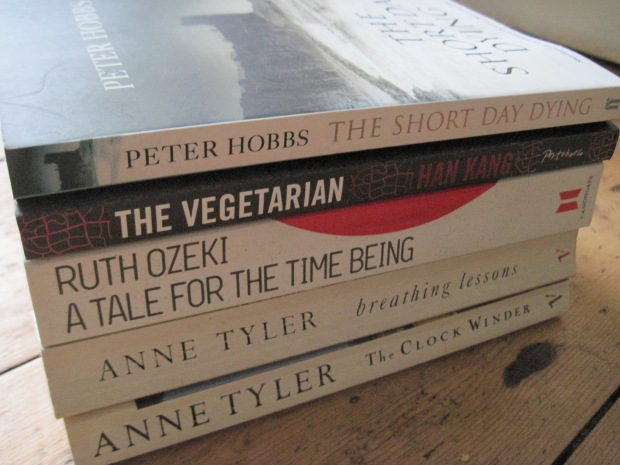
All in all, I seem to be starting my year in books as I mean to go on: reading a ton; making sure I review most or all of the books, even if I write just a few sentences; maintaining a balance between my own books, library books, and recent or advance NetGalley/Edelweiss reads; and failing to restrain myself from buying more.
Now if I could just work on my general attitude…
How’s the reading year starting off for you?
My Favorite Nonfiction Reads of 2015
Without further ado, I present to you my 15 favorite non-fiction books read in 2015. I’m a memoir junkie so many of these fit under that broad heading, but I’ve dipped into other areas too. I give two favorites for each category, then count down my top 7 memoirs read this year.
Note: Only four of these were actually published in 2015; for the rest I’ve given the publication year. Many of them I’ve already previewed through the year, so – like I did yesterday for fiction – I’m limiting myself to two sentences per title: the first is a potted summary; the second tells you why you should read this book. (Links given to full reviews.)
Foodie Lit
 A Homemade Life: Stories and Recipes from My Kitchen Table by Molly Wizenberg (2009): Wizenberg reflects on the death of her father Burg from cancer, time spent living in Paris, building a new life in Seattle, starting her food blog, and meeting her husband through it. Each brief autobiographical essay is perfectly formed and followed by a relevant recipe, capturing precisely how food is tied up with memories.
 Comfort Me with Apples: More Adventures at the Table by Ruth Reichl (2001): Reichl traces the rise of American foodie culture in the 1970s–80s (Alice Waters and Wolfgang Puck) through her time as a food critic for the Los Angeles Times, also weaving in personal history – from a Berkeley co-op with her first husband to a home in the California hills with her second after affairs and a sticky divorce. Throughout she describes meals in mouth-watering detail, like this Thai dish: “The hot-pink soup was dotted with lacy green leaves of cilantro, like little bursts of breeze behind the heat. … I took another spoonful of soup and tasted citrus, as if lemons had once gone gliding through and left their ghosts behind.”
Nature Books
 Meadowland: The Private Life of an English Field by John Lewis-Stempel (2014): Lewis-Stempel is a proper third-generation Herefordshire farmer, but also a naturalist with a poet’s eye. Magical moments and lovely prose, as in “The dew, trapped in the webs of countless money spiders, has skeined the entire field in tiny silken pocket squares, gnomes’ handkerchiefs dropped in the sward.”
 Landmarks by Robert Macfarlane: This new classic of nature writing zeroes in on the language we use to talk about our environment, both individual words – which Macfarlane celebrates in nine mini-glossaries alternating with the prose chapters – and the narratives we build around places, via discussions of the work of nature writers he admires. Whether poetic (“heavengravel,” Gerard Manley Hopkins’s term for hailstones), local and folksy (“wonty-tump,” a Herefordshire word for a molehill), or onomatopoeic (on Exmoor, “zwer” is the sound of partridges taking off), his vocabulary words are a treasure trove.
Theology Books
 Amazing Grace: A Vocabulary of Faith by Kathleen Norris (1998): In few-page essays, Norris gives theological words and phrases a rich, jargon-free backstory through anecdote, scripture and lived philosophy. This makes the shortlist of books I would hand to skeptics to show them there might be something to this Christianity nonsense after all.
 My Bright Abyss: Meditation of a Modern Believer by Christian Wiman (2013): Seven years into a cancer journey, Wiman, a poet, gives an intimate picture of faith and doubt as he has lived with them in the shadow of death. Nearly every page has a passage that cuts right to the quick of what it means to be human and in interaction with other people and the divine.
General Nonfiction
 Penelope Fitzgerald: A Life by Hermione Lee (2013): Although Penelope Fitzgerald always guarded literary ambitions, she was not able to pursue her writing wholeheartedly until she had reared three children and nursed her hapless husband through his last illness. This is a thorough and sympathetic appreciation of an underrated author, and another marvellously detailed biography from Lee.
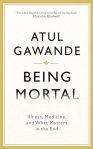 Being Mortal: Medicine and What Matters in the End by Atul Gawande (2014): A surgeon’s essential guide to decision-making about end-of-life care, but also a more philosophical treatment of the question of what makes life worth living: When should we extend life, and when should we concentrate more on the quality of our remaining days than their quantity? The title condition applies to all, so this is a book everyone should read.
Memoirs
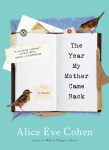 The Year My Mother Came Back by Alice Eve Cohen: Wry and heartfelt, this is a wonderful memoir about motherhood in all its variations and complexities; the magic realism (Cohen’s dead mother keeps showing up) is an added delight. I recommend this no matter what sort of relationship, past or present, you have with your mother, especially if you’re also a fan of Anne Lamott and Abigail Thomas.
- The Art of Memoir
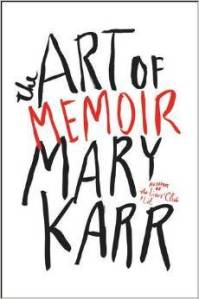 by Mary Karr: There is a wealth of practical advice here, on topics such as choosing the right carnal details (not sexual – or not only sexual – but physicality generally), correcting facts and misconceptions, figuring out a structure, and settling on your voice. Karr has been teaching (and writing) memoirs at Syracuse University for years now, so she’s thought deeply about what makes them work, and sets her theories out clearly for readers at any level of familiarity.
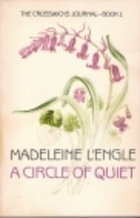 A Circle of Quiet by Madeleine L’Engle (1971): In this account of a summer spent at her family’s Connecticut farmhouse, L’Engle muses on theology, purpose, children’s education, the writing life, the difference between creating stories for children and adults, neighbors and fitting into a community, and much besides. If, like me, you only knew L’Engle through her Wrinkle in Time children’s series, this journal should come as a revelation.
-
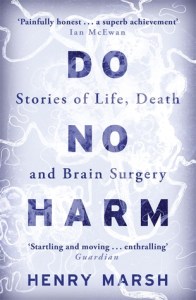 Do No Harm: Stories of Life, Death and Brain Surgery by Henry Marsh (2014): “Terrible job, neurosurgery. Don’t do it.” – luckily for us, Henry Marsh reports back from the frontlines of brain surgery so we don’t have to. In my favorite passages, Marsh reflects on the mind-blowing fact that the few pounds of tissue stored in our heads could be the site of our consciousness, our creativity, our personhood – everything we traditionally count as the soul.
 I Hate to Leave This Beautiful Place by Howard Norman (2013): Norman has quickly become one of my favorite writers. You wouldn’t think these disparate autobiographical essays would fit together as a whole, given that they range in subject from Inuit folktales and birdwatching to a murder–suicide committed in Norman’s Washington, D.C. home and a girlfriend’s death in a plane crash, but somehow they do; after all, “A whole world of impudent detours, unbridled perplexities, degrading sorrow, and exacting joys can befall a person in a single season, not to mention a lifetime.”
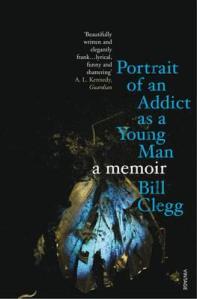 Portrait of an Addict as a Young Man by Bill Clegg (2010): Through this book I followed literary agent Bill Clegg on dozens of taxi rides between generic hotel rooms and bar toilets and New York City offices and apartments; together we smoked innumerable crack pipes and guzzled dozens of bottles of vodka while letting partners and family members down and spiraling further down into paranoia and squalor. He achieves a perfect balance between his feelings at the time – being out of control and utterly enslaved to his next hit – and the hindsight that allows him to see what a pathetic figure he was becoming.
And my overall favorite nonfiction book of the year:
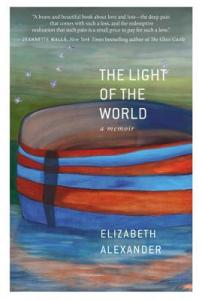 1. The Light of the World by Elizabeth Alexander: In short vignettes, beginning afresh with every chapter, Alexander conjures up the life she lived with – and after the sudden death of – her husband Ficre Ghebreyesus, an Eritrean chef and painter. This book is the most wonderful love letter you could imagine, and no less beautiful for its bittersweet nature.
What were some of your best nonfiction reads of the year?
Small Books Are Good, Too
Last week I wrote in praise of doorstoppers – books over 500 pages. But I also love really short books: there’s just as much writing skill involved in making a narrative concise, and it can be supremely satisfying to pick up a book and polish it off within a couple hours, especially if you’re in a situation of captured attention as on a plane. Being honest and slightly selfish for a moment, short books are also a great way to build up a flagging year list.
Below I highlight poetry collections, memoirs, short stories and novellas that should be on your agenda if you’re looking for a quick read (number of pages in brackets after each title):
Poetry
I try to always have a book of contemporary poetry on the go, usually by a British poet since I pluck these at random from my local public library shelves. Poetry collections aren’t always ‘quick’ reads, nor should they be, because you often have to read a poem more than once to understand it or truly appreciate its techniques. Still, with most poetry books numbering somewhere between 45 and 90 pages, even if you parcel them out over days or weeks they’ll take much less time than a novel. Pick up something by Mark Doty, Kathleen Jamie, David Harsent or Christopher Reid and you’ll have plenty of beautiful verse to ponder.
Recently reviewed and recommended:
- Learning to Make an Oud in Nazareth by Ruth Padel [80]
- All One Breath by John Burnside [96]
- Praise in Which I Live and Move and Have My Being by Paul Durcan [176]
Short Memoirs
Depending on how thorough they are, autobiographies can often hover around 300 or 400 pages. Looking through my shelves, though, I’ve spotted a few in the 140–160 page range: My Movie Business by John Irving [158], The Diving-Bell and the Butterfly by Jean-Dominique Bauby [139], and Winter by Rick Bass [162]. Another short one well worth reading is the unusual The Sound of a Wild Snail Eating by Elisabeth Tova Bailey [170], a story about debilitating illness and taking comfort from nature.
Abigail Thomas, one of my favorite memoirists, writes in an episodic style that makes her 200-page books fly by as if they were half that length. Also, Anne Lamott has written two very short faith memoirs that would serve as a good introduction to her style and content for those who haven’t read Traveling Mercies et al.: Help Thanks Wow [102] and Stitches [112].
Recently reviewed and recommended:
- The Two Kinds of Decay by Sarah Manguso [192]
- The Light of the World by Elizabeth Alexander [208]
- What Comes Next and How to Like It by Abigail Thomas [240] – also included on my BookTrib list of mother–daughter memoirs to read for Mother’s Day
Short Stories
I used to shy away from short stories because I didn’t think they were worth the emotional investment, but recently I’ve decided I really like the rhythm of picking up a set of characters, a storyline and a voice and then, after 20 or so pages, following an epiphany or an aporia (or utter confusion), trading them in for a whole new scenario. Short stories are also the perfect length for reading during a quick meal or car ride. Two short story collections made it onto my “Best of 2014” list: White Man’s Problems by Kevin Morris and The Heaven of Animals by David James Poissant.
Recently reviewed and recommended (no page numbers listed here because each story can stand alone):
- Wallflowers by Eliza Robertson
- Funny Once by Antonya Nelson
- Thunderstruck and Other Stories by Elizabeth McCracken
Novellas
With some credits for free Penguin books I got hold of Borges and the Eternal Orang-Utans by Luis Fernando Verissimo (translated from the Portuguese by Margaret Jull Costa) [135], a book I’d been hankering to read ever since I came across that terrific title. It’s an enjoyable academic comedy and locked room mystery, with nods to Borges and Poe (though I probably didn’t get them all).
I also recently discovered Peirene Press, which exclusively publishes novellas in translation. Their motto is “Contemporary European Literature. Thought provoking, well designed, short.” They publish the novellas in thematic trilogies, with headings such as “Male Dilemma: Quests for Intimacy” and “Small Epic: Unravelling Secrets.” The book I own from Peirene (scored from a secondhand bookshop in Henley-on-Thames for £1), from the “Turning Point: Revolutionary Moments” series, is Mr. Darwin’s Gardener by Kristina Carlson [122] (translated from the Finnish by Emily and Fleur Jeremiah).
It’s an odd little book, with a mixture of past and present tense and first-, third- and first-person plural narration. Set in the village of Downe, it’s peripherally about the title character, Charles Darwin’s gardener Thomas Davies, a new widower with two children, one of whom has Duchenne muscular dystrophy (newly identified). It’s thin on plot, it must be said. Daniel Lewis, the verger of Downe for five years, was dismissed for stealing from the church and is beaten up when he comes back to town; some characters think and talk about Darwin’s theory and Davies’s bereavement; there’s an overturned cart.
My favorite section, “At the Anchor,” is composed of conversations at the village pub, and my favorite individual lines reflect on Darwin’s influence on contemporary thought:
“Mr Darwin is a tree that spreads light, Thomas Davies thinks.”
“Great men are remembered, like Mr Darwin, a genuine monolith. We small folk are mere sand, washed by the waves as they go back and forth.”
“People in future decades and centuries will react to our ideas superciliously, as if we were children playing at thinking. We shall look most amusing in the light of new thoughts and inventions.”
If you’re looking to get through a classic in an afternoon, why not try one of these (full text available for free online through Project Gutenberg or other initiatives): Animal Farm by George Orwell [95], Ethan Frome by Edith Wharton [181] or Flush by Virginia Woolf (her spoof ‘biography’ of Elizabeth Barrett Browning’s cocker spaniel) [108]. E. M. Forster’s novels also read very quickly, and several of John Steinbeck’s novels are quite short. Whether or not you’ve seen the Audrey Hepburn movie, you’ll want to read the sparkling, bittersweet Breakfast at Tiffany’s by Truman Capote [100]; my edition also includes several of his best known short stories, including the wonderful “A Christmas Memory.”
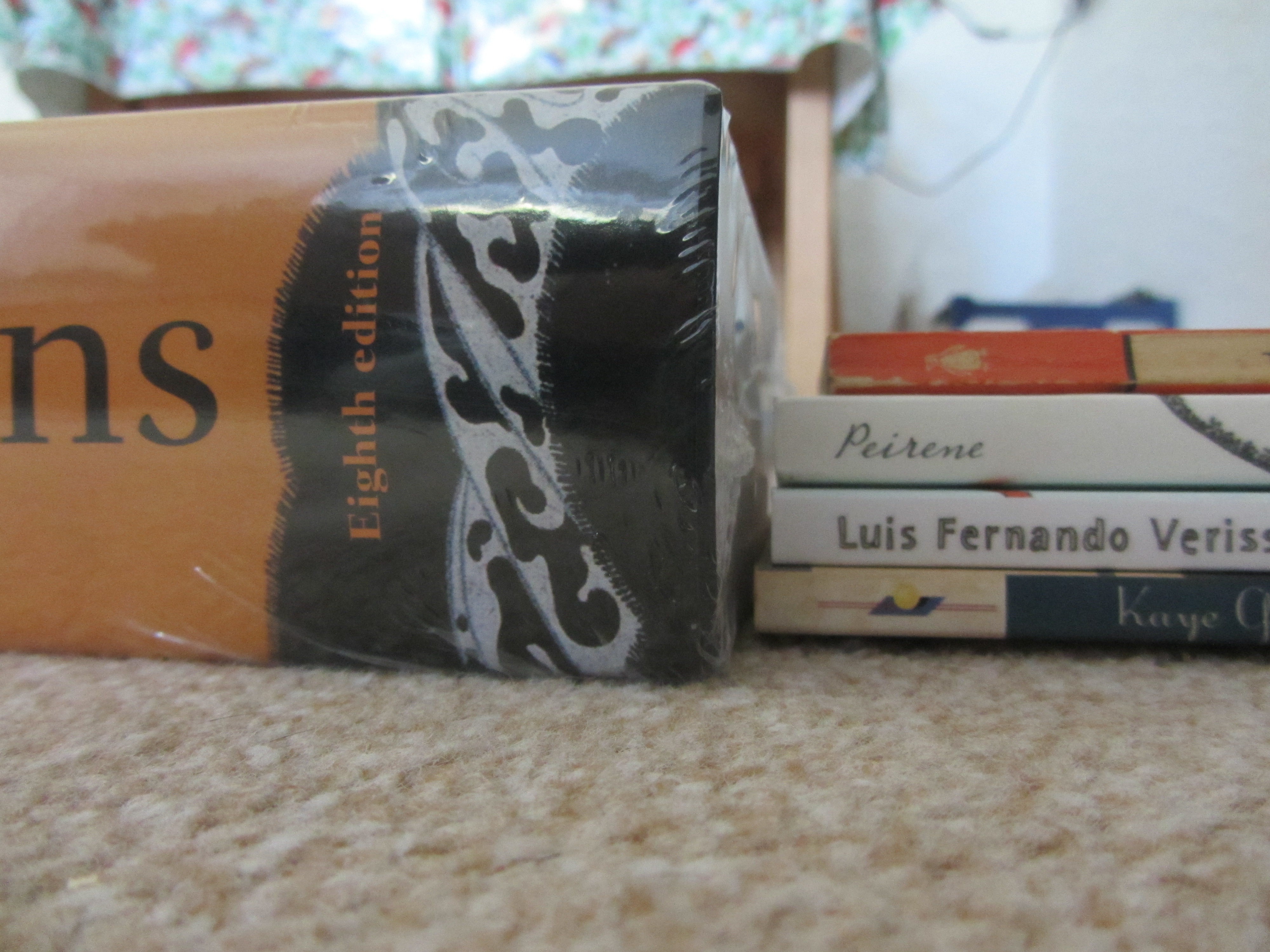
Even four novellas put together don’t stack up very far compared to the Oxford Dictionary of Quotations.
I recently finished The Bookshop by Penelope Fitzgerald [123]; all her books are similarly concise, so you may want to give her a try. The next novella on the pile for me is Ellen Foster by Kaye Gibbons [126]. I had never heard of the author, but the title and description lured me into buying it from a library book sale on a trip back to America (for 25 cents, why not?!). It’s a Southern Gothic story with an eleven-year-old narrator whom Walker Percy likened to Holden Caulfield. The alluring first line: “When I was little I would think of ways to kill my daddy.”
For more ideas, see these two Publishers Weekly’s lists:
“10 Best Books Shorter than 150 Pages” (only repeats one of my suggestions)
“10 Best Short Story Collections You’ve Never Read”
Off topic, but today is a milestone for me: it marks exactly two years that I’ve been a freelance writer!
Are you fond of short books? Do you prefer them to doorstoppers? What are some of your favorite novellas? All comments welcome!
Reviews Roundup, June–July
One of my goals with this blog is to have one convenient place where I can gather together all my writing that has appeared in disparate online locations. To that end, once a month I’ll provide links to all the book reviews I’ve published elsewhere, with a rating and a short taster so you can decide whether to click to read more. (A couple of exceptions: I won’t point out my Kirkus Indie or BlueInk reviews since I don’t get a byline.)
BookBrowse
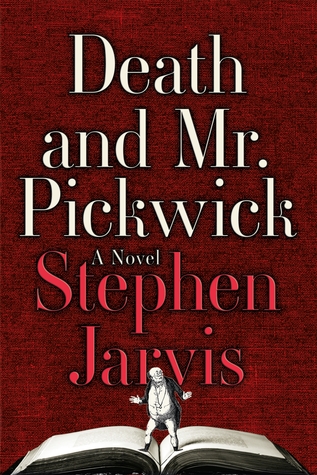 Death and Mr. Pickwick by Stephen Jarvis [subscription service; excerpt available to non-subscribers]: The Pickwick Papers was a Victorian publishing phenomenon. Originally envisioned as a series of sporting tales to accompany Robert Seymour’s engravings in a monthly magazine, the story soon took on a life of its own. Debut novelist Jarvis believes that a conspiracy between Dickens and his publishers covered up two key facts: Pickwick was primarily Seymour’s creation, and Dickens’s brash attempt to take it over was the impetus for Seymour’s suicide in 1836. At 800+ pages, this novel is chock-full of digressions – some amusing, others seemingly irrelevant. Jarvis started the project with the ambition of reading everything ever written about Pickwick. The results are exhaustive…but also a little exhausting.

 Hakai Magazine (a Canadian publication highlighting coastal ecosystems)
Coastlines by Patrick Barkham: In his third nature book, Guardian journalist Patrick Barkham blends science, history, and biography as he travels sections of the British coast protected through Enterprise Neptune, a National Trust campaign celebrating its 50th anniversary this year. His structural approach is unconventional: neither chronological nor geographical, but thematic. In sections on childhood, war, work, art, and faith, he highlights the many practical and metaphorical roles the coast has played in the British story. The choices of location often feel arbitrary and the themes are not quite strong enough to pull the book together, but Barkham succeeds in evoking the mysterious grandeur of the coast.

The Bookbag
Two Lives by Sarah Bourne (& interview): A car accident causes Emma and Loretta’s lives to be intertwined in surprising ways as they negotiate loss, domestic violence and motherhood. There’s a great dynamic between these characters: Loretta vicariously relives her own experience of pregnancy through Emma. As time moves on, their relationship is more like Barbara and Sheba’s in Notes on a Scandal; secrets provoke a tacit power struggle. For a short book, it’s filled with heavy social issues. It loses points for poor cover design as well as frequent typos. All the same, this is a compelling story built around likeable main characters. It does what fiction does best: exploring the small moments that can change lives for good.

 Nudge
Nudge
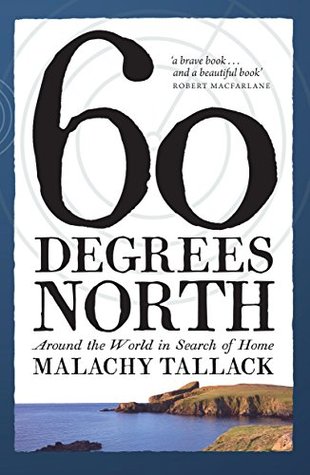
Sixty Degrees North by Malachy Tallack: “Geography begins at the only point of which we can be certain. It begins inside. And from there, from inside, rises a single question: where am I?” Tallack muses. This is a beautifully introspective book about the search for home and identity amidst the changes of time and the trappings of place. The goal of traveling across cold northern places makes it reminiscent of Joanna Kavenna’s The Ice Museum. However, a more telling comparison is with George Mackay Brown, chronicler of the Orkney Islands; like Brown, Tallack is interested in islands, both literally and metaphorically, as places of both isolation and authentic community.
Shiny New Books

The American cover is more evocative of the subject matter.

The UK cover: different thematic focus; frankly a bit tame and boring.
A Little Life by Hanya Yanagihara: Sure to be one of the books of the year, if not the decade. Jude St. Francis: Dickensian orphan, patron saint of lost causes, Christlike Man of Sorrows, and one of the most memorable characters in recent fiction. The reading experience might have been unbearable due to his suffering, but Yanagihara’s skill keeps you reading: the narration is matter-of-fact and revelation of Jude’s past is incremental, so distressing flashbacks are punctuated with more innocuous events. There is nothing ‘little’ about this book or the life portrayed. The novel is an attempt to tackle the monolithic question of what makes life worth living. Among the potential answers: love (though it doesn’t conquer all), friendship, creativity, and the family you create for yourself. Yanagihara has instantly shot to literary greatness; this is Pulitzer and Man Booker Prize-winning material.

BookTrib: A preview of the PBS broadcast of Poldark, which aired on BBC earlier this year.
I also post reviews of most of my casual reading and skimming on Goodreads (the rating is below each description).
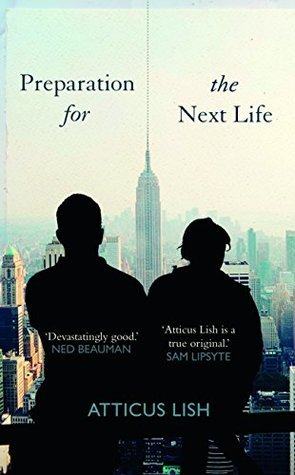 Preparation for the Next Life by Atticus Lish: Like West Side Story, this debut novel is an updated Romeo and Juliet narrative – a tragedy-bound love story with a gritty contemporary setting and a sobering message about racism and the failure of the American dream. Lish’s post-9/11 New York City is less melting pot than Boschian hell, a violent abyss lubricated with the sweat of illegal immigrants. The matter-of-fact style somehow manages to elevate the everyday and urban into an art form. (Full review in August 2015 issue of Third Way magazine.)
Housebreaking by Dan Pope: This tightly crafted novel of adultery in dysfunctional suburbia is somewhat reminiscent of Tom Perrotta’s Little Children or the movie Far from Heaven, but with less memorable characters and storyline overall. The strategy of revisiting the same events of the late summer and fall of 2007 from different characters’ perspectives makes it feel slightly repetitive and claustrophobic.
In a Dark Wood by Joseph Luzzi: In November 2007 Joseph Luzzi’s wife Katherine was in a fatal car accident; she had been eight and a half months’ pregnant, so within one day he entered “the wild uncharted terrain of being a single father and widower.” For several years Luzzi disengaged from fatherhood, throwing himself into his work – teaching Italian at Bard College, editing the proofs for a forthcoming book – while his mother did the hard work of childrearing. As Virgil was to Dante, Dante is to Luzzi: a guide through the hell of loss and into a vita nuova as he starts a new life with his daughter Isabel and, later, his second wife.
 Big Magic by Elizabeth Gilbert: Gilbert sets herself up as a layman’s creativity guru much like Anne Lamott does with Bird by Bird or Stephen King with On Writing. This is based on Gilbert’s TED talks, and it reads very much like a self-help pep talk, with short chapters, lots of anecdotes, and buzz words to latch onto. Her central tenet is “You do not need anybody’s permission to live a creative life.” The voice and message are similar to Rob Bell’s in the field of contemporary theology: reminding readers that what is too precious for words should, perhaps paradoxically, be held loosely with open hands. Releases September 22nd.
Miss Emily by Nuala O’Connor: Emily Dickinson’s Amherst is an inviting setting, and the alternating first-person voices of Emily and the family’s Irish maid, Ada Concannon, are both well realized. However, the plot soon gets mired in the melodrama of a wrong done to Ada in the Dickinson household, which results in a crisis that – you guessed it – requires the reclusive Emily to leave the house. After reading, I remained greedy for more of Emily’s inner life and poetry.
Malignant Metaphor by Alanna Mitchell: A Canadian science journalist counters three misleading adjectives often applied to cancer: inevitable, preventable, and deserved. She personalizes her quest for knowledge through two family experiences. First her brother-in-law, having already survived prostate cancer, was diagnosed with untreatable stage III melanoma. Later Mitchell’s daughter had a thyroid cancer scare. In both cases, things turned out better than expected – proof that cancer is not a death sentence. Releases September 15th.
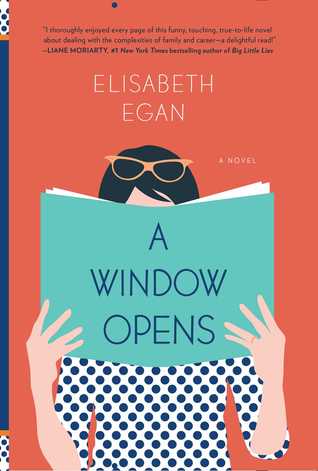 A Window Opens by Elisabeth Egan: A sweet, funny debut novel about a woman who tries to juggle all the elements of a happy life: finding the perfect job for a modern book-lover…but also being a good mother to her three children, supporting her husband after he loses his job at a law firm, and helping her mother care for her father as he suffers a relapse of throat cancer. It succeeds because its female first-person voice is immediately engaging. You like Alice and root for her. Releases August 25th.
The Sunken Cathedral by Kate Walbert: Much has been made of Walbert’s “Impressionistic” style. There is some beautiful writing here for sure, but I think it would lend itself better to short stories as there is not enough plot or character continuity to latch onto. Essentially the novel is about a set of New Yorkers in a Chelsea brownstone (chiefly Marie, an old woman who came to America from France after World War II) and their disparate memories and experiences.

 Bookish Beck = Rebecca Foster. American transplant to England. Freelance proofreader and book reviewer.
 Bookish Beck