America Reading & Book Haul, Etc.
On Wednesday we got back from two weeks in the States. We were so busy catching up with family and friends we hadn’t seen in a year and a half or more that my reading really slowed down: aside from the three books I took on the plane and finished within my first week, I only read another two books (not counting two during the trip back). Alas, I seem to be in a bit of a rut: everything I read was 3 stars. I haven’t finished anything I’d rate higher than that since late May. I do hope I can break that pattern before June ends!
What I Read:
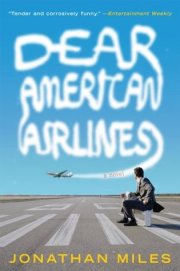 In Dear American Airlines by Jonathan Miles, Bennie Ford writes an extended letter during an unexpected overnight layover in Chicago, ostensibly to demand his $392.68 back, but really to tell his life story. His daughter is getting married in California tomorrow; it’s Bennie’s chance to make things right after years of estrangement. Will he make it to the wedding or not? The structure of the book means it doesn’t particularly matter, and I stopped caring a little bit as it went on. The sections of a novel Bennie is translating from the Polish felt irrelevant to me. Still, amusing, and a good one to read in the airport and on a plane.
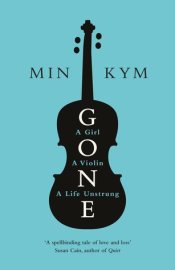 Gone: A Girl, a Violin, a Life Unstrung by Min Kym: I’m completely unmusical, so I enjoyed learning about what it’s like to be a violin virtuoso and a child prodigy, and what it means to fall in love with an instrument. Kym also puts things into the context of being a Korean immigrant to London. The central event of the book is having her Stradivarius, worth hundreds of thousands of pounds, stolen from a train station café in late 2010. It’s a brief and fairly immersive story, but the style is melodramatic and choppy at times.
 Back When We Were Grown-ups was my fifth Anne Tyler novel. Rebecca is in her fifties and the pillar of the large Davitch family, even though she only married into it six years before her husband’s sudden death. The Davitches are always renting out their home for their party business, and Rebecca has over the years developed a joyous persona that she’s not sure is really her true self. What would life have been like if she hadn’t become a stepmother to Joe’s three girls but instead married her college sweetheart, Will? While this is funny and warm, and a cozy read in the best possible way, it didn’t really stand out for me.
Three Singles to Adventure by Gerald Durrell, first published in 1954, tells of his animal collecting in Guiana, South America. The highlight is pipa toad reproduction and birth.
 Grief Cottage by Gail Godwin is a very atmospheric read, set on a South Carolina island with a haunted cottage where a family was swept away by a hurricane. However, I thought the rhythm of the young narrator’s languid summer days caring for his great-aunt became tedious, and I struggled to buy how self-aware he was meant to be of his fragile mental state at the age of 11. It’s reminiscent of John Irving (quirky secondary characters and so on) but without the same spark. I was sent a review copy for BookBrowse but found I couldn’t recommend it with 4 stars or higher.
To my surprise, I completely went off Kindle reading on this trip until the flight back, when I raced through Salmon Doubts by Adam Sacks, a sweet but inconsequential graphic novel about the salmon’s life cycle. I also started the poetry collection Fast by Jorie Graham but left it unfinished.
Two more DNFs from the trip were The Reluctant Fundamentalist by Mohsin Hamid and Between the World and Me by Ta-Nehisi Coates. I may try again with both in the future. Alas, library reading was a total wash: Hourglass by Dani Shapiro didn’t arrive in time, I abandoned the Coates, and I didn’t feel in the mood for advice letters so ended up not even starting Tiny Beautiful Things by Cheryl Strayed.
 My enjoyable read on the long journey back was Mennonite in a Little Black Dress by Rhoda Janzen. Janzen gave the Mennonite tradition she’d forsaken a second look after her life fell apart in her early forties: her husband left her for Bob, whom he met on a gay dating site; and she was in a serious car accident. It’s more in the form of linked autobiographical essays than a straight memoir, so she keeps cycling round to some of the same themes, and it gets less laugh-out-loud funny as it goes on. Still, I was impressed by how the author has managed to pull what’s good from experiences most would consider disastrous. (I also read the first third of Hotel du Lac by Anita Brookner.)
Now that I’m home I’ve started a huge pile of review books and library books and instead of the 1–3 books at a time I was reading while we were away I’m back up to my more usual 14.
What I Bought:
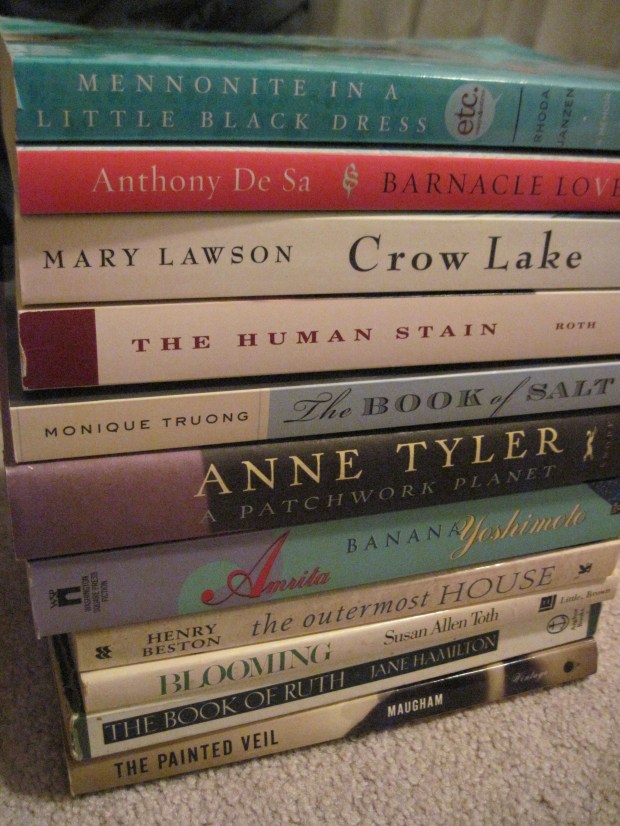
Day 2: A stop at my parents’ local Dollar Tree to stock up on greetings cards for the year’s events (2 for $1!) also brought some unexpectedly good book finds. [Not pictured: a paperback of Jonathan Franzen’s Freedom, our favorite of his novels.] Total spend: $3.18.
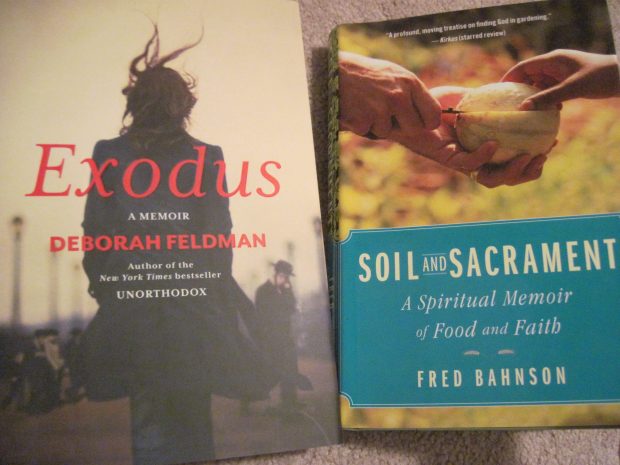
Day 4: The obligatory visit to Wonder Book & Video in Frederick, Maryland, one of my happy places.
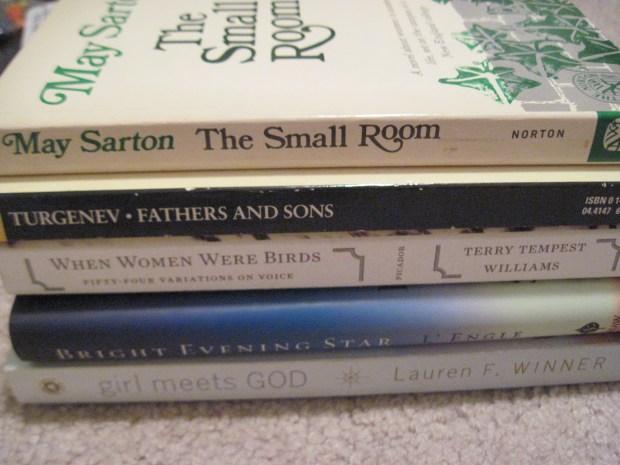
Day 5: A trip to bookstore chain 2nd & Charles in Hagerstown, MD. Total spend (minus my trade-in of various books and CDs): $5.19.
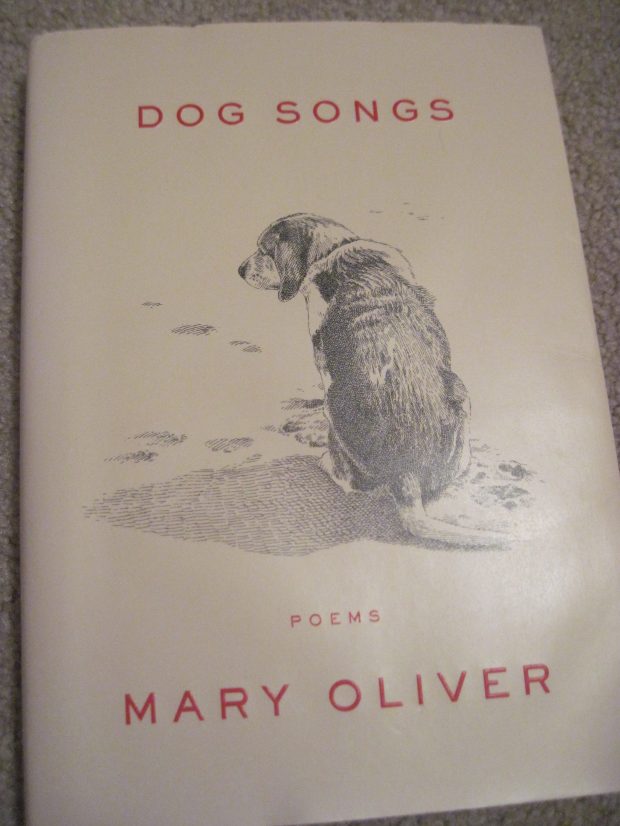
Day 6: A book of Mary Oliver poems from the Goodwill store in Westminster, MD.
Day 14: Some bargains from a thrift store in Rehoboth Beach, Delaware, where we met up with my friend and her family while they were on holiday. Total spend: $4.50.

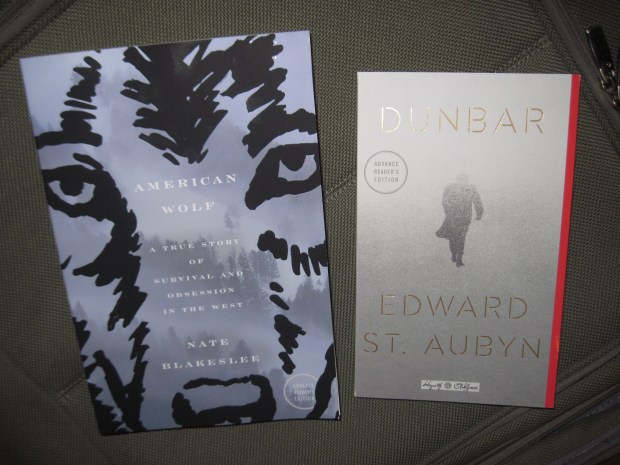
I also managed to snag a couple of Crown ARCs that are not out until October.
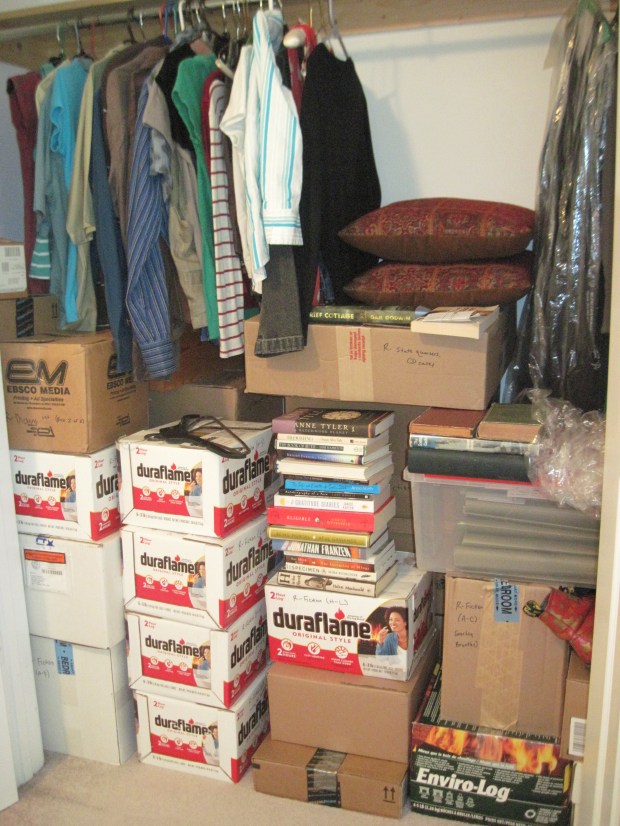
The state of my closet back in the States (most of those boxes contain books):
Other Bookish Sightings:
A Little Free Library at my parents’ local organic supermarket. I dropped off a few proof copies before I left.

The Peabody Library of Johns Hopkins University in Baltimore.

A trip to Mermaid Books in Williamsburg, Virginia (overpriced – no purchases), where I spotted an amusing cover on Anne Tyler’s first novel – she still has the same hairdo!


Ephemera in two of my purchases.


Other highlights of the trip:
- Meeting my sister’s fiancé (!) and his kids.
- Going to an alpaca farm with my sister and nephews.
- Surprising my mom with her early 70th birthday gift: a mother–daughters trip to the Kennedy Center in Washington, D.C. for dinner and a showing of Shear Madness, a long-running improvisational murder mystery with audience participation.
- Exploring Williamsburg (and Jamestown Island) for the first time since I was a kid.
- A day trip to Cape May, New Jersey – a place to go back to, methinks.
- Plus all our meet-ups, however brief, with friends.
- Not forgetting the total of seven cats and two dogs we got to spend time with.
- Two weeks of doing absolutely no work. I didn’t miss it for a second.
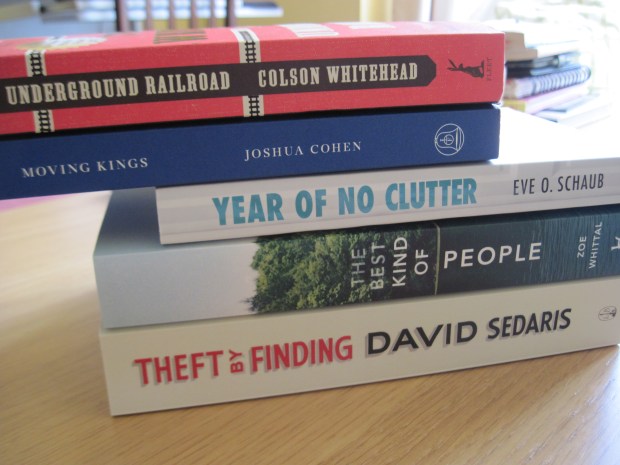
One last book haul photo: These were the review copies (top two) and giveaway books awaiting me when I got back to the UK. (I won the Schaub from Liz’s blog; I’m on a great run with Goodreads giveaways at the moment: along with these Sedaris and Whittal titles, I have new books by Cathy Rentzenbrink and Anne de Courcy on the way.)
How has your summer reading been going?
Making Plans (and Book Lists) for America
On Tuesday we leave for two weeks in America. It’s nearly a year and a half since our last trip – much too long – so we’ll be cramming in lots of visits with friends and family and doing a fair bit of driving around the Mid-Atlantic states. I’m giving myself the whole time off, which means I’ve been working flat out for the past two weeks to get everything done (including my U.K. and U.S. taxes). I’m nearly there: at the 11-day countdown I still had 12 books I wanted to finish and 12 reviews to write; now I’m down to five books, only one of which might be considered essential, and all the reviews are ready to submit/schedule. What with the holiday weekend underway, it should all be manageable.
I’m a compulsive list maker in general, but especially when it comes to preparing for a trip. I’ve kept adding to lists entitled “Pack for America,” “Do in America,” “Buy in America,” and “Bring back from America.” But the more fun lists to make are book-related ones: what paper books should I take to read on the plane? Which of the 315 books on my Kindle ought I to prioritize over the next two weeks? Which exclusively American books should I borrow from the public library? What secondhand books will I try to find? And which of the books in the dozens of boxes in the closet of my old bedroom will I fit in my suitcase for the trip back?
I liked the sound of Laila’s habit of taking an Anne Tyler novel on every flight. That’s just the kind of cozy reading I want, especially as I head back to Maryland – not far at all from Tyler’s home turf of Baltimore. I browsed the blurbs on a few of her paperbacks I have lying around and chose Back When We Were Grownups to be my fifth Tyler and one of my airplane reads.
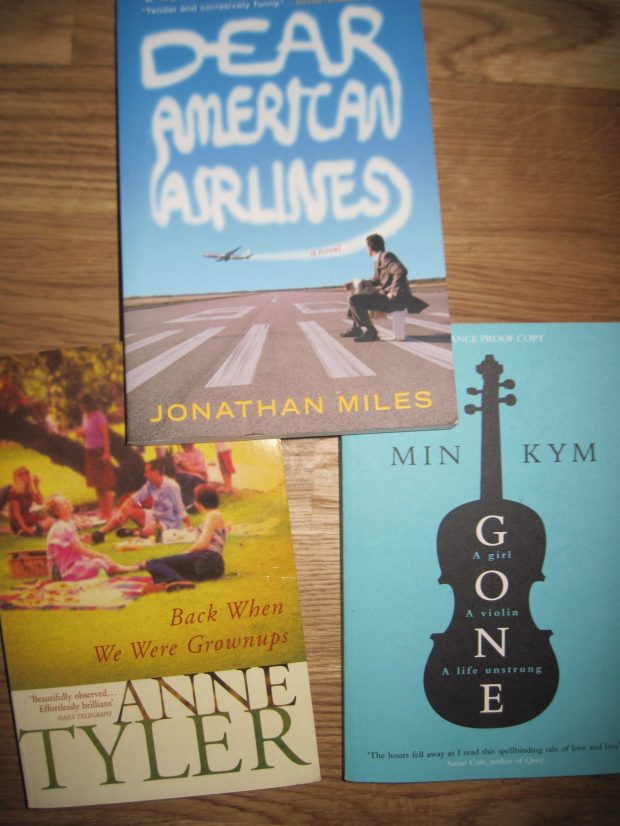
I’m also tempted by Min Kym’s Gone, a memoir by a violin virtuoso about having her Stradivarius stolen. I picked up a proof copy in a 3-for-£1 charity sale a couple of weeks ago. And then I can’t resist the aptness of Jonathan Miles’s Dear American Airlines (even though we’re actually flying on Virgin). I’ll start one or more of these before we go, just to make sure they ‘take’.
I almost certainly won’t need three print books for the trip, particularly if I take advantage of the in-flight entertainment. We only ever seem to watch films while we’re in America or en route there, so between the two legs I’ll at least try to get to La La Land and The Light between Oceans; I’m also considering Nocturnal Animals, Silence, and the live-action Beauty and the Beast – anyone seen these?
However, I’ll also keep my Kindle to hand, as I find it easier to pick up and put down on multi-part journeys like ours to the airport (train ride + coach ride). Some of the books on my Kindle priority list are: The Day that Went Missing by Richard Beard, Cork Dork by Bianca Bosker, Eleanor Oliphant Is Completely Fine by Gail Honeyman, The Fact of a Body by Alexandria Marzano-Lesnevich, Mrs. Fletcher by Tom Perrotta (out in August), The Power by Naomi Alderman, Reservoir 13 by Jon McGregor, The Rules Do Not Apply by Ariel Levy, See What I have Done by Sarah Schmidt, You Should Have Left by Daniel Kehlmann … and the list continues, but I’ll stop there.

My book shopping list is an ongoing one, as the many cross-outs and additions on this sheet show. Finding specific books at my beloved Wonder Book can be a challenge, so I usually just keep in mind the names of authors I’d like to read more by. This time that might include Arnold Bennett, Geoff Dyer, Elizabeth Hay, Bernd Heinrich, W. Somerset Maugham, Haruki Murakami and Kathleen Norris. In addition to the couple of secondhand bookstores we always hit, I hope to visit a few new-to-me ones on stays with friends in Virginia.
As for those poor books sat in boxes in the closet, I have plans to unearth novels by Anita Brookner, Mohsin Hamid, Kent Haruf, Penelope Lively, Howard Norman and Philip Roth – for reading while I’m there and/or bringing back with me. I’m also contemplating borrowing my dad’s omnibus edition of the John Updike “Rabbit” novels. From my nonfiction hoard, I fancy an Alexandra Fuller memoir, D.H. Lawrence’s travel books and more of May Sarton’s journals. If only it weren’t for luggage weight limits!
On Monday I’ll publish my intercontinental Library Checkout, on Tuesday I have a few June releases to recommend, and then I’m scheduling a handful of posts for while I’m away – a couple reviews I happen to have ready, plus some other lightweight stuff. Alas, I read no doorstoppers in May, but I have a list (of course) of potential ones for June, so will attempt to resurrect that monthly column.
Though I may be slow to respond to comments and read your blogs while I’m away, I will do my best and hope to catch up soon after I’m back.
Starting the Year as I Mean to Go On?
The houseguests have gone home, the Christmas tree is coming down tomorrow, and it’s darned cold. I’m feeling stuck in a rut in my career, the blog, and so many other areas of life. It’s hard not to think of 2017 as a huge stretch of emptiness with very few bright spots. All I want to do is sit around in my new fuzzy bathrobe and read under the cat. Luckily, I’ve had some great books to accompany me through the Christmas period and have finished five so far this year.
I thought I’d continue the habit of writing two-sentence reviews (or maybe no more than three), except when I’m writing proper full-length reviews on assignment or for blog tours or other websites. Granted, they’re usually long and multi-part sentences, and this isn’t actually a time-saving trick – as Blaise Pascal once said, “I’m sorry I wrote you such a long letter; I didn’t have time to write a short one” – but it feels like good discipline.
So here’s some mini-reviews of what I’ve been reading in late December and early January:
The Dark Flood Rises, Margaret Drabble
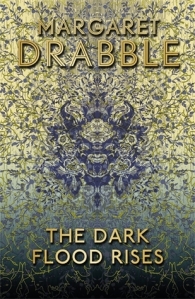 The “dark flood” is D.H. Lawrence’s metaphor for death, and here it corresponds to busy seventy-something Fran’s obsession with last words, obituaries and the search for the good death as many of her friends and acquaintances succumb – but also to literal flooding in the west of England and (dubious, this) to mass immigration of Asians and Africans into Europe. This is my favorite of the five Drabble books that I’ve read – it’s closest in style and tone to her sister A.S. Byatt as well as to Tessa Hadley, and the themes of old age and life’s randomness are strong – even though there seem to be too many characters and the Canary Islands subplot mostly feels like an unnecessary distraction. (Public library)
Hogfather, Terry Pratchett
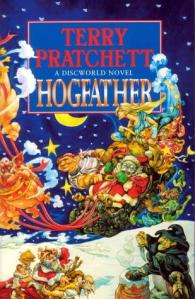 In Discworld belief causes imagined beings to exist, so when a devious plot to control children’s minds results in a dearth of belief in the Hogfather, the Fat Man temporarily disappears and Death has to fill in for him on this Hogswatch night. I laughed aloud a few times while reading this clever Christmas parody, but I had a bit of trouble following the plot and grasping who all the characters were given that this was my first Discworld book; in general I’d say that Pratchett is another example of British humor that I don’t entirely appreciate (along with Monty Python and Douglas Adams) – he’s my husband’s favorite, but I doubt I’ll try another of his books. (Own copy)
Love of Country: A Hebridean Journey, Madeleine Bunting
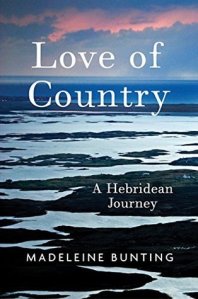 In a reprise of childhood holidays that inevitably headed northwest, Bunting takes a series of journeys around the Hebrides and weaves together her contemporary travels with the religion, folklore and history of this Scottish island chain, an often sad litany of the Gaels’ poverty and displacement that culminated with the brutal Clearances. Rather than giving an exhaustive survey, she chooses seven islands to focus on and tells stories of unexpected connections – Orwell’s stay on Jura, Lord Leverhulme’s (he of Port Sunlight and Unilever) purchase of Lewis, and Bonnie Prince Charlie’s landing on Eriskay – as she asks how geography influences history and what it truly means to belong to a place. (Public library)
Cobwebs and Cream Teas: A Year in the Life of a National Trust House, Mary Mackie
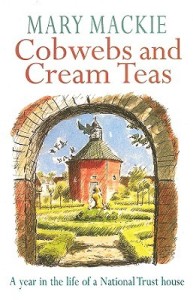 Mackie’s husband was Houseman and then Administrator at Felbrigg Hall in Norfolk in the 1980s – live-in roles that demanded a wide range of skills and much more commitment than the usual 9 to 5 (when he borrowed a pedometer he learned that he walked 15 miles in the average day, without leaving the house!). Her memoir of their first year at Felbrigg proceeds chronologically, from the intense cleaning and renovations of the winter closed season through to the following Christmas’ festivities, and takes in along the way plenty of mishaps and visitor oddities. It will delight anyone who’d like a behind-the-scenes look at the life of a historic home. (Own copy)
The Bridge Ladies: A Memoir, Betsy Lerner
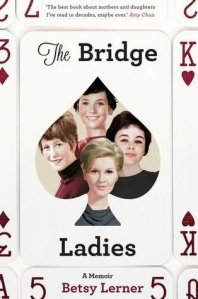 When life unexpectedly took the middle-aged Lerner back to her hometown of New Haven, Connecticut, she spent several years sitting in on her mother’s weekly bridge games to learn more about these five Jewish octogenarians who have been friends for 50 years and despite their old-fashioned reserve have seen each other through the loss of careers, health, husbands and children. Although Lerner also took bridge lessons herself, this is less about the game and more about her ever-testy relationship with her mother (starting with her rebellious teenage years), the ageing process, and the ways that women of different generations relate to their family and friends. It wouldn’t be exaggerating to say that every mother and daughter should read this; I plan to shove it in my mother’s and sister’s hands the next time I’m in the States. (Own copy)
Waiting on the Word, Malcolm Guite
 Guite chooses well-known poems (by Christina Rossetti, John Donne, Alfred Lord Tennyson, Samuel Taylor Coleridge et al.) as well as more obscure contemporary ones as daily devotional reading between the start of Advent and Epiphany; I especially liked his sonnet sequence in response to the seven “O Antiphons.” His commentary is learned and insightful, and even if at times I thought he goes into too much in-depth analysis rather than letting the poems speak for themselves, this remains a very good companion to the Christmas season for any poetry lover. (E-book from NetGalley)
 I started too many books over Christmas and have sort of put six of them on hold – including Titus Groan, which I’m thinking of quitting (it takes over 50 pages for one servant to tell another that the master has had a son?!), and City on Fire, which is wonderful but dispiritingly long: even after two good sessions with it in the days after Christmas, I’ve barely made a dent.
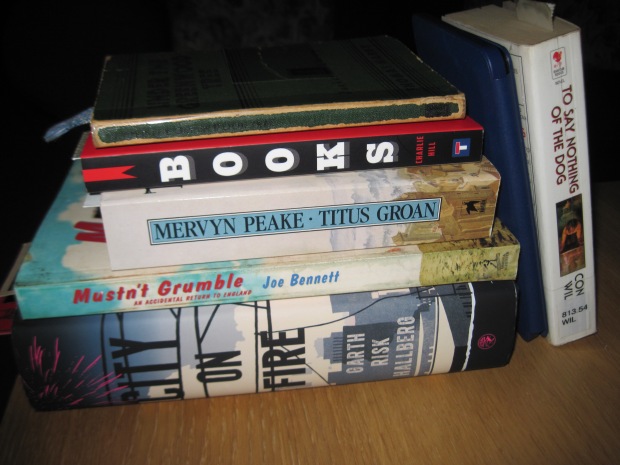
Stack on left = on hold (the book on top is Under the Greenwood Tree); standing up at right = books I’m actually reading.
However, the three books that I am actively reading I’m loving: To Say Nothing of the Dog by Connie Willis is an uproarious blend of time travel science fiction and Victorian pastiche (university library), Pachinko by Min Jin Lee is a compulsive historical saga set in Korea (ARC from NetGalley), and the memoir Birds Art Life by Kyo Maclear has been compared to H Is for Hawk in the way she turns to birdwatching to deal with depression (e-book from Edelweiss). I also will be unlikely to resist my e-galley of the latest Anne Lamott book, Hallelujah Anyway (forthcoming in April, ARC from Edelweiss), for much longer.



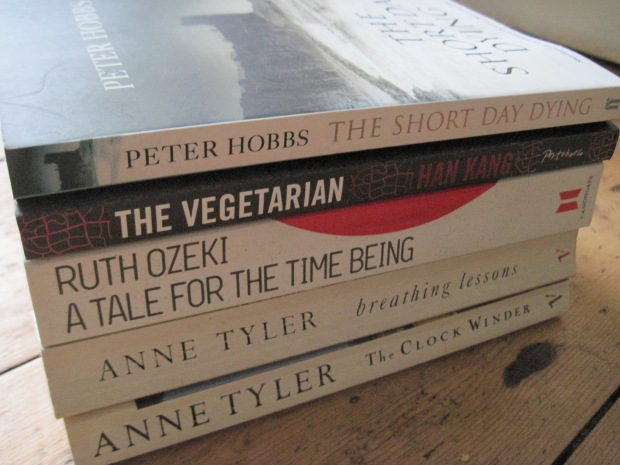
Meanwhile, in post-holiday charity shopping I scored six books for £1.90: one’s been tucked away as a present for later in the year; the Ozeki I’ve already read, but it’s a favorite so I’m glad to own it; and the rest are new to me. I look forward to trying Han Kang; Anne Tyler is a reliable choice for a cozy read; and the Hobbs sounds like a wonderful Victorian-set novel.
All in all, I seem to be starting my year in books as I mean to go on: reading a ton; making sure I review most or all of the books, even if I write just a few sentences; maintaining a balance between my own books, library books, and recent or advance NetGalley/Edelweiss reads; and failing to restrain myself from buying more.
Now if I could just work on my general attitude…
How’s the reading year starting off for you?
Return to Bookbarn
Sounds like a summer blockbuster, doesn’t it? There was certainly plenty of tension on our drive from the Reading area to Somerset this past Friday, as traffic on the M4 built up and our time for book shopping ticked down from a planned hour and a half to just 35 minutes before store closing. It had been almost exactly one year since my last trip to Bookbarn International, and after weeks of wheedling I’d finally persuaded my husband to make the detour on our way to visit friends in Bristol.
Despite the tight deadline, I enjoyed my browsing and scored some good finds. As usual, it seemed like a terrific bargain: £14.50 for 15 books. One’s a gift for our nephew in America, four are nature books my husband chose, and the rest are mine! Bonus: a few days later it occurred to me to ask after the collectible books I left behind last year for Bookbarn to sell for me and it turns out I have nearly £21 coming to me – so in effect our shopping was free!
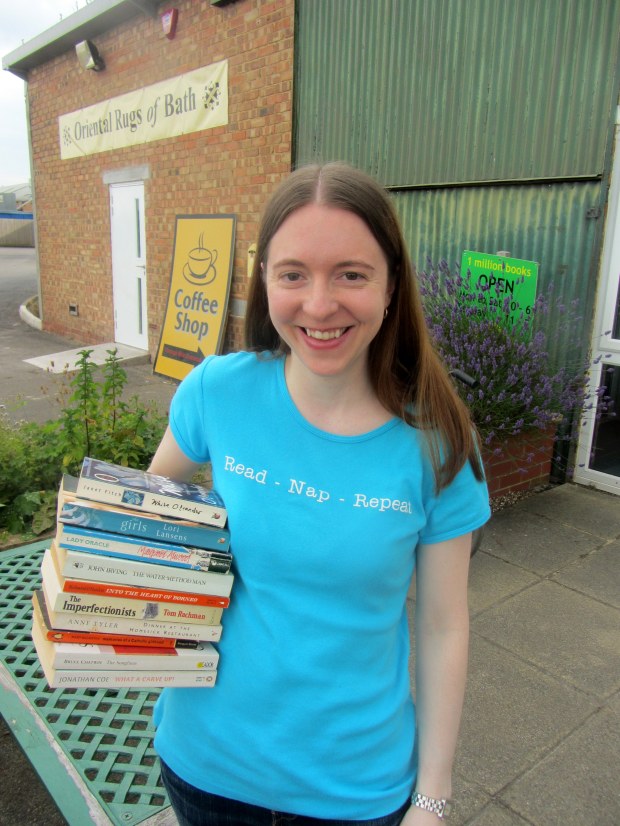
In case you can’t read the titles in the photo, here’s my haul:
Travel books:
The Songlines, Bruce Chatwin
Into the Heart of Borneo, Redmond O’Hanlon
[I featured both of the world-class travel writers in a recent article for Bookmarks, so it’s only proper that I actually read something by them.]
Memoir:
Memories of a Catholic Girlhood, Mary McCarthy [I’m a sucker for religious memoirs.]
Fiction:
Lady Oracle, Margaret Atwood [It’s been a while since I tried one from her back catalogue.]
What a Carve Up!, Jonathan Coe [I enjoyed the recent ‘sequel’, Number 11.]
White Oleander, Janet Fitch [An Oprah favorite I’ve long meant to read.]
The Water-Method Man, John Irving [Let’s hope for better things from his second novel.]
The Girls, Lori Lansens [I can’t resist a conjoined twins story.]
The Imperfectionists, Tom Rachman [Already read some years back, but worth owning.]
Dinner at the Homesick Restaurant, Anne Tyler [To continue my run of Tyler classics.]
Had any secondhand book coups lately?
What I’ve Been Reading Recently
My own paper books! Really! Not exclusively; I still find Kindle books easiest to read during lunches and on the cross trainer. Still, I’m pleased with the progress I’ve made towards my summer resolution of reading my own books. In August I’ll have to get to grips with some of those doorstoppers I’ve been meaning to pick up. Below I give brief write-ups of what I’ve gotten through lately and recall how these books came into my collection to start with.
 June by Gerbrand Bakker: It seemed to make sense to read this during the month of June. I loved Bakker’s The Twin, but struggled to connect with this one. The first chapter and the last three (starting with “June”) are the best – I felt that the core 1969 material about the Queen’s visit and the family’s tragedy would make for a great short story or novella, but the bulk of the novel is languid contemporary moping about the ongoing effects on the Kaans. It took me forever to figure out who all the characters were and keep them straight (brothers Jan and Johan, for instance), and the way the perspective drifts from one to another doesn’t help with that. Matriarch Anna, with her habit of going up and lying in the hayloft when life gets to be too much for her, was my favorite character.
[Bought in a local charity shop for 20 pence.] 
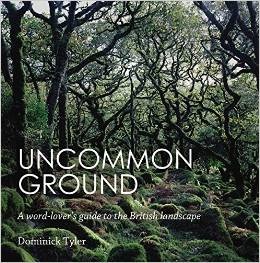 Uncommon Ground by Dominick Tyler: This is like a photographic companion to Robert Macfarlane’s Landmarks. Journeying around Britain, Tyler illustrates different geographical features, many of them known by archaic or folksy names. Some are just record shots, while others are true works of art. I especially liked the more whimsical terms: “Monkey’s birthday” for simultaneous rain and sunshine, and “Witches’ knickers” for plastic scraps waving from a tree or fence.
[I won a copy in a Guardian giveaway.] 
 Wave by Sonali Deraniyagala: The author was vacationing with her family at a national park on the southeast coast of her native Sri Lanka in December 2004 when the Boxing Day tsunami hit, killing her parents, husband, and two sons. Job-like, Deraniyagala gives shape to her grief and lovingly remembers a family life now gone forever as she tours her childhood home in Colombo and her London house. It’s not until over six years later that she feels “I can rest … with the impossible truth of my loss, which I have to compress often and misshape, just so I can bear it—so I can cook or teach or floss my teeth.” This is a wonderful tribute to everyone she lost. Her husband and sons, especially, come through clearly as individuals you feel that you know. Although it’s not a focus of the memoir, Sri Lanka’s natural beauty and food culture struck me – this would be an appealing place to visit.
[Borrowed from a friend in America.]
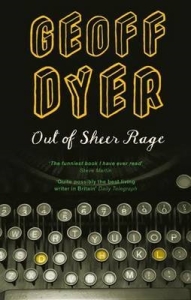 Out of Sheer Rage by Geoff Dyer: This is a book about D.H. Lawrence in the same way that Charlie Kaufman’s Adaptation is a film of The Orchid Thief. In other words, it’s not particularly about Lawrence at all; it’s just as much, if not more, about Geoff Dyer – his laziness, his procrastination, his curmudgeonly attitude, his futile search for the perfect places to read Lawrence’s works and write about Lawrence, his failure to feel the proper reverence at Lawrence sites, and so on. While I can certainly sympathize with Dyer’s wry comments about his work habits (“I hate doing anything in life that requires an effort”; “better reading than writing”; “all things in which I am interested … [are] a source of stress and anxiety”), I liked best the parts of the book where he actually writes about Lawrence. (Expanded review on Goodreads.)
[Bought – I think in the Hay Cinema Bookshop – for £2.99.] 
 The Middlesteins by Jami Attenberg: I was surprised how much I loved this. On the face of it it’s a fairly conventional dysfunctional family novel à la Jonathan Franzen, set among a Jewish family in Chicago. The main drama is provided by the mother, Edie, who seems to be slowly eating herself to death: she gorges herself on snacks and fast food several times a day even though she’s facing a third major surgery for diabetes. Her husband, Richard, ditched her in her time of need, leaving their adult children to pick up the slack. Every character is fully rounded (pun intended?) and the family interactions feel perfectly true to life. This isn’t really an ‘issues’ book, yet it deals with obesity in a much more subtle and compassionate way than Lionel Shriver’s Big Brother. (Expanded review on Goodreads.)
[In last year’s Christmas stocking, from the Waynesboro, Pennsylvania Dollar Tree.]
 The Republic of Love by Carol Shields: Not one of my favorites from Shields, but still enjoyable and reminiscent of Anne Tyler’s The Accidental Tourist. Her chapters alternate between the perspectives of radio disc jockey Tom Avery and folklorist Fay McLeod, two Winnipeg lonely hearts who each have their share of broken relationships behind them. It’s clear they’re going to meet and fall in love, but Shields is careful to interrogate myths of love at first sight and happily ever after. I especially liked the surprising interconnectedness of everyone in Winnipeg, the subplot about Fay’s parents’ marriage, and the habit of recording minor characters’ monologues. My major points of criticism would be that Tom sometimes feels like a caricature and I wasn’t entirely sure what the mermaid material was meant to achieve. (Expanded review on Goodreads.)
[In poor condition, so free from the Oxfam bookshop where I volunteered in Romsey in 2007–8.]
 Not That Kind of Girl: A Memoir by Carlene Bauer: Lena Dunham forever rendered this memoir obscure by stealing the title. I read it because I adored Bauer’s debut novel, Frances and Bernard. This could accurately be described as a spiritual memoir, and I think will probably appeal most to readers who grew up in a restrictive religious setting. A bookish, introspective adolescent, Bauer was troubled by how her church and Christian school denied the validity of secular art, including the indie rock she loved and the literature she lost herself in. All the same, Christian notions of purity and purpose stuck with her throughout her college days in Baltimore and then when she was trying to make it in publishing in New York City. This book resonated with my experience in many ways. What Bauer does best is to capture a fleeting mindset and its evolution into a broader way of thinking. (Expanded review on Goodreads.)
[Bought cheap on Amazon USA to qualify for super saver shipping.] 

A statue of Alexander von Humboldt, in the grand stairwell of the Natural History Museum in Vienna.
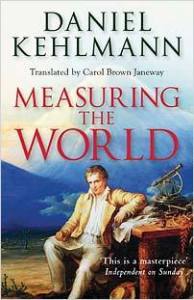
Measuring the World by Daniel Kehlmann: “Whenever things were frightening, it was a good idea to measure them.” This is a delightful historical picaresque about two late-eighteenth-century German scientists: Alexander von Humboldt, who valiantly explored South America and the Russian steppes, and Carl Friedrich Gauss, a misanthropic mathematician whose true genius wasn’t fully realized in his surveying and astronomical work. Both difficult in their own way, the men represent different models for how to do science: an adventurous one who goes on journeys of discovery, and one who stays at home looking at what’s right under his nose. I especially loved Gauss’s hot-air balloon ride and Humboldt’s attempt to summit a mountain. The lack of speech marks somehow adds to the dry wit.
[Purchased via a donation to the Book-Cycle of Exeter.]
What have you been reading recently?
European Traveling and Reading
We’ve been back from our European trip for over a week already, but I haven’t been up to writing until now. Partially this is because I’ve had a mild stomach bug that has left me feeling yucky and like I don’t want to spend any more time at a computer than is absolutely necessary for my work; partially it’s because I’ve just been a bit blue. Granted, it’s nice to be back where all the signs and announcements are in English and I don’t have to worry about making myself understood. Still, gloom over Brexit has combined with the usual letdown of coming back from an amazing vacation and resuming normal life to make this a ho-hum sort of week. Nonetheless, I want to get back into the rhythm of blogging and give a quick rundown of the books I read while I was away.
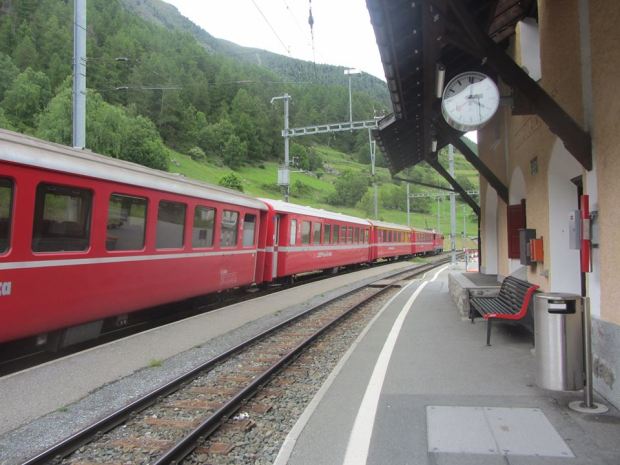
Tiny Lavin station, our base in southeastern Switzerland.
But first, some of the highlights of the trip:
- the grand architecture of the center of Brussels; live jazz emanating from a side street café
- cycling to the zoo in Freiburg with our friends and their kids
- ascending into the mountains by cable car and then on foot to circle Switzerland’s Lake Oeschinensee
- traipsing through meadows of Alpine flowers
- exploring the Engadine Valley of southeast Switzerland, an off-the-beaten track, Romansh-speaking area where the stone buildings are covered in engravings, paintings and sayings
- our one big splurge of the trip (Switzerland is ridiculously expensive; we had to live off of supermarket food): a Swiss dessert buffet followed by a horse carriage ride
- spotting ibex and chamois at Oeschinensee and marmots in the Swiss National Park
- miming “The Hills Are Alive” in fields near our accommodation in Austria (very close to where scenes from The Sound of Music were filmed)
- the sun coming out for our afternoon in Salzburg
- daily coffee and cake in Austrian coffeehouses
- riding the underground and trams of Vienna’s public transport network
- finding famous musicians’ graves in Vienna’s Zentralfriedhof cemetery
- discovering tasty vegan food at a hole-in-the-wall Chinese restaurant in Vienna that makes its own noodles
- going to Slovakia for the afternoon on a whim (its capital, Bratislava, is only 1 hour from Vienna by train – why not?!)
We went to such a variety of places and had so many different experiences. Weather and language were hugely variable, too: it rained nine days in a row; some mornings in Switzerland I wore my winter coat and hat; in Bratislava it was 95 °F. Even in the ostensibly German-speaking countries of the trip, we found that greetings and farewells changed everywhere we went (doubly true in the Romansh-speaking Engadine). Most of the time we had no idea what shopkeepers were saying to us. Just smile and nod. It was more difficult at the farm where we stayed in Austria. Thanks to Google Translate, we had no idea that the owner spoke no English; her e-mails were all in unusual but serviceable English. We speak virtually no German, so fellow farm guests, including a Dutch couple, had to translate between us. (The rest of Europe puts us to shame with their knowledge of languages!)
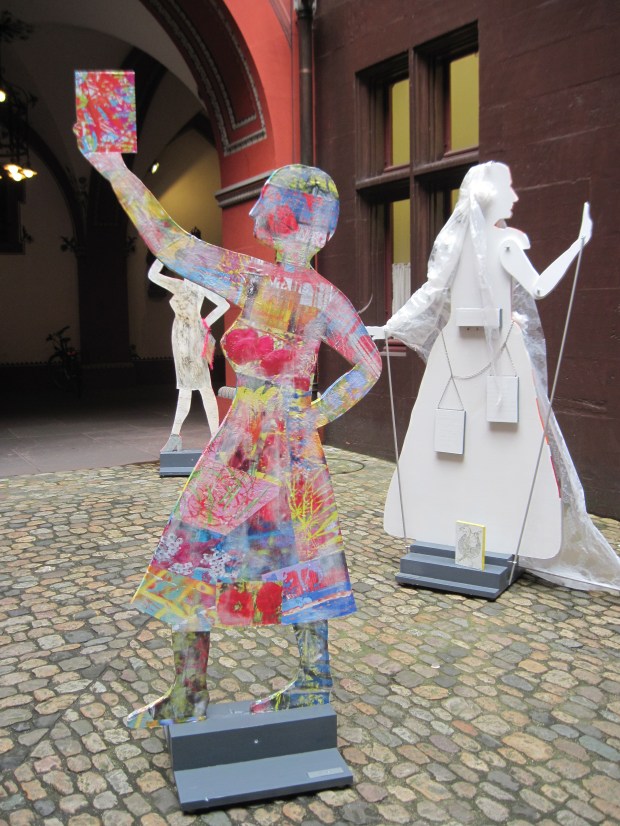
A reading-themed art installation at the Rathaus in Basel, Switzerland.
Train travel was, for the most part, easy and stress-free. Especially enjoyable were the small lines through the Engadine, which include the highest regular-service station in Europe (Ospizia Bernina, where we found fresh snowfall). The little town where we stayed in an Airbnb cabin, Lavin, was a request stop on the line, meaning you always had to press a button to get the train to stop and then walk across the tracks (!) to board. Contrary to expectations, we found that nearly all of our European trains were running late. However, they were noticeably more comfortable than British trains, especially the German ones. Thanks to train rides of an hour or more on most days, I ended up getting a ton of reading done.
 On the journey out I finished The Accidental Tourist by Anne Tyler. This is the first “classic” Tyler I’ve read, after her three most recent novels, and although I kept being plagued by odd feelings of ‘reverse déjà vu’, I really enjoyed it. This story of staid, reluctant traveler Macon Leary and how his life is turned upside down by a flighty dog trainer is all about the patterns of behavior we get stuck in. Tyler suggests that occasionally journeying into someone else’s unpredictable life might change ours for the good.
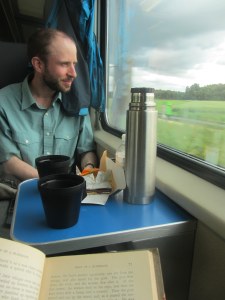 Diary of a Pilgrimage by Jerome K. Jerome was just what I expected: a very silly book about the travails of international travel. It’s much more about the luckless journey and the endurance of national stereotypes than it is about the Passion Play the travelers see once they get to Germany. It was amusing to see the ways in which some things have hardly changed in 125 years.
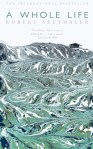 A Whole Life by Robert Seethaler, a novella set in the Austrian Alps, is the story of Andreas Egger – at various times a farmer, a prisoner of war, and a tourist guide. Various things happen to him, most of them bad. I have trouble pinpointing why Stoner is a masterpiece whereas this is just kind of boring. There’s a great avalanche scene, though.
 The Book that Matters Most by Ann Hood releases on August 9th. A new book club helps Ava cope with her divorce, her daughter Maggie’s rebelliousness, and tragic events from her past. Each month one club member picks the book that has mattered most to them in life. I thought the choices were all pretty clichéd and Ava was unrealistically passive. Although what happens to her in Paris is rather melodramatic, I most enjoyed Maggie’s sections.
 Me and Kaminski was my second novel from Daniel Kehlmann. Know-nothing art critic Sebastian Zöllner interviews reclusive artist Manuel Kaminski and then accompanies the older man on a road trip to find his lost sweetheart. Zöllner is an amusingly odious narrator, but I found the plot a bit thin. This is a rare case where I would argue the book needs to be 100 pages longer.
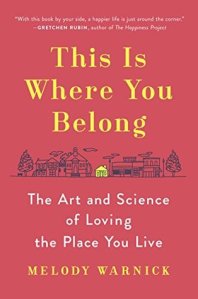 About midway through the trip I finished another I’d started earlier in the month, This Is Where You Belong by Melody Warnick. The average American moves 11.7 times in their life. I’m long past that already. The book collects an interesting set of ideas about how to feel at home wherever you are: things like learning the place on foot, shopping and eating locally, and getting to know your neighbors. I am bad about integrating into a new community every time we move, so I picked up some good tips. Warnick uses examples from all over (though mostly U.S. locations), but also makes it specific to her home of Blacksburg, Virginia.
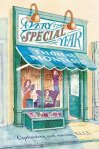 “A cabinet of fantasies, a source of knowledge, a collection of lore from past and present, a place to dream… A bookshop can be so many things.” In A Very Special Year by Thomas Montasser, Valerie takes over Ringelnatz & Co. bookshop when the owner, her Aunt Charlotte, disappears. She has the entrepreneurial skills to run a business and gradually develops a love of books, too. The title book is a magical tome with blank pages that reveal the reader’s destination when the time is right. Twee but enjoyable; a quick read.
 Eleven Hours by Pamela Erens is a taut thriller set during one woman’s experience of childbirth in New York City in 2004. Flashbacks to how the patient and her Caribbean nurse got where they are now add emotional depth. Another very quick read.
 Burning Secret by Stefan Zweig is a psychologically astute novella in which a 12-year-old tries to interpret what’s happening between his mother and a fellow hotel guest, a baron he looks up to. For this naïve boy, many things come as a shock, including the threat of sex and the possibility of deception. This reminded me most of Thomas Mann’s Death in Venice. (On a hill above Salzburg we discovered a strange disembodied bust of Stefan Zweig, along with a plaque and a road sign.)


 Playing Dead by Elizabeth Greenwood (releases August 9th) was great fun. Thinking of the six-figure education debt weighing on her shoulders, she surveys various cases of people who faked their own death or simply tried to disappear. Death fraud/“pseudocide” is not as easy to get away with as you might think. Fake drownings are especially suspect. I found most ironic the case of a man who lived successfully for 20 years under an assumed name but was caught when police stopped him for having a license plate light out. I particularly liked the chapter in which Greenwood travels to the Philippines, a great place to fake your death, and comes back with a copy of her own death certificate.
 Miss Jane by Brad Watson (releases July 12th) is a historical novel loosely based on the story of the author’s great-aunt. Born in Mississippi in 1915, she had malformed genitals, which led to lifelong incontinence. Jane is a wonderfully plucky protagonist, and her friendship with her doctor, Ed Thompson, is particularly touching. “You would not think someone so afflicted would or could be cheerful, not prone to melancholy or the miseries.” This reminded me most of What Is Visible by Kimberly Elkins, an excellent novel about living a full life and finding romance in spite of disability.
I also left two novels unfinished (that’ll be for another post) and made progress in two other nonfiction titles. All in all, a great set of reading!


I’m supposed to be making my way through just the books we already own for the rest of the summer, but when I got back of course I couldn’t resist volunteering for a few new books available through Nudge and The Bookbag. Apart from a few blog reviews I’m bound to, my summer plan will be to give the occasional quick roundup of what I’ve read of late.
What have you been reading recently?
European Holiday Reading – A (Temporary) Farewell
Tomorrow we’re off to continental Europe for two weeks of train travel, making stops in Brussels, Freiburg (Germany), two towns in Switzerland, and Salzburg and Vienna in Austria. This will be some of the most extensive travel I’ve done in Europe in the 11 or so years that I’ve lived here – and the first time I’ve been to Switzerland or Austria – so I’m excited. I’ve been working like a fiend recently to catch up and/or get ahead on reviews and blogs, so it will be particularly good to spend two weeks away from a computer. It’s also nice that our adventure doesn’t have to start with going to an airport.
Here’s what I’ve packed:
- Setting Free the Bears by John Irving (his first novel; set in Vienna)
- Diary of a Pilgrimage by Jerome K. Jerome (about a train journey from England to Germany)
- Me and Kaminski by Daniel Kehlmann (the author is Austrian)
- A Whole Life by Robert Seethaler (a novella set in the Austrian Alps)
+ Enchanting Alpine Flowers & the Rough Guide to Vienna
Also on the e-readers, downloaded from Project Gutenberg:
- Three Men on the Bummel by Jerome K. Jerome (further humorous antics in Germany)
- Burning Secret by Stefan Zweig (a novella; the author is Austrian)
+ another 250+ Kindle books from a wide variety of genres and topics – I’ll certainly have no shortage of reading material!
(Looking back now, it occurs to me that this all skews rather towards Austria! Oh well. Vienna is one of our longer stops.)

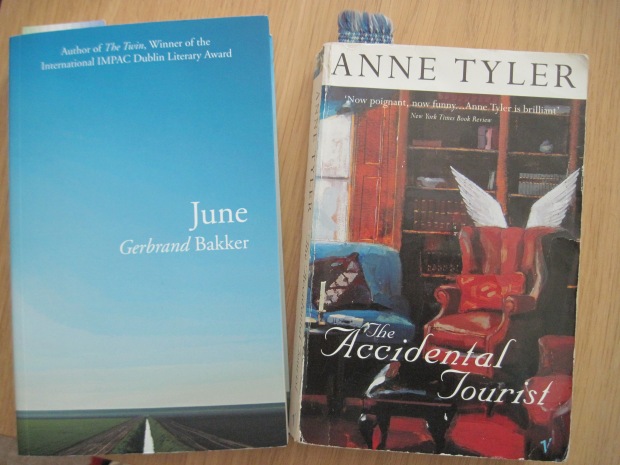
I’m supposed to be making my way through the books we already own, but on Saturday I was overcome with temptation at our local charity shop when I saw that all paperbacks were on sale – 5 for £1. I’m in the middle of one of the novels I bought that day, June by Gerbrand Bakker, along with The Accidental Tourist by Anne Tyler, and need to decide whether to put them on hold while I’m away or take one or both with me. Either way I’ll try to finish June this month; it’s just too appropriate not to!
I was also overcome with temptation at the thought of a new Eowyn Ivey novel coming out in August, so requested a copy for review.

It’s an odd time here in the UK. Readers from North America or elsewhere might be unaware that we’re gearing up for a referendum to decide whether to remain in the European Union. By the time we pass back through Brussels (‘capital’ of the European Union) on the 24th, there’s every chance the UK might no longer be an official member of Europe. I haven’t taken British citizenship so am ineligible to cast a vote; I won’t court debate by elaborating on a comparison of “Brexit” with the specter of Trump in the States. My husband has sent in his postal vote, so collectively we’ve done all we can do and now just have to wait and see.
We’re not back until late on the 24th, but I’ve scheduled a few posts for while we’re away. I will only have sporadic Internet access during these weeks, so won’t be replying to blog comments or reading fellow bloggers’ posts, but I promise to catch up when we get back.
Happy June reading!
Reviews Roundup, March–April
One of my goals with this blog was to have one convenient place where I could gather together all my writing that appears in disparate online locations. To that end, once a month I provide links to all book reviews I’ve published elsewhere, with a rating (below each description) and a taster so you can decide whether to read more. A few exceptions: I don’t point out my Kirkus Indie, BlueInk or Publishers Weekly reviews since I don’t get a byline.
The Bookbag
 The Improbability of Love by Hannah Rothschild: From the Baileys Prize longlist, an enchanting debut novel that blends art and cooking, mystery and romance. Annie McDee, a heartbroken PA and amateur chef, pays £75 for a painting from a junk shop, not realizing it’s a lost Watteau that will spark bidding wars and uncover a sordid chapter of history. In a triumph of playful narration, we mostly learn about the artwork’s history from the painting ‘herself’. She recounts her turbulent 300-year-history and lists her many illustrious owners, including Marie Antoinette, Napoleon and Queen Victoria. These are the novel’s only first-person sections; you can just imagine a voiceover from Helen Mirren or Judi Dench.

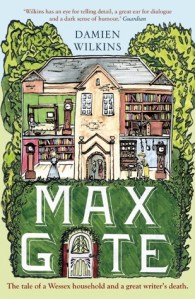 Max Gate by Damien Wilkins: This is a novel of Thomas Hardy’s last days, but we get an unusual glimpse into his household at Max Gate, Dorchester through the point-of-view of his housemaid, twenty-six-year-old Nellie Titterington. Ultimately I suspect a third-person omniscient voice would have worked better. In fact, some passages – recounting scenes Nellie is not witness to – are in the third person, which felt a bit like cheating. Fans familiar with the excellent Claire Tomalin biography might not learn much about Hardy and his household dynamics, but it was fun to spend some imaginary time at a place I once visited. [First published in New Zealand in 2013; releases in the US and UK on June 6th.]

 Dust by Michael Marder: A philosopher carries out an interdisciplinary study of dust: what it’s made of, what it means, and how it informs our metaphors. In itself, he points out, dust is neither positive nor negative, but we give it various cultural meanings. In the Bible, it is the very substance of mortality. Meanwhile “The war on dust, a hallmark of modern hygiene, reverberates with the political hygiene of the war on terror.” The contemporary profusion of allergies may, in fact, be an unintended consequence of our crusade against dust. The discussion is pleasingly wide-ranging, with some unexpected diversions – such as the metaphorical association between ‘stardust’ and celebrity – but also some impenetrable jargon. I’d be interested to try other titles from Bloomsbury’s “Object Lessons” series.
Foreword Reviews
How to Cure Bedwetting by Lane Robson (Oh, the interesting topics my work with self-published books introduces me to!): Explaining the anatomical and behavioral reasons behind bedwetting, the Calgary-based physician gives practical tips for curing the problem within six to twelve months. Throughout, the text generally refers to “pee” and “poop,” which detracts slightly from the professionalism of the work. All the same, this compendium of knowledge, drawing as it does on the author’s forty years of experience, should answer every possible question on the subject. Highly recommended to parents of younger elementary school children, this book will be an invaluable reference in tackling bedwetting.
Nudge
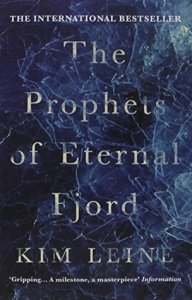 The Prophets of Eternal Fjord by Kim Leine: An epic novel about an unconventional priest, set in late-eighteenth-century Denmark and Greenland. This struck me as a cross between Carsten Jensen’s We, the Drowned, another historical saga from Denmark and one of my favorite novels of all time, and Michel Faber’s The Crimson Petal and the White. Like the former, it features perilous sea voyages and ambivalent father–son relationships; like the latter, it’s edgy and sexualized, full of lechery and bodily fluids. No airbrushing the more unpleasant aspects of history here. The entire story is told in the present tense, with no speech marks. It took me nearly a month and a half to read; by the end I felt I’d been on an odyssey as long and winding as Morten’s.
PANK
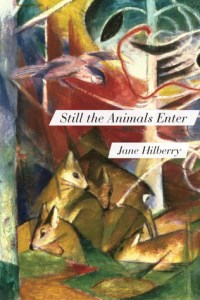 Still the Animals Enter by Jane Hilberry: A rich, strange, and gently erotic collection featuring diverse styles and blurring the lines between child and adult, human and animal, life and death through the language of metamorphosis. Ambivalence about the moments of transition between childhood and adulthood infuses Part One. Early on, “A Hole in the Fence” finishes on a whispered offer: “You could be part of this.” The message in this resonant collection, though, is that we already are a part of it: part of a shared life that moves beyond the individual family or even the human species. We are all connected—to the children we once were, to lovers and family members lost and found, and to the animals we watch in wonder.
Pittsburgh Post-Gazette
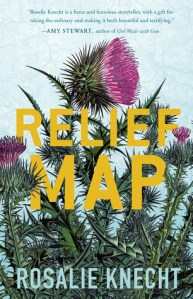 Relief Map by Rosalie Knecht: Lomath, Pennsylvania consists of a half-mile stretch between old textile mills and is home to just 150 people. During one unpredictable summer, blackouts and the arrival of an Eastern European fugitive draw the residents into a welter of paranoia and misguided choices. Our eyewitness to provincial commotion is 16-year-old Livy Marko, who considers herself plain and awkward – her childhood style was supplied by Anne of Green Gables and Goodwill. Knecht’s writing is marked by carefully chosen images and sounds. The novel maintains a languid yet subtly tense ambience. For Livy, coming of age means realizing actions always have consequences. Offbeat and atmospheric, this debut is probably too quiet to make a major splash, but has its gentle rewards.
Shiny New Books
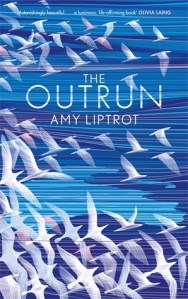 The Outrun by Amy Liptrot: Put simply, this is a memoir about Amy Liptrot’s slide into alcoholism and her subsequent recovery. Liptrot grew up on mainland Orkney, a tight-knit Scottish community she was eager to leave as a teenager but found herself returning to a decade later, washed up after the dissolute living and heartbreak she left behind in London. A simple existence, close to nature and connected to other people, was just what she needed during her first two years of sobriety. Her atmospheric writing about the magical Orkney Islands and their wildlife, rather than the slightly clichéd ruminating on alcoholism, is what sets the book apart. (On the Wellcome Prize shortlist.)

I also post reviews of most of my casual reading and skimming on Goodreads:
 Look We Have Coming to Dover! by Daljit Nagra: The dialect was a bit too heavy for me in some of these poems about the Sikh experience in Britain. By far my favorite was “In a White Town,” which opens: “She never looked like other boys’ mums. / No one ever looked without looking again / at the pink kameez and balloon’d bottoms, // mustard-oiled trail of hair, brocaded pink / sandals and the smell of curry. That’s why / I’d bin the letters about Parents’ Evenings …”
 Work Like Any Other by Virginia Reeves: Between the blurb and the first paragraph, you already know everything that’s going to happen. I admire books that can keep you reading with interest even though you know exactly what’s coming, but this isn’t really one of those. Ultimately I would have preferred for the whole novel, rather than just alternating chapters, to be in Roscoe’s first-person voice, set wholly in prison (where he helps out in the library and with the guard dogs) but with brief flashbacks to his electricity siphoning and the circumstances of his manslaughter conviction. The writing is entirely capable, but the structure made it so I felt the story wasn’t worth my time.
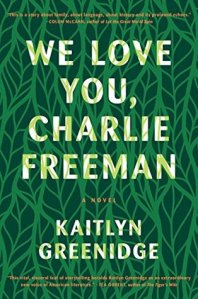 We Love You, Charlie Freeman by Kaitlyn Greenidge: The Freemans are raising Charlie, a chimpanzee, as part of their family for a Toneybee Institute experiment and teaching him to communicate via sign language. Flashbacks to the late 1920s bring an uncomfortable racial subtext to the surface, suggesting that the Toneybee has been involved in dodgy anthropological research over the decades. This is a deep and unsettling story of human–human interactions, even more so than human–animal interactions. I much preferred it to We Are All Completely Beside Ourselves.
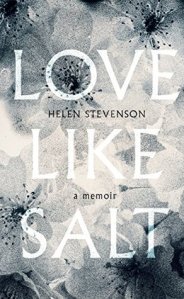 Love Like Salt by Helen Stevenson: Stevenson’s daughter Clara has cystic fibrosis, so I approached and enjoyed this as an illness memoir. However, it’s very scattered, with lots of seemingly irrelevant material included simply because it happened to the author: her mother’s dementia, their life in France, her work as a translator and her hobby of playing the piano, her older husband’s love for Italy and Italian literature, etc. Really the central drama is their seemingly idyllic life in France, Clara being bullied there, and the decision to move back to England (near Bristol), where the girls would attend a Quaker school on scholarships and Clara was enrolled in a widespread clinical trial with modest success. Enjoyable enough if you share some of the author’s interests.
 Springtime: A Ghost Story by Michelle de Kretser: Ghost story? Really? There’s very little in the way of suspense, and not too much plot either, in this Australia-set novella. I would expect tension to linger and questions to remain unanswered. Instead, the author exposes Frances’s ‘ghost’ as harmless. What I think de Kretser is trying to do here is show that ghosts can be people we have known and loved or, alternatively, places we have left behind. There is some nice descriptive writing (e.g. “three staked camellias stood as whitely upright as martyrs”), but not enough story to hold the interest.

 Let the Empire Down by Alexandra Oliver: This debut collection is heavily inspired by history and travel, as well as Serbian poetry and personal anecdote. I enjoyed the earlier poems, especially the ones with ABAB or ABBA rhyme schemes. My favorite was “Plans,” about a twenty-something manicurist who abandoned her talent for science to get ready cash: “A girl’s future should be full and bright, a marble, / but (alas for her) there is a catch: / we take on the immediate. Hope flags: / wishing to be wise and come out shining, / we pop a beaker over our own flame. / We do it cheerfully. We do it coldly.” The last quarter is devoted to poems about films, especially Italian cinema.
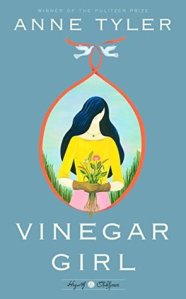 Vinegar Girl by Anne Tyler: This is the most fun I’ve had with the Hogarth Shakespeare series so far, as well as my favorite of the three Anne Tyler novels I’ve read. Yes, it’s set in Baltimore. Kate Battista, the utterly tactless preschool assistant, kept cracking me up. Her father, an autoimmune researcher, schemes for her to marry his lab assistant, Pyotr, so he can stay in the country after his visa expires. The plot twists of the final quarter felt a little predictable, but I was won over by the good-natured storytelling and prickly heroine. (I don’t know The Taming of the Shrew well enough to comment on how this functions as a remake.) Releases in June.
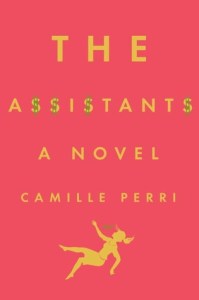 The Assistants by Camille Perri: At age 30, Tina Fontana has been a PA to media mogul Robert Barlow for six years. He’s worth millions; she lives in a tiny Brooklyn apartment. One day a mix-up in refunding expenses lands her with a check for $19,147. If she cashes it she can pay off her debts once and for all and no one at Titan Corporation will be any the wiser, right? This is a fun and undemanding read that will probably primarily appeal to young women. I would particularly recommend it to readers of Friendship by Emily Gould and A Window Opens by Elisabeth Egan. Releases May 3rd.
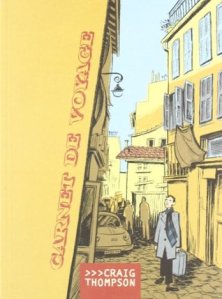 Carnet de Voyage by Craig Thompson: A sketchbook Thompson kept on his combined European book tour for Blankets and research trip for Habibi in March–May 2004. It doesn’t really work as a stand-alone graphic memoir because there isn’t much of a narrative, just a series of book signings, random encounters with friends and strangers, and tourism. My favorite two-page spread is about a camel ride he took into the Moroccan desert. I could also sympathize with his crippling hand pain (from all that drawing) and his “chaos tolerance” overload from the stress of travel.
 Rising Ground: A Search for the Spirit of Place by Philip Marsden: Some very nice writing indeed, but not much of a storyline. The book is something of a jumble of mythology, geology, prehistory, and more recent biographical information about some famous Cornish residents, overlaid on a gentle travel memoir. I enjoyed learning about the meanings of Cornish place names, in particular, and spotting locations I’ve visited.
And my highest recommendation goes to…
Commonwealth by Ann Patchett: It all starts with an early 1960s christening party Los Angeles policeman Fix Keating is throwing for his younger daughter, Franny. DA Bert Cousins turns up, uninvited, with a bottle of gin the grateful guests quickly polish off in their fresh-squeezed orange juice. He also kisses the hostess, sparking a chain of events that will rearrange the Keating and Cousins families in the decades to come. The novel spends time with all six step-siblings, but Franny is definitely the main character – and likely an autobiographical stand-in for Patchett. As a waitress in Chicago, she meets a famous novelist who’s in a slump; the story of her childhood gives him his next bestseller but forces the siblings to revisit a tragic accident they never fully faced up to. Sophisticated and atmospheric; perfect for literary fiction fans in general and Patchett fans in particular. Releases September 13th.
Reviews Roundup, September–October
One of my goals with this blog is to have one convenient place where I can gather together all my writing that has appeared in disparate online locations. To that end, once a month I’ll provide links to all the book reviews I’ve published elsewhere, with a rating (below each description) and a short taster so you can decide whether to click to read more. A couple of exceptions: I won’t point out my Kirkus Indie, BlueInk or Publishers Weekly reviews since I don’t get a byline.
The Bookbag
Rising Strong by Brené Brown: Brown, a qualitative researcher in the field of social work, encourages readers to embrace vulnerability and transform failure and shame through a simple process of re-evaluating the stories we tell ourselves. The gimmicky terminology and frequent self-referencing grated on me a bit, but I appreciated how the book made me reconsider events from my own life. It’s the ideas that carry Rising Strong, so as long as you come to it expecting a useful tool rather than a literary experience you shouldn’t be disappointed. Genuinely helpful self-help.

 Life After You by Lucie Brownlee: With honesty and humor, Brownlee reconstructs the two years following her husband’s sudden death. My sister is still a new widow, so I read this expecting it to resonate with her situation, and it certainly does. I had an issue with the title and marketing, though. When originally published last year, the book had the title Me After You. That’s been changed to sound a little less like a Jojo Moyes novel, but the cover is more chick lit than ever, which doesn’t really match the contents of the book.
The Glass Girl by Sandy Hogarth (& interview): Moving between Australia and England and spanning several decades of Ruth Bishop’s life, this debut novel explores the psychological effects of sexual trauma and betrayal. The middle of the book feels a little meandering, and the chronology is sometimes over-complicated. However, Ruth’s is a warm first-person voice, and the ending hints at welcome resolution to unanswered questions. My favorite aspect of the novel, though, is the frequent observations of the natural world.

 The Year of the Runaways by Sunjeev Sahota: With multilingual slang and several Sikh characters, Sahota’s second novel illuminates aspects of the South Asian experience that might be unfamiliar. Daily life is a struggle for Tochi, Randeep and Avtar: they work multiple jobs to make ends meet, serving at Crunchy Fried Chicken, cleaning sewers, or building a luxury hotel in Leeds. The fourth protagonist is Randeep’s visa-wife, Narinder. Through flashbacks we discover each one’s past. It’s a harrowing read, but you can’t help but sympathize with the four runaways as they make and dissolve connections over the year.
The Gap of Time by Jeanette Winterson: This contemporary ‘cover version’ of The Winter’s Tale links a London financier, a Parisian singer, and a blended family in New Orleans. Winterson creates clear counterparts for each Shakespeare characters, often tweaking names so they are recognizable but more modern. Inventive and true to the themes and imagery (time, adoption; angels, bears, statues) of the original, but ultimately adds little to one’s experience of Shakespeare. I’ll hope for better things from the rest of the Hogarth Shakespeare series. (Still to come: Margaret Atwood on The Tempest, Howard Jacobson on The Merchant of Venice and Anne Tyler on The Taming of the Shrew, among others.)
BookBrowse
 After the Parade by Lori Ostlund [subscription service, but the full text of my review will be available for free during the week of October 20th as part of Editor’s Choice]: Ostlund’s debut novel explores trauma and loneliness through the past and present of the protagonist, an ESL teacher who has just left his long-term partner, as well as the stories of those he meets. Although set over a six-month period, the novel is so full of flashbacks that it feels dense with the weight of the past. At times this can seem more like a set of short stories, only loosely connected through Aaron. Still, the overarching theme is strong and resonant: “after the parade,” after everything has changed irrevocably, you must keep going, pushing past the sadness to build a new life.
BookTrib
 The Best Small Fictions 2015, ed. by Tara L. Masih and Robert Olen Butler: In this very strong anthology of flash fiction, stories range from Tweet length to a few pages, but are always under 1,000 words. Titles and first lines carry a lot of weight. One of the best openers is “I didn’t recognize her without her head” (“Before She Was a Memory,” Emma Bolden). In genre the stories run the gamut from historical fiction to whimsical fantasy. You’ll be introduced to a wealth of fresh and existing talent. There are literally dozens of stand-outs here, but if I had to choose a top 3, they’d be “A Notice from the Office of Reclamation” by J. Duncan Wiley, “The Lunar Deep” by David Mellerick Lynch, and (overall favorite) “Something Overheard” by Yennie Cheung.
For Books’ Sake
 Fates and Furies by Lauren Groff: An incisive study of a marriage, beautifully written and rich with allusions to Shakespeare and Greek mythology. Short, verbless sentences pile up to create exquisite descriptions, as in “Sunset. House on the dunes like a sun-tossed conch. Pelicans thumb-tacked in the wind.” However, I was less sure about the necessity of the bracketed phrases, which seem to represent a Greek chorus giving omniscient commentary, and the use of slang and nicknames can grate. Groff makes it onto a short list of women I expect to produce the Great American Novel.
Foreword Reviews
 When All Goes Quiet by Augustinus F. Lodewyks: This religious memoir should interest those who are curious about how spiritual experience can infiltrate everyday life. “When all goes quiet, I know that Heaven is trying to show me its glory,” Lodewyks writes. In autobiographical vignettes, he vividly expresses his mystical visions, particularly those featuring Jesus, the Virgin Mary and angels, who tend to appear in times of crisis and during events of ritual significance like weddings, funerals and religious pilgrimages. Some will still object to the overt proselytizing, especially in the book’s last quarter.

The Blessing of Movement by Deborah Konrad: Konrad’s story is an inspirational memoir about life with disability and caring for dying relatives. Her sister Sandra became a quadriplegic in her twenties. Throughout the book, Konrad investigates the secret strength that underlay “the sunny disposition of the pretty paralyzed woman.” She concludes that it was all about thankfulness, as proven by Sandra’s gratitude journal. Konrad’s own life undeniably gets sidelined, though; more self-reflection would provide a good match for her insights into her sister’s character.
 DNA of Mathematics by Mehran Basti: Drawing on his academic specialty in mathematics, Basti explores how scientific theories have been used and misused through history. The book lacks focus due to frequent unrelated asides. It may be difficult to grant credibility to a scientist who dismisses the big bang because it was theorized through “semi-broken scientific methods” and seems to have a personal vendetta against Stephen Hawking. Most importantly, the mathematics that forms the book’s basis is never fully explained.

From Hell to Heaven, One Man’s Journey by Gustav Daffy: This book was inspired by an acrimonious divorce and other family troubles; although Christian faith helped Gustav adjust his thinking, many of the poems still feel like the angry outpourings of a man with an ax to grind. Moreover, formulaic rhyming and poor spelling and grammar mar this overlong collection. It would take a professional copyeditor to hone this into a concise set of linguistically and stylistically acute poems. However, the author’s in-the-moment reactions are easy to relate to.
Shiny New Books
 Grief Is the Thing with Feathers by Max Porter: It may seem perverse to twist Emily Dickinson’s words about hope into a reflection on bereavement, but Porter’s exceptional debut does just that: tweak poetic forebears – chiefly Poe’s “The Raven” and Ted Hughes’s Crow – to create a hybrid response to loss. The novella is composed of three first-person voices: Dad, Boys and Crow (the soul of the book: witty, onomatopoeic, often macabre). Dad and his two young sons are adrift in mourning; the boys’ mum died after an unspecified accident in their London flat. The three narratives resemble monologues in a play, with short lines laid out on the page more like stanzas of a poem.
We Love This Book
 A Slanting of the Sun by Donal Ryan: The Irish author of the novels The Spinning Heart (winner of the Guardian First Book Award in 2013) and The Thing About December, returns with 20 jolting, voice-driven short stories suffused with loneliness and anger. Nineteen of the 20 are in the first person, echoing the chorus of voices that made The Spinning Heart so effective. Many of the narrators speak in thick dialect and run-on sentences, which helps to immerse you in the rhythms of Irish speech. In a book full of lonely people, it is the moments of connection – however fleeting – that matter. For example, in “Long Puck,” one of the best stories, a Catholic priest posted to Syria initiates interfaith hurling matches that temporarily lift everyone’s spirits.
I also post reviews of most of my casual reading and skimming on Goodreads.
 The River by Helen Humphreys: Humphreys has lived along Ontario’s Napanee River for over a decade. I was expecting a blend of personal reflection and natural observations, but instead the book is mostly composed of brief fictional passages illuminating a handful of species. I liked the passages about the heron best – Humphreys successfully imagines the life of a plume hunter and contrasts it with the excitement of two women involved in the foundation of a bird conservation charity. However, much of the book felt like unconnected vignettes, not building to any kind of grander picture of a location.

The Mountain Can Wait by Sarah Leipciger: The novel opens and closes with a hit-and-run, but in between those momentous peaks it’s a quieter tale of a single father trying to guide his son and daughter into young adulthood in the wilds of Canada’s west and islands. Tom Berry’s work is not cutting trees down but planting them – an interesting adaptation of a traditional woodsman’s activity to a new eco age. I found the story a little sleepy but loved Leipciger’s writing, especially her account of the daily drudgery of manual labor and her descriptions of wilderness scenery.
 Decline of the Animal Kingdom by Laura Clarke: Bizarre, in-your-face poetry from a 30-year-old Canadian: business jargon, YouTube videos, fast food…and, yes, animals. Many of the poems feature mules and lions, including weird dialogues between a mule and its supervisor / domestic partner / psychiatrist. With plays on words and sexualized vocabulary, Clarke considers inter-species altruism and the inevitable slide towards extinction. Two favorite lines: “You forget you live parallel to violence” (from “Carnivora”); “The Tasmanian tiger live-tweets its extinction from the Hobart zoo in 1933” (from “Extirpation”).
Do No Harm: Stories of Life, Death and Brain Surgery by Henry Marsh: “Terrible job, neurosurgery. Don’t do it.” Lucky for us, Henry Marsh reports back from the frontlines of brain surgery so we don’t have to. He’s nearing retirement age after a career divided between a London hospital and medical missions to Ukraine. The punchy chapters are named after conditions he has treated or observed. Marsh comes across as having a hot temper, exhibiting extreme frustration with NHS bureaucracy. At the same time, he gets very emotional over his patients declining and dying, and experiences profound guilt over operations that go wrong or were ultimately unnecessary.

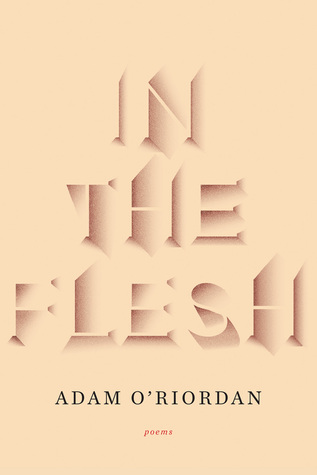 In the Flesh by Adam O’Riordan: My favorite poems in O’Riordan’s debut collection were about Victorian Manchester, 1910s suffragettes and the Wordsworths, this last based on the author’s year in residence at their Lake District cottage. I also liked “The Corpse Garden” – about the outdoor forensic lab in Knoxville, Tennessee – and a couple of multi-part poems that seem to enliven family history. It’s the vocabulary and alliteration that make these poems; there are only a handful of rhyming couplets.
A Circle of Quiet by Madeleine L’Engle: If, like me, you only knew L’Engle through her Wrinkle in Time children’s series, this journal should come as a revelation. I didn’t know she wrote any nonfiction for adults. The Crosswicks books cannot be called simple memoirs, however; there’s so much more going on. In this journal (published 1972) of a summer spent at their Connecticut farmhouse, L’Engle muses on theology, purpose, children’s education, the writing life, the difference between creating stories for children and adults, neighbors and fitting into a community, and much besides.
 A View of the Harbour by Elizabeth Taylor: My third Taylor – not as good as Mrs. Palfrey, but better than Angel. It’s about the everyday family and romantic entanglements of a small English harbor village in the 1940s. Beth is a preoccupied writer who doesn’t notice that her husband, the local doctor, is carrying on an affair with her best friend, the divorcée Tory, who is also their next-door neighbor. As always, Taylor has great insight into the human psyche and unlikely relationships. The plot is low on thrills for sure, but it’s pleasant reading, especially if you’re on holiday at the seaside (I started reading it on the coast near Dublin).
Amazing Grace: A Vocabulary of Faith by Kathleen Norris: This makes the shortlist of books I would hand to skeptics to show them there might be something to this Christianity nonsense after all. Norris spent 20 years away from the faith but gradually made her way back, via the simple Presbyterianism of her Dakota relatives but also through becoming an oblate at a Benedictine monastery – two completely different expressions of the same faith. In few-page essays, she gives each word or phrase a rich backstory through anecdote, scripture and lived philosophy, ensuring that it’s not just religious jargon anymore.
 Undermajordomo Minor by Patrick deWitt: What The Sisters Brothers did for the Western, this does for the Gothic fairytale. It’s not quite as fun or successful as the previous book, but has a nicely campy Dracula or Jane Eyre feel. Lucien “Lucy” Minor, a compulsive liar, sets out to find adventure and romance as undermajordomo of a castle in the quaint German countryside. Here he meets pickpockets, a periodically insane baron, a randy maiden, and a strapping rival who’s a soldier in the absurdist local conflict. DeWitt’s understated humor is not as clearly on display here; there’s also, strangely, quite a bit of sex.
Sentenced to Life by Clive James: James, an Australian critic and all-round man of letters, was first diagnosed with leukemia in 2010. After a setback in 2013, he’s rallied, but these poems are certainly infused with a sense of imminent mortality. The incessant ABAB rhyming in the early poems set up a jaunty rhythm I didn’t find appropriate to the subject matter; I much prefer the later unrhymed poems. “Plot Points” is my favorite, artfully linking disparate historical moments.
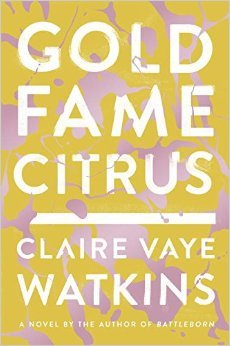 Gold Fame Citrus by Claire Vaye Watkins: Gold, fame, citrus: reasons people once came to California. Now, only a desperate remnant remains in this waterless wasteland. Luz and Ray squat in a starlet’s abandoned mansion and live off of Luz’s modeling money – she was once the environmental movement’s poster child, “Baby Dunn.” When they take charge of a baby called Ig, however, their priorities change. They set off for the strangely beautiful sea of dunes, the Amargosa, leaving behind the ‘frying pan’ of exposure to the elements for the ‘fire’ of a desert cult. There is some absolutely beautiful prose. This is the book that California (Edan Lepucki) wanted to be.
Satin Island by Tom McCarthy: U. is a corporate anthropologist in London, coming off the success of the Koob–Sassen contract and facing the blank page of the Great Report he’s tasked with writing. Not much happens here; the book is more about his anthropological observations and the things he fixates on, like oil spills, a sabotaged parachutist, and Satin Island – a place he encounters in a dream and then, by word association, likens to Staten Island, a destination he doesn’t quite make it to. For me the most interesting parts were about narrative. I found this too clever for its own good; not Booker Prize material.
 Bookish Beck = Rebecca Foster. American transplant to England. Freelance proofreader and book reviewer.
 Bookish Beck