Five Nonfiction Review Books: Hammond, Iorio, Rault, Riley & Rutt
A diagnosis of motor neurone disease; a father’s dispiriting experience of censorship trials. An illustrated history of fonts; an essay on grief; a cold weather-appropriate record of geese-watching. I gear up for Nonfiction November by catching up on five nonfiction review books I’ve been sent over the last couple of months. You can’t say that I don’t read a variety, even within nonfiction! See if one or more of these tempts you.
A Short History of Falling: Everything I Observed about Love whilst Dying by Joe Hammond
 Hammond, a playwright, takes a wry, clear-eyed approach to his diagnosis of motor neurone disease (ALS) and the knowledge that his physical capacities will only deteriorate from here on out. “New items arrive almost daily and I am unexpectedly becoming the curator of the Museum of my own Decline.” Yet he also freezes funnier moments, like blowing his nose on a slice of bread because he couldn’t reach a tissue box, or spending “six hours of my fiftieth birthday sat on this hospice toilet, with a bottle of good Scotch wedged between my knees.”
Still, Hammond regrets that he’s become like a third small child for his wife Gill to look after, joining his sons Tom and Jimmy, and that he won’t see his boys grow up. (This book arose from an article he wrote for the Guardian in 2018 about making 33 birthday cards for his sons to open in the years after his death.) Although I wasn’t as interested in the details of Hammond’s earlier life, or his relationship with his narcissistic father, I appreciated his quiet acceptance of disability, help and impending death. 
Favorite lines:
“I’ve waited all my life to know this peace. To know that I am nothing more than this body.”
“my place in all of this is becoming smaller, historic and just the right size of important.”
With thanks to 4th Estate for the free copy for review.
An Author on Trial: The Story of a Forgotten Writer by Luciano Iorio
 The author’s father, Giuseppe Jorio, was a journalist and schoolteacher who wrote an infamous novel based on an affair he had in the 1930s. Using italicized passages from his father’s diary and letters to Tina, who was 19 when their affair started, Iorio reconstructs the sordid events and unexpected aftermath in fairly vivid detail. Tina fell pregnant and decided to abort the baby. Meanwhile, Giuseppe’s wife, Bruna, got the truth out of him and responded with more grace than might be expected. Giuseppe was devastated at the loss of his potential offspring, and realized he wanted to have a child with Bruna. He bid Tina farewell and the family moved to Rome, where the author was born in 1937.
Giuseppe’s novel inspired by the affair, Il Fuoco del Mondo (The Fire of the World) was rejected by all major publishers and accused of obscenity in a series of five trials that threatened his reputation and morale. It’s a less familiar echo of the Lady Chatterley’s Lover trial, and a poignant portrait of a man who felt he never lived up to his potential because of bad luck and societal disapproval. I enjoyed learning a bit about Italian literature. However, inconsistent use of tenses and shaky colloquial English (preposition issues, etc.) suggest that a co-writer or translator was needed to bring this self-published work up to scratch. 
With thanks to the publicist for the free copy to review as part of a blog tour.
ABC of Typography by David Rault
[Translated from the French by Edward Gauvin]
 From cuneiform to Gutenberg to Comic Sans, this history of typography is delightful. Graphic designer David Rault wrote the whole thing, but each chapter has a different illustrator, so the resulting book is like a taster course in comics styles. As such, I would highly recommend it to those who are fairly new to graphic novels and want to see whose work appeals to them, as well as to anyone who enjoyed Simon Garfield’s book about fonts, Just My Type.
I found it fascinating to explore the technical characteristics (serif vs. sans serif, etc.) and aesthetic associations of various fonts. For instance, I didn’t realize that my mainstay – Times New Roman – is now seen as a staid choice: “Highly readable, but overexposed in the early days of the Internet, it took on a reputation for drabness that it hasn’t shed since the ’90s.” Nowadays, some newspapers and brands pay typeface creators to make a font for their exclusive use. Can you name the typeface that is used on German road signs, or in Barack Obama’s campaign materials? (You’ll be able to after you read this.) 


With thanks to SelfMadeHero for the free copy for review.
Time Lived, Without Its Flow by Denise Riley
 What Virginia Woolf’s essay “On Being Ill” does for sickness, this does for bereavement. Specifically, Riley, whose son Jake died suddenly of a heart condition, examines how the experience of time changes during grief. “I’ll not be writing about death, but about an altered condition of life,” she opens. In short vignettes written from two weeks to three years after her son’s death, she reflects on how her thinking and feelings have morphed over time. She never rests with an easy answer when a mystery will do instead. “What if” questions and “as if” imaginings proliferate. Poetry – she has also written an exquisite book of poems, Say Something Back, responding to the loss of Jake – has a role to play in the acceptance of this new reality: “rhyme may do its minute work of holding time together.”
Max Porter provides a fulsome introduction to this expanded version of Riley’s essay, which first appeared in 2012. This small volume meant a lot more to him than it did to me; I preferred Riley’s poetic take on the same events. Still, this is sure to be a comfort for the bereaved.
Favorite passages:
“I’ll try to incorporate J’s best qualities of easy friendliness, warmth, and stoicism, and I shall carry him on in that way. Which is the only kind of resurrection of the dead that I know about.”
“I don’t experience him as in the least dead, but simply as ‘away’. Even if he’ll be away for my remaining lifetime. My best hope’s to have a hallucination of his presence when I’m dying myself.”
With thanks to Picador for the free copy for review.
Wintering: A Season with Geese by Stephen Rutt
 Rutt’s The Seafarers: A Journey among Birds, one of my favorite recent nature/travel books, came out in May. What have we done to deserve another publication from this talented young author just four months later?! I didn’t enjoy this as much as The Seafarers, yet it does a lot of the same things well: it provides stunning word portraits of individual bird species, explores the interaction between nature and one’s mental state, and gathers evidence of the cultural importance of birds through legends and classical writings.
Here the focus is on geese, which the author had mostly overlooked until the year he moved to southern Scotland. Suddenly they were impossible to ignore, and as he became accustomed to his new home these geese sightings were a way of marking the seasons’ turn. Ethical issues like hunting, foie gras and down production come into play, and, perhaps ironically, the author eats goose for Christmas dinner!
Rutt’s points of reference include Paul Gallico (beware plot spoilers!), Aldo Leopold, Mary Oliver and Peter Scott. The writing in this short book reminded me most of Horatio Clare (especially The Light in the Dark) and Jim Crumley (who’s written many short seasonal and single-species nature books) this time around.
A favorite passage (I sympathize with the feelings of nomadism and dislocation):
“I envy the geese their certainty, their habits of home. I am forever torn between multiple places that feel like home. Scotland where I live or Suffolk, Essex, Norfolk: the flatlands of golden evenings and reeds, mud and water and sand. The distant horizon and all the space in between I grew up with, which seems to lurk somewhere, subconsciously calling me back.”
[Neat aside: My husband and I both got quotes (about The Seafarers) on the press release for this book!]

With thanks to Elliott & Thompson for the free copy.
Would you be interested in reading one or more of these?
20 Books of Summer, #1–4: Alexis, Haupt, Rutt, Tovey
I was slow to launch into my 20 Books of Summer reading, but have now finally managed to get through my first four books. These include two substitutes: a review copy I hadn’t realized fit in perfectly with my all-animals challenge, and a book I’d started earlier in the year but set aside and wanted to get back into. Three of the four were extremely rewarding; the last was somewhat insubstantial, though I always enjoy reading about cat antics. All have been illuminating about animal intelligence and behavior, and useful for thinking about our place in and duty towards the more-than-human world. Not all of my 20 Books of Summer will have such an explicit focus on nature – some just happen to have an animal in the title or pictured on the cover – but this first batch had a strong linking theme so was a great start.
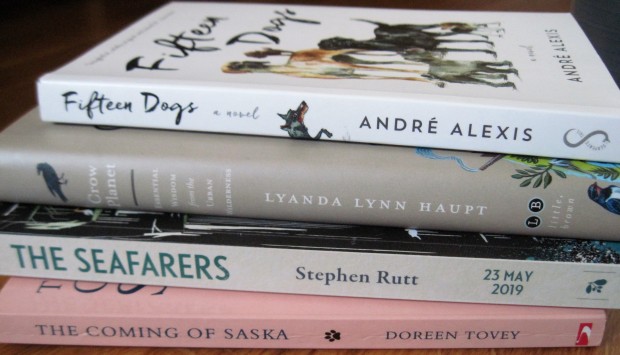
Fifteen Dogs by André Alexis (2015)
In this modern folk tale with elements of the Book of Job, the gods Apollo and Hermes, drinking in a Toronto tavern, discuss the nature of human intelligence and ponder whether it’s inevitably bound up with suffering. They decide to try an experiment, and make a wager on it. They’ll bestow human intelligence on a set of animals and find out whether the creatures die unhappy. Apollo is willing to bet two years’ personal servitude that they will be even unhappier than humans. Their experimental subjects are the 15 dogs being boarded overnight at a nearby veterinary clinic.
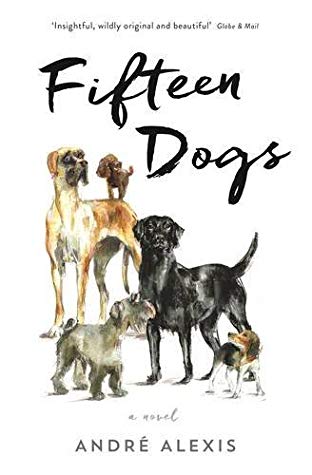 The setup means we’re in for an And Then There Were None type of picking-off of the 15, and some of the deaths are distressing. But strangely – and this is what the gods couldn’t foresee – knowledge of their approaching mortality gives the dogs added dignity. It gives their lives and deaths the weight of Shakespearean tragedy. Although they still do doggy things like establishing dominance structures and eating poop, they also know the joys of language and love. A mutt called Prince composes poetry and jokes. Benjy the beagle learns English well enough to recite the first paragraph of Vanity Fair. A poodle named Majnoun forms a connection with his owner that lasts beyond the grave. The dogs work out who they can trust; they form and dissolve bonds; they have memories and a hope that lives on.
It’s a fascinating and inventive novella, and a fond treatment of the relationship between dogs and humans. When I read in the Author’s Note that the poems all included dogs’ names, I went right back to the beginning to scout them out. I’m intrigued by the fact that this Giller Prize winner is a middle book in a series, and keen to explore the rest of the Trinidanian-Canadian author’s oeuvre.
These next two have a lot in common. For both authors, paying close attention to the natural world – birds, in particular – is a way of coping with environmental and mental health crises.
Crow Planet: Essential Wisdom from the Urban Wilderness by Lyanda Lynn Haupt (2009)
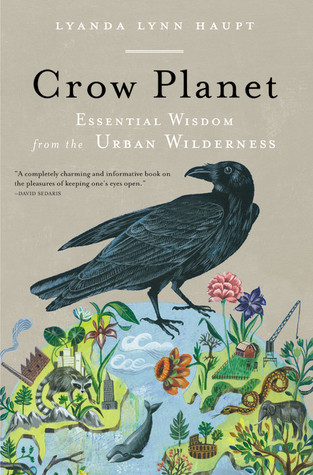 Lyanda Lynn Haupt has worked in bird research and rehabilitation for the Audubon Society and other nature organizations. (I read her first book, Rare Encounters with Ordinary Birds, quite a few years ago.) During a bout of depression, she decided to start paying more attention to the natural world right outside her suburban Seattle window. Crows were a natural place to start. From then on she took binoculars everywhere she went, even on walks to Target. She spent time watching crows’ behavior from a distance or examining them up close – devoting hours to studying a prepared crow skin. She even temporarily took in a broken-legged fledgling she named Charlotte and kept a close eye on the injured bird’s progress in the months after she released it.
Were this simply a charming and keenly observed record of bird behavior and one woman’s gradual reawakening to the joys of nature, I would still have loved it. Haupt is a forthright and gently witty writer. But what takes it well beyond your average nature memoir is the bold statement of human responsibility to the environment. I’ve sat through whole conference sessions that try to define what nature is, what the purpose of nature writing is, and so on. Haupt can do it in just a sentence, concisely and effortlessly explaining how to be a naturalist in a time of loss and how to hope even when in possession of all the facts. 
A few favorite passages:
“an intimate awareness of the continuity between our lives and the rest of life is the only thing that will truly conserve the earth … When we allow ourselves to think of nature as something out there, we become prey to complacency. If nature is somewhere else, then what we do here doesn’t really matter.”
“I believe strongly that the modern naturalist’s calling includes an element of activism. Naturalists are witnesses to the wild, and necessary bridges between ecological and political ways of knowing. … We join the ‘cloud of witnesses’ who refuse to let the more-than-human world pass unnoticed.”
“here we are, intricate human animals capable of feeling despair over the state of the earth and, simultaneously, joy in its unfolding wildness, no matter how hampered. What are we to do with such a confounding vision? The choices appear to be few. We can deny it, ignore it, go insane with its weight, structure it into a stony ethos with which we beat our friends and ourselves to death—or we can live well in its light.”
The Seafarers: A Journey among Birds by Stephen Rutt (2019)
 In 2016 Rutt left his anxiety-inducing life in London in a search for space and silence. He found plenty of both on the Orkney Islands, where he volunteered at the North Ronaldsay bird observatory for seven months. In the few years that followed, the young naturalist travelled the length and breadth of the British Isles – from Skomer to Shetland – courting encounters with seabirds. He’s surrounded by storm petrels one magical night at Mousa Broch; he runs from menacing skuas; he watches eider and terns and kittiwakes along the northeast coast; he returns to Orkney to marvel at gannets and fulmars. Whether it’s their beauty, majesty, resilience, or associations with freedom, such species are for him a particularly life-enhancing segment of nature to spend time around.
Discussion of the environmental threats that hit seabirds hardest, such as plastic pollution, makes for a timely tie-in to wider conservation issues. Rutt also sees himself as part of a long line of bird-loving travellers, including James Fisher and especially R.M. Lockley, whose stories he weaves in. This is one of the best nature/travel books I’ve read in a long time, especially enjoyable because I’ve been to a lot of the island locations and the elegantly evocative writing, making particularly effective use of varied sentence lengths, brought back to me just what it’s like to be in the far north of Scotland in the midst of an endless summer twilight, a humbled observer as a whole whirlwind of bird life carries on above you. 
A favorite passage:
“Gannets nest on the honeycombs of the cliff, in their thousands. They sit in pairs, pointing to the sky, swaying heads. They stir. The scent of the boat’s herring fills the air. They take off, tessellating in a sky that is suddenly as much bird as light. The great skuas lurk.”
My husband also reviewed this, from a birder’s perspective.
With thanks to Elliott & Thompson for the proof copy for review.
The Coming of Saska by Doreen Tovey (1977)
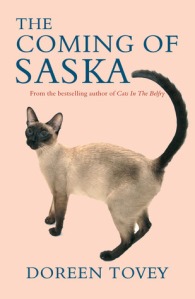 I’ve read four of Tovey’s quaint Siamese cat books now; this was the least worthwhile. It’s partially a matter of false advertising: Saska only turns up for the last 15 pages, as a replacement of sorts for Seeley, who disappeared one morning a year earlier and was never seen again. Over half of the book, in fact, is about a trip Tovey and her husband Charles took to Edmonton, Canada. The Canadian government sponsored them to come over for the Klondike Days festivities, and they also rented a camper and went looking for bears and moose. Mildly amusing mishaps, close shaves, etc. ensue. They then come back and settle into everyday life with their pair of Siamese half-siblings; Saska had the same father as Shebalu. Entertaining enough, but slight, and with far too many ellipses.
Four Recent Review Books: Butler, Hunt, Paralkar and Vestre
Four February–April releases: A quiet novel about the clash of religion and reason; a birdwatching odyssey in London; a folktale-inspired story of the undead descending on an Indian medical clinic; and a layman’s introduction to fetal development – you can’t say I don’t read a wide variety of books! See if any of these tempt you.
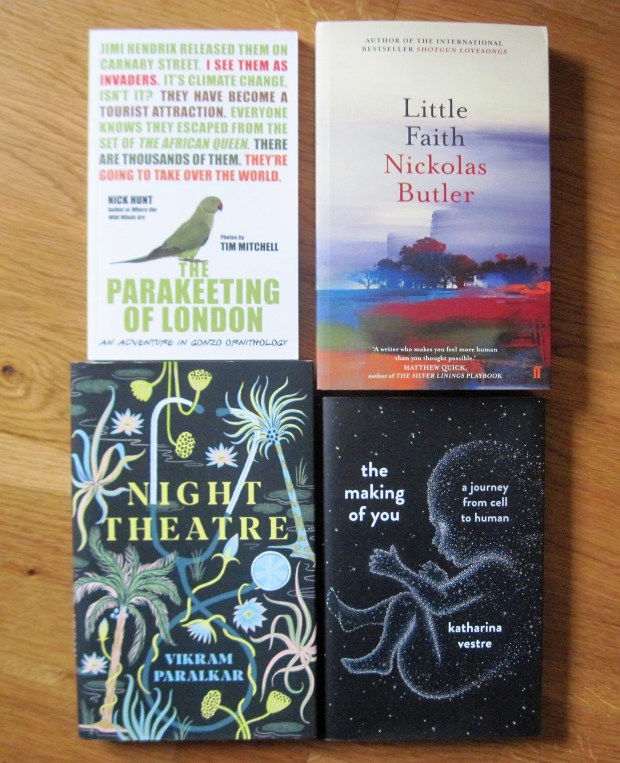
Little Faith by Nickolas Butler
Butler follows in Kent Haruf’s footsteps with this quiet story of ordinary Midwesterners facing a series of small crises. Lyle Hovde works at a local Wisconsin orchard but is more interested in spending time with Isaac, his five-year-old grandson. Lyle has been an atheist since he and Peg lost a child in infancy, making it all the more ironic that their adopted daughter, Shiloh, has recently turned extremely religious. She attends a large non-denominational church that meets in an old movie theatre and is engaged to Pastor Steven*, whose hardline opinions are at odds with his hipster persona.
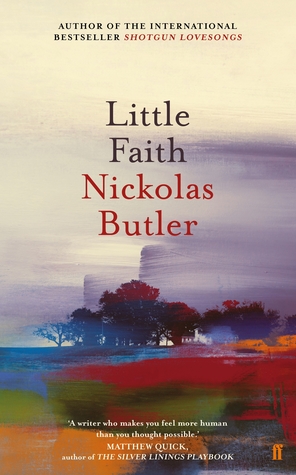 Steven and Shiloh believe Isaac has a healing gift – perhaps he can even help Lyle’s old pal, Hoot, who’s just been diagnosed with advanced cancer? The main story line reminded me most of Emily Fridlund’s History of Wolves (health and superstition collide) and Carolyn Parkhurst’s Harmony (the dangers of a charismatic leader). It’s all well and good to have faith in supernatural healing, but not if it means rejecting traditional medicine.
This is the epitome of a slow burner, though: things don’t really heat up until the final 35 pages, and there were a few chapters that could have been cut altogether. The female characters struck me as underdeveloped, but I did have a genuine warm feeling for Lyle. There are some memorable scenes, like Lyle’s heroic effort to save the orchard from an ice storm – a symbolic act that’s more about his desperation to save his grandson from toxic religion. But mostly this is a book to appreciate for the slow, predictable rhythms of a small-town life lived by the seasons.
[*So funny because that’s my brother-in-law’s name! I’ve also visited a Maryland church that meets in a former movie theatre. I was a part of somewhat extreme churches and youth groups in my growing-up years, but luckily nowhere that would have advocated foregoing traditional medicine in favor of faith healing. There were a few false notes here that told me Butler was writing about a world he wasn’t familiar with.]
A favorite passage:
“‘Silent Night’ in a darkened country chapel was, to Lyle, more powerful than any atomic bomb. He was incapable of singing it without feeling his eyes go misty, without feeling that his voice was but one link in a chain of voices connected over the generations and centuries, that line we sometimes call family. Or memory itself.”
With thanks to Faber & Faber for the free copy for review.
The Parakeeting of London: An Adventure in Gonzo Ornithology by Nick Hunt
 Rose-ringed parakeets were first recorded in London in the 1890s, but only in the last couple of decades have they started to seem ubiquitous. I remember seeing them clustered in treetops and flying overhead in various Surrey, Kent and Berkshire suburbs we’ve lived in. They’re even more noticeable in London’s parks and cemeteries. “When did they become as established as beards and artisan coffee?” Nick Hunt wonders about his home in Hackney. He and photographer Tim Mitchell set out to canvass public opinion about London’s parakeets and look into conspiracy theories about how they escaped (Henry VIII and Jimi Hendrix are rumored to have released them; the set of The African Queen is another purported origin) and became so successful an invasive species.
A surprising cross section of the population is aware of the birds, and opinionated about them. Language of “immigrants” versus “natives” comes up frequently in the interviews, providing an uncomfortable parallel to xenophobic reactions towards human movement – “people had a tendency to conflate the avian with the human, turning the ornithological into the political. Invading, colonizing, taking over.” This is a pleasant little book any Londoner or British birdwatcher in general would appreciate.
With thanks to Paradise Road for the free copy for review.
Night Theatre by Vikram Paralkar
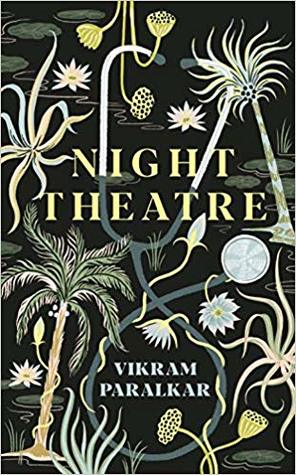 This short novel has an irresistible (cover and) setup: late one evening a surgeon in a rural Indian clinic gets a visit from a family of three: a teacher, his pregnant wife and their eight-year-old son. But there’s something different about this trio: they’re dead. They each bear hideous stab wounds from being set upon by bandits while walking home late from a fair. In the afterlife, an angel reluctantly granted them a second chance at life. If the surgeon can repair their gashes before daybreak, and as long as they stay within the village boundaries, their bodies will be revivified at dawn.
Paralkar draws on dreams, folktales and superstition, and the descriptions of medical procedures are vivid, as you would expect given the author’s work as a research physician at the University of Pennsylvania. The double meaning of the word “theatre” in the title encompasses the operating theatre and the dramatic spectacle that is taking place in this clinic. But somehow I never got invested in any of these characters and what might happen to them; the précis is more exciting than the narrative as a whole.
A favorite passage:
“Apart from the whispering of the dead in the corridor, the silence was almost deliberate – as if the crickets had been bribed and the dogs strangled. The village at the base of the hillock was perfectly still, its houses like polyps erupting from the soil. The rising moon had dusted them all with white talc. They appeared to have receded in the hours after sunset, abandoning the clinic to its unnatural deeds.”
With thanks to Serpent’s Tail for the free copy for review.
The Making of You: A Journey from Cell to Human by Katharina Vestre
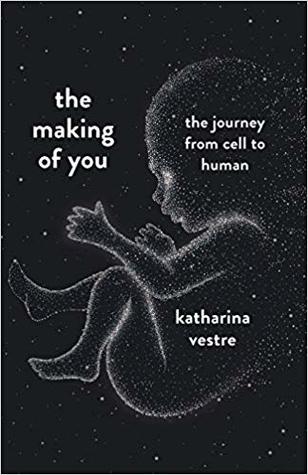 A sprightly layman’s guide to genetics and embryology, written by Doctoral Research Fellow at the University of Oslo Department of Biosciences. Addressed in the second person, as the title suggests, the book traces your development from the sperm Leeuwenhoek studied under a microscope up to labor and delivery. Vestre looks at all the major organs and the five senses and discusses what can go wrong along with the normal quirks of the body.
I learned all kinds of bizarre facts. For instance, did you know that sperm have a sense of smell? And that until the 1960s pregnancy tests involved the death of a mouse or rabbit? Who knew that babies can remember flavors and sounds experienced in utero?
Vestre compares human development with other creatures’, including fruit flies (with whom we share half of our DNA), fish and alligators (which have various ways of determining gender), and other primates (why is it that they stay covered in fur and we don’t?). The charming style is aimed at the curious reader; I rarely felt that things were being dumbed down. Most chapters open with a fetal illustration by the author’s sister. I’m passing this on to a pregnant friend who will enjoy marveling at everything that’s happening inside her.
A representative passage:
“This may not sound terribly impressive; I promised you dramatic changes, and all that’s happened is that a round plate has become a triple-decker cell sandwich. But you’re already infinitely more interesting than the raspberry you were a short while ago. These cells are no longer confused, needy newcomers with no idea where they are or what they’re supposed to do. They have completed a rough division of labour. The cells on the top layer will form, among other things, skin, hair, nails, eye lenses, nerves and your brain. From the bottom layer you’ll get intestines, liver, trachea and lungs. And the middle layer will become your bones, muscles, heart and blood vessels.”
With thanks to Wellcome Collection/Profile Books for the free copy for review.
Would you be interested in reading one or more of these?
Recent Writing for BookBrowse, Shiny New Books and the TLS
We’re back from a pleasant but whirlwind weekend in France. Even just sticking to one corner of Normandy, there was far too much to see and do and not enough good weather to do it all in. Highlights were the Bayeux tapestry, the gorse-covered rocky cliff above a river at Les Roches de Ham, a delicious three-course meal in a restaurant just outside Bayeux, fresh bread and cake from boulangeries, and the enormous Sunday morning open-air market in Caen. (Low point: being sick on the boat on the way back. I hate sailing.) I finished up The Dreamers by Karen Thompson Walker, read all of A Breath of French Air by H.E. Bates, and started a few more books.
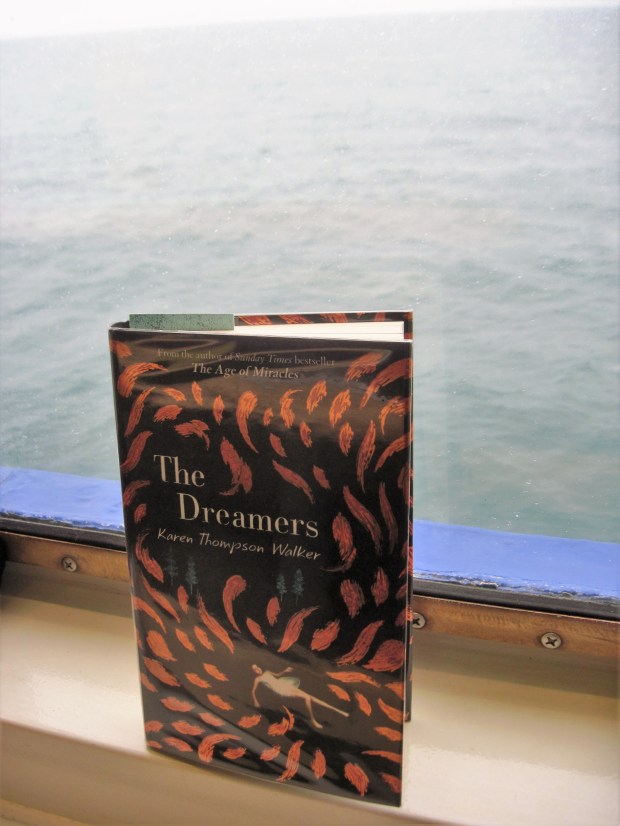
It was good to have a gripping novel to take my mind off the rocking motion of the ferry on the trip out.
Here are excerpts from and links to some of my recent print or online writing for other places. (No surprise that four out of the five are nonfiction and involve medical or bereavement themes!)
BookBrowse
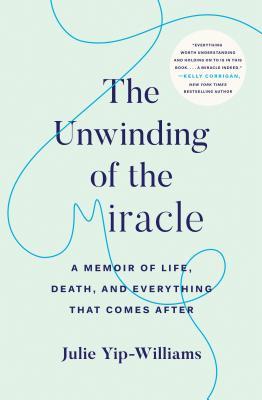 The Unwinding of the Miracle: A Memoir of Life, Death, and Everything That Comes After by Julie Yip-Williams: A lawyer facing late-stage cancer reflects on the happy life she had despite disability and an inauspicious start, and bids farewell to her family. It was miracle enough to have survived her first few years (blindness, a euthanasia attempt, and fleeing Vietnam by boat), but she eventually graduated from Harvard Law School and joined a Wall Street law firm. The author dubs herself “a somewhat ruthless realist.” Early on she vowed she would do nothing desperate or bizarre in her quest for healing, in contravention of what she calls the American “hope industrial complex.” Yet she also left room for spirituality to surprise her. The book resembles a set of journal entries or thematic essays, written at various times over her five years with colon cancer. Some stories are told more than once; an editor might have combined or cut some passages to avoid repetitiveness. Still, this posthumous memoir stands as a testament to a remarkable life of overcoming adversity, asking questions, and appreciating beauty wherever it’s found. (See also my list of other recommended posthumous cancer memoirs.)
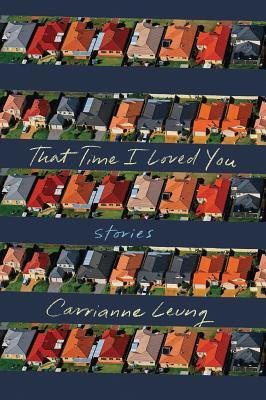 That Time I Loved You: Stories by Carrianne Leung: The residents of a Toronto suburb cope with growing up amid a spate of surprise suicides in the late 1970s and early 1980s. Leung explores different points of view on the same events and changes that take place in a community over several years. Three of the stories are narrated by June, who is 11 years old at the start. Her parents came over from Hong Kong 15 years ago. Other stories fill in a kaleidoscopic view of the neighborhood, showing how lonely the residents are – and how segregated along ethnic lines. Leung returns to June’s perspective at the beginning, middle, and end of the book, so we see her growing up and learning how the world works. Hard lessons are in store for her: people are sometimes punished for their differences, and the older generation doesn’t have it all figured out. Suburbia gets a bad rap, but it’s where so many of us come from, so it’s heartening to see a writer taking it seriously here. (See also my article on linked short story collections, for which I enlisted lots of blogger help via book Twitter.)
Shiny New Books
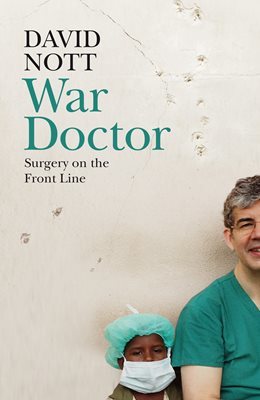 War Doctor: Surgery on the Front Line by David Nott: Welsh surgeon David Nott combines advanced technical skills with extreme altruism: for weeks of every year he takes unpaid leave to volunteer with a medical charity like Médecins sans Frontières or Syria Relief in war zones or disaster areas around the world. The kinds of procedures he has performed in Sarajevo, Kabul and Darfur are a world away from his normal work as an NHS consultant in London: amputations, treating injuries caused by homemade bombs, and delivering the babies of young rape victims. His memoir is mostly structured by countries and/or time periods. There are gripping moments – such as completing a difficult amputation by following instructions texted to him by a London colleague – but also some less fascinating chronology. The book is slow to start and took me weeks to get through. However, it shines when Nott recalls particular patients who have stood out for him. All told, his is an amazing and inspiring story.
As if you haven’t already heard enough about the Wellcome Book Prize from me (!), I also wrote this article for Shiny about the Prize’s history and the range of books that have won or been nominated over the last 10 years, finishing up with some reflections on this year’s shortlist.
Times Literary Supplement
Somehow I seem to have become a TLS regular. The biography editor periodically contacts me with lists of recent memoirs to be reviewed in 400 words for the “In Brief” section, and I’ve been doing about one per month this year.
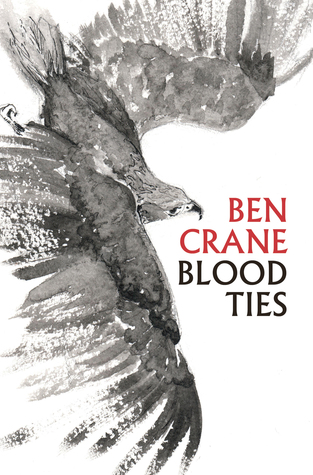 Blood Ties by Ben Crane: Artist Ben Crane has developed a passion for birds of prey, raising hawks and training as a falconer. “I saw that my feelings towards nature, and birds of prey in particular, ran in parallel with my feelings for my son,” he writes. Blood Ties accordingly cuts between the story of rehabilitating a pair of rescued sparrowhawks named Girl and Boy and a parallel story about raising his son as a part-time single father. Together these strands emphasize the common concerns that arise when caring for any creature. Crane’s descriptive language is memorably sharp. Whatever struggles his Asperger’s entails, it seems to heighten his observational skills. Pruning the travel segments would have produced a more focused memoir, but this is a powerful story all the same – of the ties that bind us, both to nature and our own families. (Full review in February 8th issue.)
 Notes for the Everlost: A Field Guide to Grief by Kate Inglis: Inglis, a Nova Scotian photographer and children’s author, has written this delicate, playful handbook – something between a bereavement memoir and a self-help guide – for people who feel they might disappear into grief for ever. In 2007, Inglis’s identical twin sons were born premature, at twenty-seven weeks. Ben lived but Liam died. Every milestone in Ben’s life would serve as a reminder of the brother who should have been growing up alongside him. The unfairness was particularly keen on the day she returned to hospital for two appointments: Ben’s check-up and a report on Liam’s autopsy. Unable to sustain the eye-popping freshness of the prose in the introduction, Inglis resorts to some clichés in what follows. But this kooky, candid book will be valuable to anyone facing bereavement or supporting a loved one through it. (Full review in March 15th issue.)
Would any of these books interest you?
Recent Poetry Reads
I love interspersing poetry with my other reading, and this year it seems like I’m getting to more of it than ever. Although I try to have a poetry collection on the go at all times, I still consider myself a novice and enjoy discovering new-to-me poets. However, I know many readers who totally avoid poetry because they assume they won’t understand it or it would feel too much like hard work.
Sinking into poems is certainly a very different experience from opening up a novel or a nonfiction narrative. Often I read parts of a poem two or three times – to make sure I’ve taken it in properly, or just to savor the language. I try to hear the lines aloud in my head so I can appreciate the sonic techniques at work, whether rhyming or alliteration. Reading or listening to poetry engages a different part of the brain, and it may be best to experience it in something of a dreamlike state.
I hope you’ll find a book or two that appeals from the selection below.
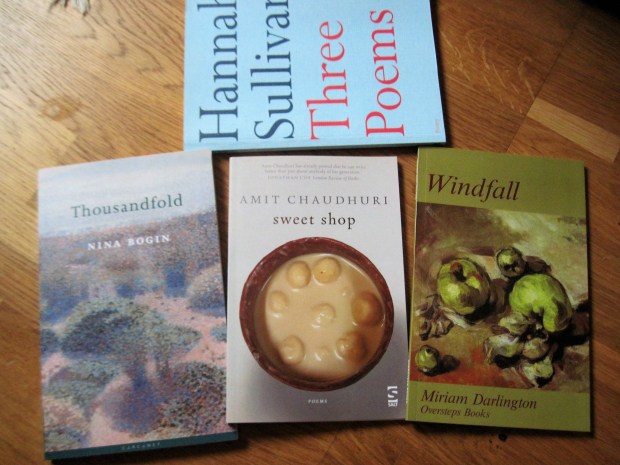
Thousandfold by Nina Bogin (2019)
 This is a lovely collection whose poems devote equal time to interactions with nature and encounters with friends and family. Birds – along with their eggs and feathers – are a frequent presence. Often a particular object will serve as a totem as the poet remembers the most important people in her life: her father’s sheepskin coat, her grandmother’s pink bathrobe, and the slippers her late husband shuffled around in – a sign of how diminished he’d become due to dementia. Elsewhere Bogin greets a new granddaughter and gives thanks for the comforting presence of her cat. Gentle rhymes and half-rhymes lend a playful or incantatory nature. I’d recommend this to fans of Linda Pastan.
My rating:
Thousandfold will be published by Carcanet Press on January 31st. My thanks to the publisher for the free copy for review.
Sweet Shop by Amit Chaudhuri (2019)
 I was previously unfamiliar with Chaudhuri’s work, and unfortunately this insubstantial book about his beloved Indian places and foods hasn’t lured me into trying any more. The one poem I liked best was “Creek Row,” about a Calcutta lane used as a shortcut: “you are a thin, short-lived, / decaying corridor” and an “oesophageal aperture”. I also liked, as stand-alone lines go, “Refugees are periodic / like daffodils.” Nothing else stood out for me in terms of language, sound or theme. Poetry is so subjective; all I can say is that some poets will click with you and others don’t. In any case, the atmosphere is similar to what I found in Korma, Kheer and Kismet: Five Seasons in Old Delhi by Pamela Timms.
My rating: 
My thanks to Salt Publishing for the free copy for review.
Windfall by Miriam Darlington (2008)
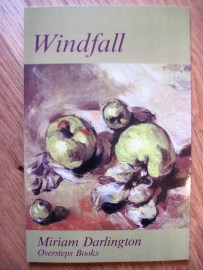 Before I picked this up from the bookstall at the New Networks for Nature conference in November, I had no idea that Darlington had written poetry before she turned to nature writing (Otter Country and Owl Sense). These poems are rooted in the everyday: flipping pancakes, sitting down to coffee, tending a garden, smiling at a dog. Multiple poems link food and erotic pleasure; others make nature the source of exaltation. I loved her descriptions of a heron (“a standing stone / perched in silt / a wrap of grey plumage”) and a blackbird (“the first bird / a glockenspiel in C / an improvisation on morning / a blue string of notes”), Lots of allusions and delicious alliteration. Pick this up if you’re missing Mary Oliver.
My rating:
A Responsibility to Awe by Rebecca Elson (2018)
 Elson, an astronomer who worked on the Hubble Space Telescope, died of breast cancer; this is a reprint of her posthumous 2001 publication. Along with a set of completed poems, the volume includes an autobiographical essay and extracts from her notebooks. Her impending mortality has a subtle presence in the book. I focused on the finished poems, which take their metaphors from physics (“Dark Matter”), mathematics (“Inventing Zero”) and evolution (indeed, “Evolution” was my favorite). In the essay that closes the book, Elson remembers long summers of fieldwork and road trips across Canada with her geologist father (I was reminded of Margaret Atwood’s Cat’s Eye), and traces her academic career as she bounced between the United States and Great Britain.
My rating:
My thanks to Carcanet Press for the free copy for review.
These next two were on the Costa Prize for Poetry shortlist, along with Hannah Sullivan’s Three Poems, which was one of my top poetry collections of 2018 and recently won the T. S. Eliot Prize. I first encountered the work of all three poets at last year’s Faber Spring Party.
Us by Zaffar Kunial (2018)
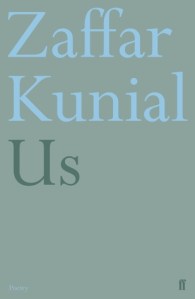 Many of these poems are about split loyalties and a composite identity – Kunial’s father was Kashmiri and his mother English – and what the languages we use say about us. He also writes about unexpectedly developing a love for literature, and devotes one poem to Jane Austen and another to Shakespeare. My favorites were “Self Portrait as Bottom,” about doing a DNA test (“O I am translated. / The speech of numbers. / Here’s me in them / and them in me. … What could be more prosaic? / I am split. 50% Europe. / 50% Asia.”), and the title poem, a plea for understanding and common ground.
My rating:
Soho by Richard Scott (2018)
 When I saw him live, Scott read two of the amazingly intimate poems from this upcoming collection. One, “cover-boys,” is about top-shelf gay porn and what became of the models; the other, “museum,” is, on the face of it, about mutilated sculptures of male bodies in the Athens archaeological museum, but also, more generally, about “the vulnerability of / queer bodies.” If you appreciate the erotic verse of Mark Doty and Andrew McMillan, you need to pick this one up immediately. Scott channels Verlaine in a central section of gritty love poems and Whitman in the final, multi-part “Oh My Soho!”
My rating:
Don’t Call Us Dead by Danez Smith (2017)
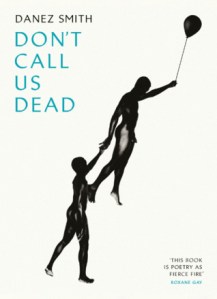 Like Claudia Rankine’s Citizen, this is a book whose aims I can admire even though I didn’t particularly enjoy reading it. It’s about being black and queer in an America where both those identifiers are dangerous, where guns and HIV are omnipresent threats. “reader, what does it / feel like to be safe? white?” Smith asks. “when i was born, i was born a bull’s-eye.” The narrator and many of the other characters are bruised and bloody, with blood used literally but also metaphorically for kinship and sexual encounters. By turns tender and biting, exultant and uncomfortable, these poems are undeniably striking, and a necessary wake-up call for readers who may never have considered the author’s perspective.
My rating:
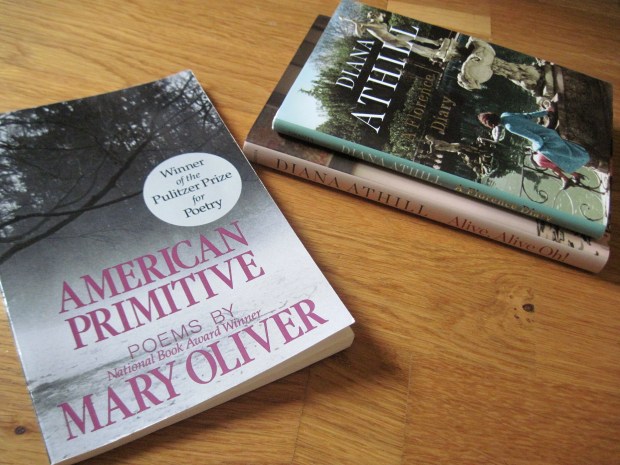
Up next: This Pulitzer-winning collection from the late Mary Oliver, whose work I’ve had mixed success with before (Dream Work is by far her best that I’ve read so far). We lost two great authors within a week! RIP Diana Athill, too, who was 101.
Any recent poetry reads you can recommend to me?
Novellas in November, Part 1: 3 Fiction, 3 Nonfiction
This is my third year of prioritizing novellas for my November reading. I have plenty more on the go that I’ll try to write up as the month progresses. For this first installment I review three each of my recent fiction and nonfiction reads, all of them 150 pages or fewer.

Fiction:
Lady into Fox by David Garnett (1922)
[53 pages]
 I accidentally did things the wrong way round: a few months back I read Sarah Hall’s Madame Zero, which includes the BBC National Short Story Prize 2013 winner “Mrs Fox,” clearly modeled on Garnett’s half-charming, half-horrible fable. In both, an upper-middle-class marriage is derailed when the wife turns into a fox. Here Mr. Tebrick sends away the servants and retreats from the world to look after Silvia, who grows increasingly feral. To start with the vixen will wear clothing, sleep in a bed, play cards and eat table scraps, but soon she’s hunting birds outdoors. Before long she’s effectively a wild creature, though she still shows affection to Tebrick when he comes to visit her den.
Anyone in a partnership will experience a bittersweet sense of recognition at how Tebrick and Silvia try to accommodate each other’s differences and make compromises to maintain a relationship in defiance of the world’s disapproval and danger. Beware unsentimental animal peril throughout. I downloaded it from Project Gutenberg.
The Old Man and the Sea by Ernest Hemingway (1952)
[99 pages]
 It’s a wonder I never read this Pulitzer winner in high school. Like that other syllabus favorite, Steinbeck’s The Pearl, it’s a Great American novella praised for spare prose and weighty symbolism. My two decades’ worth of preconceptions were proven accurate insomuch as this is a gloomy story about the nobility but ultimate futility of human striving. After 84 days without a catch, Santiago returns to the waters off of Havana and finally gets a bite. Even after the harrowing process of reeling in the 18-foot marlin, his struggle isn’t over.
This is my third experience with Hemingway’s fiction; I remain unconvinced. I appreciated some of the old man’s solitary ruminations on purpose and determination – “My big fish must be somewhere,” “Now is no time to think of what you do not have. Think of what you can do with what there is” – though they sound rather like sound bites. And I kept almost falling asleep while reading this (until the sharks showed up), which almost never happens. Take that as you will.
Ghost Wall by Sarah Moss (2018)
[149 pages]
 It’s the late 1980s and teenager Silvie Hampton and her parents have joined a university-run residential archaeology course in the North of England, near bogs where human sacrifice once took place. Her father is a Rochdale-area bus driver, but British prehistory is his all-consuming hobby. They’ll skin rabbits with stone tools and forage for roots and berries. What could be better?! As it turns out, it’s a stifling summer, and the students can’t sneak off to civilization often enough. Mocked for her family’s accent, Silvie is uncomfortably aware of her class. And, always, she must tread carefully to avoid angering her father, who punishes perceived offenses with his belt or his fists.
Women’s bodies and what can be done to them is central; as the climax approaches, the tricksy matter of consent arises. Though I enjoyed Silvie’s sarcastic voice, I was underwhelmed for much of the book, yet ended up impressed by how much is conveyed in so few pages. If you haven’t read anything by Sarah Moss, do so immediately. 
Nonfiction:
Losing Susan: Brain Disease, the Priest’s Wife, and the God Who Gives and Takes Away by Victor Lee Austin (2016)
[146 pages]
 Austin, an Episcopal priest and academic, met his wife Susan at St. John’s College in Santa Fe, New Mexico. She was his companion for nearly 40 years. Unusually for a cancer story, it wasn’t the beginning of the end when Susan was diagnosed with an astrocytoma brain tumor in 1993; surgery was successful and she lived for another 19 years, but white-matter disease, a side effect of radiation, meant that her brain function was continually diminishing.
The book gives a clear sense of Susan’s personality despite the progression of her illness, and of the challenges of being a caregiver while holding down a career. I enjoyed the details of the human story of coping with suffering, but in overlaying a spiritual significance on it Austin lost me somewhat. “God, who had given us so much, now gave us this evil,” he writes. While once this kind of language would have meant something to me, now it alienates me. I valued this more as a straightforward bereavement memoir than as a theological treatise. 
The Secret Life of the Owl by John Lewis-Stempel (2017)
[84 pages]
 “There is something about owls. More than any other family of birds they produce a reaction in us, and have done so across time and continents.” Some species-specific natural/cultural histories can be long-winded, giving significantly more information than your averagely interested lay reader needs (Foxes Unearthed, for instance), but Lewis-Stempel’s short book about Britain’s owls gets it just right.
He gives some general information about the family, surveys the native species and occasional visitors, gives tips for telling them apart – I’m going to photograph a page on the difference between the five major species’ pellets for future reference – and shares legends and poems that feature owls (including a jaunty little Tennyson piece that reads like a folk song; I’ll suggest that my husband turn it into one). The black-and-white illustrations by Beci Kelly are charming, too. It’s a shame I missed this when it first came out, but it would still make a great gift for a bird lover this Christmas.
Pages from a Nature-Lover’s Diary by Kathleen A. Renninger (2013)
[72 pages]
 These are lovely excerpts from nature sketchbooks Renninger kept between 1987 and 2013. My mother bought the self-published book from the author at a craft fair, and I enjoyed spotting lots of familiar place names from southern central Pennsylvania, where my mother and sister used to live. In the past I’ve unfairly considered the area devoid of natural beauty, but it’s clear from Renninger’s encounters that the wildlife is out there if you’re patient and lucky enough to find it – mostly birds and insects, but even larger mammals like foxes and bears.
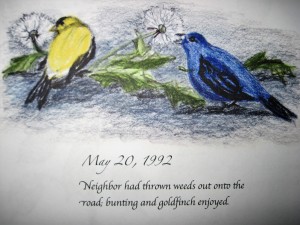 Many of her sightings are by chance: near her feeders or clothesline, or while driving past fields or down a residential street. Each month ends with a poem; these are slightly florid, but so earnest that they won me over. There are plentiful punctuation issues and the cursive font is a challenge to read, but the captured moments and the sense of the seasons’ passing make for a sweet book I’d recommend to anyone with a local interest.
Have you read any of these novellas? Which one takes your fancy?
The Feather Thief by Kirk Wallace Johnson
 The Feather Thief is a delightful read that successfully combines many genres – biography, true crime, ornithology, history, travel and memoir – to tell the story of an audacious heist of rare bird skins from the Natural History Museum at Tring in 2009. Somehow I managed not to hear about it at the time, but it was huge news in terms of museum collections and endangered species crime. The tendrils of this thorny case wind around Victorian explorers, tycoons, and fashionistas through to modern obsessions with music, fly-fishing and refugees.
Author Kirk Wallace Johnson worked for USAID in Iraq, heading up the reconstruction of Fallujah, then founded a non-profit organization rehoming refugees in America. Plagued by PTSD, he turned to fly-fishing as therapy, and this was how he heard about the curious case of Edwin Rist, who stole the bird specimens from Tring to sell the bright feathers to fellow hobbyists who tie elaborate Victorian-style fishing flies.
Rist, from upstate New York, was a 20-year-old flautist studying at the Royal Academy of Music in London. Since age 11 he’d been fixated on fly-tying, especially old-fashioned salmon ties, which use exotic feathers or ordinary ones dyed to look like them. An online friend told him he should check out Tring – the museum Walter Rothschild’s financier father built for him as a twenty-first birthday present – when he got to London. In 2008 Rist scoped out the collection, pretending to be photographing the birds of paradise for a friend’s book.
A year later he took the train to Tring one summer night with an empty suitcase and a glass cutter, broke in through a window, stole 300 bird skins, and made it back to his flat without incident. The museum only discovered the crime a month later, by accident. Rist sold many feathers and whole birds via a fly-tying forum and on eBay. It was nearly another year and a half before the police knocked on his door, having been alerted by a former law enforcement officer who encountered a museum-grade bird skin at the Dutch Fly Fair and asked where it came from.

An interior shot showing some plates of fishing flies.
Here is where things get really interesting, at least for me. Rist confessed immediately, but a psychological evaluation diagnosed him with Asperger’s; on the strength of that mental health defense he was given a suspension and a large fine, but no jail time, so he graduated from the Royal Academy as normal and auditioned for jobs. The precedent was a case from 2000 in which a young man with Asperger’s who stole human remains from a Bristol graveyard was exonerated.
The book is in three parts: the first gives historical context about specimen collection and the early feather trade; the second is a blow-by-blow of Rist’s crime and the aftermath, including the trial; and the third goes into Wallace’s own investigation process. He started by attending a fly-tying symposium, where he felt like an outsider and even received vague threats: Rist was now a no-go subject for this community. But Wallace wasn’t going to be deterred. Sixty-four bird skins were still missing, and his quest was to track them down. He started by contacting Rist’s confirmed customers, then interviewed Rist himself in Germany and traveled to Norway to meet someone who might have been Rist’s accomplice – or fall guy.

From the back cover.
I happened to be a bit too familiar with the related history – I’ve read a lot of books that touch on Alfred Russel Wallace, whose specimens formed the core of the Tring collection, as well as a whole book on the feather trade for women’s hats and the movement against the extermination, which led to the formation of the Audubon Society (Kris Radish’s The Year of Necessary Lies). This meant that I was a little impatient with the first few chapters, but if you are new to these subjects you shouldn’t have that problem. For me the highlights were the reconstruction of the crime itself and Wallace’s inquiry into whether the Asperger’s diagnosis was accurate and a fair excuse for Rist’s behavior.
This whole story is stranger than fiction, which would make it a great selection for readers who don’t often pick up nonfiction, perhaps expecting it to be dry or taxing. Far from it. This is the very best sort of nonfiction: wide-ranging, intelligent and gripping.
My rating:
The Feather Thief was published in the UK by Hutchinson on April 26th. My thanks to Najma Finlay for the free copy for review.
Blog Tour Review: Why Do Birds Suddenly Disappear? by Lev Parikian
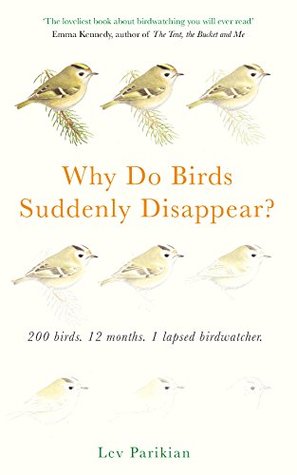 Lev Parikian was a keen birdwatcher when he was 11, but as an adult he barely remembered most of what he used to know about birds. He’d confidently declare that he’d seen a nightingale and then be too embarrassed to later admit it was actually a skylark. Also, he had to acknowledge that he hadn’t been completely honest as a preteen birder: No way had he seen a black redstart, for instance. Probably about 30% of his childhood sightings could be dismissed as cheats or downright lies. As the birdwatching bug bit again at the start of 2016, he decided it was time to set the record straight. His aim? To see 200 birds in a year, with no twitching (driving many miles to see a reported rarity) and no cheating.
Most of the book is a chronological tour through 2016, with each month’s new sightings totaled up at the end of the chapter. Being based in London isn’t the handicap one might expect – there’s a huge population of parakeets there nowadays, and the London Wetland Centre in Barnes is great for water birds – but Parikian also fills in his list through various trips around the country. He picks up red kites while in Windsor for a family wedding, and his list balloons in April thanks to trips to Minsmere and Rainham Marshes, where he finds additions like bittern and marsh harrier. The Isle of Wight, Scotland, Lindsifarne, North Norfolk… The months pass and the numbers mount until it’s the middle of December and his total is hovering at 196. Will he make it? I wouldn’t dare spoil the result for you!
I’ve always enjoyed ‘year-challenge’ books, everything from Julie Powell’s Julie and Julia to Nina Sankovitch’s Tolstoy and the Purple Chair, so I liked this memoir’s air of self-imposed competition, and its sense of humor. Having accompanied my husband on plenty of birdwatching trips, I could relate to the alternating feelings of elation and frustration. I also enjoyed the mentions of Parikian’s family history and career as a freelance conductor – I’d like to read more about this in his first book, Waving, Not Drowning (2013). This is one for fans of Alexandra Heminsley’s Leap In and Kyo Maclear’s Birds Art Life, or for anyone who needs reassurance that it’s never too late to pick up a new skill or return to a beloved hobby.
Lastly, I must mention what a beautiful physical object this book is. The good folk of Unbound have done it again. The cover image and endpapers reproduce Alan Harris’s lovely sketch of a gradually disappearing goldcrest, and if you lift the dustjacket you’re rewarded with the sight of some cheeky bird footprints traipsing across the cover.


Some favorite passages:
“Birders love a list. Day lists, week lists, month lists, year lists, life lists, garden lists, county lists, walk-to-work lists, seen-from-the-train lists, glimpsed-out-of-the-bathroom-window-while-doing-a-poo lists.”
“It’s one thing sitting in your favourite armchair, musing on the plumage differences between first- and second-winter black-headed gulls, but that doesn’t help identify the scrubby little blighter that’s just jigged into that bush, never to be seen again. And it’s no use asking them politely to damn well sit still blast you while I jot down the distinguishing features of your plumage in this notebook dammit which pocket is it in now where did I put the pencil ah here it is oh bugger it’s gone. They just won’t. Most disobliging.”
“There is a word in Swedish, gökotta, for the act of getting up early to listen to birdsong, but the knowledge that this word exists, while heartwarming, doesn’t make it any easier. It’s a bitter pill, this early rising, but my enthusiasm propels me to acts of previously unimagined heroism, and I set the alarm for an optimistic 5 a.m., before reality prompts me to change it to 5.15, no 5.30, OK then 5.45.”
My rating:
Why Do Birds Suddenly Disappear? was published by Unbound on May 17th. My thanks to the publisher for the free copy for review.
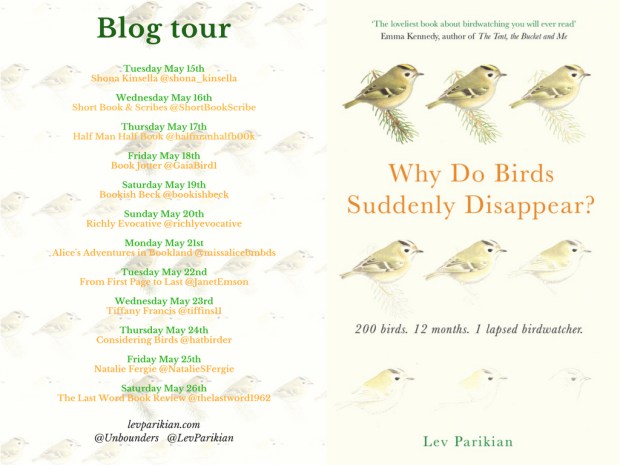
I was delighted to be invited to participate in the blog tour for Why Do Birds Suddenly Disappear? See below for details of where other reviews and features have appeared or will be appearing soon (including on my hubby’s blog on Thursday!).
Reviews Roundup, July–August
One of my goals with this blog is to have one convenient place where I can gather together all my writing that has appeared in disparate online locations. To that end, once a month I’ll provide links to all the book reviews I’ve published elsewhere, with a rating (below each description) and a short taster so you can decide whether to click to read more. A couple of exceptions: I won’t point out my Kirkus Indie or BlueInk reviews since I don’t get a byline.
The Bookbag
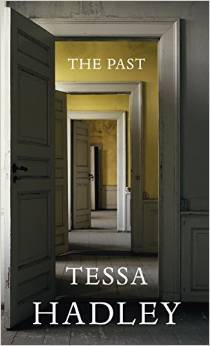 The Past by Tessa Hadley: Four adult siblings gather at their grandfather’s Devon vicarage for one last summer holiday before the house is sold. Their interactions, past and present, skirt the edges of tragedy and show the secrets and psychological intricacies any family harbors. Hadley writes beautifully subtle stories of English family life. Here she channels Elizabeth Bowen with a setup borrowed from The House in Paris: the novel is divided into three parts, titled “The Present,” “The Past,” and “The Present.” That structure allows for a deeper look at what the house and a neighboring cottage have meant to the central family. Hadley writes great descriptive prose and has such insight into family dynamics. Releases September 3rd.

 Between Gods by Alison Pick: At a time of transition – preparing for her wedding and finishing her first novel, set during the Holocaust – the author decided to convert to Judaism, the faith of her father’s Czech family. There are so many things going on in this sensitive and engrossing memoir: depression, her family’s Holocaust history, her conversion, career struggles, moving to Toronto, adjusting to marriage, and then pregnancy and motherhood following soon after – leading full circle to a time of postpartum depression. That said, this book is exactly what you want from a memoir: it vividly depicts a time of tremendous change, after which the subject is still somehow the same person, or perhaps more herself than ever.
BookBrowse
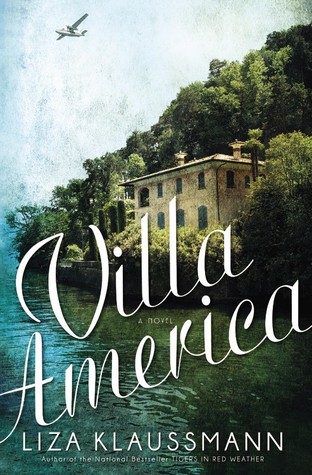 Villa America by Liza Klaussmann [the full text of my review is available for free this week as part of Editor’s Choice]: In her second novel, Klaussmann explores the glittering, tragic lives of Gerald and Sara Murphy, real-life models for F. Scott Fitzgerald’s Tender Is the Night. The book is slow to start with, with the first third unnecessarily devoted to Gerald’s and Sara’s childhoods and courtship. It is not until the Murphys are established in France and receive visits from fellow artists that the book really comes to life. It is easy to see why the Murphys attracted hangers-on. Yet beneath the façade of glamour, there is real sadness and struggle. Gerald’s uncertain sexuality is a tacit issue between him and Sara, and sickness strikes the family with cruel precision. The novel set up a beautiful contrast between happiness and tragedy.
Foreword Reviews
Stop the Diet, I Want to Get Off! by Lisa Tillinger Johansen: Yo-yo dieters and newbies alike should pick up Johansen’s witty book before wasting any time, money, or heartache on ineffective fad diets. Surveying diets old and new in a conversational style, Johansen gives the merits and dangers of each and suggests realistic principles for healthy eating and exercise. She bases her advice on solid facts, but cannily avoids the dry, scientific tone some experts might use. Instead, she uses chatty, informal language and personal stories to enliven her writing.
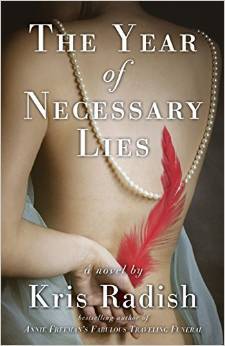 The Year of Necessary Lies by Kris Radish: Radish’s tenth novel highlights women’s role in the Audubon Society campaign to eradicate feathers from ladies’ hats. Her fictional heroine, Julia Briton, is a composite portrait of the many courageous women who stood up to plume hunters and the fashion industry alike in the early years of the twentieth century. “I did not simply want to survive, but to live with great passion and to do something that made a difference in the world,” Julia declares. Recommended for fans of Sue Monk Kidd’s The Invention of Wings.

Nudge
Now and at the Hour of Our Death by Susana Moreira Marques: In 2011 Marques, a freelance journalist, spent five months visiting the dying through a Portuguese home palliative care project. The resulting book falls into two parts: “Travel Notes about Death,” one-line aphorisms and several-paragraph anecdotes; and “Portraits,” case studies and interview transcripts from three families facing the death of a loved one. The lack of a straightforward narrative and the minimal presence of the author mean that the book overall feels disjointed. Nonetheless, it is a thought-provoking look at hospice services and emotions surrounding death. Releases September 3rd.
 Caught by Lisa Moore: A classic cat-and-mouse story in which a Canadian drug smuggler escapes from prison to score another load of marijuana from Colombia. Moore paints Slaney and Hearn as “modern-day folk heroes,” and her writing elevates what could have been a plain crime story into real literature. From the title onwards, the book is heavy with foreshadowing as Moore exploits the dramatic irony that readers know the police have a sting operation trailing Slaney the whole way. Indeed, the most remarkable thing about the novel is how it maintains tension even though the outcome seems inevitable. “The best stories … we’ve known the end from the beginning.” To my surprise, Caught is not just a good old-fashioned adventure story, but also has the epic, tragic weight of Homer’s Odyssey.
Field Notes from the Edge by Paul Evans: A book full of unexpected nuggets of information and inspiration: in addition to the travel notes and field observations, Evans (who writes a Guardian country diary from Wenlock Edge, Shropshire) incorporates personal anecdote, folk songs, myths and scientific advances. His central idea is that we have lost our connection with nature due to fear – “ecophobia,” the opposite of which is E.O. Wilson’s “biophilia.” How do we overcome that fear? Mostly by doing just what Evans does: spending time in nature, finding beauty and developing an affinity for particular places and species.
Shiny New Books
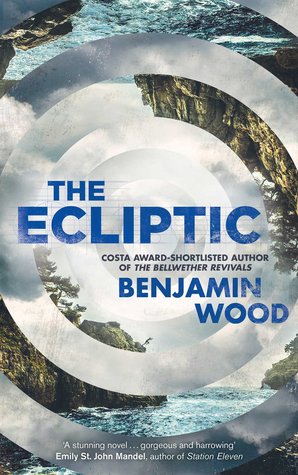 The Ecliptic by Benjamin Wood: Portmantle is a mysterious artists’ retreat center on a Turkish island. Our narrator, Elspeth Conroy (aka Knell), is a Scottish painter who came to Portmantle in 1962 after some struggles with mental illness. The first third of the novel is tremendously gripping and Gothic. The core of the book, nearly 200 pages, is a flashback to Elspeth’s life before. At last, after what feels like too long a digression, we come full circle back to Portmantle. I didn’t warm to The Ecliptic quite as much as I did to Wood’s debut, The Bellwether Revivals. Still, it’s really interesting to see how he alternates between realism and surrealism here. The parts that feel most real and immediate and the parts that are illusory are difficult to distinguish between. An odd, melancholy, shape-shifting novel.
We Love This Book
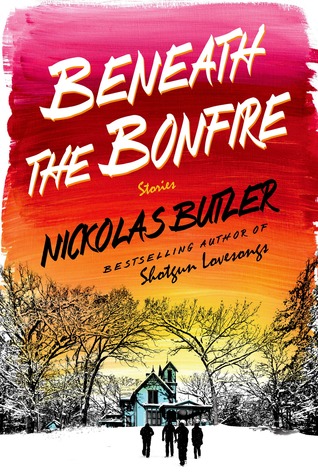 Beneath the Bonfire by Nickolas Butler: Ten tales of moral complexity in America’s gritty heartland. Fire and recreational drugs are powerful forces linking these Wisconsin-set stories. Opener “The Chainsaw Soirée” sets the tone by describing a failed utopia reminiscent of Lauren Groff’s Arcadia. The stand-out is “Morels,” in which three stoned friends go foraging for mushrooms in their dying rural community. The title’s similarity to “morals” is no coincidence: when the trio are involved in a hit-and-run they have to decide what to stand for. Unsentimental but lyrically composed, these stories will appeal to fans of Ron Rash.
 Among the Ten Thousand Things by Julia Pierpoint: Pierpont’s ambitiously structured debut novel explores how infidelity affects a whole New York City family. In short sections of matter-of-fact statements Pierpont gives a what-happened-next for each of the characters over the next decade or so. But “it’s the between-time that lasted,” Pierpoint argues as she returns to that summer of revelations for a closer look. The climactic events of the holiday contrast childhood innocence and adulthood; when you’re on the cusp, certain experiences can push you over the brink from one to the other. This offbeat take on the dysfunctional family novel should interest fans of Nicole Krauss or Rebecca Dinerstein (The Sunlit Night). [Few extra thoughts at Goodreads.]

I also post reviews of most of my casual reading and skimming on Goodreads.
 F: A Novel by Daniel Kehlmann: What does F stand for? Faith, finances, fraud, forgery, family and Fate all play a role in Kehlmann’s fourth novel available in English translation. F is also for the Friedlands: Arthur the unreliable patriarch; Martin, a portly Catholic priest who doesn’t believe in God; and his twin half-brothers, Eric and Ivan, a mentally ill businessman and a homosexual painter who forges his mentor’s masterworks. Reading this brilliant, funny spoof on the traditional family saga is like puzzling out a Rubik’s Cube: it is a multi-faceted narrative with many meanings that only become clear the deeper you go. (Full review in September/October 2015 issue of Third Way magazine.)

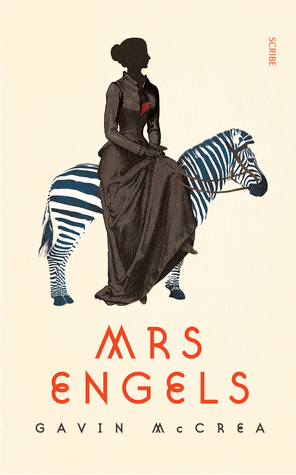 Mrs. Engels by Gavin McCrea: I generally love Victorian-set historical fiction and books about famous wives, so I was surprised by how little I liked this novel about Lizzie Burns, the illiterate, working-class Irish woman who was Frederick Engels’ longtime partner. The novel flits between 1870–1, when Lizzie and Frederick were newly arrived in London and involved in helping the poor and Franco-Prussian War refugees, and their earlier years in Manchester. Lizzie is a no-nonsense first-person narrator, and her coarse, questionably grammatical speech fits with her background. Unfortunately, I never warmed to Lizzie or felt that she was giving a truly intimate look at her own life. This novel had such potential to bring an exciting, revolutionary time to life, but it never fulfilled its promise for me. Releases in the States on October 13th.

Rank by Aaron McCollough: Some nice alliteration and pleasant imagery of flora, fauna and musical instruments. However, I struggled to find any overarching meaning in these run-on poems. In fact, I could not tell you what a single one of them is actually about. Story is just as important as sound in poetry, I feel, and in that respect this collection was lacking. Releases September 1st.
Trout’s Lie by Percival Everett: “The line of time / Is past. / The line folds back, / Splits. / Two lines now, future, present. The past / Is a circle of / Abstraction, regret.” There is a lot of repetition and wordplay in these poems. The title piece uses a line in Italian from Dante – translating to “in the middle of our life’s path” – that forms another recurring theme: being stuck between times or between options and having to decide which way to go. These read quickly, with the run-on phrases flowing naturally from topic to topic. I’m not sure this was the best introduction to a prolific author I’d never heard of; I’ll have to look into his other work. Releases October 15th.
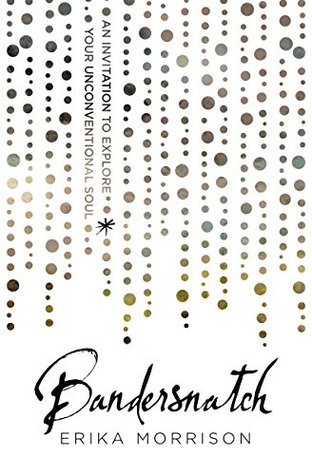 Bandersnatch by Erika Morrison: This is Christian self-help, an ideal read for fans of Glennon Doyle Melton and Rob Bell. The title, a creature from Lewis Carroll’s imagination, is Morrison’s shorthand for a troublemaker. She argues that as Christians we should be following Jesus down the road of “positive nonconformity”: taking an avant-garde approach to life, turning ordinary moments into divine opportunities through spiritual alchemy, taking an interest in the least of these with kingdom anthropology, and making the everyday trials of marriage and parenthood our works of art. I liked the book best when Morrison illustrated her points with stories from her own life. Overall I found the book repetitive, and the language can definitely be hippy-dippy in places. Releases October 6th.

Family Values by Wendy Cope: Cope mostly uses recognizable forms (villanelles, sonnets, etc.): this is interesting to see in contemporary poetry, but requires a whole lot of rhyming, most of it rather twee (e.g. “tuppence/comeuppance”), which gives the whole collection the feeling of being written for children. My two favorites were “Lissadell,” about a vacation to Ireland, and “Haiku,” perfect in its simplicity:
A perfect white wine
is sharp, sweet and cold as this:
birdsong in winter.
 Bookish Beck = Rebecca Foster. American transplant to England. Freelance proofreader and book reviewer.
 Bookish Beck