R.I.P. Catch-Up (Part III): Donoghue, Dunmore, Hahn, Thummler
I’m behind on all the things. In the first of several catch-up posts, I’ll take a quick look back at the other spooky reads I picked up last month. This is my third post for Readers Imbibing Peril, after one on scary story collections and another on two East Anglian horror novels.
Kissing the Witch by Emma Donoghue (1997)
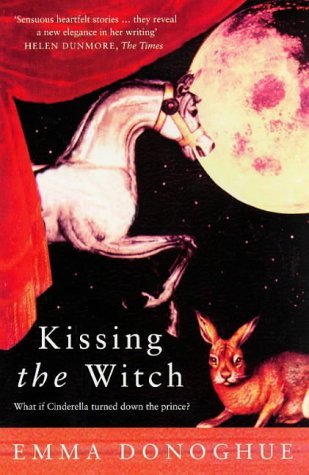 This is a terrific set of retellings of European fairytales, some I recognized (Cinderella, Rapunzel, Hansel and Gretel, The Little Mermaid) and some I didn’t. Each of the 13 stories is a first-person testimonial, and they all run into each other in a satisfying way because there are no speech marks and at the end the narrator of one asks a question that sparks a character to tell the next one, and so on. Many of them have cautionary elements (“In the days when wishing was having, I got what I wished and then I wished I hadn’t”) so there is sometimes an air of regret, but elsewhere there is defiance of convention. Maids lord their power over princesses and witches manipulate feuding spouses. As the title suggests, there is a queer slant to many to these familiar narratives. Witches aren’t evil hags to be shunned but alluring sexual creatures, making for some cheeky twist endings. This was a random choice from Donoghue’s back catalogue but might actually be one of my favourites from her oeuvre. (Secondhand – Awesomebooks.com with voucher)

The Greatcoat by Helen Dunmore (2012)
{SPOILERS IN THIS ONE}
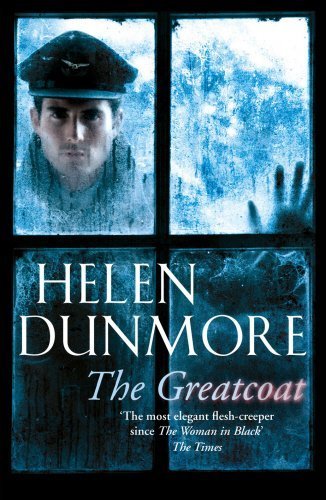 I’m always surprised by how much Dunmore published, especially in a life cut short by cancer; her bibliography is full of titles I’ve never heard of. So this commissioned horror novella was an unexpected discovery. Isabel is a newlywed in 1952 Yorkshire. Her husband, Philip Carey, is a doctor who’s often away on emergency house calls. Until she fulfils everyone’s expectations by falling pregnant, she will have little to occupy herself beyond cooking and cleaning, with the landlady always stomping about overhead. It’s a bitter winter and one day she pulls an old RAF greatcoat from the back of a wardrobe to put over the bedclothes. The garment seems to summon the soldier who once wore it at a local airfield, Alec, and as he starts to visit more frequently, Isabel channels the memories of the woman who carried on an affair with him. The ghost lover is nothing novel, but possession by the past experiences of another person who’s still alive was a new one on me. I wasn’t sure Dunmore always demarcated the real and the imaginary effectively; then again, that’s part of the point of horror. Anyway, a quick and easy read, and what happened to Isabel’s parents during the war is a good way of pointing up the everyday trauma that many were living with in that decade. (Little Free Library)

The Time of the Witch by Mary Downing Hahn (1982)
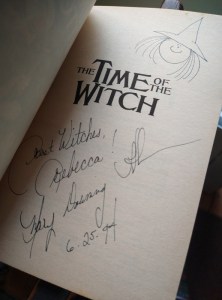
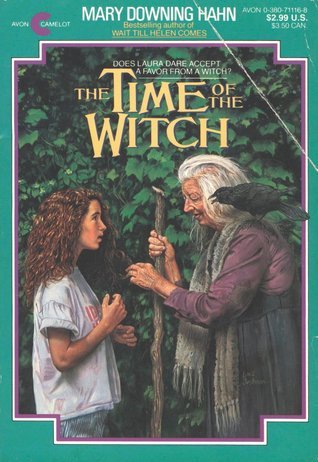 This might be the first book I ever got signed at an author event, aged 10. I don’t specifically recall reading it as a child, but I think it must be a reread for me. (Some of Hahn’s other titles listed inside the book ring a bell, anyway.) Laura and her little brother Jason come from the Washington, D.C. area to stay with Aunt Grace in West Virginia for the summer while their parents finalize their divorce. When Laura learns that there is a nearby witch, an old woman named Maude who goes around with a crow on her shoulder, she decides to ask for a spell to bring her parents back together. But, as happens with these sorts of stories, her request has unforeseen consequences and she soon wants to take it all back. This was so very ’80s, the names and descriptions of the locals are stereotypical “hick” fodder, and it’s a pretty predictable message to accept what you cannot control and trust that adults know what they’re doing. I’m sure I found it suspenseful as a kid, but I doubt this one has stood the test of time. (Gift – purchased new by my mother at a Bowie Library event in 1994)
Sheets & Lights by Brenna Thummler (2018; 2023)
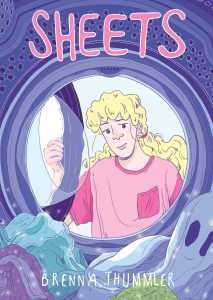 I finished off this teen graphic novel trilogy (the middle book is Delicates) by rereading parts of the first volume that I missed out on when my NetGalley download expired, and finding the third book I never got to. Middle schooler Marjorie Glatt works in her family’s laundromat in small-town Pennsylvania. Since her mother died, it’s just been her, her little brother, and their absent-minded father. When she starts seeing the ghost of a little boy named Wendell – and ghosts in this world are literally just sheets with eye-holes – he makes her life more complicated but also acts as a bridge to another dimension she’s been denying. With his mischief, he also helps her to resist the buyout offer of awful Mr. Saubertuck, who keeps threatening to turn the laundromat into a yoga retreat center.
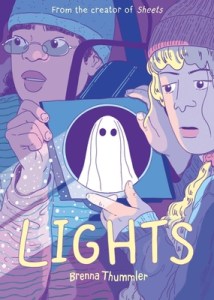 In the other two volumes, Marjorie makes friends with Eliza, a ghost photographer, and they help Wendell investigate his own untimely death. Whereas Eliza is bullied and feels like an outcast, Marjorie makes some friends among the popular girls and tries to bring her two friend circles together, with mixed results. I like the pastel, kitsch 1980s-90s vibe of these comics, though Thummler can’t really draw noses, at least not on white people. I would recommend the series for younger teens. (Public library)

Any stand-out creepy reading for you this year?
R.I.P., Part I: Michel Faber, Rebecca Green and Lize Meddings
For my first installment of this year’s Readers Imbibing Peril challenge, I have a highly undemanding selection of a novella, a picture book, and a teen graphic novel. And nothing here is nearly as scary as proper horror-fiction readers might be expecting.
The Hundred and Ninety-Nine Steps by Michel Faber (2001)
 One of my reads in Hay was this suspenseful novella set in Whitby. Faber was invited by the then artist in residence at Whitby Abbey to write a story inspired by the English Heritage archaeological excavation taking place there in the summer of 2000. His protagonist, Siân, is living in a hotel and working on the dig. She meets Magnus, a handsome doctor, when he comes to exercise the dog he inherited from his late father on the stone steps leading up to the abbey. Siân had been in an accident and is still dealing with the physical and mental after-effects. Each morning she wakes from a nightmare of a man with large hands slitting her throat. When Magnus brings her a centuries-old message in a bottle from his father’s house for her to open and decipher, another layer of intrigue enters: the crumbling document appears to be a murderer’s confession.
At first I worried Faber would turn this into a simple, predictable ghost story and milk expected sources of trauma. But the plot twists kept surprising me. The focus on women’s bodies and sexuality is appropriate for the town that gave us Dracula. This had hidden depths and at 116 pages could easily be a one-sitting read. Hadrian the dog is a great character, too, and this is even in my favourite font, Mrs Eaves, one that Canongate uses often. [Unfortunate error: Faber twice refers to Whitby as being Northumbrian. Although it was in the historical kingdom of Northumbria, it is actually in North Yorkshire rather than Northumberland.] (Secondhand – Bookcase, Carlisle) 
How to Make Friends with a Ghost by Rebecca Green (2017)
 Here Green proposes a ghost as a lifelong, visible friend. The book has more words and more advanced ideas than much of what I pick up from the picture book boxes. It’s presented as almost a field guide to understanding the origins and behaviours of ghosts, or maybe a new parent’s or pet owner’s handbook telling how to approach things like baths, bedtime and feeding. What’s unusual about it is that Green takes what’s generally understood as spooky about ghosts and makes it cutesy through faux expert quotes, recipes, etc. She also employs Rowling-esque grossness, e.g. toe jam served on musty biscuits. Perhaps her aim was to tame and thus defang what might make young children afraid. I enjoyed the art more than the sometimes twee words. (Public library)

The Sad Ghost Club by Lize Meddings (2021)
 This is the simplest of comics. Sam or “SG” goes around wearing a sheet – a tangible depression they can’t take off. (Again, ghosts aren’t really scary here, just a metaphor for not fully living.) Anxiety about school assignments and lack of friends is nearly overwhelming, but at a party SG notices a kindred spirit also dressed in a sheet: Socks. They’re awkward with each other until they dare to be vulnerable, stop posing as cool, and instead share how much they’re struggling with their mental health. Just to find someone who says “I know exactly what you mean” and can help keep things in perspective is huge. The book ends with SG on a quest to find others in the same situation. The whole thing is in black-and-white and the setups are minimalist (houses, a grocery store, a party, empty streets, a bench in a wooded area where they overlook the town). Not a whole lot of art skill required to illustrate this one, but it’s sweet and well-meaning. I definitely don’t need to read the sequels, though. The tone is similar to the later Heartstopper books and the art is similar to in Sheets and Delicates by Brenna Thummler, all of which are much more accomplished as graphic novels go. (Public library)

 Bookish Beck = Rebecca Foster. American transplant to England. Freelance proofreader and book reviewer.

