R.I.P. Catch-Up (Part III): Donoghue, Dunmore, Hahn, Thummler
I’m behind on all the things. In the first of several catch-up posts, I’ll take a quick look back at the other spooky reads I picked up last month. This is my third post for Readers Imbibing Peril, after one on scary story collections and another on two East Anglian horror novels.
Kissing the Witch by Emma Donoghue (1997)
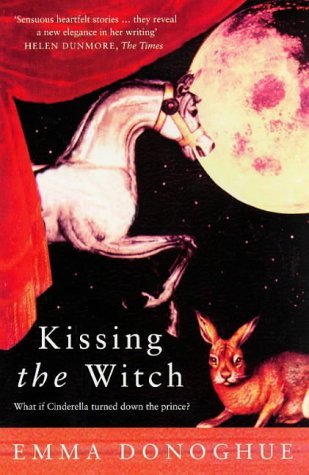 This is a terrific set of retellings of European fairytales, some I recognized (Cinderella, Rapunzel, Hansel and Gretel, The Little Mermaid) and some I didn’t. Each of the 13 stories is a first-person testimonial, and they all run into each other in a satisfying way because there are no speech marks and at the end the narrator of one asks a question that sparks a character to tell the next one, and so on. Many of them have cautionary elements (“In the days when wishing was having, I got what I wished and then I wished I hadn’t”) so there is sometimes an air of regret, but elsewhere there is defiance of convention. Maids lord their power over princesses and witches manipulate feuding spouses. As the title suggests, there is a queer slant to many to these familiar narratives. Witches aren’t evil hags to be shunned but alluring sexual creatures, making for some cheeky twist endings. This was a random choice from Donoghue’s back catalogue but might actually be one of my favourites from her oeuvre. (Secondhand – Awesomebooks.com with voucher)

The Greatcoat by Helen Dunmore (2012)
{SPOILERS IN THIS ONE}
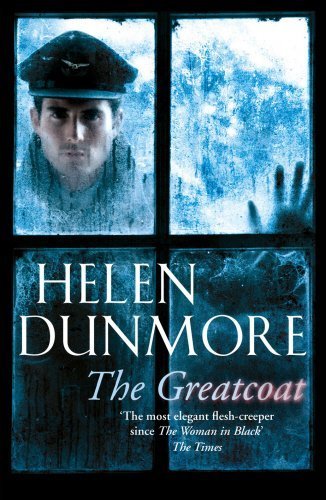 I’m always surprised by how much Dunmore published, especially in a life cut short by cancer; her bibliography is full of titles I’ve never heard of. So this commissioned horror novella was an unexpected discovery. Isabel is a newlywed in 1952 Yorkshire. Her husband, Philip Carey, is a doctor who’s often away on emergency house calls. Until she fulfils everyone’s expectations by falling pregnant, she will have little to occupy herself beyond cooking and cleaning, with the landlady always stomping about overhead. It’s a bitter winter and one day she pulls an old RAF greatcoat from the back of a wardrobe to put over the bedclothes. The garment seems to summon the soldier who once wore it at a local airfield, Alec, and as he starts to visit more frequently, Isabel channels the memories of the woman who carried on an affair with him. The ghost lover is nothing novel, but possession by the past experiences of another person who’s still alive was a new one on me. I wasn’t sure Dunmore always demarcated the real and the imaginary effectively; then again, that’s part of the point of horror. Anyway, a quick and easy read, and what happened to Isabel’s parents during the war is a good way of pointing up the everyday trauma that many were living with in that decade. (Little Free Library)

The Time of the Witch by Mary Downing Hahn (1982)
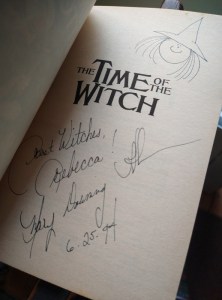
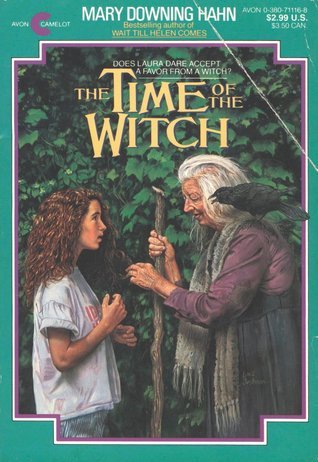 This might be the first book I ever got signed at an author event, aged 10. I don’t specifically recall reading it as a child, but I think it must be a reread for me. (Some of Hahn’s other titles listed inside the book ring a bell, anyway.) Laura and her little brother Jason come from the Washington, D.C. area to stay with Aunt Grace in West Virginia for the summer while their parents finalize their divorce. When Laura learns that there is a nearby witch, an old woman named Maude who goes around with a crow on her shoulder, she decides to ask for a spell to bring her parents back together. But, as happens with these sorts of stories, her request has unforeseen consequences and she soon wants to take it all back. This was so very ’80s, the names and descriptions of the locals are stereotypical “hick” fodder, and it’s a pretty predictable message to accept what you cannot control and trust that adults know what they’re doing. I’m sure I found it suspenseful as a kid, but I doubt this one has stood the test of time. (Gift – purchased new by my mother at a Bowie Library event in 1994)
Sheets & Lights by Brenna Thummler (2018; 2023)
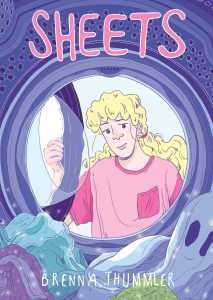 I finished off this teen graphic novel trilogy (the middle book is Delicates) by rereading parts of the first volume that I missed out on when my NetGalley download expired, and finding the third book I never got to. Middle schooler Marjorie Glatt works in her family’s laundromat in small-town Pennsylvania. Since her mother died, it’s just been her, her little brother, and their absent-minded father. When she starts seeing the ghost of a little boy named Wendell – and ghosts in this world are literally just sheets with eye-holes – he makes her life more complicated but also acts as a bridge to another dimension she’s been denying. With his mischief, he also helps her to resist the buyout offer of awful Mr. Saubertuck, who keeps threatening to turn the laundromat into a yoga retreat center.
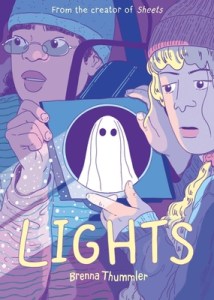 In the other two volumes, Marjorie makes friends with Eliza, a ghost photographer, and they help Wendell investigate his own untimely death. Whereas Eliza is bullied and feels like an outcast, Marjorie makes some friends among the popular girls and tries to bring her two friend circles together, with mixed results. I like the pastel, kitsch 1980s-90s vibe of these comics, though Thummler can’t really draw noses, at least not on white people. I would recommend the series for younger teens. (Public library)

Any stand-out creepy reading for you this year?
Reading Ireland Month, Part II: Dowd, Enright, Madden & Nugent
I’m catching up with a final set of reviews for #ReadingIrelandMonth26. I read two novels set at least partially during the Troubles, one of them for teenagers; a quiet novel about adultery and bereavement; and a thriller about consent and family legacy. I also read the first half of one more novel, a sombre one about the aftermath of a mental health crisis. Between this post and my first one, I covered 6.5 novels by Irish women, which I’ll call a win.
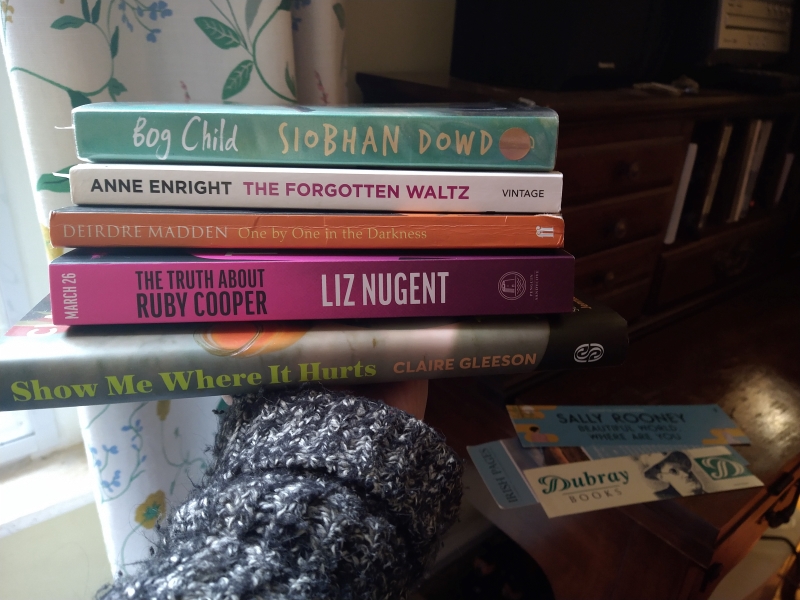
Bog Child by Siobhan Dowd (2008)
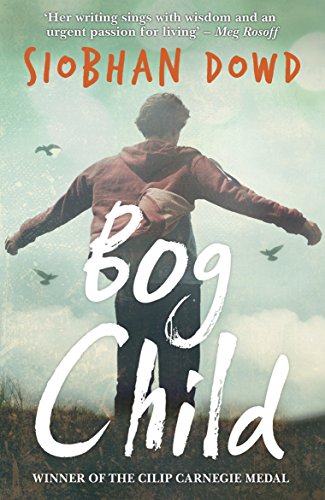 Fergus McCann is 18 and taking A levels; if he can only get three Bs, he’ll have his ticket out of Northern Ireland to study medicine at Aberdeen. This is no ordinary summer, though. He loves running on the hills at the border and here he makes a landmark discovery and embarks on a risky mission. The plot opens with Fergus and his uncle stumbling on the corpse of a girl while cutting peats. It’s a case for archaeologists rather than the police: the body is from the Iron Age and there’s evidence that the girl was sacrificed. An acquaintance then pressures Fergus into running parcels up and down the hill, right under the noses of the British at the checkpoint. He makes friends with Owain, a Welsh soldier, but gets a horrible feeling he’s partially responsible for the bombings he soon hears about on the radio. His family is enmeshed in the IRA anyway: his brother is among the hunger strikers in the local prison. There’s every chance that Joey could die before the summer is out, as much a victim of injustice as “Mel” (as Fergus names the girl from the bog, whose story he dreams).
This was Dowd’s third novel, published posthumously after her death from cancer, and won the Carnegie Medal. I’d say it’s one of the few best young adult novels I’ve ever read. (It’s shelved under Teenage Fiction at my library.) It’s an excellent peripheral glance at history ancient and modern – Fergus’s letter to Margaret Thatcher is brilliant – and effectively recreates a teen’s divided attention: friends, schooling, family drama, the future, and romance (via the daughter of the archaeologist). I searched my library catalogue for further books on bog bodies after reading Anna North’s Bog Queen and it really paid off! (Public library)
The Forgotten Waltz by Anne Enright (2011)
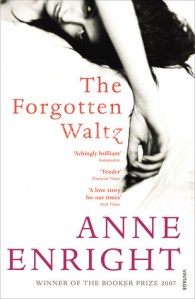 I’ve only read a handful of Enright novels and wanted to experience more, so picked this one because it was shortlisted for the Orange Prize. On the face of it, it’s a fairly straightforward adultery story, but the unshowy potency of Enright’s writing and her realistic insight into relationships set it apart. While married to Conor, Gina has an affair with Seán, who’s older and married to Aileen. Seán is part of their social circle but also someone she knows through work, and business trips are an easy excuse. “The office game was another game for us to play, after the suburban couples game, and before the game of hotel assignations and fabulous, illicit lust, and neither of us thought there might come a moment when all the games would stop. It was a lot of fun.” Gina narrates matter-of-factly, rejecting cause-and-effect language. She doesn’t defend herself, or fool herself that Seán is perfect. This new relationship involves as many challenges as her marriage, what with her mother’s death and Seán’s preteen daughter, Evie, who appears to be autistic and epileptic. The short chapters are all headed with song lyrics, mostly from love songs (“Will You Love Me Tomorrow,” “Stop! In the Name of Love”) whose ironic optimism underlines the novel’s gently melancholy tone. This reminded me most of Maggie O’Farrell’s early work, and more than justified delving into Enright’s back catalogue. (Secondhand – Awesomebooks.com)
{SPOILERS IN THE REST!!}
One by One in the Darkness by Deirdre Madden (1996)
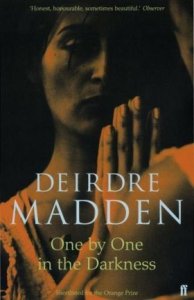 Louise Kennedy’s Trespasses was our book club selection for March; I’d read it just two years ago, so skimmed back through and was impressed by its construction. Some were less convinced by the framing story and not emotionally engaged with Michael and Cushla’s affair, but we all appreciated it as a sideways look at Northern Irish history. One by One in the Darkness, which was also shortlisted for the Women’s (then Orange) Prize, is set close to its publication in the 1990s but returns to the Troubles through memories and flashbacks. Set over one week – Saturday to Friday – it’s the story of the three Quinn sisters. Cate is a journalist in London who flies home to Antrim to break the news that she’s pregnant out of wedlock. Helen is a lawyer and Sally a schoolteacher. They, their mother, and Uncle Brian have all gotten on with life as best they could, but their father’s murder is something they can’t forget and won’t ever get over. By saving that scene for the very last page of this novella, Madden keeps the horror of it fresh. Through one family’s story, she gives a sense of the scope of the country’s loss. But the book is not without a dark sense of humour, either. Madden was a new author for me. I found her work profound at the sentence level (see below for some favourite lines) rather than engaging at the plot level. (Secondhand – Awesomebooks.com)
“‘What’s wrong with Uncle Peter?’ ‘Two things,’ [Granny] said. ‘He thinks too much, and then he drinks too much.’”
“Once when [Cate] was home she’d remarked to Helen that she thought the forecasts were often inaccurate in Northern Ireland. ‘It’s probably deliberate,’ Helen had replied. ‘If they read out the average day’s news here and then said at the end of it, “Oh, and by the way, it’s going to bucket rain for the next twenty-four hours,” it might be more than people could take.’”
“Cate had remarked once that it was only when you lived away from Northern Ireland that you realised on returning how deeply divided a society it was, and how strange the effect of that could be.”
“There’d been well over three thousand people killed since the start of the Troubles, and every single one of them had parents or husbands and wives and children whose lives had been wrecked. It would be written about in the paper for two days, but as soon as the funeral was over it was as if that was the end, when it was really only the beginning.”
The Truth about Ruby Cooper by Liz Nugent (2026)
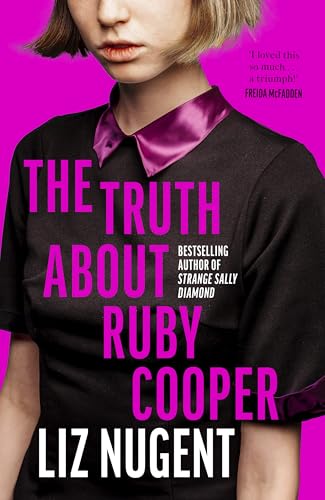 We read Nugent’s Strange Sally Diamond for book club a couple years ago and it was a great Northumberland holiday read for me, with a deliciously off-kilter narrator whose traumatized (and perhaps neurodivergent) perspective carried the novel. Here again Nugent prioritizes unreliable women’s voices and dark happenings, but Ruby is awfully hard to like. At age 16, she falsely accuses her older sister Erin’s boyfriend Milo of raping her. Milo maintains his innocence all along, but goes to jail for the crime; after all, DNA evidence can’t lie, right? Years of his life – and a heartbroken Erin’s – are stolen, his mother dies by suicide, Ruby becomes dependent on alcohol: all of this because of sisterly jealousy and an elaborate lie that their mother upholds rather than expose the family to further shame.
Narration alternates between Erin in Boston and Ruby, who’s moved back to Ireland with their mother. For Ruby’s confession to work, readers are kept in the dark about the truth of the incident, though only for 76 pages. Together the sisters give a tedious blow-by-blow of the intervening years – until Ruby’s daughter, Lucy, is raped by her boss on a drunken night out. Ruby refuses to believe her “because if it was true, that was karma coming to bit me on the ass.” This is where things finally get interesting, as Nugent explores ironies and familial patterns. But I’m sure I won’t be the only one to find the whole thing distasteful. Nugent clearly anticipates a backlash, stating in a prefatory letter, “I need to be very clear about the fact that girls and women like Ruby Cooper are extremely rare.” Was it worth undermining the #BelieveWomen campaign to explore a certain state of mind? Nah.
With thanks to Sandycove (Penguin) for the proof copy for review.
I’d also hoped to finish one more, but ran out of time. Here are my thoughts on the first half:
Show Me Where It Hurts by Claire Gleeson (2025)
 Rachel knew Tom had recurring problems with depression, but had no idea he was on the verge of a breakdown when he deliberately drove their car off the road with the intention of killing his entire family. Their two young children die in the crash but they both survive – Tom held in a psychiatric hospital and Rachel resuming her life as a nurse. The chapters alternate between “After” and “Before,” giving relative date markers in weeks, months or years out from the incident. Gleeson’s understated prose makes it possible for readers to face a tragedy so awful we’d otherwise look away; it never tips over into mawkishness.
 Bookish Beck = Rebecca Foster. American transplant to England. Freelance proofreader and book reviewer.

