The 2025 McKitterick Prize Winner & SoA Awards Ceremony
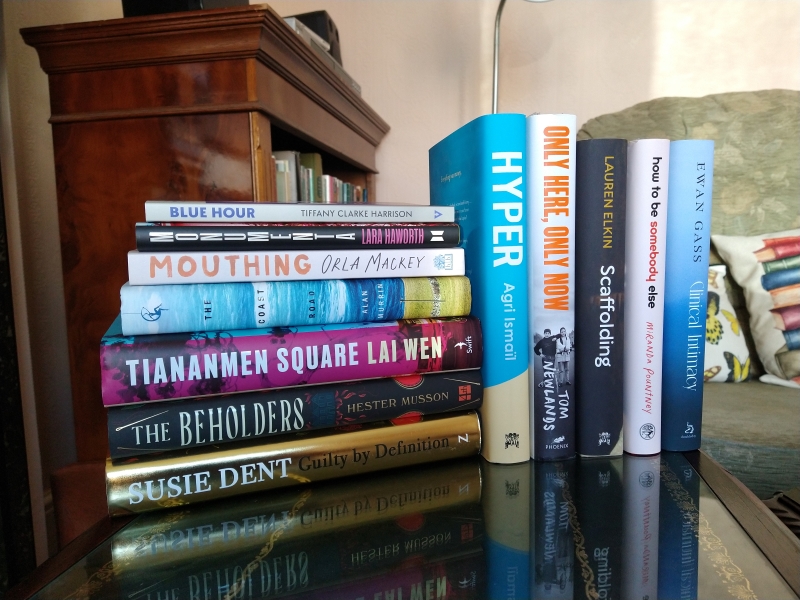
Yesterday the Society of Authors’ awards were announced and the prizes handed out at a ceremony in London. As a McKitterick Prize judge, I was asked last month to give a 50-word blurb on the shortlist as a whole—
Each of these six novels has a fully realized style. So confident and inviting are they that it’s hard to believe they are debuts. With nuanced characters and authentic settings and dilemmas, they engage the mind and delight the emotions. I will be following these authors’ careers with keen interest.
—and on each individual shortlisted title:
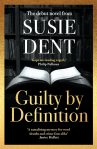 Etymology and Shakespeare studies are the keys to solving a cold case in Susie Dent’s clever, engrossing mystery, Guilty by Definition.
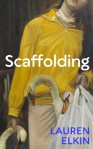 Psychoanalysis, motherhood, and violence against women are resounding themes in Lauren Elkin’s Scaffolding. As history repeats itself one sweltering Paris summer, the personal and political structures undergirding the protagonists’ parallel lives come into question. This fearless, sophisticated work ponders what to salvage from the past—and what to tear down.
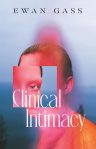 Clinical Intimacy’s mysterious antihero comes to life through interviews with his family, friends and clients. The brilliant oral history format builds a picture of isolation among vulnerable populations, only alleviated by care and touch—especially during Covid-19. Ewan Gass’s intricate story reminds us of the ultimate unknowability of other people.
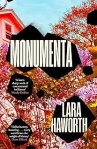
In Monumenta, Lara Haworth braids satire, magic realism, and metafiction into a compact and surprising meditation on how we seek to memorialise the tragedies of history.
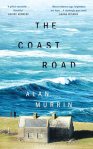
Set in small-town Ireland, The Coast Road is a subtle, compassionate novel in which the characters learn to write their own stories rather than bow to convention and fate. Alan Murrin is a must-read author for fans of Claire Keegan, Louise Kennedy, and Colm Tóibín.
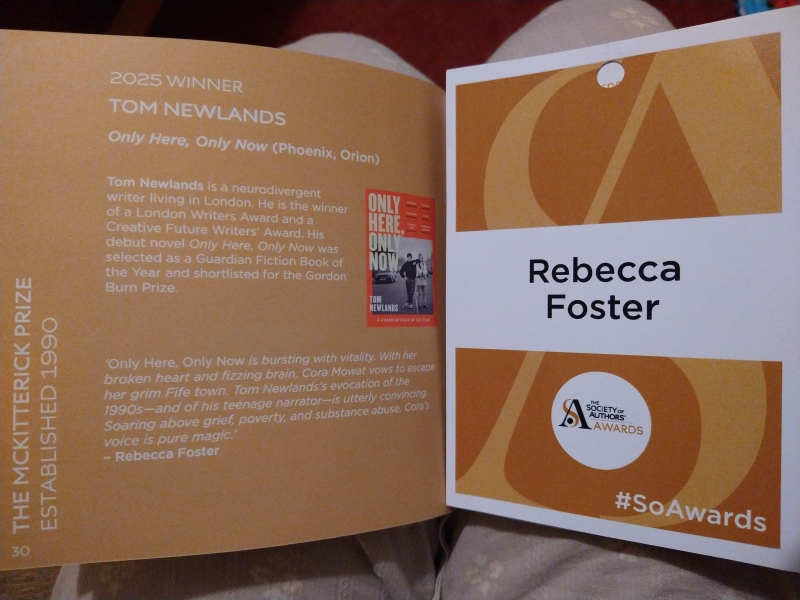
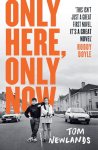 Only Here, Only Now is bursting with vitality. With her broken heart and fizzing brain, Cora Mowat vows to escape her grim Fife town. Tom Newlands’s evocation of the 1990s—and of his teenage narrator—is utterly convincing. Soaring above grief, poverty, and substance abuse, Cora’s voice is pure magic.
Our winner was Tom Newlands for Only Here, Only Now and our runner-up was Lauren Elkin for Scaffolding. (What an honour to have my blurb for the former used in the winners press release, the ceremony programme, and social media publicity.)


Newlands was also a runner-up for the ADCI Literary Prize “for a disabled or chronically ill writer, for an outstanding novel containing a disabled or chronically ill character or characters.” Here’s an excerpt from his statement for the press release:
To have my debut novel recognised in these two categories is particularly meaningful for me because they are linked by my experience. I didn’t start writing until the age of 40, in large part because growing up neurodivergent I didn’t feel my thought processes or methods of working were compatible with the production of a novel. There were no role models out there publishing stories like mine, and in the end, I wrote Only Here, Only Now because I couldn’t find the novel I wanted to read – a warm, vivid and funny story that examined poverty, disability and belonging, and that featured characters rarely found in British fiction.
Looking back to early on in this prize journey (which started back in November) … here was some of my early reading:
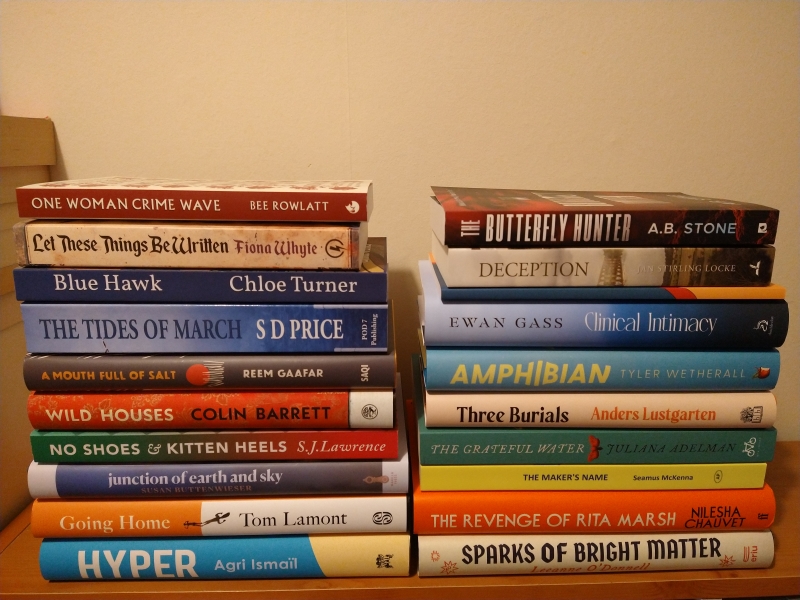
And our longlist:
A couple of my favourite books from my reading that didn’t make the shortlist were:
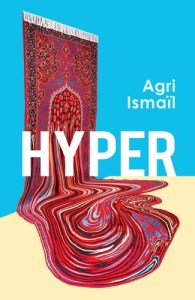 Hyper by Agri Ismaïl [I longlisted it – and then shortlisted it – but was outvoted]
Following a Kurdish family across several decades, this is a zeitgeist-y story that examines questions of national and personal autonomy. With its Dubai, Baghdad, London, and New York settings, it sets the second generation’s luxury, high finance, and fully online worlds against their parents’ bitter experience of exile after a failed independence movement. With its themes of dysfunction and failures and the long view of how we got here from there, it reminded me of Jonathan Franzen’s body of work.
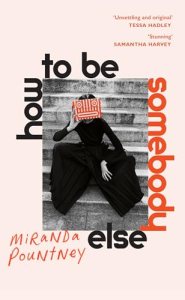 How to Be Somebody Else by Miranda Pountney [It had two votes to make the shortlist, but because it was so similar to Scaffolding in its basics (a thirtysomething woman in a big city, the question of motherhood, and pregnancy loss) we decided to cut it.]
This is the addictively readable story of Dylan, a late-thirties English woman who gives up her New York City advertising job and ponders authorship and motherhood while house-sitting an acquaintance’s apartment—and carrying on an affair with the married downstairs neighbour. As we see her interact with family and friends, we come to appreciate her not as some stereotypical ‘sad girl’ or ‘disaster woman’, but as an Everywoman seeking the time and space to become herself. It’s a sharp and witty novel for fans of Sally Rooney.
For the first time, I got to attend the SoA Awards ceremony in person yesterday. It was a hot day to be travelling in London, and after the oven of the Bakerloo line I was grateful to escape into the cool of Southwark Cathedral and its grounds. It was such a juxtaposition between the sleek City architecture and the ancient refuge of a church.
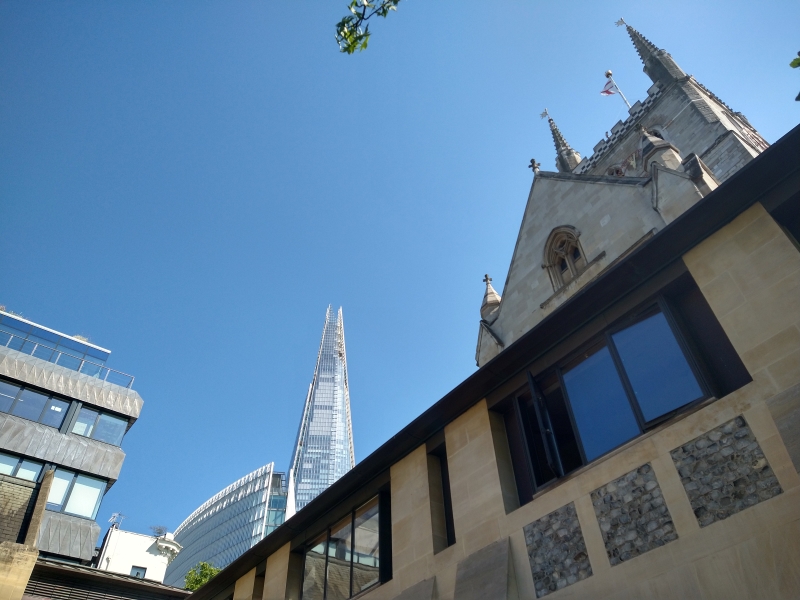
I worried that on such a warm and then busy day Hodge the cathedral cat wouldn’t show himself, but as I picked up my name badge he was asking to be let inside from the courtyard. He didn’t seem interested in strokes so I followed him at a respectful distance and let him settle in for a watchful rest.


Nominated authors and judges were treated to an exceptional afternoon tea, followed by the ceremony and drinks reception. It was lovely to meet my fellow judges Anietie Isong and Kathy O’Shaughnessy (author of the fantastic In Love with George Eliot, which won the SoA’s Paul Torday Memorial Prize) in the flesh as I’d only met them on Zoom before. We chatted a good bit with Lara Haworth, one of our shortlistees, and with Anne Booth, one of the Queen’s Knickers Award (children’s books) nominees, and also got to briefly meet Tom Newlands when he arrived for the ceremony. I always look out for literary ‘celebrities’ at such events and yesterday spotted Naomi Alderman, Caroline Bird, Joanne Harris and Alice Jolly.
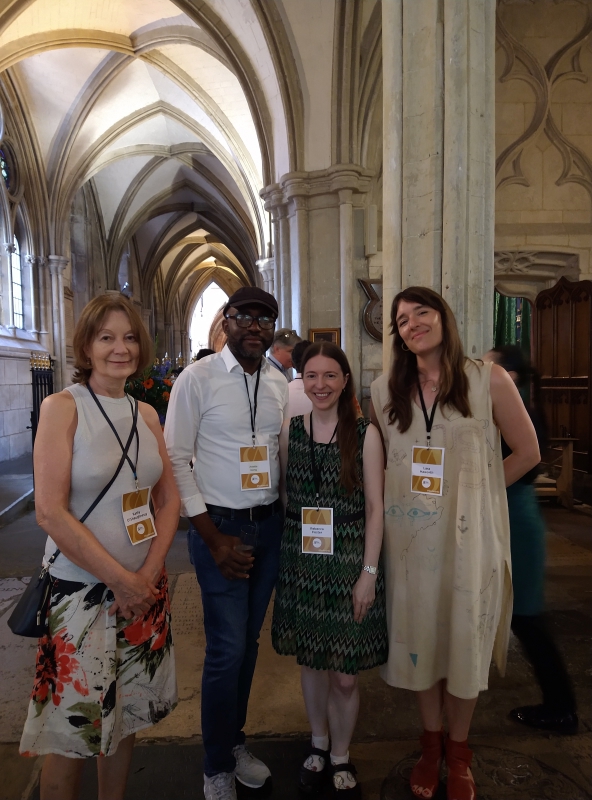


Dean Rev. Mark Oakley gave a welcome address via video, praising authors for bringing “resonance” rather than just “relevance.” He exhorted us, in the words of David Copperfield, to “read as if for life.” Joseph Coelho then gave a terrific keynote speech celebrating words written by humans (as opposed to an inaccurate AI-written bio of himself that he once encountered) and encouraging shortlistees, especially, to take time to bask in their achievement. Rejection is an ongoing, annual thing for him even at this stage of his career – he still remembers the £50 poetry gigs, changing in library toilets and school staff rooms; and the 12 years he spent trying to get published – even after he became the youngest-ever children’s laureate in 2022. “Wait for no one,” he challenged us: no one is going to give you permission or come save you, so go out there and do what you’re meant to do.
What an all-round fantastic experience this was! I’m so grateful to the Society of Authors for the opportunity.
Other notable winners announced yesterday included:
- Ashani Lewis (the only double winner): the Betty Trask Prize and Somerset Maugham award for Winter Animals
- Hisham Matar & Elif Shafak: the Gordon Bowker Volcano Prize (for a novel focusing on the experience of travel away from home), joint winners for My Friends and There Are Rivers in the Sky
Reading Ireland Month, I: Donoghue, Longley, Tóibín
St. Patrick’s Day is a good occasion to compile my first set of contributions to Cathy’s Reading Ireland Month. Today I have an early novel by a favourite author, a poetry collection inspired by nature and mythology, and a sequel that I read for book club.
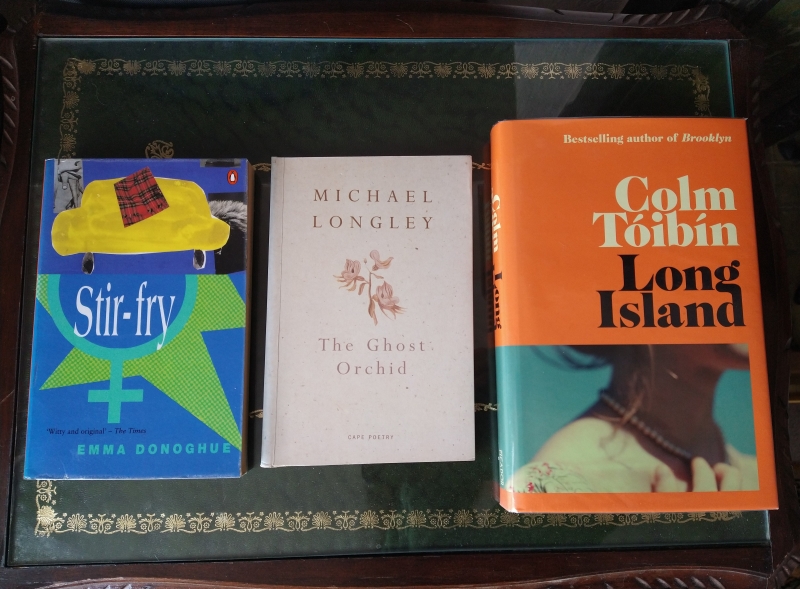
Stir-Fry by Emma Donoghue (1994)
After enjoying Slammerkin so much last year, I decided to catch up on more of Donoghue’s way-back catalogue. She tends to alternate between contemporary and historical settings. I have a slight preference for the former, but she can excel at both; it really depends on the book. I reckon this was edgy for its time. Maria (whose name rhymes with “pariah”) arrives in Dublin for university at age 17, green in every way after a religious upbringing in the countryside. In response to a flat-share advert stipulating “NO BIGOTS,” she ends up living with Ruth and Jael (pronounced “Yale”), two mature students. Ruth is the mother hen, doing all the cooking and fretting over the others’ wellbeing; Jael is a wild, henna-haired 30-year-old prone to drinking whisky by the mug-full. Maria attends lectures, takes a job cleaning office buildings, and finds a friend circle through her backstage student theatre volunteering. She’s mildly interested in American exchange student Galway and then leather-clad Damien (until she realizes he has a boyfriend), but nothing ever goes further than a kiss.
 It’s obvious to readers that Ruth and Jael are a couple, but Maria doesn’t work it out until a third of the way into the book. At first she’s mortified, but soon the realization is just one more aspect of her coming of age. Maria’s friend Yvonne can’t understand why she doesn’t leave – “how can you put up with being a gooseberry?” – but Maria insists, “They really don’t make me feel left out … I think they need me to absorb some of the static. They say they’d be fighting like cats if I wasn’t around to distract them.” Scenes alternate between the flat and the campus, which Donoghue depicts as a place where radicalism and repression jostle for position. Ruth drags Maria to a Tuesday evening Women’s Group meeting that ends abruptly: “A porter put his greying head in the door to comment that they’d have to be out in five minutes, girls, this room was booked for the archaeologists’ cheese ’n’ wine.” Later, Ruth’s is the Against voice in a debate on “That homosexuality is a blot on Irish society.”
Mostly, this short novel is a dance between the three central characters. The Irish-accented banter between them is a joy. Jael’s devil-may-care attitude contrasts with Ruth and Maria’s anxiety about how they are perceived by others. Ruth and Jael are figures in the Hebrew Bible and their devotion/boldness dichotomy is applicable to the characters here, too. The stereotypical markers of lesbian identity haven’t really changed, but had Donoghue written this now I think she would at least have made Maria a year older and avoided negativity about Damien and Jael’s bisexuality. At heart this is a sweet romance and an engaging picture of early 1990s feminism, but it doesn’t completely steer clear of predictability and I would have happily taken another 50–70 pages if it meant she could have fleshed out the characters and their interactions a little more. [Guess what was for my lunch this afternoon? Stir fry!] (Secondhand – Awesomebooks.com) 
The Ghost Orchid by Michael Longley (1995)
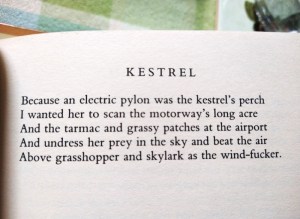
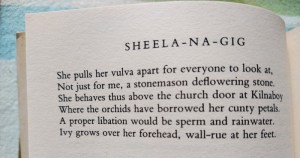
 Longley’s sixth collection draws much of its imagery from nature and Greek and Roman classics. Seven poems incorporate quotations and free translations of the Iliad and Odyssey; elsewhere, he retells the story of Baucis and Philemon and other characters from Ovid. The Orient and the erotic are also major influences; references to Hokusai bookend poems about Chinese artefacts. Poppies link vignettes of the First and Second World Wars. Longley’s poetry is earthy in its emphasis on material objects and sex. Alliteration and slant rhymes are common techniques and the vocabulary is always precise. This was the third collection I’ve read by the late Belfast poet, and with its disparate topics it didn’t all cohere for me. My two favourite poems are naughty indeed:
(Secondhand – Green Ink Booksellers, Hay-on-Wye) 
Long Island by Colm Tóibín (2024)
{SPOILERS in this one}
 I read Brooklyn when it first came out and didn’t revisit it (via book or film) before reading this. While recent knowledge of the first book isn’t necessary, it probably would make you better able to relate to Eilis, who is something of an emotional blank here. She’s been married for 20 years to Tony, a plumber, and is a mother to two teenagers. His tight-knit Italian American family might be considered nurturing, but for her it is more imprisoning: their four houses form an enclave and she’s secretly relieved when her mother-in-law tells her she needn’t feel obliged to join in the Sunday lunch tradition anymore.
When news comes that Tony has impregnated a married woman and the cuckolded husband plans to leave the baby on the Fiorellos’ doorstep when the time arrives, Eilis checks out of the marriage. She uses her mother’s upcoming 80th birthday as an excuse to go back to Ireland for the summer. Here Eilis gets caught up in a love triangle with publican Jim Farrell, who was infatuated with her 20 years ago and still hasn’t forgotten her, and Nancy Sheridan, a widow who runs a fish and chip shop and has been Jim’s secret lover for a couple of years. Nancy has a vision of her future and won’t let Eilis stand in her way.
I felt for all three in their predicaments but most admired Nancy’s pluck. Ironically given the title, the novel spends more of its time in Ireland and only really comes alive there. There’s also a reference to Nora Webster – cute that Tóibín is trying out the Elizabeth Strout trick of bringing multiple characters together in the same fictional community. But, all told, this was just a so-so book. I’ve read 10 or so works by Tóibín now, in all sorts of genres, and with its plain writing this didn’t stand out at all. It got an average score from my book club, with one person loving it, a couple hating it, and most fairly indifferent. (Public library)
Another batch will be coming up before the end of the month!
#NovNov23 Week 4, “The Short and the Long of It”: W. Somerset Maugham & Jan Morris
Hard to believe, but it’s already the final full week of Novellas in November and we have had 109 posts so far! This week’s prompt is “The Short and the Long of It,” for which we encourage you to pair a novella with a nonfiction book or novel that deals with similar themes or topics. The book pairings week of Nonfiction November is always a favourite (my 2023 contribution is here), so think of this as an adjacent – and hopefully fun – project. I came up with two pairs: one fiction and one nonfiction. In the first case, the longer book led me to read a novella, and it was vice versa for the second.

W. Somerset Maugham
The House of Doors by Tan Twan Eng (2023)
&
Liza of Lambeth by W. Somerset Maugham (1897)
I wasn’t a huge fan of The Garden of Evening Mists, but as soon as I heard that Tan Twan Eng’s third novel was about W. Somerset Maugham, I was keen to read it. Maugham is a reliably readable author; his books are clearly classic literature but don’t pose the stylistic difficulties I now experience with Dickens, Trollope et al. And yet I know that Booker Prize followers who had neither heard of nor read Maugham have enjoyed this equally. I’m surprised it didn’t make it past the longlist stage, as I found it as revealing of a closeted gay writer’s life and times as The Master (shortlisted in 2004) but wider in scope and more rollicking because of its less familiar setting, true crime plot and female narration.
The main action is set in 1921, as “Willie” Somerset Maugham and his secretary, Gerald, widely known to be his lover, rest from their travels in China and the South Seas via a two-week stay with Robert and Lesley Hamlyn at Cassowary House in Penang, Malaysia. Robert and Willie are old friends, and all three men fought in the First World War. Willie’s marriage to Syrie Wellcome (her first husband was the pharmaceutical tycoon) is floundering and he faces financial ruin after a bad investment. He needs a good story that will sell and gets one when Lesley starts recounting to him the momentous events of 1910, including a crisis in her marriage, volunteering at the party office of Chinese pro-democracy revolutionary Dr Sun Yat Sen, and trying to save her friend Ethel Proudlock from a murder charge.

It’s clever how Tan weaves all of this into a Maugham-esque plot that alternates between omniscient third-person narration and Lesley’s own telling. The glimpses of expat life and Asia under colonial rule are intriguing, and the scene-setting and atmosphere are sumptuous – worthy of the Merchant Ivory treatment. I was left curious to read more by and about Maugham, such as Selina Hastings’ biography. (Public library) 
But for now I picked up one of the leather-bound Maugham books I got for free a few years ago. Amusingly, the novella-length Liza of Lambeth is printed in the same volume with the travel book On a Chinese Screen, which Maugham had just released when he arrived in Penang.
{SPOILERS AHEAD}
This was Maugham’s debut novel and drew on his time as a medical intern in the slums of London. In tone and content it falls almost perfectly between Dickens and Hardy, because on the one hand Liza Kemp and her neighbours are cheerful paupers even though they work in factories, have too many children and live in cramped quarters; on the other hand, alcoholism and domestic violence are rife, and the wages of sexual sin are death. All seems light to start with: an all-village outing to picnic at Chingford; pub trips; and harmless wooing as Liza rebuffs sweet Tom in favour of a flirtation with married Jim Blakeston.
 At the halfway point, I thought we were going full Tess of the d’Urbervilles – how is this not a rape scene?! Jim propositions her four times, ignoring her initial No and later quiet. “‘Liza, will yer?’ She still kept silence, looking away … Suddenly he shook himself, and closing his fist gave her a violent, swinging blow in the belly. ‘Come on,’ he said. And together they slid down into the darkness of the passage.” So starts their affair, which leads to Liza getting beaten up by Mrs Blakeston in the street and then dying of an infection after a miscarriage. The most awful character is Mrs Kemp, who spends the last few pages – while Liza is literally on her deathbed – complaining of her own hardships, congratulating herself on insuring her daughter’s life, and telling a blackly comic story about her husband’s corpse not fitting in his oak coffin and her and the undertaker having to jump on the lid to get it to close.
Liza isn’t entirely the stereotypical whore with the heart of gold, but she is a good-time girl (“They were delighted to have Liza among them, for where she was there was no dullness”) and I wonder if she could even have been a starting point for Eliza Doolittle in Pygmalion. Maugham’s rendering of the cockney accent is over-the-top –
“‘An’ when I come aht,’ she went on, ‘’oo should I see just passin’ the ’orspital but this ’ere cove, an’ ’e says to me, ‘Wot cheer,’ says ’e, ‘I’m goin’ ter Vaux’all, come an’ walk a bit of the wy with us.’ ‘Arright,’ says I, ‘I don’t mind if I do.’”
– but his characters are less caricatured than Dickens’s. And, imagine, even then there was congestion in London:
“They drove along eastwards, and as the hour grew later the streets became more filled and the traffic greater. At last they got on the road to Chingford, and caught up numbers of other vehicles going in the same direction—donkey-shays, pony-carts, tradesmen’s carts, dog-carts, drags, brakes, every conceivable kind of wheeled thing, all filled with people”
In short, this was a minor and derivative-feeling work that I wouldn’t recommend to those new to Maugham. He hadn’t found his true style and subject matter yet. Luckily, there’s plenty of other novels to try. (Free mall bookshop) [159 pages] 
Jan Morris
Conundrum by Jan Morris (1974)
&
Jan Morris: Life from Both Sides, A Biography by Paul Clements (2022)

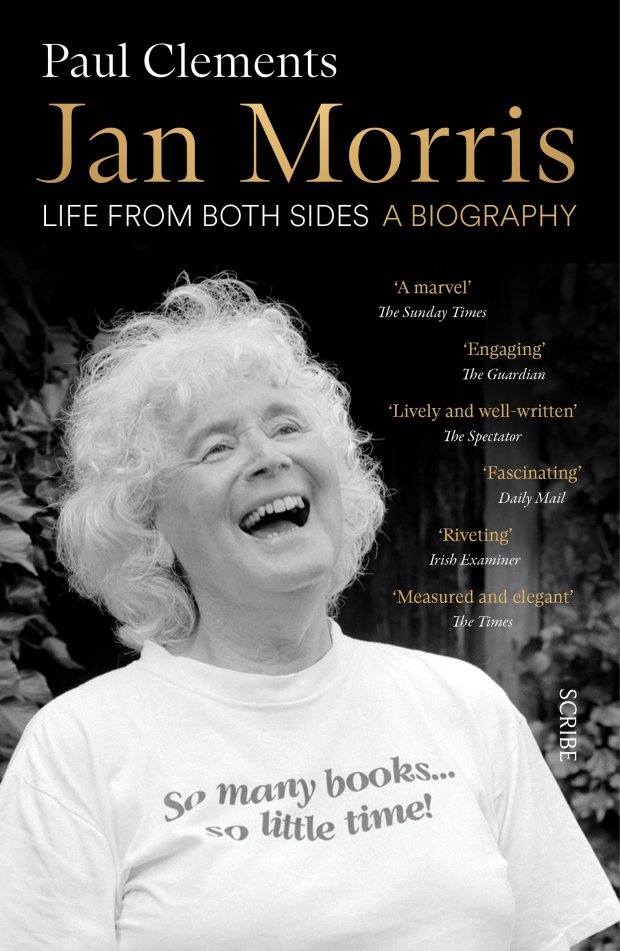
Back in 2021, I reread and reviewed Conundrum during Novellas in November. It’s a short memoir that documents her spiritual journey towards her true identity – she was a trans pioneer and influential on my own understanding of gender. In his doorstopper of a biography, Paul Clements is careful to use female pronouns throughout, even when this is a little confusing (with Morris a choirboy, a soldier, an Oxford student, a father, and a member of the Times expedition that first summited Everest). I’m just over a quarter of the way through the book now. Morris left the Times before the age of 30, already the author of several successful travel books on the USA and the Middle East. I’ll have to report back via Love Your Library on what I think of this overall. At this point I feel like it’s a pretty workaday biography, comprehensive and drawing heavily on Morris’s own writings. The focus is on the work and the travels, as well as how the two interacted and influenced her life.

The Best Books from the First Half of 2022
Yes, it’s that time of year already! At first I thought I wouldn’t have enough 2022-released standouts to fill a post, but the more I looked through my list the more I realized that, actually, it has been a pretty good reading year. It remains to be seen, of course, how many of these will make it onto my overall best-of year list, but for now, these are my highlights. I made it up to an even 20 by including one that doesn’t release until July. Fiction is winning thus far! I give review excerpts below and link to the full text here or elsewhere.
Fiction
 Our Wives under the Sea by Julia Armfield: Miri is relieved to have her wife back when Leah returns from an extended deep-sea expedition. Something went wrong with the craft when it was too late to evacuate, though. Chapters alternate between Miri describing their new abnormal and Leah recalling the voyage. As Miri tries to tackle life admin for both of them, she feels increasingly alone. This is a sensitive study of love, grief and dependency. Armfield gives an increasingly eerie story line a solid emotional foundation.
 These Days by Lucy Caldwell: A beautiful novel set in Belfast in April 1941. We see the Second World War mostly through the eyes of the Bell family – especially daughters Audrey, engaged to be married to a young doctor, and Emma, in love with a fellow female first aider. The evocation of a time of crisis is excellent. The lack of speech marks, fluid shifting between perspectives, and alternation between past and present tense keep the story from seeming too familiar or generic. All of the female characters have hidden depths.
 Groundskeeping by Lee Cole: In Cole’s debut novel, two aspiring writers meet on a Kentucky college campus and form a romantic connection despite very different backgrounds. There are stereotypes to be overcome as Owen introduces Alma to Kentucky culture and slang. Trump’s election divides families and colleagues. The gentle satire on the pretensions of writing programs is another enjoyable element. Three-dimensional characters, vivid scenes ripe for the Netflix treatment, timely themes and touching relationships: alright!
 Days of Sand by Aimée de Jongh: This Great Depression-era story was inspired by the work of photographers such as Dorothea Lange. John Clark is following in his father’s footsteps as a photographer, leaving NYC for the Oklahoma panhandle. Locals are suspicious of John as an outsider, especially when they learn he is working to a checklist. Whether a cityscape or the midst of a dust storm, de Jongh’s scenes are stark and evocative. It’s rare for me to find the story and images equally powerful in a graphic novel, but that’s definitely the case here.
 Dance Move by Wendy Erskine: The 11 stories in Erskine’s second collection do just what short fiction needs to: dramatize an encounter, or a moment, that changes life forever. Her characters are ordinary, moving through the dead-end work and family friction that constitute daily existence, until something happens, or rises up in the memory, that disrupts the tedium. Erskine being from Belfast, evidence of the Troubles is never far away. Her writing is blunt and edgy, with no speech marks plus flat dialogue and slang.
 Antipodes by Holly Goddard Jones: Riveting stories of contemporary life in the American South and Midwest. Some have pandemic settings; others are gently magical. All are true to the anxieties of modern careers, marriage and parenthood. Endings elicit a gasp, particularly the audacious inconclusiveness of “Exhaust,” a tense tale of a quarreling couple driving through a blizzard. Worry over environmental crises fuels “Ark,” about a pyramid scheme for doomsday preppers. Nickolas Butler and Lorrie Moore fans will find much to admire.
 Sea of Tranquility by Emily St. John Mandel: This dazzlingly intricate novel blends historical fiction, up-to-the-minute commentary and science-fiction predictions. In 2401, the Time Institute hires Gaspery-Jacques Roberts to investigate a recurring blip in time. Fans of The Glass Hotel will recognize some characters, and those familiar with Station Eleven will find similarities in a pandemic plot that resonates with the Covid-19 experience. How does Mandel do it? One compulsively readable hit after another.
 Very Cold People by Sarah Manguso: The aphoristic style of some of Manguso’s previous books continues here as discrete paragraphs and brief vignettes build to a gloomy portrait of Ruthie’s archetypical affection-starved childhood in the fictional Massachusetts town of Waitsfield in the 1980s and 90s. The depiction of Ruthie’s narcissistic mother is especially acute. So much resonated with me. This is the stuff of girlhood – if not universally, then certainly for the (largely pre-tech) American 1990s as I experienced them.
 How High We Go in the Dark by Sequoia Nagamatsu: Just the right blend of literary fiction and science fiction. Opening in 2031 and stretching another 70 years into the future, this linked short story collection imagines how a pandemic reshapes the world and how communication and connection might continue after death. All but one story are in the first person, so they feel like personal testimonies. The whole is greater than the sum of the parts. The focus on illness and bereavement, but also on the love that survives, made this a winner.
 The Swimmers by Julie Otsuka: Otsuka’s third novel of the Japanese American experience again employs the first-person plural, as well as the second person – rarer perspectives that provide stylistic novelty. The first two chapters are set at a pool that, for the title swimmers, serves as a locus of escape and safety. On the first page we’re introduced to Alice, whose struggle with dementia becomes central. I admired Otsuka’s techniques for moving readers through the minds of the characters, alternating range with profundity and irony with sadness.
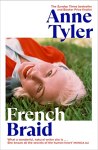 French Braid by Anne Tyler: My 17th from Tyler, and easily her best new work in 18 years. It joins my other favourites such as Dinner at the Homesick Restaurant which reveal a dysfunctional family’s quirks through a close look, in turn, at the various members. Mercy is a painter and essentially moves into her studio, but without announcing it, and her husband Robin spends the next 25+ years pretending they still share a home. Other surprises from Tyler this time: a mild sex scene and a gay character. A return to form. Brava!
Nonfiction
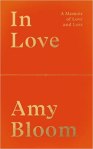 In Love by Amy Bloom: Bloom’s husband, Brian Ameche, was diagnosed with early-onset Alzheimer’s in his mid-60s, having exhibited mild cognitive impairment for several years. Brian quickly resolved to make a dignified exit while he still, mostly, had his faculties. This achieves the perfect tone, mixing black humour with teeth-gritted practicality as Bloom chronicles their relationship, the final preparations, his assisted suicide at Dignitas in Switzerland, and the aftermath. An essential, compelling read.
 Everything Is True by Roopa Farooki: Second-person, present-tense narration drops readers right into the life of a junior doctor. In February 2020, Farooki’s sister Kiron died of breast cancer. During the first 40 days of the initial UK lockdown, she continues to talk to Kiron. Grief opens the door for magic realism. There is also wry humour, wordplay, slang and cursing. A hybrid work that reads as fluidly as a novel while dramatizing real events, this is sure to appeal to people who wouldn’t normally pick up a bereavement or medical memoir.
 Body Work by Melissa Febos: A boldly feminist essay collection that explores how autobiographical writing can help one face regrets and trauma and extract meaning from the “pliable material” of memory. “In Praise of Navel Gazing” affirms the importance of women airing their stories of abuse and thereby challenging the power structures that aim to keep victims silent. “A Big Shitty Party” warns of the dangers of writing about real people. “The Return” employs religious language for the transformation writing can achieve.
 All Down Darkness Wide by Seán Hewitt: This poetic memoir about love and loss in the shadow of mental illness blends biography, queer history and raw personal experience. The book opens, unforgettably, in a Liverpool graveyard where Hewitt has assignations with anonymous men. His secret self, suppressed during teenage years in the closet, flies out to meet other ghosts: of his college boyfriend; of men lost to AIDS during his 1990s childhood; of English poet George Manley Hopkins; and of a former partner who was suicidal. (Coming out on July 12th from Penguin/Vintage (USA) and July 14th from Jonathan Cape (UK). My full review is forthcoming for Shelf Awareness.)
Poetry
 Thorpeness by Alison Brackenbury: This tenth collection features abundant imagery of animals and the seasons. Alliteration is prominent, but there is also a handful of rhymes. Family history and the perhaps-idyllic rural underpin the verse set in Lincolnshire and Gloucestershire as Brackenbury searches for ancestral graves and delivers elegies. I especially loved “Aunt Margaret’s Pudding,” a multipart poem about her grandmother’s life. There are also playful meetings between historical figures.
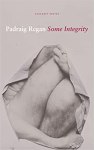 Some Integrity by Padraig Regan: The sensual poems in this debut collection are driven by curiosity, hunger and queer desire. Flora and foods are described as teasing mystery, with cheeky detail. An unusual devotion to ampersands; an erotic response to statuary; alternating between bold sexuality and masochism to the point of not even wanting to exist; a central essay on the Orlando nightclub shooting and videogames – the book kept surprising me. I loved the fertile imagery, and appreciated Regan’s exploration of a nonbinary identity.
 Love Poems in Quarantine by Sarah Ruhl: Having read Ruhl’s memoir Smile, I recognized the contours of her life and the members of her family. Cooking and laundry recur: everyday duties mark time as she tries to write and supervises virtual learning for three children. “Let this all be poetry,” she incants. Part 2 contains poems written after George Floyd’s murder, the structure mimicking the abrupt change in focus for a nation. Part 3’s haiku and tanka culminate in a series on the seasons. A welcome addition to the body of Covid-19 literature.
 Rise and Float by Brian Tierney: Although it tackles heavy subjects like grief and mental health, the collection’s candor and stunning images transform the melancholy into the sublime. Much of the verse is in the first person, building an intimate portrait of the poet and his relationships. A family history of mental illness and electroshock treatment occasions a visit to a derelict psychiatric hospital. Recurring metaphors of holes dramatize a struggle against the void. Tierney’s close attention lends beauty to bleak scenes.
 Vinegar Hill by Colm Tóibín: I didn’t realize when I started that this was Tóibín’s debut collection; so confident is his verse, I assumed he’d been publishing poetry for decades. There’s a wide range of tone, structures and topics. Bereavements and chemotherapy are part of a relatable current events background. Irish-Catholic nostalgia animates a witty sequence from “The Nun” to “Vatican II.” Come along on armchair travels. Poems are based around anecdotes or painterly observations. The line breaks are unfailingly fascinating.
What are some of the best books you’ve read so far this year?
What 2022 releases do I need to catch up on right away?
Reading Ireland Month: Erskine, O’Farrell, Quinn and Tóibín
Reading Ireland Month is hosted each year by Cathy of 746 Books. I’m sneaking in on the final day of March (there’s a surprise snow squall out the window as I write this) with four short reviews and feeling rather smug that my post covers lots of bases: short stories, a novel, a book of autobiographical pieces, and a poetry collection.
Dance Move by Wendy Erskine (2022)
 The 11 stories in Erskine’s second collection do just what short fiction needs to: dramatize an encounter, or moment, that changes life forever. Her characters are ordinary, moving through the dead-end work and family friction that constitute daily existence, until something happens, or rises up in the memory, that disrupts the tedium.
Erskine being from Belfast, evidence of the Troubles is never far away. In “Nostalgie,” a washed-up rocker is asked to perform his hit song at a battalion’s party. A woman and her lodger are welded together by a violent secret in “Bildungsroman,” which reminded me of a tale from Bernard MacLaverty’s Blank Pages and Other Stories. “Gloria and Max” struck me most of all: a drive to a film festival becomes a traumatic flashback when they’re first on the scene of an accident.
Erskine’s writing is blunt and edgy, the kind that might be stereotyped as male but nowadays is also, inevitably for Irish authors, associated with Sally Rooney: matter-of-fact; no speech marks, flat dialogue and slang. A couple of other favourites: “Mathematics,” in which a cleaner finds an abandoned child in a hotel room and tries to do right by her; and “Memento Mori,” about two deaths, one drawn out and one sudden; both equally unexpected; and only enough compassion to cope with one. (Public library) 
After You’d Gone by Maggie O’Farrell (2000)
 In form this is similar to O’Farrell’s The Distance Between Us, one of my Reading Ireland selections from last year: short sections of a few pages flit between times and perspectives. (There’s also an impulsive trip from London to Scotland in both.) But whereas in her third novel I found the jump cuts confusing and unnecessary, here they just work, and elegantly, to build a portrait of Alice Raikes, in a coma after what may have been a suicide attempt. That day she’d taken a train from London to Edinburgh at the last minute, met her sisters at the station, seen something that threw her, and gotten right on a return train. Back in London and on the way to the shop for cat food, she stepped off the kerb and into the path of a car.
Scenes from Alice’s childhood in Scotland are interspersed with her love affairs; her parents’ disappointing marriage serves as a counterpoint to her great passion for John. The setup of three female generations in North Berwick and the question of sexual autonomy reminded me strongly of Evie Wyld’s The Bass Rock.
This is a bold debut novel, refusing to hold readers’ hands through shifts from now to near past to further ago, from third to second to first person (even Alice from her coma: “my body still clings to life, and I find myself suspended like Persephone between two states … I am somewhere. Drifting. Hiding.”). Loss, secrets and family inheritance may be familiar themes, but when this was published at the millennium it must have seemed thrillingly fresh; it still does now.
I only have one unread O’Farrell novel awaiting me now, My Lover’s Lover. I’ll be saving that up, maybe for this time next year. Having not much enjoyed Hamnet, I’m disappointed that her forthcoming novel will also be historical and will probably skip it; I miss her stylish contemporary commentary. (Secondhand from a charity shop)
A Portrait of the Artist as a Young Girl, ed. John Quinn (1986)
 These autobiographical essays were compiled by Quinn based on interviews he conducted with nine women writers for an RTE Radio series in 1985. I’d read bits of Dervla Murphy’s and Edna O’Brien’s work before, but the other authors were new to me (Maeve Binchy, Clare Boylan, Polly Devlin, Jennifer Johnston, Molly Keane, Mary Lavin and Joan Lingard). The focus is on childhood: what their family was like, what drove these women to write, and what fragments of real life have made it into their books.
I read the first couple of pieces but then started to find the format repetitive and didn’t want to read out-of-context illustrative passages from novels I’d never heard of, so only skimmed through the rest. You can work out what Quinn’s questions were based on how the essays spin out: What is your earliest memory? What was your relationship with your parents? What was your schooling? Were you lonely? What part did books and writing play in your childhood? Distant fathers, a strict Catholic upbringing, solitude/boredom and escaping into novels are common elements. Some had happier childhoods than others, but all are grateful for the life of the mind: A solid base of familial love and the freedom to explore were vital.
The best passage comes from Seamus Heaney’s foreword: “The woman writer, like everybody else, is in pursuit of coherence, attempting to bring into significant alignment the creature she was and the being she is striving to become.” (Secondhand from Bookbarn International) 
Vinegar Hill by Colm Tóibín (2022)
 I didn’t realize when I started it that this was Tóibín’s debut collection; so confident is his verse that I assumed he’s been publishing poetry for decades. He’s one of those polymaths who’s written in many genres – contemporary fiction, literary criticism, travel memoir, historical fiction – and impresses in all. I’ve been finding his recent Folio Prize winner, The Magician, a little too dry and biography-by-rote for someone with no particular interest in Thomas Mann (I’ve only ever read Death in Venice), so I will likely just skim it before returning it to the library, but I can highly recommend his poems as an alternative.
There’s such a range of tone, structures and topics here. Bereavements and chemotherapy are part of a relatable current events background, as in “Lines Written After the Second Moderna Vaccine at Dodgers’ Stadium Los Angeles, 27 February 2021.” Irish-Catholic nostalgia animates the very witty sequence from “The Nun” to “Vatican II.” You can come along on some armchair travels: “In Washington DC,” “In San Clemente,” “Canal Water” (Venice), “Jericho,” and so on. The poems are based around anecdotes or painterly observations; there are both short phrases and prose paragraphs. The line breaks are unfailingly fascinating (any other enjambment geeks out there?). I particularly loved “Kennedy in Wexford,” “In the White House,” “Eccles Street” and “Eve.”

With thanks to Carcanet Press for the e-copy for review.
Have you read any Irish literature this month?
Love Your Library, March 2022
Naomi has been reading a variety of books from the library, including middle grade fiction and Indigenous poetry. Rosemary and Laura posted photos of the books they’ve borrowed from their local libraries recently.


Like Laura, I’ve been sourcing prize nominees from various places. In April I hope to read two nonfiction books from the Jhalak Prize longlist (Things I Have Withheld by Kei Miller and Brown Baby by Nikesh Shukla) and two more novels from the Women’s Prize longlist (The Paper Palace by Miranda Cowley Heller and The Island of Missing Trees by Elif Shafak), and I’ve just started Colm Tóibín’s Folio Prize-winning The Magician.
All from the library: a great way to read new and critically acclaimed books without having to buy them!


 I’ve joined Kay, Lynn and Naomi for the Literary Wives online book club and our first read, coming up in June, will be The Sentence by Louise Erdrich, which will be doing double duty as part of the Women’s Prize longlist. I’m in the library holds queue and my copy should come in soon. My only other Erdrich so far, Love Medicine, was a 5-star read, so I have high hopes even though the premise for this one sounds a little iffy. (A bookshop ghost – magic realism being a common denominator on this year’s list – and a Covid lockdown setting.)
For those of you who like to plan ahead, here’s our schedule thereafter. I’ll be rereading two of them (Hornby and O’Farrell) and getting four out from the library (Feito, Hurston, Medie, O’Farrell). One I’ll request as a review copy (Lee), one was 99p on Kindle (Brown), and two more remain to be found secondhand (Gaige and Hunter). Maybe there’s one or more you’d like to join in with?
September 2022 Red Island House by Andrea Lee
December 2022 State of the Union by Nick Hornby
March 2023 His Only Wife by Peace Adzo Medie
June 2023 The Harpy by Megan Hunter
September 2023 Sea Wife by Amity Gaige
December 2023 Hamnet by Maggie O’Farrell
March 2024 Mrs. March by Virginia Feito
June 2024 Recipe for a Perfect Marriage by Karma Brown
September 2024 Their Eyes Were Watching God by Zora Neale Hurston
What have you been reading or reviewing from the library recently?

Do share a link to your own post in the comments, and feel free to use the above image. I’ve co-opted a hashtag that is already popular on Twitter and Instagram: #LoveYourLibrary.
Here’s a reminder of my ideas of what you might choose to post (this list will stay up on the project page):
- Photos or a list of your latest library book haul
- An account of a visit to a new-to-you library
- Full-length or mini reviews of some recent library reads
- A description of a particular feature of your local library
- A screenshot of the state of play of your online account
- An opinion piece about library policies (e.g. Covid procedures or fines amnesties)
- A write-up of a library event you attended, such as an author reading or book club.
If it’s related to libraries, I want to hear about it!
Love Your Library, February 2022
We’re now onto the fifth month of the Love Your Library feature. A big thank you to…
- “The Fab Four of Cley,” who run a Little Free Library in their area. They found last month’s post and gave me a link to a bilingual piece they wrote about a book sale they ran at their local church, with the thousands of books they’d amassed. Heavenly!
- Margaret of From Pyrenees to Pennines for her lovely account (with photos!) of a visit to the Central Public Library of Valencia.
- Mary R. of Bibliographic Manifestations for her post on interlibrary loans.
Blogger Laila of Big Reading Life also mentioned ILLs recently. I know some states and provinces are able to offer this service for free. When I lived in Maryland, statewide ILLs were free and I took full advantage of it. It’s how I binged on books by Marcus Borg, Frederick Buechner, Jan Morris, and many others during the year between my Master’s degree and moving back to England permanently. For my thesis research I’d had the University of Leeds’ ILL team get me an obscure Victorian novel on microfiche all the way from Australia. I also cheekily put through a few university ILLs for myself while I worked for King’s College London’s library system. Where I live now in the UK, a public library ILL costs £3 per book, so isn’t worth doing; you might as well find a secondhand copy at that price. I do miss the freedom of knowing that I could borrow (almost) anything I want.
Two funny moments from my recent library volunteering: I found Mrs Dalloway shelved under D, and an M. C. Beaton “Agatha Raisin” mystery shelved under R!
Read from the library recently:
 The Jasper & Scruff series by Nicola Colton: Having insisted I don’t like sequels or series … I do sometimes make exceptions, like I did for these early reader books (meant for, I don’t know, maybe ages 7 to 9?). I was drawn by the grey and white cat with a bowtie – that’s Jasper, a dapper fellow who likes the fine things in life and desperately wants to be admitted to the Sophisticats’ club, until he realizes they’re snooty and just plain mean. Whereas Scruff the puppy, though he makes life messy, is loving and fun. I liked the sequels more than the original because they build on each other, bringing back characters from the earlier books for a pirate-themed scavenger hunt, a reality TV-style talent show, and bookshop and diner ventures. There are good lessons about being honest and fair, even if others are cheating to outcompete you, and being yourself instead of putting on airs. I also like the menagerie of mammals: not just dogs and cats, but African megafauna, too.
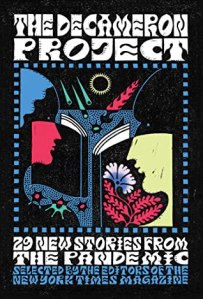 The Decameron Project: 29 New Stories from the Pandemic (originally published in The New York Times): Creative responses to Covid-19, ranging from the prosaic to the fantastical. I appreciated the mix of authors, some in translation and some closer to genre fiction than lit fic. Standouts were by Victor LaValle (NYC apartment neighbours; magic realism), Colm Tóibín (lockdown prompts a man to consider his compatibility with his boyfriend), Karen Russell (time stops during a bus journey), Rivers Solomon (an abused girl and her imprisoned mother get revenge), Matthew Baker (a feuding grandmother and granddaughter find something to agree on), and John Wray (a relationship starts up during quarantine in Barcelona). The best story of all, though, was by Margaret Atwood.
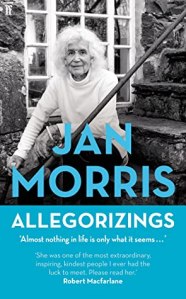 Allegorizings by Jan Morris: Disparate, somewhat frivolous essays written mostly pre-2009, or in 2013, and kept in trust by her publisher for publication as a posthumous collection, so strangely frozen in time. She was old but not super-old; thinking vaguely about death, but not at death’s door. The organizing principle, that everything can be understood on more than one level and so we must think beyond the literal, is interesting but not particularly applicable to the contents. There are mini travel pieces and pen portraits, but I got more out of the explorations of concepts (maturity, nationalism) and universal experiences (being caught picking one’s nose, sneezing).
 The Priory by Dorothy Whipple (read for book club): A cosy between-the-wars story, pleasant to read even though some awful things happen, or nearly happen. Like in Downton Abbey and the Cazalet Chronicles, there’s an upstairs/downstairs setup that’s appealing. It was interesting to watch how my sympathies shifted. The Persephone afterword provides useful information about the Welsh house (where Whipple stayed for a month in 1934) and family that inspired the novel. Whipple is a new author for me and I’m sure the rest of her books would be just as enjoyable, but I would only attempt another if it was significantly shorter than this one.
Borrowed since last month:

My latest university library book haul. Paradise by Toni Morrison is to read with my women’s classics book club subgroup in mid-April. Findings is to reread just because Kathleen Jamie is amazing. The other three are in preparation for the 1954 Club coming up in April.
Do share a link to your own post in the comments, and feel free to use the above image. I’ve co-opted a hashtag that is already popular on Twitter and Instagram: #LoveYourLibrary.
Here’s a reminder of my ideas of what you might choose to post (this list will stay up on the project page):
- Photos or a list of your latest library book haul
- An account of a visit to a new-to-you library
- Full-length or mini reviews of some recent library reads
- A description of a particular feature of your local library
- A screenshot of the state of play of your online account
- An opinion piece about library policies (e.g. Covid procedures or fines amnesties)
- A write-up of a library event you attended, such as an author reading or book club.
If it’s related to libraries, I want to hear about it!
Thoughts on Literary Prizes, Sequels, and Finishing Books
I feel like my blogging is all over the place so far this month, but I’ll get back on track in the next couple of weeks with a few thematic roundups. Today, some disparate thoughts.
 Literary prize season will soon be in full swing, and can be overwhelming. I’m currently reading Megan Nolan’s Acts of Desperation, doing double duty from the Dylan Thomas Prize longlist and the Sunday Times Young Writer of the Year Award shortlist, and enjoying it more than expected given the inevitable Sally Rooney comparisons and messed-up young female tropes. However, I abandoned Here Comes the Miracle (from the latter) after 46 pages because it was just as When God Was a Rabbit as I feared.
 Today the second Barbellion Prize winner was announced: Lynn Buckle for What Willow Says, her lyrical novella about communication between a terminally ill woman, her deaf granddaughter, and the natural world. My choice from the shortlist would have been Josie George’s A Still Life, but I can see how the judges might have felt, in an early year when precedents are still being set, that it was important to recognize fiction as being just as valid a way of writing about disability and chronic illness.
Earlier in the week, the Rathbones Folio Prize shortlist was announced. Everyone remarked on the attractive mint green colour scheme! I found myself slightly disappointed; the Prize is usually more various since it includes nonfiction and poetry as well as fiction. Only one nonfiction title here: Philip Hoare going on (again) about whales. I’ve read another of poet Selima Hill’s collections so would gladly read this, too. I’ve already read the Brown and Keegan novellas and Sahota’s novel; I DNFed the Riley. Galgut has already won the Booker Prize. I’m awaiting a library hold of The Magician but I rather doubt my staying power with a 500-page biographical novel. My vote would, overwhelmingly, be for China Room.

I’m more tempted by the Fiction with a Sense of Place shortlist, announced as part of the Edward Stanford Travel Writing Awards early this month. What an intriguing and non-obvious set of nominees! Elena Knows was on the Barbellion longlist and the Greengrass and Shafak novels were previously shortlisted for the Costa Prize. I plan to try the Heller again this summer.

I’m also delighted to see that Small Bodies of Water by Nina Mingya Powles is shortlisted for the Stanford Dolman Travel Book of the Year Award.

I’ve been pondering my predictions and wishes (entirely separate things) for the Women’s Prize longlist and will post them early next month; for now, check out Laura’s.
I believe books should be self-contained and I struggle to engage with ANY series. Unpopular opinion alert: sequels are almost always indulgent and/or money-grubbing on the part of the author. Here are four high-profile literary fiction sequels I plan on skipping this year (in all the cases, I just didn’t like the original enough to continue the story):
- Either/Or by Elif Batuman – The Idiot was bizarre, deadpan and slightly entertaining, but I have no need to spend any more time with Selin.)
 The Candy House by Jennifer Egan – A Visit from the Goon Squad didn’t stand up to a reread.
- Less Is Lost by Andrew Sean Greer – Less, only mildly funny, was hugely overrated by critics.
- Tracy Flick Can’t Win by Tom Perrotta – I read, and saw the Reese Witherspoon-starring movie version of, Election ages ago; this is the one I’d be most likely to change my mind about, if I read good reviews.
I learned via a friend’s Instagram post that there is such a thing as #FinishItFebruary and felt seen. My goal had been to clear my set-aside shelf by the end of January; of course that didn’t happen, but I have been making some progress, reducing it from about 40 to more like 25. I try to reintroduce a part-finished book into my stack every few days. Sometimes it ‘takes’ and I finish it shortly; other times it languishes again, just in a different location. I’ll see how many more I can get to before the end of February.

A reminder of that set-aside shelf, as of early January.
Following any literary prize races this year?
Do you also avoid sequels, and leave books part-read?
Love Your Library, November 2021
It’s the second month of the new Love Your Library feature.
I’d like to start out by thanking all those who have taken part since last month’s post:
Adrian shared lovely stories about the libraries he’s used in Ireland, from childhood onwards.
Laila, Lori and Margaret highlighted their recent loans and reads.
Laura sent a photo of her shiny new library copy of Sally Rooney’s latest novel.

Finally, Marcie contributed this TikTok video of her library stacks!
As for my recent library experiences…
A stand-out read:
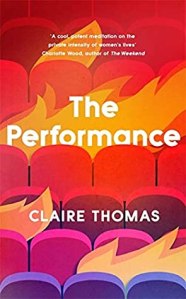 The Performance by Claire Thomas: What a terrific setup: three women are in a Melbourne theatre watching a performance of Samuel Beckett’s Happy Days. Margot is a veteran professor whose husband is developing dementia. Ivy is a new mother whose wealth hardly makes up for the devastating losses of her earlier life. Summer is a mixed-race usher concerned about her girlfriend during the fires rampaging outside the city. In rotating close third person sections, Thomas takes us into these characters’ inner worlds, contrasting their personal worries with wider issues of women’s and indigenous people’s rights and the environmental crisis, as well as with the increasingly claustrophobic scene on stage. In “The Interval,” written as a script, the main characters interact with each other, with the “forced intimacy between strangers” creating opportunities for chance meetings and fateful decisions.
Doorstoppers: A problem
Aware that I’m heading to the States for Christmas on the 14th of December (only a couple of weeks from now!), I’ve started culling my library stacks, returning any books that I’m not super-keen to read before the end of the year. A few I’ll borrow another time, but most I decided weren’t actually for me, even if raved about elsewhere.
I mentioned in a post last week that I’ve had a hard time finding the concentration for doorstoppers lately, which is ironic giving how many high-profile ones there have been this year – or even just this autumn. (For example, seven of BookPage’s top 20 fiction releases of 2021 are over 450 pages.) I gave up twice on Great Circle by Maggie Shipstead, swiftly abandoned Cloud Cuckoo Land by Anthony Doerr (a silly bookish attempt at something like Cloud Atlas), didn’t have time to attempt Tenderness by Alison Macleod and The Magician by Colm Tóibín, and recently returned The Morning Star by Karl Ove Knausgaard unread.
Why so many chunky reads this year, and this season in particular? I’ve wondered if it has had something to do with the lockdown mentality – for authors or readers, or both. It can be awfully cozy, especially as winter advances (in this hemisphere), to sink into a big book. But I find that I’m always looking for an excuse to not engage with a doorstopper.
 I generally enjoy the scope, detail and moral commentary of Jonathan Franzen’s novels; his previous two, Freedom and Purity, which also numbered 500+ pages, were fantastic. But Crossroads wasn’t happening for me, at least not right now. I only got to page 23 on this attempt. The Chicago setting was promising, and I’m there for the doubt and hypocrisy of church-bound characters. But with text this dense, it feels like it takes SO MANY WORDS to convey just one scene or conversation. I was finding the prose a little obnoxious, too, e.g.
Of Santa the Hildebrandts had always said, Bah, humbug. And yet somehow, long past the age of understanding that presents don’t just buy and wrap themselves, he’d accepted their sudden annual appearance as, if not a miraculous provision, then a phenomenon like his bladder filling with urine, part of the normal course of things. How had he not grasped at nine a truth so obvious to him at ten? The epistemological disjunction was absolute.
Problems here: How many extra words do you need to say “He stopped believing in Santa at age 10”? When is the phrase “epistemological disjunction” ever anything other than showing off? And why did micturition present itself as an apt metaphor?
But anyway, I’ve hardly given this a fair shake yet. I daresay I’ll read it another time; it’ll be my eighth book by Franzen.
Do share a link to your own post in the comments, and feel free to use the above image. I’ve co-opted a hashtag that is already popular on Twitter and Instagram: #LoveYourLibrary.
Here’s a reminder of my ideas of what you might choose to post (this list will stay up on the project page):
- Photos or a list of your latest library book haul
- An account of a visit to a new-to-you library
- Full-length or mini reviews of some recent library reads
- A description of a particular feature of your local library
- A screenshot of the state of play of your online account
- An opinion piece about library policies (e.g. Covid procedures or fines amnesties)
- A write-up of a library event you attended, such as an author reading or book club.
If it’s related to libraries, I want to hear about it!
Memoirs by Casey Gerald and Catherine Simpson
These two memoirs may be very different in terms of the setting (Texas and Yale versus rural Lancashire) and particulars, but I’m reviewing them together because they are both about dysfunctional families and the extent to which external circumstances determine how others see us – and how we view ourselves.
There Will Be No Miracles Here: A Memoir from the Dark Side of the American Dream by Casey Gerald (2018)
The title comes from a seventeenth-century sign in a French village that was intended to get the God-dazzled peasants back to work. For Gerald it’s a somewhat tongue-in-cheek reminder that his life, even if he has made good after an unpromising beginning, is not some American dream or fairytale. It’s more complicated than that. Still, there’s no sugar-coating his family issues. His father missed his tenth birthday party because he was next door with dope fiends; his bipolar mother was in the psych ward while his father was in jail, and then disappeared for several years. Gerald and his older sister, a college dropout, got an apartment and set their own lax rules. In the meantime, he was coming to terms with the fact that he was gay and trying to reconcile his newfound sexual identity with his Christian faith.
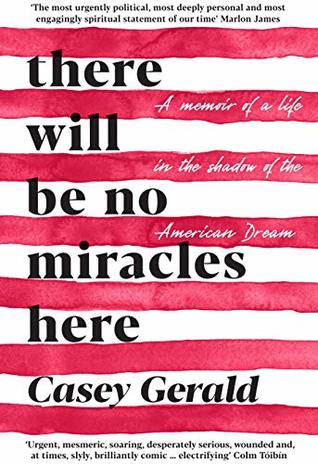 In spite of it all, Gerald shone academically and athletically. He was his Texas high school’s valedictorian and followed his father into a thriving college football career – at Yale, where he accidentally fell into leadership via a Men of Color council across the Ivy League schools. It wasn’t until he got to Yale that it even occurred to him that he was poor. (I was reminded of the moment in Michelle Obama’s memoir when she got to Princeton and experienced being a minority for the first time.) As he neared graduation, he decided to go into investment banking “simply because I did not have any money and none of my people had any money.” Back in Texas after a year in a Washington, D.C. think tank, he even considered a run for Congress under the slogan “We can dream again.”
I loved the prologue, which has the 12-year-old Gerald cowering with his church congregation on the last night of 1999, in fear of being left behind at the end of the world. I think I expected religion to continue as a stronger theme throughout the book. The style wasn’t really what I imagined either: it’s a coy combination of reader address, stream-of-consciousness memories, and remembered speech in italics that often set me skimming. Whereas landmark events like his mother’s departure are left impressionistic, football games and the inner workings of Yale’s societies are described in great detail. Scenes in the classroom and with boyfriends, though still occasionally tedious, at least feel more relevant.
Gerald proudly calls himself a “faggot” and is going for a kind of sassy, folksy charm here. For me the tone only landed sometimes. Mostly I appreciated his alertness to how others (often wrongly) perceived him – a great instance of this is when he meets George W. Bush in 2007 and tells him the bare bones of his story, only for Dubya to later twist it into an example in a speech. The memoir tails off into a rather odd and sudden ending, and overall I wasn’t sure it had enough to say to fill close to 400 pages. Perhaps Gerald could have waited another 10 years? As a more successful take on similar themes, I’d recommend the memoir-in-essays Live Through This: Surviving the Intersections of Sexuality, God, and Race by Clay Cane.
My rating:
There Will Be No Miracles Here was hand-picked by Colm Tóibín for publication by Tuskar Rock Press, a new imprint of Serpent’s Tail, on January 10th. It was published in the USA by Riverhead Books in October 2018. My thanks to the UK publisher for the free copy for review.
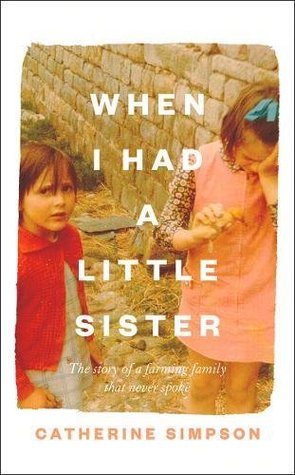
When I Had a Little Sister: The Story of a Farming Family that Never Spoke by Catherine Simpson (2019)
On December 7, 2013, Simpson’s younger sister, Tricia, was found dead by their 87-year-old father at the family farmhouse where she lived in Lancashire. She was 46 and had been receiving daily mental health visits for her bipolar disorder, but the family had never been notified about a previous suicide attempt just three weeks before. Simpson excavates her family history to ask how things could have gotten so bad that they didn’t realize that Tricia’s depression had reached suicidal levels.
Simpson’s grandparents – her grandfather a World War I veteran – moved into the property in 1925, so by this time there was literally generations’ worth of stuff to clear out. “I ask myself now: is it possible to dispose of a person’s effects with dignity?” Simpson frets. As she and her father sifted through antique furniture, gadgets and craft supplies, she recalls the previous death in the family: her mother’s from non-Hodgkin’s lymphoma seven years before. Growing up on a cattle farm in the 1970s, the three daughters were expected to be practical and unsentimental; there was never any discussion of emotions, and they got the sense that their overworked, unfulfilled mother would rather they weren’t around at all. In this context, it was hard for Tricia to cope with everyday challenges like struggling with schoolwork and the death of a beloved cousin. She started smoking at 12 and went on antidepressants at 19.
 Simpson started writing this family memoir on a fellowship at Hawthornden Castle in February 2016. The first step of her project was to read all of Tricia’s diaries, from age 14 on. There were happy experiences, like six months as a nanny in Vienna and a travel grant to a kibbutz in Israel. There were also unwelcome surprises, like a 1981 suicide note – from when Tricia was just 15. Simpson had never realized just how prone her little sister was to all-or-nothing thinking. She dove headlong into short-lived relationships and, when they failed, feared she would never find love again. Over the years Tricia grew increasingly paranoid, believing she was being watched on the farm and her sisters were plotting to sell the property and leave her with nothing. One time she even locked her parents in to keep them safe.
Although the subtitle is melodramatic, it conveys all that went unsaid in this family: not just sadness, but also love and tenderness. The cover image shows Simpson crying over a dead duckling; Tricia is at the left, her look of consternation startlingly intense for a three-year-old. “It’s only a duck. There’s plenty more where that came from” was their father’s hardhearted response. There are many other family photographs printed in black and white throughout the text; Tricia loved fashion, and is stunning in her glamour shots. While the book is probably overlong, I was absorbed in the family’s story, keen to see how Simpson would reconstruct events through objects, photographs and journals. (My sister is a Tricia, too.) Recommended to readers of Jill Bialosky’s History of a Suicide and Clover Stroud’s The Wild Other.
My rating:
When I Had a Little Sister will be published by Fourth Estate on February 7th. My thanks to the publisher for an early proof copy for review.
 Bookish Beck = Rebecca Foster. American transplant to England. Freelance proofreader and book reviewer.
 Bookish Beck