Love Your Library, July 2025
Thank you to Eleanor (here and here) and Skai for posting about their recent library reading.
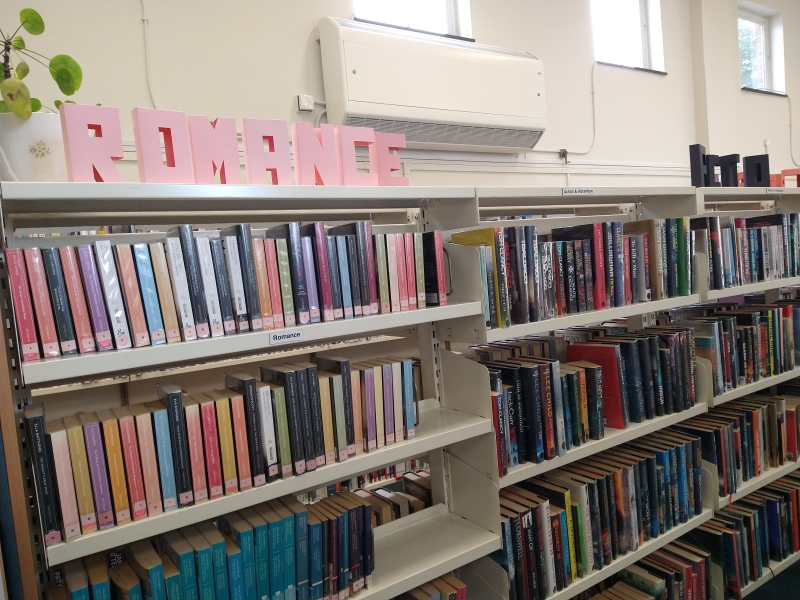
On a brief trip to Tilehurst last week for a podiatry consultation, I popped into its library (part of Reading Borough, where I’ve lived at various points) and liked how they designated subgenres with 3D paper letter names above the bays along with a suitable spine sticker on the books themselves. Action is to the right of romance here; they also give Family Sagas and Historical Fiction their own sections.
My library system recently made a slight change to our classifications. Now, instead of a monolithic Crime designation (red circular sticker on spine) there will be a white square spine label with either a magnifying glass and CRI or a gun target with THR for thriller; both will be shelved in the Crime section. Likewise, the SFF section (previously, green circular sticker) will have two subdivisions, FAN with a unicorn and SCI with a ringed planet. I can see why the new subgenres were perceived to be more helpful for readers, but I predict that the shelving, which is almost exclusively done by volunteers, will go haywire. Even with the very clear coloured stickers, books are frequently mis-shelved. (During each of my sessions, I probably reshelve 10 to 15 books.) Now there will be a mixture of coloured and white labels, the latter of which must be read carefully to not end up on the wrong trolley or shelf…
My library use over the last month:
(links are to books not already reviewed on the blog)
READ
- Don’t Forget We’re Here Forever: A New Generation’s Search for Religion by Lamorna Ash

- To the Edge of the Sea: Schooldays of a Crofter’s Child by Christina Hall

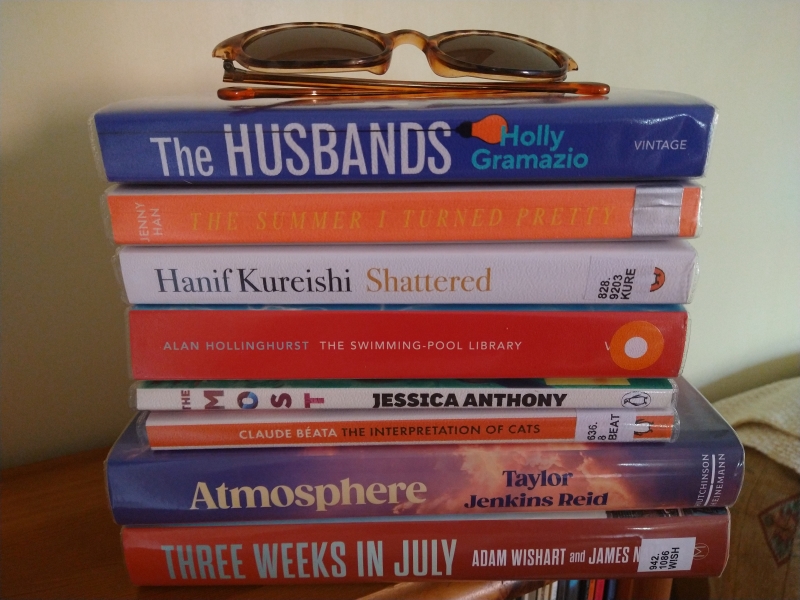
- Shattered by Hanif Kureishi
- Ripeness by Sarah Moss
- Three Weeks in July: 7/7, The Aftermath, and the Deadly Manhunt by Adam Wishart & James Nally
CURRENTLY READING
- The Most by Jessica Anthony
- The Interpretation of Cats: And Their Owners by Claude Béata; translated by David Watson
- The Honesty Box by Luzy Brazier
- Bellies by Nicola Dinan
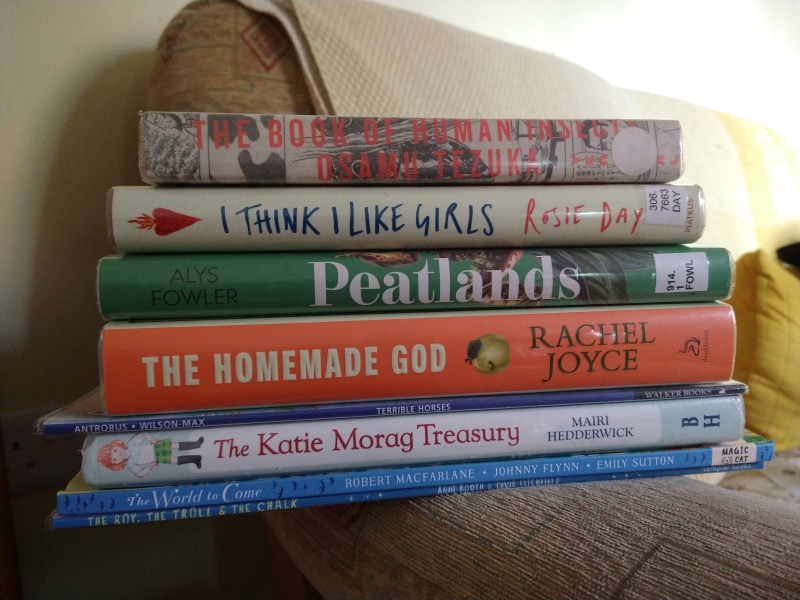
- The Homemade God by Rachel Joyce
- The Mermaid Chair by Sue Monk Kidd
- The Secret Lives of Booksellers and Librarians: True Stories of the Magic of Reading by James Patterson & Matt Eversmann
CHECKED OUT, TO BE READ
- I Think I Like Girls by Rosie Day
- Fragile Minds by Bella Jackson
- Enchanted Ground: Growing Roots in a Broken World by Steven Lovatt
- Wife by Charlotte Mendelson
- The Forgotten Sense: The Nose and the Perception of Smell by Jonas Olofsson
+ various children’s books
(the other books pictured are for my husband’s stack)
IN THE RESERVATION QUEUE
- Helm by Sarah Hall
- An Eye on the Hebrides by Mairi Hedderwick
- Albion by Anna Hope
- The Names by Florence Knapp
- The Eights by Joanna Miller
- The Dig by John Preston
- Birding by Rose Ruane
- Opt Out by Carolina Setterwall

RETURNED UNFINISHED
- The Husbands by Holly Gramazio – I read the first 28 pages or so. A fun premise, but I felt I’d gotten the gist already and couldn’t imagine another 300 pages of the same.
- The Summer I Turned Pretty by Jenny Han – This was requested off me before I could get halfway. So annoying! I’ve placed a hold but don’t know if it will come back into my hands in time to actually finish it during the summer. Harrumph.
- Atmosphere by Taylor Jenkins Reid – I read about 18 pages. I always like the idea of her novels, but since Daisy Jones haven’t gotten far in one.
- Boiled Owls by Azad Ashim Sharma – This poetry collection was not for me.
RETURNED UNREAD
- Fulfillment by Lee Cole – Requested off me before I could start it. I’m back in the queue.
- Adam by Gboyega Odubanjo – This poetry collection was not for me.
- The Artist by Lucy Steeds – Requested off me before I could start it. I’m back in the queue.
- The Sleepwalkers by Scarlett Thomas – Ditto!
What have you been reading or reviewing from the library recently?

Share a link to your own post in the comments. Feel free to use the above image. The hashtag is #LoveYourLibrary.
Reporting Back on My Most Anticipated Reads of 2024
Most years I’ve combined this topic with a rundown of my DNFs for the year; this time I can’t be bothered to list them. There have maybe not been as many as usual; generally, I’ve given a sentence or two about each DNF in a Love Your Library post. In any case, I hereby give you blanket permission to drop that book you’ve been struggling with. I absolve you of all potential guilt. It makes no difference if it has been nominated for or won a major prize, or if everyone else seems to love it. If for any reason a book isn’t connecting with you, move onto something else; you can always come back to try it another time, or not. Life is short.
So, on to those Most Anticipated books! In January, I picked the 12 new releases I was most looking forward to reading in 2024. Here’s how I fared with them – links are to my reviews:
Read and enjoyed: 5 (2 will appear on my Best-of list!)
 The Ministry of Time by Kaliane Bradley
- Fi: A Memoir of My Son by Alexandra Fuller
- Rapture’s Road by Seán Hewitt
- Wellness by Nathan Hill
- Come and Get It by Kiley Reid
Read and found somewhat disappointing (i.e., 3 stars or below): 5
 Martyr! by Kaveh Akbar
- Cairn by Kathleen Jamie
- Exhibit by R.O. Kwon
- The Vulnerables by Sigrid Nunez
- The Paris Novel by Ruth Reichl
DNF: 1
 Enlightenment by Sarah Perry
Haven’t managed to get hold of, but have basically decided against anyway: 1
 Memory Piece by Lisa Ko – The reviews from Susan and Laura made me realize I probably won’t love this as much as I want to. (Plus the average rating on Goodreads is disconcertingly low.)
I’ve really come to wonder if designating a book as “Most Anticipated” is a kiss of death. Are my hopes so high that only the rare book can live up to them?!
Nonetheless, I can’t resist compiling this list each year. In the first week of January, I’ll be previewing my 25 Most Anticipated titles for the first half of 2025.
Do you choose Most Anticipated books each year? (Or do you prefer to be surprised?) And if so, do they generally meet your expectations?
Love Your Library, June 2024
Everyone is welcome to join in with this meme that runs on the last Monday of the month.
Thanks to Eleanor (here and here) and Laura (and image below) for posting about their recent library reads! I loved seeing Marina Sofia feature beautiful public library designs in one of her Friday Fun posts. Tom Beer, the Kirkus Reviews editor-in-chief, wrote about the love of books starting with libraries. And Sarah Turley shared this New York Times article (no paywall for the next few weeks) about the history of Black librarians during the Harlem Renaissance, including Nella Larsen.

The computer system was down at my library for a couple of weeks in May–June, such that I had to spend my volunteering sessions shelf-tidying or processing returns rather than filling reservations as I usually do. After the system update, I found that my saved lists had disappeared from my online account. Along with a general list of ~170 books I might want to borrow in the future, I had shelves for short stories, novellas, and Literary Wives. It is annoying that they’re gone, but maybe also freeing. If I hadn’t borrowed a book already, I must not have really wanted to read it, right?
There have also been tweaks to what certain categories are called. “Bestsellers” are now listed as “Short term loan,” which makes more sense for the two-week-loan collection as not all the books are blockbusters. But instead of Young Adult, the call number is now “Older teenage fiction” in the “Young person’s fiction” collection. Rather than School-Age Picture Books, it’s now “Picture books for older readers.” Seems like reinventing the wheel to me, but oh well…
My library use over the last month:
READ
- Piglet by Lottie Hazell

- Soldier Sailor by Claire Kilroy

- Knife: Meditations After an Attempted Murder by Salman Rushdie

- The Invention of Hugo Cabret by Brian Selznick

SKIMMED
- Languishing by Cory Keyes
CURRENTLY READING
- Death Valley by Melissa Broder
- The Tale of Despereaux by Kate DiCamillo
- Learning to Think: A Memoir about Faith, Demons, and the Courage to Ask Questions by Tracy King
- Unearthing: A Story of Tangled Love and Family Secrets by Kyo Maclear
- Late Light: Finding Home in the West Country by Michael Malay
- Mrs Gulliver by Valerie Martin
- After Dark by Haruki Murakami
- Excellent Women by Barbara Pym
- Stowaway: The Disreputable Exploits of the Rat by Joe Shute
- Mrs Hemingway by Naomi Wood (a reread)
RETURNED UNFINISHED
- Restless Dolly Maunder by Kate Grenville – It somehow seemed like I’d read this fictionalized family history before. The first two chapters were fine but I didn’t need to continue.
- Kay’s Incredible Inventions by Adam Kay – Silly and insubstantial, yet felt endless. I loved Kay’s Anatomy, his first book for kids, but the sequels have been unnecessary. I read 57 pages. (The other day at church I was amused to see a boy of ~11 years old walk in with this book under his arm. Truly, he is the target audience. I hope it kept him entertained during service!)

RETURNED UNREAD
- Bookshops & Bonedust by Travis Baldree – Seemed weird/twee/try-hard.
- You Are Here by David Nicholls – I read a few mini-chapters and thought, meh; I should release this to the 52 other people of my library system who appear to be desperate to read it. I did like the “Accept All Changes” section about the proofreader protagonist’s pedantry (I read a similar passage in a Mary Costello short story recently). If I ever want to try again, I have it on my Kindle from Edelweiss.
- The Spoiled Heart by Sunjeev Sahota – The first few pages were not just dull but actively awkwardly written, such that I had to go back and read particular sentences two to three times. Even the tiny fraction that I read felt dated and arbitrary: why focus on this situation, this time period, these people? Again, if I wish to try again I have it on my Kindle from NetGalley.
- Quilt on Fire by Christie Watson – I read a few pages and it seemed like this midlife memoir was going to be scattered and cliched.
What have you been reading or reviewing from the library recently?
Share a link to your own post in the comments. Feel free to use the above image. The hashtag is #LoveYourLibrary.
Review Catch-up: Matt Gaw, Sheila Heti, Liz Jensen (and a Pile of DNFs)
Today I have a travel book about appreciating nature in any weather, a sui generis memoir drawn from a decade of diaries, and an impassioned cry for the environment in the wake of a young adult son’s death.
I’m also bidding farewell to a whole slew of review books that have been hanging around, in some cases, for literal years – I think one is from 2021, and several others from 2022. Putting a book on my “set aside” shelf can be a kiss of death … or I can go back at a better time and end up loving it. It’s hard to predict which will occur. On these, alas, I have had to admit defeat and will pass the books on to other homes.
In All Weathers: A Journey through Rain, Fog, Wind, Ice and Everything in Between by Matt Gaw
Gaw’s two previous nature/travel memoirs, the enjoyable The Pull of the River and Under the Stars, involve gentle rambles through British landscapes, along with commentary on history, nature and science. The remit is much the same here. The book is split into four long sections: “Rain,” “Fog,” “Ice and Snow,” and “Wind.” The adventures always start from and end up at the author’s home in Suffolk, but he ranges as far as the Peak District, Cumbria and the Isle of Skye. Wild swimming is one way in which he experiences places. He notices a lot and describes it all in lovely and relatable prose.
 I was tickled by the definitions of, and statistics about, a “white Christmas”: in the UK, it counts if there’s even a single snowflake falling, whereas in the US there has to be 2.5 cm or more of standing snow. (Scotland is most likely to experience white Christmases; it has had 37 since 1960 vs. 26 in northern England. The English snow record is 43 cm, at Buxton and Malham Tarn in 1981 and 2009.) There’s underlying mild dread as he notes how weather patterns have changed and will likely continue changing, ever more dramatically, into his children’s future.
I find I don’t have much to say about this book because it is very nice but doesn’t do anything interesting or tackle anything that isn’t familiar from many other nature books (such as Rain by Melissa Harrison and Forecast by Joe Shute). It’s unfortunate for Gaw that his ideas often seem to have been done before – his book on night-walking, in particular, was eclipsed by several other works on that topic that came out at around the same time. I hope that the next time around he’ll get more editorial guidance to pursue original topics. It might take just a little push to get him to the next level where he could compete with top UK nature writers.
With thanks to Elliott & Thompson Books for the free copy for review.
Alphabetical Diaries by Sheila Heti
Heti put the contents of ten years of her diaries into a spreadsheet, alphabetizing each sentence (including articles), and then ruthlessly culled the results until she had a 25-chapter (no ‘X’) book. You could hardly call it a narrative, yet looking for one is so hardwired that every few sentences you are jolted out of what feels like a mini-story and into something new. Instead, you might think of it as an autobiographical mosaic. The recurring topics are familiar from the rest of Heti’s oeuvre, with obsessive cogitating about relationships, art and identity. But there are also the practicalities of trying to make a living as a woman in a creative profession. Tendrils of the everyday poke out here and there as she makes a meal, catches a plane, or buys clothes. Men loom large: explicit accounts of sex with Pavel and Lars (though also Fiona); advising her friend Lemons on his love life. There are also meta musings on what she is trying to achieve with her book projects and on what literature can be.
 Grammatically, the document is a lot more interesting than it could be – or than a similar experiment based on my diary would be, for instance – because Heti sometimes writes in incomplete sentences, dropping the initial pronoun; or intersperses rhetorical questions or notes to self in the imperative. So, yes, ‘I’ is a long chapter, but not only because of self-absorbed “I…” statements; there’s also plenty of “If…” and “It’s…” ‘H’ and ‘W’ are longer sections than might be expected because of the questioning mode. But it’s at the sentence level that the book makes the biggest impression: lines group together, complement or contradict each other, or flout coherence by being so merrily à propos of nothing. Here are a few passages to give a flavour:
Am I wasting my time? Am low on money. Am making noodles. Am reading Emma. Am tired and will go to sleep. Am tired today and I feel like I may be getting a cold. Ambivalence gives you something to do, something to think about.
Best not to live too emotionally in the future—it hardly ever comes to pass. Better to be on the outside, where you have always been, all your life, even in school, nothing changes. Better to look outward than inward. Blow jobs and tenderness. Books that fall in between the cracks of all aspects of the human endeavour.
It’s 2:34 every time I check the time these days. It’s 4 p.m. It’s 4:41 now. It’s a fantasy of being saved. It’s a stupid idea. It’s a yellow, cloudy sky. It’s amazing to me how life keeps going. It’s better to work, to go into the underground cave where there are books, than to fritter away time online. It’s crazy that I need all of these mental crutches in order to live. It’s fiction. It’s fine.
Scrambled eggs on toast at Yaddo. Second-guessing everything. Second, he said that no one is buying fiction. See the complexity. See the souls. See what kind of story the book can accommodate, if any. Seeing her for coffee was not so bad.
It’s surprising how much sense a text constructed so apparently haphazardly makes, perhaps because of the same subject and style throughout. Sometimes aphoristic, sometimes poetic (all that anaphora), the book is playful but overall serious about the capturing of a life on the page. Heti transcends the quotidian by exploding the one-thing-after-another tedium of chronology. Remarkably, the collage approach produces a more genuine, crystalline vision of the self than precise scenes and cause-and-effect chains ever could. A work of life writing like no other, it must be read in a manner all its own that it teaches you as you go along. I admire it enormously and hope I might write something even half as daring one day.
With thanks to Fitzcarraldo Editions for the free copy for review.
Your Wild and Precious Life: On grief, hope and rebellion by Liz Jensen
Jensen’s younger son, Raphaël Coleman, was just 25 when he collapsed while filming a documentary in South Africa and died of a previously undiagnosed heart condition. Raph had been involved in Extinction Rebellion and Jensen is a founding member of Writers Rebel. They both deemed activism “the best antidote to depression.” Her son had been obsessed with wildlife from a young age and was rewilding acres of their land in France, as well as making environmentalist films (he had achieved minor fame as a child actor in Nanny McPhee) and participating in direct action, such as at the Brazilian embassy in London.
 For Jensen, the challenge, especially after lockdown confined her to her Copenhagen flat, was to channel grief into further radicalism rather than retreating into herself or giving in to the lure of suicide. She tried to see personal grief as a reminder of ecogrief, and therefore as a spur. One way that she coped was turning towards the supernatural. She continued to hear and speak to Raph, in daily life as well as through a medium, and interpreted bird sightings as signs of his continued presence. An additional point of interest to me was that the author’s husband is Carsten Jensen, the writer of one of my favourite books, We, the Drowned.
This doesn’t particularly stand out among the dozens of bereavement memoirs I’ve read. (It was also remarkably similar to Alexandra Fuller’s Fi, which I’d read not long before.) Perhaps more years of reflection would have helped – Mary Karr advises seven – though I suspect Jensen felt, quite rightly, that given the current state of the environment we have no time to waste. And I have no doubt that the combination of a mother’s love and an ecological conscience will make this book meaningful to many readers.
With thanks to Canongate for the free copy for review.
And the DNFs…
there are more things, Yara Rodrigues Fowler – I loved Stubborn Archivist so much that I leapt at the chance to read her follow-up, but it was just too dull and involved about Brazilian versus UK politics. Nor did the stylistic tricks feel as novel this time around. I read 66 pages. (Fleet)
The Rabbit Hutch, Tess Gunty – Gunty dazzled critics and prize judges in the USA, winning a National Book Award. I was drawn to her debut novel for the composite picture of the residents of one Indiana apartment building and the strange connections that develop between them over one summer week, including perhaps a murder? Blandine, the central character, is a sort of modern-day mystic but hard to warm to (“She normally tries to avoid saying in which out loud, to minimize the number of people who find her insufferable”), as are all the characters. This felt like try-hard MFA writing. I read 85 pages. (Oneworld)
Eve: The Disobedient Future of Birth, Claire Horn – I usually get on well with Wellcome Collection books. I think the problem here was that there was too much material that was familiar to me from having read Womb by Leah Hazard – even the SF-geared stuff about artificial wombs. I read 45 pages. (Profile Books)
Blessings, Chukwuebuka Ibeh – This debut novel has a confident voice, buttressed by determination to reveal what life is like for queer people living in countries where homosexuality is criminalized. Obiefuna is cast out for having a crush on Aboy, his father’s apprentice, even though the two young men share nothing more physical than a significant gaze into each other’s eyes. The strict boarding school his father sends him to is a place of privation, hierarchy, hazing and, I suspect, same-sex experimentation. I found the writing capable but couldn’t get past a sense of dread about what was going to happen. Meanwhile, I didn’t think the alternating chapters from Obiefuna’s mother’s perspective added anything to the narrative. I read 62 pages. (Penguin Viking)
The War for Gloria, Atticus Lish – Lish’s debut novel, Preparation for the Next Life, was excellent, but I could never get stuck in to this follow-up, despite the appealing medical theme. When Gloria Goltz is diagnosed with ALS, her 15-year-old son Corey turns to his absent father and others for support. It was also unfortunate that Lish mentions the Ice Bucket Challenge: that was popularized in 2014, whereas the book is set in 2010. I read 75 pages. (Serpent’s Tail)
Snow Widows: Scott’s Fatal Antarctic Expedition through the Eyes of the Women They Left Behind, Katherine MacInnes – I seriously overestimated my interest in polar exploration narratives. MacInnes seems to have done quite a good job of creating novelistic scenes through research, though. I read 35 pages. (William Collins)
The Woodcock, Richard Smyth – I feel particularly bad about this one as I’ve read and enjoyed three of Smyth’s nature books and my husband and I are friendly with him on Twitter. Initially, I got Thomas Hardy, D.H. Lawrence and Sarah Perry (The Essex Serpent, anyway) vibes from this 1920s-set novel about the upheaval a naturalist and his wife experience when an American whaler and his daughters arrive in their small coastal English town. I read 90 pages. (Fairlight Books)
Better Broken than New: A Fragmented Memoir, Lisa St Aubin de Terán – I accepted this for review because I’d often seen the author’s name on spines in secondhand bookstores but didn’t know anything about her work. The précis of her globe-trotting life is stranger than fiction: marriage to a Venezuelan freedom fighter, managing a sugar plantation in the Andes, living in an Italian palace for 20 years, founding a charity in Mozambique. The vignettes in the early part of the book (e.g., skipping school and going on daytrips by train at age eight) are entertaining, if written with blithe disregard for a reader’s need for context or perspective. But the fragmented nature means it all feels as random as life, without the necessary authorial shaping. The publisher has done her a disservice as she seeks to relaunch her career by not proofreading properly: Many small errors slipped through the net, making this look like a sloppy manuscript. The worst happen to be other authors’ names: Jane ‘Austin’, ‘Kahil’ Gibran, Virginia ‘Wolfe’. Are you kidding me?! I read 53 pages. (Amaurea Press)
Carol Shields Prize Reading: Coleman Hill and Between Two Moons
Two last Carol Shields Prize nominees today: from the shortlist, a gorgeous tapestry of African-American family history; and, from the longlist, a likable debut novel about Muslim twin sisters navigating the febrile summer of their high school graduation in Brooklyn.
Coleman Hill by Kim Coleman Foote
Is this family memoir or autofiction? I’ve shelved it as both on Goodreads; it’s a blend, one for which Foote borrows the term that Audre Lorde coined for Zami, “biomythography.” Like Edwidge Danticat, Jesmyn Ward and Jacqueline Woodson, Foote draws on personal stories but also invokes overarching narratives of Black migration and struggle. The result is magisterial, a debut novel that feels like oral history and a family scrapbook rolled into one.
During the First World War, the Coleman family were part of a mass exodus from the segregated South to the industrialized North. They hoped for a better life in New Jersey than they’d had under slavery and sharecropping in Alabama and Florida, but in fact many of the author’s ancestors became mired in ill-paid service roles (cleaner, maid, refuse collector) and, ironically, ended up having fewer opportunities for advancement than relatives who stayed behind and enrolled in Black educational institutions in the South.
Like a linked short story collection, the book pulls together 15 vignettes stretching from 1916 to 1989 and told in different styles and voices, including AAVE – I’m reliably informed that the audiobook is wonderful for that reason. A prologue in the first-person plural introduces the women who would become family matriarchs: “We wanted to go to school but couldn’t. The walk was too long. We was needed at home to plant and harvest. And boys could get more outta schooling, folks said, so it was our brothers who went.”

Other sections alternate first and third person. I especially admired the use of the second person for passages from the perspective of Celia Coleman, who develops a dependence on Four Roses whisky after being widowed. An interlude gives two poems from the point-of-view of cotton – crop failure was partly responsible for the initial relocation. There are also black-and-white photographs heading each chapter, and a family tree at the start. When I first heard about this book through its longlisting, the idea of family history told by nine characters sounded overwhelming (and potentially worthy). But the voices are so distinct that there is never a danger of getting lost, and the scenes are so vivid that you cringe from the beatings and cheer when a woman stands up to her meddling mother-in-law. There are echoes and reversals across the generations, as alcoholism and domestic abuse recur.
The core story is about Celia’s nastiness and resistance to her son Jeb’s marriage to Bertha Grimes. Bertha, battered by Jebbie and Celia alike, escapes to a brothel where she works as a cleaner. Celia ends up raising their children, along with another set of grandchildren, earning the nickname “Gra’ Coleman” and a reputation for meanness. (One excellent stand-alone story about the younger generation is titled “How to Kill Gra’ Coleman and Live to Tell About It (c. 1950).”) The inherited trauma is clear, yet I never found the content as bleak here as in A Council of Dolls; Foote weaves in enough counterbalancing lightness and love. There are so many strong female characters – Jeb’s older sisters, Bertha’s younger ones; their daughters – and plenty of humour and spirit despite the sometimes distressing subject matter. The family home, and the objects hoarded there, also play a major role.
It’s difficult to suggest the scope, as large and various as any American family’s history. An author’s note at the end details Foote’s approach – somewhere between “channeling spirits” and fictionalizing – to a novel that was many years in the gestation. I’d particularly recommend Coleman Hill to fans of Ayana Mathis and Toni Morrison. For me, there’s no contest; this should win the Carol Shields Prize for Fiction. 
With thanks to publicist Nicole Magas and SJP Lit (Zando) for the free e-copy for review.
Longlisted:
Between Two Moons by Aisha Abdel Gawad
 This debut novel is cleverly set within the month of Ramadan, a time of abstention. In this way, Gawad emphasizes the tension between faith and the temptations of alcohol and sex. Egyptian-American twin sisters Amira and Lina Emam are on the cusp, about to graduate from high school and go their separate ways. Lina wants to be a model and is dating a nightclub manager she hopes can make this a reality; Amira, ever the sensible one, is college-bound. But then she meets her first boyfriend, Faraj, and lets Lina drag her into a reckless partying lifestyle. “I was seized with that summertime desire of girls: to push my body to its limits.” Meanwhile, the girls’ older brother, Sami, just home from prison, is finding it a challenge to integrate back into the family and their Bay Ridge mosque, reeling from a raid on a Muslim-owned neighbourhood business and a senseless attack on the old imam.
I feared that a tired terrorism plot would surface and was relieved when this wasn’t the case, although there is a passionate message about the injustice of police surveillance of Muslim communities. I agree with Laura (see her review) that it does at times feel like an adult is producing YA fiction. It’s proficiently written and I enjoyed getting a glimpse into an unfamiliar world, but the novel never truly sparked into life for me. It also commits one of my pet peeves: inserting third-person segments to fill in events that the narrator could not have witnessed (while referring to the other characters as “the mother,” “the boy,” or “the other girl”). One to put on high school curricula but not on a prize list. 
With thanks to Laura for passing on her copy.
And a DNF:
 You Were Watching from the Sand by Juliana Lamy – I read the first 22% of this short fiction collection, which equated to a brief opener in the second person about a situation of abuse, followed by part of one endless-feeling story based around one apartment and bodega and featuring two young female family friends, one of whom accepts sexual favours in the supply closet from most male visitors. The voice and prose didn’t grab me, but of course I can’t say whether later stories would have been more to my taste. (Edelweiss)
Overall thoughts and prediction:
I’m grateful for the chance to have read most of the Carol Shields Prize longlist this year, thanks to the library, Edelweiss, and especially the publicist providing multiple books in digital format straight from the publishers. I’ve been introduced to a number of books and authors I might never have otherwise come across, and my reactions to what I expected to love or to dislike sometimes surprised me. It was also fun to do a few as buddy reads with Laura.
Here’s a recap of what I read, from favourite to least favourite:
Coleman Hill by Kim Coleman Foote – see above
Land of Milk and Honey by C Pam Zhang
Cocktail by Lisa Alward
I Have Some Questions for You by Rebecca Makkai (read last year)
Dances by Nicole Cuffy
Daughter by Claudia Dey
Chrysalis by Anuja Varghese
The Future by Catherine Leroux
Between Two Moons by Aisha Abdel Gawad – see above
Brotherless Night by V.V. Ganeshananthan (a skim)
A Council of Dolls by Mona Susan Power
You Were Watching from the Sand by Juliana Lamy (DNF) – see above
Birnam Wood by Eleanor Catton (skimmed last year)
Loot by Tania James (skim/DNF)
Thus, my ideal shortlist would have been the top five: Coleman Hill, Land of Milk and Honey, Cocktail, I Have Some Questions for You, and Dances.
It’s impossible to predict what the judges will pick from the actual shortlist. I never even attempted one of the finalists (A History of Burning by Janika Oza – Marcie’s comments made me confident it wouldn’t be for me) and only skimmed two others (Catton and Ganeshananthan). Sod’s law would suggest that one of those few will therefore win! I could see the case for any of the five, anyway. But I will have my fingers crossed for Coleman Hill.
The winner will be announced on Monday, 13 May.
Will you seek out something from the shortlist (or longlist)?
The Ones that Got Away: 2023’s DNFs, Most Anticipated Reads & More
Every time I list my DNFs the posts are absurdly popular, so if this is the permission you need to drop that book you’ve been struggling with, take it! If for any reason a book isn’t connecting with you, move onto something else; you can always try it another time. In rough chronological order:
Snowflake, AZ, Marcus Sedgwick – I wanted to try something else by the late Sedgwick (I’ve only read his nonfiction monograph, Snow) and this seemed like an ideal addition to a winter-themed post. I could have gotten onboard with the desert dystopia, but Ash’s narration was so unconvincing. Sedgwick was attempting a folksy American accent but all the “ain’t”s and “darned”s really don’t work from a teenage character. I only managed about 20 pages.
The Furrows, Namwali Serpell – I pushed myself through the first 78 pages for a buddy read with Laura, but once it didn’t advance in the Carol Shields Prize race there was no impetus to continue and it wasn’t compelling enough to finish. Magic realism, unreliable narrator … even when done well they can feel pretentious. I liked Serpell’s writing well enough. I marked out the line “Wayne’s absence in our lives had become the drain toward which everything ran.” I also noted neologisms like “splummeshing” and “spitz and thunk.” It’s always fun for me to read something set in familiar places (Baltimore area).
How Not to Drown in a Glass of Water by Angie Cruz – I read the first 40 pages. A voice-driven novel about a middle-aged immigrant re-entering the work force, it has a certain charm but also (the Spanglish!) a slightly irksome quality.
Corpse Beneath the Crocus by N.N. Nelson – Cliché-riddled and full of obvious sentiments and metaphors as it explores specific moments but mostly overall emotions. “Love Letter,” a prose piece, held the most promise, which suggests Nelson would have been better off attempting memoir. I slogged (hate-read, really) my way through to the halfway point but could bear it no longer.
Nothing Special by Nicole Flattery – The title is, unfortunately, apt. I read nearly half of this novel (109 pages!), waiting all the time for something to happen; something more than a disaffected teenager’s flat narration or her older self’s bitter remembrances. The premise of a typist working for Andy Warhol seemed promising, but here is the extent of his presence in what I read: “I never saw him come in but I felt the atmosphere change when he did” and Mae once approaching him to hand over a phone call.
All the Men I Never Married, Kim Moore – I hadn’t heard of the poet, and had never read anything from the publisher, but took a chance because I’ll read any new-to-me contemporary poetry that my library system acquires. I got to page 16. It’s fine: poems about former love interests, whether they be boyfriends or aggressors. There looks to be good variety of structure in the book. I just didn’t sense adequate weight. A stanza I liked: “I want to say to them now / though all we are to each other is ghosts / once you were all that I thought of”.
Music in the Dark, Sally Magnusson – I loved The Ninth Child, but have DNFed her other two novels, alas! I even got to page 122 in this, but I had so little interest in seeing how the two Scotland storylines fit together.
Tracks, Robyn Davidson – I got to page 93, hoping for adventure but finding only preamble, disturbing human behaviour, and cruelty to camels. It’s a shame, as I had in mind that this was an Australian classic and of course I was interested in an intrepid female travel writer’s perspective. Her thoughts about solitude were also valuable.
The Five Red Herrings by Dorothy L. Sayers – I’m awful about trying mystery series, usually DNFing or giving up after the first book. I just can’t care whodunnit.
The Other Side of Mrs Wood by Lucy Barker – I read the first 82 pages. This was capable hist fic but without the spark that would have kept me interested.
Study for Obedience by Sarah Bernstein – The first few pages seemed medieval; the next two 19th-century; the next several hyper-contemporary. Always, the vocabulary felt arcane and overblown. Feeling this was going to be one of those annoyingly vague fables of strangers and peculiar happenings, I gave up after the first 10 pages.
Weyward by Emilia Hart – I read the first 48 pages. The setup is EXACTLY the same as in The Bass Rock by Evie Wyld (three women characters connected in similar ways, and set at three almost identical time periods). Unfortunately, that one’s amazing whereas this was pedestrian. I could never be bothered to pick it up.
The Last Bookwanderer by Anna James – I read the first 36 pages and felt no impetus to read any more. The series went downhill after Book 3 in particular, but really never topped Book 1. Say no to series! Stand-alone books are fine!!
All In: Cancer, Near Death, New Life by Caitlin Breedlove – Unconnected and slightly pretentious thoughts. It didn’t seem like she had anything new to say about cancer.
The Elegance of the Hedgehog by Muriel Barbery – I read the first 88 pages before giving up. This story of several residents of the same apartment building, their families and sadness and thoughts, was reminiscent of Sophie’s World and didn’t grip me.
The Pleasing Hour by Lily King – I read the first 75 pages. In theme and atmosphere this debut novel was most like her short stories (adolescents, travel, relationships). After giving up her baby to her sister, a young woman goes abroad to be an au pair for a family who live on a Paris houseboat. I failed to warm to any of the characters and the perspective seemed too diffuse for such a short book. Had this been my first taste of King’s work I would likely not have read anything else, because it seems quite ordinary.
Plus a handful more I didn’t keep notes on and barely remember, including:
- Ghost Apples by Katharine Coles
- Becky by Sarah May
- Industrial Roots by Lisa Pike
- I Laugh Me Broken by Bridget van der Zijpp
- A Terrible Kindness by Jo Browning Wroe
- The Premonition by Banana Yoshimoto
Overall, that feels like a lot fewer than in previous years, which I’ll call a win.
In January, I wrote about the 20 new releases I was most looking forward to reading in 2023. Here’s how I did with them:
Read and enjoyed: 7 (a few will appear on my Best-of list for the year)
Read and found disappointing (3 stars or below): 6
DNFed: 1
Currently reading: 1
Started but set aside and need to finish: 2
Haven’t managed to get hold of yet: 3
A pretty poor showing!
However, I did recently get the chance to go back and read one of my most anticipated books of 2019, the graphic memoir Good Talk by Mira Jacob, and really enjoyed it (my review is here). I found a secondhand copy at 2nd & Charles for $4 and bought it with my store credit for purchasing some gift vouchers. The lesson is that it’s never too late to catch up on a most anticipated book.
What are some of the ‘ones that got away’ from you this year?
Love Your Library & Miscellaneous News, July 2023
Thanks, as always, to Elle for her faithful participation (her post is here).
Today happens to be my 10th freelancing anniversary. I’m not much in the mood for celebrating as my career feels like it’s at a low ebb just now. However, I’m trying to be proactive: I contacted all my existing employers asking about the possibility of more work and a few opportunities are forthcoming. Plus I have a new paid review venue in the pipeline.
Tomorrow the Booker Prize longlist will be announced. I haven’t had a whole lot of time to think about it, but over the past few months I did keep a running list of novels I thought would be eligible, so here are 13 (a “Booker dozen”) that I think might be strong possibilities:
Old God’s Time, Sebastian Barry
The New Life, Tom Crewe
Fire Rush, Jacqueline Crooks
The Wren, The Wren, Anne Enright
The Vaster Wilds, Lauren Groff
Enter Ghost, Isabella Hammad
Hungry Ghosts, Kevin Jared Hosein
August Blue, Deborah Levy
The Sun Walks Down, Fiona McFarlane
Cuddy, Benjamin Myers
Shy, Max Porter
The Fraud, Zadie Smith
Land of Milk and Honey, C Pam Zhang
See also Clare’s and Susan’s predictions. All three of us coincide on one of these titles!
Back to the library content!
I appreciated this mini-speech by Bob Comet, the introverted librarian protagonist of Patrick deWitt’s The Librarianist, about why he loves libraries … but not people so much:
“I like the way I feel when I’m there. It’s a place that makes sense to me. I like that anyone can come in and get the books they want for free. The people bring the books home and take care of them, then bring them back so that other people can do the same. … I like the idea of people.”
I recently added a new regular task to my library volunteering roster: choosing a selection of the month’s new stock (30 fiction releases and 9 fiction) and adding them to a PDF template with the cover, title and author, and a blurb from the library catalogue or Goodreads, etc. The sheets are printed out at each branch library and displayed in a binder for patrons to browse. I was so proud to see my pages in there! There are three of us alternating this task, so I’ll be doing it four times a year. My next month is October.
On my Scotland travels last month, I took photos of two cute little libraries, one in Wigtown (L) and the other in Tarbert.


I’m currently on holiday again, with university friends in the Lake District for a week (Wild Fell, below, is for reading in advance of a trip to, and on location in, Haweswater), and you can be sure I brought plenty of library books along with me.
My reading and borrowing since last time:
READ
- The Happy Couple by Naoise Dolan

- Yellowface by Rebecca F. Kuang

- Death of a Bookseller by Alice Slater
- The Archaeology of Loss by Sarah Turlow

- The Legacy of Elizabeth Pringle by Kirsty Wark
- Sunburn by Andi Watson
- How Much of These Hills Is Gold by C. Pam Zhang (for book club)
+ 3 children’s picture books from the Wainwright Prize longlist:
- Blobfish by Olaf Falafel: Silly and with the merest scrape of an environmentalist message pasted on (the fish temporarily gets stuck in a plastic bag).

- The Zebra’s Great Escape by Katherine Rundell: Loved this super-cute, cheeky story of a little girl whose understanding of animal language allows her to become part of a natural network rescuing a menagerie held captive by an evil collector.
- Grandpa and the Kingfisher by Anna Wilson: Nice drawings and attention to nature and its seasonality, but rather mawkish. (Adult birds don’t die off annually!)
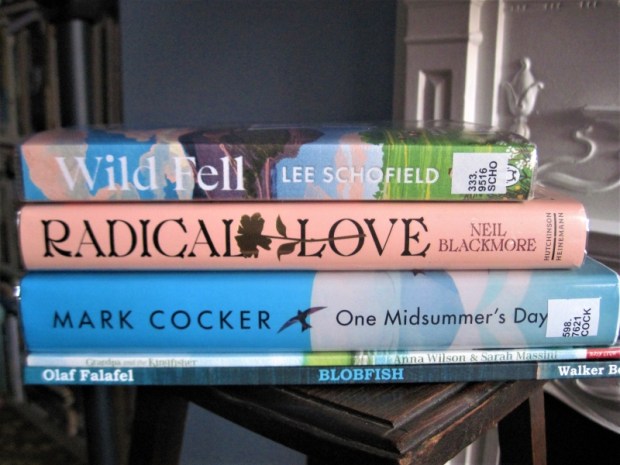
SKIMMED
- A Life of One’s Own: Nine Women Writers Begin Again by Joanna Biggs – The backstory is Biggs getting divorced in her thirties and moving to NYC. Her eight chosen female authors are VERY familiar, barring, perhaps, Zora Neale Hurston (thank goodness she chose two Black authors, as so many group biographies are all about white women). Do we need potted biographies of such well-known figures? Probably not. Nonetheless, it was clever how she wove her own story and reactions to their works into the biographical material, and the writing is so strong I could excuse any retreading of ground.

CURRENTLY READING
- One Midsummer’s Day by Mark Cocker
- King by Jonathan Eig
- Emily Wilde’s Encyclopaedia of Faeries by Heather Fawcett
- Milk by Alice Kinsella
- Wild Fell by Lee Schofield
CHECKED OUT, TO BE READ

Lots of lovely teal in this latest batch.
RETURNED UNFINISHED
- Undercurrent by Natasha Carthew – This was requested after me. I read 21% and will either pick it up on my Kindle via the NetGalley book or get it out another time.
- The Gifts by Liz Hyder – I’ll try this another time when I can give it more attention.
- Music in the Dark by Sally Magnusson – I loved The Ninth Child, but have DNFed her other two novels, alas! I even got to page 122 in this, but I had little interest in seeing how the storylines fit together.
- The Five Red Herrings by Dorothy L. Sayers – I’m awful about trying mystery series, usually DNFing or giving up after the first book. I just can’t care whodunnit.
What have you been reading or reviewing from the library recently?

Share a link to your own post in the comments. Feel free to use the above image. The hashtag is #LoveYourLibrary.
Winter Reads, Part I: Patrick Gale & Tove Jansson (#NordicFINDS23)
This winter has been a disappointment: it’s bloody cold, but with no snow. It’s impossible to keep our house warm, even with extra loft insulation and new double-glazed windows (home ownership is boring and overrated), so I’m ready for signs of spring. Maybe by the time I review a second batch of seasonal reads in February, winter will truly be on its way out.
A Place Called Winter by Patrick Gale (2015)
 This was our January book club read. We’d had good luck with Gale before: his Notes from an Exhibition received our joint highest rating ever. As he’s often done in his fiction, he took inspiration from family history: here, the story of his great-grandfather Harry Cane, who emigrated to the Canadian prairies to farm in the most challenging of conditions. Because there is some uncertainty as to what precipitated his ancestor’s resettlement, Gale has chosen to imagine that Harry, though married and the father of a daughter, was in fact gay and left England to escape blackmailing and disgrace after his affair with a man was discovered.
There are very evocative descriptions of the pioneer life, lightened for Harry by his relationship with his closest neighbours, siblings Petra and Paul. The novel covers the First World War and the start of the Spanish flu epidemic, which provide much fodder for melodrama, but somehow I don’t mind it from Gale. Harry himself is so diffident as to seem blank, but that means he is free to become someone else in a new land. My other main criticism would be that the villain is implausibly evil. Some of our book club members also thought there were too many coincidences. Gale really makes you feel for these characters and their suffering, though. Sexuality and mental health, both so misunderstood at that time, are the two main themes and he explores them beautifully. In that both are historical fiction where homosexuality is simply a fact of life, not a titillating novelty, this reminded me a lot of Days Without End by Sebastian Barry. (Free from mall bookshop)
A Winter Book: Selected Stories by Tove Jansson (2006)
[Translated from the Swedish by Silvester Mazzarella, David McDuff and Kingsley Hart]
 A brief second review for Nordic FINDS. It’s the third time I’ve encountered some of these autofiction stories: this was a reread for me, and 13 of the pieces are also in Sculptor’s Daughter, which I skimmed from the library a few years ago. And yet I remembered nothing; not a single one was memorable. Most of the pieces are impressionistic first-person fragments of childhood, with family photographs interspersed. In later sections, the protagonist is an older woman, Jansson herself or a stand-in. I most enjoyed “Messages” and “Correspondence,” round-ups of bizarre comments and requests she received from readers. Of the proper stories, “The Iceberg” was the best. It’s a literal object the speaker alternately covets and fears, and no doubt a metaphor for much else. This one had the kind of profound lines Jansson slips into her children’s fiction: “Now I had to make up my mind. And that’s an awful thing to have to do” and “if one doesn’t dare to do something immediately, then one never does it.” A shame this wasn’t a patch on The Summer Book. (Free from a neighbour)

Original rating in 2012:
Rating now:
Averaged rating: 
And a DNF:
Winter’s Tale by Mark Helprin (1983)
 Laila (Big Reading Life) and I attempted this as a buddy read, but we both gave up on it. I got as far as page 53 (in the 600+-page pocket paperback). The premise was alluring, with a magical white horse swooping in to rescue Peter Lake from a violent gang. I also appreciated the NYC immigration backstory, but not the adjective-heavy wordiness, the anachronistic exclamations (“Crap!” and “Outta my way, you crazy midget” – this is presumably set some time between the 1900s and 1920s) or the meandering plot. It was also disturbing to hear about Peter’s sex life when he was 12. From a Little Free Library (at Philadelphia airport) it came, and to a LFL (at the Bar Convent in York) it returned. Laila read a little further than me, enough to tell the library patron who recommended it to her that she’d given it a fair try.
Any snowy or icy reading (or weather) for you lately?
The Ones that Got Away: 2022’s DNFs, Most Anticipated Reads & More
Every time I list my DNFs the posts are absurdly popular, so if this is the permission you need to drop that book you’ve been struggling with, take it! If for any reason a book isn’t connecting with you, move onto something else; you can always try it another time. I’ve given a few words as to why I gave up on each one. In rough chronological order:
What Cannot Be Undone by Walter M. Robinson: Medical essays. Repetitive and mawkish; won’t stand out in the crowded field of doctors’ memoirs.
Loss of Memory Is Only Temporary by Johanna Kaplan: Rediscovered short stories of Jewish NYC in the 1960s–70s. The character portraits are sharp, but the first story, “Other People’s Lives,” is novella length and felt absolutely endless.
Six Walks: In the Footsteps of Henry David Thoreau by Ben Shattuck: Nice enough travel writing about trips to Cape Cod, Walden Pond and Mt. Katahdin, but the information on Thoreau (including extensive quotations) is not well integrated and the reflections generic.
Here Comes the Miracle by Anna Beecher (from the ST Young Writer of the Year Award shortlist): MA-course writing-by-numbers and seemed to be building towards When God Was a Rabbit-style mawkishness.
Empire of Wild by Cherie Dimaline: The premise was appealing but it was so slow to go anywhere and the writing was only so-so.
Devotion by Hannah Kent: I was enjoying the beautiful writing and the gentle love story unfolding between two teenage girls setting off from Prussia to Australia with their families. My interest waned a little during the start of the sea voyage, as I kept waiting for the bizarre twist other bloggers had warned of. When I finally got to it, it seemed so silly that I could scarcely be bothered to continue. A shame as I was getting Kiran Millwood Hargrave vibes.
Mercury Pictures Presents by Anthony Marra: A huge disappointment as I adored Marra’s two previous works. I wasn’t connecting to the characters or setting at all. Something about it felt too familiar, also; I kept trying to think what it was reminding me of. Mr Wilder & Me by Jonathan Coe?
After Sappho by Selby Wynn Schwartz: From the Booker Prize longlist. Another case of a terrific premise – and interesting style, too, what with the first person plural in the prologue and the discrete paragraphs like prose poems – but I found that there were too many historical figures, most of them too obscure for me to get interested in.
Raining Sideways: A Devonshire Diary of Food and Farming by Sally Vincent: Boring observations, poorly edited.
Motherthing by Ainslie Hogarth: I actually read about two-thirds of this comic horror novel about a woman dealing with the aftermath of her hateful mother-in-law’s suicide, and intended to review it for R.I.P. even though it felt try-hard. But when my mother died I found that the whole thing seemed in poor taste and I didn’t want to go back to it.
Liberation Day by George Saunders: I only read the first story, which was so much like “The Semplica Girl Diaries” (from Tenth of December) in voice and content that it felt unnecessary, as well as being overlong (nearly 1/3 of the whole book). I’ll hold my place in the Kindle edition and think about trying the rest again another time.
Lessons by Ian McEwan: I’m used to much shorter novels with more contrived plots from McEwan, whereas this feels like the sort of rambling life story William Boyd would have written. I was intrigued by the promised element of Roland’s abuse by his childhood piano teacher, but bored with the Cold War theme of the 1980s strand (which feels most like The Child in Time from his past oeuvre). Perhaps I’ll try it again another day.
Plus a handful more I didn’t keep notes on and barely remember, so they just get my reductive and unfair two-word summaries (alphabetical order this time):
- Human Croquet by Kate Atkinson: Too quirky.
- The Flow by Amy-Jane Beer: Too overwritten.
- The Wilderness by Sarah Duguid: Too pulpy.
- Brave New World: A Graphic Novel by Fred Fordham: Too lurid.
- Mother’s Boy by Patrick Gale: Too mild.
- The Quarry by Ben Halls: Too gritty.
- The White Rock by Anna Hope: Too what’s-the-point.
- One Good Story, That One by Thomas King: Too trickster.
- As I Walked Out One Midsummer Morning by Laurie Lee: Too old-fashioned.
- Homage to Catalonia by George Orwell: Too academic.
- What Is Not Yours Is Not Yours by Helen Oyeyemi: Too weird.
- Catch Your Breath by Ed Patrick: Too unfunny.
- The Unadoptables by Hana Tooke: Too boring.
Whew. I think that’s all.
That works out to abandoning about 8% of the books I started in the year, which is not a bad average for me (often it’s closer to 15%).
In January, I wrote about the 20 new releases I was most looking forward to reading in 2022. Here’s how I did with them:
Read and enjoyed (3.5* or above rating): 10 (a few will appear on my Best-of lists for the year)
Currently reading: 2
Started but set aside; need to finish: 3
Haven’t managed to get hold of: 3
Not actually published yet: 2 (Heartstopper, Volume 5 is now due out in 2023; try as I might, I can’t find any info on A Violent Woman by Ayana Mathis.)
This beats last year’s showing, when I had 5 DNFs from my Most Anticipated list!
I regret running out of time to finish True Biz and Horse from that Most Anticipated list, as well as The Rabbit Hutch (a bit too clever for its own good?) and Fight Night. It’s entirely possible that I could have found some more year favourites on my groaning set-aside and review backlog shelves. I also would have liked to get to the in-demand 2022 releases I’ve just picked up from the library, including The Seven Moons of Maali Almeida and Our Missing Hearts. No matter – I’ll enjoy these just as much when I get to them in an unhurried fashion next year.
What are some of the ‘ones that got away’ from you this year?
The Ones that Got Away: 2021’s DNFs, Most Anticipated Reads & More
I’ve not been great about keeping track of my abandoned books this year, nor have I been consistent about writing justifications. I’m particularly wary about casting aspersions on books that I know others have loved (such as the latest novels by Jonathan Franzen, Lauren Groff and Elizabeth Strout). I don’t like to belabour the matter, but every time I list my DNFs I do find that the posts are absurdly popular, so if this is the permission you need to drop that book you’ve been struggling with for months, take it! If for any reason a book isn’t connecting with you, move onto something else; you can always try it again another time.
For most I’ve given the usual (horribly reductive and unfair) two-word summaries, with longer reactions then given to the DNFs that were on my “most anticipated” list. In rough chronological order:
The Dickens Boy by Thomas Keneally: Too dull.
A Fire in My Head: Poems for the Dawn by Ben Okri: Too unsubtle.
Nobody Told Me: Poetry and Parenthood by Hollie McNish: Too long.
A Burning by Megha Majumdar: Too amateurish.
A Crooked Tree by Una Mannion: Too 1980s.
The Lamplighters by Emma Stonex: Too suspense-less.
The Art of Falling by Danielle McLaughlin: Too slow.
Escape Routes by Naomi Ishiguro: Too undistinctive.
You Exist Too Much by Zaina Arafat: Too Creative-Writing-MA-alum.
The Last Migration by Charlotte McConaghy: Too overwrought.
Of Women and Salt by Gabriela Garcia: Too dispersed.
Bewilderness by Karen Tucker: Too Marlena-wannabe.
Drowning Ruth by Christina Schwarz: Too early-2000s-Oprah’s-book-club.
Will This House Last Forever? by Xanthi Barker: Too Featherhood-lite.
The Union of Synchronised Swimmers by Cristina Sandu: Too vague.
The Cape Doctor by E. J. Levy: Too plodding.
Fathoms by Rebecca Giggs: Too dense.
Crossroads by Jonathan Franzen: Too wordy.
Fox and I: An Uncommon Friendship by Catherine Raven: Too lyrical.
Oh William! by Elizabeth Strout: Too scatter-brained.
Dark Tourist: Essays by Hasanthika Sirisena: Too unfocused.
Darwin’s Dragons by Lindsay Galvin: Too non-Darwin.
Something Out of Place: Women and Disgust by Eimear McBride: Too researched.
The Art of Reassembly by Peg Conway: Too homespun.
Coming Clean: A true story of love, addiction and recovery by Liz Fraser: Too soon.
Beautiful Country: A Memoir by Qian Julie Wang: Too child-POV.
Deadheading and Other Stories by Beth Gilstrap: Too drifting-to-nowhere.
Malibu Rising by Taylor Jenkins Reid: Too soapy.
Philomath: Poems by Devon Walker-Figueroa: Too weird.
Taste: My Life through Food by Stanley Tucci: Too celebrity-rather-than-author.
Somewhere between 30 and 40 DNFs is not too bad for me, representing around 10% of the books I started this year, rather than my standard 15%.
In January, I highlighted the 20 releases that I was most looking forward to reading in 2021. Here’s how I did:
Read and loved: 7 (4 will be on my Best-of lists for the year)
Read and found disappointing (i.e., rated 3.5 stars or below): 4
Still have a review copy to read: 1
Haven’t managed to find yet: 3
DNFs: 5 (oh so poor! – is my “most anticipated” designation actually a kiss of death?)
These were:
Libertie by Kaitlyn Greenidge – I was a big fan of Greenidge’s debut novel, We Love You, Charlie Freeman, but this Reconstruction-era story of an African American doctor and her daughter/protégée bored me stiff. After two attempts I could barely get past page 30.
Matrix by Lauren Groff – It’s as if Groff set herself the challenge of applying the most modern style possible (present tense, no speech marks, pared-back prose, sexual frankness) to a medieval setting. The result is readable, which is more than I can say for most of what’s set in that time period, but I waited 75 pages for something to happen. All we’d had thus far was people commenting on how unsuitable ungainly six-foot Marie is to be an abbess and lots of detail about the privations of life at that time unless you have money as a cushion.
Hot Stew by Fiona Mozley – I read the first 110 pages and felt a bit puzzled by Mozley’s change in direction: This is the sort of state-of-the-nation (via London) novel that male authors were writing a decade ago, in the Dickensian mode of broad characterization and coincidental connection. The omniscient, present-tense narration does too much skating over the surface and not enough digging into characters’ individuality and motivation.
An Ordinary Wonder by Buki Papillon – I read 25 pages or so. Adebayo/Adichie vibes but not the writing chops or the interesting story. Too bad, as I was interested in another intersex narrative to compare with Middlesex et al.
Great Circle by Maggie Shipstead – I tried this twice and found it bloated and slow; such a disappointment. Perhaps I’ll find the right moment in the future. In the meantime, I look forward to reading Shipstead’s first short story collection next year instead. Here’s hoping that her short-form storytelling will work out better for me!
Not a great showing, then, but I can’t seem to resist getting my hopes up each year. (My Most Anticipated Books of 2022 post will be coming up early in January!)
I regret running out of time in 2021 to finish The Final Revival of Opal and Nev by Dawnie Walton or read my review copy of Build Your House Around My Body by Violet Kupersmith. The other 2021 releases I’m most keen to get hold of are Radiant Fugitives by Nawaaz Ahmed, The Secret to Superhuman Strength by Alison Bechdel, Seeing Ghosts by Kat Chow, The War for Gloria by Atticus Lish, What Doesn’t Kill You by Tessa Miller, On Freedom by Maggie Nelson, Names of the Women by Jeet Thayil and O Beautiful by Jung Yun.
 Bookish Beck = Rebecca Foster. American transplant to England. Freelance proofreader and book reviewer.
