November Plans: Novellas, Margaret Atwood Reading Month & More
This is my fourth year joining Laura Frey and others in reading mostly novellas in November. Last year Laura put together a history of the challenge (here); it has had various incarnations but has no particular host or rules. Join us if you like! (#NovNov and #NovellasinNovember) The definition of a novella is loose – it’s based more on the word count than the number of pages – so it’s up to you what you’d like to classify as one. I generally limit myself to books of 150 pages or fewer, though I might go as high as 180-some if there aren’t that many words on a page. Some, including Laura and Susan, would be as generous as 200.


I’ve trawled my shelves for fiction and nonfiction stacks to select from, as well as a few volumes that include several novellas (I’d plan on reading at least the first one) and some slightly longer novels (150–190 pages) for backups. [From the N. West volume, I just have the 52-page novella The Dream Life of Balso Snell, his debut, to read. The Tangye book with the faded cover is Lama.] Also available on my Kindle are The Therapist by Nial Giacomelli*, Record of a Night too Brief by Hiromi Kawakami, Childhood: Two Novellas by Gerard Reve, and Milton in Purgatory by Edward Vass* (both *Fairlight Moderns Novellas, as is Atlantic Winds by William Prendiville).
Other November reading plans…
Margaret Atwood Reading Month
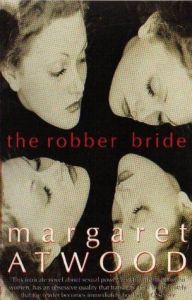 This is the second year of #MARM, hosted by Canadian bloggers extraordinaires Marcie of Buried in Print and Naomi of Consumed by Ink. This year they’re having a special The Handmaid’s Tale/The Testaments theme, but even if you’re avoiding the sequel, join us in reading one or more Atwood works of your choice. She has so much to choose from! Last year I read The Edible Woman and Surfacing. This year I’ve earmarked copies of the novel The Robber Bride (1993) and Moral Disorder (2006), a linked short story collection, both of which I got for free – the former from the free bookshop where I volunteer, and the latter from a neighbor who was giving it away.
Nonfiction November
I don’t usually participate in this challenge because nonfiction makes up at least 40% of my reading anyway, but last year I enjoyed putting together some fiction and nonfiction pairings and ‘being the expert’ on women’s religious memoirs, a subgenre I have a couple of books to add to this year. So I will probably end up doing at least one post. The full schedule is here.
Young Writer of the Year Award
Being on the shadow panel for the Sunday Times/PFD Young Writer of the Year Award was a highlight of 2017 for me. I was sad to not be able to attend any of the events last year. I’m excited for this year’s shadow panelists, a couple of whom are blogging friends (one I’ve met IRL), and I look forward to following along with the nominated books and attending the prize ceremony at the London Library on December 5th.
 With any luck I will already have read at least one or two books from the shortlist, which is to be announced on November 3rd. I have my fingers crossed for Yara Rodrigues Fowler, Daisy Johnson, Elizabeth Macneal, Stephen Rutt and Lara Williams; I expect we may also see repeat appearances from one of the poets recognized by the Forward Prizes and Guy Gunaratne, the winner of the 2019 Dylan Thomas Prize.
Any reading plans for November? Will you be joining in with novellas, Margaret Atwood’s books or Nonfiction November?
Dylan Thomas Prize Blog Tour: Eye Level by Jenny Xie
The Swansea University International Dylan Thomas Prize recognizes the best published work in the English language written by an author aged 39 or under. All literary genres are eligible, so short stories and poetry sit alongside novels on this year’s longlist of 12 titles:
- Nana Kwame Adjei-Brenyah, Friday Black
- Michael Donkor, Hold
- Clare Fisher, How the Light Gets In
- Zoe Gilbert, Folk
- Emma Glass, Peach
- Guy Gunaratne, In Our Mad and Furious City
- Louisa Hall, Trinity
- Sarah Perry, Melmoth
- Sally Rooney, Normal People
- Richard Scott, Soho
- Novuyo Rosa Tshuma, House of Stone
- Jenny Xie, Eye Level
For this stop on the official blog tour, I’m featuring the debut poetry collection Eye Level by Jenny Xie (winner of the Walt Whitman Award of the Academy of American Poets), which was published by Graywolf Press in 2018 and was a National Book Award finalist in the USA last year. Xie, who was born in Hefei, China and grew up in New Jersey, now teaches at New York University. Her poems focus on the sense of displacement that goes hand in hand with immigration or just everyday travel, and on familial and evolutionary inheritance.
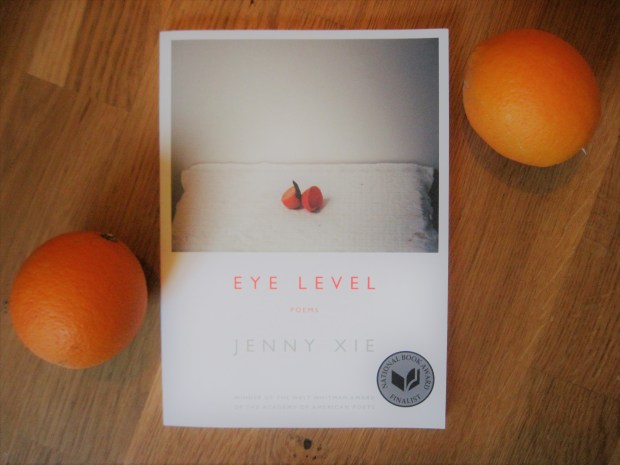
The opening sequence of poems is set in Vietnam, Cambodia and Corfu, with heat and rain as common experiences that also enter into the imagery: “See, counting’s hard in half-sleep, and the rain pulls a sheet // over the sugar palms and their untroubled leaves” and “The riled heat reaches the river shoal before it reaches the dark.” The tragic and the trivial get mixed up in ordinary sightseeing:
The tourists curate vacation stories,
days summed up in a few lines.
Killing fields tour, Sambo the elephant
in clotted street traffic,
dusky-complexioned children hesitant in their approach.
Seeing and being seen are a primary concern, with the “eye” of the title deliberately echoing the “I” that narrates most of the poems. I actually wondered if there was a bit too much first person in the book, which always complicates the question of whether the narrator equals the poet. One tends to assume that the story of a father going to study in the USA and the wife following, giving up her work as a doctor for a dining hall job, is autobiographical. The same goes for the experiences in “Naturalization” and “Exile.”
The metaphors Xie uses for places are particularly striking, often likening a city/country to a garment or a person’s appearance: “Seeing the collars of this city open / I wish for higher meaning and its histrionics to cease,” “The new country is ill fitting, lined / with cheap polyester, soiled at the sleeves,” and “Here’s to this new country: / bald and without center.”
The poet contemplates what she has absorbed from her family line and upbringing, and remembers the sting of feeling left behind when a romance ends:
I thought I owned my worries, but here I was only pulled along by the needle
of genetics, by my mother’s tendency to pry at openings in her life.
Love’s laws are simple. The leaving take the lead.
The left-for takes a knife to the knots of narrative.
Those last two lines are a good example of the collection’s reliance on alliteration, which, along with repetition, is used much more often than end rhymes and internal or slant rhymes. Speaking of which, this was my favorite pair of lines:
Slant rhyme of current thinking
and past thinking.
Meanwhile, my single favorite poem was “Hardwired,” about the tendency to dwell on the negative:
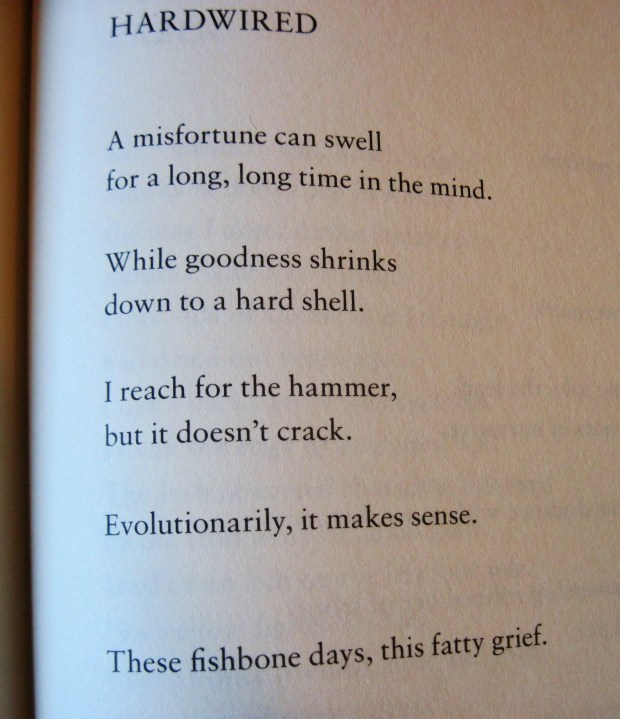
Though I didn’t always connect with Xie’s style – it can be slightly detached and formal in a way that is almost at odds with the fairly personal subject matter, and there were some pronouncements that seemed to me not as profound as they intended to be (it may well be that her work would be best read aloud) – there were occasional lines and images that pulled me up short and made me think, Yes, she gets it. What it’s like to be from one place but live in another; what it’s like to be fond but also fearful of the ways in which you resemble your parents. I expect this to be a strong contender for the Dylan Thomas Prize shortlist, which will be announced on April 2nd. The winner is then announced on May 16th.
My thanks to Midas PR for the free copy for review.
March Reading Plans and Books to Look out For
My apologies if you’ve already heard this story on social media: I was supposed to be in France this past weekend, but for the fourth time in a row we’ve been plagued by transport problems on a holiday: a flat tire in Wigtown, a cancelled train to Edinburgh, a cancelled flight to the States, and now car trouble so severe we couldn’t get on the ferry to Normandy. Though we made it all the way to the ferry port in Poole, our car was by then making such hideous engine noises that it would have been imprudent to drive it any further. We got a tow back to the auto shop where our car is usually serviced and currently await its prognosis. If it can be fixed, we may be able to reschedule our trip for this coming weekend.
The good news about our strange (non-)travel day: I got a jump on my Doorstopper of the Month, Cutting for Stone by Abraham Verghese, a terrific read that reminds me of a cross between Midnight’s Children and The Cider House Rules, and also started Priestdaddy by Patricia Lockwood – though my husband made me stop reading it because I couldn’t stop sniggering while he was trying to make important phone calls about the car. We ended up having a nice weekend at home anyway: going out for Nepalese food, gelato and a screening of The Favorite; doing some gardening and getting bits of work and writing done; and (of course) doing plenty of reading. Waking up with a purring cat on my legs and tucking into a stack of pancakes with maple syrup, I thought to myself, being home is pretty great, too.
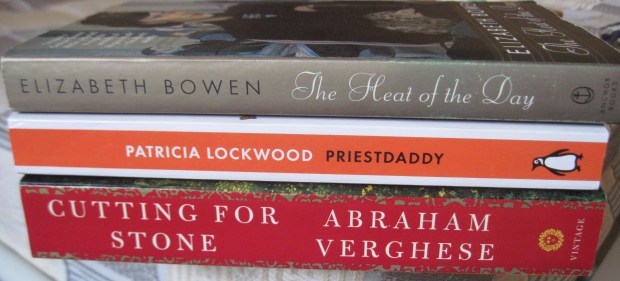
What I packed to read in France.
Reading Ireland Month 2019
This will be my second time participating in the annual challenge hosted by Cathy of 746 Books. I recently started The Heat of the Day by Elizabeth Bowen and I’m also currently reading two nonfiction books by Irish women: a review copy of Vagina: A Re-Education by Lynn Enright (which releases on March 7th) and the essay collection Notes to Self by Emilie Pine, on my Kindle. I have several other novels to choose from – two of which are set in Ireland rather than by Irish authors – plus a classic travel book by Dervla Murphy.
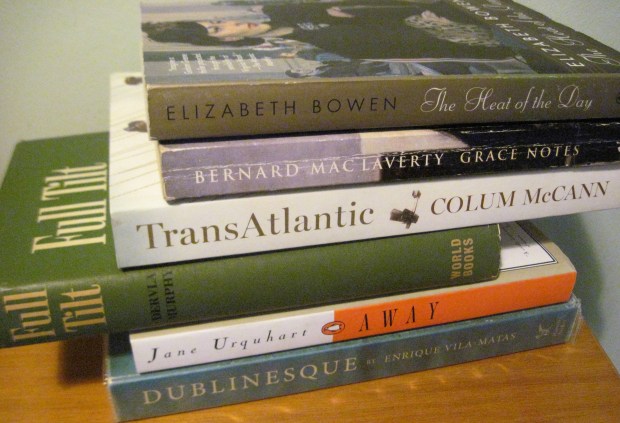
Irish selections.
Wellcome Book Prize
The second of my ‘assigned’ longlist reviews will be going up on Wednesday. I’m currently reading another three books from the longlist and will post some brief thoughts on them if I manage to finish them before the shortlist announcement on the 19th. At that point I will have read 10 out of the 12 books on the longlist, so should feel pretty confident about making predictions (or at least stating wishes) for what will go through to the next round.
Blog Tours
I have two blog tours coming up later in the month, including the official one that’s being run for the Dylan Thomas Prize longlist.
Review Books
I’ve got a pile-up of review copies that came out in February or are releasing early this month – 9, I think? Some I’ve already read and some are still in progress. So I will be doing my best to group these sensibly and write short reviews, but you may well notice a lot of posts from me.
Blog Anniversary
This Friday marks four years that I’ve been blogging about books!
Here are a few March releases I’ve read that you may want to look out for:
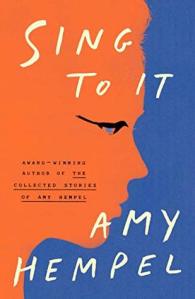 Sing to It: New Stories by Amy Hempel [releases on the 26th]: “When danger approaches, sing to it.” That Arabian proverb provides the title for Amy Hempel’s fifth collection of short fiction, and it’s no bad summary of the purpose of the arts in our time: creativity is for defusing or at least defying the innumerable threats to personal expression. Only roughly half of the flash fiction achieves a successful triumvirate of character, incident and meaning. The author’s passion for working with dogs inspired the best story, “A Full-Service Shelter,” set in Spanish Harlem. A novella, Cloudland, takes up the last three-fifths of the book and is based on the case of the “Butterbox Babies.” (Reviewed for the Pittsburgh Post-Gazette.)
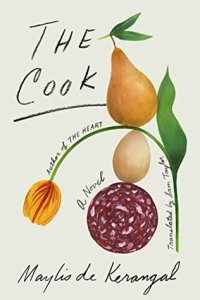 The Cook by Maylis de Kerangal (translated from the French by Sam Taylor) [releases on the 26th]: This is a pleasant enough little book, composed of scenes in the life of a fictional chef named Mauro. Each chapter picks up with the young man at a different point as he travels through Europe, studying and working in various restaurants. If you’ve read The Heart / Mend the Living, you’ll know de Kerangal writes exquisite prose. Here the descriptions of meals are mouthwatering, and the kitchen’s often tense relationships come through powerfully. Overall, though, I didn’t know what all these scenes are meant to add up to. Kitchens of the Great Midwest does a better job of capturing a chef and her milieu.
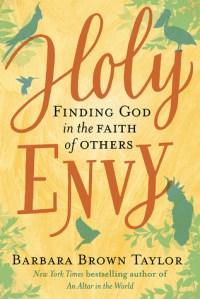 Holy Envy: Finding God in the Faith of Others by Barbara Brown Taylor [releases on the 12th]: After she left the pastorate, Taylor taught Religion 101 at Piedmont College, a small Georgia institution, for 20 years. This book arose from what she learned about other religions – and about Christianity – by engaging with faith in an academic setting and taking her students on field trips to mosques, temples, and so on. She emphasizes that appreciating other religions is not about flattening their uniqueness or looking for some lowest common denominator. Neither is it about picking out what affirms your own tradition and ignoring the rest. It’s about being comfortable with not being right, or even knowing who is right.
What’s on your reading docket for March?
In Praise of Literary Prizes
I like a spot of competition. Whether watching Olympic figure skating, playing board games like Scrabble and Boggle, entering a low-key Oscars pool, or rooting for my favorites in American Idol seasons and Miss America pageants, I’ve always loved trying to pick the best. This means that literary prizes are hugely exciting for me, and I follow the races closely.
I’m particularly devoted to the Man Booker Prize. I was delighted to see Hanya Yanagihara’s A Little Life on the recent longlist (catch up on it here), a truly interesting set of books, diverse in terms of their genres and authors’ nationalities and nicely balanced between male and female writers (6:7). I’ve read four of the longlisted titles so far:
 The Fishermen, Chigozie Obioma (full review in May 2015 issue of Third Way): From a young Nigerian debut novelist comes a haunting tale of sibling rivalry and revenge. With sectarian riots afoot, the four oldest Agwu boys decide to make money by skipping school and fishing in the Omi-Ala River. Things get more complicated when Abulu, the local madman, issues a prophecy that seems bound to divide the brothers. The first quarter of the novel, especially, is drenched in foreshadowing (not always subtle, nor do the plot turns often rise above the predictable). Rich with prophecy and allusions, this owes much to biblical narratives and tragedies from Shakespeare to Chinua Achebe.
- Lila, Marilynne Robinson – reviewed at For Books’ Sake
- A Spool of Blue Thread, Anne Tyler – also reviewed at For Books’ Sake
- A Little Life, Hanya Yanagihara – reviewed at Shiny New Books

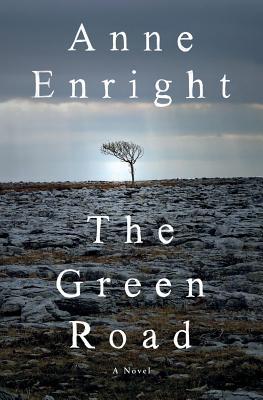 Next up: I’m reviewing The Green Road by Anne Enright for the November 2015 issue of Third Way. The Booker Prize shortlist will be announced on September 15th and the winner on October 13th.
Beyond the Booker, here are some of the other prizes I follow throughout the year, listed in vague chronological order:
 The Not the Booker Prize run by the Guardian. On this year’s shortlist is Shame by Melanie Finn, a book I loved when I reviewed it for Third Way’s April 2015 issue. It’s a powerful story of regret and the search for redemption. Though it has elements of a straightforward psychological thriller, the daring structure and moral complexities are more akin to Graham Greene. In alternating chapters, Pilgrim Jones contrasts flashbacks to her car accident and the subsequent investigation back in Switzerland with her present-tense African odyssey. This is Conrad’s Africa, a continent characterized by darkness and suffering. The question of culpability remains murky, yet the possibility of salvation shines through. [Voting will take place in October.]

- The Guardian First Book Award (open to both fiction and nonfiction): the shortlist will be announced this Friday, August 14th. One entry, Spill Simmer Falter Wither by Sara Baume, has already been chosen by readers, and the other nine are selected from publishers’ submissions. [Winner announced in late November.]
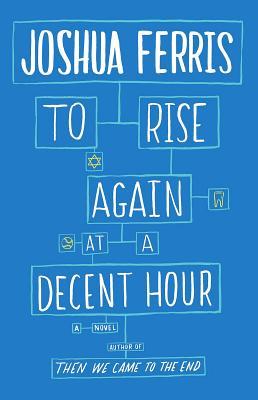
 The Dylan Thomas Prize for young writers (under 39) went to Joshua Ferris for To Rise Again at a Decent Hour last year. [Longlist in September, shortlist in October and winner announced in November.]
- The Costa Book Awards give separate prizes for fiction, debut fiction, biography, poetry, and children’s books, and also choose one overall winner. [Category shortlists in late November, category winners in early January and overall winner on January 26, 2016.]
- The Folio Prize, only two years old, considers any work of fiction published in English; before the Booker expanded to include American entries last year, it was the most Catholic of the fiction prizes. Now it risks being considered redundant; especially since it lost its Folio Society sponsorship, it’s unclear whether it will continue. [Shortlist in February and winner announced in March.]
 The Wellcome Book Prize is for medical-themed literature, fiction or nonfiction. Last year’s winner, The Iceberg by Marion Coutts, meant a lot to me for personal reasons but was also one of the most unusual and impressive memoirs I’ve ever read. I reviewed it for The Bookbag here. [Shortlist in March and winner announced in April.]

- The Pulitzer Prize is America’s premier literary award. I confess I often feel a little out of touch with the winners and don’t necessarily make a conscious effort to seek out the nominated books. I’d like to be more familiar with Pulitzer winners. Next year marks the prize’s centennial, so there’s no better time! [Winners announced in April.]
- The Independent Foreign Fiction Prize is for any book that has been translated into English and published in the UK in the previous year. I’ve found some great offbeat reads by browsing through previous longlists. As of next year, the prize is merging with the Man Booker International award, which previously recognized the life work of a foreign author every other year. [Longlist in March, shortlist in April and winner announced in May.]
 The Bollinger Everyman Wodehouse Prize, the UK’s prize for comic literature, has run since 2000. Among the past winners are Paul Torday, Howard Jacobson, Terry Pratchett, Geoff Dyer, Gary Shteyngart, and (surprise!) Ian McEwan. I’ve read five of the winners, including Lost for Words by Edward St. Aubyn. [Shortlist in March and winner announced in May.]
- The Baileys Women’s Prize for Fiction (formerly known as the Orange Prize). Ali Smith won the 2015 award for How to Be Both. [Longlist in March; shortlist and winner announced in June.]
Do you follow literary prize races? Do you make a point of reading the winner and/or the shortlisted books? All comments welcome!
 Bookish Beck = Rebecca Foster. American transplant to England. Freelance proofreader and book reviewer.
 Bookish Beck