January Novels by Alix E. Harrow & Patricia Highsmith
The month of January was named for the Roman god Janus, known for having two faces: one looking backward, the other forward. “He presided not over one particular domain but over the places between – past and present, here and there, endings and beginnings,” as Alix E. Harrow writes. In her novel, the door is a prevailing metaphor for liminal times and spaces; Highsmith’s work, too, focuses on the way life often pivots on tiny accidents or decisions.
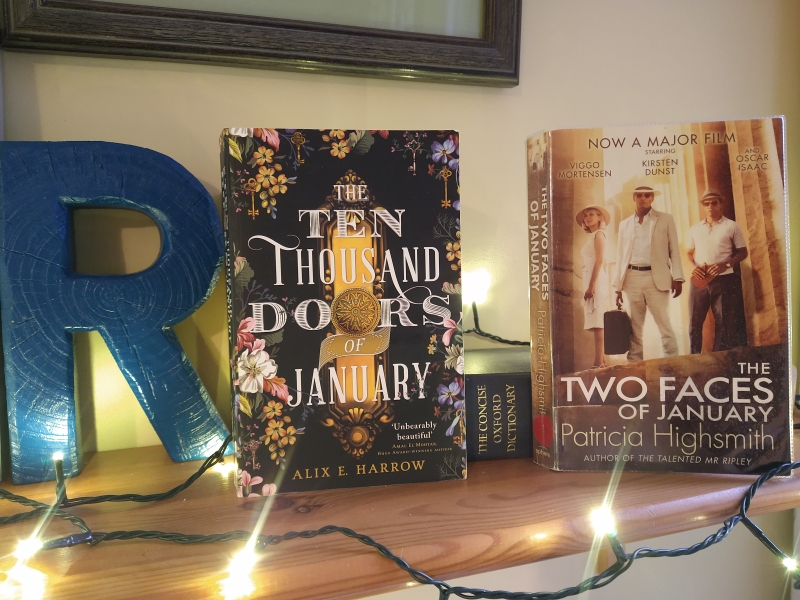
The Ten Thousand Doors of January by Alix E. Harrow (2019)
“I didn’t want to be safe … I wanted to be dangerous, to find my own power and write it on the world.”
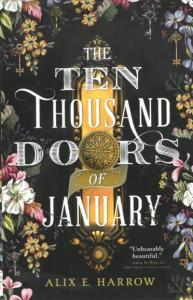 As the mixed-race ward of a wealthy collector, January Scaller grows up in a Vermont mansion with a dual sense of privilege and loss. She barely sees her brown-skinned father, who travels the world amassing treasures for Mr. Locke and his archaeological society; and her mother’s absence is an unexplained heartbreak. But when her father also disappears in 1911 – to be apparently replaced by an African governess named Jane Irimu (it’s her quote above) and an enticing scholarly manuscript entitled The Ten Thousand Doors – 17-year-old January discovers the power of words to literally open doors to new worlds, and sets off on a quest to reunite her family. At every turn, though, she’s thwarted by evil white men who, after plundering foreign cultures, intend to close the doors of opportunity behind them.
This was an unlikely book for me to pick up: I didn’t get on with that whole wave of books with books and keys on the cover (Bridget Collins et al.) and wouldn’t willingly pick up romantasy – yet this features two meant-to-be romances fought for across worlds and eras. I grow impatient with a book-within-the-book format. But The Chronicles of Narnia, which no doubt inspired Harrow, were my favourite books as a child. Especially early on, I found this as thrilling as The Absolute Book and The End of Mr. Y. Whereas those doorstoppers held my interest all the way through, though, this became a trudge at a certain point. Harrow is maybe a little too pleased with her own imagination and turns of phrase, like T. Kingfisher. (Bad the dog is also in peril far too often.) In the end, this reminded me most of Babel by R.F. Kuang with its postcolonial conscience and words as power. I enjoyed this enough that I think I’ll propose her The Once and Future Witches for book club. (Little Free Library) 
The Two Faces of January by Patricia Highsmith (1964)
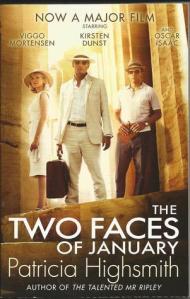 Three American vacationers meet in a hotel in Greece one January. But the circumstances are far from auspicious. Conman Chester MacFarland is traveling with his 15-years-younger wife, Colette. Rydal Keener is a stranger who, seemingly on a whim, helps them cover up the accidental death of a Greek police investigator who came to ask Chester some questions. From here on in, they’re in lockstep, moving around Greece together, obtaining fake passports and checking the headlines obsessively to outrun consequences. Colette takes a fancy to Rydal, and the jealousy emanating from the love triangle is complicated by Chester’s alcoholism and Rydal’s hurt over earning a police record for a consensual teenage relationship. I have a dim memory of seeing the 2014 Kirsten Dunst and Viggo Mortensen film, but luckily I didn’t recall any major events. A climactic scene takes place at the palace of Knossos, and the chase continues until an unavoidably tragic end.
I’ve read several Ripley novels and a few standalone psychological mysteries by Highsmith and enjoyed them well enough, but murders aren’t really my thing. (Carol is the only work of hers that I’ve truly loved.) My specific issue here was with the central trio of characters. Colette is thinly drawn and doesn’t get enough time on the page. Chester seems much older than his 42 years and is an irredeemable swindler. It’s only because of our fondness for Rydal that we want them all to get away with it. But even Rydal doesn’t get the in-depth portrayal one might hope for. There’s the injustice of his backstory and the fact that he’s a would-be poet, true, but we never understand why he helped the MacFarlands, so have to conclude that it was the impulse of a moment and committed him to a regrettable course. This is pacey enough to keep the pages turning, but won’t stick with me. (Public library) 
I’m turning my face forward: Good riddance to January 2026, during which I’ve mostly felt rubbish; here’s hoping for a better rest of the year. I’m off to the opera tonight – something I’ve only done once before, in Leeds in 2006! – to see Susannah, a tale from the Apocrypha transplanted to the 1950s U.S. South.
Six Degrees of Separation: True History of the Kelly Gang to Geek Love
This month we begin with True History of the Kelly Gang by Peter Carey. (See also Kate’s opening post.) I feel like I still have an unread copy, but won’t find out now until after we move. I’ve read several of Carey’s novels; my favourite by far was Parrot and Olivier in America, a delightful picaresque set in the early 19th century.

 #1 Flaubert’s Parrot by Julian Barnes was one of my most-admired novels in my twenties, though I didn’t like it quite as much when I reread it in 2020. Funnily enough, his new novel has a bird in the title, too: Elizabeth Finch. I’m two-thirds through and it’s feeling like warmed-up leftovers of The Sense of an Ending with extra history and philosophy on the side.
 #2 My latest reread was Falling Angels by Tracy Chevalier, for book club. I’ve read all of her novels and always thought of this one as my favourite. A reread didn’t change that, so I rated it 5 stars. I love the neat structure that bookends the action between the death of Queen Victoria and the death of Edward VII, and the focus on funerary customs (with Highgate Cemetery a major setting) and women’s rights is right up my street.
 #3 Another novel featuring an angel that I read for a book club was The Vintner’s Luck by Elizabeth Knox. It’s set in Burgundy, France in 1808, when an angel rescues a drunken winemaker from a fall. All I can remember is that it was bizarre and pretty terrible, so I’m glad I didn’t realize it was the same author and went ahead with a read of The Absolute Book.
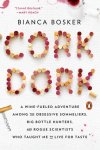 #4 The winemaking theme takes me to my next selection, Cork Dork by Bianca Bosker, which I read on a trip to the Netherlands and Belgium in 2017. Bosker, previously a technology journalist, gave herself a year and a half to learn everything she could about wine in hopes of passing the Court of Master Sommeliers exam. The result is such a fun blend of science, memoir and encounters with people who are deadly serious about wine.
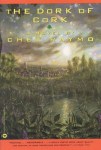 #5 I have so often heard the title The Dork of Cork by Chet Raymo, though I don’t know why because I can’t think of an acquaintance who’s actually read or reviewed it. The synopsis: “When Frank, an Irish dwarf, writes a personal memoir, he moves from dark isolation into the public eye. This luminous journey is marked by memories of his lonely childhood, secrets of his doomed young mother, and his passion for a woman who is as unreachable as the stars.” Sounds a bit like A Prayer for Owen Meany.
 #6 Another novel with a dwarf: Geek Love by Katherine Dunn, about a carnival of freaks that tours U.S. backwaters. I have meant to read this for many years and was even convinced that I owned a copy, but on my last few trips to the States I’ve not been able to find it in one of the boxes in my sister’s basement. Hmmm.
To the extent that we have ‘a song,’ “Geek Love” by Nerina Pallot would be it for my husband and me. A line from the chorus is “We’re geeks, but we know this is love.” It’s from her breakout album Fires, which came out in 2005 and was almost constant listening fodder for us while we were engaged. We’ve seen her live three times and she always plays this one.
From a gang via dorks to geeks, linked by the fact of books being stuck in (Schrödinger’s) boxes. Where will your chain take you? Join us for #6Degrees of Separation! (Hosted on the first Saturday of each month by Kate W. of Books Are My Favourite and Best.) Next month’s starting point is Sorrow and Bliss by Meg Mason — perfect given that it’s the book my book group has been sent to discuss as we shadow this year’s Women’s Prize.
Have you read any of my selections? Tempted by any you didn’t know before?
Doorstopper of the Month: The Absolute Book by Elizabeth Knox (2019)
Epic fantasy is far from my usual fare, but this was a book worth getting lost in. The reading experience reminded me of what I had with A Discovery of Witches by Deborah Harkness, The Wind-Up Bird Chronicle by Haruki Murakami, or perhaps Jonathan Strange & Mr. Norrell by Susanna Clarke – though it’s possible this last association was only in my mind because of Dan Kois. You see, we have Kois, an editor at Slate, to thank for this novel being published outside of Knox’s native New Zealand. He wrote an enthusiastic Slate review of an amazing novel he’d found that was only available through a small university press, and Clarke’s novel was his main point of reference. How’s that for the power of a book review?
Taryn Cornick, 33, has adapted her PhD thesis into a popular history of libraries – the search for absolute knowledge; the perennial threats that libraries face, from budget cuts to burnings – that she’s been discussing at literary festivals around the world. One particular burning looms large in her family’s history: the library at her grandfather’s country estate near the border of England and Wales, Princes Gate. As girls, Taryn and her older sister, Beatrice, helped to raise the alarm and saved the bulk of their grandfather’s collection. But one key artifact has been missing ever since: the Firestarter, an ancient scroll box that is said to have been through five fires and will survive another arson attempt before the book is through.

Nearly 15 years ago now, Beatrice was the victim of a random act of violence. Soon after her killer was released from prison, he turned up dead in unusual circumstances. Ever since, Detective Inspector Jacob Berger has suspected that Taryn arranged a revenge killing, but he has no proof. His cold case heats back up when Taryn lands in the hospital and complains of a series of prank calls.
What ensues is complicated, but in essence, the ongoing fallout of Beatrice’s murder and a cosmic battle over the Firestarter are twin forces that plunge Taryn and Jacob into the faerie realm (Sidh). Their guide to the Sidh is Shift, a shapeshifter who can create impromptu gates between the two worlds (while others, like Princes Gate, are permanent passageways).
Fairies (sidhe), demons, talking ravens … there’s some convoluted world-building here, and when I reached the end I realized I still had many ‘how’ and ‘why’ questions, though often this was because I hadn’t paid close enough attention and if I glanced back I’d see that Knox did indeed tell us how characters got from A to B, and who was after the Firestarter and why.
The book travels everywhere from Provence to Purgatory, but I particularly liked the descriptions of the primitive lifestyle in the faerie realm. Knox gives enough detail about things like food and clothing that you can really imagine yourself into each setting, and there’s the occasional funny turn of phrase that inserts the magical into everyday life in a tongue-in-cheek way, like “The Nespresso [machine] made hatching-dragon sounds.”
My two favorite scenes were an intense escape from a marsh and one that delightfully blends the human world and faerie: Taryn’s father, Basil Cornick, is a Kiwi actor best known for his role in a Game of Thrones-style television show. He’s roped into what he thinks is a screen test, playing Odin opposite a very convincing animatronic monster and pair of talking birds. We and Taryn know what he doesn’t: that he was used to negotiate with a real demon. The terrific epilogue also offers an appealing vision of how the sidhe might save the world.
If, like me, all you know of Knox’s previous work is the bizarre and kind of awful The Vintner’s Luck (which I read for a book club a decade or so ago), you’ll be intrigued to learn that angels play a role here, too. But beneath all the magical stuff, which is sometimes hard to follow or believe in, the novel is a hymn to language and libraries. A number of books are mentioned, starting with the one that was in Beatrice’s backpack at the time of her death: “the blockbuster of that year, 2003, a novel about tantalising, epoch-spanning conspiracies. Beatrice enjoyed those books, perhaps because they were often set in libraries.” (That’s The Da Vinci Code, of course.) Also mentioned: Labyrinth by Kate Mosse, the Moomin books, and the film Spirited Away – no doubt these were beloved influences for Knox.
I appreciated the words about libraries’ enduring value, even on a poisoned planet. “I want there to be libraries in the future. I want today to give up being so smugly sure about what tomorrow won’t need,” Taryn says. She knows that, for this to happen, people must “care about the transmission of knowledge from generation to generation, and about keeping what isn’t immediately necessary because it might be vital one day. Or simply intriguing, or beautiful.” That’s an analogy for species, too, I think, and a reminder of our responsibility: to preserve human accomplishments, yes, but also the more-than-human world (even if that ‘more’ might not include fairies).
Page count: 626 (my only 500+-page doorstopper so far this year!)
My rating: 
Book Serendipity, Mid-March to Early May 2021
In early April, the publisher Canongate ran a newsletter competition for one reader to win a stack of their recent releases. All you had to do was reply with your favourite word. On Twitter they gave a rundown of the most popular responses. Turning up several times each were petrichor, mellifluous, and oleaginous. Most frequent of all was serendipity: I was one of 15 to submit it! And one of those entries, but not mine, won. Anyway, fun little story there.
I call it Book Serendipity when two or more books that I read at the same time or in quick succession have something pretty bizarre in common. Because I have so many books on the go at once (usually 20‒30), I suppose I’m more prone to such incidents. I’ve realized that, of course, synchronicity is really the more apt word, but this branding has stuck.
The following are in roughly chronological order.
- A white peacock is mentioned in Indelicacy by Amina Cain and The Mermaid of Black Conch by Monique Roffey, both of which were on the 2021 Rathbones Folio Prize shortlist.
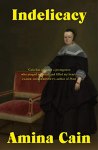

- Speaking of that Rathbones Folio Prize shortlist, four of the eight were paperbacks with French flaps.
- The main character takes ballet lessons in Indelicacy by Amina Cain and A Feather on the Breath of God by Sigrid Nunez.
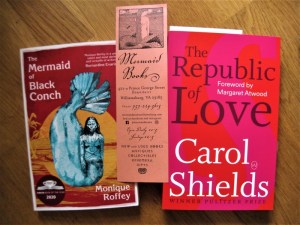
- Mermaids! A big theme in The Mermaid of Black Conch by Monique Roffey (of course) and The Republic of Love by Carol Shields, but they’re also mentioned in the opening story of The Office of Historical Corrections by Danielle Evans and are main characters in “The Pangs of Love” by Jane Gardam in the anthology Close Company.
- The Brothers Grimm story about brothers who have been transformed into swans and their sister who sews shirts out of nettles to turn them back is reworked in The Charmed Wife by Olga Grushin and used as a metaphor in Dusk, Night, Dawn by Anne Lamott.
- An electric carving knife is mentioned as a means of suicide (yipes!) in The Inevitable by Katie Engelhart and Woman on the Edge of Time by Marge Piercy.
- A discussion of the distinction between the fear of dying and the fear of being dead in This Party’s Dead by Erica Buist and The Inevitable by Katie Engelhart.
- Two novels in a row in which an older man is appalled by the squalor of his young girlfriend’s apartment, and she calls him “daddy” during sex (double yipes!), made the Dylan Thomas Prize shortlist: Luster by Raven Leilani and My Dark Vanessa by Kate Elizabeth Russell.


- Architect husbands in The Push by Ashley Audrain and The Art of Falling by Danielle McLaughlin (and, last year, in A Celibate Season by Blanche Howard and Carol Shields), as well as a female architect as a main character in The Living Sea of Waking Dreams by Richard Flanagan earlier this year.
- The next-to-last essay in the Trauma anthology quotes from The Bell Jar by Sylvia Plath, which I was also reading at the time.
- A mention of the eels in London absorbing cocaine from the Thames in the final essay in the Trauma anthology; I then moved right on to the last 40 pages of Nobody Is Talking About This by Patricia Lockwood and the same bizarre fact was mentioned. A week and a half later, there it was again, this time in Asylum Road by Olivia Sudjic.
- A mention of sailors’ habit of getting tattoos of swallows in The Circling Sky by Neil Ansell (who has a swallow tattoo, even though he’s not a sailor) and Birdsong in a Time of Silence by Steven Lovatt.

- A father and teenage child wander an unfamiliar city and enter a sex shop together (yipes yet again!) in Three O’Clock in the Morning by Gianrico Carofiglio and Ten Days by Austin Duffy.
- A mention of the same University of Virginia study in which people self-administered electric shocks to alleviate the boredom of sitting alone with their thoughts in Rooted by Lyanda Lynn Haupt and You’re Not Listening by Kate Murphy.
- Basho’s poetry and George Monbiot’s Feral are both cited in The Circling Sky by Neil Ansell and Rooted by Lyanda Lynn Haupt.
- A dead sister named Mattie in Consent by Annabel Lyon and Drowning Ruth by Christina Schwarz.

- A young Black female protagonist and the same family dynamic (the mother committed suicide and the father is in the Marines/Navy) in The Mothers by Brit Bennett and Luster by Raven Leilani.
- On the same night, I read about two pets encountering snow for the first time: a cat in Close Encounters of the Furred Kind by Tom Cox and a dog in Open Water by Caleb Azumah Nelson.
- A character is described as being as wide as they are tall in Mother for Dinner by Shalom Auslander and The Absolute Book by Elizabeth Knox.


- A character is known as Seventh in Mother for Dinner by Shalom Auslander and the story “The Pangs of Love” by Jane Gardam in the Close Company anthology. Plus, there’s Septimus in Mrs Dalloway by Virginia Woolf, which I’m reading concurrently with those two.
What’s the weirdest reading coincidence you’ve had lately?
My Patchy Experience with Book Clubs
I know that a number of you have long-term, faithful book clubs. Boy, am I envious! You might find it surprising that I’ve only ever been in one traditional book club, and it wasn’t a resounding success. Partway through my time working for King’s College, London, an acquaintance from another library branch started the club. A group of five to eight of us from Library Services aimed to meet after work one evening a month at a Southbank venue or a staff room to discuss our latest pick. By poring over old e-mails and my Goodreads library, I’ve managed to remember 10 of the books we read between November 2011 and June 2013:
- Do Androids Dream of Electric Sheep?, Philip K. Dick [classic science fiction]
- The Little Shadows, Marina Endicott [Canadian historical fiction]
- A Spot of Bother, Mark Haddon [contemporary fiction]
- The Talented Mr. Ripley, Patricia Highsmith [classic suspense]
- The Vintner’s Luck, Elizabeth Knox [bizarre historical fiction/magic realism]
- What Was Lost, Catherine O’Flynn [contemporary fiction]
- Franny and Zooey, J.D. Salinger [classic short fiction]
- The Rabbi’s Cat, Joann Sfar [graphic novel in translation]
- Girl Meets Boy, Ali Smith [an update of Greek myth]
- Angel, Elizabeth Taylor [an obscure English classic]
That may well be the complete list. Although I was a member for 20 months until I quit to go freelance, we often only managed to meet every other month because we couldn’t find a mutually convenient free evening or no one had read the book in time. I was consistently frustrated that – even when our selections were only about 200 pages long – I was often one of the only people to have read the whole book.
Overall, the quality of books we chose struck me as mediocre: I rated half of these books 2 stars, and the rest 3 stars. (I think I was a harsher rater then, but it’s not a good sign, is it?) Perhaps this is part of the inevitable compromising that goes with book clubs, though: You humor other people in their choices and hope they’ll be kind about yours? My suggestion, for the record, was the pretty dismal Little Shadows, for which I got a free set of book club copies to review for Booktime magazine. But I also voted in favor of most of the above list.
Looking back, I am at least impressed by how varied our selections were. People were interested in trying out different genres, so we ranged from historical fiction to sci-fi, and even managed a graphic novel. But when we did get together for discussion there was far too much gossipy chat about work, and when we finally got around to the book itself the examination rarely went deeper than “I liked it” or “I hated all the characters.”
If it was profound analysis I was after, I got that during the years I volunteered at Greenbelt, an annual summer arts festival with a progressive Christian slant. I eagerly read the eclectic set of three books the literature coordinator chose for book club meetings in 2010 – Star of the Morning: The Extraordinary Life of Lady Hester Stanhope by Kirsten Ellis, The First Person and Other Stories by Ali Smith, and The Bridge of San Luis Rey by Thornton Wilder – and then as a literature volunteer for the next three years I read and prepared copious notes and questions about our festival “Big Read.” We did Exile by Richard North Patterson in 2011, Dark Eden by Chris Beckett in 2012 and So Many Ways to Begin by Chris Beckett in 2013, and each time I offered to chair the book club meetings.
Unfortunately, due at least in part to logistical considerations, these were run in the way many festival events are: a panel of two to five talking heads with microphones was at the front of the tent, sometimes on a raised dais, while the audience of whatever size sat towards the back. This created a disconnect between the “experts” and the participants, and with the exception of the McGregor meeting I don’t recall much audience input. I’ve mostly blanked out the events – as I tend to for anything that entails public speaking and nervous preparation for something you can’t control – but I was pleased to be involved and I should probably make more of this on my CV. It wasn’t your average book club setting, that’s for sure.
In recent years the closest thing I’ve had to a book club has been online buddy reading. The shadow panels for the Wellcome Book Prize and Sunday Times Young Writer of the Year Award fall into this category, as do online readalongs I’ve done for several Iris Murdoch novels and for C.S. Lewis’s Mere Christianity with various female family members. A few of us book bloggers chatted about Andrea Levy’s Small Island in an online document earlier this year, and my mom and I e-mailed back and forth while reading W. Somerset Maugham’s The Painted Veil in May. I’m also doing my last three of the #20BooksofSummer as online buddy reads, checking in occasionally on Twitter.
Of course, there are some inherent limitations to this kind of discussion – people read at different paces and don’t want to spoil the plot for others, and at some point the back-and-forth fizzles out – but it’s always been easier for me to organize my thoughts in writing, so I likely feel more comfortable contributing than I might in an in-person meeting.
This is all context for my decision to join my neighborhood book club next month. The club arose some months back out of our community’s Facebook group, a helpful resource run by a go-getting lady a few doors down from us. So far it’s turning out to be a small group of thirty- and fortysomething women who alternate meetings at each other’s houses, and the name they’ve chosen gives an idea of the tone: “Books, Booze and Banter.”
I made the mistake of not getting involved right at the start; I wanted to hang back and see what kind of books they’d choose. This means I wasn’t part of the early process of putting titles in a hat, so I’ve looked on snobbishly for several months as they lurched between crime and women’s fiction, genres I generally avoid. (Still, there were actually a couple books I might have joined them for had I not been in America and had they been readily available at the public library.) For many people a book club selection will be the only book they get through that month, so I can understand how they’d want it to be something ‘readable’ that they’d be happy to pick up anyway. Even though statistically I read 27 books a month, I’m still jealously protective of my reading time; I want everything I read to be worthwhile.
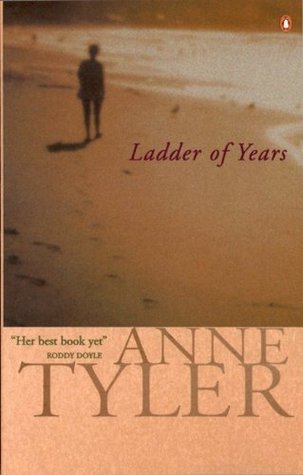 So for September I managed to steer the group away from a poorly received historical novel of over 400 pages and the new Joël Dicker and onto Ladder of Years by Anne Tyler, which the bookstore chain Waterstones has been promoting heavily as one of their books of the month. I already had a charity shop copy in hand and the others liked the sound of it, so we’re all set for September 12th! Future months’ literary fiction choices look promising, too, so provided I enjoy the discussion and the camaraderie I plan to stick with it: a backlist Pat Barker novel I’ve not read, and Kirsty Logan and Jonathan Coe novels I’ve read before and won’t reread but will remind myself about briefly before the meetings.
I’m out of practice with this book club thing. My mother tells me that I have a lot to contribute but that I must also be open to what I’ll learn from other people – even if I don’t expect to. So I don’t want to set myself up as some kind of expert. In fact, I probably won’t even mention that I’m a freelance book reviewer and book blogger. Mostly I’m hoping to find some friendly faces around the neighborhood, because even though we’ve lived here just over two years I still only know a handful of names and keep myself to myself as I work from home. Even if I have to read books I wouldn’t normally, it’ll be worth it to meet more people.
 Bookish Beck = Rebecca Foster. American transplant to England. Freelance proofreader and book reviewer.
 Bookish Beck