20 Books of Summer, 4–7: Fadiman; Kingsolver & O’Farrell Rereads; Sullivan
I finished several of these a while ago now, but it’s been a struggle to summon up the motivation to write about them, especially during the heat wave we’re currently experiencing in the southern half of England. You’ve heard a lot from me recently as I’ve been catching up on reviews, so I’ll try to keep these responses to one (long) paragraph each.
Frog and Other Essays by Anne Fadiman (2026)
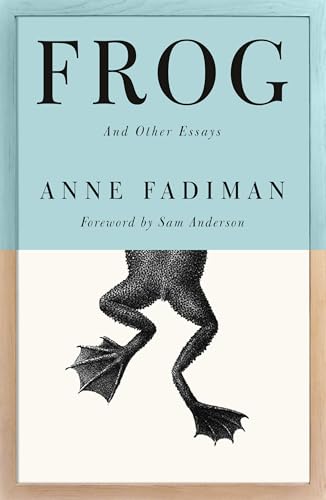 This was one of my Most Anticipated titles of the year because I’ve loved Fadiman’s nonfiction, especially the bookish Ex Libris, which I’ve read twice. Her essays are warm and fluent, braiding memoir and observation in a natural way and drawing readers in whether they share her particular preoccupations or not. “Frog” is about her guilt for not being more attentive to her children’s surprisingly long-lived pet frog, Bunky; “South Polar Times” recounts her obsession with polar exploration and what she discovered in the archives of the magazine Shackleton produced in the 1910s. At the centre of the book is a triptych on modern technology (“My Old Printer”) and language use, especially as she’s experienced it as a Yale professor trying to adjust to pandemic-era teaching (“Screen Share”) and expanded gender possibilities (“All My Pronouns,” which is mostly about getting used to “they” as a singular pronoun for nonbinary individuals). What a relief that advancing age and pedantry didn’t see her joining the anti-woke camp. The final essay, “Yes to Everything,” was – I think – the afterword to her late student Marina Keegan’s The Opposite of Loneliness (2014). For me the highlight was “The Oakling and the Oak,” about Samuel Taylor Coleridge’s disappointing son (“A penumbra of impossible expectation began to settle around Hartley’s head”). There’s a tantalizing parallel here with her own sense of needing to live up to her literary father, Clifton Fadiman, that I wish she’d explored further. So: good stuff here, but only seven essays, all of which were originally published elsewhere. It feels like scraping the barrel. And why the laudatory foreword by someone I’ve never heard of (Sam Anderson)? I ordered this while in the States to get to a free-shipping limit and I’m glad I got the chance to read it, but it’s not a must. Do seek out “Frog” and “Oak,” though. (New purchase – Target.com)
Prodigal Summer by Barbara Kingsolver (2000)
In all her life Lusa had never seen such an oversexed, muggy summer. Just breathing was a torrid proposition.
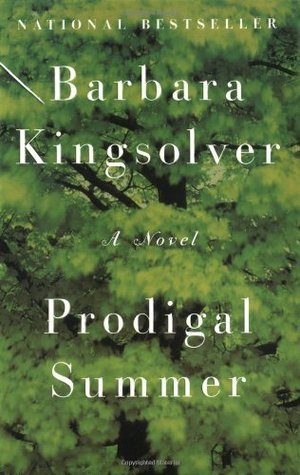 Although I remembered this as being in Kingsolver’s top tier of novels, I recalled no details beyond a female ranger who lives in the woods, has an affair with a hunter, and studies coyotes (actually, I thought it was wolves – I was conflating Deanna’s surname, Wolfe, and Sarah Hall’s The Wolf Border, which has a similar setup). I’d forgotten that there are two other strands: Lusa, a Polish-Palestinian entomologist widowed young, inherits her husband’s family farm and tries to make a go of goat breeding despite others’ disapproval; and Garnett, a pious old man trying to resurrect the American chestnut after it was wiped out by blight, has an ongoing low-key feud with his organic orchard-keeping neighbour, Nannie. These threads rotate under the headings “Predators,” “Moth Love,” and “Old Chestnuts.” There are pleasing connections between the main characters, who are also thematically linked by ideological disagreements and the possibility of new life and romance when age or circumstances seemed to disqualify them. Kingsolver writes brilliantly about science, and although she gets a little preachy through Nannie, in a way that presages Unsheltered (“It’s glory, to be part of a bigger something. The glory of an evolving world”), her environmentalist messages are always right on. It’s depressing to note that, more than a quarter-century later, the issues she raises related to food production and pesticide use are worse rather than better. Like Margaret Atwood, she’s a literary prophet of our time. I’m nearly halfway through her upcoming novel, Partita, for a Shelf Awareness review and its protagonist, Livia, seems to be in the lineage of Deanna – an Appalachian girl who tries to exceed her origins. This was a big ol’ satisfying summer read. Whyever didn’t Kingsolver win the Women’s Prize for this one? (Little Free Library)
My original rating: 
My rating now: 
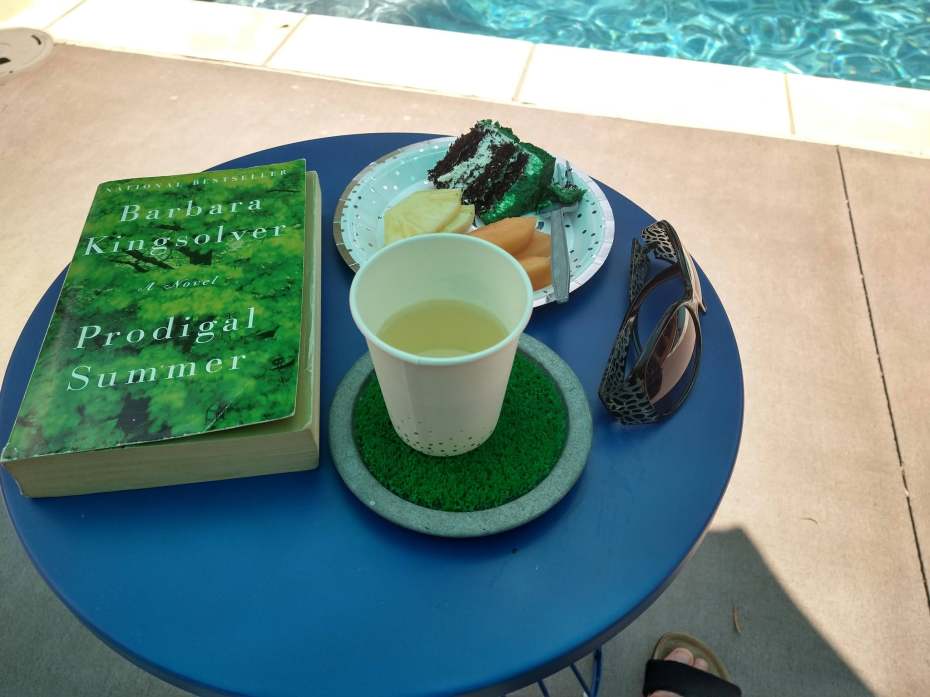
Poolside reading at my nephew’s graduation party.
The Vanishing Act of Esme Lennox by Maggie O’Farrell (2006)
Nothing is our own. We begin in the world as anagrams of our antecedents.
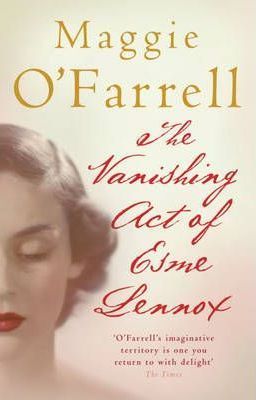 Another reread. I remembered the mental hospital element but think I may have otherwise had this confused with Sebastian Barry’s The Secret Scripture, which also features historical family secrets and a great big twist. This was our book club selection for June, and although I missed the meeting (which was also our summer social) while I was back visiting my family, I wanted to catch up by reading it again – especially after it earned a perfect score from the rest of the group! In the novel’s present day, vintage clothing store owner Iris is having an affair with a married man and learns that she has a ‘mad’ great-aunt who will soon be her responsibility when the hospital Esme has called home for 60 years closes. Why did Iris’s grandmother, Kitty, hide that she had a sister? With Kitty on a dementia ward, she can’t ask outright. Instead, narration alternates between the sisters’ growing-up years in India and Edinburgh – where flighty, rebellious Esme caught boys’ eyes while obedient Kitty didn’t – and Iris and Esme embarking on a tentative relationship. The use of the present tense for both, as well as the fragments of memory we gradually work out are Kitty’s, create a continuous narrative so gripping that I could easily have consumed it in one sitting had I not had other commitments. Grief, parenting, male privilege, family legacies, and a freedom of spirit that might today be branded neurodivergence are strong elements. It’s appalling how women have been punished for breaking the rules, but the other ensuing betrayals are just as shocking. This must have one of THE best surprise endings out there. I can’t believe I’d forgotten the details. After a couple of lacklustre early novels, O’Farrell’s career truly took off with this one. Now to reread her other gems. (Borrowed from a book club friend)
My original rating:
My rating now: 
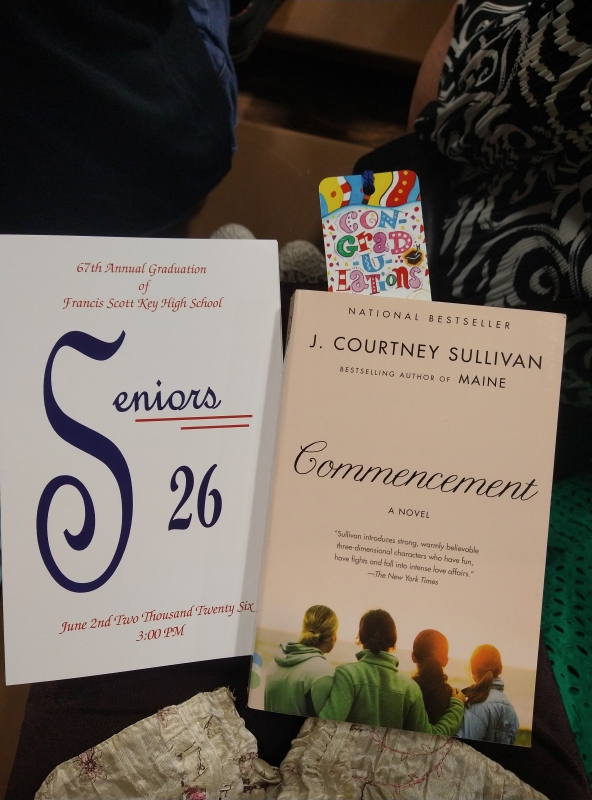
Commencement by J. Courtney Sullivan (2009)
Smith had left its mark on her, so that the place would always feel like home
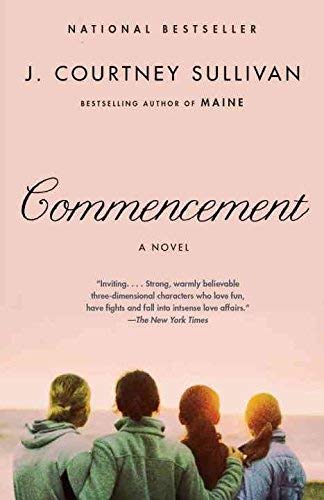 I’ve had a mixed experience with Sullivan’s novels, but this debut was a delight. Let’s start with the clever title: An American graduation ceremony is called “commencement,” so it marks both an ending and a beginning. For four friends who meet at Smith College, a women-only institution, in the late 1990s, their student experiences have effects that carry on into their ‘real’ lives afterwards. We watch how their relationships with each other, and with family members and partners, shift over the course of nearly a decade. Sally arrives on campus bereft from the death of her mother, but she doesn’t let her sadness corrode her ambition or her kind heart. Bree is engaged to a man when she comes up from Savannah but leaves in a committed relationship with a woman. April was raised by a single mother and has always been a strident feminist, but graduates with plans to go to extremes in drawing attention to the plight of sex workers. The framing story of the friends gathering for Sally’s wedding introduces us first to Celia, who is in some sense still living the student life in the small New York City apartment she brings one-night stands back to after drunken evenings. The wedding ends up in a huge fight between the four, and as the years pass they split off into pairs and trios of loyalty before a crisis brings them back together. It’s a little far-fetched how this all plays out, but I was invested enough in all four characters that I was happy to go along with it. Sullivan went to Smith (I also attended what was a women’s college at the time, Hood), so you have to wonder if anything was autobiographical for her. She weaves in various women’s issues, such as sexual assault and decisions about career and motherhood. I applaud Sullivan for mentioning support for trans men on campus, though her discussion does seem of its time and today I think the debate would be more around allowing trans women to attend. I chose this to read because my recent USA trip was for my nephew’s high school graduation. It’s perfect for Curtis Sittenfeld fans. (Secondhand purchase – 2nd & Charles)
Some Bookish Pet Peeves
 Happy Feast of the Inauguration!
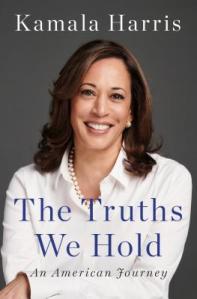
This is a feast day we made up simply because 2021 needs as many excuses for celebration as it can get. (Our next one will be in mid-February: Victoriana Fest, to celebrate the birthdays of a few of our Victorian heroes – Charles Darwin, Charles Dickens, and Abraham Lincoln. Expect traditional, stodgy foods.) Later tonight we’ll be having an all-American menu of veggie burgers, sweet potato fries, random Californian beers we found at Waitrose, and pecan pie with ice cream. And Vice President Kamala Harris’s autobiography is on hold for me at the library to pick up later this month.
Since I still don’t have any new book reviews ready (though I have now finished seven books in 2021, which is something), here’s some more filler content based on annoying book traits I’ve been reminded of recently.
Some of My Bookish Pet Peeves
Long excerpts from other books, in the text or as epigraphs
I often skip these. I am reading this book to hear from you, the author, not the various philosophers and poets you admire. I want to learn from your expertise and thought processes, not someone else’s.
 Exceptions: Tim Dee’s books are good examples since he weaves in copious quotations and allusions while still being eloquent in his own right. Emily Rapp’s The Still Point of the Turning World includes a lot of quotes, especially from poems, but I was okay with that because it was true to her experience of traditional thinking failing her in the face of her son’s impending death. Her two bereavement memoirs are thus almost like commonplace books on grief.
Long passages in italics
I sometimes see these used to indicate flashbacks in historical fiction. They are such a pain to read. I am very likely to skim these sections, or skip them altogether.
An exception: Thus far, the secondary storyline about the mice in The Charmed Wife by Olga Grushin, delivered all in italics, has been more compelling than the main storyline.
Huge jumps forward in time
These generally feel unnatural and sudden. Surely there’s a way to avoid them? And if they are truly necessary, I’d rather they were denoted by a new section with a time/date stamp. I’m not talking about alternating storylines from different time periods, as these are usually well signaled by a change of voice, but, e.g., a chapter picking up 15 years in the future.
Not being upfront about the fact that a book is ghostwritten
I have come to expect ghostwriters for political memoirs (Barack Obama’s being a rare exception), but in the last two years I’ve also come across a botanist’s memoir and a surgeon’s memoir that were ghostwritten but not announced as such – with the former I only found out via the acknowledgments at the end, and with the latter it was hidden away in the copyright information. I’d rather the title page came right out and said “by So and So” with “Ghostwriter Name.” (Anyone know whether Kamala had a ghostwriter?)
Matte covers or dustjackets that show fingerprints
Back in 2017 I wrote a whole post on the physical book features that I love or loathe. It was a good way of eliciting strong opinions from blog readers! (For example, some people hate deckle edge, whereas I love it.)
Something that bothers other readers but doesn’t faze me at all is a lack of speech marks, or the use of alternative indicators like dashes or indented paragraphs. I’m totally used to this in literary fiction. I even kind of like it. I’m also devoted to rarer forms of narration like the second person and the first person plural that might be a turn-off for some.
[Added later]
No, or very few, paragraphs, chapters, or other section breaks
How am I supposed to know where to stop reading and put my bookmark in?!
Whom is dead
Not just in books; in written English in general. And, even if this is inevitable, it still makes me sad.
 Bookish Beck = Rebecca Foster. American transplant to England. Freelance proofreader and book reviewer.
