20 Books of Summer, 12–13: Strange Weather in Tokyo (#WITMonth) & Mitz
Two terrific novellas I’m belatedly writing up today, one my first selection for Women in Translation month and the other a contribution to Virago’s “Summer of Sigrid.” Both: 
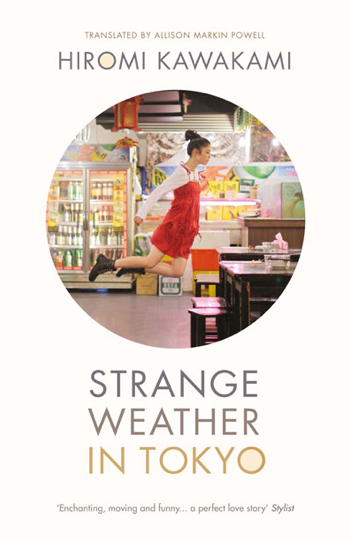
Strange Weather in Tokyo by Hiromi Kawakami (2001; 2012)
[Translated from Japanese by Allison Markin Powell]
 Tsukiko is a lonely barfly in her late thirties when she bumps into her secondary school Japanese teacher, Harutsuna Matsumoto, again. She calls him simply “Sensei,” and they start meeting up for low-key adventures: sharing tofu and saké at Satoru’s bar, marking annual holidays, and leaving the city to forage for mushrooms and visit his late wife’s island grave. Sensei quotes poetry and, ever the teacher, gently corrects his former pupil’s language. Tsukiko is an impassive young woman who never seemed to grow up (“I … still might not be considered a proper adult. … I just wasn’t able to ally myself with time”) and is prone to drinking too much, but finally starts to get a grip on her emotions thanks to this new connection.
Each chapter is discrete, building into a linked short story collection. The erratic (non)use of speech marks somehow didn’t bother me as it seems to suit Tsukiko’s slight disorientation. Kawakami infuses the book with attention to the seasons’ changes and everyday sensual pleasures like food. A drunk at the bar speaks for us readers when he asks the main characters, “You two, just what are you?” The nature of their bond is hard to pin down. Tsukiko is also courted by Kojima, a more age-appropriate boyfriend, but she feels nothing for him. Instead, a May–December relationship unfolds like cherry blossom, ever so gradually, from friendship into something deeper. Powell manages to fit some wordplay into her translation, as in this gently erotic passage:
At some point, sitting beside Sensei, I began to notice the heat that radiated from his body. Through his starched shirt, there came a sense of Sensei. A feeling of nostalgia. This sense of Sensei retained the shape of him. It was dignified, yet tender, like Sensei.
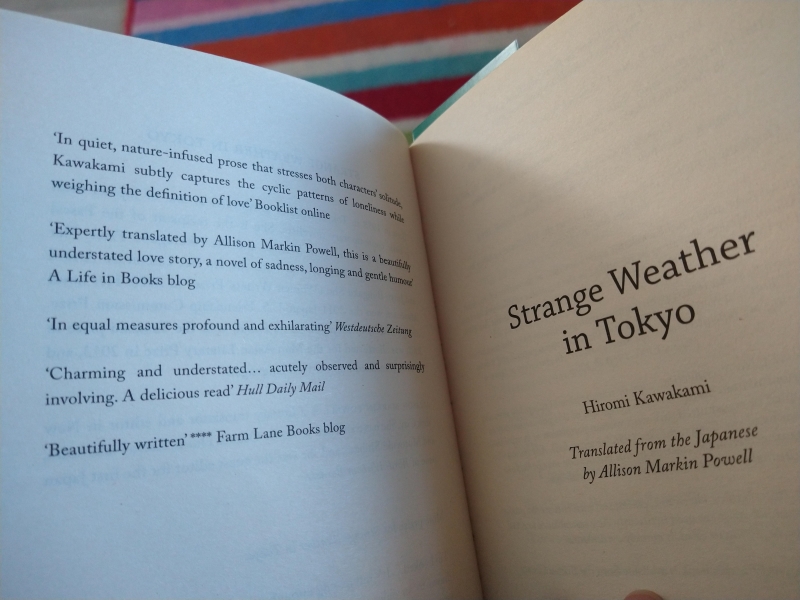
From the title and cover image, I might have expected the magic realism so common to Japanese literature, but this is something different: a lovely, subtle romance. It’s a reminder that it doesn’t have to be torrid passion to be true love. “Even a chance meeting is the result of a karmic connection,” as Sensei quotes. Susan (A life in books), whose review is excerpted in my paperback copy, is quite right. Kawakami was a great new discovery and I’ve got my eye on several more of her books: The Nakano Thrift Shop from the library and Record of a Night Too Brief and Far from Everywhere (forthcoming in February) on my e-reader. (Secondhand – Community Furniture Project, Newbury)
Mitz: The Marmoset of Bloomsbury by Sigrid Nunez (1998)
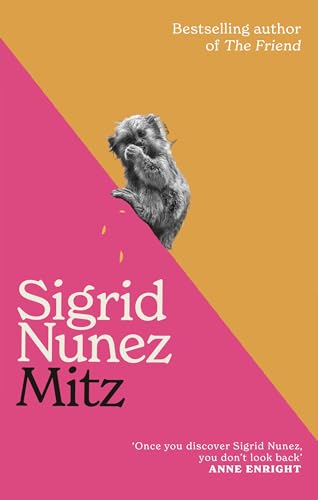 What a fun little book from Nunez’s back catalogue! On the one hand, a fictional mini-biography of the Woolfs by way of their pet marmoset might seem like a random choice of topic; on the other hand, you can see the seeds of her future autofiction in which human–animal connection is a starting point for wide-ranging meditations on life and death (a dog in The Friend; a parrot in The Vulnerables; and even, to a lesser extent, the cat in What Are You Going Through).
Mitz is a small monkey who induces strong, conflicting reactions: “You looked at her and thought, How grotesque. And the very next instant, How adorable. And then, How grotesque, again.” She takes a shine to Leonard on a visit the Woolfs pay to their friends the Rothschilds in 1934, and before long they’ve offered to take Mitz home to share their London and Sussex life, along with Pinka and Sally, the spaniels they had in succession. Mitz’s favourite spot thereafter was sat on Leonard’s shoulders, or napping on his feet. She accompanied the couple on their travels, too, so distracting people in Germany that Virginia would write in a letter that “the marmoset saved us from Hitler” (Leonard was Jewish). Visitors were less enamoured, thinking Mitz dirty and bad-tempered.
In any case, the creature was a lucky accessory to genius, and Nunez makes her our eyewitness to the composition of works such as Roger Fry and The Years:
From a distance, then, Mitz observed Virginia. And she saw how this mysterious activity that could bring such a flush to Virginia’s cheek could also have quite the opposite effect: Virginia was as white as her own writing paper. She scribbled and slashed; she muttered and she groaned and she cursed. She jumped up from the chair and wandered in circles about the room.
How much Mitz understands of ageing, death, and conflict, can never be known. These were tumultuous pre-war years, during which Virginia lost a nephew and fascism loomed large. Nunez sets personal cataclysms against international ones, imagining Mitz’s journey from a Brazilian forest, via a hellish ship, to the London junk shop where she was made to sit in a draughty window to drum up business. That she spent her last five years so loved and cosseted was a stroke of good fortune. Her death ends up feeling like a more general omen, as in the book’s final line: “It was Christmas Day, the last year of peace.”
I was reminded of the complications of keeping an exotic pet in My Animals and Other Family by Julia Blackburn, in which she buys Congo the bushbaby from Harrods (and there is also a family spaniel). As part of the backmatter of this reissue, a thank-you letter from Nigel Nicolson to Nunez and a 2019 afterword by Peter Cameron note the undeniable inspiration of Virginia Woolf’s Flush, a playful short biography of Elizabeth Barrett Browning’s cocker spaniel (for whom Pinka, a gift from Vita Sackville-West, was a model). I fancied rereading Flush so have picked that up as one of my substitute Books of Summer and am enjoying discovering the connections between it and Mitz. More anon.
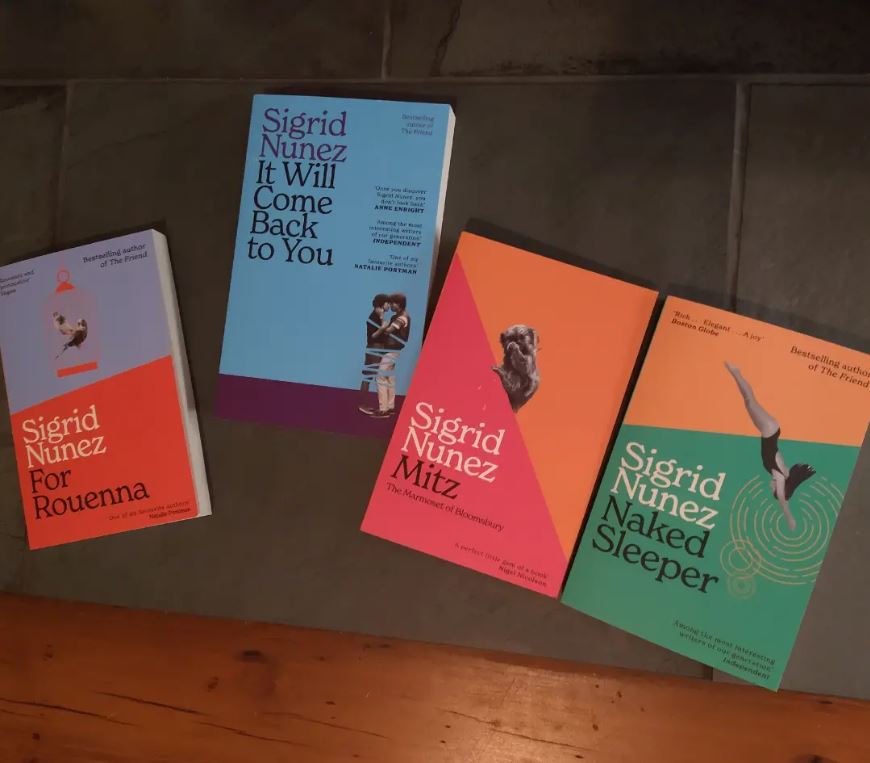
With thanks to Virago for the free copy for review, one of several matching reissues they sent me as part of their “Summer of Sigrid.”
Summer Reads, Part I: Buti, Ellis, C. Foster (Reread), Itami, Thomson
The less said about the summer of 2026, the better. It feels like the heat wave will never end. We’ve had 4 mm of rain the whole month. Drought imperils so much. But it’s not right to complain when wildfires rage not so far away. One glance at the news headlines and there’s no avoiding the signs of climate breakdown everywhere. I can’t bear it. I just keep reading.
Year of the Drought by Roland Buti (2015; 2017)
[Translated from French by Charlotte Mandell]
How exhausting was that summer of 1976, always beating down on our heads!
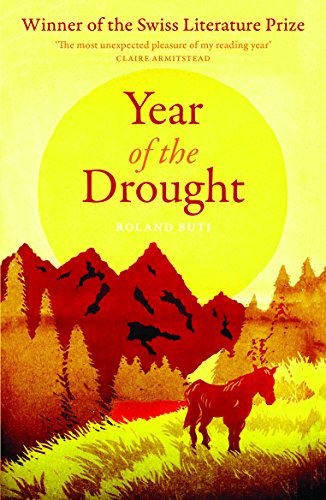 This Swiss novella takes place during the infamous European heat wave that people still talk about half a century later. It’s a perfect febrile setting for 13-year-old Gus’s coming-of-age, which includes a sexual awakening and the dawning realisation that his parents aren’t perfect; that in fact his family is falling apart. The Sutters’ operations embody the move from family smallholding to an industrial model. They keep a small number of cattle but are also experimenting with large-scale henhouses holding thousands of birds. In contrast with that vast flock, about whose welfare the characters seem indifferent, is an injured white dove that Gus finds and keeps as a pet. (A wise choice by Buti: it’s easier to feel compassion for an individual, such as the dove or the old farm horse, Bagatelle, than for a faceless mass.) Helping Gus and his father on the farm is distant cousin Rudy, who has Down’s syndrome; disrupting their routines is Cécile, Gus’s mother’s friend, who has come to stay with them.
Because of the drought, our minds were full of dreams of coolness and moisture
Dreams of rain, dreams of love, dreams of preserving some mythical family happiness that maybe never existed. Like the weather, everything goes wrong – in tragic ways. It’s all so awful I recoiled. Buti jumps ahead several decades to offer a longer view of the land, but I couldn’t ignore how casually the teenage Gus adopted his father’s violent, misogynistic ways. None of what happens bodes well for the future. The one laugh I got out of the experience was the charity shop accidentally labelling the book “Romance fiction.” (Secondhand – BHF, Newbury) 
Book 1 of The Summerhouse Trilogy
The Clothes in the Wardrobe by Alice Thomas Ellis (1987)
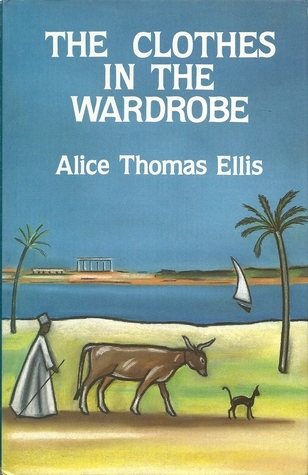 I hadn’t had great luck with Ellis, fiction and nonfiction, before, but I’m so glad I was tempted by this omnibus edition and tried her again. This melancholy, introspective novella was right up my street. Margaret’s yearning for her Egyptian upbringing isn’t the only reason I reached for Moon Tiger as a readalike; Ellis’s tone reminded me of Barbara Comyns and Penelope Lively for its mix of cynicism and nostalgia. Margaret is soon to marry Sylvester, though she doesn’t love him at all and he’s closer to her mother’s age as well as a known womanizer. Perhaps the engagement was her mother’s idea more than her own? The title is an apt symbol for living to someone else’s expectations: “my life fitted me as ill as a garment designed for somebody else,” Margaret thinks. It’s no coincidence that she’s to be married in her mother’s old wedding dress. There are also sartorial metaphors around memory (“Did the elderly have minds like old wardrobes stuffed to overflowing…”) and resistance to ageing. I marked out so many shrewd observations and witty conversations. I empathized with Margaret’s feeling of being trapped in a life she hasn’t chosen.
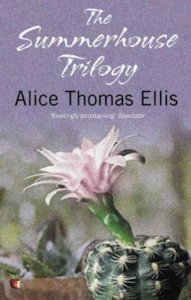 It seems like one of those books where nothing will happen, but there’s actually a surprise ending that looks set to move Margaret onto a different track. As I understand it, the other two volumes repeat the weeks leading up to the wedding from other perspectives: Margaret’s staid mother-in-law-to-be; and her mother’s bohemian friend Lili, who was her bridesmaid back in Egypt and arrives in time to shake things up. I love that premise. The omnibus cover seems random, but the question of whether the cactus in the summerhouse will flower as good luck for the wedding becomes an important plot point. I’ll jump right into Book 2. (Secondhand – Regent Books, Wantage)
The Screaming Sky by Charles Foster (2021)
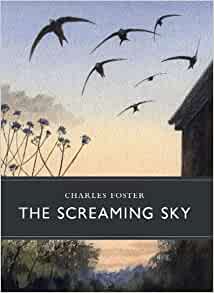 The only thing that has redeemed these dry, scorching days is the swifts screeching across the sky. How can it be that I was once unaware of them? How is it possible for people not to look up for these noisy acrobats whenever they’re outdoors? Somehow, I was oblivious until maybe 10–15 years ago. Now, I always have at least one eye on the sky during these crucial few months. And although this year swifts have been with me since early April (first in Portugal and then in our neighbourhood), I’m already dreading their departure for Africa in a few weeks. They’re still here! I trill to myself each morning. But soon that won’t be true. And with populations in freefall, there may come a day when they don’t return to the UK at all.
Charles Foster is a kindred spirit who sets similar emotional store by the presence or absence of the common swift (Apus apus). I appreciated this when I first read it five years ago (my review), but all the more so now. The monograph takes us through one year with swifts. In the summer, he needs travel no further than his own street in Oxford, but the rest of the time he has to chase them down in continental Europe and central and southern Africa. It’s an old-fashioned quest, a romantic pursuit, a hopeless attempt to keep hold of creatures as fast and elusive as the wind. Foster salts his narrative with all the salient facts but acknowledges that, for all we claim to know about them, these birds retain an essential magic and mystery. “Their power, freedom and joy are the way that everything really is – though we don’t usually see it. It is just that when the swifts scream through the sky, you can’t miss it. That’s how everything, all the time, is meant to be.” (Review copy from Little Toller Books)
My original rating:
My rating now: 
Bonus content:
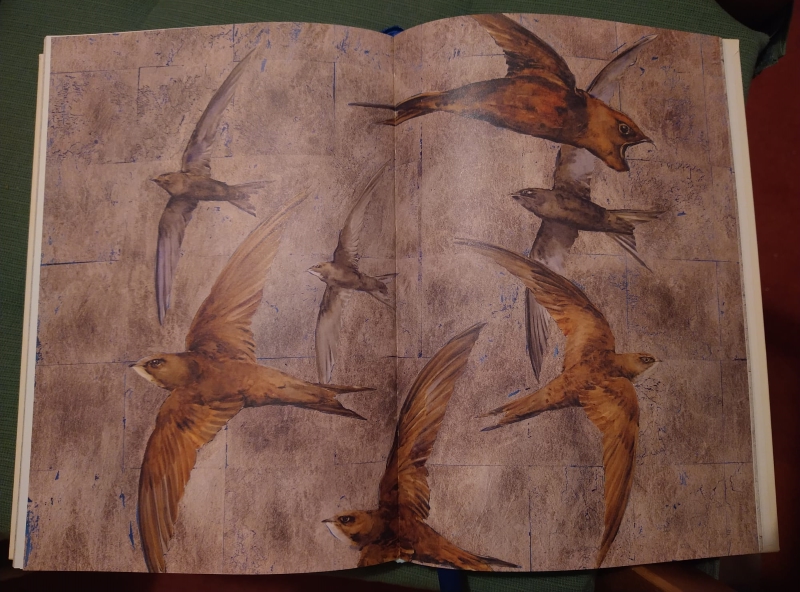
From Robert Macfarlane’s The Book of Birds (illus. Jackie Morris):
From the Spell Songs album Let the Light In: “Swifts”
& My current earworm, also featuring Kris Drever: a more general reassurance – or at least philosophical acceptance – that change is the one constant in life, in perfect pop song form (“Change”)
And from Ugandan poet Nick Makoha’s The New Carthaginians: “in the first part of the night, I saw the coastal villages, men arguing / about the price of oil and swifts darting into shadows.” (from “Codex© of Birds”)
Kakigori Summer by Emily Itami (2025)
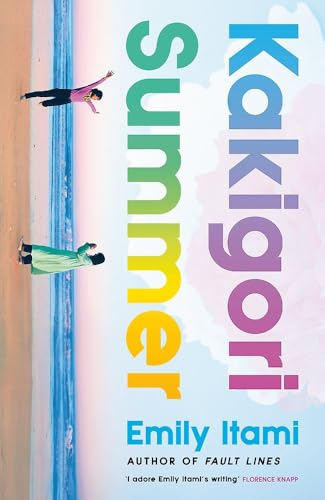 Itami was shortlisted for a Costa Award for her enjoyable 2021 debut, Fault Lines. Kakigori is a flavoured shaved-ice dessert and it’s a great choice of title for this bittersweet – but mostly sweet – story of three sisters raised between Tokyo and London who reunite in Japan to spend a summer together with their prickly great-grandmother, Obaachan, who’s nearing 100. Narration alternates between Rei, the oldest, who has a high-flying finance job and keeps everyone in line; Kiki, who’s a single mother and works in a care home for the elderly; and Ai, a flighty pop star now in disgrace for her affair with a married man. Although there is much joy in their banter, little Hikaru’s antics, and the pursuit of the finest culinary treats, a shadow over it all is their mother’s unexplained death. She went for a swim one day when they were girls and never came back, nor was a body ever found; they have to suspect suicide. (“Well, that’s that, then. Nothing will be all right ever again.”) This easy-reading novel affirms the goodness of life despite the reality of death. Its typically Japanese feasts and funerary rites brought to mind Bryan Washington’s similarly well-balanced Memorial. My only note would be that I’m not sure the voices were distinctive enough to warrant three first-person narrators; third person rotating would probably have done the job. (Public library)
Saltwater: A Midsummer Ghost Story by Elaine Thomson (2026)
“The dead are closer than we think.”
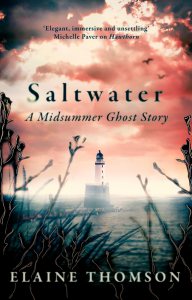 I hadn’t heard of the Scottish island of Stroma, so assumed it was made up. In fact, it’s real, lying between Orkney and the north coast of Caithness on mainland Scotland, but uninhabited as of 1962. Tom Torrance travels by train and boat from Edinburgh a few days before midsummer to oversee the last steps in the construction of the island’s lighthouse and meet with Mr Stevenson (of the famous lighthouse-building clan, which included novelist Robert Louis Stevenson). With him is his brother Jamie; he’s not of much practical help, but they cling to each other because they lost their mother to tuberculosis a week ago. The travelling minister Tom meets on the train gives him a rowan-wood amulet and cautions him that midsummer is a liminal time when the spirit world is close at hand. Tom doesn’t heed the warning. He arrives to find a disaster-prone construction project that has entailed serious injuries and broken machinery. Flora Christie and her grandmother, Thrawn Jean, are local women with healing powers who are treated with suspicion: women, especially those with red hair, are considered bad luck around boats. The men want to seal a “witch bottle” into the wall for good luck. He dismisses their superstitions but at the same time keeps seeing hallucinations of the dead in the waves and on the in-construction edifice. Is it grief, Flora’s special whisky, or a real taste of the supernatural?
This was highly reminiscent of Michelle Paver’s work. The typical Victorian-pastiche ghost story bores me because it’s always just the same: the narrator is a dignified gentleman who can’t possibly be seeing such things, yet documents them and his own horror with great precision. Thomson set herself an interesting challenge, writing a quartet of Scottish ghost stories set at turning points of the year. (This is the second, after Hawthorn.) I probably won’t try the others unless my library acquires them. (Public library) 
(More) Most Anticipated Books for the Second Half of 2026
Yesterday, I reported back on how I’ve done with the 25 Most Anticipated books I chose at the beginning of the year. I have another dozen to add to the list today. These are in release date order by genre, with the UK publication info given first if available. The blurbs are adapted from Goodreads and I’ve taken the liberty of using whichever cover I prefer.
Fiction
 Heartstopper: Volume 6 by Alice Oseman [2 July, Hodder Children’s Books – out now! / July 7, Graphix]: I have simply adored this YA graphic novel series, so much I read it twice. Oseman seems to be having trouble figuring out how to end it, which isn’t surprising given how long it’s been a part of her life and how popular it’s become. “The final installment in the bestselling LGBTQ+ graphic novel series about life, love, and everything that happens in between. Everyone in school knows Nick and Charlie. Everyone knows they’re going to be together forever. But Charlie’s busy with his bid to become head boy. And while Nick is preparing to leave for college, he’s starting to wonder who he’ll be… without Charlie.”
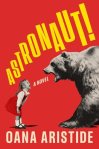 Astronaut! by Oana Aristide [July 14, W. W. Norton & Company; out in the UK from Headline since March, but I missed it!]: I really enjoyed Aristide’s McKitterick Prize-shortlisted debut, Under the Blue, and I wondered if this might be similar to Spaceman of Bohemia. (Nothing to do with astronauts, actually?) “Romania, 1989, the twilight of Ceausescu’s dictatorship: A time when every neighbor, every friend, every family member may be an informant for the regime. When news emerges of a man-eating bear terrorizing the country, two bright lives collide. Constantin, an idealistic police detective [… and] Lia, a rebellious, inquisitive schoolgirl … unwittingly drawn into an elderly neighbor’s secret plot against the regime.” (Edelweiss download)
 The New People by Andrea Uptmor [July 21, Little, Brown]: “A searing and strikingly intimate debut set in the wake of the 2008 financial crisis, about a newly married lesbian couple who move into a flipped foreclosure, unaware that the former homeowners are still living in the attic. … As Rachel immerses herself in her new role as a tenure-track professor and bestselling novelist, adjunct Emma struggles in the shadow of her wife’s success. Desperate to build something of her own, Emma secretly pursues IVF, even as Rachel insists they wait to have children.” This sounds like a fun blend of Leave the World Behind, The Underground Railroad, and Detransition, Baby. (For BookBrowse review)
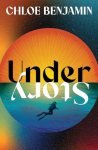 Under Story by Chloe Benjamin [1 Sept., Tinder Press /G.P. Putnam’s Sons]: I loved Benjamin’s previous novel, The Immortalists, which had some speculative/magic realist elements. It looks like she’s now really leaning into the (literary end of) science fiction. This should be a good one to sink into this summer. “Biologist Laurel Salter … works as a dishwasher at McMurdo Station, an isolated research base in Antarctica. … But even in this remote outpost, Laurel can’t outrun her past. … Laurel is captivated by the Arc: its surreal glow; the way it seems almost alive. … Laurel is convinced that the Arc leads down a rabbit hole, and into a world, they can barely imagine. … A breathless page-turner and a love letter to our planet.” (Review copy from publisher)
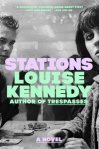 Stations by Louise Kennedy [24 Sept., Bloomsbury Circus / Nov. 3, Riverhead]: I admired Kennedy’s McKitterick Prize-winning debut, Trespasses, very much. “In 1982, Róisín and Red meet as teenagers in their hometown in Ireland. Red’s reputation for trouble might precede him, but Róisín finds in him an intelligent and funny – if unlikely – friend. … As the years pass, they grow up and apart. [… A] devastating story of love and friendship, and the choices we blithely make when we are young, unaware that the consequences will reverberate throughout our lives.” (Edelweiss download)
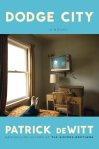 Dodge City by Patrick deWitt [29 Sept., Fourth Estate / Ecco]: DeWitt is reliable for his deadpan humour and quirky plots. “It’s 1967 in Los Angeles and Lee Clarke has received his draft notice, calling him up to fight in the Vietnam War. … He signs up at a drive-away car-delivery service, chancing into a showroom-new Jaguar bound for the East Coast. … In four different towns strung out along the northern United States, Lee visits each member of his immediate family. … An arresting portrait of a country in flux and a family in disarray.” (Edelweiss download)
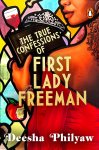 The True Confessions of First Lady Freeman by Deesha Philyaw [29 Sept., Transworld / Mariner Books]: Philyaw’s short story collection, The Secret Lives of Church Ladies, was terrific, and her debut novel sounds like more of the same: (religious) Black women behaving ‘badly’ (make that sexually). “From the moment Scharisse Freeman ditched her humble roots and married a megachurch pastor fifteen years her senior, she’s been labeled too brash and too ‘of the world’ by church folks. … On the eve of her 40th birthday, Schar gets the final bit of validation she’s always dreamt a coveted invitation to participate in the First Lady USA pageant.”
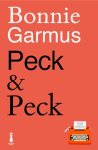 Peck & Peck by Bonnie Garmus [13 Oct., Manila Press / Scribner]: It feels like it’s been a long time (but only four years, actually) since Lessons in Chemistry, which everybody and their aunt’s book club read. “Batter Gray is … in his early twenties, living in New York City, and he wants something different; something that alienates some readers and bores most. Poetry. And yet—to him and exactly thirty-nine editors at a company called Peck & Peck—poetry not only represents the power of humanity but holds the key to its survival. Batter is named after his mother’s heroic dog. An identical twin who lost his brother at birth, he finds himself confronted by the everyday dualities that make up life.” (Edelweiss download)
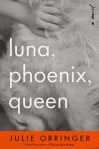 Luna, Phoenix, Queen by Julie Orringer [Oct. 13, Knopf]: Orringer is one of my favourite authors, especially after the brilliance of The Invisible Bridge and The Flight Portfolio. This sounds very different (more like Elizabeth Strout, maybe) but equally good. “Dava and Barr Pennington, professors at a Midwestern university, both harbor potent secrets. [… Dava is] secretly in love with a colleague, Svetlana White; [… and] tests reveal that she’s suffering from early-onset Alzheimer’s. … Soon afterward, her husband, alone in the house at night, discovers her hidden manuscript. … [A] tale of artistic and marital betrayal in a chorus of voices.” (Edelweiss download for Shelf Awareness review)
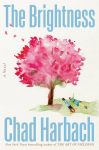 The Brightness by Chad Harbach [27 Oct., Fourth Estate / Little, Brown]: Fifteen years between novels must be some kind of record. Will it be worth the wait?! I read his debut, The Art of Fielding, when it was newly out in 2011, but I reckon I’ll need to reread it before deciding whether to embark on this doorstopper of a sequel. “At 27, Pella’s life looks settled: she’s a recent college graduate, engaged to Mike, her longtime boyfriend, and helping her friend Owen pull off his own destination wedding on Block Island. But over that wild wedding weekend, Pella’s past and present collide spectacularly, blowing up her plans and sending her spiralling toward an unplanned future in New York City.”
Nonfiction
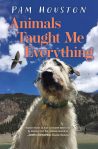 Animals Taught Me Everything by Pam Houston [Oct. 13, Torrey House Press]: Houston is fab in any genre, but I do especially appreciate her writing about nature and her dogs. “From Icelandic mares and Irish wolfhounds to elephants, leopards, hyenas, and a desert-adapted lioness named Charlie, Pam Houston has learned life’s most important lessons from animals. How to play. How to rest. How to love. How to die. How to be present with the dying. How to be present with the living and with the Earth. How to find joy in the least likely places. How to find joy, literally, everywhere. With playful sincerity, Houston finds power and promise in the teachings of our fellow creatures and reminds us that animals are here for us, every day and everywhere.” (Edelweiss download for Shelf Awareness review)
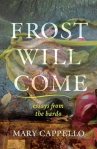 Frost Will Come: Essays from the Bardo by Mary Cappello [Oct. 27, University of Wisconsin Press]: An illness/grief-themed memoir-in-essays = right up my street. “When her octogenarian poet mother was diagnosed with terminal ovarian cancer, Mary Cappello and her wife moved into the living room of Rosemary’s one-bedroom apartment in Philadelphia to help fulfill her wish to live out her life at home. A memoir in the form of lyric essays—with her mother’s own writing interspersed—Frost Will Come is a daughter’s tribute to her mother’s months-long transition from a deeply lived life to a difficult, beautiful, and uneasy death.” (PDF review copy for Shelf Awareness review)
Are any of these calling to you as well?
20 Books of Summer, 4–7: Fadiman; Kingsolver & O’Farrell Rereads; Sullivan
I finished several of these a while ago now, but it’s been a struggle to summon up the motivation to write about them, especially during the heat wave we’re currently experiencing in the southern half of England. You’ve heard a lot from me recently as I’ve been catching up on reviews, so I’ll try to keep these responses to one (long) paragraph each.
Frog and Other Essays by Anne Fadiman (2026)
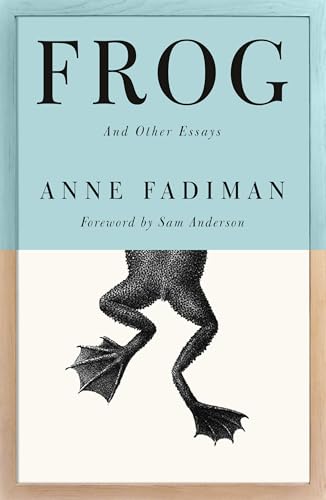 This was one of my Most Anticipated titles of the year because I’ve loved Fadiman’s nonfiction, especially the bookish Ex Libris, which I’ve read twice. Her essays are warm and fluent, braiding memoir and observation in a natural way and drawing readers in whether they share her particular preoccupations or not. “Frog” is about her guilt for not being more attentive to her children’s surprisingly long-lived pet frog, Bunky; “South Polar Times” recounts her obsession with polar exploration and what she discovered in the archives of the magazine Shackleton produced in the 1910s. At the centre of the book is a triptych on modern technology (“My Old Printer”) and language use, especially as she’s experienced it as a Yale professor trying to adjust to pandemic-era teaching (“Screen Share”) and expanded gender possibilities (“All My Pronouns,” which is mostly about getting used to “they” as a singular pronoun for nonbinary individuals). What a relief that advancing age and pedantry didn’t see her joining the anti-woke camp. The final essay, “Yes to Everything,” was – I think – the afterword to her late student Marina Keegan’s The Opposite of Loneliness (2014). For me the highlight was “The Oakling and the Oak,” about Samuel Taylor Coleridge’s disappointing son (“A penumbra of impossible expectation began to settle around Hartley’s head”). There’s a tantalizing parallel here with her own sense of needing to live up to her literary father, Clifton Fadiman, that I wish she’d explored further. So: good stuff here, but only seven essays, all of which were originally published elsewhere. It feels like scraping the barrel. And why the laudatory foreword by someone I’ve never heard of (Sam Anderson)? I ordered this while in the States to get to a free-shipping limit and I’m glad I got the chance to read it, but it’s not a must. Do seek out “Frog” and “Oak,” though. (New purchase – Target.com)
Prodigal Summer by Barbara Kingsolver (2000)
In all her life Lusa had never seen such an oversexed, muggy summer. Just breathing was a torrid proposition.
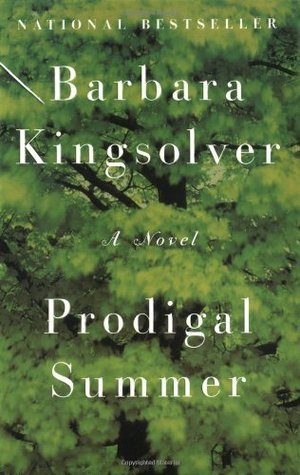 Although I remembered this as being in Kingsolver’s top tier of novels, I recalled no details beyond a female ranger who lives in the woods, has an affair with a hunter, and studies coyotes (actually, I thought it was wolves – I was conflating Deanna’s surname, Wolfe, and Sarah Hall’s The Wolf Border, which has a similar setup). I’d forgotten that there are two other strands: Lusa, a Polish-Palestinian entomologist widowed young, inherits her husband’s family farm and tries to make a go of goat breeding despite others’ disapproval; and Garnett, a pious old man trying to resurrect the American chestnut after it was wiped out by blight, has an ongoing low-key feud with his organic orchard-keeping neighbour, Nannie. These threads rotate under the headings “Predators,” “Moth Love,” and “Old Chestnuts.” There are pleasing connections between the main characters, who are also thematically linked by ideological disagreements and the possibility of new life and romance when age or circumstances seemed to disqualify them. Kingsolver writes brilliantly about science, and although she gets a little preachy through Nannie, in a way that presages Unsheltered (“It’s glory, to be part of a bigger something. The glory of an evolving world”), her environmentalist messages are always right on. It’s depressing to note that, more than a quarter-century later, the issues she raises related to food production and pesticide use are worse rather than better. Like Margaret Atwood, she’s a literary prophet of our time. I’m nearly halfway through her upcoming novel, Partita, for a Shelf Awareness review and its protagonist, Livia, seems to be in the lineage of Deanna – an Appalachian girl who tries to exceed her origins. This was a big ol’ satisfying summer read. Whyever didn’t Kingsolver win the Women’s Prize for this one? (Little Free Library)
My original rating: 
My rating now:
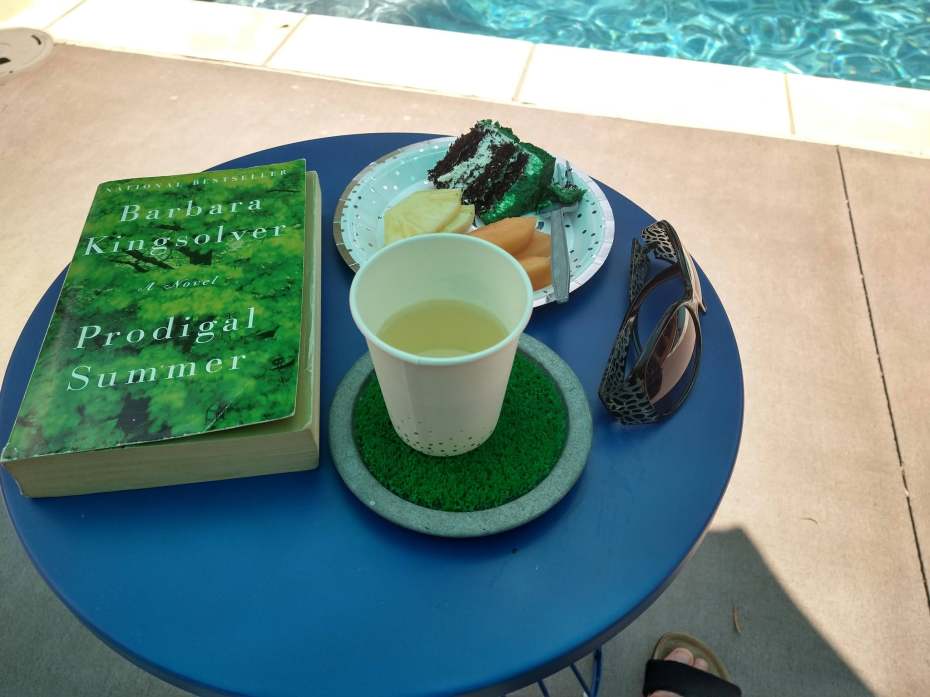
Poolside reading at my nephew’s graduation party.
The Vanishing Act of Esme Lennox by Maggie O’Farrell (2006)
Nothing is our own. We begin in the world as anagrams of our antecedents.
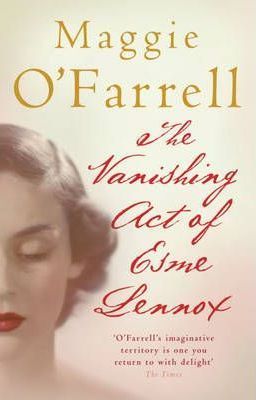 Another reread. I remembered the mental hospital element but think I may have otherwise had this confused with Sebastian Barry’s The Secret Scripture, which also features historical family secrets and a great big twist. This was our book club selection for June, and although I missed the meeting (which was also our summer social) while I was back visiting my family, I wanted to catch up by reading it again – especially after it earned a perfect score from the rest of the group! In the novel’s present day, vintage clothing store owner Iris is having an affair with a married man and learns that she has a ‘mad’ great-aunt who will soon be her responsibility when the hospital Esme has called home for 60 years closes. Why did Iris’s grandmother, Kitty, hide that she had a sister? With Kitty on a dementia ward, she can’t ask outright. Instead, narration alternates between the sisters’ growing-up years in India and Edinburgh – where flighty, rebellious Esme caught boys’ eyes while obedient Kitty didn’t – and Iris and Esme embarking on a tentative relationship. The use of the present tense for both, as well as the fragments of memory we gradually work out are Kitty’s, create a continuous narrative so gripping that I could easily have consumed it in one sitting had I not had other commitments. Grief, parenting, male privilege, family legacies, and a freedom of spirit that might today be branded neurodivergence are strong elements. It’s appalling how women have been punished for breaking the rules, but the other ensuing betrayals are just as shocking. This must have one of THE best surprise endings out there. I can’t believe I’d forgotten the details. After a couple of lacklustre early novels, O’Farrell’s career truly took off with this one. Now to reread her other gems. (Borrowed from a book club friend)
My original rating:
My rating now: 
Commencement by J. Courtney Sullivan (2009)
Smith had left its mark on her, so that the place would always feel like home
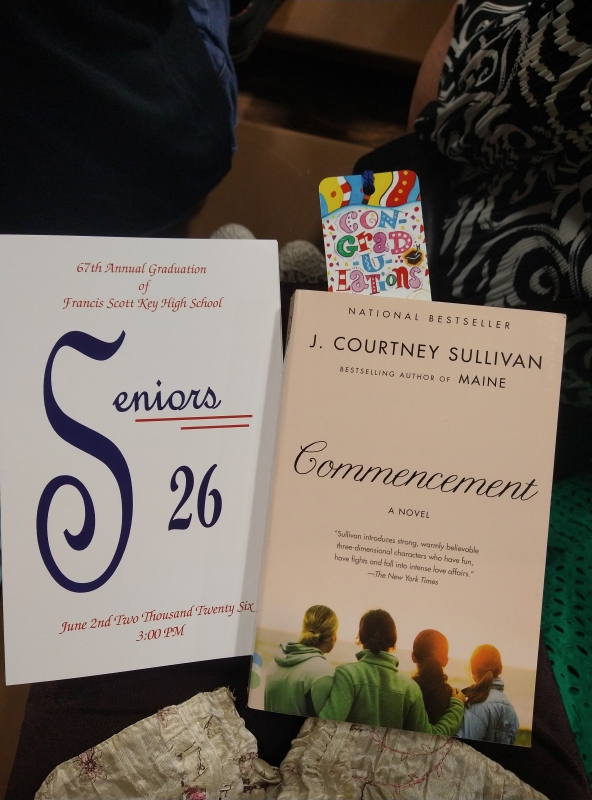
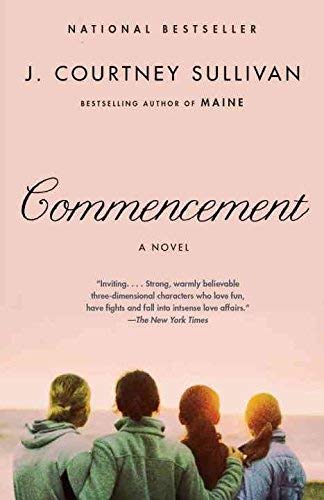 I’ve had a mixed experience with Sullivan’s novels, but this debut was a delight. Let’s start with the clever title: An American graduation ceremony is called “commencement,” so it marks both an ending and a beginning. For four friends who meet at Smith College, a women-only institution, in the late 1990s, their student experiences have effects that carry on into their ‘real’ lives afterwards. We watch how their relationships with each other, and with family members and partners, shift over the course of nearly a decade. Sally arrives on campus bereft from the death of her mother, but she doesn’t let her sadness corrode her ambition or her kind heart. Bree is engaged to a man when she comes up from Savannah but leaves in a committed relationship with a woman. April was raised by a single mother and has always been a strident feminist, but graduates with plans to go to extremes in drawing attention to the plight of sex workers. The framing story of the friends gathering for Sally’s wedding introduces us first to Celia, who is in some sense still living the student life in the small New York City apartment she brings one-night stands back to after drunken evenings. The wedding ends up in a huge fight between the four, and as the years pass they split off into pairs and trios of loyalty before a crisis brings them back together. It’s a little far-fetched how this all plays out, but I was invested enough in all four characters that I was happy to go along with it. Sullivan went to Smith (I also attended what was a women’s college at the time, Hood), so you have to wonder if anything was autobiographical for her. She weaves in various women’s issues, such as sexual assault and decisions about career and motherhood. I applaud Sullivan for mentioning support for trans men on campus, though her discussion does seem of its time and today I think the debate would be more around allowing trans women to attend. I chose this to read because my recent USA trip was for my nephew’s high school graduation. It’s perfect for Curtis Sittenfeld fans. (Secondhand purchase – 2nd & Charles)
#ReadingtheMeow2026, Part II: George Mikes & Louise Ross Memoirs; Letters of Note: Cats
I’m a few days late with this second batch (after my first post on some Chinese and Japanese cat books). Thanks again to Mallika of Literary Potpourri for hosting the annual Reading the Meow challenge, which is always a great excuse for me to get to a handful of the many cat books on my shelves and e-readers.
Tsi-Tsa by George Mikes; illus. Nicholas Bentley (1978)
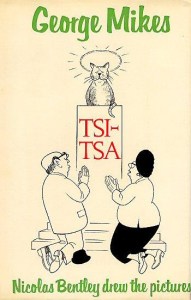 Mikes wasn’t an animal lover at all, but when Tsi-Tsa (from the Hungarian cica, which means pussycat) started turning up in his London house, he finally got it. “A man who had made fun of British cat-worship for several decades, I fell for Tsi-Tsa in the grand way – at first without even noticing it,” he writes. She was actually Sooty, his neighbour’s cat, but so determinedly adopted Mikes – sleeping on his chest, with her right paw on his left shoulder – that her owner told him he could have the cat. His transformation into an ailurophile was soon complete: “The days when I thought that all cats were alike – that a cat was a cat was a cat – have long passed. … By now I am fully aware that cats differ from one another as significantly – and are as much individuals – as humans, or more so.”
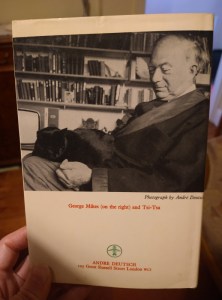 Most of the book is devoted to two crises: his diagnosis of impending blindness, and Tsi-Tsa going missing. If you’re wary of cat memoirs because the pet tends to die at the end, you needn’t worry. This ‘biography’ of Tsi-Tsa ends with her very much alive, having learned to adjust to her physical limitations after being hit by a car. I’ve read several of Mikes’s books, including the trilogy of satirical expat advice books that make up How to Be a Brit. This is similarly light-hearted, if a little insubstantial. If you’ve enjoyed books by Derek Tangye and Doreen Tovey, you’ll find it comparable. (Secondhand – Addymans bargain alley, Hay-on-Wye)
And another novella-length memoir about a black cat that makes itself at home and becomes part of the family!
Slow Blink: A Memoir by Louise Ross (2026)
A 1927 book found on her elderly father’s bookshelf, the poetry collection archy and mehitabel by Don Marquis, sparked Ross’s journey into memory for a look at two very special cats. In Marquis’ book, Archy the cockroach was a human poet in a previous life, while Mehitabel the alley cat was Cleopatra. Ross’s family thus gave to one of their cats the noble name of Mehitabel, and she became the girl’s best buddy as she was growing up in Australia. It became a nightly ritual: her mother would put the cat outside, Mehitabel cried underneath Ross’s window, which she opened to let the cat sneak in and share her bed. In the morning, back out Mehitabel would hop, dashing round to the laundry room yard to pretend she’d been outside all night. Boarding school, early career and travels drove the friends apart somewhat before Mehitabel died at the venerable age of 22.
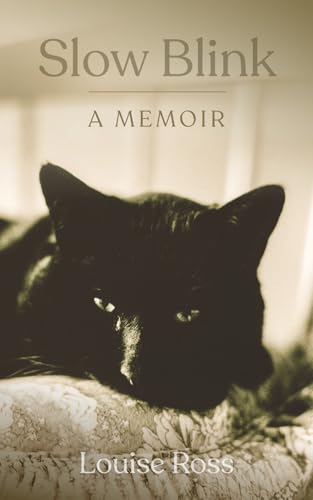 Eight years later, Ross was living in Colorado with her husband and struck up a friendship with a stray black cat who hung out by the bins of their townhouse complex. Eventually he came to trust her and even to shelter indoors from harsh winter weather. What name to give him? Archy, of course. He survived their landlord’s laying down of the law as well as a period of being lost miles away before dying of feline leukaemia. It was only a yearlong relationship in the end, but it had a lasting effect, not least because Ross continued to see Archy after his death. Future losses only reinforced for her the idea that something continues beyond death. “He taught me that some experiences can’t be explained, and that love persists in ways we don’t understand but can, if we’re open and willing, receive.”
While not all pet owners will have experience of such a literal enduring relationship, we can all affirm the strength of the bond with animals, and I also appreciated Ross’s brief (95-page) memoir for its marveling at life’s twists and turns – she now lives in Portugal and has published two volumes of interviews with fellow expatriates and immigrants living there.
With thanks to the author for the free e-copy for review.
Letters of Note: Cats, ed. Shaun Usher (2020)
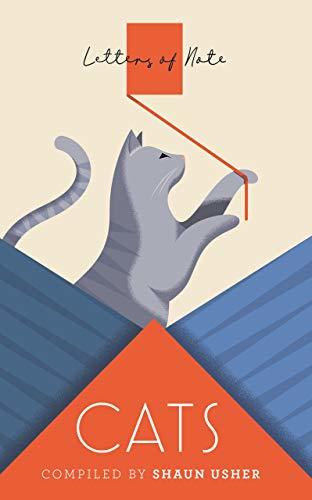 Canongate’s series of short thematic letters anthologies launched in 2013, arising from the website lettersofnote.com. There’s a variety of encounters and experiences here, and the tone ranges from forlorn or silly to outraged. Elizabeth Taylor mourns her missing cat and Jack Kerouac’s mother informs him of the death of his pet. T.S. Eliot tries out the cat-themed nonsense verse he’d become famous for in a birthday note to his godson. Jack Lemmon proposes a cat ranch to his pal Walter Matthau; Erasmus Darwin (grandfather of Charles) and poet Anna Seward exchange slightly saucy ‘love letters’ written in the voices of their cats. Charles Dickens and Jane Carlyle both recount cats’ vendettas against pet canaries.
Some letters are more interesting than others, as you’d expect. There are nice glimpses of cats’ oddities – a reminder that, in many ways, they’re the same across centuries and countries. I was most struck by two entries. One was Adlai Stevenson’s official objection to an Illinois Senate bill proposing owners restrain cats on leashes so they can’t kill birds. “The problem of cat versus bird is as old as time,” he rightly observes, but I can personally attest that leash training works and means our little hunter only kills spiders and houseflies instead of … everything that moves. This environmentalist bill would have been ahead of its time for 1949. The most affecting piece was an open letter by Guy Davenport to the drivers of Lexington, Kentucky, one of whom ran over his cat. It’s a brilliant miniature polemic. This was intermittent entertainment; fun to browse or sample. (Secondhand – hospital book sale)
Four (Almost) One-Sitting Novellas by Blackburn, Murakami, Porter & School of Life (#NovNov25)
I never believe people who say they read 300-page novels in a sitting. How is that possible?! I’m a pretty slow reader, I like to bounce between books rather than read one exclusively, and I often have a hot drink to hand beside my book stack, so I’d need a bathroom break or two. I also have a young cat who doesn’t give me much peace. But 100 pages or thereabouts? I at least have a fighting chance of finishing a novella in one go. Although I haven’t yet achieved a one-sitting read this month, it’s always the goal: to carve out the time and be engrossed such that you just can’t put a book down. I’ll see if I can manage it before November is over.
A couple of longish car rides last weekend gave me the time to read most of three of these, and the next day I popped the other in my purse for a visit to my favourite local coffee shop. I polished them all off later in the week. I have a mini memoir in pets, a surreal Japanese story with illustrations, an innovative modern classic about bereavement, and a set of short essays about money and commodification.
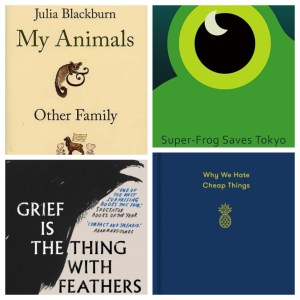
My Animals and Other Family by Julia Blackburn; illus. Herman Makkink (2007)
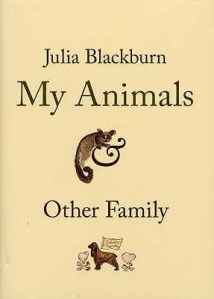 In five short autobiographical essays, Blackburn traces her life with pets and other domestic animals. Guinea pigs taught her the facts of life when she was the pet monitor for her girls’ school – and taught her daughter the reality of death when they moved to the country and Galaxy sired a kingdom of outdoor guinea pigs. They also raised chickens, then adopted two orphaned fox cubs; this did not end well. There are intriguing hints of Blackburn’s childhood family dynamic, which she would later write about in the memoir The Three of Us: Her father was an alcoholic poet and her mother a painter. It was not a happy household and pets provided comfort as well as companionship. “I suppose tropical fish were my religion,” she remarks, remembering all the time she devoted to staring at the aquarium. Jason the spaniel was supposed to keep her safe on walks, but his presence didn’t deter a flasher (her parents’ and a policeman’s reactions to hearing the story are disturbingly blasé). My favourite piece was the first, “A Bushbaby from Harrods”: In the 1950s, the department store had a Zoo that sold exotic pets. Congo the bushbaby did his business all over her family’s flat but still was “the first great love of my life,” Blackburn insists. This was pleasant but won’t stay with me. (New purchase – remainder copy from Hay Cinema Bookshop, 2025) [86 pages]
Super-Frog Saves Tokyo by Haruki Murakami; illus. Seb Agresti and Suzanne Dean (2000, 2001; this edition 2025)
[Translated from Japanese by Jay Rubin]
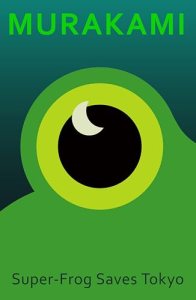 This short story first appeared in English in GQ magazine in 2001 and was then included in Murakami’s collection after the quake, a response to the Kobe earthquake of 1995. “Katigiri found a giant frog waiting for him in his apartment,” it opens. The six-foot amphibian knows that an earthquake will hit Tokyo in three days’ time and wants the middle-aged banker to help him avert disaster by descending into the realm below the bank and doing battle with Worm. Legend has it that the giant worm’s anger causes natural disasters. Katigiri understandably finds it difficult to believe what’s happening, so Frog earns his trust by helping him recover a troublesome loan. Whether Frog is real or not doesn’t seem to matter; either way, imagination saves the city – and Katigiri when he has a medical crisis. I couldn’t help but think of Rachel Ingalls’ Mrs. Caliban (one of my NovNov reads last year). While this has been put together as an appealing standalone volume and was significantly more readable than any of Murakami’s recent novels that I’ve tried, I felt a bit cheated by the it-was-all-just-a-dream motif. (Public library) [86 pages]
Grief Is the Thing with Feathers by Max Porter (2015)
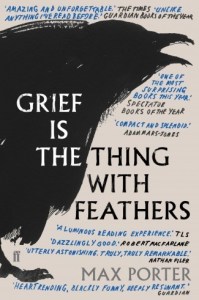 A reread – I reviewed this for Shiny New Books when it first came out and can’t better what I said then. “The novel is composed of three first-person voices: Dad, Boys (sometimes singular and sometimes plural) and Crow. The father and his two young sons are adrift in mourning; the boys’ mum died in an accident in their London flat. The three narratives resemble monologues in a play, with short lines often laid out on the page more like stanzas of a poem than prose paragraphs.” What impressed me most this time was the brilliant mash-up of allusions and genres. The title: Emily Dickinson. The central figure: Ted Hughes’s Crow. The setup: Edgar Allan Poe’s “The Raven” – while he’s grieving his lost love, a man is visited by a black bird that won’t leave until it’s delivered its message. (A raven cronked overhead as I was walking to get my cappuccino.) I was less dazzled by the actual writing, though, apart from a few very strong lines about the nature of loss, e.g. “Moving on, as a concept, is for stupid people, because any sensible person knows grief is a long-term project.” I have a feeling this would be better experienced in other media (such as audio, or the play version). I do still appreciate it as a picture of grief over time, however. Porter won the Sunday Times Young Writer of the Year Award as well as the Dylan Thomas Prize. (Secondhand – Gifted by a friend as part of a trip to Community Furniture Project, Newbury last year; I’d resold my original hardback copy – more fool me!) [114 pages]


My original rating (in 2015): 
My rating now: 
Why We Hate Cheap Things by The School of Life (2017)
 I’m generally a fan of the high-brow self-help books The School of Life produces, but these six micro-essays feel like cast-offs from a larger project. The title essay explores the link between the cost of an item or experience and how much we value it – with reference to pineapples and paintings. The other essays decry the fact that money doesn’t get fairly distributed, such that craftspeople and arts graduates often struggle financially when their work and minds are exactly what we should be valuing as a society. Fair enough … but any suggestions for how to fix the situation?! I’m finding Robin Wall Kimmerer’s The Serviceberry, which is also on a vaguely economic theme, much more engaging and profound. There’s no author listed for this volume, but as The School of Life is Alain de Botton’s brainchild, I’m guessing he had a hand. Perhaps he’s been cancelled? This raises a couple of interesting questions, but overall you’re probably better off spending the time with something more in depth. (Little Free Library) [78 pages]
Six Degrees of Separation: From The Soho Leopard to The Feast
This month we begin with a wildcard selection: the book you finished with last month (or, if you didn’t do an August chain, the last book you’ve read. See Kate’s opening post.) For me that’s Ruth Padel’s poetry collection The Soho Leopard.

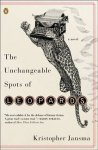 #1 Another “leopard” title I’ve read is The Unchangeable Spots of Leopards by Kristopher Jansma, a fun selection from my 20 Books of Summer in 2019. A linked short story collection with an unreliable narrator, it explores how life becomes fiction and vice versa.
 #2 The typewriter on the cover immediately made me think of Uncommon Type, the short story collection by Tom Hanks. I haven’t read this one and, if I’m honest, don’t ever plan to.
 #3 Tom Hanks features in the delightful story behind the title essay of These Precious Days by Ann Patchett: after Patchett interviewed him on his book tour, she became close with his personal assistant, Sooki Raphael, and ended up having Sooki stay at her Tennessee home during Covid lockdown while Sooki underwent cancer treatment.
 #4 That’s Sooki’s painting of Patchett’s dog Sparky on the cover. Another pet named Sparky adorns Jenny Offill’s charming children’s book about a sloth. I love finding the odd-one-out in an author’s oeuvre, and Sparky is simply darling.
 #5 Was the animal named after the personality trait/failing or the other way around? In any case, Sloth by Wendy Wasserstein is one of three books I happen to have read from the Seven Deadly Sins Series published by Oxford University Press (the others were Lust by Simon Blackburn and Gluttony by Francine Prose; all were, I’m sorry to report, just okay).
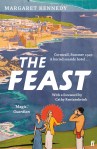 #6 The Seven Deadly Sins provide the metaphorical setup of The Feast by Margaret Kennedy, a rediscovered classic that I read on our trip to Spain in May.
Where will your chain take you? Join us for #6Degrees of Separation! (Hosted on the first Saturday of each month by Kate W. of Books Are My Favourite and Best.) Next month’s starting book is Notes on a Scandal by Zoë Heller.
Have you read any of my selections? Tempted by any you didn’t know before?
 Bookish Beck = Rebecca Foster. American transplant to England. Freelance proofreader and book reviewer.
 Bookish Beck