Love Your Library, September 2025
Thanks, as always, to Eleanor for posting about her recent library reading! And thank you to Skai for joining in again.
Somehow over the summer I forgot to mark two anniversaries: my library’s 25th birthday (July), and five years of me volunteering there (August). When I first started as a volunteer, Covid was still a raging unknown and the library was closed to the public. I shelved returns in an empty building. It was blissful, in all honesty. But I know it’s perverse to be nostalgic about the pandemic. I still enjoy my Tuesday morning sessions of hunting for reservations, even when it’s (too) busy and noisy during the school holidays.
Early in the month, my husband and I went to an evening event at the library with Jasper Fforde. C is a fan, having read five of his novels, whereas I read The Eyre Affair during graduate school and found it silly – in the same way I can’t really get on with Douglas Adams or Terry Pratchett. But with tickets just £5, I thought why not go and support the library.
Fforde considers himself an “accidental author” for two reasons: one, he was seen as a stupid child who would never achieve anything – his dyslexia wasn’t diagnosed until he was in his fifties; and two, he wanted to work on films, and indeed did for a time. In 1988 he sat down to write a short story treatment of his intended film script and fell in love with the process of writing. He described it as being like a jigsaw where the words just fell into place. Thirteen years of hard work later, he made the New York Times bestseller list.
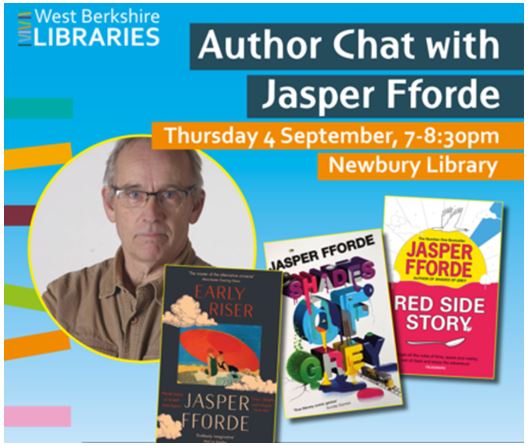
I didn’t realize that Fforde has lived fairly locally and set novels in Reading and Swindon – comic in itself because these are very unlovely towns. His first two series, nursery rhyme crime novels and the Thursday Next books (the eighth and last, Dark Reading Matter, is due out in September 2026), were about “moving the furniture around in people’s heads,” taking existing classic stories and twisting them. When he tried making things up, as with the Shades of Grey and Red Side Story duology and The Last Dragonslayer children’s books, the results were not as commercially successful. During the question time he reflected on the irony of his book getting confused with the blockbuster Fifty Shades of Grey. He joked that some probably bought his book by mistake and then wondered where the bondage was.
The evening was a conversation with the library staff member who seems to organise all the events. She asked him a lot of questions about his process. He listed a few tenets he lives by: “the narrative dare” (come up with a random idea and then figure out how to pull it off), “the path less-trodden,” and “the no-plan plan” (he makes it up as he goes along). His mind works like a drift net, he said, saving bits and pieces up to use another time, such as snippets of conversation overheard on a bus. For instance, “Oh my goodness, they’ve trodden on the gibbon!” and “They say haddock is making a comeback.” He also leaves himself “off-ramps” he can take up later if he ends up writing a sequel.
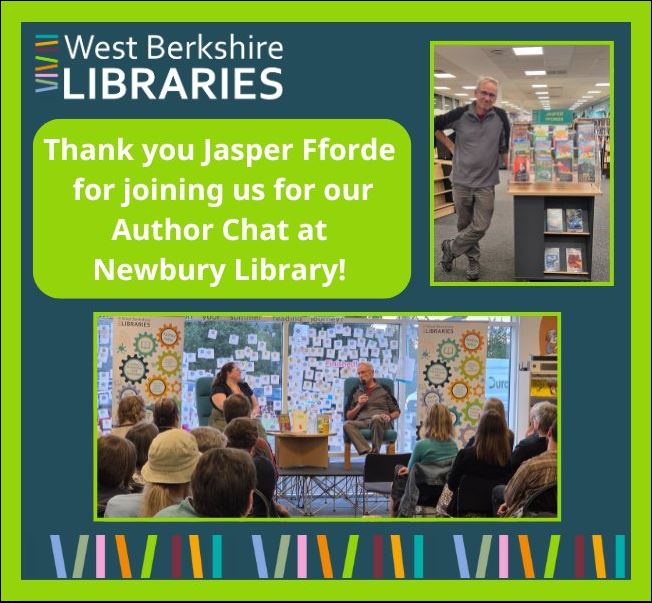
(C is at the bottom right of the second photo.)
Fforde was very personable and self-deprecating and I got more out of the event than I might have expected to.
My library use over the last month:
(links are to books not already reviewed on the blog)
READ
- The Most by Jessica Anthony

- Sojourn by Amit Chaudhuri

- The Wedding People by Alison Espach
- Of All that Ends, Günter Grass

- The Summer I Turned Pretty by Jenny Han

- Seascraper by Benjamin Wood

SKIMMED
- Wild City by Ben Hoare
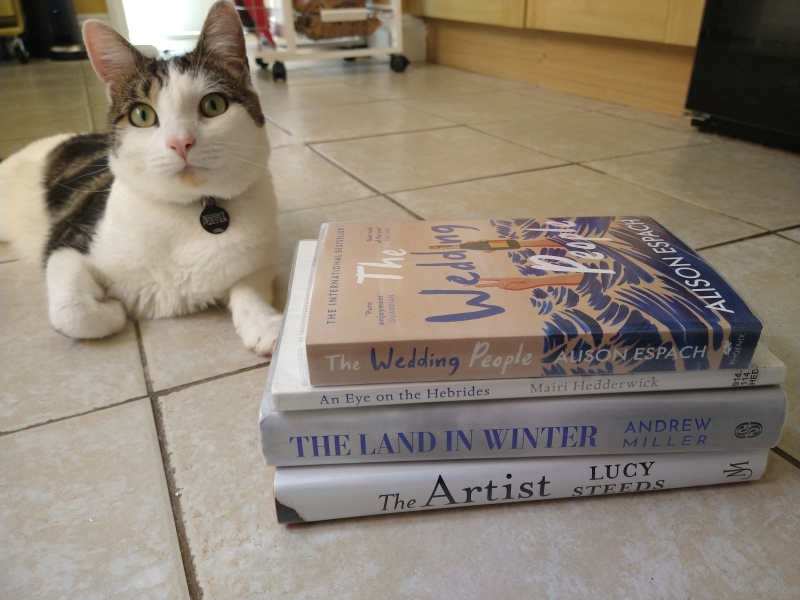
- The Land in Winter by Andrew Miller – The chilly writing and atmosphere suit the subject matter, but didn’t draw me in or make me care about the central characters.
- Cuddy by Benjamin Myers (for book club)
CURRENTLY READING
- Kairos by Jenny Erpenbeck
- Of Thorn & Briar: A Year with the West Country Hedgelayer by Paul Lamb
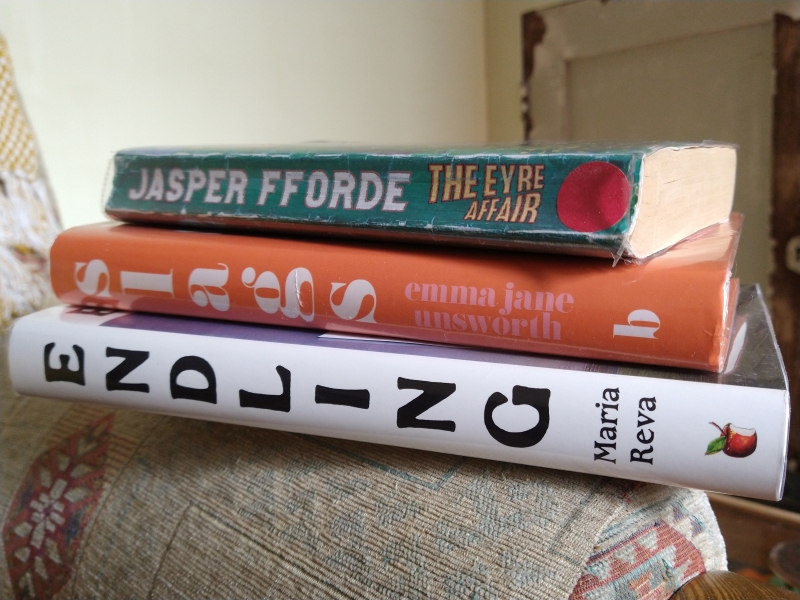
- Endling by Maria Reva
CHECKED OUT, TO BE READ
- The Penelopiad by Margaret Atwood (for book club)
- Red Pockets: An Offering by Alice Mah
- Death in Venice and Other Stories by Thomas Mann
- Opt Out by Carolina Setterwall
- Slags by Emma Jane Unsworth
ON HOLD, TO BE COLLECTED
- The Two Roberts by Damian Barr
- All the Way to the River by Elizabeth Gilbert
- The Haunted Wood: A History of Childhood Reading by Sam Leith
- Buckeye by Patrick Ryan
- A Long Winter by Colm Tóibín
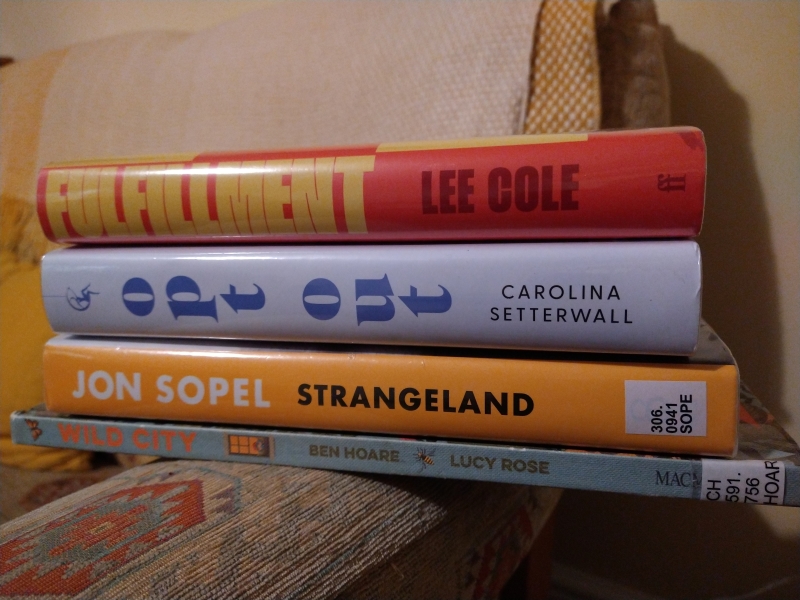
C will read the Sopel for book club, but I have to miss that meeting for a Repair Cafe committee meeting.
IN THE RESERVATION QUEUE
- New Cemetery by Simon Armitage
- Book of Lives: A Memoir of Sorts by Margaret Atwood
- It’s Not a Bloody Trend: Understanding Life as an ADHD Adult by Kat Brown
- Flashlight by Susan Choi
- The Perimenopause Survival Guide: A Feel-Like-Yourself-Again Roadmap for Every Woman over 35 by Heather Hirsch
- Queen Esther by John Irving
- The Matchbox Girl by Alice Jolly
- Heart the Lover by Lily King
- Misery by Stephen King
- The Rest of Our Lives by Benjamin Markovits
- What We Can Know by Ian McEwan
- The Eights by Joanna Miller
- Mexican Gothic by Silvia Moreno-Garcia
- Super-Frog Saves Tokyo by Haruki Murakami
- Rainforest by Michelle Paver
- Death of an Ordinary Man by Sarah Perry
- The Lamb by Lucy Rose
- Flesh by David Szalay
RETURNED UNREAD
- Fulfillment by Lee Cole – Argh, this keeps being requested off me!
- An Eye on the Hebrides by Mairi Hedderwick
- Love in Five Acts by Daniela Krien
- The Artist by Lucy Steeds
I missed the moment on the last three but may try another time.
- The Eyre Affair by Jasper Fforde – I thought about giving him another try after the event, but … no.
RETURNED UNFINISHED
- The Mermaid Chair by Sue Monk Kidd – I read about 45 pages. The setup was interesting but the narrative voice did not captivate.
- The Names by Florence Knapp – Ditto, but only 25 pages. The writing was just not very good.
What have you been reading or reviewing from the library recently?

Share a link to your own post in the comments. Feel free to use the above image. The hashtag is #LoveYourLibrary.
R.I.P. Reads, Part I: Magrs Buddy Read; Hynes, Johnson, Oates
This is my third year participating in R.I.P. (Readers Imbibing Peril), now in its 15th year. I read my first novel by Paul Magrs as a buddy read with Liz of Adventures in reading, running and working from home, and coincidentally had Daisy Johnson’s creepy second novel out from the library. Rounding out this first post are a novella by James Hynes and a short story by Joyce Carol Oates, by whom I still haven’t managed to read a whole book. For my planned Part II, I’m working on historical suspense novels by Michelle Paver (a constant on my R.I.P. lists, it seems) and Laura Purcell, and trying my first Henning Mankell.

666 Charing Cross Road by Paul Magrs (2011)
 Apart from Dracula, my only previous experience of vampire novels was Deborah Harkness’s books. My first book from Paul Magrs ended up being a great choice because it’s pretty lighthearted and as much about the love of books as it is about supernatural fantasy – think of a cross between Jasper Fforde and Neil Gaiman. The title is a tongue-in-cheek nod to Helene Hanff’s memoir, 84 Charing Cross Road. Like Hanff, Aunt Liza sends letters and money to a London bookstore in exchange for books that suit her tastes. A publisher’s reader in New York City, Liza has to read new stuff for work but not-so-secretly prefers old books, especially about the paranormal – a love she shares with her gay bookseller friend, Jack.
One day the bookstore (actual address: 66b) sends a gruesome treasure, a grimoire soaked in vampire blood. In the wrong hands, it returns the vampiric spirit to life and sets off a chain reaction as each victim bites and infects others. I couldn’t help but think of the pandemic; indeed, Magrs uses the word “disease” at one point. Vampirism always has erotic overtones, though, making it seem more like an STD. As it happens, the vampires’ New York leader is Liza’s niece Shelley’s boyfriend, Daniel. Meanwhile, the star exhibit at the Museum of Outsider Art where Shelley works, a Scottish Bride effigy nicknamed Bessie, has come to life. Bessie leads Liza and Jack to London in the fight against Daniel and his kind.
Set between Halloween and Christmas, this is a pacy and quick-witted story that is easy to follow even as it gets more complicated and adds in ever more secondary characters. Hints about Liza’s past experience of the supernatural and an open ending leave room for a prequel or sequel. There were a few melodramatic moments and I wasn’t always convinced by Liza’s New Yawk accent. (I also wanted to stick up for Liza and another character about her age, Consuela – Magrs often refers to one or both as “the old woman,” when in the context they can’t be far past 60!) But these are minor niggles about a book that was so much fun to read. I’ll try something else by Magrs, probably Exchange and/or one of the Brenda and Effie series – who could resist that premise of the Bride of Frankenstein running a B&B in Whitby? (See also Liz’s review.)
My rating: 
The rest…
Queen of the Jungle (from Publish and Perish: Three Tales of Tenure and Terror) by James Hynes (1997)
 I read the first of this volume’s three suspense novellas and will save the others for future years of R.I.P. or Novellas in November. At 95 pages, it feels like a complete, stand-alone plot with solid character development and a believable arc. Paul and Elizabeth are academics marooned at different colleges: Paul is finishing up his postdoc and teaches menial classes at an English department in Iowa, where they live; Elizabeth commutes long-distance to spend four days a week in Chicago, where she’s on track for early tenure at the university.
The couple’s cat, Charlotte, starts acting up, peeing in random places around the apartment. The animal psychic they hire says it’s because a woman keeps coming and going, disturbing the cat’s routines. Elizabeth assumes it’s her fault, feels terrible, and redoubles her efforts to get her boss to offer Paul a job on the basis of his bizarre literary/pop culture mash-up thesis chapters. But readers soon learn the real reason for the cat’s unease: Paul is carrying on an affair with Kymberly, a graduate student from the communications department. Charlotte is preternaturally determined to terrorize Kym and broadcast Paul’s secret. It’s an amusing battle of wills that comes to have greater stakes. Mentions of computer and telephone technology made this seem slightly dated, but I liked Hynes’s writing.
My rating:
Sisters by Daisy Johnson (2020)
 Teenagers September and July were born just 10 months apart, with July always in thrall to her older sister. September can pressure her into anything, no matter how risky or painful, in games of “September Says.” But one time things went too far. That was the day they went out to the tennis courts to confront the girls at their Oxford school who had bullied July.
For much of this short novel, Johnson keeps readers guessing about what happened that day and why the girls’ mother, Sheela, took them away to Settle House, her late husband’s family home in the North York Moors. Despite the new setting, July finds it impossible to shrug off her sister’s influence. Their psychic connection is such that she feels she’s losing her own virginity as she watches September have sex with a local boy on the beach. September’s is so much the dominant personality that July admits she feels like no more than “an appendage.”
Emotionally used and physically harmed, July starts to doubt her sanity. This was most evident for me in the scene where she goes up to a soggy-looking wall of Settle House and puts a hand through it, hearing “the rustle and gurgle of motion, the shuttering of thousands of wings.” (Presuming that’s a deliberate word choice and not a typo for shuddering.) Ants start pouring out of the wall, followed by a bird. But when she goes back to look at the wall later that day, it’s intact. I was reminded of The Haunting of Hill House, with its picture of a malevolent house preying on its inhabitants’ fears.

Sisters is a book that depends entirely on its late twist, so I shall say no more. About halfway through, I had a vague idea of what the surprise might be, but convinced myself I was wrong. “What if? … Nah, couldn’t be.” I wonder how early you’ll catch on. I adore the U.S. cover, but the UK cover contains more of a hint. I think I liked Everything Under, Johnson’s Booker-shortlisted debut novel, that little bit more, but my bottom line for that one goes for this, too: “As mesmerizing as it is unsettling.” Johnson is such a talented young author, and she also has the best author photo out there at the moment, a black-and-white image of her reflected in a train window.
My rating: 
“The Woman in the Window” (from Night-Gaunts and Other Tales of Suspense) by Joyce Carol Oates (2018)
 Oates was inspired by Edward Hopper’s 1926 painting, Eleven A.M. (The striking cover image is from a photographic recreation by Richard Tuschman. Very faithful except for the fact that Hopper’s armchair was blue.) A secretary pushing 40 waits in the New York City morning light for her married lover to arrive. She’s tired of him using her and keeps a sharp pair of sewing shears under her seat cushion. We bounce between the two characters’ perspectives as their encounter nears. He’s tempted to strangle her. Will today be that day, or will she have the courage to plunge those shears into his neck before he gets a chance? In this room, it’s always 11 a.m. The tension is well maintained, but the punctuation kind of drove me crazy. I might try the rest of the book next year.
Have you been reading anything fantastical or spooky this October?
Advent Reading: In the Bleak Midwinter by Rachel Mann & More
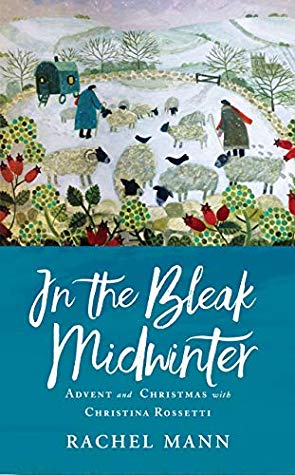
Today marks 189 years since poet Christina Rossetti’s birth in 1830. You could hardly find better reading for Advent than poet–priest Rachel Mann’s new seasonal devotional, In the Bleak Midwinter, which journeys through Advent and the 12 days of Christmas via short essays on about 40 Rossetti poems.
 If your mental picture of Rossetti’s work is, like mine was, limited to twee repetition (“Snow had fallen, snow on snow, / Snow on snow,” as the title carol from 1872 goes), you’ll gain a new appreciation after reading this. Yes, Rossetti’s poetry may strike today’s readers as sentimental, with a bit too much rhyming and overt religion, but it is important to understand it as a product of the Victorian era.
Mann gives equal focus to Rossetti’s techniques and themes. Repetition is indeed one of her main tools, used “to build intensity and rhythm,” and some of her poems are psalm-like in their diction and emotion. I had no idea that Rossetti had written so much – and so much that’s specific to the Christmas season. She has multiple poems entitled “Advent” and “A Christmas Carol” (the technical title of “In the Bleak Midwinter”) or variations thereon.
The book’s commentary spins out the many potential metaphorical connotations of Advent: anticipation, hope, suffering, beginnings versus endings. Mann notes that Rossetti often linked Advent and apocalypse as times of change and preparation. Even as Christians await the birth of Christ, the poet seems to say, they should keep the end of all things in mind. Thus, some of the poems include surprisingly dark or premonitory language:
The days are evil looking back,
The coming days are dim;
Yet count we not His promise slack,
But watch and wait for Him. (from “Advent,” 1858)
Death is better far than birth,
You shall turn again to earth. (from “For Advent”)
 Along with that note of memento mori, Mann suggests other hidden elements of Rossetti’s poetry, like desire (as in the sensual vocabulary of “Goblin Market”) and teasing mystery (“Winter: My Secret,” which reminded me of Emily Dickinson). Not all of her work is devotional or sweet; those who feel overwhelmed or depressed at Christmastime will also find lines that resonate for them here.
Mann helped me to notice Rossetti’s sense of “divine time” that moves in cycles. She also makes a strong case for reading Rossetti to understand how we envision Christmas even now: “In some ways, ‘In the Bleak Midwinter’ offers the acme of our European cultural representations of this season.”
My rating:
With thanks to Canterbury Press for the free copy for review.
(I also reviewed Mann’s poetry collection, A Kingdom of Love, earlier in the year.)
 For December I’m reading Do Nothing, the Advent booklet Stephen Cottrell (now the Bishop of Chelmsford; formerly Bishop of Reading) wrote in 2008 about a minimalist, low-stress approach to the holidays. I have to say, it’s inspiring me to cut way back on card-sending and gift-giving this year.
A few seasonal snippets spotted in my recent reading:
“December darkens and darkens, and the streets sprout forth their Christmas tinsel, and the Salvation Army brass band sings hymns and jingles its bells and stirs up its cauldron of money, and loneliness blows in the snowflurries”
(from The Robber Bride by Margaret Atwood)
“Fine old Christmas, with the snowy hair and ruddy face, had done his duty that year in the noblest fashion, and had set off his rich gifts of warmth and colour with all the heightening contrast of frost and snow.”
(from The Mill on the Floss by George Eliot)
A week to Christmas, cards of snow and holly,
Gimcracks in the shops,
Wishes and memories wrapped in tissue paper,
Trinkets, gadgets and lollipops
And as if through coloured glasses
We remember our childhood’s thrill
… And the feeling that Christmas Day
Was a coral island in time where we land and eat our lotus
But where we can never stay.
(from Autumn Journal by Louis MacNeice)


 I’m always on the lookout for books that seem to fit the season. Here are the piles I’ve amassed for winter (Early Riser imagines a human hibernation system for the winters), Christmas and snow. I’ll dip into these over the next couple of months. I plan to get more “winter,” “snow” and “ice” titles out from the library. Plus I have this review book (at left), newly in paperback, to start soon.
 Bookish Beck = Rebecca Foster. American transplant to England. Freelance proofreader and book reviewer.
 Bookish Beck