Three on a Theme: English Gardeners (Bradbury, Laing and Mabey)
These three 2024 releases share a passion for gardening – but not the old-fashioned model of bending nature to one’s will to create aesthetically pleasing landscapes. Instead, the authors are also concerned with sustainability and want to do the right thing in a time of climate crisis (all three mention the 2022 drought, which saw the first 40 °C day being recorded in the UK). They seek to strike a balance between human interference and letting a site go wild, and they are cognizant of the wider political implications of having a plot of land of one’s own. All three were borrowed from the public library. #LoveYourLibrary
One Garden against the World: In Search of Hope in a Changing Climate by Kate Bradbury
Bradbury is Wildlife Editor of BBC Gardeners’ World Magazine and makes television appearances in the UK. She’s owned her suburban Brighton home for four years and has tried to turn its front and back gardens into havens, however small, for wildlife. The book covers April 2022 to June 2023, spotlighting the drought summer. “It’s about a little garden in south Portslade and one terrified, angry gardener.” Month by month, present-tense chapters form not quite a diary, but a record of what she’s planting, pruning, relocating, and so on. There is also a species profile at the end of each chapter, usually of an insect (as in the latest Dave Goulson book) – she’s especially concerned that she’s seeing fewer, yet she’s worried for local birds, trees and hedgehogs, too.
Often, she takes matters into her own hands. She plucks caterpillars from vegetation in the path of strimmers in the park and raises them at home; protects her garden’s robins from predators and provides enough food so they can nest and raise five fledglings; undertakes to figure out where her pond’s amphibians have come from; rescues hedgehogs; and bravely writes to neighbours who have scaffolding up (for roof repairs, etc.) beseeching them to put up swift boxes while they’re at it. Sometimes it works: a pub being refurbished by new owners happily puts up sparrow boxes when she tells them the birds have always nested in crevices in the building. Sometimes it doesn’t; people ignore her letters and she can’t seem to help but take it personally.
For individuals, it’s all too easy to be overtaken by anxiety, helplessness and despair, and Bradbury acknowledges that collective action and solidarity are vital. “I am reminded, once again, that it’s the community that will save these trees, not me. I’m reminded that community is everything.” She bands together with other environmentally minded people to resist a local development, educate the public about hedgehogs through talks, and oppose “Drone Bastard,” who flies drones at seagulls nesting on rooftops (not strictly illegal; disappointingly, their complaint doesn’t get anywhere with the police, RSPB or RSPCA).

Along the way, there are a few insights into the author’s personal life. She lives with her partner Emma and dog Tosca and accesses wild walks even right on the edge of a city in the Downs. Separate visits to her divorced parents are chances for more nature spotting – in Suffolk to see her father, she hears her first curlew and lapwings – but also involve some sadness, as her mother has aphasia and fatigue after a stroke.
Nearly every day of the chronology seems to bring more bad news for nature. “It’s hard, sometimes,” she admits, “trying to enjoy natural, wonderful events, trying to keep the clawing sense of unease at bay”. She is staunch in her fond stance: “I will love it, with all my heart, whatever has managed to remain, whatever is left.” And she models through her own amazingly biodiverse garden the ways we can extend refuge to other creatures if we throw out that pointless notion of ‘tidiness.’ “The UK’s 30 million gardens represent 30 million opportunities to create green spaces that hold on to water and carbon, create shade, grow food and provide habitats for wildlife that might otherwise not survive.” Reading this made me feel less guilty about the feral tangle of buddleia, ragwort, hemp agrimony and bindweed overtaking the parts of our back garden that aren’t given over to meadow, pond and hedge. Every time I venture back there I see tons of insects and spiders, and that’s all that matters.
My main critique is that one year would have been adequate, cutting the book to 250 pages rather than 300 and ensuring less repetition while still being a representative time period. But Bradbury is impressive for her vigilance and resolve. Some might say that she takes herself and life too seriously, but it’s really more that she’s aware of the scale of destruction already experienced and realistic about what we stand to lose. 
The Garden Against Time: In Search of a Common Paradise by Olivia Laing
I consider Laing one of our most important public thinkers. I saw her introduce the book via the online Edinburgh Book Festival event “In Search of Eden,” in which she appeared on screen and was interviewed by JC Niala. Laing explained that this is not a totally new topic for her as she has been involved in environmental activism and in herbalism. But in 2020, when she and her much older husband bought a house in Suffolk – the first home she has owned after a life of renting – she started restoring its walled garden, which had been created in the 1960s by Mark Rumary. For a year, she watched and waited to see what would happen in the garden, only removing obvious weeds. This coincided with lockdown, so visits to gardens and archives were limited; she focused more on the creation of her own garden and travelling through literature. A two-year diary resulted, in seven notebooks.
Niala observed that the structure of the book, with interludes set in the Suffolk garden, means that the reader has a place to come back to between the deep dives into history. Why make a garden? she asked Laing. Beauty, pleasure, activity: these would be pat answers, Laing insisted. Instead, as with all her books, the reason is the impulse to make complicated structures. Repetitive tasks can be soothing; “the drudgery can be compelling as well.”
Laing spoke of a garden as both refuge and resistance, a mix of wild and cultivated. In this context, Derek Jarman’s Dungeness garden was a “wellspring of inspiration” for her, “a riposte to a toxic atmosphere” of nuclear power and the AIDS crisis (Rumary, like Jarman, was gay). It’s hard to tell where the beach ends and his garden begins, she noted, and she tried to make her garden similarly porous by kicking a hole in the door so frogs could get in. She hopes it will be both vulnerable and robust, a biodiversity hotspot. With Niala, she discussed the idea of a garden as a return to innocence. We have a “tarnished Eden” due to climate change, and we have to do what we can to reverse that.
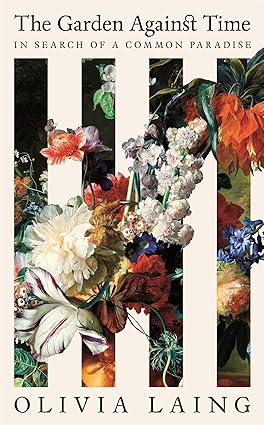
The event was brilliant – just the level of detail I wanted, with Laing flitting between subjects and issuing amazingly intelligent soundbites. The book, though, seemed like page after page about Milton (Paradise Lost) and Iris Origo or the Italian Renaissance. I liked it best when it stayed personal to her family and garden project. There are incredible lyric passages, but just stringing together floral species’ names – though they’re lovely and almost incantatory – isn’t art; it also shuts out those of us who don’t know plants, who aren’t natural gardeners. I wasn’t about to Google every plant I didn’t know (though I did for a few). Also, I have read a lot about Derek Jarman in particular. So my reaction was admiration rather than full engagement, and I only gave the book a light skim in the end. It is striking, though, how she makes this subject political by drawing in equality of access and the climate crisis. (Shortlisted for the Kirkus Prize and the Wainwright Prize.) 
Some memorable lines:
“A garden is a time capsule, as well as a portal out of time.”
“A garden is a balancing act, which can take the form of collaboration or outright war. This tension between the world as it is and the world as humans desire it to be is at the heart of the climate crisis, and as such the garden can be a place of rehearsal too, of experimenting with this relationship in new and perhaps less harmful ways.”
“the garden had become a counter to chaos on a personal as well as a political level”
“the more sinister legacy of Eden: the fantasy of perpetual abundance”
The Accidental Garden: Gardens, Wilderness and the Space in Between by Richard Mabey
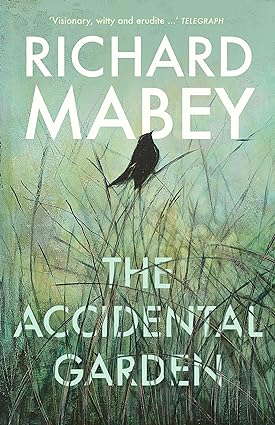 Mabey gives a day-to-day description of a recent year on his two-acre Norfolk property, but also an overview of the past 20 years of change – which of course pretty much always equates to decline. He muses on wildflowers, growing a meadow and hedgerow, bird behaviour, butterfly numbers, and the weather becoming more erratic and extreme. What he sees at home is a reflection of what is going on in the world at large. “It would be glib to suggest that the immeasurably complex problems of a whole world are mirrored in the small confrontations and challenges of the garden. But maybe the mindset needed for both is the same: the generosity to reset the power balance between ourselves and the natural world.” He seeks to create “a fusion garden” of native and immigrant species, trying to intervene as little as possible. The goal is to tend the land responsibly and leave it better off than he found it. As with the Laing, I found many good passages, but overall I felt this was thin – perhaps reflecting his age and loss of mobility – or maybe a swan song. Again, I just skimmed, even though it’s only 160 pages.
Some memorable lines:
“being Earth’s creatures ourselves, we too have a right to a niche. So in our garden we’ve had more modest ambitions, for ‘parallel development’ you might say, and a sense of neighbourliness with our fellow organisms.”
“We feel embattled at times, and that we should try to make some sort of small refuge, a natural oasis.”
“A garden, with its complex interactions between humans and nature, is often seen as a metaphor for the wider world. But if so, is our plot a microcosm of this troubled arena or a refuge from it?”
You might think I would have been more satisfied by Mabey’s contemplative bent, or Laing’s wealth of literary and historical allusions. It turns out that when it comes to gardening, Bradbury’s practical approach was what I was after. But you may gravitate to any of these, depending on whether you want something for the hands, intellect or memory.
Mrs. Shields & Me: (Re)reading Carol Shields in 2020
It’s pure happenstance that I started reading Carol Shields’s work in 2006.

2005: When I first returned to England for my MA program at Leeds, I met a PhD student who was writing a dissertation on contemporary Canadian women writers. At that point I could literally name only one – Margaret Atwood – and I hadn’t even read anything by her yet.
2006: Back in the States after that second year abroad, living with my parents and killing time until my wedding, I got an evening job behind the circulation desk of the local community college library. A colleague passed on four books to me one day. By tying them up in a ribbon, she made a gift out of hand-me-downs: The Giant’s House, The Secret History, and two by Shields: Happenstance and The Stone Diaries. I’ve gone on to read most or all of the books by these authors, so I’m grateful to this acquaintance I’ve since lost touch with.
The inspiration for my post title.
Starting in June this year, I joined Marcie of Buried in Print in reading or rereading six Shields novels. She’s been rereading Shields for many years, and I benefited from her insight and careful attention to connections between the works’ characters and themes during our buddy reads. I’d treated myself to a secondhand book binge in the first lockdown, including copies of three Shields novels I’d not read before. We started with these.
Small Ceremonies (1976)
Shields’s debut ended up being my surprise favorite. A flawless novella, it brings its many elements to a satisfying conclusion and previews the author’s enduring themes in 180 pages. Judith is working on a third biography, of Susanna Moodie, and remembering the recent sabbatical year that she and her husband, a Milton scholar, spent with their two children in Birmingham. High tea is a compensating ritual she imported from a dismal England. She also brought back an idea for a novel. Meanwhile family friend Furlong Eberhardt, author of a string of twee, triumphantly Canadian novels, is casting around for plots.
 What ensues is something of a sly academic comedy à la David Lodge, laced with Shields’s quiet wisdom on marriage, parenting, the writer’s vocation, and the difficulty of ever fully understanding another life. Specific links to her later work include a wonderful dinner party scene with people talking over each other and a craft project.
The Box Garden (1977)
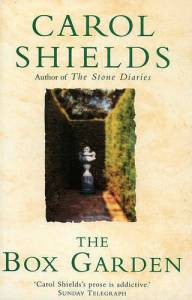 The companion novel to Small Ceremonies is narrated by Judith’s sister Charleen, a poet and single mother who lives in Vancouver and produces the National Botanical Journal. I imagined the sisters representing two facets of Shields, who had previously published poetry and a Moodie biography. Charleen is preparing to travel to Toronto for their 70-year-old mother’s wedding to Louis, an ex-priest. Via flashbacks and excruciating scenes at the family home, we learn how literally and emotionally stingy their mother has always been. If Charleen’s boyfriend Eugene’s motto is to always assume the best of people, her mother’s modus operandi is to assume she’s been hard done by.
The title comes from the time when a faithful Journal correspondent, the mysterious Brother Adam, sent Charleen some grass seed to grow in a window box – a symbol of thriving in spite of restrictive circumstances. I thought the plot went off in a silly direction, but loved the wedding reception. Specific links to Shields’s later work include a botanical hobby, a long train journey, and a final scene delivered entirely in dialogue. 
A Celibate Season (1991)
“We’re suffering a communication gap, that’s obvious.”
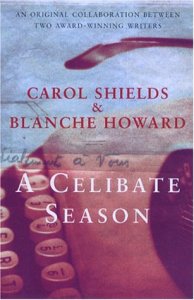 This epistolary novel was a collaboration: Blanche Howard wrote the letters by Jocelyn (“Jock”), who’s gone to Ottawa to be the legal counsel for a commission looking into women’s poverty, while Shields wrote the replies from her husband Charles (“Chas”), an underemployed architect who’s keeping the home fire burning back in Vancouver. He faces challenges large and small: their daughter’s first period versus meal planning (“Found the lentils. Now what?”). The household starts comically expanding to include a housekeeper, Chas’s mother-in-law, a troubled neighbor, and so on.
Both partners see how the other half lives. The misunderstandings between them become worse during their separation. Howard and Shields started writing in 1983, and the book does feel dated; they later threw in a jokey reference to the unreliability of e-mail to explain why the couple are sending letters and faxes. Two unsent letters reveal secrets Jock and Chas are keeping from each other, which felt like cheating. I remained unconvinced that so much could change in 10 months, and the weird nicknames were an issue for me. Plus, arguing about a solarium building project? Talk about First World problems! All the same, the letters are amusing.
Rereads
Happenstance (1980/1982)
 This was the first novel I read by Shields. My Penguin paperback gives the wife’s story first and then you flip it over to read the husband’s story. But the opposite reflects the actual publishing order: Happenstance is Jack’s story; two years later came Brenda’s story in A Fairly Conventional Woman. The obvious inheritor of the pair is A Celibate Season with the dual male/female narratives, and the setups are indeed similar: a man is left at home alone with his teenage kids, having to cope with chores and an unexpected houseguest.
What I remembered beforehand: The wife goes to a quilting conference; an image of a hotel corridor and elevator.
Happenstance
Jack, a museum curator in Chicago, is writing a book about “Indian” trading practices (this isn’t the word we’d use nowadays, but the terminology ends up being important to the plot). He and his best friend Bernie, who’s going through a separation, are obsessed with questions of history: what gets written down, and what it means to have a sense of the past (or not). I loved all the little threads, like Jack’s father’s obsession with self-help books, memories of Brenda’s vivacious single mother, and their neighbor’s failure as Hamlet in a local production. I also enjoyed an epic trek in the snow in a final section potentially modeled on Ulysses. 
A Fairly Conventional Woman
“Aside from quiltmaking, pleasantness was her one talent. … She had come to this awkward age, forty, at an awkward time in history – too soon to be one of the new women, whatever that meant, and too late to be an old-style woman.”
Brenda is in Philadelphia for a quilting conference. Quilting, once just a hobby, is now part of a modern art movement and she earns prizes and hundreds of dollars for her pieces. The hotel is overbooked, overlapping with an International Society of Metallurgists gathering, and both she and Barry from Vancouver, an attractive metallurgist in a pinstriped suit whom she meets in the elevator, are driven from their shared rooms by roommates bringing back one-night stands. This doesn’t add anything to the picture of a marriage in Jack’s story and I only skimmed it this time. It’s a wonder I kept reading Shields after this, but I’m so glad I did! 
I reviewed these last two earlier this year. They were previously my joint favorites of Shields’s work, linked by a gardening hobby, the role of chance, and the unreliability of history and (auto)biography. They remain in my top three.
 The Stone Diaries (1995)
What I remembered beforehand: a long train ride, a friend who by the feeling ‘down there’ thought that someone had had sex with her the night before, and something about the Orkney Islands.
 Larry’s Party (1997)
What I remembered beforehand: a food poisoning incident (though I’d thought it was in one of Shields’s short stories), a climactic event involving a garden maze, a chapter entitled “Larry’s Penis,” and the closing dinner party scene.

Looking back: Fortunately, in the last 15 years I’ve done something to redress my ignorance, discovering Canadian women writers whom I admire greatly: Elizabeth Hay, Margaret Laurence, Mary Lawson and especially Margaret Atwood and Carol Shields.
Looking out: “I am watching. My own life will never be enough for me. It is a congenital condition, my only, only disease in an otherwise lucky life. I am a watcher, an outsider whether I like it or not, and I’m stuck with the dangers that go along with it. And the rewards.”
- That’s Judith on the last page of Small Ceremonies. It’s also probably Shields. And, to an extent, it seems like me. A writer, but mostly a reader, absorbing other lives.
Looking forward: I’m interested in rereading Shields’s short stories and Mary Swann (to be reissued by World Editions in 2021). And, though I’ve read 13 of her books now, there are still plenty of unread, lesser-known ones I’ll have to try to find secondhand one day. Her close attention to ordinary lives and relationships and the way we connect to the past makes her work essential.
Robertson Davies Weekend 2020: The Rebel Angels
Last year for the Robertson Davies readalong, hosted annually by Lory of The Emerald City Book Review, I reviewed Fifth Business, the first volume in The Deptford Trilogy. This time I chose to read the first volume in The Cornish Trilogy, The Rebel Angels (1981). Published 11 years after Fifth Business, it shares a number of that book’s features, including a campus setting and a preoccupation with good and evil. If I can generalize about Davies from having read just two of his books, I would say that his novels engage with philosophy and the Christian tradition, and though he dives into the dark things of life his is an essentially comic vision, giving his work an attractively puckish air.
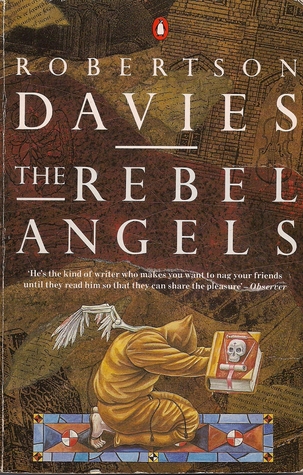 Maria Magdalena Theotoky is a 23-year-old graduate student at the College of St. John and the Holy Ghost (nicknamed “Spook”) in Toronto. She slept with her advisor, Clement Hollier, precisely once in his office last term. Two events spark the plot: the return of Brother John Parlabane, an ex-monk and -drug addict, and the death of Francis Cornish, a local patron of the arts. Parlabane becomes a university parasite, sleeping on couches and hitting up Maria, Hollier and Anglican priest Simon Darcourt for money. Along with Darcourt and Hollier, Urquhart McVarish, Hollier’s lecherous academic rival, is a third co-executor of Cornish’s artworks and manuscripts. Rumor has it the collection includes a lost manuscript by François Rabelais, the subject of Maria’s research, and Hollier and McVarish fight over it.
They also fight over Maria – no fewer than five male characters fall in love with her over the course of the novel. A sort of Helen of Troy (her first names bring to mind the presumed harlot from the Bible, while her surname means “God-bearer”), she is so beautiful that she sows conflict and heartache wherever she goes. Maria narrates about half of the novel – the other half, in alternating chapters, is by Father Darcourt, who’s writing an everyday history of the university inspired by Aubrey’s Brief Lives – and her coming to terms with her Gypsy heritage is a key element: Maria’s mother, Mamusia, is an entertaining character who tells fortunes and administers love potions, but Maria mostly finds her embarrassing.
Gypsy culture recurs in the book. So does poop. Professor Ozias Froats does research into what effect body type (endomorph, mesomorph, ectomorph) has on fecal samples. Rabelais was a notably scatological writer, and Maria’s mother repairs subpar stringed instruments by storing them in barrels of wool and horse dung. Hollier has an academic interest in medieval excrement therapies, and asks to go see Mamusia’s folk remedy in action. I found this strand very amusing, but it’s further evidence that this novel is not for the squeamish – it also includes one of the most hideous murder methods I’ve encountered in fiction, so beware.

Lucifer thrown out of heaven. Gustave Doré’s engraving for Paradise Lost (Public domain).
The title refers to angels thrown out of heaven, and is Maria’s shorthand for the trio of Darcourt, Hollier and Parlabane. Parlabane is explicitly likened to Lucifer and Satan, making him an embodiment of evil. For much of the book the homosexual hedonist seems harmless, yet he does engage in all the deadly sins. Gluttony and pride, especially: he has two enormous meals on Maria’s dime, and is determined to get his dense, pretentious autobiographical novel published by any means necessary. However, he carries the book, and I wanted even more of him. (They say Satan is the most interesting character in Paradise Lost, too.)
“To thine own self be true” is a message one might extract from the novel – phrased subtly differently in the Paracelsus quote that gives Parlabane’s novel its title, Be Not Another. Accepting all parts of oneself, even the hidden ones, prevents an inconvenient return of the repressed. Davies’s exploration of the types of human relationships, chaste versus base, suggests that true friendship is superior to sexual love. I greatly enjoy his novels of ideas and would recommend them to readers of Michael Arditti, Julian Barnes, D.H. Lawrence and Iris Murdoch. Shall I go straight on to the Booker-shortlisted What’s Bred in the Bone? I’m intrigued to see what characters and themes will carry over into the second volume.
Some favorite lines:
“The house stank; a stench all its own pervaded every corner. It was a threnody in the key of Cat minor, with a ground-bass of Old Dog, and modulations of old people, waning lives, and relinquished hopes.”
(this seems apt for Davies’s work in general) “some grotesquerie, some wrenching originality, is a necessary part of real scholarship, and brings a special glory with it.”
Source: Oxfam charity shop, Newbury
My rating: 
A Week in Italy and What I Read
We’re relieved to be back in the balmy UK after a sweltering week in northern Italy. Though our sixth-floor Airbnb apartment in Milan suited our needs perfectly, it was a challenge to keep it minimally comfortable. Eventually we worked out that it was essential to get up by 6:30 a.m. to close the balcony doors and shutter. The bedroom happened to be shaded, so I could set up my laptop in there and work until noon, when it was time to close out the heat of the day on that side. In the afternoons I read and napped on the divan, and then sometime between 6 and 10 p.m., depending on how sunny it had been during the day, we could fling the windows and doors wide open again. Fans helped, but we still passed some horribly muggy nights.


My husband was at his conference for four of the days, so we only braved the city centre itself on Monday morning, touring the Duomo and climbing the steps to the roof. This was well worth doing for views over the city. Afterwards we walked through the associated museum (mostly underground, and blissfully cool with air conditioning) and Galleria Vittorio Emanuele II, a luxurious nineteenth-century shopping arcade filled with designer fashions.


Two day trips by train got us out of the city and into slightly cooler temperatures: on Wednesday we explored Varenna and Bellagio on Lake Como, and on Saturday we took a bus and cable car from Lecco into the mountains at Piani d’Erna. We took full advantage of one-euro espressos and glasses of wine, and ate lots of pizza, pasta and gelato.

After much deliberation, this is the book stack I actually packed for our trip. I got through the first half of the Orwell, an excellent account of working as a dishwasher in Paris hotels and having to scrape together enough money to ward off starvation. I’ll be writing it up as my Classic of the Month in a couple of weeks. I also read Sunburn by Laura Lippman, which I’ll hold in reserve for a summer-themed post, and (on Kindle) So Many Rooms by Laura Scott, a debut poetry collection coming out in October that I’ll review here at a later date.
Two of my other Kindle reads ended up being perfect for the setting:
From Scratch: A Memoir of Love, Sicily, and Finding Home by Tembi Locke: This was the perfect book for me to read during the week in Italy. Not only is it set largely in Sicily, but it ticks a lot of boxes in terms of my reading interests: food, travel, bereavement, and the challenges of being an American overseas. During a semester abroad in Florence, Locke (an actress I was previously unfamiliar with) met and fell in love with Saro Gullo, an Italian chef. His parents could hardly accept him marrying someone from outside of Sicily, let alone a black woman from Texas, and refused to attend their wedding. But as the years passed they softened towards Locke, who gradually became accepted in Saro’s hometown of Aliminusa.
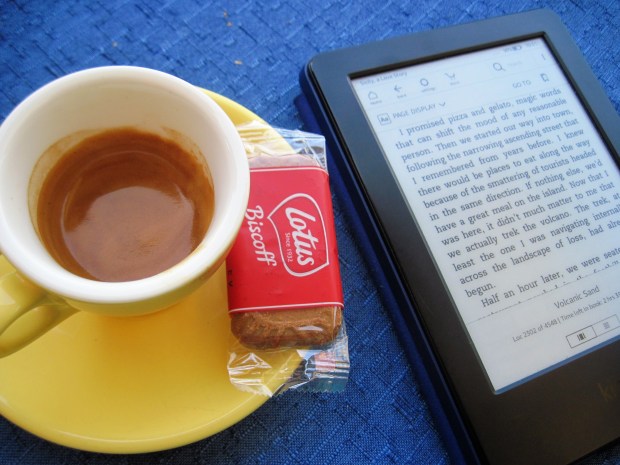
In fact, after Saro’s death from bone cancer in 2012, she became like a second daughter to Saro’s mother. The book focuses on the three summers in a row when she and her adopted daughter Zoela traveled to the family home in Sicily to stay with Nonna. I particularly appreciated the exploration of what it’s like to live between countries and cultures. This is one of three Reese Witherspoon book club books I’ve read so far (along with Where the Crawdads Sing and Daisy Jones and the Six), and all have been great – Reese’s recommendations are proving as reliable as Oprah’s.
 A mudslide blocked the route we should have taken back from Milan to Paris, so we rebooked onto trains via Switzerland. This plus the sub-Alpine setting for our next-to-last day made the perfect context for racing through Where the Hornbeam Grows: A Journey in Search of a Garden by Beth Lynch in just two days. Lynch moved from England to Switzerland when her husband took a job in Zurich. Suddenly she had to navigate daily life, including frosty locals and convoluted bureaucracy, in a second language. The sense of displacement was exacerbated by her lack of access to a garden. Gardening had always been a whole-family passion, and after her parents’ death their Sussex garden was lost to her. Two years later she and her husband moved to a cottage in western Switzerland and cultivated a garden idyll, but it wasn’t enough to neutralize their loneliness.
Much of what Lynch has to say about trying to find genuine connections as an expatriate rang true for me. Paradise Lost provides an unexpected frame of reference as Lynch asks what it means for a person or a plant to be transplanted somewhere new, and what it takes to thrive. Her elegant writing reminded me of Diana Athill’s and Penelope Lively’s, and the exploration of the self through gardens is reminiscent of Allan Jenkins’s Plot 29.
Other successful reads:
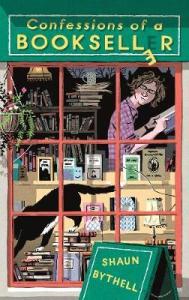 Confessions of a Bookseller by Shaun Bythell: This picks up right where The Diary of a Bookseller left off and carries through the whole of 2015. Again it’s built on the daily routines of buying and selling books, including customers’ and colleagues’ quirks, and of being out and about in a small town. I wished I was in Wigtown instead of Milan! Because of where I was reading the book, I got particular enjoyment out of the characterization of Emanuela (soon known as “Granny” for her poor eyesight and myriad aches and gripes), who comes over from Italy to volunteer in the bookshop for the summer. Bythell’s break-up with “Anna” is a recurring theme in this volume, I suspect because his editor/publisher insisted on an injection of emotional drama.
 City of Girls by Elizabeth Gilbert: There’s a fun, saucy feel to this novel set mostly in 1940s New York City. Twenty-year-old Vivian Morris comes to sew costumes for her Aunt Peg’s rundown theatre and falls in with a disreputable lot of actors and showgirls. When she does something bad enough to get her in the tabloids and jeopardize her future, she retreats in disgrace to her parents’ – but soon the war starts and she’s called back to help with Peg’s lunchtime propaganda shows at the Brooklyn Navy Yard. The quirky coming-of-age narrative reminded me a lot of classic John Irving, while the specifics of the setting made me think of Wise Children, All the Beautiful Girls and Manhattan Beach. The novel takes us to 2010, when Vivian is 90 and still brazenly independent. I was somewhat underwhelmed – while it’s a fairly touching story of how to absorb losses and make an unconventional family, I wondered if it had all meant much. I’ll be expanding this into a Shiny New Books review.
 Judgment Day by Sandra M. Gilbert: English majors will know Gilbert best for her landmark work of criticism, The Madwoman in the Attic (co-written with Susan Gubar). I had no idea that she writes poetry. This latest collection has a lot of interesting reflections on religion, food and art, as well as elegies to those she’s lost. Raised Catholic, Gilbert married a Jew, and the traditions of Judaism still hold meaning for her after husband’s death even though she’s effectively an atheist. “Pompeii and After,” a series of poems describing food scenes in paintings, from da Vinci to Hopper, is particularly memorable.
Not-so-successful reads:
 Vintage 1954 by Antoine Laurain: Dreadful! I would say: avoid this sappy time-travel novel at all costs. I thought the setup promised a gentle dose of fantasy, and liked the fact that the characters could meet their ancestors and Paris celebrities during their temporary stay in 1954. But the characters are one-dimensional stereotypes, and the plot is far-fetched and silly. I know many others have found this delightful, so consider me in the minority…
As well as a few DNFs…
What Dementia Teaches Us about Love by Nicci Gerard: I’ve read a lot of books about dementia, both clinical and anecdotal, and this doesn’t add anything new. (11%)
The Great Railway Bazaar by Paul Theroux: I read the first 32 pages, up to when Theroux arrives in northern Italy. He mostly describes his fellow passengers, as well as the details of meals and sleeping arrangements on trains. The writing struck me as old-fashioned, and I couldn’t imagine getting through another nearly 350 pages of it.
Out of the Woods by Luke Turner: Attempts to fuse nature and sexuality in a way that’s reminiscent of Hidden Nature by Alys Fowler. The writing didn’t draw me in at all. (5%)
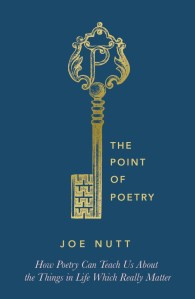
Blog Tour Review: The Point of Poetry by Joe Nutt
Lots of adults are afraid of poetry, Joe Nutt believes. As a Midlands lad he loved going to the public library and had a magical first encounter with poetry at secondary school – the last time many people will ever read it. A former English teacher and Times Educational Supplement columnist who has written books about Shakespeare, Donne and Milton, he also spent many years in the business world, where he sensed apprehension and even hostility towards poetry. This book is meant as a gentle introduction, or reintroduction, to the joys of reading a poem for yourself.
The 22 chapters each focus on a particular poem, ranging in period and style from the stately metaphysical verse of Andrew Marvell to the rapid-fire performance rhythms of Hollie McNish. The pattern in these essays is to provide background on the poet and his or her milieu or style before moving into more explicit interpretation of the poem’s themes and techniques; the poem is then generally printed at the end of the chapter.*

I most appreciated the essays on poems I already knew and loved but gained extra insight into (“Blackberry-Picking” by Seamus Heaney and “The Darkling Thrush” by Thomas Hardy) or had never read before, even if I knew other things by the same poets (“The Bistro Styx” by Rita Dove and “The Sea and the Skylark” by Gerard Manley Hopkins). The Dove poem echoes the Demeter and Persephone myth as it describes a meeting between a mother and daughter in a Paris café. The mother worries she’s lost her daughter to Paris – and, what’s worse, to a kitschy gift shop and an artist for whom she works as a model. Meanwhile, Heaney, Hardy and Hopkins all reflect – in their various, subtle ways – on environmental and societal collapse and ask what hope we might find in the midst of despair.

Joe Nutt
Other themes that come through in the chosen poems include Englishness and countryside knowledge (E. Nesbit and Edward Thomas), love, war and death. Nutt points out the things to look out for, such as doubling of words or sounds, punctuation, and line length. His commentary is especially useful in the chapters on Donne, Wordsworth and Hopkins. In other chapters, though, he can get sidetracked by personal anecdotes or hang-ups like people not knowing the difference between rifles and shotguns (his main reason for objecting to Vicki Feaver’s “The Gun,” to which he devotes a whole chapter) or Bob Dylan winning the Nobel Prize. These felt like unnecessary asides and detracted from the central goal of celebrating poetry. One can praise the good without denigrating what one thinks bad, yes?
 *Except for a few confusing cases where it’s not. Where’s Ted Hughes’s “Tractor”? If reproduction rights couldn’t be obtained, a different poem should have been chosen. Why does a chapter on Keats’s “The Eve of St. Agnes” quote just a few fragments from it in the text but then end with a passage from Shakespeare’s Venus and Adonis (ditto with the excerpt from Donne that ends the chapter on Milton)? The particular Carol Ann Duffy and Robert Browning poems Nutt has chosen are TL; DR, while he errs to the other extreme by not quoting enough from The Rime of the Ancient Mariner and Paradise Lost, perhaps assuming too much audience familiarity. (I’ve never read either!)
So, overall, a bit of a mixed bag: probably better suited to those less familiar with poetry; and, oddly, often more successful for me in its generalizations than in its particulars:
if you once perceive that poetry operates on the edges of man’s knowledge and experience, that it represents in art a profoundly sincere attempt by individuals to grapple with the inexorable conditions of human life, then you are well on the way to becoming not just a reader of it but a fan.
The poet’s skill is in making us look at the world anew, through different, less tainted lenses.
A poem, however unique and strange, however pure and white the page it sits on, doesn’t enter your life unaccompanied. It comes surrounded by literary echoes and memories, loaded with the past. That’s why you get better at understanding [poems], why you enjoy them more, the more you read.
Poetry is so often parsimonious. It makes us work for our supper.
Rossetti deliberately avoids certainty throughout. I enjoy that in any poem. It makes you think.
There is really only one response to great poetry: an unqualified, appreciative ‘yes’.
Related reading:
- The Hatred of Poetry by Ben Lerner
- 52 Ways of Looking at a Poem by Ruth Padel
- The Poem and the Journey and 60 Poems to Read Along the Way by Ruth Padel
- The Poetry Pharmacy by William Sieghart
- Why Poetry by Matthew Zapruder
(I have read and can recommend all of these. Padel’s explication of poetry is top-notch.)
The Point of Poetry was published by Unbound on March 21st (World Poetry Day). My thanks to the publisher for a free copy for review.
 Bookish Beck = Rebecca Foster. American transplant to England. Freelance proofreader and book reviewer.
 Bookish Beck