Book vs. Film: What Are You Going Through / The Room Next Door
Film, because…
I’m borrowing the idea from a post series by Kate of Books Are My Favourite and Best that compares books and their adaptations. It’s now vanishingly rare for me to see movies – I can probably count on the fingers of one hand the ones I’ve seen in the last three years – because we haven’t had a television for a decade or more, don’t subscribe to any streaming services, find going to the cinema too expensive, and mostly can’t be bothered to get out an old laptop to watch our measly collection of DVDs. It’s kind of a shame, because I was a real cinephile in my high school and early college years, making my way through the American Film Institute’s top 100 list, recording B&W classics from late-night TV, and following the Oscars race to enter a low-value pool. It certainly means a lot more time for books, though.
BUT I watched two streamed movies while I was staying with my sister in the States, both chosen for their literary influences or similarities. (I ran out of time to watch Women Talking, which I was eyeing up but it would have incurred a separate cost.) One was The Menu, about a megalomaniac chef for whose extravagant multi-course meals the mega-rich travel to a private island. Elle suggested it as a companion to Land of Milk and Honey with its chef protagonist and questions of power, sexuality and wealth. The Menu, starring Ralph Fiennes, was good fun, with a twisty plot and strong performances, but got darker and gorier than expected as Fiennes’ character uses dishes to explore childhood trauma and settle old scores.
The other was Pedro Almodóvar’s first English-language feature, The Room Next Door (2024). It’s based on Sigrid Nunez’s What Are You Going Through (2020), which I read at its release. It’s the story of a writer whose friend, ravaged by cancer, asks her to be present when she ends her life. As is typical of Nunez’s sparse, Cusk-like autofiction, the characters have no names and minimal histories, there are no speech marks, and the scant plot is layered with various other found stories and aphorisms. The film is, of necessity, very different: it zeroes in on the assisted suicide plot, makes events more concrete, and goes as far as the aftermath rather than just-before-the-end. I watched it with my sister because, as a hospice nurse, she has an interest in the topic.
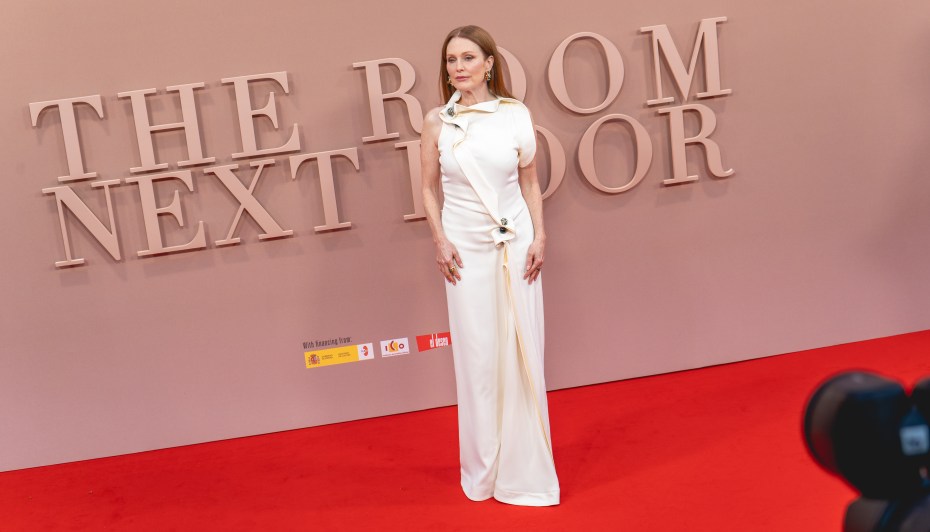
Julianne Moore at The Room Next Door premiere (BFI LFF: Royal Festival Hall, 19 October 2024) (Raph_PH, CC BY 2.0, via Wikimedia Commons).
{SPOILERS IN THE REMAINDER}
In The Room Next Door, Ingrid (Julianne Moore) is a writer whose latest book explores her fear of death. She and Martha (Tilda Swinton) were acquaintances when they worked for the same magazine, but they seem to have lost touch over the decades. Martha’s journalistic career was much more exciting, taking her to war zones as a correspondent. Martha has a daughter, Michelle, whom she’s really not in touch with, partly as a result of not being frank about the identity of Michelle’s father. Ingrid is shocked by Martha’s request and it takes her a while to come around to the idea of being the person ‘in the room next door’ when Martha takes the euthanasia drug she’s bought off the dark web.
Nunez’s novel opens with the narrator attending a doom-and-gloom lecture by her ex, who is convinced that climate change won’t be addressed and the human race will die out. I was surprised that he’s included in the film and in fact given an expanded role: not only is there the scene from the book in which Ingrid meets Damian (John Turturro) for lunch and tells him what’s going on with her friend, but we learn that he was an ex for both of them, and he helps Ingrid deal with the fallout of Martha’s actions. He also seems to function as a reminder of sexuality, which remains a powerful impulse even in the face of individual or collective death.
When I got home from the States, I reread the Nunez and – though she’s a favourite of mine – I confess I was disappointed. The philosophical and storytelling asides seem like unnecessary distractions when all you want to know is what happens with her friend. (I have, of course, also read The Spare Room, which preceded the Nunez by 12 years, in the meantime.) My original review seems generous as well as admirably succinct. (It’s depressing for me to go back to old reviews; not only have I not gotten any better, my writing has deteriorated, if anything. Is it laziness? Erosion of formality? Lack of time? Loss of focus?)

My sole complaint then was that Nunez spent too much time recounting the plot of a mystery novel the narrator reads. Well! Having reviewed her collected short stories, It Will Come Back to You, I can report that said plot is that of her “The Plan,” published in LitMag in 2019. How (playful and meta, yes, but) self-indulgent to borrow her own short story! So while I still appreciated the overall theme of empathy and the wise observations (“The only thing harder than seeing yourself grow old is seeing the people you’ve loved grow old … most people are in denial about aging, just as they are about dying”), and enjoyed the monologue from a cat which I’d forgotten about, I got bored and impatient the second time around. (I’m still a Nunez stan, though. – Am I using that right? Are we still saying that?)
Ultimately, then, The Room Next Door surpasses its source material for its focus, its performances, its locations, and its weirdness. Almodóvar cuts most of the peripheral material and makes it all about the women’s relationship with each other, as well as Ingrid’s with her ex and Martha’s with her daughter. The elegant Moore does a fine job in the role; the only way to have given a flavour of Nunez’s narration would have been to use voiceover or diary-writing scenes, which could have been naff. But Swinton is a marvel. Her American accent is ever so slightly strange, but that works; she’s such a striking person that it fits for her to be somewhat otherworldly. She is a perfect vessel for Martha’s frustrated rage and her body language, as well as the costuming and makeup, highlight the differences between her well periods, when she’s vibrant, and her worst relapses, when she’s pale and gaunt. (I was astonished to learn that both actors are now 65, by the way!)
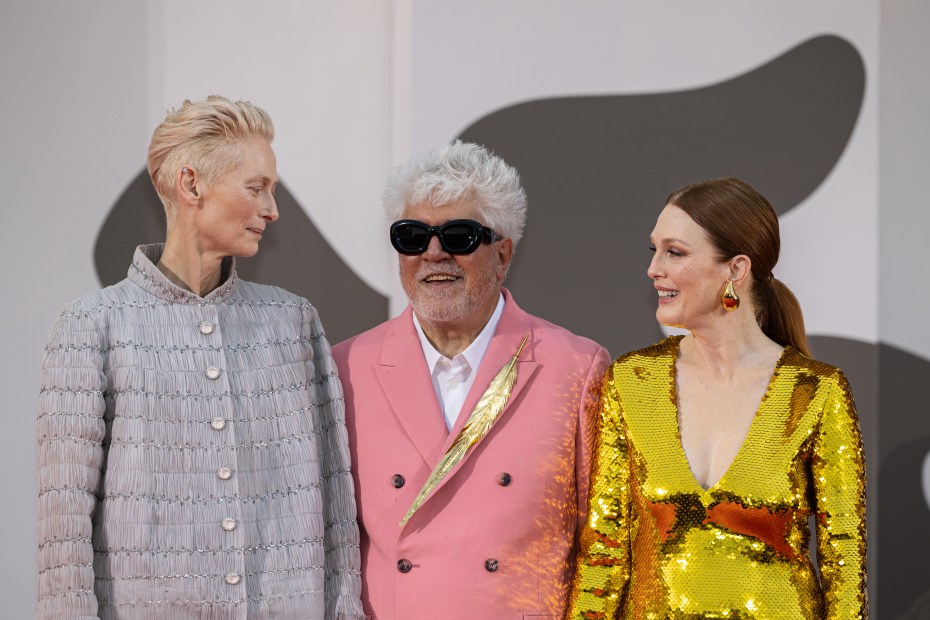
Tilda Swinton, Pedro Almodóvar, and Julianne Moore at 81st Venice International Film Festival (Harald Krichel, CC BY-SA 4.0, via Wikimedia Commons).
In the book, the friends stay in an Airbnb in upstate New York. In the film, Casa Szoke, an hour from Madrid in Spain, stands in. It’s a stunning Modernist (also described as “brutalist”) house, and the pool terrace and the staircase dividing Martha’s room from Ingrid’s downstairs are key features. Probably the single most interesting decision Almodóvar made was to have Swinton play Michelle as well, which emphasizes the persistence of family traits and – because Michelle has a scene after Martha is dead – makes it seem like she’s not completely gone. Of course, Almodóvar has always gone in for surrealism and doubling, and I loved this hint of the mysterious. I also appreciated the repeated quotes from James Joyce’s novella The Dead (“faintly falling … upon all the living and the dead.”).
The gist may be the same, but the reading and viewing experiences are really very dissimilar and, while I wouldn’t dissuade you from either, it was the film that impressed me most.
Book
My original rating: 
My rating now: 
Film
Nonfiction November: Fiction/Nonfiction Pairings
I’d never participated in Nonfiction November before because I tend to read at least 40% nonfiction anyway, but I couldn’t resist the temptation to put together some fiction and nonfiction pairings based on books I’ve read this year and last. (This week of the month-long challenge is posted by Sarah’s Book Shelves, a blog I love for its no-nonsense recommendations of what to read – and what not to read – from the recent U.S. releases.)
My primary example is two books that reveal what it’s really like to have Alzheimer’s disease. Mitchell’s, in particular, is a book that deserves more attention. When it came out earlier this year, it was billed as the first-ever “dementia memoir” (is that an oxymoron?) – except, actually, there had been one the previous year (whoops!): Memory’s Last Breath by Gerda Saunders, which I have on my Kindle and still intend to read. [See also Kate W.’s picks, which include a pair of books with a dementia theme.]
Still Alice by Lisa Genova (2007)
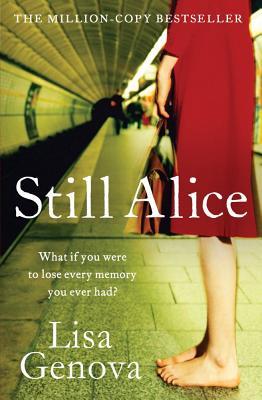 Genova’s writing, Jodi Picoult-like, keeps you turning the pages; I read 225+ pages in an afternoon. There’s true plotting skill to how Genova uses a close third-person perspective to track the mental decline of Harvard psychology professor Alice Howland, who has early-onset Alzheimer’s disease. “Everything she did and loved, everything she was, required language,” yet her grasp of language becomes ever more slippery even as her thought life remains largely intact. I also particularly enjoyed the descriptions of Cambridge and its weather, and family meals and rituals. There’s a certain amount of suspension of disbelief required – Would the disease really progress this quickly? Would Alice really be able to miss certain abilities and experiences once they were gone? – and ultimately I preferred the 2014 movie version, but this would be a great book to thrust at any caregiver or family member who’s had to cope with dementia in someone close to them.
My rating: 
 Other fictional takes on dementia that I can recommend: Unforgettable: Short Stories by Paulette Bates Alden, The Only Story by Julian Barnes, Everything Under by Daisy Johnson and Turn of Mind by Alice LaPlante.
&
Somebody I Used to Know by Wendy Mitchell with Anna Wharton (2018)
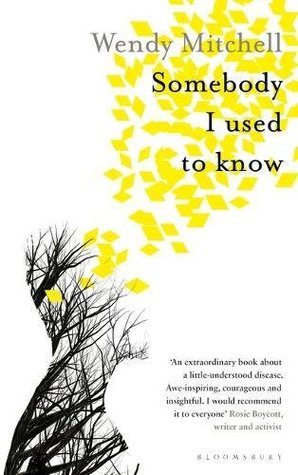 A remarkable insider’s look at the early stages of Alzheimer’s. Mitchell took several falls while running near her Yorkshire home, but it wasn’t until she had a minor stroke in 2012 that she and her doctors started taking her health problems seriously. In July 2014 she got the dementia diagnosis that finally explained her recurring brain fog. She was 58 years old, a single mother with two grown daughters and a 20-year career in NHS administration. Having prided herself on her good memory and her efficiency at everything from work scheduling to DIY, she was distressed that she couldn’t cope with a new computer system and was unlikely to recognize the faces or voices of colleagues she’d worked with for years. Less than a year after her diagnosis, she took early retirement – a decision that she feels was forced on her by a system that wasn’t willing to make accommodations for her.
The book, put together with the help of ghostwriter Anna Wharton, gives a clear sense of progression, of past versus present, and of the workarounds Mitchell uses to outwit her disease. The details and incidents are well chosen to present the everyday challenges of dementia. For instance, baking used to be one of Mitchell’s favorite hobbies, but in an early scene she’s making a cake for a homeless shelter and forgets she’s already added sugar; she weighs in the sugar twice, and the result is inedible. By the time the book ends, not only can she not prepare herself a meal; she can’t remember to eat unless she sets an alarm and barricades herself into the room so she won’t wander off partway through.
In occasional italicized passages Mitchell addresses her past self, running through bittersweet memories of all that she used to be able to do: “It amazes me now how you did it, because you didn’t have anyone to help you. You were Mum, Dad, taxi, chef, counsellor, gardener and housekeeper, all rolled into one.” Yet it’s also amazing how much she still manages to do as an ambassador for the Alzheimer’s Society and Dementia Friends. She crisscrosses the country to give speeches, attend conferences, and advise universities; she writes a blog and has appeared on radio to promote this book. Like many retired people, she’s found she’s busier than ever, and her engagements help her to feel purposeful and like she’s giving a positive impression of early-stage dementia. No matter that she has to rely on dozens of reminders to self in the form of Post-It notes, iPad alarms and a wall of photographs.
The story lines of this and Still Alice are very similar in places – the incidents while running, the inability to keep baking, and so on. And in fact, Mitchell reviewed the film and attended its London premiere, where she met Julianne Moore. Her book is a quick and enjoyable read, and will be so valuable to people looking to understand the experience of dementia. She is such an inspiring woman. I thank her for her efforts, and wish her well. This is one of my personal favorites for the shortlist of next year’s Wellcome Book Prize for medical reads.
My rating: 
 Other nonfiction takes on dementia that I can recommend: In Pursuit of Memory by Joseph Jebelli and The Summer of the Great-Grandmother by Madeleine L’Engle.
Additional pairings I would commend to you (all are books I have read and rated or above):


Talk before Sleep by Elizabeth Berg
&
Let’s Take the Long Way Home by Gail Caldwell and Truth and Beauty by Ann Patchett
- Celebrating the strength of female friendship, even in the face of life-threatening illness.


Bad News by Edward St. Aubyn
&
Portrait of an Addict as a Young Man by Bill Clegg
- Vivid portrayals of drug addiction.


Miss Smilla’s Feeling for Snow by Peter Høeg
&
This Cold Heaven by Gretel Ehrlich
- Armchair traveling in Greenland.


Sweetbitter by Stephanie Danler
&
Cork Dork by Bianca Bosker
- Glimpses into the high-class world of fine dining – and fine wine.
 Dear Fahrenheit 451: Love and Heartbreak in the Stacks by Annie Spence is chock-full of recommendations and reading pairs. The Novel Cure is also good for this sort of thing, though it is (no surprise) overwhelmingly composed of fiction suggestions.
 Bookish Beck = Rebecca Foster. American transplant to England. Freelance proofreader and book reviewer.
