#NovNov24 Halfway Check-In & Small Things Like These Film Review
Somehow half of November has flown by. We hope you’ve been enjoying reading and reviewing short books this month. So far we have had 40 participants and 84 posts! Remember to add your posts to the link-up, or alert us via a comment here or on Bluesky (@cathybrown746.bsky.social / @bookishbeck.bsky.social), Instagram (@cathy_746books / @bookishbeck), or X (@cathy746books / @bookishbeck).

If you haven’t already, there’s no better time to pick up our buddy read, Orbital by Samantha Harvey, which won the Booker Prize on Tuesday evening. Chair of judges Edmund de Waal said it is “about a wounded world” and that the panel’s “unanimity about Orbital recognises its beauty and ambition.” I was surprised to learn that it is only the second-shortest Booker winner; Offshore by Penelope Fitzgerald is even shorter.

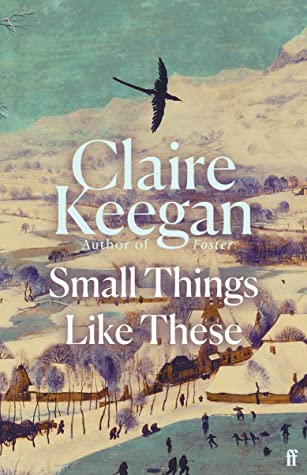
Another popular novella many of us have read is Small Things Like These by Claire Keegan (my latest review is here). I went to see the excellent film adaptation, with a few friends from book club, at our tiny local arthouse cinema on Wednesday afternoon. I’ve read the book twice now – I might just read it a third time before Christmas – and from memory the film is remarkably faithful to its storyline and scope. (The only significant change I think of is that Bill doesn’t visit Ned in the hospital, but there are still flashbacks to the role that Ned played in Bill’s early life.)
 The casting and cinematography are exceptional. Cillian Murphy portrays Bill with just the right blend of stoicism, meekness, and angst. Emily Watson is chilling as Sister Mary, the Mother Superior of the convent, which is suitably creepy with dim brick hallways and clinical laundry rooms. The grimy cobbles and dull streetlamps of the town contrast with the warm light in the scenes of Bill’s remembered childhood at Mrs Wilson’s. Repeated shots – of Bill’s truck setting off across the bridge in the early morning, of him scrubbing coal dust from his hands with carbolic soap, of his eyes wide open in the middle of the night – are not recursive but a way of establishing the gruelling nature of his tasks and the unease that plagues him. A life of physical labour has aged him beyond 39 (cf. Murphy is 48) and he’s in pain from shouldering sacks of coal day in and day out.
Both book and film are set in 1985 but apart from the fashions and the kitschy Christmas decorations and window dressings you’d be excused for thinking it was the 1950s. Bill’s business deals in coal, peat and tinder; rural Ireland really was that economically depressed and technologically constrained. (Another Ireland-set film I saw last year, The Miracle Club, is visually very similar – it even features two of the same actors – although it takes place in 1967. It’s as if nothing changed for decades.)
 By its nature, the film has to be a little more overt about what Bill is feeling (and generally not saying, as he is such a quiet man): there are tears at Murphy’s eyes and anxious breathing to make Bill’s state of mind obvious. Yet the film retains much of the subtlety of Keegan’s novella. You have to listen carefully during the conversation between Bill and Sister Mary to understand she is attempting to blackmail him into silence about what goes on at the convent.
At the end of the film showing, you could have heard a pin drop. Everyone was stunned at the simple beauty of the final scene, and the statistics its story is based on. It’s truly astonishing that Magdalene Laundries were in operation until the late 1990s, with Church support. Rage and sorrow build in you at the very thought, but Bill’s quietly heroic act of resistance is an inspiration. What might we, ordinary people all, be called on to do for women, the poor, and the oppressed in the years to come? We have no excuse not to advocate for them.
(Arti of Ripple Effects has also reviewed the film here.)
So far this month I’ve read nine novellas and reviewed eight. One of these was a one-sitting read, and I have another pile of ones that I could potentially read of a morning or evening next week. I’m currently reading another 16 … it remains to be seen whether I will average one a day for the month!
Seasons’ Greetings: Winter (Part I) & Christmas Reading
My first few wintry reads for the season included a modern children’s classic, a wonderful poetry collection, and a so-so Advent-set novella. For my pre-Christmas reads, I have a couple of story-length classics and two recent novellas.
Winter Story by Jill Barklem (1980)
 My favourite of the series so far (just Spring still to go) for how nostalgic it is for winter traditions.
“Tobogganing tomorrow,” said Wilfred.
“Snow pancakes for tea,” said Clover.
“We’ll make a snow mouse,” said Catkin.
The mice host a Snow Ball at the Ice Hall, with outfits and dances out of Austen and victuals out of Dickens. As always, the tree-trunk interiors are lit up like doll’s house tableaux with cosy rooms and well-stocked larders. Nothing much happens in this one, but that was fine with me: no need for a conflict and its resolution when you’ve got such a lovely, lucky life. (Public library) 
The Winter Orchards by Nina Bogin (2001)
 After enjoying Thousandfold in 2019, I was keen to catch up on Bogin’s previous poetry. Themes I’d noted in her latest work, nature and family, are key here, too. There is an overall wistful tone to the book, as in the passages below:
I didn’t like lungwort at first,
its spotted leaves, its furred
flowers, and I didn’t like its name.
But now I want to gather lungwort again,
now that I can’t return
to the brook meadow I picked it in (from “Lungwort”)
I’ll love the fallow and forgotten fields
because I have no choice, and woods
whose paths have been erased. (from “Landscape”)
The losses responded to are sometimes personal – saying Kaddish for her father – and sometimes more broadly representative, as when she writes about a dead bird found on the road or conflicts like the Gulf War and former Yugoslavia. Alongside beautiful nature poetry featuring birds and plants are vignettes from travels in France, Sweden, and upstate New York. (New purchase) 
An Advent Calendar by Shena Mackay (1978)
 I smugly started this on the first day of Advent, and initially enjoyed Mackay’s macabre habit of taking elements of the Nativity scene or a traditional Christmas and giving them a seedy North London twist. So we open on a butcher’s shop and a young man wearing “bloody swabbing cloths” rather than swaddling clothes, having lost a finger to the meat mincer (and later we see “a misty Christmas postman with his billowy sack come out of the abattoir’s gates”). In this way, John Wood becomes an unwitting cannibal after taking a parcel home from the butcher’s that day, and can’t forget about it as he moves his temporarily homeless family into his old uncle’s house and continues halfheartedly in his job as a cleaner. His wife has an affair; so does a teenage girl at the school where his sister works. No one is happy and everything is sordid. “Scouring powder snowed” and the animal at this perverse manger scene is the uncle’s neglected goat. This novella is soon read, but soon forgotten. (Secondhand purchase)
And so to Christmas…
“The Christmas Dinner” by Washington Irving (1820)
 An evocative portrait of an English Christmas meal, hosted by a squire in the great hall of his manor, originally published in Irving’s The Sketch Book of Geoffrey Crayon, Gent. A boar’s head, a mummers’ play, the Lord of Misrule: you couldn’t get much more traditional. “Master Simon covered himself with glory by the stateliness with which, as Ancient Christmas, he walked a minuet with the peerless, though giggling, Dame Mince Pie.” Irving’s narrator knows this little tale isn’t profound or intellectually satisfying, but hopes it will raise a smile. He also has a sense that he is recording something that might soon pass away:
I felt also an interest in the scene, from the consideration that these fleeting customs were posting fast into oblivion. … There was a quaintness, too, mingled with all this revelry, that gave it a peculiar zest; it was suited to the time and place; and as the old Manor House almost reeled with mirth and wassail, it seemed echoing back the joviality of long-departed years.
A pleasant one-sitting read; so much better than a Christmas card! 
This Renard Press pamphlet is in support of Three Peas, a charity providing food and medical care to refugees in Europe. Thanks to Annabel for my gifted copy!
Small Things Like These by Claire Keegan (2021)
Always, Christmas brought out the best and the worst in people.
 This was our second most popular read during last month’s Novellas in November challenge. I’d read a lot about it in fellow bloggers’ posts and newspaper reviews so knew to expect a meticulously chiselled and heartwarming story about a coal merchant in 1980s Ireland who comes to value his quiet family life all the more when he sees how difficult existence is for the teen mothers sent to work in the local convent’s laundry service. Born out of wedlock himself nearly 40 years ago, he is grateful that his mother received kindness and wishes he could do more to help the desperate girls he meets when he makes deliveries to the convent.
I found this a fairly predictable narrative, and the nuns are cartoonishly villainous. So I wasn’t as enthusiastic as many others have been, but still enjoyed having this as one of my reads on my travel day to the USA. I was familiar with the Magdalene Laundries from the movie The Magdalene Sisters and found this a touching reminder to be grateful for what you have while helping those less fortunate. A perfect message for Christmas. (NetGalley) 
Miss Marley by Vanessa Lafaye (2018)
 Lafaye was a local-ish author to me, an American expat living in Marlborough. When she died of breast cancer in 2018, she left this A Christmas Carol prequel unfinished, and fellow historical novelist Rebecca Mascull completed it for her. Clara and Jacob Marley come from money but end up on the streets, stealing from the rich to get by. Jacob sets himself up as a moneylender to the poor and then, after serving an apprenticeship alongside Ebenezer Scrooge, goes into business with him. They are a bad influence on each other, reinforcing each other’s greed and hard hearts. Jacob is determined never to be poor again. Because he’s forgotten what it’s like, he has no compassion when Clara falls in love with a luckless Scottish tea merchant. Like Scrooge, Jacob is offered one final chance to mend his ways. This was easy and pleasant reading, but I did wonder if there was a point to reading this when one could just reread Dickens’s original. (Secondhand purchase)
A Child’s Christmas in Wales by Dylan Thomas (1952)
(Illus. Edward Ardizzone, 1978)
 It’s a wonder I’d never managed to read this short story before. I was prepared for something slightly twee; instead, it is sprightly and imaginative, full of unexpected images and wordplay. In the Wales of his childhood, there were wolves and bears and hippos. Young boys could get up to all sorts of mischief, but knew that a warm house packed with relatives and a cosy bed awaited at the end of a momentous day. Reflective and magical in equal measure; a lovely wee volume that I am sure to reread year after year. (Little Free Library)
A favourite passage:
Our snow was not only shaken from whitewash buckets down the sky, it came shawling out of the ground and swam and drifted out of the arms and hands and bodies of the trees; snow grew overnight on the roofs of the houses like a pure and grandfather moss, minutely white-ivied the walls and settled on the postman, opening the gate, like a dumb, numb thunderstorm of white, torn Christmas cards.
If there’s been one adjective linking most of these books, it’s been “nostalgic.” There’s something about winter in general, and the holiday season in particular, that lends itself to thinking back to the past and trying to preserve traditions, isn’t there?
 Bookish Beck = Rebecca Foster. American transplant to England. Freelance proofreader and book reviewer.
 Bookish Beck